World Maritime University
The Maritime Commons: Digital Repository of the World
Maritime University
World Maritime University Dissertations Dissertations
2000
Efficiency and effectiveness in maritime safety
administration
Shubing Li
World Maritime University
Follow this and additional works at:http://commons.wmu.se/all_dissertations
Part of thePublic Affairs, Public Policy and Public Administration Commons
This Dissertation is brought to you courtesy of Maritime Commons. Open Access items may be downloaded for non-commercial, fair use academic purposes. No items may be hosted on another server or web site without express written permission from the World Maritime University. For more information, please [email protected].
Recommended Citation
WORLD MARITIME UNIVERSITY
Malmö, Sweden
EFFICIENCY AND EFFECTIVENESS IN
MARITIME SAFETY ADMINISTRATION
By
LI SHUBING
China
A dissertation submitted to the World Maritime University in partial fulfilment of the requirements for the award of the degree of
MASTER OF SCIENCE
In
MARITIME ADMINISTRATION AND ENVIRONMENT PROTECTION
2000
DECLARATION
I certify that all the material in this dissertation that is not my work has been identified, and that no material is included for which a degree has previously been conferred on me.
The contents of this dissertation reflect my own personal views, and are not necessarily endorsed by the University.
Signature: ………..
Date: ………..
Supervised by:
Professor Dick Hodgson Course Professor
Maritime Administration and Environment Protection World Maritime University
Assessor:
Mr. Jan-Ake Jonsson Professor
Maritime safety and Environment Protection World Maritime University
Co-assessed by:
Mr. M. Brennan
Associate Assistant Deputy Minister for Policy (Retd.) Department of Transport
ACKNOWLEDGEMENTS
I would like to extend my gratitude to the Chinese Maritime Safety Administration and the Department of International Cooperation of the Ministry of Communications, which nominated me to pursue a course of studies at the World Maritime University. I am also most grateful to the Canadian International Development Agency for its generous sponsorship during my two years of study.
I would like to express my sincere thanks to Professor Dick Hodgson, my course professor and supervisor of this dissertation, for his insightful guidance and assistance; and to Professor Jan-Ake Jonsson and Professor Ma Shuo, for their encouragement and support of my research on this topic.
My sincere appreciation is also extended to all the staff of World Maritime University, especially the staff at the library of the University, without whose effective guidance and help this dissertation could not have been completed.
In particular, I would like to thank all visiting professors to the University for their expertise and valuable knowledge, which has contributed immensely to my research of this dissertation.
Finally, I wish to express my gratitude to my wife, Cui Jishun and my beloved son, Li Qiming, who have had to make many sacrifices imposed by my study abroad.
ABSTRACT
Title of dissertation: Efficiency and Effectiveness in Maritime Safety Administration
Degree: MSc
This dissertation endeavours to examine the concept of maritime safety administration from a global point of view. The essential mandate and functions of maritime safety administration have been carefully studied and discussed, together with trends in the changing environment in the shipping industry. An attempt is made to identify possible ways of achieving efficiency and effectiveness from various perspectives.
Chapter 2 makes an in-depth review and discussion of the roles and functions of maritime safety administration, and provides background information on government intervention and policy with respect to national shipping industries.
Trends in the changing environment in shipping and safety are identified in Chapter 3. Three broad areas, (status of world shipping, technology, and safety issues), are discussed.
As a government specialized agency, coordination and cooperation between the maritime safety administration and the shipping industry is essential, especially in the areas of survey and inspection, search and rescue, and pollution preparedness and response. This is discussed in Chapter 4.
An overview of innovation in the public sector and its influences on maritime safety administration is presented in Chapter 5, so as to provide a better understanding of the difficulties and challenges faced by maritime safety administrations.
In Chapter 6, efficiency and effectiveness of maritime safety administration are examined, and possible approaches to improve efficiency and effectiveness are identified.
The general results of the study are summarised in the conclusions at the end of the dissertation. Some suggestions to improve the work of maritime safety administration are proposed.
TABLE OF CONTENTS
Declaration ii
Acknowledgements iii
Abstract iv
Table of Contents v
List of Tables vii
List of Figures vii
List of Abbreviations viii
1 Introduction 1
2 Roles and functions of maritime safety administration 5
2.1 The importance of maritime safety 5
2.2 Prevention of pollution from ships and its consequences 9
2.3 Government intervention and policy 12
2.3.1 Historical evolution of government intervention 12
2.3.2 Government general policy in shipping 19
2.4 Traditional roles and functions of maritime safety administration 22
2.4.1 Public administration 23
2.4.2 Areas of function 24
3 Trends of the changing environment 39
3.1 Increasing demand of shipping and fragment 39
3.1.1 World trade and shipping 40
3.1.2 Competition between shipping and other models 44
3.1.3 Shipping development in developing countries 46
3.1.4 World fleets and seafarers 47
3.2 Technology 51
3.2.1 Revolutionary changes in shipping technology 52
3.2.2 Information technology and navigation 55
3.2.3 Communication 57
3.3 Safety net and safety culture 59
3.3.1 Safety net 60
3.3.2 Safety culture 61
3.4 Formal Safety Assessment 62
4 Coordination and cooperation 65
4.1 Classification society 65
4.2 Search and Rescue 72
4.3 Pollution preparedness and response 75
5 Innovation in public administration 82
5.1 New public management 82
5.2 Budget versus accountability 84
5.2.1 Responsibility and Accountability in Public Sector 85
5.2.2 Budget in the Public Sector 88
5.3 Provision of service 89
6 Efficiency and effectiveness 92
6.1 Efficiency and effectiveness defined 92
6.2 How safe is safe 94
6.3 Who is safer 97
6.4 Quality shipping 99
6.4.1 Different Roles within the Safety Net 100
6.4.2 Key Role of Maritime Safety Administration in Quality Shipping 104
6.5 Transparency 106
6.6 Partnership 109
7 Conclusion 112
Bibliography 117
LIST OF TABLES
Table 2.1 Total losses of ships and gross tonnage before 1984 Table 2.2 Total losses of ships of more than 100GT
Table 2.3 Lives lost (as a result of total losses of ships) Table 2.4 Sources of oil pollution to the seas (million tonnes) Table 2.5 Causes of oil pollution
Table 2.6 Some memorable tanker accidents
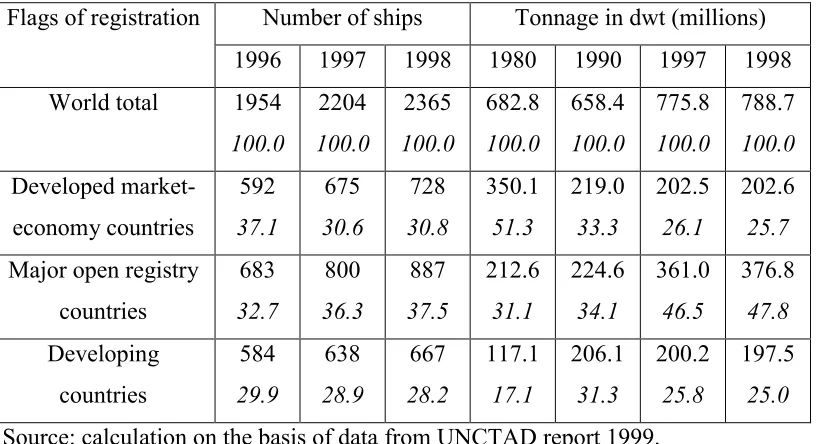
Table 2.7 Piracy and armed robbery incidents by locations (1991-1999) Table 3.1 Development of international seaborne trade
Table 3.2 World shipping performance by types of cargo (billions of ton-miles) Table 3.3 World fleet size by principal types of vessel, 1996—1998
Table 3.4 Distribution of world tonnage (dwt) by groups of countries
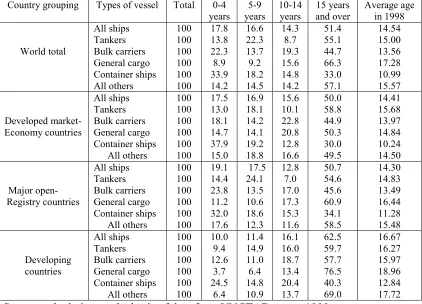
Table 3.5 Age distribution of the world merchant fleet by types of vessel, as at 31 December 1998
Table 3.6 Comparison of major transport modes
Table 3.7 Major suppliers and demanders of seamen (1995)
Table 3.8 Average size of world fleet by types and years (Bulk and Tanker) Table 3.9 Average size of world fleet by years of building
Table 5.1 Arrangements of public service provision
LIST OF FIGURES
Figure 3.1 The relationship of different parties within the safety net
Figure 4.1 Types of organizations participating in responses to major marine incidents
Figure 4.2 ICS modular organizational structure
LIST OF ABBREVIATIONS
BIMCO Baltic and International Maritime Council
CLC International Convention on Civil Liability for Oil Pollution Damage CMI Comité Maritime International
COSCO China Ocean Shipping (Group) Company DGPS Differential Global Positioning System DSC Digital Selective Calling
DWT Dead Weight Ton
ECDIS Electronic Chart Display and Information System EGC Enhanced Group Calling
EIA Environmental Impact Assessment ENC Electronic Navigational Chart
EPRIB Emergency Position-Indicating Radio Beacon FSA Formal Safety Assessment
GMDSS Global Maritime Distress and Safety System GIS Geographic Information System
GT Gross Tonnage HF High frequency
IACS International Association of Classification Societies
IAMSAR International Aeronautical and Maritime Search and Rescue ICAO International Civil Aviation Organization
ICS Incident Command System
ILO International Labour Organization IHO International Hydrographic Organization IMB International Maritime Bureau
IMO International Maritime Organization ISF International Shipping Federation ISM International Safety Management
ISO International Standardisation Organization IT Information Technology
LL International Convention on Load Lines
LLMC Convention on Limitation of Liability for Maritime Claims LNG Liquefied Natural Gas
LPG Liquefied Petroleum Gas
MARPOL International Convention for the Prevention of Pollution from Ships MEPC Marine Environment Protection Committee
MOU Memorandum of Understanding MSA Maritime Safety Administration MSC Maritime Safety Committee NPM New Public Management
OECD Organization for Economic Co-operation and Development
OILPOL International Convention for the Prevention of Pollution of the Sea by Oil
OPA Oil Pollution Act
P& I Protection and Indemnity PSC Port State Control
PSCO Port State Control Officer PTP Prevention Through People
QSCS Quality System Certification Scheme RCC Rescue Coordination Centre
SAR Search and Rescue SBT Segregated Ballast Tank
SENC System Electronic Navigational Chart
SOLAS International Convention for the Safety of Life at Sea SRR search and rescue region
STCW The International Convention on Standards of Training, Certification and Watchkeeping for seafarers
ULCC Ultra Large Crude Oil Carrier
UNCLOS United Nations Convention of the Law of the Sea UNCTAD United Nations Conference on Trade and Development VLCC Very Large Crude Oil Carrier
VTS Vessel Traffic Service WHO World Health Organization WMU World Maritime University
WWNWS World-Wide Navigational Warning Service
CHAPTER I INTRODUCTION
In view of the great importance of administration today, it seems rather strange that the theoretical foundations are hardly sufficiently clear in this field. This is obvious when people try to harmonize the various conceptual interpretations of the term “administration”. Historically, the development of the concept of administration can be traced as far as the 15th century (Strunz, 1995, p.54). At that time the term was used in connection with the private-law activities of the territorial princes. In the 18th century, it was still used mainly in the context of the private economy, which referred particularly to the administration of assets, estates, property, and goods. During the same century, the concept shifted from such private-law matters to the activities of the State, referring to the administration of State property, or the administration of an authority.
The term administration went through further conceptual changes at the beginning of the 19th century. It continued to be used directly for administrative activities in organizations on the one hand. On the other hand, it was eventually emphasised for the function of management in the modern State, the function of enforcement with authority. Generally speaking, the term of administration can be defined in both negative and positive ways (Winkle, 1958, p.66-86). In the negative definition “Administration is any activity by the State that is neither legislation nor jurisdiction.” The positive definition of the term is that “Administration is any activity aimed at the practical implementation of State functions, and it is the enforcement of laws by all non-judicial organs.”
accepted that in the maritime industry the “administration” is the government department or agency exclusively responsible for the work of maritime safety and prevention of pollution from ships, normally called the “maritime safety administration”.
According to Vanchiswar (1996, p.61) “the maritime safety administration is the specialised executive arm of a maritime government to implement or enforce the regulatory (and allied) functions embodied in the national maritime legislation, especially those pertaining to registration of ships, maritime safety, marine personnel, maritime casualty investigations and protection of the marine environment.” Due to the quite broad scope of maritime activities over which the government exercises its obligations, each maritime safety administration established in a specific country may reflect its own historical, customary and geographical features. Therefore, the organizational structure of the maritime safety administration must conform to the local circumstances, follow the development, and meet the requirements of that particular country. Some are called “the maritime safety administration”, while others are entitled “the coast guard” or even “the maritime administration”, which is usually regarded as having more functions than the maritime safety administration.
On the other hand, shipping is an industry of international nature. It is generally believed that maritime law has been well developed at the international level, particularly with respect to public maritime law, which later becomes the prerequisite and mandate of the maritime safety administration. So, the traditional roles and functions of maritime safety administrations in various countries must have something in common, and they will continue to be the basic functions of the maritime safety administration for the years to come. These roles and functions can be broken down into five broad areas, namely: flag state control, port state control, search and rescue, pollution preparedness and response, and navigational services.
towards, maritime activities should be reviewed and discussed. In every maritime country, the government’s general policy in shipping may include two broad aspects, namely promotion of, and participation in, international shipping, and implementation of international obligations. Under international conventions, such as UNCLOS, SOLAS, MARPOL, and ILO C147, flag States and coastal States have certain rights and obligations. To enjoy these rights and to protect their national interests, States have to fulfil their obligations by ratifying the conventions, giving them legal effect, and enforcing them.
During the second half of the last century, especially the past three decades, great changes have taken place in the world shipping industry. This changing environment of shipping has challenged the maritime safety administration to adapt itself to meet contemporary requirements. As a major driving force, world trade has been increasing steadily. As a result, the world fleet has expanded in response to the demands of the world trade. At the same time, the structural changes of world trade have encouraged ships to become more diversified. Container ships and other sophisticated designs, such as LNG/LPG, are growing much faster than traditional ones.
Science and technology has changed the shipping industry significantly from the perspective of ship design and building to ships’ navigation and management. Ships are becoming much bigger, and much faster, while ships’ bridges are increasingly equipped with advanced and automatic equipment.
Perhaps the most important change with respect to maritime safety has been the re-thinking of the safety issue. Today the world maritime community believes that additional rules and regulations are not necessarily the only way to improve safety and prevention of pollution. Instead, taking proactive, rather than reactive initiatives, and enforcing existing regulations may be more effective in achieving the objectives of safety. In so doing, a safety culture needs to be encouraged within the safety net, and all entities in the shipping industry must play a broader role in the future management of safety.
order to fulfil its duties and obligations efficiently and effectively, coordination and cooperatioin with the shipping industry is essential. This is particularly true in the areas of survey and inspection, search and rescue, and pollution preparedness and response.
Change in the public sector is the rule rather than the exception. The goal of perfect government management has existed as long as there has been a government. Although change is a common experience in the public sector, the reform activity during the 1980s and 1990s has been extraordinary, not only in the number of reform initiatives but also in the fundamental nature of the changes being considered. The ideas contained in these reform efforts are mainly driven by the introduction of commercial performance into the public sector under the pressure of the general public, which is demanding deregulation, decentralisation, privatisation, etc.
The desire to improve organizational performance has focused particular attention on the pursuit of greater efficiency and effectiveness, which has been regarded as paramount in both private and public organizations. This pursuit, which has dominated government thinking in the last two decades and continues in the new millennium, merits detailed scrutiny. To improve its efficiency and effectiveness, the maritime safety administration should have a clear understanding of the issue “how safe is safe”. Based on this understanding, the work of the maritime safety administration may be improved by encouraging quality shipping, improving transparency, and establishing partnerships with the shipping industry.
CHAPTER II
ROLES AND FUNCTIONS OF MARITIME SAFETY ADMINISTRATION
In the maritime world, seafarers, shipowners, governments and others have been concerned for years about the safety of ships, their crews, cargoes and passengers. This is illustrated clearly by the fact that although various governments and the shipping industry have made significant and continuing efforts to improve the situation of safety at sea, serious maritime accidents have occurred from time to time. More recently, increasing attention has focused on the environment and the urgent need for the earth’s resources to be preserved for the benefit of future generations. This has had a marked impact on all industries, including the shipping industry. The enormous loss of lives and properties, and the damage to the environment have made it clear that safety and prevention of pollution from ships have to be given top priority of consideration in the shipping industry, especially by governments.
The maritime safety administration is a specialised government agency, principally responsible for maritime safety and prevention of pollution from ships. Its prerequisite and mandate is not only embodied in national legislation but also stipulated in public international laws, mainly in international conventions.
On the other hand, as part of the public administration, the roles and functions of the maritime safety administration have to be considered within the framework of the government’s overall maritime policy. Therefore, it is of great importance to understand the concept of government intervention in shipping, and its general policy: promotion of, and participation in, international shipping, and implementation of international obligations.
2.1 The Importance of Maritime Safety
In the early stage of shipping practice with sailing vessels, it was a common assumption that little could be done to make shipping safer. It was not until the beginning of the nineteenth century when the first steam engine was used on the vessel “Charlotte Dundas” (Rinman & Brodefors, 1983, p.25) that the fatalistic attitude towards safety began to change. Along with the industrial revolution of the eighteenth and nineteenth centuries and the rapid development of technology and international trade, more and more efforts have been made to ensure the safe delivery of passengers and cargoes by sea. Especially in the second half of the twentieth century great changes have taken place in shipping regulation and management internationally and nationally, which has made the shipping industry increasingly safe. Today shipping is regarded as the safest, most efficient and most environmentally friendly means of transportation.
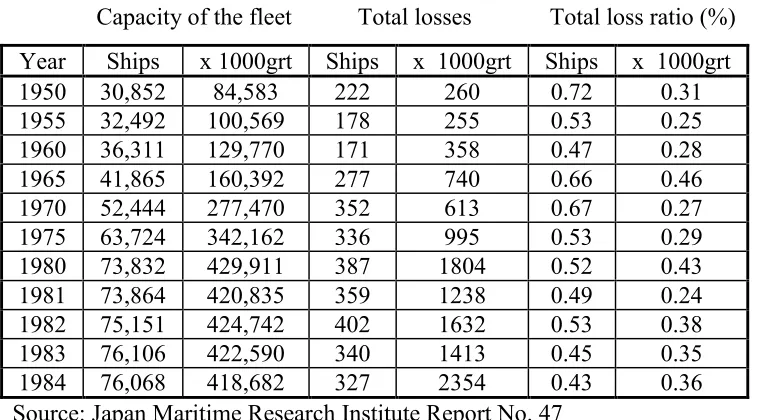
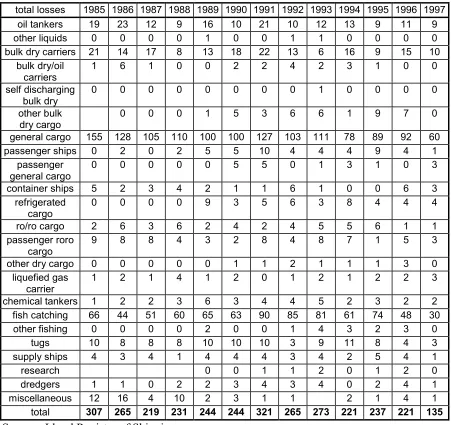
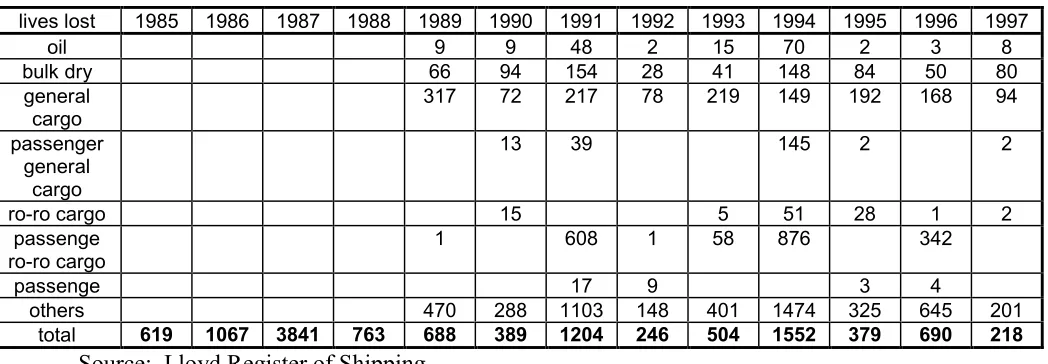
Although the rate of shipping casualties has fallen steadily in the past years, as shown in Tables 2.1, 2.2 and 2.3, the safety situation is still serious if we look at the
Table 2.1
Total losses of ships and gross tonnage before 1984 Capacity of the fleet Total losses Total loss ratio (%)
Year Ships x 1000grt Ships x 1000grt Ships x 1000grt 1950 30,852 84,583 222 260 0.72 0.31 1955 32,492 100,569 178 255 0.53 0.25 1960 36,311 129,770 171 358 0.47 0.28 1965 41,865 160,392 277 740 0.66 0.46 1970 52,444 277,470 352 613 0.67 0.27 1975 63,724 342,162 336 995 0.53 0.29 1980 73,832 429,911 387 1804 0.52 0.43 1981 73,864 420,835 359 1238 0.49 0.24 1982 75,151 424,742 402 1632 0.53 0.38 1983 76,106 422,590 340 1413 0.45 0.35 1984 76,068 418,682 327 2354 0.43 0.36 Source: Japan Maritime Research Institute Report No. 47
following major accidents that have occurred during the last few decades:
• The collision of the passenger ship MV Dona Paz in the Philippines in 1987 with the loss of more than 4,000 lives.
• The capsize of the ro-ro ferry Herald of Free Enterprise off Zeebrugge in 1987 with the loss of 193 lives.
Table 2.2
Total losses of ships of more than 100GT
total losses 1985 1986 1987 1988 1989 1990 1991 1992 1993 1994 1995 1996 1997
oil tankers 19 23 12 9 16 10 21 10 12 13 9 11 9
other liquids 0 0 0 0 1 0 0 1 1 0 0 0 0
bulk dry carriers 21 14 17 8 13 18 22 13 6 16 9 15 10 bulk dry/oil
carriers 1 6 1 0 0 2 2 4 2 3 1 0 0
self discharging
bulk dry 0 0 0 0 0 0 0 0 1 0 0 0 0
other bulk
dry cargo 0 0 0 1 5 3 6 6 1 9 7 0
general cargo 155 128 105 110 100 100 127 103 111 78 89 92 60
passenger ships 0 2 0 2 5 5 10 4 4 4 9 4 1
passenger general cargo
0 0 0 0 0 5 5 0 1 3 1 0 3
container ships 5 2 3 4 2 1 1 6 1 0 0 6 3
refrigerated
cargo 0 0 0 0 9 3 5 6 3 8 4 4 4
ro/ro cargo 2 6 3 6 2 4 2 4 5 5 6 1 1
passenger roro cargo
9 8 8 4 3 2 8 4 8 7 1 5 3
other dry cargo 0 0 0 0 0 1 1 2 1 1 1 3 0
liquefied gas
carrier 1 2 1 4 1 2 0 1 2 1 2 2 3
chemical tankers 1 2 2 3 6 3 4 4 5 2 3 2 2
fish catching 66 44 51 60 65 63 90 85 81 61 74 48 30
other fishing 0 0 0 0 2 0 0 1 4 3 2 3 0
tugs 10 8 8 8 10 10 10 3 9 11 8 4 3
supply ships 4 3 4 1 4 4 4 3 4 2 5 4 1
research 0 0 1 1 2 0 1 2 0
dredgers 1 1 0 2 2 3 4 3 4 0 2 4 1
miscellaneous 12 16 4 10 2 3 1 1 2 1 4 1
total 307 265 219 231 244 244 321 265 273 221 237 221 135
Source: Lloyd Register of Shipping
• The fire on board the Scandinavian Star off Norway in 1990 with the loss of 158 lives.
• The Aegean Sea swept onto the rocks whilst manoeuvring to enter port off the north- west tip of Spain with heavy pollution from her cargo of oil.
• The collision involving the tanker Maersk Navigator in the Malacca Straits.
• One of the world's worst ever oil spills, the accident of the Amoco Cadiz, which ran aground off the north-west coast of France and spilled nearly all of her 230,000 tonnes of crude oil cargo into the sea.
• The grounding of the crude oil tanker Sea Empress in February of 1996 resulting in the discharge of approximately 72,000 tonnes of oil into the seas around the coast of south-west Wales.
Table 2.3
Lives lost (as a result of total losses of ships)
lives lost 1985 1986 1987 1988 1989 1990 1991 1992 1993 1994 1995 1996 1997
oil 9 9 48 2 15 70 2 3 8
bulk dry 66 94 154 28 41 148 84 50 80
general
cargo 317 72 217 78 219 149 192 168 94
passenger general
cargo
13 39 145 2 2
ro-ro cargo 15 5 51 28 1 2
passenge
ro-ro cargo 1 608 1 58 876 342
passenge 17 9 3 4
others 470 288 1103 148 401 1474 325 645 201
total 619 1067 3841 763 688 389 1204 246 504 1552 379 690 218
Source: Lloyd Register of Shipping
More recently, the Chinese ro-ro passenger ship “Da Shun” ran aground and capsized near the port of Yan Tai in 1999 with a loss of more than 200 lives. The Malta-registered tanker “Erika” broke in two during a storm at the end of 1999 and spilled thousands of tonnes of its heavy fuel oil cargo into the sea. The oil subsequently washed up on the French coast.
2.2 Prevention of Pollution from Ships and Its Consequences
Until quite recently, despite the introduction of many millions of tonnes of oil and other wastes into the world’s oceans, there had been little evidence to show that serious problems were caused by the sea being used as a dump for man made wastes. The sea was considered so big that it had enough ability to assimilate the wastes.
However, this attitude began to change as a result of the adoption of the International Convention for the Prevention of Pollution of the Sea by Oil, 1954 (OILPOL 54), which was initiated by the United Kingdom government. This convention mainly covered operational pollution by oil. It recognised that most oil pollution resulted from routine shipboard operations in which the common practice was to clean oily residues of vessel’s tanks, and then simply pump them into the sea where they were left to disperse.
OILPOL 54 also prohibited the dumping of oily wastes within a certain distance from land and in “special areas” where the danger to the environment was especially acute. Although OILPOL 54 covered neither accidental pollution nor pollution from substances other than oil and only a few countries (8 out of 32 countries attending the 1954 conference) regarded oil pollution as requiring action, this convention was a milestone in the prevention of pollution from ships.
During the 1950s and 1960s tankers grew rapidly in size. The first 100,000-tonne crude oil tanker was delivered in 1959 and a 200,000-100,000-tonne oil tanker was put into service in 1966. The growth in maritime transport of oil as well as other chemicals gave rise to more and more attention to the potential threat of pollution.
In 1967, the oil tanker Torrey Canyon ran aground while entering the English channel and spilled 120,000 tons of crude oil into the sea. This resulted in the biggest recorded oil pollution incurred up to that time. The event stimulated shock waves through the maritime industry and the general public of bordering coastal States. It raised urgent questions about what provisions should be put in place to prevent pollution from ships as well as what constituted adequate compensation to persons who suffered oil pollution damage resulting from maritime casualties, which was non-existent at the time.
Compensation for Oil Pollution Damage, 1971, the International Convention Relating to Intervention on the High Seas in Cases of Oil Pollution Casualties, 1969, and the International Convention for the Prevention of Pollution from ships, 1973, one of the most important instruments ever created by IMO.
Another example that illustrates the significant consequences arising from the reaction to oil pollution accidents was the Exxon Valdez incident, which resulted in the USA adopting unilateral legislation, the Oil Pollution Act 1990 (OPA 90). Even though the maritime world did not accept this expanded regulation without having reasons of doubt about its aims, the OPA 90 had a massive impact on shipping generally, not just tanker owners, with the result that some companies were no longer prepared to take the risks involved in trading to the US.
This legislation was a clear indication of an environmentally driven measure. Whilst it was said at the time that the US had “shot itself in the foot” and that shipowners would not trade to the US, this had not happened as widely as was feared. Although there is little doubt that the legislation has achieved its major purpose from the viewpoint of US politicians and the public, the cost to the shipping industry in time and energy has been immense, and remains so.
Over the years the shipping industry has seen increasing attention being paid to the prevention of pollution from ships. New conventions and more and more rigorous regulations have been developed with respect to prevention of, and response to, pollution as well as liability and compensation mechanisms. This situation will continue and possibly even speed up due to continuing severe accidents.
However, it may also be argued that pollution from ships is not as serious as it has been regarded. Shipping is not the main contributor to the pollution of the seas, although statistics are rather poor to document this. One study, which compares the years 1973 and 1981 (see table 2.4), concluded that less than 50% of all pollution could be attributed to shipping. These figures are consistent with those of a Japanese study in 1991, as shown in table 2.5.
spill, but the cleanup costs after this accident were the most expensive, involving billions of dollars.
Table 2.4
Sources of oil pollution to the seas (million tonnes)
Source 1973 1981
Shipping
of which accident
2.1 0.2
1.5
Land based sources 2.7 1.2 Other sources (offshore, natural, etc.) 1.3 0.6
Total pollution 6.1 3.3
Source: Bongaerts & de Bievre, 1987 Table 2.5 Causes of oil pollution
Cause Percentage Industrial spill and sewage systems 37
Vessel operation 33 Tanker accidents 12
Atmosphere 9
Natural sources 7
Other causes 2
Source: JAMRI, 1991
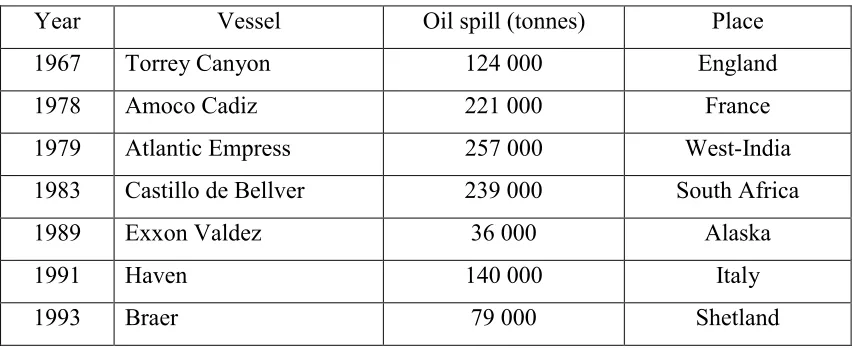
Table 2.6
Some memorable tanker accidents
Year Vessel Oil spill (tonnes) Place 1967 Torrey Canyon 124 000 England 1978 Amoco Cadiz 221 000 France 1979 Atlantic Empress 257 000 West-India 1983 Castillo de Bellver 239 000 South Africa 1989 Exxon Valdez 36 000 Alaska
1991 Haven 140 000 Italy
1993 Braer 79 000 Shetland
The central question is of course whether shipping provides safe enough transportation. Taking into account the total number of trips undertaken per year, tanker shipping has a quite impressive track record. If we assume that larger ships, on average, make 5 trips per year and the smallest ships 15 trips per year, then international tanker shipping undertakes about 32, 000 trips per year. Since 1967, some 35 major accidents have occurred. In this period, tanker shipping made more than 800,000 trips. So in 99.9956% of the cases no major accident occurred. One might therefore argue that the overall performance of tanker shipping is quite good and is constantly improving.
To understand the consequences of pollution from ships, another fact is worth mentioning. Up to now, there have been no successful response actions taken after major oil spill accidents because of the inefficiency of the equipment even though millions of dollars have been spent on preparedness and response. Most of the equipment designed to contain and recover spilled oil are efficient in calm waters, with no currents and calm wind. But unfortunately these conditions are not very frequent at sea, especially in the open sea. Therefore, in most cases the spilled oil spreads and is finally naturally dispersed.
2.3 Government Intervention and Policy
Shipping is an international business. Historically, ships have always enjoyed the “freedom of the seas”. A hundred years or more ago many shipowners were also ship’s masters and traders. Their business was often inherited from their families and almost all commercial transactions were handled with private organizations.
However, the “freedom of the seas” has gradually eroded from the early days of shipping due, directly or indirectly, to government intervention, directed principally at the protection of national economy and trade, as well as for reasons of security. Today, national governments of maritime States are deeply involved in the shipping industry. Governmental policy with respect to shipping can be seen as the promotion and participation of international shipping and the implementation of international obligations under international laws.
2.3.1 Historical Evolution of Government Intervention
Freedom of the seas
hindrance. On the other, one is free to trade one’s ships so long as there is no interference in the commercial operations by others.
However, both these aspects have been subject to erosion, often under private and public international laws. Today ships are subject to more and more statutory rules and regulations in compliance with international conventions, most of which are technical standards – navigation, safety, construction, pollution control, etc.
Under the United Nations Convention of the Law of the Sea (UNCLOS 1982), ships enjoy freedom of navigation on the high seas. On the other hand, the flag State is required to discharge its duties under Article 94, UNCLOS: “Every State shall effectively exercise its jurisdiction and control in administrative, technical and social matters over ships flying its flag.” and “Every State shall take such measures for ships flying its flag as are necessary to ensure safety at sea.” In general, the flag State has exclusive jurisdiction over ships flying its flag, and over persons working on such ships in terms of issuing and withdrawing certificates of competence, except that (Intervention Convention 1969) a coastal State has the right to take such measures on the high seas as may be necessary to prevent, mitigate or eliminate danger to its coastline or related interests from pollution by oil or the threat of such pollution following a maritime casualty.
Ships also enjoy the right of innocent passage through the territorial sea and international strait under UNCLOS. A coastal State shall not intervene in the passage so long as it is not prejudicial to the peace, good order or security of the coastal State.
for access to their ports. For example, ships must obtain permission before entering or leaving a port.
There are two different approaches to State jurisdiction over ships within its territorial waters, namely plenary and limited jurisdiction. Under the common law system, States have total rights of jurisdiction, but under the civil law system, States shall not intervene in the “internal economy” or internal affairs of ships unless if it is requested by the master or flag State. Yet, the difference between plenary and limited doctrines is theoretical rather than practical. In fact, the actual enforcement practice of States is more or less uniform.
Government protection of trade
Despite the fact that shipping was initiated mainly by private practitioners hundreds of years ago, and shipowners, mariners and traders are frequently confronted with rules and regulations enacted by public administrations, government intervention has always existed throughout the evolution of the shipping industry in order to respond to the collective needs and concerns of the general public. In the early stage of shipping development, government intervention was mainly directed at the protection of national interests, trade and the security of ships and seafarers. As the importance of shipping in national economic development has increased, many interventive measures have been created by the governments of various maritime countries. However, the economic globalization and liberalization movement is now pushing governments towards facilitating and fostering the establishment and expansion of enterprises through market mechanisms, while maintaining sustainable development.
From the very beginning of history, maritime trade was carried on by merchants who conveyed their own commodities. Seafarers who discovered new resources and virgin territories kept their own business a secret. As the business expanded, maritime insurance and inspection systems, with the aim of securing seaworthy vessels for the cargo owners, were developed and spread everywhere as a common practice. The shipping generally enjoyed freedom from government power at that time.
colonies worldwide and the governments protected their exclusive shipping and trading routes, which largely destroyed the “freedom of the seas”.
In the seventeenth century England and the Netherlands gained increasing market shares of the sea traffic and challenged the Spanish and Portuguese powers. However, as early as the reign of Henry VII (1485-1509), the British monarch passed the first “navigation” law, which gave a preferential position to English vessels in the carriage of goods to and from Britain. Thus he invented the principle of flag discrimination: a form of protectionism often termed cargo reservation or cargo preference, which remains even today in certain protectionist areas of the world.
While the “navigation” law was a historical action against the Spanish and Portuguese monopolies, the real growth of protectionism was the British Navigation Act which was adopted in 1651 under Cromwell, and its subsequent development and enforcement. This government intervention had a significant impact because of the rapidly expanding trade to and from British colonies. Under the Act all goods trading between Britain and British colonies had to be carried by British ships. No foreign ships could be used. In its evolution, the law was further strengthened in favour of British ships. For example, colonial ships were required to route through English ports where a levy was imposed.
The Navigation Act was partly repealed in 1841 and finally repealed in 1853 partly as the result of the pressure of the free-trade expansionist voice, and partly because of the strength of British shipowners and shipping, which was so strong that they no longer needed protection. However, the influence of the protectionist policies remains even today although measures are not necessarily the same as the Navigation Act.
Over the years, a number of protectionist forms have been adopted by governments to promote and protect national shipping industry. These may be broadly categorised as follows:
National regulations or requirements
• Flag reservation which reserves all or part of national export and import cargoes to national-flag ships, and restricts employment of seamen on board national-flag ships;
• Cabotage, which reserves domestic trade to the national flag;
• Trade restrictions imposed by a requirement that all goods exported are sold on c.i.f. terms and imported goods are purchased on f.o.b.
• Access to ports and port facilities, setting up conditions for access to and from ports, favourable to the national fleet;
• Access to military and strategic cargoes.
Financial treatment
• Subsidies, which include direct subsidies to the national shipbuilding industry, ports, and the national fleet;
• Investment incentives, designed to encourage national carriers to invest in new or second-hand tonnage;
• Fiscal treatment, which is in favour of national shipping, e.g. depreciation and taxation policies;
• More beneficial credit arrangements for national shipowners building ships in their own countries;
• Social security and welfare systems to support national seafarers training and employment.
Bilateral and multilateral arrangements
• Bilateral liner agreements designed to divide the shipping market between two countries;
• Common shipping policies, e.g. European Union and North American trade union;
• United Nations Convention on a Code of Conduct for Liner Conferences, which covers a number of aspects, such as market shares, pricing policy, relationship between lines and their customers and membership criteria for liner conferences.
Security at sea
provided regular military expeditions at that time. Portuguese, Spaniards, Dutch and English sailed in heavily armed ships against pirates.
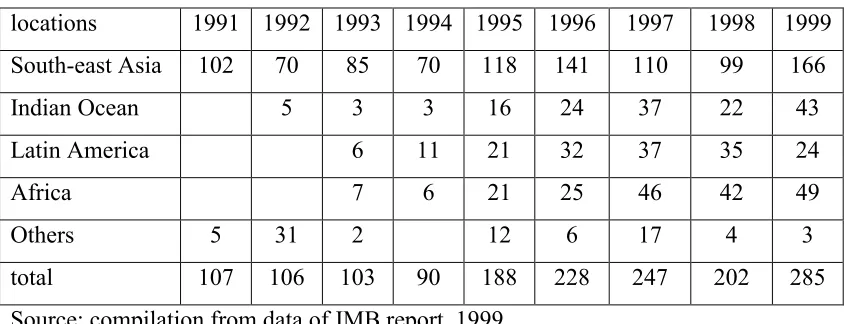
The world was subsequently relatively peaceful without serious pirate incidents for many years. Unfortunately, piracy and armed robbery returned sharply in the 1980s, especially in South East Asia due to economic, social and political reasons. According to the statistics by the International Maritime Bureau (IMB), annual piracy and armed robbery incidents against ships have exceeded 200 since 1996. Table 2.7 provides the total number of incidents by location between 1991 and 1999. This situation has impressed on government the need for action. In 1983, Sweden submitted a report to the Maritime Safety Committee (MSC) of IMO calling for the consideration of piracy and armed robbery problems. Since then the issue has become a regular agenda item in IMO
Table 2.7
Piracy and armed robbery incidents by locations (1991-1999)
locations 1991 1992 1993 1994 1995 1996 1997 1998 1999 South-east Asia 102 70 85 70 118 141 110 99 166 Indian Ocean 5 3 3 16 24 37 22 43 Latin America 6 11 21 32 37 35 24
Africa 7 6 21 25 46 42 49
Others 5 31 2 12 6 17 4 3
total 107 106 103 90 188 228 247 202 285 Source: compilation from data of IMB report, 1999
Meetings and several IMO Resolutions have been adopted by the Organization, including guidelines for measures to prevent acts of piracy and armed robbery against ships. Since 1998, IMO has organized missions of experts in South East Asia, South America, West Africa and the Indian Ocean to impress on governments the need for action, and to motivate political will to act on both national and international levels. Although some steps have been taken nationally, regionally and internationally, it is likely that this problem will continue until meaningful national actions are implemented by all the governments concerned.
The development of maritime law
the international nature of shipping today, almost all aspects of deep-sea shipping have been regulated by international law. Maritime law can also be divided into private and public law. Although maritime law was initiated from private law, public law, especially public international law, has been well developed, this latter being the mandate of the maritime safety administration.
As early as Roman Times, merchant navigation included a system of insuring vessels. This took the form of a loan raised by the merchant of the shipowner from a banker on the security of the vessel and/or the cargo. This loan was to be repaid if the voyage was successfully concluded but would be written off if the vessel and/or the cargo was lost. In A. D. 554 the Roman emperor Justinian I introduced a particular regulation concerning marine insurance which laid down that the normal premium on maritime loans should be 6 per cent. Later on, this insurance system was widely practised in the Mediterranean countries and gradually became an international rule. Several international marine insurance terms used today can be traced from ancient times. For example, the term average was derived from the Italian avaria, which means loss due to damage.
Similarly, salvage law and the law related to the carriage of goods by sea were developed in the same way. Not only private law but also public law was developed in the very early stage of shipping, the latter having emerged from the need to protect merchant ships from piracy in order to enable them to continue their trade. The initial maritime law was even codified, for example, the Roman maritime law which covered subjects such as the sea, the ship, and the cargo, as well as the obligations of those engaged in shipping and dispute settlement mechanisms.
international maritime laws. Some of them have been successfully adopted as international conventions, including the United Nations Convention on a Code of Conduct for Liner Conferences 1974, the International Convention on Maritime Liens and Mortgages 1993, the International Convention on Arrest of Ships 1999, the Athens Convention Relating to the Carriage of Passengers and their Luggage by Sea (PAL) 1974, the International Convention on Civil Liability for Oil Pollution Damage (CLC) 1969, the International Convention on the Establishment of an International Fund for Compensation for Oil Pollution Damage (FUND) 1971, and the Convention on Limitation of Liability for Maritime Claims (LLMC) 1976.
Others have also achieved uniformity to some extent, for example, standard shipbuilding contracts, standard charterparties, and bills of lading.
Maritime public law, which concerns matters related to the distribution and exercise of rights, duties and obligations by public authorities, and the legal relations between States and individuals, or among States, can be grouped mainly into three categories, namely maritime safety, pollution prevention and maritime security. During the second half of the last century, considerable progress had been made in harmonising public international law through inter-governmental organizations, mainly IMO, ILO, WHO and ITU. Today, almost all of this field has been covered by international conventions.
Public international maritime law forms the basis on which the maritime safety administration has been established and mandated. But it can be effective only when national law has been enacted and implemented. Since maritime law has been well developed at the international level, the key issue is the State’s progress in implementation and enforcement. This will be discussed in more detail in Section 2.4.
Whilst international law regulates most shipping fields, it is also necessary for States to enact national laws which are not within the sphere of international law. For example, government authorities have obligations to regulate non-convention ships (smaller, fishing or domestic-sailing ships).
2.3.2 Government general policy in shipping
framework of the government’s overall maritime (shipping) policy and duly reflected in its maritime legislation. Some economists define shipping policy as “A totality of economic, legal and administrative measures by which the State influences the position of its fleet in the national economy and in the international freight market.” It is quite correct from the economic point of view that one of the most important functions of the government is to strive for the development of the national economy and international trade in which shipping plays a very important part. In fact today, under the generally peaceful environment, government policy in all countries, whether developed or developing countries, is economically oriented. However, as an instrument of the State with the ultimate goal to meet and maintain the continuously increasing requirements of the general public, the national government has a large variety of goals, not only those described by the economists, but also those which can be justified for the good of the general public. As mentioned earlier, government general policy in shipping falls into two broad areas, namely promotion of, and participation in, international shipping, and implementation of international obligations.
Promotion and participation of international shipping
How to achieve the maximum gain for a national shipping industry in the international market has always been a major concern of all governments. The natural tendency of all nations, including the traditional maritime countries and newly developing maritime States, is to look at shipping from their own national standpoint, and to see where they can gain an advantage. As discussed before, historically, a large number of interventionist measures have been developed and practised by various governments, which have mainly taken the form of national regulations or requirements, financial treatment, or bilateral and multi-lateral arrangements.
It would be wrong to say that all protectionist measures are negative and therefore should be abolished. In fact, some of them have become international customary practice recognised by all countries, such as cabotage, and bilateral and multi-lateral agreements. It is also broadly acknowledged that some kind of protection is essential to promote national shipping development, especially in the newly developing maritime countries where shipping and related industries are too weak to compete on equal grounds in the international market.
progressively shifting towards providing an appropriate enabling environment for private enterprise, and facilitating and fostering the establishment and expansion of private business. A number of governments in both developed and developing countries have successfully pursued pro-active policy interventions in order to: influence savings and investment rates; promote the efficient functioning of markets; improve access to international markets; stipulate the diffusion of technology; and create the best possible conditions for ensuring the competitiveness of their shipping and other related commercial activities. However, there is growing recognition in nearly all countries that governments, in promoting shipping development, should rely closely on market forces as the primary means of ensuring optimum allocation of resources.
Another important role of the government in promoting its shipping industry is to provide necessary services, which contribute to enhanced economic performance. Typically, it falls to the government to ensure the provision of port infrastructures, including dredging of channels, maintenance of navigation support services, icebreaking, and so on. The government role is also directed at promoting human resource development, providing facilities for training of seafarers, ensuring a free flow of information and the advancement of science and technology, as will as setting up systems of labour and social welfare conditions.
Implementation of International Obligations
The rights and duties of flag States, port States and coastal States have been embodied in various international regulations or conventions adopted by competent international organizations, namely IMO and ILO. To enjoy these rights and to protect their national interests, States have to fulfil their obligations.
In this connection, a flag State , whether a contracting party to an international convention or not, will be bound by the convention vis a vis other contracting Parties. Ships flying its flag will be subject to the requirements of the convention when they visit ports of contracting Parties, which is often referred as “no more favourable treatment”. If a ship fails to meet the requirements of the convention because its flag State has not ratified it, for example, the ship has no a required certificate, then the ship will be detained. In fact, due to this reason some ships have been forced to change their flag. On the other hand, when and only when a State has become a Party to a convention and has given it legal effect by enacting national law with respect to the convention, the State is able to enforce ships visiting its ports.
National interests with respect to implementing international obligations related to safety and pollution regulations can be identified as follows:
• To protect citizens from loss of life and personal injury;
• To protect against property or other economic losses caused by accidents;
• To protect the environment and maintain sustainable development; and
• To maintain a good national reputation, and thereby to promote the opportunities for economic development.
However, some countries, especially developing countries, have faced difficulties in implementing international obligations due to their economic difficulties, legislation, infrastructure, law enforcement resources, or expertise. Once these difficulties are overcome, these countries will certainly be active in implementing the conventions because of the advantages mentioned above which are so attractive for the countries to do so.
2.4 Traditional Roles and Functions of Maritime Safety Administration
However, the roles and functions of the MSA, which can be identified from different perspectives, are similar in all countries because its rationale and mandate are mainly provided for under various international conventions.
2.4.1 Public Administration
As part of the public administration, the maritime safety administration has attributes that are common to other public sectors. The role and function of the MSA may be considered to fall into three broad categories: policy development, regulation, and provision of services.
Policy-making can be defined (Barber, 1983, p.59) as the determination of major objectives, the selection of methods of achieving these, and the continuous adaptation of existing policies to the problems that face a government. It is a complex process involving individuals and organizations outside, as well as within, the political influence. Policy-making is effectively a two-part process. First is the analysis and choice presentation, which involves the primary determination of problem areas, definition of the issues involved therein and an examination of the methods of problem-solving. Second is decisions on policy, which includes the making of the actual decision as to the choice and implementation of alternatives presented.
A good policy-making process should be based on risk analysis, cost/benefit analysis, impartiality and scientific approach, and should be directed at the efficient assignment of responsibilities, and resource identification and allocation, in both public and private sectors. But due to the nature of public administration, it is quite often criticized that the public section has negative features: a tendency towards balance and compromise; lack of professionalism; lack of long-term strategies; and a failure of make effective use of professionals.
Another role of the Maritime Safety Administration is the development and administration of legislation and regulation. The MSA is one of the main government organizations responsible for the establishment and maintenance of the national Merchant Shipping Act, which is the body of laws that control maritime activities, including social and safety matters. Since the activities of the MSA rely on these laws, this role is essential. The MSA can only function effectively when the laws are in place.
one of the major legislative activities of the MSA is to transfer international conventions into national law in order to enforce them.
There are two doctrines in the transforming process. In the monistic system, a convention can become part of domestic law simply as a consequence of its ratification or accession by the State. Virtually no legislative action is required. However, it requires that the legislation must be officially published. On the other hand, in the dualistic system, legislative action is always required for an international convention to be effective after ratification or accession.
Moreover, the MSA is a specialised organization. It provides a series of services, including:
• Training, examination and certification of seafarers;
• Search and rescue;
• Navigational services, such as hydrographic survey and aids to navigation; and
• Pollution prevention and emergency response.
2.4.2 Areas of Function
The role and function of the maritime safety administration can be broken down into different areas, namely flag state control, port state control, search and rescue, pollution preparedness and response, and navigational services.
Various international conventions stipulate the respective jurisdictions of flag State, port State and coastal State. UNCLOS 82 is the blueprint covering all aspects of the functions of the maritime safety administration. Detailed requirements are described in the generally accepted international regulations established by the competent international organizations, such as IMO, ILO, ITU and WHO.
Flag State Control
An important function of the maritime safety administration is flag State control which is directed at ensuring vessels flying its flag meet the requirements for safety of life, property and the marine environment. Article 94 of UNCLOS 1982 describes in general the duties of the flag State:
Article 94 Duties of the flag State
1. Every State shall effectively exercise its jurisdiction and control in administrative, technical and social matters over ships flying its flag.
(a) maintain a register of ships containing the names and particulars of ships flying its flag, except those which are excluded from generally accepted international regulations on account of their small size; and
(b) assume jurisdiction under its internal law over each ship flying its flag and its master, officers and crew in respect of administrative, technical and social matters concerning the ship.
3. Every State shall take such measures for ships flying its flag as are necessary to ensure safety at sea with regard, inter alia, to:
(a) the construction, equipment and seaworthiness of ships;
(b) the manning of ships, labour conditions and the training of crews, taking into account the applicable international instruments;
(c) the use of signals, the maintenance of communications and the prevention of collisions.
4. Such measures shall include those necessary to ensure:
(a) that each ship, before registration and thereafter at appropriate intervals, is surveyed by a qualified surveyor of ships, and has on board such charts, nautical publications and navigational equipment and instruments as are appropriate for the safe navigation of the ship;
(b) that each ship is in the charge of a master and officers who possess appropriate qualifications, in particular in seamanship, navigation, communications and marine engineering, and that the crew is appropriate in qualification and numbers for the type, size, machinery and equipment of the ship;
(c) that the master, officers and, to the extent appropriate, the crew are fully conversant with and required to observe the applicable international regulations concerning the safety of life at sea, the prevention of collisions, the prevention, reduction and control of marine pollution, and the maintenance of communications by radio. 5. In taking the measures called for in paragraphs 3 and 4 each State is required to conform to generally accepted international regulations, procedures and practices and to take any steps which may be necessary to secure their observance.
7. Each State shall cause an inquiry to be held by, or before, a suitably qualified person or persons into every marine casualty or incident of navigation on the high seas involving a ship flying its flag and causing loss of life or serious injury to nationals of another State, or serious damage to ships or installations of another State or to the marine environment. The flag State and the other State shall co-operate in the conduct of any inquiry held by that other State into any such marine casualty or incident of navigation.
While UNCLOS, Article 94 provides the general prescription of the flag State’s duties and obligations, the itemized list of flag State duties are expected to be, inter alia, the following:
• Ship registration and related functions;
• Survey, inspection and certification of ships;
• Training, examination and certification of seafarers;
• Dealing with matters of safe manning and labour conditions;
• Casualty inquiries/investigations;
• Investigation of allegations of non-conformity, deficiency or pollution reports;
• Making offences punishable; and
• Ensuring the safety of fishing and other non-convention vessels.
Ship registration is a process which establishes the legal tie between a ship and its flag State. Registration is used as evidence of the right to fly the flag of the State, and therefore, the ship enjoys all rights and privileges granted by its flag State on the one hand. On the other hand, the flag State extends its jurisdiction to ships flying its flag and has the right to enforce its ships in conformity with its national law. By registration the flag State also declares, in fact, that a vessel meets the relevant national requirements. Moreover, another purpose of registration is to record property rights and registerable changes on the ship, for example, the shipowner and mortgages.
UNCLOS, Article 91 and 92, regulates the nationality and status of ships: Article 91
Nationality of ships
nationality of the State whose flag they are entitled to fly. There must exist a genuine link between the State and the ship.
2. Every State shall issue to ships, to which it has granted the right to fly its flag, documents to that effect.
Article 92 Status of ships
1. Ships shall sail under the flag of one State only and, save in exceptional cases expressly provided for in international treaties or in this Convention, shall be subject to its exclusive jurisdiction on the high seas. A ship may not change its flag during a voyage or while in a port of call, save in the case of a real transfer of ownership or change of registry.
2. A ship which sails under the flag of two or more States, using them according to convenience, may not claim any of the nationalities in question with respect to any other State, and may be assimilated to a ship without nationality.
In order to ensure that ships meet the requirements of various international conventions, such as Load Line, SOLAS, MARPOL, and Tonnage, as well as national regulations, the flag State must carry out surveys and inspections on its ships, and issue relevant certificates as the evidence of compliance. Because of the special knowledge and expertise required, almost all of flag States have delegated, to a certain extent, some of the statutory surveys, inspections and issuance of certificates to classification societies. However, the responsibility with respect to safety and pollution remains with the flag State.
While the safety of ships’ construction and equipment is ensured by surveys and inspections, the competence of seafarers is controlled by training, examination and certification. Because of the dominant importance of human errors as the principal factor leading to maritime accidents or incidents, as established by many studies, all traditional and developing maritime countries have accepted that the training and certification of seamen must be a responsibility of their governments.
The International Convention on Standards of Training, Certification and Watchkeeping for seafarers, 1978, as amended in 1995 and 1997 (STCW Convention) provides duties and obligations of State parties, for example:
“Regulation I/6
Each Party shall ensure that:
.1 the training and assessment of seafarers, as required under the Convention, are administered, supervised and monitored, and
.2 those responsible for the training and assessment of competence of seafarers, as required under the Convention are appropriately qualified."
The requirements for safe manning and labour conditions are described in IMO and ILO conventions as follows:
SOLAS, Chapter V, Regulation 13:
(a) The Contracting Governments undertake to maintain or adopt measures for the purpose of ensuring that all ships shall be sufficiently and efficiently manned.
(b) Every ship shall be provided with an appropriate safe manning document or equivalent issued by the Administration as evidence of the minimum safe manning.
ILO C109, Article 21:
1. Every vessel shall be sufficiently and efficiently manned for the purpose of: (a) ensuring the safety of life at sea;
(b) preventing excessive strain on the crew and avoiding or minimising as far as practicable the working of overtime.
2. Every Member undertakes to maintain efficient machinery for the investigation and settlement of any complaint or dispute concerning safe manning.
In addition, in 1999 IMO adopted Resolution A. 890(21) as a guideline for the principles of safe manning.
Maritime casualty investigation is one of the main functions of the maritime safety administrations of all States. The purpose of casualty investigation is to enable governments and the shipping industry to take necessary steps to prevent, as far as practicable , the occurrence of similar casualties in the future. Casualty investigations identify the circumstances of the casualty and determine as precisely as possible the causes by gathering and analysing information and drawing conclusions.
preliminary investigation is usually conducted by a qualified and experienced investigator of the maritime administration. On the other hand, a formal investigation is held in addition to, or instead of, a preliminary inquiry, as may be required by national law, especially in common law countries. While a formal investigation is held by a Court, the role of the maritime administration in the formal investigation is to assist the Court, as may be required, in every possible manner, with its special knowledge and expertise.
Whilst States may take different approaches in conducting casualty investigations, the rights and obligations of States, whatever flag States, coastal States, or interested States, with respect to casualty investigation are stipulated in various international conventions, including UNCLOS, Article 97, 94(7), 217(4), (6), 2, 220, 221 and Article 226, SOLAS, Regulation 21, LL, Article 23, MARPOL, Article 6(2), (4), (5), Article 12, and ILO C147, Article 2(g). In 1997, IMO adopted the Code for the Investigation of Marine Casualties and Incidents, which is a guideline for holding casualty investigations. Under the IMO Code (paragraph 4.11) the substantially interested States, which may be encouraged (IMO Code, paragraph 9.1, 9.2 and 9.3) to take part in a casualty investigation, include: the flag State; the coastal State in whose internal waters or territorial sea a casualty has occurred, or to whose interests or environment the casualty has caused/threatened serious harm; the State whose nationals have been involved in the casualty; and any other State that is considered significant by the investigating State.
The flag State has the duty to investigate all incidents or deficiencies of its ships with regard to safety and pollution when asserted by any State or any person, as required by many conventions. For example, MARPOL, Article 4(1) states that: “Any violation of the requirements of the present Convention shall be prohibited and sanctions shall be established therefor under the law of the Administration of the ship concerned wherever the violation occurs. If the Administration is informed of such a violation and is satisfied that sufficient evidence is available to enable proceedings to be brought in respect of the alleged violation, it shall cause such proceedings to be taken as soon as possible, in accordance with its law.”
attention by the respective national maritime safety administration because it is a domestic matter but part of the MSA’s functions. In order to fulfil this function, domestic law and regulations should be in place, and a system needs to be established, at least in order to ensure:
(1) the inspection and certification of safety equipment of fishing vessels and other small craft, and
(2) competent manning of such vessels/craft.
Port State Control
Although the primary responsibilities for ensuring that ships comply with safety and pollution standards fall on the flag State, port State control is envisaged as a back up system, which is intended as a means of diminishing the number of sub-standard ships, which result from irresponsibility or incompetence on the part of flag States.
PSC can be traced as far back as SOLAS 1929. Its basic concept is that all countries have the right to inspect ships visiting their ports to ensure they meet IMO requirements regarding safety and pollution prevention standards, and ILO requirements relating to working conditions and welfare of seafarers. The international legal framework regarding PSC can be found in a number of conventions, including UNCLOS 82, SOLAS 74, MARPOL 73/78, LL66, STCW 78, and ILO C147.
When provisions for PSC were introduced in SOLAS and other conventions, initially it was assumed that their application would be a national concern. Generally speaking, because there were no recommendations on how many ships should be inspected and what procedures and standards should be followed, there were few actions taken on PSC until the Paris Memorandum of Understanding (MOU) on PSC, which was signed in 1982 within the region covering Europe and the North Atlantic. Since then, PSC, as a major tool for enforcing compliance with marine safety and standards, has became more and more active, and practical experience has shown that PSC works best when it is organized on a regional basis.
19 west and central Africa nations on 22 October, 1999. A first draft of a regional PSC agreement for the ROPME (Regional Organization for the Protection of the Marine Environment) sea area was discussed in July 1999 in Manama, Bahrain and a second meeting is expected to see the signature of an MOU on PSC in the Persian Gulf region. A first preparatory meeting for the establishment of a port State control system in the Black Sea region took place in Varna, Bulgaria in September 1999, and the MOU for this region is expected to be adopted and signed in 2000.
With the adoption of these MOUs, most of the world's oceans will be covered by PSC. At present, great progress has been made under the Paris, Latin America and Tokyo MOUs. The Paris MOU recently held its thirty-second meeting and a major issue was how to disseminate more information. The Paris and Tokyo MOUs have signed a joint declaration to tighten PSC in both regions and to maximise its deterrent effort. The Latin America MOU held its fifth meeting in 1998, adopting new Codes. Other MOUs have been mainly addressing issues such as training of PSC officers, adoption of PSC manuals and regional Codes. In addition, each MOU has its different regional considerations. For example, one of the major considerations in Caribbean countries is focused on non-Convention sized ships (Rial, 1999, p.5).
The rationale reflecting the growing need for PSC is to protect port State interests; to promote and encourage flag State implementation; and to rectify failures of flag State control, classification society standards, shipowners/operators responsibilities, and the insurance industries (Mukherjee, 1999). Whilst flag State implementation enforces ships which are entitled to fly its flag, port State control is aimed at inspecting foreign ships visiting its ports. However, FSI and PSC are not separate but complementary to each other with the same basic concern: ensuring that IMO and ILO standards are implemented. Yet, prior to the existence of formalised regional PSC agreements, the same inspectors did both jobs. As the PSC role has developed, PSC officers have been trained with specialised knowledge with respect to inspection procedures, regional Codes and manuals, and PSC is now a separate, specialised area.