International Journal of Advances in Engineering Research http://www.ijaer.com
(IJAER) 2014, Vol. No. 8, Issue No. V, November ISSN: 2231-5152
A REVIEW ON NOICE REMOVAL IN DIGITAL IMAGE
PROCESSING
SASIKALA1, DR. SUKUMAR2
1Assistant Professor, University college of Engineering, Anna University, Dindigul, Tamilnadu
2 Professor, Sethu Institute of Technology, Virudhu Nagar Tamilnadu.
ABSTRACT
Now, in this beginning of the twenty-first century, image processing has become a well-established engineering discipline. Digital image processing is a field of study which is rapidly growing during the past few decadeswith the increased utilization in manyengineering applications. Image processing has found a significant role in scientific, industrial, space, and government applications. Image processing is carried out withvarious improvements in the size, speed, and cost effectiveness of digital computers andrelated signal processing technologies. Algorithms used for digital image processing provides different results on different types of image sources, for example, an edge segmentation algorithm which provides better result for medical image may give worst result for satellite images. Advances in the theoretical basis of image processingcontinue still even after decades of research.This paper provides reviews on recent research techniques developed for image processing on recent years. This paper is prepared to help the researchers those started their research in digital image processing.
Keywords: Image processing, Segmentation, Noise Removal, Image Enhancement
INTRODUCTION
Digital image processing is an algorithmic process which may be executed by a computer with little or no human intervention, on any specific images like satellite image, medical image or typical photo. Many interfaces like Programmer’s Imaging Kernel System (PIKS) application program interface (API) and simulation tools like Matlab helps the researchers for increased interest on image processing.
International Journal of Advances in Engineering Research http://www.ijaer.com
(IJAER) 2014, Vol. No. 8, Issue No. V, November ISSN: 2231-5152
possible ways of meaningfully grouping pixels. Additionally, after choosing a definition for an optimal segmentation, there are many computational difficulties in finding such segmentation.Fast image segmentation method can be more useful and valuable in the field of Medical imaging, Satellite imaging, underwater imaging, etc. Several general-purpose algorithms and techniques have been developed for image segmentation.
When the input data to an algorithm is too large to be processed and it is suspected to be particularly redundant then the input data will be transformed into a reduced representation set of features. Transforming the input data into the set of features is called feature extraction.
Figure 1 Vision of Image (Grosso and Tistarelli, 1995)
PROCESS OF DIGITAL IMAGE PROCESSING
International Journal of Advances in Engineering Research http://www.ijaer.com
(IJAER) 2014, Vol. No. 8, Issue No. V, November ISSN: 2231-5152
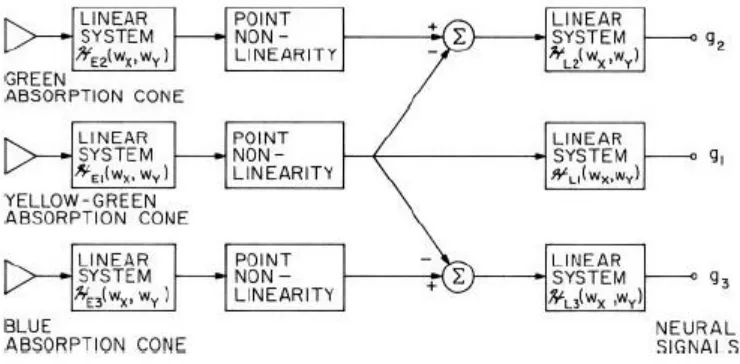
Figure 2Fundamentals of digital image processing system
The first phase of digital image processing is sampling. In a physical image sampling system, the sampling array will be of finite extent, thesampling pulses will be of finite width, and the image may be undersampled. In operation, a narrow light beam is scanned directly across a positivephotographic transparency of an ideal image. The light passing through thetransparency is collected by a condenser lens and is directed toward the surface of aphotodetector. The electrical output of the photodetector is integratedover the timeperiod during which the light beam strikes a resolution cell. In the analysis it will beassumed that the sampling is noise-free (Munoz-Salinas, 2008).
International Journal of Advances in Engineering Research http://www.ijaer.com
(IJAER) 2014, Vol. No. 8, Issue No. V, November ISSN: 2231-5152
been identified and experimented to represent content of single images according to low-level features, such as color, texture, shape and structure, intermediate-level features of saliency and spatial relationships, or high-level traits modelling the semantics of image content (Sudha and Mohan, 2011).
IMAGE RETRIEVAL
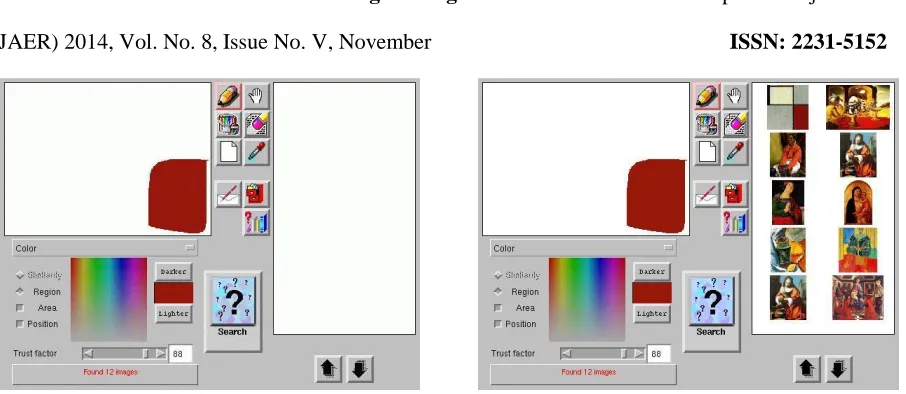
In this section, image retrieval based on size, colour are implemented in MatLab using GUI tools are shown for the easy understandability. Most of the image retrieval are implemented using region based image representation. In addition to the region-based image representation, image chromatic content is globally represented by a histogram which enables image retrieval by global color similarity. In this latter case, the user can select an example image and search for images similar to the query on the base of color distribution. A simple image representation GUI is shown in figure 3.
Shape based retrieval is supported by letting the user sketch the contour of a shape he/she is looking for. A shape based retrieval GUI is shown in figure 4.The shape is represented by breaking its boundary into tokens according to points of minima of the curvature function computed on the shape boundary. A sample broken shape and its curvature function is shown in the figure 5. Shape tokens are then individually represented using their curvature and orientation.Shape comparison is supported by combining distances computed on individual tokens of two matching shapes.
In addition to this, shape tokens are combined with an indexing structure (metric tree) capable to speed up the search by reducing the number of distance computation between the query shape to the database shapes from a linear scan of the database shapes to a sub-linear scan (Weimin et al, 2010).
International Journal of Advances in Engineering Research http://www.ijaer.com
(IJAER) 2014, Vol. No. 8, Issue No. V, November ISSN: 2231-5152
Figure 3.Sample image retrieval in GUI Based Matlab
International Journal of Advances in Engineering Research http://www.ijaer.com
(IJAER) 2014, Vol. No. 8, Issue No. V, November ISSN: 2231-5152
IMAGE PROCESSING IN 3D MODELS
In recent years, the use of 3D models has been progressively spreading throughout many application domains: in manufacturing industries, 3D models are used in the design of many different objects and components, and are archived to enable reuse and rapid prototyping of new products; in medicine, many tests that are fundamental for disease study and diagnosis provide output data in the form of 3D models; in videogames design, reuse of available models may speed up the development of new games; in video production, where high quality 3D models are used for special effects, considerable resources, in terms of time and effort, can be saved by reusing or adapting existing models (Bradski and Kaehler, 2008); in cultural heritage, regular acquisition of the 3D structure of statues, bas-reliefs and art-pieces supports monitoring potential deformations of object structure due to inappropriate preservation conditions.
In addition to this, it should be noticed that the availability of 3D models is increasing thanks to a growing number of techniques enabling their generation. These solutions differ in terms of costs, resolution and type of acquired information (the un-textured external surface of the object, the textured external surface or even the interior composition of the object) and include CAD, tomography, magnetic resonance, 3D laser scanners, structured light systems and photogrammetry.
Holding these assumptions, retrieval by content of 3D models will emerge as a key issue in the next future and some solutions have already been proposed to address this problem. Many solutions proposed so far, rely on the extraction of content descriptors capturing global properties of 3D object surface: moments, distributions of vertex distances, surface curvature or angles between faces. Alternatively, surface properties can be described in transformed domains, like the wavelets and the spherical harmonics.
International Journal of Advances in Engineering Research http://www.ijaer.com
(IJAER) 2014, Vol. No. 8, Issue No. V, November ISSN: 2231-5152
Figure 6.Vertex of a 3D model and Four normal object surface
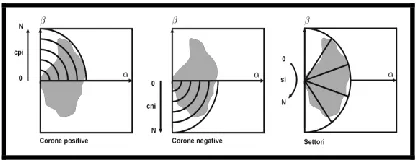
Recent days, fuzzy and swarm intelligence based clustering are become more popular and provides optimal results (Chandramohan and Baskaran, 2010, 2011a and 2011b). Description vectors have been clustered using fuzzy clustering so as to take the centers of the clusters as signatures of the spin image representation. The optimal number of clusters is derived considering two functions that express a measure of under- and over-partitioning, respectively. The optimal number of clusters is the number that minimizes the sum of the two functions representing the trade-off between under- and over-partitioning. Finally, similarity between spin image signatures of 3D objects is obtained considering the permutation that minimizes the sum of distances between the corresponding cluster centers. A sample circular crowns and sectors used to derive a vector representation of the spin image are shown in figure 7.
Figure 7.Vector representation of the spin image
In order to validate the retrieval performance of the proposed approach, a compound 3D repository of VRML models has been constructed by gathering 3D models featuring different characteristics mainly in terms of resolution and complexity. In particular, the 3D repository includes 3D models collected from the Web, from the 3D Princeton Shape Benchmark Archive and from the De Espona Encyclopedia.
International Journal of Advances in Engineering Research http://www.ijaer.com
(IJAER) 2014, Vol. No. 8, Issue No. V, November ISSN: 2231-5152
been used to provide a representative comparison of the performance of prototype retrieval engines.
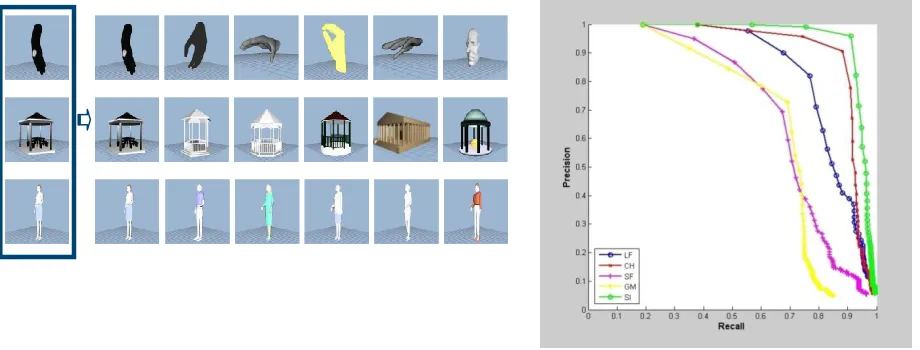
Retrieval performance based on Spin Image signatures has been compared against the performance of four other prototype retrieval engines, using Light Field (LI), Curvature Histogram (CH), Shape Functions (SF) and Curvature Moments (CM). Comparison has been carried out in terms of figures of precision and recall. Although comparison is still in progress, preliminary results suggest that retrieval based on Spin Image signatures outperforms the other prototype retrieval engines for medium- and high-resolution 3D models. In Figure 8, the average precision/recall curves are reported for the five methods under investigation are shown. This has been obtained by using objects from every model category of the Princeton shape benchmark database as query model. In the figure 8, retrieval results are reported for three query models, average precision/recall curves are reported, comparing Spin Images (SI) against four other approaches for 3D object retrieval, namely, Light Field (LI), Curvature Histogram (CH), Shape Functions (SF) and Curvature Moments (CM) are shown.
Figure 8.Retrieval results based on three query models and its Average precision/recall curves
Image Retrieval (IR) is one of the most exciting and fastest growing research areas in the field of multimedia technology. Some of the major problems recognized in image retrieval are:
Lack of a good measurement of visual similarity
Little importance accorded to user interaction and feedback
Neglect of spatial information.
International Journal of Advances in Engineering Research http://www.ijaer.com
(IJAER) 2014, Vol. No. 8, Issue No. V, November ISSN: 2231-5152
productivity, however, there must be an effective and precise method for users to search, browse, and interact with these collections and do so in a timely manner.The fundamental operation in image retrieval is similarity assessment. This reflects the preference in image retrieval of general users, who want to retrieve a number of similar images and then use them to iteratively refine their queries. Therefore IR systems should be designed to be an effective and efficient tool for browsing and navigating in image databases.
CONCLUSION
Image retrieval is a very fast growing research area in the last few years. Famous early examples include the QBIC system from IBM which allows users to retrieve images based on color, texture, layout and by a sketch; the Photobook system by MIT Media Lab which is very powerful for retrieving images from homogeneous collections; the Virage system by Virage company which can be tailored to many applications; the Chabot system from UC Berkeley. These systems provide interactive human-machine interfaces for image searching and browsing. The above are only a few of the best-known approaches, much work is being carried out on specific areas used by these systems, in particular by the computer-vision and pattern recognition specialists, for developing better segmentation, classification and interpretation algorithms of the image content.
Most systems use the query by example approach, where the user selects one or several images, and the system returns the ones judged similar. An alternative way of querying the image database based on content, is by allowing the user to sketch the desired image’s color/texture layout, thus abstracting the objects searched for. Other more targeted systems allow the user to specify spatial constraints on the dominant objects. All of these methods suffer somewhat from the drawback that the system relies on the usersabilities and does not adapt to his/her needs.
International Journal of Advances in Engineering Research http://www.ijaer.com
(IJAER) 2014, Vol. No. 8, Issue No. V, November ISSN: 2231-5152
REFERENCES
Begum, M.; Karray, F., “Visual Attention for Robotic Cognition: A Survey”,IEEE Transactions on Autonomous Mental Development, Vol. 3, Issue: 1, 2011, pp. 92 – 105 Bradski, G.; Kaehler, A., “Robot-Vision Signal Processing Primitives”, IEEE Signal
Processing Magazine, Vol. 25, Issue: 1, 2008, pp. 130 – 133
Chandramohan, B. and Baskaran, R. “Improving Network Performance using ACO Based Redundant Link Avoidance Algorithm”, International Journal of Computer Science Issues, Vol. 7, Issue 3, No 6, May 2010
Chandramohan, B. and Baskaran, R. “Priority and Compound Rule Based Routing using Ant Colony Optimization”, International Journal of Hybrid Intelligent System, IOS Press, Netherland, Vol. 8, No. 2, pp. 93-97, 2011a.
Chandramohan, B. and Baskaran, R. “Reliable Barrier-free Services in Next Generation Networks”, Lecture Notes in Computer Science, Second International Conference on Advances in Power Electronics and Instrumentation Engineering, Nagpur, India, (PEIE 2011), Springer-Verlag Berlin Heidelberg, CCIS 148, pp. 79-82, 2011b.
Grosso, E. ;Tistarelli, M., “Active/dynamic stereo vision”, IEEE Transactions on Pattern Analysis and Machine Intelligence, Vol. 17, Issue: 9, 1995, pp. 868 – 879
Munoz-Salinas, R.; Aguirre, E. ; Cordon, O. ; Garcia-Silvente, M., “Automatic Tuning of a Fuzzy Visual System Using Evolutionary Algorithms: Single-Objective Versus Multiobjective Approaches”, IEEE Transactions on Fuzzy Systems, Vol.16, Issue: 2, 2008, pp. 485 – 501
Sudha, N. ; Mohan, A.R., “ Hardware-Efficient Image-Based Robotic Path Planning in a Dynamic Environment and Its FPGA Implementation”, IEEE Transactions on Industrial Electronics, Vol. 58, Issue: 5, 2011, pp. 1907 – 1920