19
Axiomatic and Operational Models for ARMv8
CHRISTOPHER PULTE,
University of Cambridge, UKSHAKED FLUR,
University of Cambridge, UKWILL DEACON,
ARM Ltd., UKJON FRENCH,
University of Cambridge, UKSUSMIT SARKAR,
University of St. Andrews, UKPETER SEWELL,
University of Cambridge, UKARM has a relaxed memory model, previously specified in informal prose for ARMv7 and ARMv8. Over time,
and partly due to work building formal semantics for ARM concurrency, it has become clear that some of the
complexity of the model is not justified by the potential benefits. In particular, the model was originally non-multicopy-atomic: writes could become visible to some other threads before becoming visible to all — but this has not been exploited in production implementations, the corresponding potential hardware optimisations
are thought to have insufficient benefits in the ARM context, and it gives rise to subtle complications when
combined with other ARMv8 features. The ARMv8 architecture has therefore been revised: it now has a
multicopy-atomic model. It has also been simplified in other respects, including more straightforward notions
of dependency, and the architecture now includes a formal concurrency model.
In this paper we detail these changes and discuss their motivation. We define two formal concurrency
models: an operational one, simplifying the Flowing model of Flur et al., and the axiomatic model of the
revised ARMv8 specification. The models were developed by an academic group and by ARM staff, respectively,
and this extended collaboration partly motivated the above changes. We prove the equivalence of the two
models. The operational model is integrated into an executable exploration tool with new web interface,
demonstrated by exhaustively checking the possible behaviours of a loop-unrolled version of a Linux kernel
lock implementation, a previously known bug due to unprevented speculation, and a fixed version.
CCS Concepts: •Computer systems organization→Architectures; •Theory of computation→
Con-currency;Semantics and reasoning; •Software and its engineering→Concurrent programming
languages;Assembly languages;
Additional Key Words and Phrases: Relaxed Memory Models, Semantics, Operational, Axiomatic
ACM Reference Format:
Christopher Pulte, Shaked Flur, Will Deacon, Jon French, Susmit Sarkar, and Peter Sewell. 2018. Simplifying
ARM Concurrency: Multicopy-Atomic Axiomatic and Operational Models for ARMv8.Proc. ACM Program. Lang.2, POPL, Article 19 ( January 2018),29pages.https://doi.org/10.1145/3158107
Authors’ addresses: Christopher Pulte, University of Cambridge, UK, [email protected]; Shaked Flur, University of Cambridge, UK, [email protected]; Will Deacon, ARM Ltd. UK, [email protected]; Jon French, University of Cambridge, UK, [email protected]; Susmit Sarkar, University of St. Andrews, UK, ss265@st- andrews.ac.uk; Peter Sewell, University of Cambridge, UK, [email protected].
Permission to make digital or hard copies of all or part of this work for personal or classroom use is granted without fee provided that copies are not made or distributed for profit or commercial advantage and that copies bear this notice and the full citation on the first page. Copyrights for components of this work owned by others than the author(s) must be honored. Abstracting with credit is permitted. To copy otherwise, or republish, to post on servers or to redistribute to lists, requires prior specific permission and /or a fee. Request permissions from [email protected].
© 2018 Copyright held by the owner/author(s). Publication rights licensed to the Association for Computing Machinery. 2475-1421/2018/1-ART19
1 INTRODUCTION
What is the semantics of concurrent ARM machine-code programs? The vendor architecture
manuals for ARMv7 and early ARMv8 described a relaxed memory model, with programmer-visible
out-of-order and speculative execution, that wasnon-multicopy-atomic: a write could become
visible to some other threads before becoming visible to all threads. In this it was broadly similar
to the IBM POWER architecture. The two were unfortunately also alike in another way: their
memory models were expressed as prose definitions that were hard to interpret precisely. (x86
and MIPS are similarly imprecise, while SPARC and Itanium have precise vendor-defined models.)
This prompted extensive work to establish mathematically precise models for ARM and for IBM
POWER, initially based on the vendor texts, but later, as the deficiencies of those became apparent,
relying more heavily on experimental investigation of the behaviour of processor implementations,
and on discussion with ARM and IBM architects of their architectural intent:Flur et al.[2017,
2016b];Gray et al.[2015];Alglave et al.[2014];Maranget et al.[2012];Sarkar et al.[2012];Alglave et al.[2011];Sarkar et al.[2011];Alglave et al.[2010,2009];Sarkar et al.[2009];Chong and Ishtiaq
[2008];Adir et al.[2003];Corella et al.[1993].
Broadly speaking, over time these models have become more complete, covering more
relaxed-memory phenomena and larger fragments of the architectures, and more accurate, with respect
both to experimental results and to the architects’ intentions. They have also become more complex
— partly due to the increased coverage, but also as they have exposed more of the complexity
implicit in those intentions.
This complexity has a cost, especially for architectures implemented by multiple vendors, and
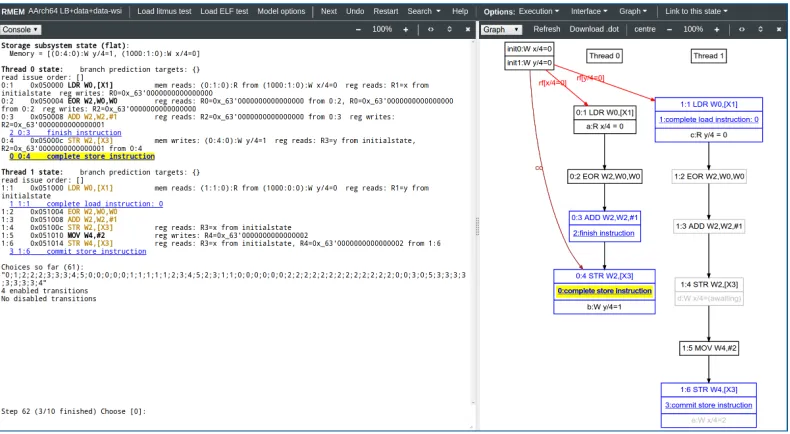
ARM has recently made a significant shift to a simpler model. In particular, while
non-multicopy-atomic (non-MCA) behaviour is observable on IBM POWER implementations, the hardware
im-plementation freedom it permits has not been exploited on production ARMv8 imim-plementations,
by any of the several vendors thereof. This was previously suggested by experimental data for
some implementations [Maranget et al. 2012;Alglave et al. 2014;Flur et al. 2016b,2017], and has been confirmed by discussion with ARM Architecture Partners; it is thought that in the ARM
context the potential hardware performance benefits of non-MCA do not justify the ensuing
com-plexity of implementation, validation and reasoning. Allowing non-MCA behaviour gives rise
to substantial complexity in the model, especially when combined with the previous
architec-tural desire for a model that provided as much implementation freedom as possible, and with the
store-release/load-acquire instructions added in ARMv8. Accordingly, ARM have now revised their
ARMv8 specification to prohibit non-MCA behaviour: when a write is visible to some other thread,
it is now guaranteed to be visible to all [ARM Ltd. 2017, BS-84,90]. Further, the revised ARMv8 specification document now includes, for the first time, a formal memory model to specify (for a
fragment of the architecture) exactly what behaviour is and is not allowed; the architecture contains
a prose version of the formal model byDeacon[2016]. The specification is also being clarified in various other respects, including the definition of inter-instruction dependencies.
In this paper we detail these changes to the ARMv8 concurrency architecture and discuss the
motivation for them. We define two formal concurrency models: an operational model that simplifies
the Flowing model ofFlur et al.[2016b,2017], and the axiomatic model of the revised ARMv8 specification. The two models were developed by an academic group and by ARM staff, respectively,
with an extended collaboration and discussion of examples that started for non-MCA ARMv8 and
partly motivated the shift to MCA ARMv8. We then prove the two models equivalent, establishing
the correspondence between particular operational model transitions and axiomatic model events.
This increases confidence in both formal models and in the architecture itself, providing a clear
rmemtool, with a new web interface for interactive, pseudo-random, and exhaustive exploration
of litmus tests and small ELF binaries. The tool can be used for testing and understanding the
concurrency model, and for exploring the behaviour of concurrent software, at least in small
instances. We demonstrate the latter for a Linux kernel lock implementation, by exhaustively
checking the reachable states of a loop-unrolled version. In short, this paper contributes:
• discussion of the motivation for the new MCA ARMv8 concurrency architecture, including
complexities that arose in the non-MCA case (§3); • an informal description of the new architecture (§4);
• a formal semantics for MCA ARMv8 expressed as an operational model, with an abstract microarchitectural flavour (§5,6);
• a formal semantics for MCA ARMv8 expressed as an axiomatic model, as presented in the new architecture document and byDeacon[2016] (§5,7);
• proof of equivalence of the two models (§8);
• experimental validation of that equivalence and of the model soundness with respect to
hardware (§9);
• a verification, simulation, and debugging tool,rmem, based on the operational model (§10); • a demonstration ofrmemin use, for verifying a lock implementation from the Linux kernel
with respect to the MCA ARMv8 architecture semantics (§11).
The supplementary material includes details of the operational model, proof, and tests, athttp:
//www.cl.cam.ac.uk/~pes20/armv8- mca/. Thermemtool is available athttp://www.cl.cam.ac.uk/
~pes20/rmem/, including the tests mentioned in the paper (best viewed in chrome/chromium). The
new models should aid future work on reasoning about and verification of concurrent ARM code,
as these become considerably simpler in the MCA case.
Caveats.The two formal semantics do not have identical coverage, and so our proof addresses the intersection of the two. The operational model is integrated with semantics for a substantial
fragment of the instruction set, and supports mixed-size accesses. The axiomatic model does not
include that ISA integration or support mixed-size, but it does cover the more relaxed form of
load-acquire (LDAPR) introduced in ARMv8.3 and the atomic read-modify-write instructions introduced in ARMv8.1, which are not in the operational model. We believe that the operational model and
proof could be straightforwardly extended to cover theLDAPRand read-modify-write instructions. Integrating the axiomatic model with the full ISA model requires work on the axiomatic model and
tooling to support mixed-size (to the best of our knowledge no existing axiomatic model or tool
does), including some open questions concerning the allowed behaviour, and work to handle the
full ISA intra-instruction semantics.
The operational model can deadlock in cases where there are memory accesses or barriers
between load/store-exclusive pairs, or when the store-exclusive has extra dependencies (these two
are cases that are not really intended to be supported by the architecture), and when a load and a
store-exclusive are paired successfully but have different addresses, which is still being clarified.
Neither model addresses systems aspects of the architecture, e.g. virtual memory. Finally, our
proof is a hand proof, not mechanised, and currently is limited to finite executions.
2 BACKGROUND: THE NON-MCA FLOWING MODEL
We briefly recall how the Flowing model exhibits non-MCA, as it was the model most often
referred to in discussions with architects, matching their intuitions, and is simple to understand.
We refer toFlur et al.[2016b] for a more complete description of this and the associated POP model. Flowing comprises an operational semantics for each hardware thread, with explicit out-of-order
tree-structured hierarchy of queues, of writes, read requests, and barriers, above a simple memory.
When the storage subsystem receives a memory access or barrier, it is placed at the top of the
queue that is associated with the submitting thread. The bottom-most event in a queue can “flow”
to the top of the next queue in the topology. The memory is a map from byte locations to the
most recent write events to those locations. The bottom-most event in the bottom-most queue can
“flow” to memory: for a write event, updating the memory mapping; for a read event, sending a
read-response to its thread with the appropriate value from the memory map; and, for a barrier
event, removing the barrier. A read event may also be satisfied from within a queue if the event
immediately below it is a write event to the same location. Finally, adjacent events in a queue (even
if from different threads) may switch places with each other (reorder), subject to some constraints.
To demonstrate how Flowing exhibits non-MCA, consider the classic non-MCAIRIW+addrs1
lit-mus test (WRC+addrsis similar but with (d) merged into (c)). Here Threads 0 and 2 write to the memory
locationsxandy, respectively, which are then read by Threads 1 and 3, in opposite orders; the
intra-Thread 0
a: W x=1
Thread 1
b: R x=1
c: R y=0 addr
Thread 2
d: W y=1
Thread 3
e: R y=1
f: R x=0 addr
rf rf
rf rf
fr
fr
thread order of each pair of reads is
pre-served by address dependencies. In the
execution shown, each thread observes
the new value in its first read and the
initial-state value in its second read. The
vertical arrows are program-order (po)
edges, describing the particular
control-flow unfolding of the execution, including address (addr), data (data), and control (ctrl)
dependen-cies; the reads-from (rf) edges indicate the source write (or initial state) for each memory read; and
coherence order (co) indicates the order in which writes to the same location are sequentialised.
The derivedfrom-readsrelation (fr) [Ahamad et al. 1995;Alglave et al. 2010] relates a read to all writes that are later in the coherence order than the write from which it read, defined asrf−1
;co. This behaviour can be observed in Flowing with the topology below. After Threads 0 and
2 perform their writes, the writex=1of Thread 0 can flow to the queueq01 that is shared be-tween Threads 0 and 1, and the writey=1of Thread 2 can flow to the queueq23that is shared between Threads 2 and 3. Now Thread 1 can perform its first read, which flows down until it
reaches the writex=1(in queue q01) and then it performs its second read which flows down
q01 q23
memory
Thread 0 Thread 1 Thread 2 Thread 3
all the way to memory, reordering with
the writex=1on the way, and readsy=0.
Finally Thread 3 performs its first read
which flows down until it reaches the
writey=1(in queueq23) and then per-forms its second read which flows down
all the way to memory, reordering with
the writey=1on the way, and readsx=0.
3 COMPLEXITIES ARISING IN THE NON-MCA ARMv8 ARCHITECTURE
For regular memory accesses Flowing captures the original non-MCA intent with straightforward
rules: memory accesses can be reordered only if to distinct memory locations. The strong memory
barrier (dmb sy) is also straightforward: it cannot be reordered with any event. Flowing can exhibit non-architectural asymmetry between threads, which was addressed by the POP model.
1
Things become more complex when considering other kinds of memory accesses that guarantee
stronger properties (store-release, load-acquire and load/store-exclusive), and weaker kinds of
barriers (dmb standdmb ld). When the vendor documentation does not clearly define the ar-chitectural intent, our normal, and previously effective, strategy has been to create litmus tests
that demonstrate the phenomenon, run those on real hardware using the litmus tool [Alglave et al. 2011], discuss with architects what microarchitectural mechanisms they implement (or think might reasonably be implemented) that would give rise to the phenomenon, and finally, adapt an
operational model with abstractions of those mechanisms. For example, the “PPOCA” test ofSarkar et al.[2011] is observable on ARM and POWER because, microarchitecturally, reads can be satisfied from writes in thread-local store queues, even on speculative paths (if the write and read follow an
as-yet-uncommitted conditional branch); that can be smoothly modelled with write-forwarding in
the operational models, giving a clean envelope around all anticipated implementations.
For non-MCA ARM, however, the lack of non-MCA processor implementations meant that
experi-ment was not informative, and indeed the space of hypothetical microarchitectural impleexperi-mentations
was not clear. Our discussions did not identify realistic mechanisms that are exactly as relaxed
as the architectural intent, and in fact, the lack of MCA in the ARM architecture was motivated
by a general desire for implementation freedom rather than specific microarchitectural designs.
Broadly, non-MCA permits two hardware optimisations: (1) a shared, pre-cache store-buffer that
allows early forwarding of data between a subset of the system threads, and (2) the ability to post
snoop invalidations to other caches participating in a cache-coherence protocol without waiting
for their acknowledgement. Whilst these optimisations may be worthwhile (or even necessary) in
some contexts, for ARM there was a clear internal conclusion that these optimisations offer little
benefit in ARM’s context, partly because the ARM bus architecture (AMBA) has always been MCA.
In this light, the greater flexibility was not considered to outweigh the complexities that non-MCA
added in ARMv8.
The rest of this section describes some of the issues we encountered during work to establish
formal models for non-MCA ARMv8: refining the Flowing and POP models ofFlur et al.[2016b,
2017], developing axiomatic models (within ARM), and trying to establish the correspondence between the two. The complexity this uncovered was part of the motivation for the shift to the
new MCA ARMv8 model we address in the rest of the paper, where these issues disappear. The
discussion may also be instructive for those developing other memory models.
MCA of store-release.The non-MCA ARMv8 documentation stated [ARM Ltd. 2016, B2.7.3]“A Store-Release instruction is multicopy atomic when observed with a Load-Acquire instruction”. When
this line was discussed with ARM architects they explained that this would be achieved in practice
by allowing a load-acquire read to be satisfied from a store-release write only after that write has
propagated to all cores. In the Flowing model this is expressed by forbidding load-acquire reads
from reading from store-release writes in a queue; they can only read from such writes in memory.
As intended, this forbids a version of IRIW where all the stores are store-release and all the loads
are load-acquire (TestIRIW+poaas+LL). However, it unintentionally also forbids the variant where all
the stores are store-release and just the first load of each thread is a load-acquire (IRIW+poaps+LL), which the original architectural intent would allow (as the MCA of the store-releases is not
guaranteed for the regular loads). Our discussions did not identify a reasonable non-MCA
microar-chitectural mechanism that would forbidIRIW+poaas+LLand still allowIRIW+poaps+LL. This issue
does not arise for MCA ARMv8: the architecture is now defined to be MCA for all memory accesses,
irrespective of whether they are release/acquire or not, which forbids both these litmus tests.
read request from the queues. By itself, however, this would lead to behaviour that is unsound
w.r.t. C/C++11. Consider a C/C++11 version ofIRIWwhere all the loads are sequentially consistent
(SC) and each writing thread performs two stores, the first one being SC and the second one
relaxed (to the same location), with the loads reading from the latter. As those relaxed stores
are the immediate modification-order successors of the SC store from the same thread, they
form a release sequence [Batty et al. 2011;Becker 2011]. C/C++11 guarantees SC behaviour in this case, and therefore this execution is forbidden. The mapping of this litmus test to ARMv8
is below, using store-release and load-acquire instructions (the C and ARM versions are named
WW+RR+WW+RR+wsiscrlx+poscsc+wsiscrlx+poscsc.c and WW+RR+WW+RR+wsilp+poaa+wsilp+poaa, in
the supplementary material). As with the §2example, the first reads of each thread can read from the
Thread 0
a: Wrel x=1
b: W x=2
Thread 1
c: Racq x=2
d: Racq y=0
Thread 2
e: Wrel y=1
f: W y=2
Thread 3
g: Racq y=2
h: Racq x=0
co rf co
rf
rf rf
fr fr
intermediate-level queues. If those
reads were removed at this point,
noth-ing would prevent the follownoth-ing reads
from flowing all the way to memory and
reading from the initial state, making
this behaviour allowed. To avoid this,
the flowing model introduced “acquire
tokens”: it kept the satisfied read in the queue, but below the write it was satisfied from [Flur et al. 2016a, Satisfy read from segment]. This gave the extensional behaviour originally intended by the architects, but it did not abstract from any known or imagined microarchitecturally reasonable
mechanism, reducing confidence in the model, and highlighting the difficulty of establishing good
architecture models unguided by plausible implementation practice.
Cumulativity for dmb ld and dmb st.A similar vanishing-reads issue arose fordmb ld. The
dmb sybarrier orders arbitrary memory actions that are thread-locally before and after it, and it also has cumulativity properties. Among other things, it orders stores that the barrier thread
reads from, before thedmb sy, w.r.t. stores that it performs after (A-cumulativity), and orders stores (from the barrier thread) that occur before the barrier w.r.t. stores (from any thread) that appear
logically after the barrier (B-cumulativity). For regular accesses, this worked straightforwardly in
the non-MCA architecture.
Fordmb ld, on the other hand, it was unclear from the ARM documentation which cumula-tive propertiesdmb ldenforced. Following discussion, ARM decided (for the earlier non-MCA architecture) thatdmb ldshould not be cumulative in any way. Instead, it was made similar to an address dependency, which is reflected in Flowing by makingdmb ldhandled entirely in the thread semantics (not submitted to the queues), thus eliminating the issue of vanishing reads for
dmb ld. In the non-MCA architecture, this weakening would makedmb ldunsound as a mapping of the C11 fence-acquire. Initially, ARM believed that this should be fixed by changing either the
mapping or the semantics of the C/C++11 fence-acquire. Instead, shifting to MCA for all memory
accesses strengthensdmb ldand makes the mapping sound.
Fordmb st, the ARM conclusion for the non-MCA architecture was to makedmb stbe only B-cumulative, again following extended discussion. That was straightforward to express in Flowing.
Again, in the MCA model the question is moot.
Partially satisfying reads.Mixed-size accesses also present unique challenges in the non-MCA context. To guarantee single-copy atomicity in the Flowing model (a read that reads from any
byte of a write cannot also read from any coherence-hidden byte of another write), when a read is
partially satisfied by a write with a smaller memory footprint, the unsatisfied part of the read and
the write are reordered and never allowed to be reordered with each other again. This reordering
satisfaction of reads, yet the architecture intentionally did not forbid it. In fact, one of the processor
implementation errata mentioned byFlur et al.[2017], #855830 ofARM Ltd.[2017], was found by noticing the issue for a previous version of the Flowing model, conjecturing that it would be a
likely hardware bug, and trying the corresponding test on hardware.
Big detour.One can create order between memory accesses from the same thread using intervening memory accesses from another thread. For example, the litmus test on the left is a version of MP with
the order in Thread 0 enforced by a barrier and the order in Thread 1 enforced by a combination of
address dependencies and a “detour” [Alglave et al. 2014] via Thread 2. In the general case the detour
Thread 0
a: W x=1
c: W y=1
dmb
Thread 1
d: R y=1
e: W z=1 addr
f: R z=2
g: R x=0 addr
Thread 2
h: W z=2
co
rf
rf
rf
fr
might involve dependencies or other means
of creating order in the third thread,
in-cluding nested detours. Capturing such “big
detour” examples in axiomatic models
re-quired the definition of the relations in the
model to be mutually recursive. This was
the straw that broke the camel’s back in
terms of readability among industry
col-leagues: it meant that one could not easily
incrementally build up a picture of the
rela-tions; instead one had to iterate to a (global)
fixed point.
Write subsumption.Another key difficulty in axiomatic modelling for the non-MCA ARMv8 ar-chitecture was handlingwrite subsumption. In that architecture, and in the Flowing and POP models
ofFlur et al.[2016b,2017], a write was allowed to propagate to other threads before program-order
Thread 0
a: R x=2
b: W y=1 data
Thread 1
c: R y=1
d: W x=1 data
e: W x=2
co
rf
rf
preceding writes to the same location were
committed: the earlier write could besubsumed
by the later ones. For example, the illustrated
variant ofLB, with data dependencies and with
a second non-dependent write on the right
thread (LB+data+data-wsi), was allowed. This
was handled in the axiomatic model with a
variant of the usual coherence order, but again
proved challenging to explain.
4 THE MCA ARMv8 ARCHITECTURE
The most notable change in the revised ARMv8 architecture is the switch to an MCA model.2This
makes tests such asIRIW+addrsandWRC+addrsforbidden, together with all but the last test named in
§3, and means that the concept of barrier cumulativity is no longer required. The remaining
relaxed-memory effects (which are still subtle) are all due to thread-local out-of-order and speculative
execution and thread-local buffering. Writes can still be visible to program-order later reads on the
same thread (even on speculative paths, as inPPOCA) before becoming visible to other threads.
The second change is a strengthening of the order preserved in the threads: the revised ARMv8
memory model forbids write subsumption, and thereby creates order from a data-dependent write
to program-order successor writes to the same address, forbidding also the last test from §3.
2
The third change is concerned with the definition of dependencies (read-to-read address and
control+isb/isync dependencies3, and read-to-write address, data, and control dependencies).
His-torically other architectures, e.g. IBM POWER, have explicitly respected all syntactic dependencies.
Previous versions of the ARM architecture text introduced notions of “true” and “false”
dependen-cies, aiming to require processors only to preserve “true” dependendependen-cies, to allow optimisations
in value computations (such asxAND 0=0):“A False Register data dependency is a Register data dependency where no register in the system holds a variable for which a change of the first data value
causes a change of the second data value.”[ARM Ltd. 2016, B2-92]. It is unclear how this could be made precise in a satisfactory way, as “causes a change” itself involves the whole concurrency
and nondeterministic semantics. Recent work on C/C++ concurrency illustrates the difficulties of
defining envelopes around such optimisations [Batty et al. 2015;Pichon-Pharabod and Sewell 2016;
Kang et al. 2017]. The revised ARMv8 architecture makes no such distinction.
Since no production hardware implementations have exploited the relative weakness of early
ARMv8 compared with the revised architecture, all these changes have been “backported” — they
apply to already-existing ARMv8 hardware, and the ARMv8.0 architecture has been revised.
5 INTRODUCING THE TWO FORMAL MODELS
We capture the ARM architectural intent for MCA ARMv8 with two formal models, an operational
model and an axiomatic model, that are proved equivalent (for the instruction-set features covered
by both, and for finite executions). Both have their advantages, as we discuss below, so having such
an equivalence result is the ideal situation, not often achieved.
The operational model builds onFlur et al.[2017,2016b];Gray et al.[2015];Sarkar et al.[2012,
2011]. The MCA architecture could be captured using the Flowing model ofFlur et al.[2017,2016b], as recalled in §2, by choosing a flat topology in which all hardware threads are siblings. However,
that would have internal redundancy, as some relaxed behaviours could be exhibited either by
out-of-order execution within a thread or by reordering in its queue. One of the key observations
of the current work is that the necessary relaxations can (with some care) be made admissible in
the thread semantics alone. That means the hierarchical interconnect can be replaced by a memory
which essentially just records the most recent write to each location. This simplifies both the
operational model itself and the relationship between it and the axiomatic model.
The operational model supports incremental construction of arbitrary allowed executions. It is a
nondeterministic labelled transition system, of states and transitions between them, expressed as a
function that computes the possible transitions of each state. That makes it usable in several ways.
Given an initial program, memory, and register state:
(1) one can explore the possible executions interactively;
(2) for small litmus-test examples, one can calculate the set of all allowed outcomes by an
exhaustive search; and
(3) for larger examples, e.g. for small instances of concurrent algorithms, one can explore longer
randomly-chosen single traces, or sets thereof.
Importantly, the operational model aims to explain and define the envelope of architecturally
allowed relaxed-memory behaviour in an “abstract microarchitectural” style, with relaxed-memory
behaviour arising in the model in essentially the same way that it does in hardware implementations.
(Of course, an actual hardware implementation that extensionally conforms to the model could be
less aggressive than the model, or it could be more aggressive internally, as some are, so long as it
does not extensionally allow more programmer-visible behaviours.) Accordingly, the model makes
out-of-order and speculative execution explicit, as these are essentially what give rise to the relaxed
3
behaviour allowed by the ARM architecture and observed on ARM hardware. Similarly following
conventional hardware practice, the model does not involve value speculation (except of computed
branch addresses, where our tool necessarily approximates), or let writes be speculatively visible to
other threads.
Given that, the model aims to abstract as much as possible from the lower-level microarchitectural
detail of actual implementations, while keeping the intended envelope of programmer-visible
behaviour: out-of-order and speculative execution are explicit, but in terms of an abstract tree
or list of instruction instances, not a concrete pipeline; the instruction semantics are specified in
terms of execution of their instruction-description pseudocode from the ARM manual (manually or
automatically translated from the ASL used there into the Sail language ofGray et al.[2015] and [Flur et al. 2016b]), rather than hardware operations; the observable effects of shadow registers and register renaming are included by having instruction instances read from their predecessors
rather than having explicit register files and renaming; there are no explicit buffers (of writes, read
requests, or barriers); and there is no cache hierarchy or cache protocol.
Supporting incremental construction of executions with explicit speculative execution requires
the operational model to roll-back and restart instructions in certain circumstances, and to discard
speculative paths that turn out to be mistaken. That adds some complexity, but keeps the clear
correspondence with microarchitecture. (One could define an operational model that just deadlocks
in such cases, effectively a roll-back to the initial state; that would support exhaustive search but
be awkward in interactive exploration.) The fact that the operational model constructs candidate
executions incrementally means that it can execute the pseudocode of each instruction instance on
concrete values; it does not require symbolic execution of the ASL or Sail metalanguage used for
instruction description (modulo calculation of some register and memory footprint information).
FollowingFlur et al.[2017], the operational model supports mixed-size and misaligned accesses: aligned memory accesses of different sizes (e.g. 1, 2, 4, 8, or 16 bytes) can overlap, single load and
store instructions can (e.g. if misaligned) give rise to many memory read and write accesses, and
register accesses can touch different parts of registers. This also adds complexity, but it is necessary
for defining the semantics of real code, rather than just non-mixed-size litmus tests.
The abstract-microarchitectural nature of the model has made it malleable in the face of
archi-tectural changes over time, and the fact that we have to define the model behaviour in any model
state has helped identify previously unconsidered subtleties, including some of those of §3.
The axiomatic model, on the other hand, is expressed as a predicate that defines which candidate
complete executions are permitted, where a candidate execution is a graph of memory-access and
barrier events, related by program-order, dependency, coherence, and atomicity relations. This
model is expressed using theherdtool ofAlglave and Maranget[2017];Alglave et al.[2014]. The axiomatic model does not describe the incremental construction of partial executions; only
the successful complete executions. For small litmus-test examples, one can calculate the set of
all allowed outcomes usingherd, analogous to (2) above, but it does not support the interactive or
single-random-trace exploration of (1) and (3). Historically the axiomatic computation of allowed
outcomes has been considerably faster than the exhaustive memoised search used for operational
models, which is especially combinatorially challenging for non-MCA models. The shift to MCA
has made this less of an issue, as both computations are fast enough to allow easy iteration during
model development: the operational model 55 minutes whileherdtakes 7 minutes, for our entire
non-mixed test suite of around 9 000 tests. In contrast, the non-MCA Flowing and POP models took
days, with some tests still not terminating.
The two models differ in their temporal granularity: the axiomatic model has a single event
to many transitions. For example, for a load instruction there are transitions for the instruction
fetch/decode, for register reads and writes, for instruction-internal steps of the ASL/Sail pseudocode,
for announcing the memory footprint (when that becomes provisionally known), for each individual
read being satisfied (from memory or by forwarding), for the point at which all reads are satisfied,
and for the point when the instruction is finished and cannot be restarted. One can single-step
through each of these, if desired, but all the transitions except those for read-satisfaction can be
taken eagerly, as soon as they are enabled, without excluding other behaviour; this is important for
performance of the exhaustive search.
This structure of the operational model is desirable in several ways. It arises from the choice of an
abstract microarchitectural style, which gives a clear operational intuition and correspondence to
plausible hardware implementations; from incremental construction of partial possibly-speculative
executions; from the handling of mixed-size; and from the integration with the
instruction-description ASL/Sail semantics. But it does introduce complexity with respect to the axiomatic
model, which defines the thread-local memory ordering between (non-mixed-size) memory
ac-cesses in a more direct way. Axiomatic modelling is much simplified in the MCA setting, just
as operational modelling is: those thread-local ordering properties are now the only things the
axiomatic model has to handle, without non-MCA propagation and cumulativity effects. Pleasingly,
the main part of the axiomatic model fits on a single page. A priori one may find it surprising that
one can define a satisfactory axiomatic model in terms of just a single event for each memory
access instruction; this paper may help explain why that is so, by showing how certain causal
dependencies that involve many steps in the operational model are collapsed to access-to-access
relational constraints in the axiomatic model.
Note also that the axiomatic model relies on primitive notions of address, data, and control
dependencies (hard-coded into theherdimplementation), while in the operational model these
arise from the instruction semantics and from the thread-semantics treatment of register accesses
and conditional branches (taking them as primitive simplifies the concurrency model, but is
less foundational). The axiomatic model can then be expressed using just inductive definitions
of binary relations, e.g. as in theherdmodel definition language, whereas the enumeration of
operational model transitions requires a more expressive metalanguage — it is essentially a typed
pure terminating functional program (or higher-order-logic definition), inlem[Mulligan et al. 2014]. The two models differ in the features they cover, for historical reasons: they both cover memory
accesses (regular, release/acquire, and exclusives) and barriers (dmb sy,dmb st, anddmb ld), but the axiomatic model does not cover mixed-size accesses, while the operational model does not
cover the more relaxed form of load-acquire (LDAPR) introduced in ARMv8.3, or the atomic read-modify-write instructions introduced in ARMv8.1. Neither covers load/store-pair instructions,
exceptions, interrupts, floating-point, vector instructions, MMU behaviour, self-modifying code, or
other systems aspects. The operational model is integrated with a more authoritative instruction
semantics, derived from the ARM-internal specification, for a larger fragment of the ISA (including,
e.g., all the instructions used in compiling simple C code), while the axiomatic model currently relies
on the smaller and more ad hoc instruction semantics built intoherd. Currently,herd’s instruction semantics differs from that of the operational model in that the success bit of a successful
store-exclusive introduces address/data/control dependencies from the load-store-exclusive it is paired with.
This does not match the intention of the ARMv8 architecture where the success bit is not supposed
to introduce any dependencies.
Each style has advantages for certain kinds of proof: the operational model supports induction
6 AN OPERATIONAL MODEL FOR MCA ARMv8
In the following we give a prose description of our formal operational model for multicopy-atomic
ARMv8, theFlat model. For brevity we omit load/store-exclusive instructions; the full description, including those, is in the supplementary material, as is the formal model. The full description also
includes remarks about the difficulties in modelling ARMv8 exclusive instructions operationally
(due to the architecture’s intention to allow store exclusives to promise success/failure very early).
To see the model’s behaviour on example programs, using the web interface, we give a
step-by-step execution of how the model allows thePPOCAtest as an example (press ‘Enter’ repeatedly to
follow the steps):https://is.gd/qSJM6H.
The operational model is expressed as a state machine, with states that are an abstract
represen-tation of hardware machine states. We first introduce the model states and transitions informally.
Model states.A model state consists just of a shared memory and a tuple of thread model states:
Shared Memory Thread 1 . . . Thread n
. . .
The shared memory state effectively just records the most recent write to each location, together
with some additional data for exclusives.
Each thread model state consists principally of a list or tree of instruction instances, some of
which have been finished, and some of which have not. For example, below we show a thread model
state with instruction instancesi1, . . . ,i13, and the program-order-successor relation between them. Three of those (i1,i3, andi4, boxed) have been finished; the remainder are non-finished.
i1 i2 i3 i4 i5
i6 i7
i8 i9
i10 i11 i12
i13
Non-finished instruction instances can be subject to restart, e.g. if they depend on an out-of-order or
speculative read that turns out to be unsound. The finished instances are not necessarily contiguous:
in the example,i3andi4 are finished even thoughi2 is not, which can only happen if they are sufficiently independent. Instruction instancesi5andi9are conditional branches for which the thread has fetched multiple possible successors. When a conditional branch is finished, any
un-taken alternative paths are discarded, and instruction instances that follow (in program order) a
non-finished conditional branch cannot be finished until that conditional branch is. One can choose
whether or not to allow simultaneous exploration of multiple successors of a conditional branch
(as shown above); this does not affect the set of allowed outcomes.
The intra-instruction behaviour of a single instruction can largely be treated as sequential
(but not atomic) execution of its ASL/Sail pseudocode. Each instruction instance state includes a
pseudocode execution state, which one can think of as a representation of the pseudocode control
state, pseudocode call stack, and local variable values. An instruction instance state also includes
information, detailed below, about the instruction instance’s memory and register footprints, its
register and memory reads and writes, whether it is finished, etc.
Model transitions.For any state, the model defines the set of allowed transitions, each of which is a single atomic step to a new abstract machine state. Each transition arises from the next step of a
the rest of its thread state and/or the shared memory state. Instructions cannot be treated as atomic
units: complete execution of a single instruction instance may involve many transitions, which
can be interleaved with those of other instances in the same or other threads, and some of this is
programmer-visible. The transitions are introduced below and defined in §6.4, with a precondition
and a construction of the post-transition model state for each. The transitions labelled◦can always
be taken eagerly, as soon as they are enabled, without excluding other behaviour; the•cannot.
Transitions for all instructions:
• Fetch instruction: This transition represents a fetch and decode of a new instruction instance,
as a program-order successor of a previously fetched instruction instance, or at the initial
fetch address for a thread.
◦ Register read: This is a read of a register value from the most recent program-order predecessor
instruction instance that writes to that register. ◦ Register write
◦ Pseudocode internal step: this covers ASL/Sail internal computation, function calls, etc. ◦ Finish instruction: At this point the instruction pseudocode is done, the instruction cannot
be restarted or discarded, and all memory effects have taken place. For a conditional branch,
any non-taken po-successor branches are discarded.
Load instructions:
◦ Initiate memory reads of load instruction: At this point the memory footprint of the load is
provisionally known and its individual reads can start being satisfied.
• Satisfy memory read by forwarding from writes: This partially or entirely satisfies a single
read by forwarding from its po-previous writes.
• Satisfy memory read from memory: This entirely satisfies the outstanding slices of a single
read, from memory.
◦ Complete load instruction (when all its reads are entirely satisfied): At this point all the
reads of the load have been entirely satisfied and the instruction pseudocode can continue
execution. A load instruction can be subject to being restarted until theFinish instruction
transition. In some cases it is possible to tell that a load instruction will not be restarted or
discarded before that, e.g. when all the instructions po-before the load instruction are finished.
TheRestart conditionover-approximates the set of instructions that might be restarted.
Store instructions:
◦ Initiate memory writes of store instruction, with their footprints: At this point the memory
footprint of the store is provisionally known.
◦ Instantiate memory write values of store instruction: At this point the writes have their
values and program-order-subsequent reads can be satisfied by forwarding from them. ◦ Commit store instruction: At this point the store is guaranteed to happen (it cannot be
restarted or discarded), and the writes can start being propagated to memory. • Propagate memory write: This propagates a single write to memory.
◦ Complete store instruction (when its writes are all propagated): At this point all writes have
been propagated to memory, and the instruction pseudocode can continue execution.
Barrier instructions:
◦ Commit barrier
6.1 Intra-instruction Pseudocode Execution
To link the model transitions introduced above to the execution of the instructions an interface
intra-instruction semantics is expressed as a state machine, essentially running the instruction
pseudocode, where each pseudocode execution state is a request of one of the following forms:
Read_mem(read_kind,address,size,read_continuation) Read request
Write_ea(write_kind,address,size,next_state) Write effective address
Write_memv(memory_value,write_continuation) Write value
Barrier(barrier_kind,next_state) Barrier
Read_reg(reg_name,read_continuation) Register read request
Write_reg(reg_name,register_value,next_state) Write register
Internal(next_state) Pseudocode internal step
Done End of pseudocode
Each of these states is a suspended computation with a request for an action or input from the
concurrency model and, except in the case of Done, a continuation for the remaining execution.
Here memory values are lists of bytes, addresses are 64-bit numbers, read and write kinds identify
whether they are regular, exclusive, and/or release/acquire operations, register names identify
a register and slice thereof (start and end bit indices), and the continuations describe how the
instruction instance will continue for any value that might be provided by the surrounding memory
model. This largely followsGray et al.[2015, §2.2], except that memory writes are split into two steps, Write_ea and Write_memv. We ensure these are paired in the pseudocode, but there may
be other steps between them: it is observable that the Write_ea can occur before the value to
be written is determined, because the potential memory footprint of the instruction becomes
provisionally known then.
We ensure that each instruction has at most one memory read, memory write, or barrier step,
by rewriting the pseudocode to coalesce multiple reads or writes, which are then split apart into
the architecturally atomic units by the thread semantics; this gives a single commit point for all
memory writes of an instruction.
Each bit of a register read should be satisfied from a register write by the most recent (in program
order) instruction instance that can write that bit, or from the thread’s initial register state if there is
no such. That instance may not have executed its register write yet, in which case the register read
should block. The semantics therefore has to know the register write footprint of each instruction
instance, which it calculates when the instruction instance is created. We ensure in the pseudocode
that each instruction does exactly one register write to each bit of its register footprint, and also
that instructions do not do register reads from their own register writes. In some cases, but not in
the fragment of ARM that we cover at present, register write footprints need to be dynamically
recalculated, when the actual footprint only becomes known during pseudocode execution.
Data-flow dependencies in the model emerge from the fact that a register read has to wait for
the appropriate register write to be executed (as described above). This has to be carefully handled
in order not to create unintentional strength. First, for some instructions we need to ensure that
the pseudocode is in the maximally liberal order, e.g. to allow early computed-address register
writebacks before the corresponding memory write. Leaving load-pair aside (which we do not
cover), and the treatment of the multiple reads or writes that can be associated with a single load
or store instruction (which we do), we have not so far needed other intra-instruction concurrency.
Second, the model has to be able to know when a register read value can no longer change (i.e. due
to instruction restart). We approximate that by recording, for each register write, the set of register
and memory reads the instruction instance has performed at the point of executing the write.
This information is then used as follows to determine whether a register read value is final: if the
instruction instance that performed the register write from which the register reads from is finished,
memory reads, and continue recursively with the recorded register reads. For the instructions we
cover this approximation is exact.
We express the pseudocode execution semantics in two ways: a definitional interpreter for
Sail [Gray et al. 2015], with an exhaustive symbolic mode to (re)calculate an instruction’s memory and register footprints, and as a shallow embedding, translating Sail into directly executable code,
with separate hand-written definitions of the footprint functions. The two are essentially equivalent:
the first lets one small-step through the pseudocode interactively, while the second is more efficient
and should be more convenient for proof.
6.2 Instruction Instance States
Each instruction instanceihas a state comprising:
• program_loc, the memory address from which the instruction was fetched;
• instruction_kind, identifying whether this is a load, store, or barrier instruction, each with
the associated kind; or a conditional branch; or a ‘simple’ instruction. • regs_in, the set of inputreg_names, as statically determined;
• regs_out, the outputreg_names, as statically determined; • pseudocode_state(or sometimes just ‘state’ for short), one of
– Plain next_state, ready to make a pseudocode transition;
– Pending_mem_reads read_cont, performing the read(s) from memory of a load; or
– Pending_mem_writes write_cont, performing the write(s) to memory of a store;
• reg_reads, the accumulated register reads, including their sources and values, of this instance’s
execution so far;
• reg_writes, the accumulated register writes, including dependency information to identify
the register reads and memory reads (by this instruction) that might have affected each; • mem_reads, a set of memory read requests. Each request includes a memory footprint (an
address and size) and, if the request has already been satisfied, the set of write slices (each
consisting of a write and a set of its byte indices) that satisfied it.
• mem_writes, a set of memory write requests. Each request includes a memory footprint
and, when available, the memory value to be written. In addition, each write has a flag that
indicates whether the write has been propagated (passed to the memory) or not. • information recording whether the instance is committed, finished, etc.
Read requests include their read kind and their memory footprint (their address and size), the
as-yet-unsatisfied slices (the byte indices that have not been satisfied), and, for the satisfied slices,
information about the write(s) that they were satisfied from. Write requests include their write
kind, their memory footprint, and their value. When we refer to a write or read request without
mentioning the kind of request we mean the request can be of any kind. A load instruction which
has initiated (so its read request listmem_readsis not empty) and for which all its read requests are
satisfied (i.e. there are no unsatisfied slices) is said to beentirely satisfied.
6.3 Thread States
The model state of a single hardware thread includes:
• thread_id, a unique identifier of the thread;
• register_data, the name, bit width, and start bit index for each register; • initial_register_state, the initial register value for each register; • initial_fetch_address, the initial fetch address for this thread;
• instruction_tree, a tree or list of the instruction instances that have been fetched (and not
6.4 Model Transitions
Fetch instruction.A possible program-order successor of instruction instanceican be fetched from addresslocif:
(1) it has not already been fetched, i.e., none of the immediate successors ofiin the thread’s
instruction_treeare fromloc;
(2)locis a possible next fetch address fori:
(a) for a non-branch/jump instruction, the successor instruction address (i.program_loc+4);
(b) for an instruction that has performed a write to the program counter register (_PC), the value that was written;
(c) for a conditional branch, either the successor address or the branch target address4; or
(d) for a jump to an address which is not yet determined, any address (this is approximated in
our tool implementation, necessarily); and
(3) there is a decodable instruction in program memory atloc.
Note that this allows speculation past conditional branches and calculated jumps.
Action: construct a freshly initialized instruction instancei′for the instruction in the
pro-gram memory atloc, including the static information available from the ISA model such as its
instruction_kind,regs_in, andregs_out, and addi′to the thread’sinstruction_treeas a successor ofi.
This involves only the thread, not the storage subsystem, as we assume a fixed program rather
than modelling fetches with memory reads; we do not model self-modifying code.
Initiate memory reads of load instruction.An instruction instanceiwith next state
Read_mem(read_kind, address, size, read_cont)can initiate the corresponding memory reads. Action:
(1) Construct the appropriate read requestsrrs:
• ifaddressis aligned tosizethenrrsis a single read request ofsizebytes fromaddress; • otherwise,rrs is a set of size read requests, each of one byte, from the addresses
ad-dress. . .address+size-1.
(2) seti.mem_readstorrs; and
(3) update the state ofitoPending_mem_reads read_cont.
Satisfy memory read by forwarding from writes.For a load instruction instanceiin state
Pending_mem_reads read_cont, and a read request,rini.mem_readsthat has unsatisfied slices, the
read request can be partially or entirely satisfied by forwarding from unpropagated writes by store
instruction instances that are po-beforei, if theread-request-conditionpredicate holds. This is if:
(1) all po-previousdmb syand isbinstructions are finished; (2) [dmb ld/
dmb st] all po-previousdmb ldinstructions are finished; (3) [
release/
acquire] ifiis a load-acquire, all po-previous store-releases are finished; and (4) [
release/
acquire] all non-finished po-previous load-acquire instructions are entirely satisfied.
Letwssbe the maximal set of unpropagated write slices from store instruction instances po-before
i, that overlap with the unsatisfied slices ofr, and which are not superseded by intervening stores
that are either propagated or read from by this thread. That last condition requires, for each write
slicewsinwssfrom instructioni′:
• that there is no store instruction po-betweeniandi′with a write overlappingws, and • that there is no load instruction po-betweeniandi′that was satisfied from an overlapping
write slice from a different thread.
4
Action:
(1) updaterto indicate that it was satisfied bywss; and
(2) restart any speculative instructions which have violated coherence as a result of this, i.e., for
every non-finished instructioni′that is a po-successor ofi, and every read requestr′ofi′that
was satisfied fromwss′, if there exists a write slicews′inwss′, and an overlapping write slice
from a different write inwss, andws′is not from an instruction that is a po-successor ofi,
restarti′and its data-flow dependents (including po-successors of load-acquire instructions).
Note that store-release writes cannot be forwarded to load-acquires: a load-acquire instruction
cannot be satisfied before all po-previous store-release instructions are finished, andwssdoes not
include writes from finished stores (as those must be propagated).
Satisfy memory read from memory.For a load instruction instanceiin statePending_mem_reads read_cont, and a read requestrini.mem_reads, that has unsatisfied slices, the read request can be
satisfied from memory.
If: the read-request-condition holds (see previous transition).
Action: letwssbe the write slices from memory covering the unsatisfied slices ofr, and apply
the action ofSatisfy memory read by forwarding from writes.
Note thatSatisfy memory read by forwarding from writesmight leave some slices of the read
request unsatisfied.Satisfy memory read from memory, on the other hand, will always satisfy all
the unsatisfied slices of the read request.
Complete load instruction (when all its reads are entirely satisfied).A load instruction instancei in statePending_mem_reads read_cont can be completed (not to be confused with
finished) if all the read requestsi.mem_readsare entirely satisfied (i.e., there are no unsatisfied
slices).
Action: update the state ofitoPlain (read_cont (memory_value)), wherememory_valueis
assem-bled from all the write slices that satisfiedi.mem_reads.
Initiate memory writes of store instruction, with their footprints.An instruction instance
iwith next stateWrite_ea(write_kind, address, size, next_state′)can announce its pending write
footprint. Action:
(1) construct the appropriate write requests:
• ifaddressis aligned tosizethenwsis a single write request ofsizebytes toaddress; • otherwisewsis a set ofsizewrite requests, each of one byte size, to the addresses
ad-dress. . .address+size-1.
(2) seti.mem_writestows; and
(3) update the state ofitoPlain next_state′.
Note that at this point the write requests do not yet have their values. This state allows
non-overlapping po-following writes to propagate.
Instantiate memory write values of store instruction.An instruction instanceiwith next state
Write_memv(memory_value, write_cont)can initiate the corresponding memory writes. Action:
(1) splitmemory_valuebetween the write requestsi.mem_writes; and
(2) update the state ofitoPending_mem_writes write_cont.
Commit store instruction.For an uncommitted store instructioniin statePending_mem_writes write_cont,ican commit if:
(1)ihas fully determined data (i.e., the register reads cannot change, see §6.5);
(3) all po-previousdmb syand isbinstructions are finished; (4) [dmb ld/
dmb st] all po-previousdmb ldinstructions are finished; (5) [
release/
acquire] all po-previous load-acquire instructions are finished;
(6) all po-previous store instructions have initiated and so have non-emptymem_writes;
(7) [ release/
acquire] ifiis a store-release, all po-previous memory access instructions are finished; (8) [dmb lddmb st/] all po-previousdmb stinstructions are finished;
(9) all po-previous memory access instructions have a fully determined memory footprint; and
(10) all po-previous load instructions have initiated and so have non-emptymem_reads.
Action: recordias committed.
Propagate memory write.For an instructioniin statePending_mem_writes write_cont, and an unpropagated write,wini.mem_writes, the write can be propagated if:
(1) all memory writes of po-previous store instructions that overlapwhave already propagated
(2) all read requests of po-previous load instructions that overlap withwhave already been
satisfied, and the load instruction is non-restartable (see §6.5); and
(3) all read requests satisfied by forwardingware entirely satisfied.
Action:
(1) restart any speculative instructions which have violated coherence as a result of this, i.e., for
every non-finished instructioni′po-afteriand every read requestr′ofi′that was satisfied
fromwss′, if there exists a write slicews′inwss′that overlaps withwand is not fromw, and
ws′is not from a po-successor ofi, restarti′and its data-flow dependents;
(2) recordwas propagated; and
(3) update the memory withw.
Complete store instruction (when its writes are all propagated).A store instructioni in statePending_mem_writes write_cont, for which all the memory writes ini.mem_writeshave been
propagated, can be completed. Action: update the state ofitoPlain(write_cont(true)).
Commit barrier.A barrier instructioniin statePlain next_statewherenext_stateis
Barrier(barrier_kind, next_state′)can be committed if:
(1) all po-previous conditional branch instructions are finished;
(2) [dmb lddmb st/] ifiis admb ldinstruction, all po-previous load instructions are finished; (3) [dmb lddmb st/] ifiis admb stinstruction, all po-previous store instructions are finished; (4) all po-previousdmb sybarriers are finished;
(5) ifiis anisbinstruction, all po-previous memory access instructions have fully determined memory footprints; and
(6) ifiis admb syinstruction, all po-previous memory access instructions and barriers are finished.
Note that this differs from the previous Flowing and POP models: there, barriers committed in
program-order and potentially re-ordered in the storage subsystem. Here the thread subsystem is
weakened to subsume the re-ordering of Flowing’s (and POP’s) storage subsystem.
Action: update the state ofitoPlain next_state′.
Register read.An instruction instanceiwith next stateRead_reg(reg_name, read_cont)can do a register read if every instruction instance that it needs to read from has already performed the
expected register write.
Letread_sourcesinclude, for each bit ofreg_name, the write to that bit by the most recent (in
program order) instruction instance that can write to that bit, if any. If there is no such instruction,
value fromread_sources. Action:
(1) addreg_nametoi.reg_readswithread_sourcesandregister_value; and
(2) update the state ofitoPlain (read_cont(register_value)).
Register write.An instruction instanceiwith next stateWrite_reg(reg_name, register_value, next_state′)can do the register write. Action:
(1) addreg_nametoi.reg_writeswithwrite_depsandregister_value; and
(2) update the state ofitoPlain next_state′.
wherewrite_depsis the set of allread_sourcesfromi.reg_readsand a flag that is set to true ifiis a
load instruction that has already been entirely satisfied.
Pseudocode internal step.An instruction instanceiwith next stateInternal(next_state′)can do that pseudocode-internal step. Action: update the state ofitoPlain next_state′.
Finish instruction.A non-finished instructioniwith next state Done can be finished if:
(1) ifiis a load instruction:
(a) all po-previousdmb syandisb instructions are finished; (b) [dmb ld/
dmb st] all po-previousdmb ldinstructions are finished; (c) [release/acquire] all po-previous load-acquire instructions are finished;
(d) it is guaranteed that the values read by the read requests ofiwill not cause coherence
violations, i.e., for any po-previous instruction instancei′, letcfpbe the combined footprint
of propagated writes from store instructions po-betweeniandi′and fixed writes that were
forwarded toifrom store instructions po-betweeniandi′includingi′, and letcfp′be the
complement ofcfpin the memory footprint ofi. Ifcfp′is not empty:
(i) i′has a fully determined memory footprint;
(ii) i′has no unpropagated memory write that overlaps withcfp′; and
(iii) Ifi′is a load with a memory footprint that overlaps withcfp′, then all the read requests
ofi′that overlap withcfp′are satisfied andi′can not be restarted (see §6.5).
Here a memory write is called fixed if it is the write of a store instruction that has fully
determined data.
(e) [ release/
acquire] ifiis a load-acquire, all po-previous store-release instructions are finished; (2)ihas fully determined data; and
(3) all po-previous conditional branches are finished.
Action:
(1) ifiis a branch instruction, discard any untaken path of execution, i.e., remove any
(non-finished) instructions that are not reachable by the branch taken ininstruction_tree; and
(2) record the instruction as finished, i.e., setfinishedtotrue.
6.5 Auxiliary Definitions
Fully determined.An instruction is said to have fully determined footprint if the memory reads feeding into its footprint are finished: A register writew, of instructioni, with the associated
write_depsfromi.reg_writesis said to befully determinedif one of the following conditions hold:
(1)iis finished; or
(2) the load flag inwrite_depsisfalseand every register write inwrite_depsis fully determined.
An instructioniis said to havefully determined dataif all the register writes ofread_sourcesin
if all the register writes ofread_sourcesini.reg_readsthat are associated with registers that feed
intoi’s memory access footprint are fully determined.
Restart condition.To determine if instructionimight be restarted we use the following recursive condition:iis a non-finished instruction and at least one of the following holds,
(1) there exists an unpropagated writewsuch that applying the action of thePropagate memory
writetransition toswill result in the restart ofi;
(2) there exists a non-finished load instructionlsuch that applying the action of theSatisfy
memory read from memorytransition tolwill result in the restart ofi(even iflis already
entirely satisfied); or
(3) there exists a non-finished instructioni′that might be restarted andi is in its data-flow
dependents (including po-successors of load-acquire instructions).
7 AN AXIOMATIC MODEL FOR MCA ARMv8
Unlike the operational model, where the behaviour of a program is an emergent property of the
model’s execution, the axiomatic model is a predicate over candidate complete executions, each
consisting of its memory and barrier events and binary relations over them, largely as inAlglave et al.
[2010,2014]:program order(po),reads-from(rf),coherence order(co), andread-modify-write(rmw). Herermwcontains the successful read/write-exclusive pairs. Therf,co, and derivedfrrelations are
each subdivided into their “internal” (same-thread) and “external” (different-thread) parts, suffixed
ianderespectively. A candidate execution also specifies the address (addr), data (data), and control
(ctrl) dependency relations.
The ARMv8 architecture reference manual defines (in text) additional relations in terms of these
and uses them to define a predicate capturing when a given candidate execution is architecturally
permitted. The main part of the correspondingherdmodel, byDeacon[2016], is below.
let ca = fr | co (* Coherence-after *)
let obs = rfe | fre | coe (* Observed-by *)
let dob = addr | data (* Dependency-ordered-before *)
| ctrl; [W]
| (ctrl | (addr; po)); [ISB]; po; [R]
| addr; po; [W]
| (ctrl | data); coi
| (addr | data); rfi
let aob = rmw (* Atomic-ordered-before *)
| [range(rmw)]; rfi; [A | Q]
let bob = po; [dmb.full]; po (* Barrier-ordered-before *)
| [L]; po; [A]
| [R]; po; [dmb.ld]; po
| [A | Q]; po
| [W]; po; [dmb.st]; po; [W]
| po; [L]
| po; [L]; coi
let ob = (obs | dob | aob | bob)+ (* Ordered-before *)