Proceedings of the 55th Annual Meeting of the Association for Computational Linguistics (Short Papers), pages 366–371 Vancouver, Canada, July 30 - August 4, 2017. c2017 Association for Computational Linguistics
Proceedings of the 55th Annual Meeting of the Association for Computational Linguistics (Short Papers), pages 366–371 Vancouver, Canada, July 30 - August 4, 2017. c2017 Association for Computational Linguistics
Differentiable Scheduled Sampling for Credit Assignment
Kartik Goyal Carnegie Mellon University
Pittsbrugh, PA, USA [email protected]
Chris Dyer DeepMind London, UK [email protected]
Taylor Berg-Kirkpatrick Carnegie Mellon University
Pittsburgh, PA, USA [email protected]
Abstract
We demonstrate that a continuous relax-ation of the argmax operrelax-ation can be used to create a differentiable approxima-tion to greedy decoding for sequence-to-sequence (seq2seq) models. By incorpo-rating this approximation into the sched-uled sampling training procedure (Bengio et al., 2015)–a well-known technique for correcting exposure bias–we introduce a new training objective that is continuous and differentiable everywhere and that can provide informative gradients near points where previous decoding decisions change their value. In addition, by using a related approximation, we demonstrate a similar approach to sampled-based training. Fi-nally, we show that our approach outper-forms cross-entropy training and sched-uled sampling procedures in two sequence prediction tasks: named entity recognition and machine translation.
1 Introduction
Sequence-to-Sequence (seq2seq) models have demonstrated excellent performance in several tasks including machine translation (Sutskever et al., 2014), summarization (Rush et al., 2015), dialogue generation (Serban et al., 2015), and image captioning (Xu et al., 2015). However, the standard cross-entropy training procedure for these models suffers from the well-known prob-lem of exposure bias: because cross-entropy train-ing always uses gold contexts, the states and con-texts encountered during training do not match those encountered at test time. This issue has been addressed using several approaches that try to in-corporate awareness of decoding choices into the training optimization. These include reinforce-ment learning (Ranzato et al., 2016; Bahdanau
et al., 2017), imitation learning (Daum´e et al., 2009; Ross et al., 2011; Bengio et al., 2015), and beam-based approaches (Wiseman and Rush, 2016; Andor et al., 2016; Daum´e III and Marcu, 2005). In this paper, we focus on one the simplest to implement and least computationally expensive approaches, scheduled sampling (Bengio et al., 2015), which stochastically incorporates contexts from previous decoding decisions into training.
While scheduled sampling has been empiri-cally successful, its training objective has a draw-back: because the procedure directly incorporates greedy decisions at each time step, the objective is discontinuous at parameter settings where previ-ous decisions change their value. As a result, gra-dients near these points are non-informative and scheduled sampling has difficulty assigning credit for errors. In particular, the gradient does not pro-vide information useful in distinguishing between local errors without future consequences and cas-cading errors which are more serious.
Here, we propose a novel approach based on scheduled sampling that uses a differentiable ap-proximation of previous greedy decoding deci-sions inside the training objective by incorporat-ing a continuous relaxation of argmax. As a re-sult, our end-to-end relaxed greedy training ob-jective is differentiable everywhere and fully con-tinuous. By making the objective continuous at points where previous decisions change value, our approach provides gradients that can respond to cascading errors. In addition, we demonstrate a related approximation and reparametrization for sample-based training (another training scenario considered by scheduled sampling (Bengio et al., 2015)) that can yield stochastic gradients with lower variance than in standard scheduled sam-pling. In our experiments on two different tasks, machine translation (MT) and named entity recog-nition (NER), we show that our approach out-performs both cross-entropy training and standard
↵= 1
↵= 10
✓
objecti
ve
(
✓
)
ˆ
yi 1(✓) =‘dog’ ˆ
[image:2.595.307.525.62.202.2]yi 1(✓) =‘kitten’ yiˆ 1(✓) =‘cat’
Figure 1: Discontinuous scheduled sampling objective (red) and continuous relaxations (blue and purple).
scheduled sampling procedures with greedy and sampled-based training.
2 Discontinuity in Scheduled Sampling While scheduled sampling (Bengio et al., 2015) is an effective way to rectify exposure bias, it can-not differentiate between cascading errors, which can lead to a sequence of bad decisions, and local errors, which have more benign effects. Specifi-cally, scheduled sampling focuses on learning op-timal behavior in the current step given the fixed decoding decision of the previous step. If a previ-ous bad decision is largely responsible for the cur-rent error, the training procedure has difficulty ad-justing the parameters accordingly. The following machine translation example highlights this credit assignment issue:
Ref: The cat purrs . Pred: Thedogbarks.
At step 3, the model prefers the word ‘barks’ af-ter incorrectly predicting ‘dog’ at step 2. To cor-rect this error, the scheduled sampling procedure would increase the score of ‘purrs’ at step 3, con-ditioned on the fact that the model predicted (in-correctly) ‘dog’ at step 2, which is not the ideal learning behaviour. Ideally, the model should be able to backpropagate the error from step 3 to the source of the problem which occurred at step 2, where ‘dog’ was predicted instead of ‘cat’.
The lack of credit assignment during training is a result of discontinuity in the objective func-tion used by scheduled sampling, as illustrated in Figure 1. We denote the ground truth target sym-bol at step i by y∗i, the embedding
representa-tion of word y by e(y), and the hidden state of a seq2seq decoder at stepiashi. Standard cross-entropy training defines the loss at each step to be logp(yi∗|hi(e(y∗i−1), hi−1)), while scheduled
sam-pling uses losslogp(y∗i|hi(e(ˆyi−1), hi−1)), where
{
e(dog)e(cat) ↵-soft argmax
{
peaked softmax argmax
hi 1 hi
e(kitten) ˆ yi 1=dog
¯
ei 1
si1(dog)
si 1(kitten)
si1(cat) X
y
e(y)·exp [↵·Zsi 1(y)]
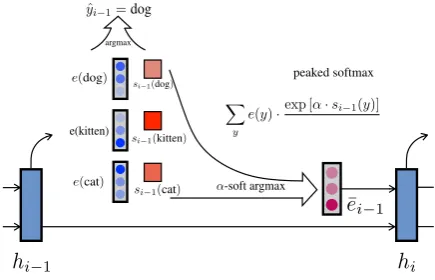
Figure 2: Relaxed greedy decoder that uses a continuous approximation of argmax as input to the decoder state at next time step.
ˆ
yi−1 refers the model’s prediction at the
previ-ous step.1 Here, the model prediction yˆ
i−1 is
obtained by argmaxing over the output softmax layer. Hence, in addition to the intermediate hid-den states and final softmax scores, the previ-ous model prediction,yˆi−1, itself depends on the
model parameters,θ, and ideally, should be
back-propagated through, unlike the gold target symbol
yi∗−1 which is independent of model parameters.
However, the argmax operation is discontinuous, and thus the training objective (depicted in Fig-ure 1 as the red line) exhibits discontinuities at pa-rameter settings where the previous decoding deci-sions change value (depicted as changes from ‘kit-ten’ to ‘dog’ to ‘cat’). Because these change points represent discontinuities, their gradients are unde-fined and the effect of correcting an earlier mistake (for example ‘dog’ to ‘cat’) as the training proce-dure approaches such a point is essentially hidden. In our approach, described in detail in the next section, we attempt to fix this problem by incorpo-rating a continuous relaxation of the argmax op-eration into the scheduled sampling procedure in order to form an approximate but fully continuous objective. Our relaxed approximate objective is depicted in Figure 1 as blue and purple lines, de-pending on temperature parameterαwhich
trades-off smoothness and quality of approximation.
3 Credit Assignment via Relaxation In this section we explain in detail the continu-ous relaxation of greedy decoding that we will use to build a fully continuous training objective. We also introduce a related approach for sample-based training.
1For the sake of simplicity, the ‘always sample’ variant of
[image:2.595.74.291.66.184.2]3.1 Soft Argmax
In scheduled sampling, the embedding for the best scoring word at the previous step is passed as an input to the current step. This operation2 can be
expressed as
ˆ
ei−1=
X
y
e(y)1[∀y06=y si−1(y)> si−1(y0)]
whereyis a word in the vocabulary,si−1(y)is the
output score of that word at the previous step, and ˆ
ei−1is the embedding passed to the next step. This
operation can be relaxed by replacing the indicator function with apeaked softmax functionwith hy-perparameterαto define a soft argmax procedure:
¯
ei−1 =
X
y
e(y)·Pexp (α si−1(y))
y0exp (α si−1(y0))
As α → ∞, the equation above approaches the true argmax embedding. Hence, with a finite and large α, we get a linear combination of all the
words (and therefore a continuous function of the parameters) that is dominated heavily by the word with maximum score.
3.2 Soft Reparametrized Sampling
Another variant of scheduled sampling is to pass a sampled embedding from the softmax distribu-tion at the previous step to the current step instead of the argmax. This is expected to enable better exploration of the search space during optimiza-tion due to the added randomness and hence re-sult in a more robust model. In this section, we discuss and review an approximation to the Gum-bel reparametrization trick that we use as a mod-ule in our sample-based decoder. This approxima-tion was proposed by Maddison et al. (2017) and Jang et al. (2016), who showed that the same soft argmax operation introduced above can be used for reducing variance of stochastic gradients when sampling from softmax distributions. Unlike soft argmax, this approach is not a fully continuous ap-proximation to the sampling operation, but it does result in much more informative gradients com-pared to naive scheduled sampling procedure.
The Gumbel reparametrization trick shows that sampling from a categorical distribution can be refactored into sampling from a simple distribu-tion followed by a deterministic transformadistribu-tion
2Assuming there are no ties for the sake of simplicity.
as follows: (i) sampling an independent Gum-bel noise G for each element in the
categori-cal distribution, typicategori-cally done by transforming a sample from the uniform distribution: U ∼
U nif orm(0,1) as G = −log(−log U), then
(ii) adding it componentwise to the unnormalized score of each element, and finally (iii) taking an argmax over the vector. Using the same argmax softening procedure as above, they arrive at an ap-proximation to the reparametrization trick which mitigates some of the gradient’s variance intro-duced by sampling. The approximation is3:
˜
ei−1=
X
y
e(y)·Pexp (α(si−1(y) +Gy))
y0exp (α(si−1(y0) +Gy0))
We will use this ‘concrete’ approximation of soft-max sampling in our relaxation of scheduled sam-pling with a sample-based decoder. We discuss details in the next section. Note that our orig-inal motivation based on removing discontinuity does not strictly apply to this sampling procedure, which still yields a stochastic gradient due to sam-pling from the Gumbel distribution. However, this approach is conceptually related to greedy relax-ations since, here, the soft argmax reparametriza-tion reduces gradient variance which may yield a more informative training signal. Intuitively, this approach results in the gradient of the loss to be more aware of the sampling procedure compared to naive scheduled sampling and hence carries for-ward information about decisions made at previ-ous steps. The empirical results, discussed later, show similar gains to the greedy scenario.
3.3 Differentiable Relaxed Decoders
With the argmax relaxation introduced above, we have a recipe for a fully differentiable greedy de-coder designed to produce informative gradients near change points. Our final training network for scheduled sampling with relaxed greedy decod-ing is shown in Figure 2. Instead of conditiondecod-ing the current hidden state, hi, on the argmax em-bedding from the previous step,eˆi−1, we use the
α-soft argmax embedding, e¯i−1, defined in
Sec-tion 3.1. This removes the discontinuity in the original greedy scheduled sampling objective by passing a linear combination of embeddings, dom-inated by the argmax, to the next step. Figure 1
3This is different from using the expected softmax
illustrates the effect of varyingα. Asαincreases, we more closely approximate the greedy decoder. As in standard scheduled sampling, here we minimize the cross-entropy based loss at each time step. Hence the computational complexity of our approach is comparable to standard seq2seq train-ing. As we discuss in Section 5, mixing model predictions randomly with ground truth symbols during training (Bengio et al., 2015; Daum´e et al., 2009; Ross et al., 2011), while annealing the prob-ability of using the ground truth with each epoch, results in better models and more stable train-ing. As a result, training is reliant on the anneal-ing scheduleof two important hyperparameters: i) ground truth mixing probability and ii) theα
pa-rameterused for approximating the argmax func-tion. For output prediction, at each time step, we can still output the hard argmax, depicted in Fig-ure 2.
For the case of scheduled sampling with sample-based training–where decisions are sam-pled rather than chosen greedily (Bengio et al., 2015)–we conduct experiments using a related training procedure. Instead of using soft argmax, we use the soft sample embedding, ˜ei−1, defined
in Section 3.2. Apart from this difference, training is carried out using the same procedure.
4 Related Work
Gormley et al. (2015)’s approximation-aware training is conceptually related, but focuses on variational decoding procedures. Hoang et al. (2017) also propose continuous relaxations of de-coders, but are focused on developing better infer-ence procedures. Grefenstette et al. (2015) suc-cessfully use a soft approximation to argmax in neural stack mechanisms. Finally, Ranzato et al. (2016) experiment with a similarly motivated ob-jective that was not fully continuous, but found it performed worse than the standard training.
5 Experimental Setup
We perform experiments with machine translation (MT) and named entity recognition (NER).
Data: For MT, we use the same dataset (the
German-English portion of the IWSLT 2014 ma-chine translation evaluation campaign (Cettolo et al., 2014)), preprocessing and data splits as Ran-zato et al. (2016). For named entity recognition, we use the CONLL 2003 shared task data (Tjong
Kim Sang and De Meulder, 2003) for German lan-guage and use the provided data splits. We per-form no preprocessing on the data.The output vo-cabulary length for MT is 32000 and 10 for NER.
Implementation details: For MT, we use a
seq2seq model with a simple attention mechanism (Bahdanau et al., 2015), a bidirectional LSTM en-coder (1 layer, 256 units), and an LSTM deen-coder (1 layer, 256 units). For NER, we use a seq2seq model with an LSTM encoder (1 layer, 64 units) and an LSTM decoder (1 layer, 64 units) with a fixed attention mechanism that deterministically attends to the ith input token when decoding the ith output, and hence does not involve learning of
attention parameters.4
Hyperparameter tuning: We start by training
with actual ground truth sequences for the first epoch and decay the probability of selecting the ground truth token as an inverse sigmoid (Bengio et al., 2015) of epochs with a decay strength pa-rameterk. We also tuned for different values ofα
and explore the effect of varyingαexponentially
(annealing) with the epochs. In table 1, we report results for the best performing configuration of de-cay parameter and theαparameter on the
valida-tion set. To account for variance across randomly started runs, we ran multiple random restarts (RR) for all the systems evaluated and always used the RR with the best validation set score to calculate test performance.
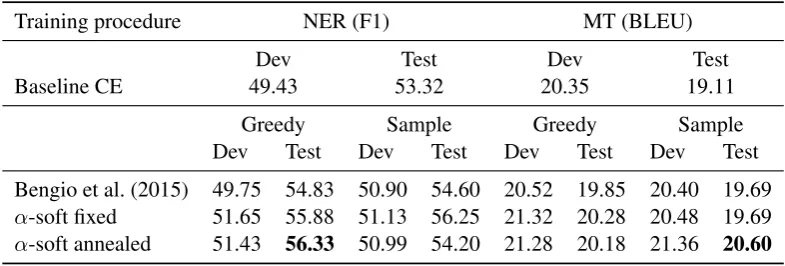
Comparison We report validation and test
met-rics for NER and MT tasks in Table 1, F1 and BLEU respectively. ‘Greedy’ in the table refers to scheduled sampling with soft argmax decisions (either soft or hard) and ‘Sample’ refers the cor-responding reparametrized sample-based decod-ing scenario. We compare our approach with two baselines: standard cross-entropy loss minimiza-tion for seq2seq models (‘Baseline CE’) and the standard scheduled sampling procedure (Bengio et al. (2015)). We report results for two variants of our approach: one with a fixed α parameter
throughout the training procedure (α-soft fixed),
and the other in which we vary α exponentially with the number of epochs (α-soft annealed).
4Fixed attentionrefers to the scenario when we use the
bidirectional LSTM encoder representation of the source se-quence token at time steptwhile decoding at time stept
Table 1: Result on NER and MT. We compare our approach (α-soft argmax with fixed and annealed temperature) with standard
cross entropy training (Baseline CE) and discontinuous scheduled sampling (Bengio et al. (2015)). ‘Greedy’ and ‘Sample’ refer to Section 3.1 and Section 3.2.
Training procedure NER (F1) MT (BLEU)
Dev Test Dev Test
Baseline CE 49.43 53.32 20.35 19.11
Greedy Sample Greedy Sample
Dev Test Dev Test Dev Test Dev Test Bengio et al. (2015) 49.75 54.83 50.90 54.60 20.52 19.85 20.40 19.69
α-soft fixed 51.65 55.88 51.13 56.25 21.32 20.28 20.48 19.69
α-soft annealed 51.43 56.33 50.99 54.20 21.28 20.18 21.36 20.60
6 Results
All three approaches improve over the standard cross-entropy based seq2seq training. Moreover, both approaches using continuous relaxations (greedy and sample-based) outperform standard scheduled sampling (Bengio et al., 2015). The best results for NER were obtained with the re-laxed greedy decoder with annealed α which
yielded an F1 gain of +3.1 over the standard seq2seq baseline and a gain of +1.5 F1 over stan-dard scheduled sampling. For MT, we obtain the best results with the relaxed sample-based de-coder, which yielded a gain of +1.5 BLEU over standard seq2seq and a gain of +0.75 BLEU over standard scheduled sampling.
We observe that the reparametrized sample-based method, although not fully continuous end-to-end unlike the soft greedy approach, results in good performance on both the tasks, partic-ularly MT. This might be an effect of stochas-tic exploration of the search space over the out-put sequences during training and hence we ex-pect MT to benefit from sampling due to a much larger search space associated with it. We also ob-serve that annealingαresults in good performance
which suggests that a smoother approximation to the loss function in the initial stages of training is helpful in guiding the learning in the right direc-tion. However, in our experiments we noticed that
k 100 10 1 Always
NER (F1) 56.33 55.88 55.30 54.83
Table 2: Effect of different schedules for scheduled sampling on NER. k is the decay strength parameter. Higher k cor-responds to gentler decay schedules. Alwaysrefers to the case when predictions at the previous predictions are always passed on as inputs to the next step.
the performance while annealingα was sensitive
to the hyperparameter associated with the anneal-ing schedule of the mixanneal-ing probability in sched-uled sampling during training.
The computational complexity of our approach is comparable to that of standard seq2seq train-ing. However, instead of a vocabulary-sized max and lookup, our approach requires a matrix multi-plication. Practically, we observed that on GPU hardware, all the models for both the tasks had similar speeds which suggests that our approach leads to accuracy gains without compromising run-time. Moreover, as shown in Table 2, we ob-serve that a gradual decay of mixing probability consistently compared favorably to more aggres-sive decay schedules. We also observed that the ‘always sample’ case of relaxed greedy decoding, in which we never mix in ground truth inputs (see Bengio et al. (2015)), worked well for NER but resulted in unstable training for MT. We reckon that this is an effect of large difference between the search space associated with NER and MT.
7 Conclusion
Our positive results indicate that mechanisms for credit assignment can be useful when added to the models that aim to ameliorate exposure bias. Further, our results suggest that continuous relax-ations of the argmax operation can be used as ef-fective approximations to hard decoding during training.
Acknowledgements
References
Daniel Andor, Chris Alberti, David Weiss, Aliaksei Severyn, Alessandro Presta, Kuzman Ganchev, Slav Petrov, and Michael Collins. 2016. Globally nor-malized transition-based neural networks. In Asso-ciation for Computational Linguistics.
Dzmitry Bahdanau, Philemon Brakel, Kelvin Xu, Anirudh Goyal, Ryan Lowe, Joelle Pineau, Aaron Courville, and Yoshua Bengio. 2017. An actor-critic algorithm for sequence prediction. InInternational Conference on Learning Representations.
Dzmitry Bahdanau, Kyunghyun Cho, and Yoshua Ben-gio. 2015. Neural machine translation by jointly learning to align and translate. InInternational Con-ference on Learning Representations.
Samy Bengio, Oriol Vinyals, Navdeep Jaitly, and Noam Shazeer. 2015. Scheduled sampling for se-quence prediction with recurrent neural networks. InAdvances in Neural Information Processing Sys-tems. pages 1171–1179.
Mauro Cettolo, Jan Niehues, Sebastian St¨uker, Luisa Bentivogli, and Marcello Federico. 2014. Report on the 11th iwslt evaluation campaign, iwslt 2014. In Proceedings of the International Workshop on Spo-ken Language Translation, Hanoi, Vietnam.
Hal Daum´e, John Langford, and Daniel Marcu. 2009. Search-based structured prediction. Machine learn-ing75(3):297–325.
Hal Daum´e III and Daniel Marcu. 2005. Learning as search optimization: Approximate large margin methods for structured prediction. InProceedings of the 22nd international conference on Machine learning. ACM, pages 169–176.
Matthew R. Gormley, Mark Dredze, and Jason Eisner. 2015. Approximation-aware dependency parsing by belief propagation. Transactions of the Association for Computational Linguistics (TACL).
Edward Grefenstette, Karl Moritz Hermann, Mustafa Suleyman, and Phil Blunsom. 2015. Learning to transduce with unbounded memory. In Advances in Neural Information Processing Systems. pages 1828–1836.
Cong Duy Vu Hoang, Gholamreza Haffari, and Trevor Cohn. 2017. Decoding as continuous optimiza-tion in neural machine translaoptimiza-tion. arXiv preprint arXiv:1701.02854.
Eric Jang, Shixiang Gu, and Ben Poole. 2016. Cate-gorical reparameterization with gumbel-softmax. In International Conference on Learning Representa-tions.
Chris J Maddison, Andriy Mnih, and Yee Whye Teh. 2017. The concrete distribution: A continuous re-laxation of discrete random variables. In Interna-tional Conference on Learning Representations.
Marc’Aurelio Ranzato, Sumit Chopra, Michael Auli, and Wojciech Zaremba. 2016. Sequence level train-ing with recurrent neural networks. InInternational Conference on Learning Representations.
St´ephane Ross, Geoffrey J Gordon, and Drew Bagnell. 2011. A reduction of imitation learning and struc-tured prediction to no-regret online learning. In AIS-TATS. volume 1, page 6.
Alexander M Rush, Sumit Chopra, and Jason Weston. 2015. A neural attention model for abstractive sen-tence summarization. InEmpirical Methods in Nat-ural Language Processing.
Iulian V Serban, Alessandro Sordoni, Yoshua Bengio, Aaron Courville, and Joelle Pineau. 2015. Building end-to-end dialogue systems using generative hier-archical neural network models. In AAAI’16 Pro-ceedings of the Thirtieth AAAI Conference on Artifi-cial Intelligence.
Ilya Sutskever, Oriol Vinyals, and Quoc V Le. 2014. Sequence to sequence learning with neural net-works. InAdvances in neural information process-ing systems. pages 3104–3112.
Erik F Tjong Kim Sang and Fien De Meulder. 2003. Introduction to the conll-2003 shared task: Language-independent named entity recognition. In Proceedings of the seventh conference on Natural language learning at HLT-NAACL 2003-Volume 4. Association for Computational Linguistics, pages 142–147.
Sam Wiseman and Alexander M Rush. 2016. Sequence-to-sequence learning as beam-search op-timization. In Empirical Methods in Natural Lan-guage Processing.