A COMPARATIVE STUDY
Dr. Vijaykumar, T. K., *Dr.
Department of Anaesthesiology, BLDE University’s ShriB.M.Patil Medical College, Hospital and Research Centre,
ARTICLE INFO ABSTRACT
Aim of study:
undertaken to compare the hemodynamic response to induction of anaesthesia with Etomidate and Propofol and various untoward effects on patients.
Materials and
years scheduled for elective surgical procedure under general anaesthesia were divided into two groups of 40 each receiving either Etomidate 0.3mg/kg or Propofol 2.5mg/kg as an indu
Hemodynamic parameter recordings were taken one minute before premedication and every minute for first three minutes after induction and post intubation 3, 5 and 10minutes. Adverse effect such as pain on injection, apnea and myoclonus were
Results
(p<0.047) and mean arterial pressures(p<0.009) at 2 to 3 minutes after induction and post intubation upto 5minutes compared to Etomidate
while myoclonus, post operative nausea, vomiting were higher in Etomidate group. Conclusion:
and preferred ov
Copyright © 2016, Dr. Vijaykumar et al. This is an open access article distributed under the Creative Commons Att use, distribution, and reproduction in any medium, provided the original work is properly cited.
INTRODUCTION
Inducing agents are given intravenously in an appropriate dose causes rapid loss of consciousness. These agents are used to induce anaesthesia prior to other drugs to maintain anaesthesia, as the sole drug for short procedures, to mainatain anaesthesia for longer procedures by intravenous infusion, for conscious sedation during procedures undergoing in local anaesthesia and intensive care unit. An ideal induction agent for general anaesthesia should have hemodynamic stability, minimal respiratory depression and rapid clearance and with minimal side effects. Presently Etomidate and Propofol are rapid act inducing agents. Etomidate is carboxylate imidazole containing compound characterized by hemodynamic stability, minimal respiratory depression and cerebral protective effects with an induction dose of 0.2–0.6 mg/kg IV1. Its lack of effect on sympathetic nervous system, baroreceptor reflex regulatory system and its effect on increased coronary perfusion even on patients with moderate cardiac dysfunction makes it an induction agent of choice2-4. Propofol chemically 2,6
*Corresponding author: Santoshkumar Alalamath,
Department of Anaesthesiology, BLDE University’s ShriB.M.Patil Medical College, Hospital and Research Centre, Vijayapur, Karnataka
ISSN: 0975-833X
Article History:
Received 24th August, 2016
Received in revised form 09th September, 2016 Accepted 17th October, 2016
Published online 30th November,2016
Key words:
Etomidate, Propofol, Myoclonus,
Hemodynamic stabililty.
Citation: Dr. Vijaykumar, T. K., Dr. Santoshkumar Alalamath and Dr. Shivanand, K. L. induction of general anaesthesia”, International Journal of Current Research
RESEARCH ARTICLE
A COMPARATIVE STUDY OF ETOMIDATE AND PROPOFOL FOR
OF GENERAL ANAESTHESIA
Dr. Santoshkumar Alalamath and Dr. Shivanand
Department of Anaesthesiology, BLDE University’s ShriB.M.Patil Medical College, Hospital and Research Centre,
Vijayapur, Karnataka
ABSTRACT
Aim of study: Etomidate and Propofol are popular rapid acting inducing agents. Present study is undertaken to compare the hemodynamic response to induction of anaesthesia with Etomidate and Propofol and various untoward effects on patients.
Materials and Methods: A randomized study of Eighty ASA I and II patients of age group 18 years scheduled for elective surgical procedure under general anaesthesia were divided into two groups of 40 each receiving either Etomidate 0.3mg/kg or Propofol 2.5mg/kg as an indu
Hemodynamic parameter recordings were taken one minute before premedication and every minute for first three minutes after induction and post intubation 3, 5 and 10minutes. Adverse effect such as pain on injection, apnea and myoclonus were watched carefully.
Results: Patients induced with Propofol had significant decrease in systolic (p<0.001), diastolic (p<0.047) and mean arterial pressures(p<0.009) at 2 to 3 minutes after induction and post intubation upto 5minutes compared to Etomidate. Pain on injection and apnea were more in Propofol group while myoclonus, post operative nausea, vomiting were higher in Etomidate group.
Conclusion: Induction with Etomidate will have stable hemodynamic profile, less pain on injection and preferred over Propofol.
is an open access article distributed under the Creative Commons Attribution License, which use, distribution, and reproduction in any medium, provided the original work is properly cited.
Inducing agents are given intravenously in an appropriate dose These agents are used to induce anaesthesia prior to other drugs to maintain anaesthesia, as the sole drug for short procedures, to mainatain anaesthesia for longer procedures by intravenous infusion, for conscious local anaesthesia and intensive care unit. An ideal induction agent for general anaesthesia should have hemodynamic stability, minimal respiratory depression and rapid clearance and with minimal side effects. Presently Etomidate and Propofol are rapid acting carboxylate imidazole containing compound characterized by hemodynamic stability, minimal respiratory depression and cerebral protective effects 0.6 mg/kg IV1. Its lack of effect c nervous system, baroreceptor reflex regulatory system and its effect on increased coronary perfusion even on patients with moderate cardiac dysfunction makes it an
4. Propofol chemically 2,6–
ar Alalamath,
Department of Anaesthesiology, BLDE University’s ShriB.M.Patil Medical College, Hospital and Research Centre, Vijayapur, Karnataka
diisopropofol, one of the group of alkyl phenols used for induction of anaesthesia in a dose of 1
25-40% reduction in systolic blood pressure, 0
in mean arterial blood pressure and diastolic pressure is also reduced due to inhibition of sympathetic vasoconstriction and impairment of baroreceptor reflex regulatory system. exaggerated effect seen in hypovolemic and elderly patients with compromised left ventricular function due to coronary artery disease. Cardiac output and cardiac index are reduced by 15%, stroke volume index +/
induction dose and speed of injection decides the incidence and duration of apnea. Incidence is 25 to 30%. It leads to initial decrease in tidal volume and increase in respiratory rate then apnea7. However the adverse effects such as pain on injection, thrombophlebitis and myoclonus for both the agents corrected by premedicating with the fentanyl.8
to compare the hemodynamic parameters and adverse effects of both the drugs so that we can choose a safe induction agent.
MATERIALS AND METHODS
This randomized study was done from December 2014 to June 2016 on patients who were admitted to BLDE UNIVERSITY
International Journal of Current Research Vol. 8, Issue, 11, pp.41783-41789, November, 2016
INTERNATIONAL
Dr. Vijaykumar, T. K., Dr. Santoshkumar Alalamath and Dr. Shivanand, K. L. 2016. “A comparative study of etomidate and propofol for
International Journal of Current Research, 8, (11), 41783-41789.
OF ETOMIDATE AND PROPOFOL FOR INDUCTION
Shivanand, K. L.
Department of Anaesthesiology, BLDE University’s ShriB.M.Patil Medical College, Hospital and Research Centre,
Etomidate and Propofol are popular rapid acting inducing agents. Present study is undertaken to compare the hemodynamic response to induction of anaesthesia with Etomidate and
A randomized study of Eighty ASA I and II patients of age group 18-60 years scheduled for elective surgical procedure under general anaesthesia were divided into two groups of 40 each receiving either Etomidate 0.3mg/kg or Propofol 2.5mg/kg as an inducing agent. Hemodynamic parameter recordings were taken one minute before premedication and every minute for first three minutes after induction and post intubation 3, 5 and 10minutes. Adverse effect such as
Patients induced with Propofol had significant decrease in systolic (p<0.001), diastolic (p<0.047) and mean arterial pressures(p<0.009) at 2 to 3 minutes after induction and post intubation . Pain on injection and apnea were more in Propofol group while myoclonus, post operative nausea, vomiting were higher in Etomidate group.
Induction with Etomidate will have stable hemodynamic profile, less pain on injection
ribution License, which permits unrestricted
diisopropofol, one of the group of alkyl phenols used for induction of anaesthesia in a dose of 1–2.5 mg/kg IV, produces 40% reduction in systolic blood pressure, 0-40% reduction in mean arterial blood pressure and diastolic pressure is also reduced due to inhibition of sympathetic vasoconstriction and impairment of baroreceptor reflex regulatory system. This exaggerated effect seen in hypovolemic and elderly patients with compromised left ventricular function due to coronary artery disease. Cardiac output and cardiac index are reduced by 15%, stroke volume index +/-20%5,6. It causes apnea after dose and speed of injection decides the incidence and duration of apnea. Incidence is 25 to 30%. It leads to initial decrease in tidal volume and increase in respiratory rate then However the adverse effects such as pain on injection, tis and myoclonus for both the agents corrected by premedicating with the fentanyl.8 This study is an attempt to compare the hemodynamic parameters and adverse effects of both the drugs so that we can choose a safe induction agent.
MATERIALS AND METHODS
This randomized study was done from December 2014 to June 2016 on patients who were admitted to BLDE UNIVERSITY
INTERNATIONAL JOURNAL OF CURRENT RESEARCH
80 patients were selected based on inclusion criteria and are randomly divided into two groups by computerized generated random numbers.
Group E: Induction with Etomidate 0.3mg/kg (n=40) Group P: Induction with Propofol 2.5mg/kg (n=40)
Inclusion criteria
Patients between the age group of 18 and 60 years.
American society of anaesthesiologist grade I and II.
Undergoing elective surgery under general anaesthesia.
Exclusion criteria
Emergency surgeries.
Patients allergic to any drugs.
History of seizure disorder.
Presence of known primary or secondary adrenal insufficiency or on steroid medication.
Presence of hypotension
Preanaesthetic evaluation and counseling for surgery was done on the previous day of surgery and reviewed on the day of surgery. A detailed medical history has taken and systemic examination was carried out and relevant investigations were advised. Patients were informed about known effects and side effects of study drugs.
On arrival to operation theatre
IV line secured
Monitors for electrocardiogram, Non invasive blood pressure, Pulse oximeter and ETCO2 were connected
Oxygen delivered via face mask 6 litre/min
The patients recording like heart rate, systolic, diastolic and mean arterial blood pressure were taken one minute before premedication (baseline) and every minute for first three minutes after induction and post intubation 3,5 and 10minutes
Patients were premedicated with inj.Ondensetron 0.1mg/kg, inj. Glycopyrrolate 0.2 mg and inj. Fentanyl 2mg/kgIV ten minutes before induction and the patients were randomized into two groups, group E and group P for patients receiving Etomidate (0.3mg/kg) and Propofol (2.5mg/kg) respectively, loss of eye lash reflexes was considered to be the end point. This was followed by inj.Vecuronium 0.1mg/kg, ventilation was assisted manually using a bain circuit with 66% N2O in O2 and Isoflurane.
Observation was made for presence of myoclonus and graded as
Mild –Short movement of body segment (a finger or shoulder).
Moderate-Slight movement of two different muscles or muscle groups of the body.
Grade 0 - No pain
Grade 1 - Verbal complain of pain Grade 2 - Withdrawal of arm
Grade 3 – Both Verbal complain of pain and Withdrawal of arm
Three minutes after the administration of muscle relaxant intubation was attempted. After confirmation of intubation, the patient was connected to bain circuit and intermittent positive airway pressure ventilation was continued until the completion of surgery with 66% N2O in O2 supplemented with Isoflurane and intravenous Vecuronium 0.08-0.1mg/kg IV. At the end of the surgery neuromuscular blockade was reversed by using intravenous Neostigmine 0.05 mg/kg and Glycopyrrolate 10 mcg/kg. The extubation was performed after the patient was fully awake. The patient was monitored postoperatively 24hours for nausea and vomiting.
Statistical analysis
All characteristics were summarized descriptively. For continuous variables, the summary statistics of N, mean, standard deviation (SD) were used. For categorical data, the number and percentage were used in the data summaries. Chi-square (χ2)/Fisher exact test was employed to determine the significance of differences between groups for categorical data. The difference of the means of analysis variables was tested with the unpaired t-test. If the p-value was < 0.05, then the results were considered to be significant. Data were analyzed using SPSS software v.23.0.
RESULTS
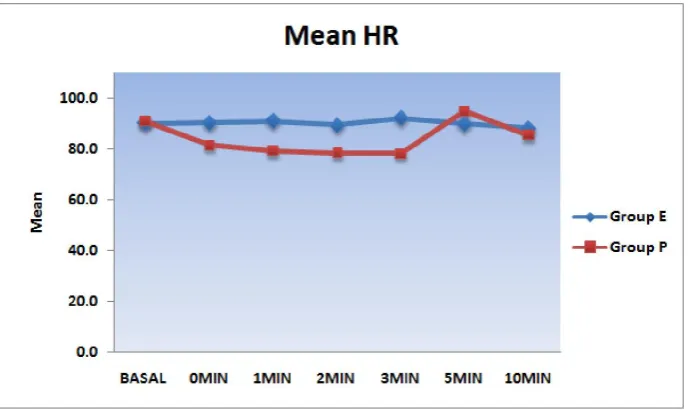
This randomized study was done from December 2014 to June 2016. The demographic data were comparable in both the groups regarding age, sex, weight and were statistically insignificant. Present study shows the changes in mean heart rate, where it was seen that among group E patients the basal MHR in beats in beats per minute was 89.8 followed by 92.1 at intubation and 89.7 at 2min and 88 in 5min. Among group P the basal MHR in beats per minute was 90.8, followed 78.1 at intubation and 94.8 at 2 min and 84.5 at 5min.Statistical evaluation between the groups showed that the change in MHR observed in both the groups were statistically significant (p<0.05) (Figure 1).
Blood pressure changes Changes in Mean Systolic Blood Pressure
Figure 1. Mean Heart rate between the study groups after induction and after intubation
Table 1. Mean Systolic Blood Pressure (SBP) between the study groups after induction
SBP Group E (mmHg) Group P (mmHg) p value
Min Max Mean SD Min Max Mean SD
BASAL 107 148 128.8 10.6 107 149 127.1 10.5 0.479
INDUCTION 98 143 118.9 10.0 90 121 107.4 6.9 <0.001*
1MIN 94 137 110.5 10.7 90 110 100.9 5.4 <0.001*
2MIN 91 136 107.5 10.6 84 109 96.4 5.5 <0.001*
*significantly different at 5% level of significance
[image:3.595.49.552.446.516.2]Table shows a more decrease in SBP in group P when compared to group E. The change in mean SBP between the group during first and second minute immediately after induction were statistically significant (p<0.001).
Table 2. Mean Systolic Blood Pressure (SBP) between the study groups after intubation
SBP Group E (mmHg) Group P (mmHg) p value
Min Max Mean SD Min Max Mean SD
BASAL 107 148 128.8 10.6 107 149 127.1 10.5 0.479
Post intubations
3MIN 93 135 115.8 10.4 85 111 97.2 6.4 <0.001*
5MIN 100 145 117.6 9.9 93 116 104.0 5.4 <0.001*
10MIN 102 148 118.8 8.4 100 126 110.8 5.3 <0.001*
*significantly different at 5% level of significance
[image:3.595.132.468.558.754.2]The decrease in SBP in group P was statistically significant compared to decrease in SBP in group E at 2min (p<0.001) and remained significant even upto 5min post intubation.
Figure 3. Mean Diastolic Blood Pressure (DBP) between the study groups after induction and after intubation
Figure 4. Mean Arterial Pressure (MAP) between the study groups after induction and after intubation
Table 3. Mean Arterial Pressure (MAP) between the study groups after induction
MAP Group E (mmHg) Group P (mmHg) p value
Min Max Mean SD Min Max Mean SD
BASAL HR 84 114 97.8 7.4 74 116 96.1 8.8 0.361
INDUCTION 71 120 91.2 11.6 68 101 83.7 7.5 0.001*
1MIN 65 109 84.3 11.3 60 93 78.5 7.5 0.009*
2MIN 64 98 79.3 9.1 63 87 76.1 7.0 0.080
*significantly different at 5% level of significance
This shows decrease in MAP in group P when compared to group E. The change in mean MAP between the group at induction (p<0.001) and during first minute immediately after induction were statistically significant (p<0.009).
Table 4. Mean Arterial Pressure (MAP) between the study groups after intubation
MAP Group E Group P p value
Min Max Mean SD Min Max Mean SD
BASAL 84 114 97.8 7.4 74 116 96.1 8.8 0.361
Post intubations
3MIN 69 107 89.8 9.8 67 95 79.2 6.3 <0.001*
5MIN 72 110 91.2 9.4 67 98 82.3 6.3 <0.001*
10MIN 79 110 92.9 7.8 77 106 86.3 6.0 <0.001*
*significantly different at 5% level of significance
[image:4.595.41.554.543.603.2] [image:4.595.43.551.669.739.2]Changes in Mean Diastolic Blood Pressure
Figure 3 shows fall in DBP in group P was more when compared to group E. The change in mean DBP between the groups at induction (p<0.006) and during first minute immediately after induction were statistically significant (p<0.047). The fall in DBP observed in both groups was statistically significant (p<0.001) at intubation, post intubation 2min and 5min.
Changes in Mean Arterial Blood Pressure
Table 3, 4 and Figure 4 Shows fall in MAP in group P was more when compared to group E. The change in mean MAP between the group at induction (p<0.001) and during first minute immediately after induction were statistically significant (p<0.009). Fall in MAP was statistically significant (p<0.001) at intubation, post intubation 2min and 5min.
Pain on injection
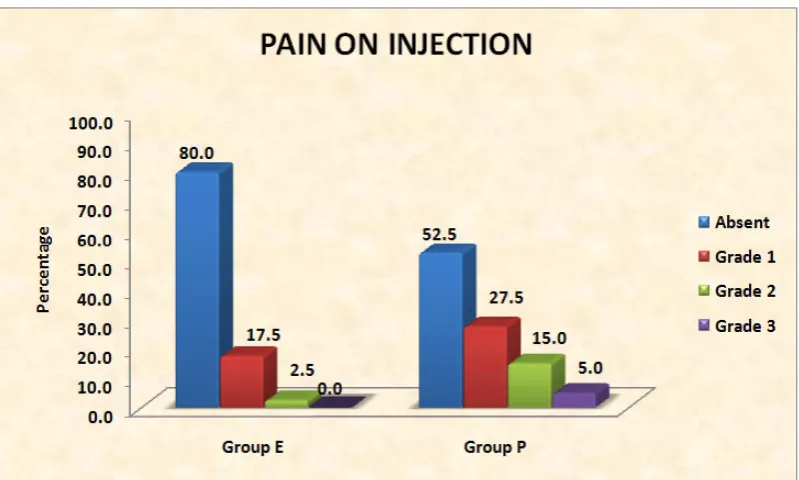
Figure 5 shows among forty patients in group E, 7 patients had grade I pain, 1 patient had grade II pain on injection. In group P 11 patients had grade I, 6 patients grade II and 2 patients grade III pain on injection respectively (p<0.032). (Table 9)
Myoclonus
Figure 6 shows among forty patients in group E, 10 patients developed grade I myoclonus, grade II and grade III in 5 and 1 patients respectively. Among forty patients in group P, 3 patients developed grade I myoclonus (p<0.005)
Apnea
[image:5.595.103.503.56.296.2]In group E, 14 out of 40 patients had apnea in the first minute of induction, whereas in group P 39 patients had apnea during first minute.
[image:5.595.104.502.330.553.2]Figure 5. Distribution of pain on injection between the study groups
nausea and 4 had vomiting.
DISCUSSION
Hypotension is known to occur with Propofol induction due to reduction of sympathetic activity causing vasodilatation, direct effect on intracellular calcium mobilization, inhibition of prostaglandin synthesis in endothelial cells etc are the causative factors (Meena and Meena, 2016). Sudden hypotension has deleterious effects on maintaining the circulation to vital organs in conditions like ischemic heart disease, valvular heart disease, systemic hypertension and shock. The hemodynamic stability observed with Etomidate may be due partly to its unique lack of effect on the sympathetic nervous system and on baroreceptor function (Ebert et al., 1992; Sarkar et al., 2005; Morel et al., 2011). In patients with valvular heart disease, pulmonary artery and pulmonary capillary wedge pressure also are reduced, implying the resultant decrease in pressure is due to a decrease in preload and after load. Although the decrease in systemic pressure after an induction dose of Propofol is due to vasodilation, the direct myocardial depressant effects of Propofol are more controversial (Reves et al., 2005). The cardiovascular effects of Propofol have been evaluated after its use for induction and for maintenance of anesthesia. The most prominent effect of Propofol is a decrease in arterial blood pressure during induction of anesthesia (Reves et al., 2005). Heart rate does not change significantly after an induction dose of Propofol. Propofol either may reset or may inhibit the baroreflex, reducing the tachycardic response to hypotension. The most common side effect during induction of anaesthesia is hypotension, which is augmented by the concomitant administration of opioids. The properties of Etomidate include hemodynamic stability, minimal respiratory depression, cerebral protection, and pharmacokinetics enabling rapid recovery after either a single dose or a continuous infusion. Induction with Etomidate produces a brief period of hyperventilation, sometimes followed by a similarly brief period of apnea (Meena and Meena, 2016). Apnea after induction with Propofol is common. The incidence of apnea is greater when compared Etomidate (Turtle et al., 1987). In our study Propofol caused increase in heart rate after intubation while Etomidate maintained stable heart rate after induction and intubation. The fall in SBP, DBP and MAP from baseline value were more with Propofol group compared to Etomidate group.
Meena K, Meena R et al. (2016) conducted a randomized control trial to compare the effect of Propofol, Etomidate and Propofol plus Etomidate induction on hemodynamic response to endotracheal intubation on 90 patients aged 15 to 60 years of either sex and ASA physical status I or II scheduled for elective surgery under general anesthesia Group I induced with Inj.Propofol (2.5 mg/kg) intravenous, Group II with Inj. Etomidate (0.3 mg/kg) intravenous and Group III with Inj.Propofol (1 mg/kg) plus Inj. Etomidate (0.2 mg/kg) intravenous. They concluded that the combination of Etomidate plus Propofol has better hemodynamic stability than Etomidate alone at 1 min after intubation, though Etomidate was equally stable at other points of time. The combination proved to be significantly better than either Propofol or Etomidate alone. (Meena and Meena, 2016) Supriya Aggarwal et al. (2016)
Etomidate (0.3mg/kg) group showed little change in mean arterial pressure (MAP) and heart rate (HR) compared to Propofol (2mg/kg) (p > 0.05) from baseline value. They found that myoclonus activity was higher in Etomidate group and pain on injection was more in Propofol group (Aggarwal et al., 2016). Our study shows similar findings compared to above studies in terms of HR, SBP, DBP, MAP, myoclonus and pain on injection. Pushkar M. Desai, Deepa Kane, Manjula S. Sarkar (2015) conducted a single blinded study to compare Etomidate and Propofol as sedative during cardioversion on sixty ASA I/II/III patients undergoing elective cardioversion. They concluded that Etomidate/Fentanyl is preffered over Propofol/Fentanyl during cardioversion for quick recovery and hemodynamic stability. (Desai et al., 2015) Ram Prasad Kaushal, Ajay Vatal, Radhika Pathak (2015) conducted a study to comapare the effect of Etomidate (0.2mg/kg) and Propofol (2mg/kg) induction on hemodynamic and endocrine response in 60 ASA II and III patients undergoing elective coronary aretery bypass grafting (CABG)/mitral valve and aortic valve replacement (MVR/AVR) surgery on cardiopulmonary bypass (CPB). Hemodynamic variable like heart rate, systolic, diastolic and mean arterial blood. Concluded that Etomidate provides more stable hemodynamic pararmeters as compared to Propofol and can therefore be safely used for induction in patients with good LV function for CABG/MVR/AVR on CPB without cortisol suppression. (Kaushal et al., 2015) Shagun Bhatia Shah et al. (2015) conducted a study to comapare the hemodynamic effects of intravenous Etomidate and Propofol during induction and intubation using entropy guided hypnosis levels on 60 ASA I and II patients undergoing modified radical mastectomy. They found that Etomidate provided hemodynamic stability without the requirement of any rescue drug in 96.6% patients whereas rescue drug Ephedrine was required in 36.6% in Propofol group. (Shah et al., 2015) Saricaoglu et al (2011) were compared Etomidate-lipuro and Propofol and 50%, (1:1) admixture of these agents at induction and monitored injection pain, hemodynamic changes, and myoclonus. They noticed that the hemodynamic changes were minimal in group PE than other two groups (P = 0.017). The intensity of myoclonus was more in the group E (76.3%). Myoclonus was not observed in group PE and group P. no injection pain in group PE as the incidence were (83.8%) in group P and in (63.2%) group E. (Saricaoglu et al., 2011) J.S.C.McCollum (1986) noticed apnea in 11% of patients after Propofol and none of the patients receiving Etomidate. (McCollum and Dundee, 1986) M.St pierre (2000) noted nausea in 17 patients, vomiting in 13 patients in Etomidate group of 80 patients and nausea in 17 patients and vomiting in 5 patients in Propofol group of 80 patients. (St Pierre et al., 2000)Our study has similar findings in comparison with above studies with respect to myoclonus, apnea, post operative nausea and vomiting.
concluded that single induction dose of Etomidate suppresses postoperative cortisol levels which last for 24hours and without any change in clinical outcome. (Yi Du et al., 2015)This study concludes that induction with Etomidate will have stable hemodynamic profile, less pain on injection and it can be preferred over Propofol especially in patients with vulvular heart disease, cardiac dysfunction if there are no contraindications for its use. Incidence of apnea and pain on injection are more with Propofol, but Etomidate caused more of myoclonus than Propofol
Acknowledgement: No
Conflicts of interest: No
REFERENCES
Aggarwal S, Goyal V, Chaturvedi S, Mathur V, Baj B, Kumar A. 2016. A comparative study between propofol and etomidate in patients under general anesthesia. Brazilian
Journal of Anesthesiology (English Edition),
66(3):237-241.
Borgeat A, Wilder-Smith OH, Saiah M, Rifat K. 1992. Subhypnotic doses of propofol relieve pruritus induced by epidural and intrathecal morphine. Anesthesiology, 76:510-512.
Carlos, R. and S. Innerarity. 1979. Effect of Premedication on Etomidate Anaesthesia. British Journal of Anaesthesia, 51:1159.
Desai P, Kane D, Sarkar M. 2015. Cardioversion: What to choose? Etomidate or Propofol. Annals of Cardiac
Anaesthesia, 18(3):306.
Ebert TJ, Muzi M, Berens R, et al. 1992. Sympathetic responses to induction of anesthesia in humans with propofol or etomidate. Anesthesiology, 76:725-733. Gan TJ, Glass PS, Howell ST, et al. 1997. Determination of
plasma concentrations of propofol associated with 50% reduction in postoperative nausea. Anesthesiology, 87:779-784.
Kaushal R, Vatal A, Pathak R. 2015. Effect of Etomidate and Propofol induction on hemodynamic and endocrine response in patients undergoing coronary artery bypass grafting/mitral valve and aortic valve replacement surgery on cardiopulmonary bypass. Annals of Cardiac Anaesthesia, 18(2):172.
Larsen R, Rathgeber J, Bagdahn A, et al. 1988. Effects of propofol on cardiovascular dynamics and coronary blood flow in geriatric patients: Acomparison with etomidate.
Anaesthesia, 43(Suppl):25-31.
McCollum J. S. C. and J. W. 1986. Dundee: Comparison of induction characteristics of four intravenous anaesthetic agents. Anaesthesia, 41:995-1000.
Meena K, Meena R. 2016. A Comparative Study of Effect of Propofol, Etomidate and Propofol Plus Etomidate Induction on Hemodynamic Response to Endotracheal Intubation: A RCT. Journal of Anesthesia & Clinical
Research, 07(05).
Morel J, Salard M, Castelain C, Bayon M, Lambert P, Vola M
et al. 2011. Haemodynamic consequences of etomidate
administration in elective cardiac surgery: A randomized double-blinded study. Br J Anaesth., 107(4):503-9. Reves, J.G., Peter Glass, David A. Lubarsky. 2005. In: Ronald
D Miller, editors. Miller’s Anesthesia. 7th ed. Philadelphia:
Churchill Livingstone Elsevier, P.719-769.
Saricaoglu F, Uzun S, Arun O, Arun F, Aypar U. 2011. A clinical comparison of etomidate-lipuro, propofol and admixture at induction. Saudi Journal of Anaesthesia, 5(1):62.
Sarkar M, Laussen PC, Zurakowski D, et al. 2005. Hemodynamic response to etomidate on induction of anesthesiain pediatric patients. Anesth Analg., 101:645-50. Shah S, Chowdhury I, Bhargava A, Sabbharwal B. 2015.
Comparison of hemodynamic effects of intravenous Etomidate versus Propofol during induction and intubation using entropy guided hypnosis levels. J Anaesthesiol Clin
Pharmacol., 31(2):180.
St Pierre M. et al. 2000. Does etomidate increase post operative nausea? A double blind controlled comparision of etomidate in lipid emulsion with propofol for balanced anaesthesia. European Journal of Anaesthesiology, 7:1-9. Stoelting Robert and Simon C.Hiller. 2006. Pharmacology and
Physiology in Anesthetic practice. 4th edition. Philadelphia: Lippincott Williams and Wilkins publishers, 159-160.
Taylor MB, Grounds RM, Mulrooney PD, Morgan M. 1986. Ventilatory effects of propofol during induction of anaesthesia: Comparison with thiopentone. Anaesthesia, 41:816-820.
Turtle MJ, Cullen P, Prys-Roberts C, et al. 1987. Dose requirements of propofol by infusion during nitrous oxide anaesthesia in man, II: Patients premedicated with lorazepam. British Journal of Anaesthesia, 59:283-287. Yi Du et al. 2015. The effects of single dose Etomidate versus
Propofol on cortisol levels in pediatric patients undergoing urologic surgery: A randomized control trial. Anesth
analg., 121: 1580-85.
Yushi U. Adachi, Maiko Sotomoto, Hideyuki Higuchi et al. 2002. Fentanyl attenuates the hemodynamic response to Endotracheal Intubation more than the response to Laryngoscopy. Anaesthesia Analgesia, 95:233-7.