http://www.scirp.org/journal/jmp ISSN Online: 2153-120X ISSN Print: 2153-1196
On the Quantum Entanglement
Reinterpretation Using the Time as Real
Instantaneous Signal Field
Elsadig Naseraddeen
Founder and General Manager, Information Fluxes-FZE, Dubai, UAE
Abstract
In relativistic mechanics the time-like vector characterize the motion in spacetime with speed faster than the speed of light in vacuum c in which the
line element 2 2 2 2 2 2
ds =c dt −dx −dx −dz is less than zero (where dt is
infi-nitesimal change in time, dx dy, and dz are infinitesimal change in space),
thus the time in relativistic mechanics can instantaneously flow [1], however in quantum mechanics although the time is treated as unobservable parame-ter (without any Hermitian observable operator have engine-value equivalent to time) any two physical quantity described by two non-commuting observa-ble operators
A
ˆ
andB
ˆ
fulfillAB
ˆ
ˆ
≠
BA
ˆ
ˆ
, the knowledge of oneimme-diately produce the knowledge of the other [2], thus in quantum mechanics if two particles interacted in finite temporal epoch and then separated in space the gaining of knowledge by the local measurement of physical quantity runs on one them (for example the measurement of spin direction of one particle using Stern-Gerlach experiment) immediately produce the knowledge of the complementary physical quantity of the other particle (for example the op-posite spin direction of the other particle), this simply called quantum entan-glement the concept that so much advanced after publication of the Jon Bell’s 1964 celebrated paper [3] in which he illustrated that we can add parameters to quantum mechanics to determine the results of individual measurements, without changing the statistical predictions, and then he conclude “there must be a mechanism whereby the setting of one measuring device can in-fluence the reading of another instrument, however remote. Moreover, the signal involved must propagate instantaneously so that such a theory could not be Lorentz invariant”. The question now what these signals that can propagate instantaneously? The answer in this paperwill be the time signals field which is defined for each constituent matter particle M and at each space point P as the measure of the total length of all occupation and leaving epochs of P by M which is representing a sequence function compactly sup-How to cite this paper: Naseraddeen, E.
(2017) On the Quantum Entanglement Reinterpretation Using the Time as Real Instantaneous Signal Field. Journal of Mo- dern Physics, 8, 853-891.
https://doi.org/10.4236/jmp.2017.86054
Received: January 14, 2017 Accepted: May 15, 2017 Published: May 18, 2017
Copyright © 2017 by author and Scientific Research Publishing Inc. This work is licensed under the Creative Commons Attribution International License (CC BY 4.0).
http://creativecommons.org/licenses/by/4.0/
ported only at the space point occupied by it and indexed by the number of occupation epochs of P by M, thus the flow of this time signal field from the far future to near future through the present to the near past to the far past inferable by the flow of matter particles constituting the system(such as sun, moon earth and clocks hands). Thus the present will represent in this paper a local absolute feature of time signals field defined at each space point as the set of all occupation epochs of it by matter particle, however the past and fu-ture will represent relativistic non-local feafu-tures of the time signal field de-fined at each space point as a set of all leaving epochs between each two se-quential occupation epochs, so the future after one occupation epoch is representing a past of the next one. Thus according to current representation of time, the two Mc-Taggard’s A and B series of time [4] will exist together as temporal set and then the time is real, the A-series in current theory is a set of all occupation and leaving epochs of space point by the matter particle that is consisting of the present, past and future epochs, and the B-series is the set of all leaving epochs of space points between each two sequential occupation epochs which are taking position before or after the discrete occupation epochs between them and then before or after each other.
Keywords
Real-Time State, Real-Time Digital State, Real-Time Transition State, Entanglement Translation, Digital Levels, Calculus of Fluctuations, Fluctuation Tensor Field, Collinear Space, Coplanar Space
1. Introduction
2. Basis Formulation
2.1. Why We Need for the Current Theory of Space and Time
In order to understand why we need to the current theory of time take for ex-ample the mechanism of forwarding the time in the analog clock, in which all three hands—second, minute and hour hand—are occupying and leaving their occupies space when the impulse system of the analog clock exerting a single impulse acting on all of them simultaneously, this single impulse is representing superposition of all electromagnetic wave that are reflecting by the surface’s points of underlying elementary constituent matter particle of the clock’s hands and its remainder parts at each exerting epoch of impulse system, however there is existing strong correlation between the number of exerted impulses, the num-ber of occupation epochs of points in the space of motion of the clock’s hands by them and the measurable time by tracking the paths occupied by the analog clock’s hands, we can illustrating this correlation using the fact that the duration of each impulse is one second to write the time t at each point in the space of motion of the specified clock’s hand CH of this analog clock defined with respect to the join points of its hands by
(
x y z, ,)
during or after the nth occupation epoch of(
x y z, ,)
by CH as the sequence function(
)
(
)
(
)
(
) (
)
(
)
(
)
(
)
(
)
(
)
(
)
(
)
(
) (
) (
) (
)
(
)
1
0 1
1 1
1
0 1
0
, ,
, ,
,
, , , , , ,
, , , , , , , , ,
,
, , , , , , , ,
1 , , , , , ,
, , , ,
n m n
n m
n
n m
n
t x y z n I x y z m T x y z m I x y z m I x y z n
T x y z m I x y z t x y z
t n
n T x y z m I
x y z
t x y z t x y z
t x y z x y z n t x y z
δ δ δ
− = −
=
− =
=
− + +
+ +
− +
+ +
+
= + +
=
∑
∑
∑
seconds, such that t0
(
x y z, ,)
is initial leaving epoch of(
x y z, ,)
started when the observer starting the tracking of the motion of CH and ending at starting of the first occupation epoch of(
x y z, ,)
by CH, I x y z k(
, , ,)
for all{
1, 2, ,}
k∈ n is representing the number of impulses exerted on CH by the
analog clock’s impulse system during the kth occupation epoch of
(
x y z, ,)
byCH, T x y z m
(
, , ,)
for all m∈{
1, 2,,n−1}
is representing the summation of the number of impulses exerting after the time t0(
x y z, ,)
on CH during the mth occupation epoch of(
x y z, ,)
by it and the number of impulses exerted on it during the mth leaving epoch of(
x y z, ,)
by it, and T x y z n(
, , ,)
is average of(
, , ,1 ,) (
, , , 2 ,)
T x y z T x y z and T x y z n
(
, , , −1)
fulfills(
) (
)
1(
)
1
1 , , , n , , ,
m
n− T x y z m =
∑
−=T x y z m , thus 1(
)
1 , , ,n
m I x y z m −
=
∑
is representingthe total lengths of all first n−1 occupation epochs of
(
x y z, ,)
by CH after the time t0(
x y z, ,)
,(
(
) (
)
)
1
1 , , , , , ,
n
m T x y z m I x y z m
−
= −
∑
is representing therepresenting a point in the space of motion of the specified hand of the ith analog clock defined with respect to the join points of its hands, ni is representing the
number of occupation epochs of
(
x y z, ,)
by CHi—which is clock hand of theith analog clock that we took under consideration,
(
, , ,)
i
I x y z k for each
1, 2, ,ni
k= , is representing the number of impulses exerted on it by the
im-pulse system of the ith analog clock during the kth occupation epoch of
(
x y z, ,)
by CHi, Ti(
x y z, , ,m)
for all m∈{
1, 2,,ni−1}
is representing thesumma-tion of the number of impulses exerting on CHi during the m
th occupation epoch of
(
x y z, ,)
by it and the number of impulses exerting on it during the mth leaving epoch of(
x y z, ,)
by it, and(
, , ,)
i i
T x y z n is average of
(
, , ,1)
i x y zT , Ti
(
x y z, , , 2 ,)
and Ti(
x y z, , ,ni−1)
fulfills(
) (
)
1(
)
1 , , ,
1 ni , , ,
i i i m i x y z m
n − T x y z n =
∑
=−T then we can define the real time state of this N analog clocks by(
, , , 1, 2, , N)
(
1(
, , , 1) (
, 2 , , , 2)
, , N(
, , , N)
)
t=t x y z n n n = t x y z n t x y z n t x y z n , such that
(
, , ,)
0(
, ,) (
1) (
, , ,)
(
, , ,)
i(
, ,)
i
i i i i i n
i i
t x y z n =t x y z + n − T x y z n +I x y z n +δt x y z
seconds where 0
(
, ,)
i
t x y z is initial time elapsed during the epoch started when
the observer starting the tracking of CHi and ending at starting of the first
oc-cupation epoch of
(
x y z, ,)
by it and(
, ,)
i
n
t x y z
δ
is the length of leaving epoch of(
x y z, ,)
by CHi elapsed after the end of theth
i
n occupation epoch
of
(
x y z, ,)
by it, now according to the classical mechanics the time is absolute at all occupation and leaving epochs of epoch of(
x y z, ,)
by CHi and then if0 0
i j
t =t for all i j, ∈
{
1, 2,,N}
then all second, minute and hour hands ofthese identical clocks are synchronously occupy their corresponding points in their spaces of motion and synchronously leave them regardless of their spatial distribution or their surfaces orientation in space, and hence the real time state t according to classical mechanics should alwayslied at the equilibrium collinear set
{
(
1, ,2 ,)
| for every ,{
1, 2, ,}
}
N N
j i N
t t t ∈ t =t i j N
= ∈
, however in
general relativity Einstein followed another direction and argued the existence of what is now called the gravitation time dilation [1] which implied that the gravi-tation field have different value of stress-energy-momentum tensor in different space points occupies by different hands of these analog clocks cause their run-ning at different rates, so according to the general theory of relativity the real time state t may deviating from the equilibrium collinear set N as result of
difference in gravitation field from one point of space to another point, thus we need mathematical formulation provide a measure to degree to which the real time state of any quantum system consisting of N matter Particles at any points inside their occupies paths from the equilibrium collinear set N
and all another non-equilibrium collinear set in
N, the author will approve that eachequilibrium or non-equilibrium collinear set is representing vector subspace of
N
, and then if this vector subspaces endowed with usual dot product they will represent vector subspaces of n-dimensional Euclidian space which is representing an inner product Hilbert space.2.2. The Occupation Epoch Number of the Matter Particle
donated by n x y z
(
, ,)
is representing the number of occupation epochs of(
x y z, ,)
by the matter particle with respect to some observer or measurementinstrument observing the motion of matter particle during finite observation epoch.
2.3. The Time of the Matter Particle at Each Space Point
If n=n x y z
(
, ,)
is the occupation epoch number of the matter particle P at the space point(
x y z, ,)
then the time of the matter particle P at the space point(
x y z, ,)
is defined as the total length of all the occupation and leaving epochs of(
x y z, ,)
by the matter particle P and then is defined as following:(
, , ,)
(
, , , 0) (
1) (
, , ,)
(
, , ,)
(
, , ,)
t x y z n =δt x y z + n− T x y z n +dt x y z n +δt x y z n (1)
(
)
(
)
(
)
(
)
(
)
1 1
, , ,1 , , ,1 , 1
1
, , , , , , , , , , 1
1
0, 0
n i
dt x y z t x y z n
x y z n dt x y z i t x y z i n
n
n T
δ
δ
− =
+ =
= − + >
=
∑
(2)where: δt x y z
(
, , , 0)
is the length of the initial leaving epoch elapsed before the first occupation of x y z, , by the matter particle with respect to some observer or measurement instrument observing the motion of matter particle during fi-nite observation epoch.For each i∈
{
1, 2,,n−1}
:(
, , ,)
dt x y z i is the length of the ith occupation epoch of x y z, , by the matter particle.
(
, , ,)
t x y z i
δ is the length of the ith leaving epoch of x y z, , by the matter particle elapsed aft the ith occupation epoch.
(
, , ,)
dt x y z n is the length of the nth occupation epoch of x y z, , by the mat-ter particle.
(
, , ,)
t x y z n
δ is the length of the epoch elapsed after the end of the nth occu-pation epoch of x y z, , by the matter particle elapsed aft the nth occupation epoch.
(
, , ,)
T x y z n is the average of the time periods:
(
)
(
) (
)
(
)
(
)
(
)
, , ,1 , , ,1 , , , , , , , 2 ,
and , , , 1 , , , 1 .
dt x y z t x y z dt x y z i t x y z dt x y z n t x y z n
δ
δ
δ
+ +
− + −
Important note:
1) The temporal variable t x y z n
(
, , ,)
is representing a signal indexed by the occupation epoch number.2.4. Definition of the Infinitesimal Time as a Function of
Infinitesimal Displacement of Space and Occupation Epoch
Number
In order to write infinitesimal time as a function of infinitesimal displacement of space and occupation epoch number suppose we have matter particle with rest mass m0 move by speed v with respect to some local observer through some space point
(
x y z, ,)
at the nth occupation epoch of(
x y z, ,)
by the matter par-ticle, then according to the special relativity theory the momentum of the particle is given by 02 1
m v p
v c =
−
, where c is the speed of light in vacuum, now
according of the wave-particle duality [6] if λ
( )
n is representing thewave-length of this matter particle at the nth occupation epoch of
(
x y z, ,)
by it then the momentum of this matter particle is also defined as following:( )
0 2 02 2
1 1
1
m v m
h p
n v
v c
c
λ
= = =
−
−
where h is the Planck’s constant.
⟶ 0
( )
2 2
1 1 m n
h v c
λ
− =
⟶
( )
2 2 0
2 2 2
1 1 m n
v c h
λ
− =
⟶
( )
( )
2 2
2 2 2 2
0 0
2 2 2 2 2
1 1 m n h m n c
v c h h c
λ
+λ
= + =
⟶
( )
3 3
2 2
1 1
2
2 2 2 2 2
0
i j ij
i j g dx dx h c
v
dt h m
λ
n c= = ∗
= =
+
∑ ∑
(3)
where 1
2
3
dx dx dx dy dx dz
=
is representing infinitesimal displacement vector of matter
particle at space point
(
x y z, ,)
,dt
is representing infinitesimal displacementof time and gij is the component of space metric tensor at the i
th row and the
jth column.
⟶ 2 2 2
(
2 2( )
2 2)
3 30 1 1
i j ij
i j
h c dt = h +mλ n c
∑ ∑
= = g dx dx⟶
(
)
( )
2
2 2 2
3 3
0
2 2 1 1
, , , h m n c i j ij i j
dt dt dx dy dz n g dx dx
h c
λ
= =
+
= =
∑ ∑
(4)Important notes:
From the Equation (3) the speed of matter particle is defined by:
( )
22 2 2
0
hc v
h m λ n c
=
Thus speed of matter particle should always bounded by the speed of light in vacuum c because:
( )
22 2 2
0
hc
v c
h m λ n c
= <
+ (6)
For all matter particle possess non-zero mass m0>0 and occupies non-zero volume of space λ
( )
n >0. Thus we can conclude that the speed of light in va-cuum is representing with respect to the current theory is unsurpassable limit for all matter particles possess non-zero mass and occupies non-zero volume of space.2.5. The Real-Time State of Any Physical System Consisting of
N
Matter Particles at Specified Space Point
If we have a physical system consisting of N matter particles
{
P P1, 2,,PN}
then the real-time state of this physical system at each space point
(
x y z, ,)
is defined as following:(
)
(
)
(
)
(
)
1 1
2 2
1 2
, , , , , , , , , , , ,
, , ,
N
N N
t x y z n
t x y z n t x y z n n n
t x y z n
=
(7)
(
, , ,)
(
, , , 0) (
1) (
, , ,)
(
, , ,)
(
, , ,)
,0, 0
i i i i i i i i i
i i
i
t x y z n T x y z n dt x y z n t x y z n n t x y z n
n
δ
δ
+ − + + ∈
= =
(8)
For all i∈
{
1, 2,,N}
:where: ni is the occupation epoch number of the matter particle Pi at
(
x y z, ,)
.(
, , , 0)
it x y z
δ is the length of the initial leaving epoch elapsed before the first
occupation of x y z, , by the matter particle Pi with respect to some observer
or measurement instrument observing the motion of matter particle Pi during
finite observation epoch.
(
, , ,)
i x y iT z n is average time period of the first ni time periods of Pi at
(
x y z, ,)
.(
, , ,)
i i
dt x y z n is the length of the th
i
n occupation time of
(
x y z, ,)
by the matter particle Pi.(
, , ,)
i i
t x y z n
δ is the time elapsed during the matter particle leaving the point
(
x y z, ,)
after the nith occupation epoch.Important notes:
(
)
(
)
(
)
(
)
1 2 1 2 1 2
1 2
, , , , , , , , , , , , , , , , , ,
, , , , , ,
N a N r N
u N
t x y z n n n P x y z n n n P x y z n n n
F x y z n n n
= +
+
(9)
(
)
(
) (
) (
)
(
) (
) (
)
(
) (
) (
)
1 1 1
1
2 2 2 2
1 2
, , , 0 1 , , , , , , 0 1 , , , , , , , , ,
, , , 0 1 , , ,
a N
N N
N N
t x y z n x y z n
t x y z n x y z n
P x y z n n n
t
T
x y z n T x y n
T
z
δ δ
δ
+ +
−
−
=
−
+
(
)
(
)
(
)
(
)
1 1
2 2
1 2
, , , , , , , , , , , ,
, , ,
r N
N N
dt x y z n
dt x y z n P x y z n n n
dt x y z n
=
(11)
(
)
(
)
(
)
(
)
1 1
2 2
1 2
, , , , , , , , , , , ,
, , ,
u N
N N
t x y z n
t x y z n
F x y z n n n
t x y z n
δ δ
δ
=
(12)
where: P x y z n na
(
, , , 1, 2,,nN)
, P x y z n nr(
, , , 1, 2,,nN)
and(
, , , ,1 2, ,)
u N
F x y z n n n are called hereinafter past, present and future real- time state respectively.
2.6. The Entanglement Translation of Real-Time State of Any
Physical System Consisting of
N
Matter Particles at Specified
Space Point
If
(
)
(
)
(
)
(
)
1 1
2 2
1 2
, , , , , , , , , , , ,
, , ,
N
N N
t x y z n
t x y z n t x y z n n n
t x y z n
=
is representing the real-time state
of some physical system consisting of N matter particles
{
P P1, 2,,PN}
atstarting of the th
nµ occupation of
(
x y z, ,)
by the matter particle Pµ forsome µ ∈
{
1, 2,,N}
then the measurement process of the length of the nthµ
occupation epoch of
(
x y z, ,)
by the matter particle Pµ that result the(
, , ,)
dtµ x y z nµ is always transform the real-time state of physical system
(
)
(
)
(
)
(
)
1 1
2 2
1 2
, , , , , , , , , , , ,
, , ,
N
N N
t x y z n
t x y z n t x y z n n n
t x y z n
=
according to the following Entangle-
ment Translation:
(
, , , 1, 2, , N)
(
, , , 1, 2, , N)
t x y z n n n → t x y z n n n + dt
(
)
(
)
(
(
)
)
(
)
(
(
)
)
(
)
(
(
)
)
1
2
1 1 1
2 2 2
, , , , , ,
, , , , , ,
, , ,
, , , N N , , , N N
t x y z n t x y z n t x y z n t x y z n dt dt x y z n
t x y z n t x y z n
µ µ
∇
∇
∇
∗
∗
=
∗
(13)
For all υ ∈
{
1, 2,,N}
.Important note:
1) if the
{
P P1, 2,,PN}
is representing a set of N elementary matter particlesthen the occupation epoch is infinitesimal thus using the Equation (4) we can write the entanglement translation of t x y z n n
(
, , , 1, 2,,nN)
as following:(
, , , 1, 2, , N)
(
, , , 1, 2, , N)
( )
(
)
(
(
)
)
(
)
(
(
)
)
(
)
(
(
)
)
1 1 1
2
2 2
3 3
2 2 2
1 1
1 2
2 2 2
, , , , , ,
, , , , , ,
, , , , , , )
i j i i j
N N N
j
N
t x y z n t x y z n
h m n c t x y z n t x y z n
dt g dx dx
h c
t x y z n t x y z n µ µλ
∇
∇
= =
∇
∗
+ ∗
=
∗
∑ ∑
(15)2)
(
tυ(
x y z n, , , υ)
)
∇ is representing the normalized reciprocal function of(
, , ,)
tυ x y z nυ which is normalized by removing the infinity from the range of
reciprocal function
(
1)
, , ,tυ x y z nυ .
3) dtυ
(
x y z n, , , υ)
=tυ(
x y z n, , , υ)
∗(
tυ(
x y z n, , , υ)
)
∇*dtµ(
x y z n, , , µ)
or equi- valently:(
(
, , ,)
)
(
, , ,)
(
(
, , ,)
)
1,0, 0
, , ,
n n
dt x y z n n
t x y z n t x y z n
n dt x y z n
υ µ υ
υ υ
υ υ υ υ
µ
υ µ
∇ ∈
= ∗ =
=
which
is always result binary digits indicate wither the matter particle Pυ occupied
(
x y z, ,)
or not and then determine whether the υth component of the Real-time state t x y z n n
(
, , , 1, 2,,nN)
is non-zero covariant under EntanglementTranslation or remain zero contravariant, thus the Entanglement Translation is:
I. Pure covariant transformation when ni >0 for all
i
=
1, 2,
,
N
. II. Pure contravariant transformation when ni =0 for alli
=
1, 2,
,
N
. III.Mixed covariant and contravariant transformation when ni >0 and nj =0for some i j, ∈
{
1, 2,,N}
.4) according to this transformation the measurement process of the occupa-tion of
(
x y z, ,)
by the matter particle Pµ that result dtµ(
x y z n, , , µ)
asob-servable quantity is the same to the measurement process of the part of leaving of
(
x y z, ,)
by the rest matter particles of the physical system that are occupied and left(
x y z, ,)
, thus the time of each one of these matter particle at of(
x y z, ,)
—which is representing the total length of all occupation and leavingepochs of
(
x y z, ,)
by the matter particle—should increase dtµ(
x y z n, , , µ)
immediately at the end of measurement epoch, however if some matter particle of the physical system does not occupy(
x y z, ,)
from the starting of observa-tion epoch until the starting thnµ occupation of
(
x y z, ,)
by the matter particlePµ then this matter particle will never occupy
(
x y z, ,)
during the nµthoccu-pation epoch of
(
x y z, ,)
by the matter particle Pµ, and hence the time of thismatter particle at
(
x y z, ,)
—which is representing of total length of all occupa-tion and leaving epochs of(
x y z, ,)
by it—will never change from zero during the measurement epoch.5) For all α β ∈,
{
1, 2,,N}
:(
, , , , ,1 2, , ,)
(
, , ,)
(
(
, , ,)
)
1, 0 and 0
0, either 0 or 0
N
D x y z n n n dt x y z n dt x y z n
n n
n n
α
β α α β β
α β
α β
∇
= ∗
≠ ≠
=
=
=
(16)
and covariant vector
(
)
(
)
(
)
(
(
)
)
(
)
(
(
)
)
(
)
(
(
)
)
1 1
2
1 1
2 2 2
, , , , , ,
, , , , , ,
, , ,
, , , N N , , ,
N N
t x y z n t x y z n t x y z n t x y z n dt dt x y z n
t x y z n t x y z n
µ µ
∇
∇ ∇
∇
∇
∗
∗
=
∗
and produce 2
N components of the following matrix:
(
)
( )
( )
( )
( )
( )
( )
( )
( )
( )
1 1 1 2 1
2 1 2 2 2
1 2
,
N N
N N N N
dt dt dt dt dt dt dt dt dt dt dt dt D D dt dt
dt dt dt dt dt dt ∇
∇ ∇
∇
∇ ∇
∇
∇
∇ ∇
= =
Such that dtα =dtα
(
x y z n, , , α)
and( )
dtβ ∇ =(
dtβ(
x y z n, , , β)
)
∇ thus:( )
( )
( )
( )
( )
( )
( )
( )
( )
1 1 1 2 1 1
2
2 1 2 2 2
1 2
1
2
N
N
N
N N N N
N
dt dt dt dt dt dt dt
dt
dt dt dt dt dt dt
D dt
dt
dt dt dt dt dt dt
dt
dt
dt dt dt dt dt
dt
∇
∇ ∇
∇
∇ ∇
∇
∇ ∇
∇ ∇
=
= =
(17)
Such that: dt dt dt dt1
( )
1 dt2( )
dt2 dtN( )
dtN∇
∇ ∇
∇ = + + +
is equivalent to the number of non-zero components of dt and the Real-time state
(
, , , 1, 2, , N)
t x y z n n n . Now:
D dt = dt∇ dt dt
⟶D dt − dt∇ dt dt = o
such that
0 0
0
o
=
⟶
(
D dt dt IN)
dt o∇
− =
such that IN is N × N identity matrix
⟶
(
)
(
(
)
)
(
)
(
)
(
)
(
)
(
)
1 2
1 2
1 2 , , , , , ,
, , , , , ,
, , , , , ,
N N
N N N
N N
D dt dt I t x y z n n n dt
D dt dt I t x y z n n n D dt dt I dt D dt dt I t x y z n n n
∇
∇ ∇
∇
− +
= − + −
= −
(18)
(
, , , 1, 2, , N)
(
, , , 1, 2, , N)
t x y z n n n → t x y z n n n + dt is translational
inva-riant with respect to the operator
(
D dt dt IN)
∇− .
2.7. The Real-Time Digital State of the
N
Matter Particles Physical
System at Specified Space Point
If
(
)
(
)
(
)
(
)
1 1
2 2
1 2
, , , , , , , , , , , ,
, , ,
N
N N
t x y z n
t x y z n t x y z n n n
t x y z n
=
is representing the real-time state
of some physical system consisting of N matter particles
{
P P1, 2,,PN}
at(
x y z, ,)
then the Real-time digital state at(
x y z, ,)
that is corresponding to(
, , , 1, 2, , N)
t x y z n n n is defined as following:
(
)
(
)
(
)
(
)
(
)
(
(
)
)
(
)
(
(
)
)
(
)
(
(
)
)
1 1 1
1 1
2 2 2 2 2
1 2
1
2
, , , , , ,
, , ,
, , , , , , , , ,
, , , , , ,
, , ,
, , , , , ,
N
N
N N
N N N
t x y z n t x y z n x y z n
x y z n t x y z n t x y z n x y z n n n
x y z n
t x y z n t x y z n
ϕ ϕ ϕ
ϕ
∇
∇
∇
∗
∗
= =
∗
(19)
Important note:
1) The value of ϕi
(
x y z n, , , i)
indicate wither the matter particle Pioccu-pied the point
(
x y z, ,)
or not with respect to observer or measurement instru-ment tracking its motion of Pi through(
x y z, ,)
.2) If
(
)
(
)
(
)
(
)
1 1
2 2
1 2
, , , , , , , , , , , ,
, , ,
N
N N
t x y z n
t x y z n t x y z n n n
t x y z n
=
is representing the real-time
state of the physical system at starting of the nth
µ occupation of
(
x y z, ,)
by thematter particle Pµ for some µ ∈
{
1, 2,,N}
and dtµ(
x y z n, , , µ)
is the resultof the measurement process of the length of the th
nµ occupation epoch of
(
x y z, ,)
by the matter particlePµ then the Entanglement Translation of(
, , , 1, 2, , N)
t x y z n n n is given as following:
(
, , , 1, 2, , N)
(
, , , 1, 2, , N)
t x y z n n n → t x y z n n n + dt
Such that
(
)
(
)
(
(
)
)
(
)
(
(
)
)
(
)
(
(
)
)
(
)
(
)
1 1 1
2
1
2 2
2
1 2
, , , , , ,
, , , , , ,
, , ,
, , , , , ,
, , , , , , , , ,
N
N N N
N
t x y z n t x y z n
t x y z n t x y z n dt dt x y z n
t x y z n t x y z n
dt x y z n x y z n n n
µ µ
µ µ ϕ
∇
∇
∇
∗
∗
=
∗
=
(20)
Thus the Real-time digital state ϕ
(
x y z n n, , , 1, 2,,nN)
is representing thebase state of Entanglement Translation of the real-time state
(
, , , 1, 2, , N)
However
(
)
{ }
1
2 1 2
, , , , , , N N | i 0,1 for all 1, 2, ,
N
b
b
x y z n n n B b i N
b
ϕ
∈ = ∈ =
which is
consisting of
2
N N-tuples of binary digits thus the Real-time digital state(
x y z n n, , , 1, 2, ,nN)
ϕ as well as Entanglement Translation
(
, , , 1, 2, , N)
(
, , , 1, 2, , N)
t x y z n n n → t x y z n n n + dt are quantifying the mo-tion of the constituent matter particles of the physical system through
(
x y z, ,)
, this quantification allow these matter particles move exclusively at a finite se-quential set of digital levels defined in the following section.3)
ϕ
(
x y z n n, , , ,1 2,,nN)
=Dˆt dtwhere:
(
, , , 1, 2, , N)
t = t x y z n n n
and:
(
)
(
)
(
)
(
)
(
)
(
)
1 1
2 2
, , , 0 0
0 , , , 0
ˆ
0 0 , , ,
t
N N
t x y z n
t x y z n D
t x y z n ∇
∇
∇
=
Thus we can write the Entanglement Translation of t x y z n n
(
, , , 1, 2,,nN)
:t → +t dt = t + dt
Such that
(
)
(
)
(
(
)
)
(
)
(
(
)
)
(
)
(
(
)
)
1
2
1 1 1
2 2 2
, , , , , ,
, , , , , ,
, , ,
, , , N N , , , N N
t x y z n t x y z n t x y z n t x y z n dt dt x y z n
t x y z n t x y z n
µ µ
∇
∇
∇
∗
∗
=
∗
As following:
t t dt t t tµ
δ δ
→ + = + (21)
(
, , ,)
ˆt
dt x y z n D
tµ µ µ
δ
δ = (22)
(
)
(
)
(
)
(
)
(
)
(
)
1 1
2 2
, , , 0 0
0 , , , 0
ˆ
0 0 , , ,
t
N N
t x y z n
t x y z n D
t x y z n ∇
∇
∇
=
(23)
(
)
ˆ , , , ˆ
N t
2.8. The Digital Levels of Real-Time Digital States of the Physical
System Consisting of
N
Matter Particles
For any physical system S consisting of N matter particles
{
P P1, 2,,PN}
andfor all
n
=
0,1, 2,
,
N
the digital level n of S is defined as the set of all possiblereal-time digital states of S at any space point
(
x y z, ,)
consisting of n compo-nents equivalent to one and rest compocompo-nents equivalent to zero, thus if σN( )
nis representing the set of all subsets of
{
1, 2,,N}
that are consisting of n ele-ments, and for any set A and B 1,
0, otherwise
A B
B A
δ = ⊆
then the n
th digital level of S is defined as following:
( )
{ } { }
{ }
( )
1
2 |
s
s
N N
s N
L n s n
δ δ
σ
δ
= ∈
(25)
which their element are defined as surjective function ϕn :σN
( )
n →LN( )
nsuch that for each s∈σN
( )
n :( )
{ } { }
{ }
1
2
s s n
s N
s
δ
δ
ϕ
δ
=
(26)
Important note:
1) If
(
)
(
)
(
(
)
)
(
)
(
(
)
)
(
)
(
(
)
)
1 1 1
2 2 2
1 2
2
2
, , , , , ,
, , , , , ,
, , , , , ,
, , , N , , ,
N
N N N
t x y z n t x y z n t x y z n t x y z n x y z n n n
t x y z n t x y z n
ϕ
∇ ∇
∇
∗
∗
=
∗
is repre-
senting the real-time digital state of some physical system consisting of N matter particles
{
P P1, 2,,PN}
at(
x y z, ,)
, then there exists:(
)
(
)
(
(
)
)
(
(
)
)
(
)
(
)
(
)
(
)
(
)
(
)
1 1
2 2
1 2
2 2
1
1 2
, , , , , ,
, , , , , , , , ,
, , ,
, , , , , ,
N
N
i i
i i
i
N
t x y z n
t x y z n
n t x y z n t x y z n t x y z n
t x y z n
t x y z n t x y z n
∇
∇ ∇
∇ =
= ⋅
=
∑
∗
and
( )
{ }
(, , ,1 ) 0
i i
N i t x y z n
s = i ≠
=
fulfills:(
)
( )
{ } { }
{ }
1
2 1 2
, , , , , ,
s s
N n
s N
x y z n n n s
δ
δ
ϕ
ϕ
δ
= =
2) If ϕ
(
x y z n n, , , 1, 2,,nN)
is real-time digital state of some physical systemfirst occupation epochs of
(
x y z, ,)
by any matter particle belong to{
P P1, 2,,PN}
—with respect to some observer or measurement instrumenttracing the motion of the matter particles
{
P P1, 2,,PN}
through(
x y z, ,)
—the real-time digital state of the of the physical system at
(
x y z, ,)
is equivalent to the equilibrium state(
1 2)
(
)
0( )
{}
0 0, , , , , , , , , 0, 0, , 0
0
N
x y z n n n x y z
ϕ
ϕ
ϕ
= = =
called herei-
nafter the falsehood digital state at
(
x y z, ,)
which is representing the unique element of the digital level 0 of the system, then this state either stay in the digital level 0 along the observation epoch of the physical system or change due the occupation of(
x y z, ,)
by one matter particle belong to{
P P1, 2,,PN}
to one state in the digital level 1 which is level consisting of allreal-time digital states with one components equal one and rest components equal zero, then this state either stay in the digital level 1 or change due the occupation of
(
x y z, ,)
by new one matter particle belong to{
P P1, 2,,PN}
to one state in digital level 2 which is level consisting of all digital states with two components equal one and rest components equal zero, and so on until the digital state of the physical system reach the stationary equilibrium digital
state
(
1 2)
1 1 , , , , , ,
1
N
x y z n n n
ϕ
=
at the digital level N and then resisting at
this digital state for rest of observation epoch of the physical system. However we must keep in mind the impossibility of transition the Real-time digital state
(
x y z n n, , , 1, 2, ,nN)
ϕ to another Real-time digital state belong to the same
or lower digital level or to another Real-time digital state belong to higher dig-ital level with ith component equivalent to zero for all i∈
{
1, 2,,N}
fulfill0
i
n ≠ because each components of the digital state can only change from zero
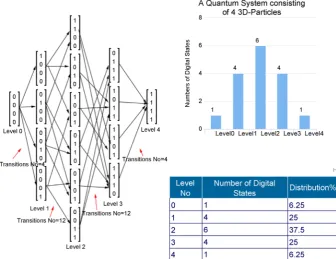
to one when some matter particle of the physical system start its first occupa-tion epoch, Figure 1 representing an explanation of distribution of real-time digital states of any physical system consisting of 4 matter particles over their corresponding digital levels in addition to the possible transition of the Real-time digital states from different digital states to the Real-time digital states distributed in their near higher digital level.
3) If the constituent matter particles of the physical system
{
P P1, 2,,PN}
Figure 1. Illustration of digital levels and all possible transition between the real-time digital states belong to them for any physical system consisting of 4 matter particles.
matter particles into set of finite orbits is equivalent to the distribution of it into set of finite digital levels such that jumping of matter particle from initial orbit to the final orbit is equivalent to the transition of digital states at all points occu-pied by it at the final orbit to the same real-time digital state belong to next higher digital level.
2.9. The Real-Time Transition State
For any physical system S consisting of N matter particles
{
P P1, 2,,PN}
thereal-time transition state of the physical system at
(
x y z, ,)
that is corresponding to its real-time digital state at(
x y z, ,)
:(
)
( )
{ } { }
{ }
1
2 1 2
, , , , , ,
s s
N n
s N
x y z n n n s
δ
δ
ϕ
ϕ
δ
= =
is defined as the superposition of all
real-time digital states at
(
x y z, ,)
that the physical system can transit to it at the of the next occupation epochs of(
x y z, ,)
by one of its constituent matter par-ticles which is defined as following:( )
( )
u N( )n1 1( )
n s n u n
s u
s s σ u
ψ α ϕ ∈ + α ϕ +
⊂
= +
∑
(27)Fulfills:
( ) ( )
( )
ˆ
n n n
T s ψ s = ϕ s (28)
( ) ( )
( )
1 1
ˆ
n n n
For all u∈σN
(
n+1)
fulfills s⊂u. Such that:( )
( )
( )
{ }
( )
{ } { }( )
{ } { }( )
{ } { }( )
{ } { }( )
{ } { }( )
{ }{ }
( )
{ } { }( )
{ } { }( )
{ }1 1 1 2 1
2 1 2 2 2
1 2
ˆ
s s s s s s
N
s s s s s s
N
n n n
s s s s s s
N N N N
T s s s
δ δ δ δ δ δ
δ δ δ δ δ δ
ϕ ϕ
δ δ δ δ δ δ
∇ ∇ ∇
∇ ∇ ∇
∇ ∇ ∇
= ⊗ =
(30)
( )
( )
( )
{ }
( )
{ } { }( )
{ } { }( )
{ } { }( )
{ } { }( )
{ } { }( )
{ }{ }
( )
{ } { }( )
{ } { }( )
{ }1 1 1 2 1
2 1 2 2 2
1 1 1
1 2
ˆ
u u u u u u
N
u u u u u u
N
n n n
u u u u u u
N N N N
T u u u
δ δ δ δ δ δ
δ δ δ δ δ δ
ϕ ϕ
δ δ δ δ δ δ
∇ ∇ ∇
∇ ∇ ∇
+ + +
∇ ∇ ∇
= ⊗ =
(31)
s
α ∈ fulfills
α
{ } =0 and α ∈u for all u∈σN(
n+1)
fulfills s⊂u. where: ⊗ is the tensor product (outer product) operation.( )
(
( )
)
n s n s
ϕ = ϕ ∇ and ϕn1
( )
u(
ϕn1( )
u)
∇
+ = + are normalized reciprocal
transpose of ϕn
( )
s and ϕn+1( )
u respectively which are defined by taking the normalized reciprocal of the components of transpose of ϕn( )
s and( )
1
n u
ϕ + respectively.
Important note:
1) When the physical system at the real-time digital state:
(
)
( )
{ } { }
{ }
1
2 1 2
, , , , , ,
s s
N n
s N
x y z n n n s
δ
δ
ϕ
ϕ
δ
= =
the next occupation epochs of
(
x y z, ,)
by one of its constituent matter particles P is either leaves the physicalsystem at the real-time digital stateϕn
( )
s in a case that P occupied(
x y z, ,)
atthe previous occupation epoch or transit the real-time digital state to some state at the next higher digital level ϕn+1
( )
u such that u∈σN(
n+1)
fulfillss⊂u, thus the real-time transition state is defined as superposition of its current real-time digital state and all real-time digital states at the next higher digital level that the physical system that can transit to them.
2) For all
i
=
1, 2,
,
N
the components of ˆ( )
n
T s and Tˆn+1
( )
u at the ith rowand the jth column which are
{ }si
( )
{ }sj { }si( )
{ }sjδ δ ∇ =δ δ and { }u
( )
{ }u { }u( )
{ }ui j i j
δ δ ∇ =δ δ
respectively indicate wither both the matter particles Pi and Pj occupied
( )
ˆn
T s and Tˆn+1
( )
u are equal to their normalized reciprocal transposes in sameway that the Hermition matrices equal to their complex conjugate transposes. In computation term ˆ
( )
n
T s and Tˆn+1
( )
u are representing irreversible gates thatforward the time of each constituent particles of the physical system only at the direction of increasing the number of occupation and leaving epochs of space points by it.
3) we can calculate the coefficients
α
s and{
αu|u∈σN(
n+1 fulfills)
s⊂u}
as following:
Since for all
1 1
2 2
,
n n
x y
x y
x y
= =
x y
and
1
2
n
z z
z
=
z
:
(
)
(
)
(
)
1 1 1 2 1 1 1
2 1 2 2 2 2 2
1
1 2
n
n n
i i i
n n n n n n
x y x y x y z x
x y x y x y z x
y z
x y x y x y z x
=
⊗ = = = ⋅
∑
x y z y z x
the conditions:
( ) ( )
( )
ˆ
n n n
T s ψ s = ϕ s
( ) ( )
( )
1 1
ˆ
n n n
T+ u ψ s = ϕ+ u
Implied that:
( )
( )
(
ϕn s ⋅ψn s)
ϕn( )
s = ϕn( )
s( )
( )
(
ϕn+1 u ⋅ψn s)
ϕn+1( )
u = ϕn+1( )
uAnd then:
( )
( )
1n s n s
ϕ ⋅ψ =
( )
( )
1 1
n u n s
ϕ+ ⋅ψ =
So if u u1, 2,,uk are representing the elements of
(
)
{
αu |u∈σN n+1 fulfillss⊂u}
for some integer k∈{
1, 2,,N}
then:( )
( )
1( )
1 i
k
n s n u n i
i
s s u
ψ α ϕ α ϕ+
=
= +
∑
And:
( )
( )
(
( )
( )
)
(
( )
( )
)
( )
( )
(
( )
( )
)
(
( )
( )
)
( )
( )
(
( )
( )
)
(
( )
( )
)
( )
( )
(
( )
( )
)
(
( )
( )
)
1 1
1 1 1 1 1 1 1
1
1 2 1 2 1 2 1
1
1 1 1 1
1
1
1
1
1
i
i
i
i
k
n n n n s n n i u
i k
n n n n s n n i u
i k
n n n n s n n i u
i k
n k n n k n s n k n i u
i
s s s s s u
u s u s u u
u s u s u u
u s u s u u
ϕ ψ ϕ ϕ α ϕ ϕ α
ϕ ψ ϕ ϕ α ϕ ϕ α
ϕ ψ ϕ ϕ α ϕ ϕ α
ϕ ψ ϕ ϕ α ϕ ϕ α
+ =
+ + + +
=
+ + + +
=
+ + + +
=
⋅ = ⋅ + ⋅ =
⋅ = ⋅ + ⋅ =
⋅ = ⋅ + ⋅ =
⋅ = ⋅ + ⋅ =