http://www.scirp.org/journal/ijcns ISSN Online: 1913-3723
ISSN Print: 1913-3715
Energy Efficient Power Allocation for
Distributed MIMO System
Qian Wang1,2, Yilong Yin1,2, Xiushan Nie1,2
1School of Computer Science and Technology, Shandong University of Finance and Economics, Jinan, China 2School of Computer Science and Technology, Shandong University, Jinan, China
Abstract
The rapid increasing demands of multi-media applications have busted the improvement of video transmission. By the increase of multimedia transmis-sion, quality of experience (QoE) has become the hot topic of the wireless networks’ research. This paper proposes a QoE-aware resource allocation al-gorithm in MIMO-OFDM Networks. The power allocation estimation is for-mulated to maximize according to QoE by considering the video transmission rate and the subcarrier schemes under the constraint of minimum power. In this paper, we will analyses the the performance of video transmission from transmission rate at the application layer to the power allocation at the physi-cal layer. From simulation results, we can see that the proposed subcarrier al-location algorithm maximizes the video QoE by minimizing the sum distor-tion of multi-users in MIMO networks with power constraints.
Keywords
QoE, Cross Layer Design, Resource Allocation, MIMO
1. Introduction
The rapid increasing demands of multi-media applications have busted the im-provement of video transmission [1]. The development of physical (PHY) layer transmission schemes, such as Multiple Input and Multiple Output (MIMO) an-tennas, as well as multiple access schemes, e.g., Orthogonal Frequency Division Multiple Access (OFDMA), has obviously changed everyday life. The concept of quality of experience (QoE) means that we can evaluate the performance of communication networks and services under the subjective opinions from ap-plication users [2]. Many researchers have proposed the equations of QoS-QoE, which could reflect the relation between QoS and QoE parameter [3] [4] [5]. In
How to cite this paper: Wang, Q., Yin, Y.L. and Nie, X.S. (2017) Energy Efficient Power Allocation for Distributed MIMO System. Int. J. Communications, Network and System Sciences, 10, 283-291.
https://doi.org/10.4236/ijcns.2017.105B028 Received: May 22, 2017
order to optimize the resource allocation during media video transmissions in next LET, it is necessary to propose an improved resource allocation driven by QoE parameter [5].
Meanwhile, new video compression techniques have dramatically improved the compression efficiency of video codecs. The H.264/ AVC (H.264 Advanced Video Coding) [6] has been shown to save up to 55% of the bits compared to prior MPEG standards. Most recently, the HEVC (High Efficiency Video Cod-ing) [7] is proposed to the improvement over the coding efficiency for the H.264. Along with the increasing demands on multimedia application, multime-dia transmission is becoming one of the most popular services in future wireless networks [8] [9].
Recently, many researchers have been proposed some scheme for videos tran-sitions over LET systems, which both PHY layer and APP layer parameter are considered to improve QoE of users [10] [11]. The performance of QoS-aware system can be improved considering the channel condition and RD at APP layer. In [11], an optimal subcarrier allocation for minimizing RD over Massive- MIMO systems is proposed, where video quality and channel capacity are con-sidered. In [12], authors proposed perspectives and research challenges for QoE in video transmission over wireless networks.
In this paper, we focus on QoE-aware cross layer optimization in a multiple access environment. We investigate the resource allocation strategy by jointly considering the physical layer information and the application layer informa-tion. With the goal of QoE optimizing the overall system video performance, the PHY layer communication resources are allocated to the video users according to the demand of the multi-users.
The rest of the papers are written as following: Section II presents PHY layer and APP layer scheme, the same as the cross layer optimization. We will propose cross layer resource allocation in Section III, In Section IV Simulation results are showed, and in Section V, we will draw the conclusions.
2. System Model
We consider a MIMO OFDM network, where there are users transmitting their video streams to one access point (AP) through single hop route as shown in Figure 1.
2.1. MIMO System Model
In this Section, we consider a central-controlling cellular OFDMA multimedia communication networks. We set the users as k = {1, 2, 3, ∙∙∙, K} where to the base station went to communicate media. The M is the number subcarrier. We can see m = {1, 2, ∙∙∙, M}. We can occupy a total frequency factors as W (Hz). All users adapt alphabet size of this modulation format, and adoptive QAM mod-ulation is determined in the resource allocation scheme.
The user k transmits the video packet with power Pk under the maximum
power constraint max
k
Figure 1. The structure of the proposed cross-layer transmission in MU-MIMO Com-munication systems.
user k is expressed as.
2
k k k k
K j j
i k
P G SINR
P G γ
≠ =
Ω +
∑
(1)where γk represents the spreading gain and Gk is the channel gain such as the
large scale and small scale fading. 2
K
Ω expresses the noise power of user k. The
corresponding link capacity of user is given as
(
)
2
log 1
k k
C =B +SINR (2)
where B is the channel bandwidth. To improve the quality of multimedia trans-mission, same assumption as made in [13] that the network works in the high SINR region. Therefore, the link capacity in (2) can be approximated as
2 2
log k k k
k
K j j
i k
P G
C B
P G
γ
≠
≈
Ω +
∑
(3).
2.2. QoE Evaluation of Multiuser
QoE is an option-related metric which is important factor for future LTE sys-tems. We use utility functions to describe QoE for multi-users in varied applica-tions. The QoE of user i can be expressed by Q( ) which is the quality function
of systems. In this section, we use a QoE function, similar to [13]. It concludes a concave function of the rates. For a mutli-user i under the same base station, corresponding to the rate Ri, the QoE of user i can be described as:
ln(1 )
( )
ln(1 )
i
i i req
i
R Q R
R
+ =
+ (4)
where req i
R is t data rate of the i user requesting.
2.3. Video RD Characteristics
Because the video is expressed as GOPs, this RD function is described under a GOP-by-GOP. Set Dik( )σ is the rate distortion function of user i in time slot k.
( ) k i i i i w D B σ α η = +
+ (5)
where αi, wi and ηi are constants, which will be jointly optimized by the
PHY layer parameters by the cross layer design. We put (4) into (5), then (5) can be written,
0 1 0 ( ) ( , ) i s k
i i M
m m m i
i i i
s m w T w T D
R P H
T T
σ α η
µ η = • = + + •
∑
(6)The QoE ignores the quality according to pricing Pi(Qi) from the users
re-quirement in the MIMO-OFDMA network.
1
max . ( n) ( n )
N
t t
i i s
n i I
Q R γ R R
= ∈
− Φ −
∑∑
s.t. 1 1 ( , ) , N ii f s i i i
R q l R
m r = ≤
∑
1 ( ) Ni i b i
P Q P
=
≤
∑
min i max
q ≤q ≤q (7)
Note γ is a quality parameter from the user. Φ( ) is a quadratic equation
for rate restrict. Thus, the Qi = Qi(qi, lf ) and Ri(qi, lf ) express the QoE quality
parameter corresponding to the quantization value qi. We assume the same-
length frame rate lf and power constraint of Pb for each user. We also assume the
adaptive modulation parameter is mi.
We can see (7) is convex and convert it into a standard form convex optimiza-tion problem [14] by modifying the optimizaoptimiza-tion funcoptimiza-tion,
1
min . ( n) ( n )
N
t t
i i s
n i I
Q R γ R R
= ∈
−
∑∑
− Φ − (8)We can apply employ the Karush-Kuhn-Tucker (KKT) framework to (8). The Lagrangian function L q( , , , )λ µ δ is,
min
1
(1 / )
1 max min 1 1 ( , , , ) ( ) ( ) ( ) ( ) i i N
i i i i i
N
d q q
i s
i
N N
i i i i
i i
L q n q
k e R
q q q q
λ µ δ β γ
λ µ δ − − − − − = − = = = = − + + − + − + −
∑
∑
∑
∑
(9)where λ µ δ, i, i, 1 ≤ i ≤ N are Lagrange multipliers, max ( )
i
i e Qi Q lt f i
β− β ,
max ( )
i
i e Qi Q lt f i
γ− γ , We set maxi
R is the maximum rate of the ith video trans-mission. The quantity ki is as follow,
max /
max (1 )
1
t f
t
c l t i
i c
i i
R e
k
m r e
−
−
− −
we obtain,
min
(1 / )
min
( i ) di q qi 0
i i i i i
d
n k e
q
β λ− − µ δ
− − + − = (11)
From (11), we can obtain the KKT complementary condition given as,
min
(1 / )
1
0
i i
N
d q q
i s
i
k e R
λ −
=
− =
∑
(12)From (12), we setμi = 0 and δi = 0, the Lagrangian multiplier λ* can be
ex-pressed as, * min 1 ( ) N j j j s j n q R d β λ − =
= −
∑
(13)We substitute the above expression for the optimal quantization parameter qi*
and then,
min
min min *
*
1
min min 1
1
ln( )
( )
ln( )
( )
ii i i
j j i
j
i
s i i
N
i j j i
j
q m r
q q
k d q
d
R n d
q q
k n d
d β λ β − − − − = − = − =
∑
(14)The above expression can obtain the optimal quantization parameter qi* for
[image:5.595.206.530.520.733.2]resource allocation. The (14) has low computational complexity scheme for op-timal video transmission for both unicast and multicast surrounding. This pro-posed joint power and subcarrier allocation algorithm in MIMO OFDM systems enables us both to overcome the challenge of full CSI. We can get optimal sub-carrier and power allocation by iterative as Table 1.
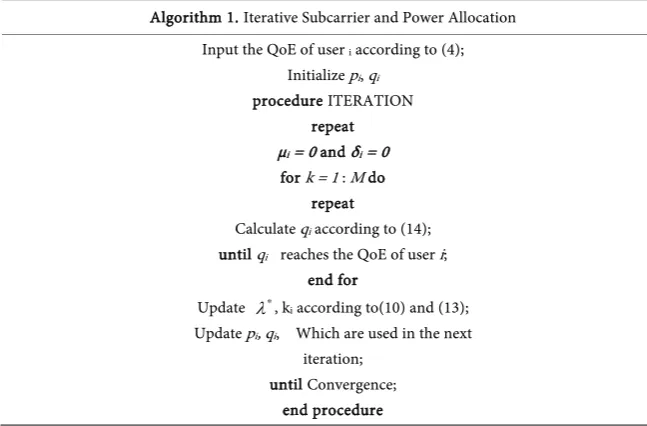
Table 1. Iterative Subcarrier and Power Allocation.
Algorithm 1. Iterative Subcarrier and Power Allocation Input the QoE of user i according to (4);
Initialize pi, qi
procedure ITERATION repeat μi = 0 and δi = 0
for k = 1 : M do repeat
Calculate qiaccording to (14);
until qi reaches the QoE of user i;
end for Update λ*, k
i according to(10) and (13);
Update pi, qi, Which are used in the next
iteration; until Convergence;
4. Simulation Results
In this section, we simulate the performance results for the MU-MIMO OFDM systems with an amount of 32 subcarriers. And the system power constrain is −120 dB/Hz.. Under the given power constraint in each bandwidth, power can be expressed as Pt = 200 mW, of which has each bandwidth of 100 kHz. We can denote the path-loss con-strain is γ = 2.45. Moreover, α is a Rayleigh fading va-riable. For each time slot i the optimization system can be automatically trans-ferred.
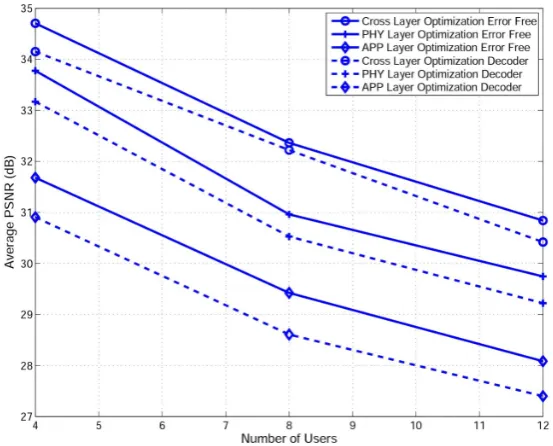
In simulation, the aim of the allocations is to be outputted to the rate and subcarrier allocation corresponding to the number of users. Figure 2 describe a set of simulate results. From Figure 2, we can see, with cross layer design, re-quirement of the packet loss in APP layer varying with the channel fading. Hence the power control coefficients can be made independent of frequency and their effect on the data rate obtained by QAM. The valid PSNR is about 40% to-ward to SER. In one word, to obtain the target PSNR under 16QAM, the rate al-location is bigger than the result of the other OFDMA system.
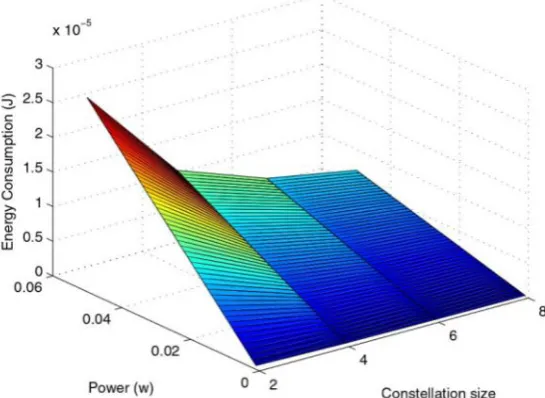
When the transmission power is decrease, the result can be shown will be made. This simulation can be shown in Figure 3 Figure 4, where the PSNR is applied under this value. When the value of power is decrease, the result can be shown will be made. This simulation to can be shown in Figure 3, where the PSNR is applied f under this value. That is to say 8 users computing for re-sources which here are 64 sub-carriers are obtained.
[image:6.595.236.513.493.716.2]Our simulation results show that the optimal cross-layer design is achieved highly performance according to the curve of QoE. Compared to a resource al-gorithm using either only PHY layer or only APP layer, the cross layer optimi- zation significantly improved the performance of the sys-tem. It is also achieved highly throughout and low delay in this numerical results.
Figure 3. Bit error rate under different power and constellation size.
Figure 4. Energy consumption with different power and constellation size.
5. Conclusion
[image:7.595.235.508.318.517.2]in-formation.
Acknowledgements
This work was supported in part by the National Natural Science Foundation of China (No. 61371109, 61671274)and NSFC Joint Fund with Guangdong under
Key Project (No. U1201258) and Shandong Natural Science Funds for Distin-guished Young Scholar (No. JQ201316).
References
[1] Cisco (2015) Cisco Visual Networking Index: Glo- bal Mobile Data Traffic Forecast Update 2014C2019 White Paper. Tech. Rep.
[2] Zhou, L., Yang, Z., Wen, Y. and Rodrigues, J. (2013) Distributed Wireless Video Scheduling with Delayed Control Information. IEEE Transactions on Circuits Syst. Video Technol., 24, 889-901. https://doi.org/10.1109/TCSVT.2013.2291311
[3] Wu, J., Cheng, B., Yuen, C., Shang, Y. and Chen, J.-L. (2015) Distortion Aware Concurrent Multipath Transfer for Mobile Video Streaming in Heterogeneous Wireless Networks. IEEE Trans. Mobile Comput., 14, 345-360.
https://doi.org/10.1109/TCSVT.2013.2291311
[4] Chan, Y., Cosman, P. and Milstein, L. (2008) A Multiple Description Coding and Delivery Scheme for Motion-Compensated Fine Granularity Scalable Video. IEEE Transactions on Image Processing, 17, 1353-1367.
https://doi.org/10.1109/TIP.2008.925300
[5] Bansal, G., Hossain, M., Bhargava, V. and Le-Ngoc, T. (2013) Subcarrier and Power Allocation for Ofdma-Based Cognitive Radio Systems with Joint Overlay and Un-derlay Spectrum Access Mechanism. IEEE Trans. Veh. Technol., 62, 1111-1122.
https://doi.org/10.1109/TVT.2012.2227856
[6] “International Telecommunication Union AAP An-nouncement No. 09”.
http://www.itu.int/dms pubaap/01/T0101000F09.htm.
[7] Zhou, L., Yang, Z., Wen, Y. and Rodrigues, J. (2013) Distributed Wireless Video Scheduling with Delayed Control Information. IEEE Trans. Circuits Syst. Video Technol., 24, 889–901. https://doi.org/10.1109/TCSVT.2013.2291311
[8] Mukhtar H., Al-Dweik A., Al-Mualla M., et al. (2015) Low Complexity Power Op-timization Algorithm for Multimedia Transmission over Wireless Networks. IEEE Journal of Selected Topics in Signal Processing, 9, 113-124.
https://doi.org/10.1109/JSTSP.2014.2331915
[9] Kuo W.H., Kaliski R., and Wei, H.Y. (2015) A QoE-based Link Adaptation Scheme for H. 264/SVC Video Multicast over IEEE 802.11. IEEE Transactions on Circuits and Systems for Video Technology, 25, 812-826.
https://doi.org/10.1109/TCSVT.2014.2363741
[10] Su, G.M., Su, X., Bai, Y., et al. (2016) QoE in Video Streaming over Wireless Net-works: Perspectives and Research Challenges. Wireless Networks, 22, 1571-1593.
https://doi.org/10.1007/s11276-015-1028-7
[11] Vosoughi, A., Cosman, P.C. and Milstein, L.B. (2015) Joint Source-Channel Coding and Unequal Error Protection for Video Plus Depth. IEEE Signal Processing Letters, 22, 31-34.https://doi.org/10.1109/LSP.2014.2346739
[13] Stuhlmuller, K., Farber, N., Link, M. and Girod, B. (2000) Analysis of Video Trans-mission over Lossy Channels. IEEE Journal on Selected Areas in Communications, 18, 1012 -1032.https://doi.org/10.1109/49.848253
[14] Kim, H., Annavajjala, R., Cosman, P. and Milstein, L. (2010) Source-Channel Rate Optimization for Progressive Image Transmission over Block Fading Relay Chan-nels. IEEE Transactions on Communications, 58, 1631-1642.
https://doi.org/10.1109/TCOMM.2010.06.080203
[15] Saki, H. and Shikh-Bahaei, M. (2015) Cross-Layer Resource Allocation for Video Streaming over OFDMA Cognitive Radio Networks. IEEE Trans. on Multimedia, 17, 333-345. https://doi.org/10.1109/TMM.2015.2389032
Submit or recommend next manuscript to SCIRP and we will provide best service for you:
Accepting pre-submission inquiries through Email, Facebook, LinkedIn, Twitter, etc. A wide selection of journals (inclusive of 9 subjects, more than 200 journals)
Providing 24-hour high-quality service User-friendly online submission system Fair and swift peer-review system
Efficient typesetting and proofreading procedure
Display of the result of downloads and visits, as well as the number of cited articles Maximum dissemination of your research work