A Shift-Reduce Parsing Algorithm for Phrase-based
String-to-Dependency Translation
Yang Liu
State Key Laboratory of Intelligent Technology and Systems Tsinghua National Laboratory for Information Science and Technology
Department of Computer Science and Technology Tsinghua University, Beijing 100084, China
Abstract
We introduce a shift-reduce parsing algorithm for phrase-based string-to-dependency translation. As the algorithm generates dependency trees for partial translations left-to-right in decoding, it allows for efficient integration of both
n-gram and dependency language
mod-els. To resolve conflicts in shift-reduce parsing, we propose a maximum entropy model trained on the derivation graph of training data. As our approach combines the merits of phrase-based and string-to-dependency models, it achieves significant improvements over the two baselines on the NIST Chinese-English datasets.
1 Introduction
Modern statistical machine translation approaches can be roughly divided into two broad categories: phrase-based andsyntax-based. Phrase-based ap-proaches treat phrase, which is usually a sequence of consecutive words, as the basic unit of trans-lation (Koehn et al., 2003; Och and Ney, 2004). As phrases are capable of memorizing local con-text, phrase-based approaches excel at handling local word selection and reordering. In addition, it is straightforward to integrate n-gram language
models into phrase-based decoders in which trans-lation always grows left-to-right. As a result, phrase-based decoders only need to maintain the boundary words on one end to calculate language model probabilities. However, as phrase-based de-coding usually casts translation as a string con-catenation problem and permits arbitrary permuta-tion, it proves to be NP-complete (Knight, 1999).
Syntax-based approaches, on the other hand, model the hierarchical structure of natural lan-guages (Wu, 1997; Yamada and Knight, 2001; Chiang, 2005; Quirk et al., 2005; Galley et al.,
2006; Liu et al., 2006; Huang et al., 2006; Shen et al., 2008; Mi and Huang, 2008; Zhang et al., 2008). As syntactic information can be exploited to provide linguistically-motivated re-ordering rules, predicting non-local permutation is computationally tractable in syntax-based ap-proaches. Unfortunately, as syntax-based de-coders often generate target-language words in a bottom-up way using the CKY algorithm, inte-grating n-gram language models becomes more expensive because they have to maintain target boundary words at both ends of a partial trans-lation (Chiang, 2007; Huang and Chiang, 2007). Moreover, syntax-based approaches often suffer from the rule coverage problem since syntac-tic constraints rule out a large portion of non-syntactic phrase pairs, which might help decoders generalize well to unseen data (Marcu et al., 2006). Furthermore, the introduction of non-terminals makes the grammar size significantly bigger than phrase tables and leads to higher mem-ory requirement (Chiang, 2007).
As a result, incremental decoding with hierar-chical structures has attracted increasing attention in recent years. While some authors try to inte-grate syntax into phrase-based decoding (Galley and Manning, 2008; Galley and Manning, 2009; Feng et al., 2010), others develop incremental al-gorithms for syntax-based models (Watanabe et al., 2006; Huang and Mi, 2010; Dyer and Resnik, 2010; Feng et al., 2012). Despite these success-ful efforts, challenges still remain for both direc-tions. While parsing algorithms can be used to parse partial translations in phrase-based decod-ing, the search space is significantly enlarged since there are exponentially many parse trees for expo-nentially many translations. On the other hand, al-though target words can be generated left-to-right by altering the way of tree transversal in syntax-based models, it is still difficult to reach full rule coverage as compared with phrase table.
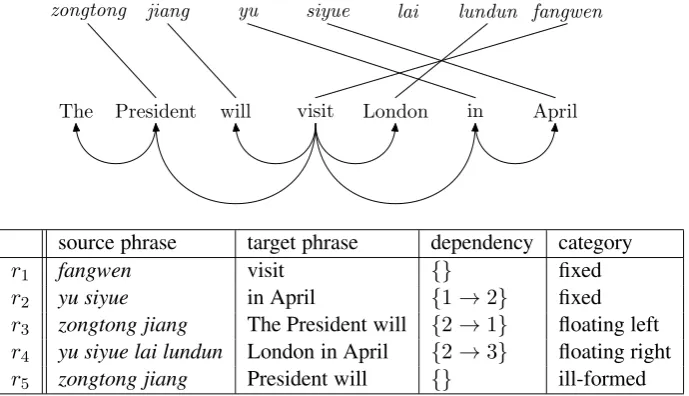
zongtong jiang yu siyue lai lundun fangwen
The President will visit London in April
source phrase target phrase dependency category
r1 fangwen visit {} fixed
r2 yu siyue in April {1→2} fixed
[image:2.595.128.473.61.259.2]r3 zongtong jiang The President will {2→1} floating left r4 yu siyue lai lundun London in April {2→3} floating right r5 zongtong jiang President will {} ill-formed
Figure 1: A training example consisting of a (romanized) Chinese sentence, an English dependency tree, and the word alignment between them. Each translation rule is composed of a source phrase, a target phrase with a set of dependency arcs. Following Shen et al. (2008), we distinguish betweenfixed, floating, and ill-formedstructures.
In this paper, we propose a shift-reduce parsing algorithm for phrase-based string-to-dependency translation. The basic unit of translation in our model isstring-to-dependency phrase pair, which consists of a phrase on the source side and a depen-dency structure on the target side. The algorithm generates well-formed dependency structures for partial translations left-to-right using string-to-dependency phrase pairs. Therefore, our approach is capable of combining the advantages of both phrase-based and syntax-based approaches:
1. compact rule table: our rule table is a subset of the original string-to-dependency gram-mar (Shen et al., 2008; Shen et al., 2010) by excluding rules with non-terminals.
2. full rule coverage: all phrase pairs, both syntactic and non-syntactic, can be used in our algorithm. This is the same with Moses (Koehn et al., 2007).
3. efficient integration of n-gram language
model: as translation grows left-to-right in our algorithm, integrating n-gram language
models is straightforward.
4. exploiting syntactic information: as the shift-reduce parsing algorithm generates tar-get language dependency trees in decoding, dependency language models (Shen et al., 2008; Shen et al., 2010) can be used to en-courage linguistically-motivated reordering.
5. resolving local parsing ambiguity: as de-pendency trees for phrases are memorized in rules, our approach avoids resolving local parsing ambiguity and explores in a smaller search space than parsing word-by-word on the fly in decoding (Galley and Manning, 2009).
We evaluate our method on the NIST Chinese-English translation datasets. Experiments show that our approach significantly outperforms both phrase-based (Koehn et al., 2007) and string-to-dependency approaches (Shen et al., 2008) in terms of BLEU and TER.
2 Shift-Reduce Parsing for Phrase-based String-to-Dependency Translation Figure 1 shows a training example consisting of a (romanized) Chinese sentence, an English de-pendency tree, and the word alignment between them. Following Shen et al. (2008), string-to-dependency rules without non-terminals can be extracted from the training example. As shown in Figure 1, each rule is composed of a source phrase and a target dependency structure. Shen et al. (2008) divide dependency structures into two broad categories:
1. well-formed
0 ◦ ◦ ◦ ◦ ◦ ◦ ◦
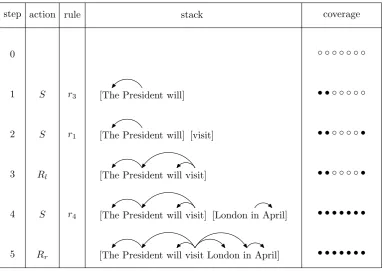
1 S r3 [The President will] • • ◦ ◦ ◦ ◦ ◦
2 S r1 [The President will] [visit] • • ◦ ◦ ◦ ◦ •
3 Rl [The President will visit] • • ◦ ◦ ◦ ◦ •
4 S r4 [The President will visit] [London in April] • • • • • • •
5 Rr [The President will visit London in April] • • • • • • •
[image:3.595.108.492.61.332.2]step action rule stack coverage
Figure 2: Shift-reduce parsing with string-to-dependency phrase pairs. For each state, the algorithm maintains a stack to store items (i.e., well-formed dependency structures). At each step, it chooses one action to extend a state: shift (S), reduce left (Rl), or reduce right (Rr). The decoding process terminates
when all source words are covered and there is a complete dependency tree in the stack.
(b) floating: sibling nodes of a common head, but the head itself is unspecified or floating. Each of the siblings must be a complete constituent.
2. ill-formed: neither fixed nor floating. We further distinguish between left and right floating structures according to the position of head. For example, as “The President will” is the left dependant of its head “visit”, it is a left floating structure.
To integrate the advantages of phrase-based and string-to-dependency models, we propose a shift-reduce algorithm for phrase-based string-to-dependency translation.
Figure 2 shows an example. We describe astate (i.e., parser configuration) as a tuplehS,Ciwhere S is a stack that stores items and C is a cover-age vectorthat indicates which source words have been translated. Each items∈ S is a well-formed
dependency structure. The algorithm starts with an empty state. At each step, it chooses one of the three actions (Huang et al., 2009) to extend a state: 1. shift(S): move a target dependency structure
onto the stack;
2. reduce left(Rl): combine the two items on
the stack,standst−1(t≥2), with the root of stas the head and replace them with a com-bined item;
3. reduce right(Rr): combine the two items on the stack,stand st−1 (t ≥ 2), with the root
ofst−1 as the head and replace them with a
combined item.
The decoding process terminates when all source words are covered and there is a complete depen-dency tree in the stack.
Note that unlike monolingual shift-reduce parsers (Nivre, 2004; Zhang and Clark, 2008; Huang et al., 2009), our algorithm does not main-tain a queue for remaining words of the input be-cause the future dependency structure to be shifted is unknown in advance in the translation scenario. Instead, we use a coverage vector on the source side to determine when to terminate the algorithm. For an input sentence ofJ words, the number of
actions is2K−1, whereKis the number of rules
used in decoding. 1There are alwaysKshifts and
1Empirically, we find that the average number of stacks
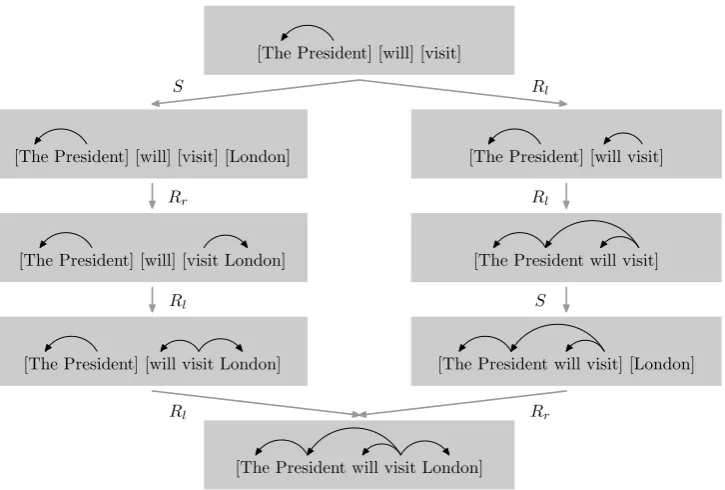
[The President] [will] [visit]
[The President] [will] [visit] [London]
[The President] [will] [visit London]
[The President] [will visit London]
[The President] [will visit]
[The President will visit]
[The President will visit] [London]
[The President will visit London] S
Rr
Rl
Rl
Rl
Rl
S
[image:4.595.119.482.60.305.2]Rr
Figure 3: Ambiguity in shift-reduce parsing.
st−1 st legal action(s)
yes S
h yes S
l yes S
r no
h h yes S,Rl,Rr
h l yes S
h r yes Rr
l h yes Rl
l l yes S
l r no
r h no
r l no
[image:4.595.112.251.353.550.2]r r no
Table 1: Conflicts in shift-reduce parsing. stand
st−1 are the top two items in the stack of a state.
We use “h” to denote fixed structure, “l” to de-note left floating structure, and “r” to dede-note right floating structure. It is clear that only “h+h” is am-biguous.
K−1reductions.
It is easy to verify that the reduce left and re-duce right actions are equivalent to the left adjoin-ing and right adjoinadjoin-ing operations defined by Shen et al. (2008). They suffice to operate on well-formed structures and produce projective depen-dency parse trees.
Therefore, with dependency structures present in the stacks, it is possible to use dependency lan-guage models to encourage linguistically plausible phrase reordering.
3 A Maximum Entropy Based Shift-Reduce Parsing Model
Shift-reduce parsing is efficient but suffers from parsing errors caused by syntactic ambiguity. Fig-ure 3 shows two (partial) derivations for a depen-dency tree. Consider the item on the top, the algo-rithm can either apply a shift action to move a new item or apply a reduce left action to obtain a big-ger structure. This is often referred to as conflict
in the shift-reduce dependency parsing literature (Huang et al., 2009). In this work, the shift-reduce parser faces four types of conflicts:
1. shift vs. shift;
2. shift vs. reduce left;
3. shift vs. reduce right;
4. reduce left vs. reduce right.
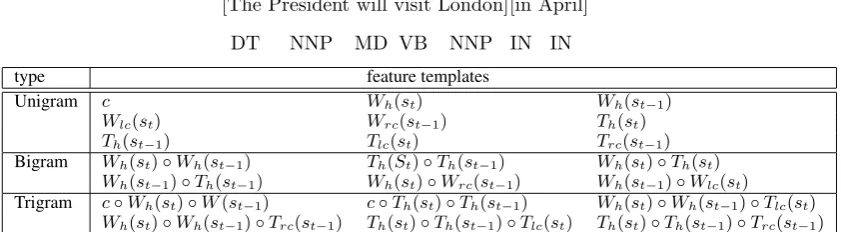
[The President will visit London][in April]
DT NNP MD VB NNP IN IN
type feature templates
Unigram c Wh(st) Wh(st−1)
Wlc(st) Wrc(st−1) Th(st)
Th(st−1) Tlc(st) Trc(st−1)
Bigram Wh(st)◦Wh(st−1) Th(St)◦Th(st−1) Wh(st)◦Th(st)
Wh(st−1)◦Th(st−1) Wh(st)◦Wrc(st−1) Wh(st−1)◦Wlc(st) Trigram c◦Wh(st)◦W(st−1) c◦Th(st)◦Th(st−1) Wh(st)◦Wh(st−1)◦Tlc(st)
[image:5.595.89.510.84.200.2]Wh(st)◦Wh(st−1)◦Trc(st−1) Th(st)◦Th(st−1)◦Tlc(st) Th(st)◦Th(st−1)◦Trc(st−1)
Figure 4: Feature templates for maximum entropy based shift-reduce parsing model. c is a boolean
value that indicate whether all source words are covered (shift is prohibited if true), Wh(·) and Th(·) are functions that get the root word and tag of an item, Wlc(·) and Tlc(·) returns the word and tag of the left most child of the root,Wrc(·)amdTrc(·)returns the word and tag of the right most child of the root. Symbol ◦denotes feature conjunction. In this example, c = true, Wh(st) = in, Th(st) = IN,
Wh(st−1) =visit,Wlc(st−1) =London.
items in the stack. “h” stands for fixed struc-ture, “l” for left floating strucstruc-ture, and “r” for right floating structure. If the stack is empty, the only applicable action is shift. If there is only one item in the stack and the item is either fixed or left float-ing, the only applicable action is shift. Note that it is illegal to shift a right floating structure onto an empty stack because it will never be reduced. If the stack contains at least two items, only “h+h” is ambiguous and the others are either unambigu-ous or illegal. Therefore, we only need to focus on how to resolve conflicts for the “h+h” case (i.e., the top two items in a stack are both fixed struc-tures).
We propose a maximum entropy model to re-solve the conflicts for “h+h”:2
Pθ(a|c, st, st−1) =
exp(θ·h(a, c, st, st−1)) P
aexp(θ·h(a, c, st, st−1))
wherea∈ {S, Rl, Rr}is an action,cis a boolean value that indicates whether all source words are covered (shift is prohibited if true), st and st−1
are the top two items on the stack,h(a, c, st, st−1)
is a vector of binary features andθ is a vector of
feature weights.
Figure 4 shows the feature templates used in our experiments. Wh(·) and Th(·) are functions that get the root word and tag of an item, Wlc(·) and
Tlc(·) returns the word and tag of the left most child of the root, Wrc(·) and Trc(·) returns the 2The shift-shift conflicts always exist because there are
usually multiple rules that can be shifted. This can be re-volved using standard features in phrase-based models.
word and tag of the right most child of the root. In this example,c=true,Wh(st) =in,Th(st) = IN,Wh(st−1) =visit,Wlc(st−1) =London.
To train the model, we need an “oracle” or gold-standard action sequence for each training exam-ple. Unfortunately, such oracle turns out to be non-unique even for monolingual shift-reduce de-pendency parsing (Huang et al., 2009). The situ-ation for phrase-based shift-reduce parsing aggra-vates because there are usually multiple ways of segmenting sentence into phrases.
To alleviate this problem, we introduce a struc-ture called derivation graphto compactly repre-sent all derivations of a training example. Figure 3 shows a (partial) derivation graph, in which a node corresponds to a state and an edge corresponds to an action. The graph begins with an empty state and ends with the given training example.
More formally, a derivation graph is a directed acyclic graph G = hV, Ei where V is a set of
nodes and E is a set of edges. Each node v
cor-responds to a state in the shift-reduce parsing pro-cess. There are two distinguished nodes: v0, the
staring empty state, and v|V|, the ending
com-pleted state. Each edgee = (a, i, j) transits node
Algorithm 1Beam-search shift-reduce parsing. 1: procedurePARSE(f)
2: V ← ∅
3: ADD(v0,V[0])
4: k←0
5: whileV[k]6=∅do
6: for allv∈ V[k]do
7: for alla∈ {S, Rl, Rr}do 8: EXTEND(f,v,a,V)
9: end for
10: end for
11: k←k+ 1
12: end while
13: end procedure
only need to focus on “h+h” states. In addition, we follow Huang et al. (2009) to use the heuristic of “shortest stack” to always preferRltoS.
4 Decoding
Our decoder is based on a linear model (Och, 2003) with the following features:
1. relative frequencies in two directions;
2. lexical weights in two directions;
3. phrase penalty;
4. distance-based reordering model;
5. lexicaized reordering model;
6. n-gram language model model;
7. word penalty;
8. ill-formed structure penalty;
9. dependency language model;
10. maximum entropy parsing model.
In practice, we extend deterministic shift-reduce parsing with beam search (Zhang and Clark, 2008; Huang et al., 2009). As shown in Al-gorithm 1, the alAl-gorithm maintains a list of stacks
Vand each stack groups states with the same num-ber of accumulated actions (line 2). The stack list
V initializes with an empty statev0(line 3). Then,
the states in the stack are iteratively extended un-til there are no incomplete states (lines 4-12). The search space is constrained by discarding any state that has a score worse than:
1. β multiplied with the best score in the stack, or
2. the score ofb-th best state in the stack.
As the stack of a state keeps changing during the decoding process, the context information needed to calculate dependency language model and max-imum entropy model probabilities (e.g., root word, leftmost child, etc.) changes dynamically as well. As a result, the chance of risk-freehypothesis re-combination(Koehn et al., 2003) significantly de-creases because complicated contextual informa-tion is much less likely to be identical.
Therefore, we use hypergraph reranking (Huang and Chiang, 2007; Huang, 2008), which proves to be effective for integrating non-local features into dynamic programming, to alleviate this problem. The decoding process is divided into two passes. In the first pass, only standard features (i.e., features 1-7 in the list in the beginning of this section) are used to produce a hypergraph. 3 In the second pass, we use the hypergraph reranking algorithm (Huang, 2008) to find promising translations using additional de-pendency features(i.e., features 8-10 in the list). As hypergraph is capable of storing exponentially many derivations compactly, the negative effect of propagating mistakes made in the first pass to the second pass can be minimized.
To improve rule coverage, we follow Shen et al. (2008) to use ill-formed structures in decoding. If an ill-formed structure has a single root, it can treated as a (pseudo) fixed structure; otherwise it is transformed to one (pseudo) left floating structure and one (pseudo) right floating structure. We use a feature to count how many ill-formed structures are used in decoding.
5 Experiments
We evaluated our phrase-based string-to-dependency translation system on Chinese-English translation. The training data consists of 2.9M pairs of sentences with 76.0M Chinese
words and 82.2M English words. We used the
Stanford parser (Klein and Manning, 2003) to get dependency trees for English sentences. We used the SRILM toolkit (Stolcke, 2002) to train a 3Note that the first pass does not work like a phrase-based
MT02 (tune) MT03 MT04 MT05
system BLEU TER BLEU TER BLEU TER BLEU TER
phrase 34.88 57.00 33.82 57.19 35.48 56.48 32.52 57.62
dependency 35.23 56.12 34.20 56.36 36.01 55.55 33.06 56.94
[image:7.595.73.528.62.137.2]this work 35.71∗∗ 55.87∗∗ 34.81∗∗+ 55.94∗∗+ 36.37∗∗ 55.02∗∗+ 33.53∗∗ 56.58∗∗
Table 2: Comparison with Moses (Koehn et al., 2007) and a re-implementation of the bottom-up string-to-dependency decoder (Shen et al., 2008) in terms of uncased BLEU and TER. We use randomiza-tion test (Riezler and Maxwell, 2005) to calculate statistical significance. *: significantly better than Moses (p <0.05), **: significantly better than Moses (p <0.01), +: significantly better than string-to-dependency (p <0.05), ++: significantly better than string-to-dependency (p <0.01).
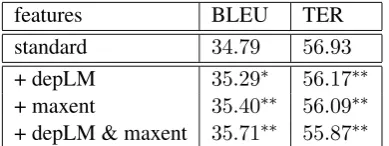
features BLEU TER
standard 34.79 56.93
+ depLM 35.29∗ 56.17∗∗
+ maxent 35.40∗∗ 56.09∗∗
+ depLM & maxent 35.71∗∗ 55.87∗∗
Table 3: Contribution of maximum entropy shift-reduce parsing model. “standard” denotes us-ing standard features of phrase-based system. Adding dependency language model (“depLM”) and the maximum entropy shift-reduce parsing model (“maxent”) significantly improves BLEU and TER on the development set, both separately and jointly.
4-gram language model on the Xinhua portion of the GIGAWORD coprus, which contians 238M English words. A 3-gram dependency language model was trained on the English dependency trees. We used the 2002 NIST MT Chinese-English dataset as the development set and the 2003-2005 NIST datasets as the testsets. We evaluated translation quality usinguncasedBLEU (Papineni et al., 2002) and TER (Snover et al., 2006). The features were optimized with respect to BLEU using the minimum error rate training algorithm (Och, 2003).
We chose the following two systems that are closest to our work as baselines:
1. The Moses phrase-based decoder (Koehn et al., 2007).
2. A re-implementation of bottom-up string-to-dependency decoder (Shen et al., 2008).
All the three systems share with the same target-side parsed, word-aligned training data. The his-togram pruning parameter b is set to 100 and
rules coverage BLEU TER well-formed 44.87 34.42 57.35
all 100.00 35.71∗∗ 55.87∗∗
Table 4: Comparison of well-formed and ill-formed structures. Using all rules significantly outperforms using only well-formed structures. BLEU and TER scores are calculated on the de-velopment set.
phrase table limit is set to20for all the three
sys-tems. Moses shares the same feature set with our system except for the dependency features. For the bottom-up string-to-dependency system, we in-cluded both well-formed and ill-formed structures in chart parsing. To control the grammar size, we only extracted “tight” initial phrase pairs (i.e., the boundary words of a phrase must be aligned) as suggested by (Chiang, 2007). For our system, we used the Le Zhang’s maximum entropy modeling toolkit to train the shift-reduce parsing model after extracting32.6M events from the training data. 4
We set the iteration limit to100. The accuracy on
the training data is90.18%.
Table 2 gives the performance of Moses, the bottom-up string-to-dependency system, and our system in terms of uncased BLEU and TER scores. From the same training data, Moses extracted 103M bilingual phrases, the
bottom-up string-to-dependency system extracted 587M
string-to-dependency rules, and our system ex-tracted124M phrase-based dependency rules. We
find that our approach outperforms both baselines systematically on all testsets. We use randomiza-tion test (Riezler and Maxwell, 2005) to calculate statistical significance. As our system can take full advantage of lexicalized reordering and
[image:7.595.85.280.230.303.2] [image:7.595.312.523.230.278.2]30.50 31.00 31.50 32.00 32.50 33.00 33.50 34.00 34.50
0 2 4 6 8 10 12
BLEU
distortion limit this work
[image:8.595.75.291.69.221.2]Moses
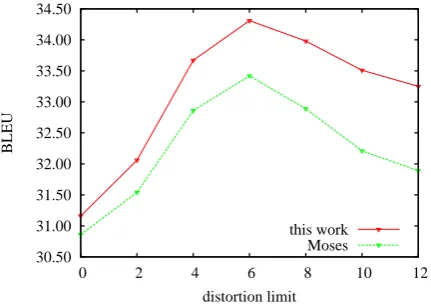
Figure 5: Performance of Moses and our system with various distortion limits.
dency language models without loss in rule cov-erage, it achieves significantly better results than Moses on all test sets. The gains in TER are much larger than BLEU because dependency language models do not modeln-grams directly. Compared with the bottom-up string-to-dependency system, our system outperforms consistently but not sig-nificantly in all cases. The average decoding time for Moses is 3.67 seconds per sentence,
bottom-up string-to-dependency is13.89seconds, and our
system is4.56seconds.
Table 3 shows the effect of hypergraph rerank-ing. In the first pass, our decoder uses standard phrase-based features to build a hypergraph. The BLEU score is slightly lower than Moses with the same configuration. One possible reason is that our decoder organizes stacks with respect to ac-tions, whereas Moses groups partial translations with the same number of covered source words in stacks. In the second pass, our decoder reranks the hypergraph with additional dependency fea-tures. We find that adding dependency language and maximum entropy shift-reduce models consis-tently brings significant improvements, both sepa-rately and jointly.
We analyzed translation rules extracted from the training data. Among them, well-formed struc-tures account for 43.58% (fixed 33.21%,
float-ing left9.01%, and floating right1.36%) and
ill-formed structures 56.42%. As shown in Table
4, using all rules clearly outperforms using only well-formed structures.
Figure 5 shows the performance of Moses and our system with various distortion limits on the development set. Our system consistently
outper-forms Moses in all cases, suggesting that adding dependency helps improve phrase reordering.
6 Related Work
The work of Galley and Manning (2009) is clos-est in spirit to ours. They introduce maximum spanning tree (MST) parsing (McDonald et al., 2005) into phrase-based translation. The system is phrase-based except that an MST parser runs to parse partial translations at the same time. One challenge is that MST parsing itself is not incre-mental, making it expensive to identify loops dur-ing hypothesis expansion. On the contrary, shift-reduce parsing is naturally incremental and can be seamlessly integrated into left-to-right phrase-based decoding. More importantly, in our work dependency trees are memorized for phrases rather than being generated word by word on the fly in decoding. This treatment might not only reduce decoding complexity but also potentially revolve local parsing ambiguity.
Our decoding algorithm is similar to Gimpel and Smith (2011)’s lattice parsing algorithm as we divide decoding into two steps: hypergraph gener-ation and hypergraph rescoring. The major differ-ence is that our hypergraph is not a phrasal lat-tice because each phrase pair is associated with a dependency structure on the target side. In other words, our second pass is to find the Viterbi derivation with addition features rather than pars-ing the phrasal lattice. In addition, their algorithm produces phrasal dependency parse trees while the leaves of our dependency trees are words, making dependency language models can be directly used. Shift-reduce parsing has been successfully used in phrase-based decoding but limited to adding structural constraints. Galley and Manning (2008) propose a shift-reduce algorithm to integrate a hi-erarchical reordering model into phrase-based sys-tems. Feng et al. (2010) use shift-reduce parsing to impose ITG (Wu, 1997) constraints on phrase permutation. Our work differs from theirs by go-ing further to incorporate lgo-inguistic syntax into phrase-based decoding.
and Resnik (2010), and Feng et al. (2012) use dot-ted rules to change the tree transversal to gener-ate target words left-to-right, either top-down or bottom-up.
7 Conclusion
We have presented a shift-reduce parsing al-gorithm for phrase-based string-to-dependency translation. The algorithm generates depen-dency structures incrementally using string-to-dependency phrase pairs. Therefore, our ap-proach is capable of combining the advantages of both phrase-based and string-to-dependency mod-els, it outperforms the two baselines on Chinese-to-English translation.
In the future, we plan to include more con-textual information (e.g., the uncovered source phrases) in the maximum entropy model to re-solve conflicts. Another direction is to adapt the dynamic programming algorithm proposed by Huang and Sagae (2010) to improve our string-to-dependency decoder. It is also interesting to com-pare with applying word-based shift-reduce pars-ing to phrase-based decodpars-ing similar to (Galley and Manning, 2009).
Acknowledgments
This research is supported by the 863 Program under the grant No 2012AA011102 and No. 2011AA01A207, by the Singapore National search Foundation under its International Re-search Centre @ Singapore Funding Initiative and administered by the IDM Programme Office, and by a Research Fund No. 20123000007 from Ts-inghua MOE-Microsoft Joint Laboratory.
References
David Chiang. 2005. A hiearchical phrase-based model for statistical machine translation. InProc. of ACL 2005.
David Chiang. 2007. Hierarchical phrase-based trans-lation.Computational Linguistics, 33(2):201–228.
Chris Dyer and Philip Resnik. 2010. Context-free re-ordering, finite-state translation. InProc. of NAACL 2010.
Yang Feng, Haitao Mi, Yang Liu, and Qun Liu. 2010. An efficient shift-reduce decoding algorithm for phrased-based machine translation. InProc. of COLING 2010.
Yang Feng, Yang Liu, Qun Liu, and Trevor Cohn. 2012. Left-to-right tree-to-string decoding with pre-diction. InProc. of EMNLP 2012.
Michel Galley and Christopher D. Manning. 2008. A simple and effective hierarchical phrase reordering model. InProc. of EMNLP 2008.
Michel Galley and Christopher D. Manning. 2009. Quadratic-time dependency parsing for machine translation. InProc. of ACL 2009.
Michel Galley, Jonathan Graehl, Kevin Knight, Daniel Marcu, Steve DeNeefe, Wei Wang, and Ignacio Thayer. 2006. Scalable inference and training of context-rich syntactic translation models. InProc. of ACL 2006.
Kevin Gimpel and Noah A. Smith. 2011. Quasi-synchronous phrase dependency grammars for ma-chine translation. InProc. of EMNLP 2011.
Liang Huang and David Chiang. 2007. Forest rescor-ing: Faster decoding with integrated language mod-els. InProc. of ACL 2007.
Liang Huang and Haitao Mi. 2010. Efficient incre-mental decoding for tree-to-string translation. In
Proc. of EMNLP 2010.
Liang Huang and Kenji Sagae. 2010. Dynamic pro-gramming for linear-time incremental parsing. In
Proc. of ACL 2010.
Liang Huang, Kevin Knight, and Aravind Joshi. 2006. Statistical syntax-directed translation with extended domain of locality. InProc. of AMTA 2006.
Liang Huang, Wenbin Jiang, and Qun Liu. 2009. Bilingually-constrained (monolingual) shift-reduce parsing. InProc. of EMNLP 2009.
Liang Huang. 2008. Forest reranking: Discrimina-tive parsing with non-local features. InProc. of ACL 2008.
Dan Klein and Christopher Manning. 2003. Accurate unlexicalized parsing. InProc. of ACL 2003.
Kevin Knight. 1999. Decoding complexity in word-replacement translation models. Computational Linguistics.
Philipp Koehn, Franz Och, and Daniel Marcu. 2003. Statistical phrase-based translation. In Proc. of NAACL 2003.
Philipp Koehn, Hieu Hoang, Alexandra Birch, Chris Callison-Burch, Marcello Federico, Nicola Bertoldi, Brooke Cowan, Wade Shen, Christine Moran, Richard Zens, Chris Dyer, Ondrej Bojar, Alexandra Constantin, and Evan Herbst. 2007. Moses: Open source toolkit for statistical machine translation. In
Yang Liu, Qun Liu, and Shouxun Lin. 2006. Tree-to-string alignment template for statistical machine translation. InProc. of ACL 2006.
Daniel Marcu, Wei Wang, Abdessamad Echihabi, and Kevin Knight. 2006. Spmt: Statistical machine translation with syntactified target language phrases. InProc. of EMNLP 2006.
R. McDonald, F. Pereira, K. Ribarov, and J. Hajic. 2005. Non-projective dependency parsing using spanning tree algorithms. InProc. of EMNLP 2005.
Haitao Mi and Liang Huang. 2008. Forest-based trans-lation. InProc. of ACL 2008.
Joakim Nivre. 2004. Incrementality in deterministic dependency parsing. InProc. of ACL 2004 Work-shop Incremental Parsing: Bringning Engineering and Cognition Together.
Franz Och and Hermann Ney. 2004. The alignment template approach to statistical machine translation.
Computational Linguistics, 30(4).
Franz Och. 2003. Minimum error rate training in sta-tistical machine translation. InProc. of ACL 2003.
Kishore Papineni, Salim Roukos, Todd Ward, and Wei-Jing Zhu. 2002. Bleu: a method for automatic eval-uation of machine translation. InProc. of ACL 2002.
Chris Quirk, Arul Menezes, and Colin Cherry. 2005. Dependency treelet translation: Syntactically in-formed phrasal smt. InProc. of ACL 2005.
S. Riezler and J. Maxwell. 2005. On some pitfalls in automatic evaluation and significance testing for mt. InProc. of ACL 2005 Workshop on Intrinsic and Extrinsic Evaluation Measures for Machine Trans-lation and/or Summarization.
Libin Shen, Jinxi Xu, and Ralph Weischedel. 2008. A new string-to-dependency machine translation algo-rithm with a target dependency language model. In
Proc. of ACL 2008.
Libin Shen, Jinxi Xu, and Ralph Weischedel. 2010. String-to-dependency statistical machine transla-tion.Computational Linguistics, 36(4).
Matthew Snover, Bonnie Dorr, Richard Schwartz, Lin-nea Micciulla, and John Makhoul. 2006. A study of translation edit rate with targeted human annotation. InProc. of AMTA 2006.
Andreas Stolcke. 2002. Srilm - an extensible language modeling toolkit. InProc. of ICSLP 2002.
Taro Watanabe, Hajime Tsukuda, and Hideki Isozaki. 2006. Left-to-right target generation for hierarchical phrase-based translation. InProc. of ACL 2006.
Dekai Wu. 1997. Stochastic inversion transduction grammars and bilingual parsing of parallel corpora.
Computational Linguistics.
Kenji Yamada and Kevin Knight. 2001. A syntax-based statistical translation model. InProc. of ACL 2001.
Yue Zhang and Stephen Clark. 2008. A tale of two parsers: investigating and combining graph-based and transition-graph-based dependency parsing us-ing beam search. InProc. of EMNLP 2008.
Min Zhang, Hongfei Jiang, Aiti Aw, Haizhou Li,
Chew Lim Tan, and Sheng Li. 2008. A tree