A Metric-based Framework for Automatic Taxonomy Induction
Hui Yang
Language Technologies Institute School of Computer Science
Carnegie Mellon University
Jamie Callan
Language Technologies Institute School of Computer Science
Carnegie Mellon University
Abstract
This paper presents a novel metric-based framework for the task of automatic taxonomy induction. The framework incrementally clus-ters terms based on ontology metric, a score indicating semantic distance; and transforms the task into a multi-criteria optimization based on minimization of taxonomy structures and modeling of term abstractness. It com-bines the strengths of both lexico-syntactic patterns and clustering through incorporating heterogeneous features. The flexible design of the framework allows a further study on which features are the best for the task under various conditions. The experiments not only show that our system achieves higher F1-measure than other state-of-the-art systems, but also re-veal the interaction between features and vari-ous types of relations, as well as the interac-tion between features and term abstractness.
1 Introduction
Automatic taxonomy induction is an important task in the fields of Natural Language Processing, Knowledge Management, and Se-mantic Web. It has been receiving increasing attention because semantic taxonomies, such as WordNet (Fellbaum, 1998), play an important role in solving knowledge-rich problems, includ-ing question answerinclud-ing (Harabagiu et al., 2003) and textual entailment (Geffet and Dagan, 2005). Nevertheless, most existing taxonomies are ma-nually created at great cost. These taxonomies are rarely complete; it is difficult to include new terms in them from emerging or rapidly changing domains. Moreover, manual taxonomy construc-tion is time-consuming, which may make it un-feasible for specialized domains and personalized tasks. Automatic taxonomy induction is a solu-tion to augment existing resources and to
pro-duce new taxonomies for such domains and tasks.
Automatic taxonomy induction can be decom-posed into two subtasks: term extraction and re-lation formation. Since term extraction is rela-tively easy, relation formation becomes the focus of most research on automatic taxonomy induc-tion. In this paper, we also assume that terms in a taxonomy are given and concentrate on the sub-task of relation formation.
Existing work on automatic taxonomy induc-tion has been conducted under a variety of names, such as ontology learning, semantic class learning, semantic relation classification, and relation extraction. The approaches fall into two main categories: pattern-based and clustering-based. Pattern-based approaches define lexical-syntactic patterns for relations, and use these pat-terns to discover instances of relations. Cluster-ing-based approaches hierarchically cluster terms based on similarities of their meanings usually represented by a vector of quantifiable features.
Pattern-based approaches are known for their high accuracy in recognizing instances of rela-tions if the patterns are carefully chosen, either manually (Berland and Charniak, 1999; Kozare-va et al., 2008) or via automatic bootstrapping (Hearst, 1992; Widdows and Dorow, 2002; Girju et al., 2003). The approaches, however, suffer from sparse coverage of patterns in a given cor-pus. Recent studies (Etzioni et al., 2005; Kozare-va et al., 2008) show that if the size of a corpus, such as the Web, is nearly unlimited, a pattern has a higher chance to explicitly appear in the corpus. However, corpus size is often not that large; hence the problem still exists. Moreover, since patterns usually extract instances in pairs, the approaches suffer from the problem of incon-sistent concept chains after connecting pairs of instances to form taxonomy hierarchies.
Clustering-based approaches have a main ad-vantage that they are able to discover relations
which do not explicitly appear in text. They also avoid the problem of inconsistent chains by ad-dressing the structure of a taxonomy globally from the outset. Nevertheless, it is generally be-lieved that clustering-based approaches cannot generate relations as accurate as pattern-based approaches. Moreover, their performance is largely influenced by the types of features used. The common types of features include contextual (Lin, 1998), co-occurrence (Yang and Callan, 2008), and syntactic dependency (Pantel and Lin, 2002; Pantel and Ravichandran, 2004). So far there is no systematic study on which features are the best for automatic taxonomy induction under various conditions.
This paper presents a metric-based taxonomy induction framework. It combines the strengths of both pattern-based and clustering-based ap-proaches by incorporating lexico-syntactic pat-terns as one type of features in a clustering framework. The framework integrates contex-tual, co-occurrence, syntactic dependency, lexi-cal-syntactic patterns, and other features to learn an ontology metric, a score indicating semantic distance, for each pair of terms in a taxonomy; it then incrementally clusters terms based on their ontology metric scores. The incremental cluster-ing is transformed into an optimization problem based on two assumptions: minimum evolution and abstractness. The flexible design of the framework allows a further study of the interac-tion between features and relainterac-tions, as well as that between features and term abstractness.
2 Related Work
There has been a substantial amount of research on automatic taxonomy induction. As we men-tioned earlier, two main approaches are pattern-based and clustering-pattern-based.
Pattern-based approaches are the main trend for automatic taxonomy induction. Though suf-fering from the problems of sparse coverage and inconsistent chains, they are still popular due to their simplicity and high accuracy. They have been applied to extract various types of lexical and semantic relations, including is-a, part-of, sibling, synonym, causal, and many others.
Pattern-based approaches started from and still pay a great deal of attention to the most common is-a relations. Hearst (1992) pioneered using a hand crafted list of hyponym patterns as seeds and employing bootstrapping to discover is-a relations. Since then, many approaches (Mann, 2002; Etzioni et al., 2005; Snow et al., 2005)
have used Hearst-style patterns in their work on is-a relations. For instance, Mann (2002) ex-tracted is-a relations for proper nouns by Hearst-style patterns. Pantel et al. (2004) extended is-a relation acquisition towards terascale, and auto-matically identified hypernym patterns by mi-nimal edit distance.
Another common relation is sibling, which de-scribes the relation of sharing similar meanings and being members of the same class. Terms in sibling relations are also known as class mem-bers or similar terms. Inspired by the conjunction and appositive structures, Riloff and Shepherd (1997), Roark and Charniak (1998) used co-occurrence statistics in local context to discover sibling relations. The KnowItAll system (Etzioni et al., 2005) extended the work in (Hearst, 1992) and bootstrapped patterns on the Web to discover siblings; it also ranked and selected the patterns by statistical measures. Widdows and Dorow (2002) combined symmetric patterns and graph link analysis to discover sibling relations. Davi-dov and Rappoport (2006) also used symmetric patterns for this task. Recently, Kozareva et al. (2008) combined a double-anchored hyponym pattern with graph structure to extract siblings.
The third common relation is part-of. Berland and Charniak (1999) used two meronym patterns to discover part-of relations, and also used statis-tical measures to rank and select the matching instances. Girju et al. (2003) took a similar ap-proach to Hearst (1992) for part-of relations.
Other types of relations that have been studied by pattern-based approaches include question-answer relations (such as birthdates and inven-tor) (Ravichandran and Hovy, 2002), synonyms and antonyms (Lin et al., 2003), general purpose analogy (Turney et al., 2003), verb relations (in-cluding similarity, strength, antonym, enable-ment and temporal) (Chklovski and Pantel, 2004), entailment (Szpektor et al., 2004), and more specific relations, such as purpose, creation (Cimiano and Wenderoth, 2007), LivesIn, and EmployedBy (Bunescu and Mooney , 2007).
soon generates undesired instances once a noisy pattern brought into the cycle.
To aid bootstrapping, methods of pattern quality control are widely applied. Statistical measures, such as point-wise mutual information (Etzioni et al., 2005; Pantel and Pennacchiotti, 2006) and conditional probability (Cimiano and Wenderoth, 2007), have been shown to be ef-fective to rank and select patterns and instances. Pattern quality control is also investigated by using WordNet (Girju et al., 2006), graph struc-tures built among terms (Widdows and Dorow, 2002; Kozareva et al., 2008), and pattern clusters (Davidov and Rappoport, 2008).
Clustering-based approaches usually represent word contexts as vectors and cluster words based on similarities of the vectors (Brown et al., 1992; Lin, 1998). Besides contextual features, the vec-tors can also be represented by verb-noun rela-tions (Pereira et al., 1993), syntactic dependency (Pantel and Ravichandran, 2004; Snow et al., 2005), co-occurrence (Yang and Callan, 2008), conjunction and appositive features (Caraballo, 1999). More work is described in (Buitelaar et al., 2005; Cimiano and Volker, 2005). Cluster-ing-based approaches allow discovery of rela-tions which do not explicitly appear in text. Pan-tel and Pennacchiotti (2006), however, pointed out that clustering-based approaches generally fail to produce coherent cluster for small corpora. In addition, clustering-based approaches had on-ly applied to solve is-a and sibling relations.
Many clustering-based approaches face the challenge of appropriately labeling non-leaf clus-ters. The labeling amplifies the difficulty in crea-tion and evaluacrea-tion of taxonomies. Agglomera-tive clustering (Brown et al., 1992; Caraballo, 1999; Rosenfeld and Feldman, 2007; Yang and Callan, 2008) iteratively merges the most similar clusters into bigger clusters, which need to be labeled. Divisive clustering, such as CBC (Clus-tering By Committee) which constructs cluster centroids by averaging the feature vectors of a subset of carefully chosen cluster members (Pan-tel and Lin, 2002; Pan(Pan-tel and Ravichandran, 2004), also need to label the parents of split ters. In this paper, we take an incremental clus-tering approach, in which terms and relations are added into a taxonomy one at a time, and their parents are from the existing taxonomy. The ad-vantage of the incremental approach is that it eliminates the trouble of inventing cluster labels and concentrates on placing terms in the correct positions in a taxonomy hierarchy.
The work by Snow et al. (2006) is the most similar to ours because they also took an incre-mental approach to construct taxonomies. In their work, a taxonomy grows based on maximization of conditional probability of relations given evi-dence; while in our work based on optimization of taxonomy structures and modeling of term abstractness. Moreover, our approach employs heterogeneous features from a wide range; while their approach only used syntactic dependency. We compare system performance between (Snow et al., 2006) and our framework in Section 5.
3 The Features
The features used in this work are indicators of semantic relations between terms. Given two in-put termscx,cy, a feature is defined as a func-tion generating a single numeric score
∈
) , (cx cy
h ℝ or a vector of numeric scores
∈
) , (cx cy
h ℝn. The features include contextual, co-occurrence, syntactic dependency, lexical-syntactic patterns, and miscellaneous.
The first set of features captures contextual in-formation of terms. According to Distributional Hypothesis (Harris, 1954), words appearing in similar contexts tend to be similar. Therefore, word meanings can be inferred from and represented by contexts. Based on the hypothe-sis, we develop the following features: (1) Glob-al Context KL-Divergence: The globGlob-al context of each input term is the search results collected through querying search engines against several corpora (Details in Section 5.1). It is built into a unigram language model without smoothing for each term. This feature function measures the Kullback-Leibler divergence (KL divergence) between the language models associated with the two inputs. (2) Local Context KL-Divergence: The local context is the collection of all the left two and the right two words surrounding an input term. Similarly, the local context is built into a unigram language model without smoothing for each term; the feature function outputs KL diver-gence between the models.
The second set of features is co-occurrence. In our work, co-occurrence is measured by point-wise mutual information between two terms:
) ( ) (
) , ( log
) , (
y x
y x y
x
c Count c
Count
c c Count c
c
pmi =
on different definitions of Count(.), we have (3) Document PMI, (4) Sentence PMI, and (5) Google PMI as the co-occurrence features.
The third set of features employs syntactic de-pendency analysis. We have (6) Minipar Syntac-tic Distance to measure the average length of the shortest syntactic paths (in the first syntactic parse tree returned by Minipar1) between two terms in sentences containing them, (7) Modifier Overlap, (8) Object Overlap, (9) Subject Over-lap, and (10) Verb Overlap to measure the num-ber of overlaps between modifiers, objects, sub-jects, and verbs, respectively, for the two terms in sentences containing them. We use Assert2 to label the semantic roles.
The fourth set of features is lexical-syntactic patterns. We have (11) Hypernym Patterns based on patterns proposed by (Hearst, 1992) and (Snow et al., 2005), (12) Sibling Patterns which are basically conjunctions, and (13) Part-of Pat-terns based on patPat-terns proposed by (Girju et al., 2003) and (Cimiano and Wenderoth, 2007). Ta-ble 1 lists all patterns. Each feature function re-turns a vector of scores for two input terms, one score per pattern. A score is 1 if two terms match a pattern in text, 0 otherwise.
The last set of features is miscellaneous. We have (14) Word Length Difference to measure the length difference between two terms, and (15) Definition Overlap to measure the number of word overlaps between the term definitions ob-tained by querying Google with “define:term”.
These heterogeneous features vary from sim-ple statistics to complicated syntactic dependen-cy features, basic word length to comprehensive Web-based contextual features. The flexible de-sign of our learning framework allows us to use all of them, and even allows us to use different sets of them under different conditions, for in-stance, different types of relations and different abstraction levels. We study the interaction
1
http://www.cs.ualberta.ca/lindek/minipar.htm.
2
http://cemantix.org/assert.
tween features and relations and that between features and abstractness in Section 5.
4 The Metric-based Framework
This section presents the metric-based frame-work which incrementally clusters terms to form taxonomies. By minimizing the changes of tax-onomy structures and modeling term abstractness at each step, it finds the optimal position for each term in a taxonomy. We first introduce defini-tions, terminologies and assumptions about tax-onomies; then, we formulate automatic taxono-my induction as a multi-criterion optimization and solve it by a greedy algorithm; lastly, we show how to estimate ontology metrics.
4.1 Taxonomies, Ontology Metric, Assump-tions, and Information Functions
We define a taxonomy T as a data model that represents a set of terms C and a set of relations R between these terms. T can be written as T(C,R). Note that for the subtask of relation for-mation, we assume that the term set C is given. A full taxonomy is a tree containing all the terms in C. A partial taxonomy is a tree containing only a subset of terms in C.
In our framework, automatic taxonomy induc-tion is the process to construct a full taxonomy Tˆ
given a set of terms C and an initial partial tax-onomyT0(S0,R0), whereS0⊆C. Note that T0 is possibly empty. The process starts from the ini-tial parini-tial taxonomy T0 and randomly adds terms from C to T0 one by one, until a full taxonomy is formed, i.e., all terms in C are added.
Ontology Metric
We define an ontology metric as a distance measure between two terms (cx,cy) in a taxonomy
T(C,R). Formally, it is a function d:C×C→ℝ+,
where C is the set of terms in T. An ontology metric d on a taxonomy T with edge weights w
for any term pair (cx,cy)∈C is the sum of all edge weights along the shortest path between the pair:
∑
∈ =
) , (
, )
, (
,
) ( )
, (
y x P e
y x y
x w T
y x
e w c
c d Hypernym Patterns Sibling Patterns
NPx (,)?and/or other NPy NPx and/or NPy such NPy as NPx Part-of Patterns NPy (,)? such as NPx NPx of NPy
NPy (,)? including NPx NPy’s NPx
[image:4.595.66.295.72.202.2]NPy (,)? especially NPx NPy has/had/have NPx NPy like NPx NPy is made (up)? of NPx NPy called NPx NPy comprises NPx NPx is a/an NPy NPy consists of NPx NPx , a/an NPy
Table 1. Lexico-Syntactic Patterns.
[image:4.595.318.519.81.144.2]where P(x,y) is the set of edges defining the shortest path from term cx to cy . Figure 1 illu-strates ontology metrics for a 5-node taxonomy. Section 4.3 presents the details of learning ontol-ogy metrics.
Information Functions
The amount of information in a taxonomy T is measured and represented by an information function Info(T). An information function is de-fined as the sum of the ontology metrics among a set of term pairs. The function can be defined over a taxonomy, or on a single level of a tax-onomy. For a taxonomy T(C,R), we define its information function as:
∑
∈ < = C y c x c y x y x c c d T Info , , ) , ( ) ( (1)Similarly, we define the information function for an abstraction level Li as:
∑
∈ < = i L y c x c y x y x ii L d c c
Info , , ) , ( ) ( (2)
where Li is the subset of terms lying at the i th
lev-el of a taxonomy T. For example, in Figure 1, node 1 is at level L1, node 2 and node 5 level L2.
Assumptions
Given the above definitions about taxonomies, we make the following assumptions:
Minimum Evolution Assumption. Inspired by the minimum evolution tree selection criterion widely used in phylogeny (Hendy and Penny, 1985), we assume that a good taxonomy not only minimizes the overall semantic distance among the terms but also avoid dramatic changes. Con-struction of a full taxonomy is proceeded by add-ing terms one at a time, which yields a series of partial taxonomies. After adding each term, the current taxonomy Tn+1 from the previous tax-onomy Tn is one that introduces the least changes between the information in the two taxonomies:
) , ( min arg ' '
1 InfoT T
T n
T
n+ = ∆
where the information change function is
| ) ( ) ( | ) ,
(Ta Tb InfoTa InfoTb
Info = −
∆ .
Abstractness Assumption. In a taxonomy, con-crete concepts usually lay at the bottom of the hierarchy while abstract concepts often occupy the intermediate and top levels. Concrete con-cepts often represent physical entities, such as “basketball” and “mercury pollution”. While ab-stract concepts, such as “science” and “econo-my”, do not have a physical form thus we must imagine their existence. This obvious difference suggests that there is a need to treat them diffe-rently in taxonomy induction. Hence we assume that terms at the same abstraction level have
common characteristics and share the same Info(.)
function. We also assume that terms at different abstraction levels have different characteristics; hence they do not necessarily share the same
Info(.) function. That is to say, ∀concept c∈T, ,
level n
abstractio Li ⊂T c∈Li ⇒cusesInfoi(.).
4.2 Problem Formulation
The Minimum Evolution Objective
Based on the minimum evolution assumption, we define the goal of taxonomy induction is to find the optimal full taxonomy Tˆ such that the infor-mation changes are the least since the initial par-tial taxonomy T0, i.e., to find:
) , ( min arg
ˆ 0 '
' T T Info T T ∆
= (3)
where T' is a full taxonomy, i.e., the set of terms
in T' equals C.
To find the optimal solution for Equation (3),
Tˆ, we need to find the optimal term set Cˆand
the optimal relation setRˆ. Since the optimal term set for a full taxonomy is always C, the only un-known part left isRˆ. Thus, Equation (3) can be transformed equivalently into:
)) , ( ), , ( ( min arg
ˆ ' ' 0 0 0
' R S T R C T Info R R ∆ =
Note that in the framework, terms are added incrementally into a taxonomy. Each term inser-tion yields a new partial taxonomy T. By the minimum evolution assumption, the optimal next partial taxonomy is one gives the least informa-tion change. Therefore, the updating funcinforma-tion for the set of relations Rn+1after a new term z is in-serted can be calculated as:
)) , ( ), }, { ( ( min arg ˆ ' ' n n n R R S T R z S T Info
R= ∆ ∪
By plugging in the definition of the information change function ∆Info(.,.)in Section 4.1 and Equ-ation (1), the updating function becomes:
| ) , ( ) , ( | min arg ˆ , } { , '
∑
∑
∈ ∪ ∈ − = n S y c x c y x z n S y c x c y x R c c d c c d RThe above updating function can be transformed into a minimization problem:
y x c c d c c d u c c d c c d u u z n S y c x c y x n S y c x c y x n S y c x c y x z n S y c x c y x < − ≤ − ≤
∑
∑
∑
∑
∪ ∈ ∈ ∈ ∪ ∈ } { , , , } { , ) , ( ) , ( ) , ( ) , ( subject to minThe Abstractness Objective
The abstractness assumption suggests that term abstractness should be modeled explicitly by learning separate information functions for terms at different abstraction levels. We approximate an information function by a linear interpolation of some underlying feature functions. Each ab-straction level Li is characterized by its own in-formation function Infoi(.). The least square fit of Infoi(.) is: min|Infoi(Li)−WiTHi |2.
By plugging Equation (2) and minimizing over every abstraction level, we have:
2 , , , )) , ( ) , ( (
min i j x y j
j i i cxcy Li
y
x c w h c c c
d
∑
∑
∑
− ∈where hi,j(.,.) is the jth underlying feature
func-tion for term pairs at level Li, wi,jis the weight
for hi,j(.,.). This minimization follows the
ab-stractness assumption; hence we call it the ab-stractness objective.
The Multi-Criterion Optimization Algorithm
We propose that both minimum evolution and abstractness objectives need to be satisfied. To optimize multiple criteria, the Pareto optimality needs to be satisfied (Boyd and Vandenberghe, 2004). We handle this by introducing 0,1 to control the contribution of each objective. The multi-criterion optimization function is:
y x c c h w c c d v c c d c c d u c c d c c d u v u y x j i j j i i c c L
y x z S c c y x S c c y x S c c y x z S c c y x i y x n y x n y x n y x n y x < − = − ≤ − ≤ − +
∑
∑ ∑
∑
∑
∑
∑
∈ ∪ ∈ ∈ ∈ ∪ ∈ 2 )) , ( ) , ( ( ) , ( ) , ( ) , ( ) , ( subject to ) 1 ( min , , , } { , , , } { , λ λThe above optimization can be solved by a gree-dy optimization algorithm. At each term insertion step, it produces a new partial taxonomy by add-ing to the existadd-ing partial taxonomy a new term z, and a new set of relations R(z,.). z is attached to every nodes in the existing partial taxonomy; and the algorithm selects the optimal position indi-cated by R(z,.), which minimizes the multi-criterion objective function. The algorithm is:
); , ( )}; ) 1 ( ( min {arg ; \ R S T v u R R {z} S S S C z (z,.) R Output foreach λ
λ + −
∪ → ∪ → ∈
The above algorithm presents a general incre-mental clustering procedure to construct taxono-mies. By minimizing the taxonomy structure changes and modeling term abstractness at each
step, it finds the optimal position of each term in the taxonomy hierarchy.
4.3 Estimating Ontology Metric
Learning a good ontology metric is important for the multi-criterion optimization algorithm. In this work, the estimation and prediction of ontology metric are achieved by ridge regression (Hastie et al., 2001). In the training data, an ontology me-tric d(cx,cy) for a term pair (cx,cy) is generated by assuming every edge weight as 1 and summing up all the edge weights along the shortest path from cx to cy. We assume that there are some un-derlying feature functions which measure the semantic distance from term cx to cy. A weighted combination of these functions approximates the ontology metric for (cx,cy):
∑
= ( , )
) ,
(x y jwjhj cx cy d
where wj is the jth weight for hj(cx,cy), the jth feature function. The feature functions are gener-ated as mentioned in Section 3.
5 Experiments
5.1 Data
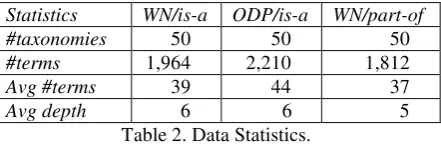
The gold standards used in the evaluation are hypernym taxonomies extracted from WordNet and ODP (Open Directory Project), and me-ronym taxonomies extracted from WordNet. In WordNet taxonomy extraction, we only use the word senses within a particular taxonomy to en-sure no ambiguity. In ODP taxonomy extraction, we parse the topic lines, such as “Topic r:id=`Top/Arts/Movies’”, in the XML databases to obtain relations, such as is_a(movies, arts). In total, there are 100 hypernym taxonomies, 50 each extracted from WordNet3 and ODP4, and 50 meronym taxonomies from WordNet5. Table 2
3
WordNet hypernym taxonomies are from 12 topics: ga-thering, professional, people, building, place, milk, meal, water, beverage, alcohol, dish, and herb.
4
ODP hypernym taxonomies are from 16 topics: computers, robotics, intranet, mobile computing, database, operating system, linux, tex, software, computer science, data commu-nication, algorithms, data formats, security multimedia, and artificial intelligence.
5
WordNet meronym taxonomies are from 15 topics: bed, car, building, lamp, earth, television, body, drama, theatre, water, airplane, piano, book, computer, and watch.
Statistics WN/is-a ODP/is-a WN/part-of
#taxonomies 50 50 50
#terms 1,964 2,210 1,812
Avg #terms 39 44 37
[image:6.595.312.533.71.143.2]Avg depth 6 6 5
summarizes the data statistics.
We also use two Web-based auxiliary datasets to generate features mentioned in Section 3:
•Wikipedia corpus. The entire Wikipedia corpus is downloaded and indexed by Indri6. The top 100 documents returned by Indri are the global context of a term when querying with the term.
•Google corpus. A collection of the top 1000 documents by querying Google using each term, and each term pair. Each top 1000 docu-ments are the global context of a query term. Both corpora are split into sentences and are used to generate contextual, co-occurrence, syntactic dependency and lexico-syntactic pattern features.
5.2 Methodology
We evaluate the quality of automatic generated taxonomies by comparing them with the gold standards in terms of precision, recall and F1-measure. F1-measure is calculated as 2*P*R/ (P+R), where P is precision, the percentage of correctly returned relations out of the total re-turned relations, R is recall, the percentage of correctly returned relations out of the total rela-tions in the gold standard.
Leave-one-out cross validation is used to aver-age the system performance across different training and test datasets. For each 50 datasets from WordNet hypernyms, WordNet meronyms or ODP hypernyms, we randomly pick 49 of them to generate training data, and test on the remaining dataset. We repeat the process for 50 times, with different training and test sets at each
6
http://www.lemurproject.org/indri/.
time, and report the averaged precision, recall and F1-measure across all 50 runs.
We also group the fifteen features in Section 3 into six sets: contextual, co-concurrence, pat-terns, syntactic dependency, word length differ-ence and definition. Each set is turned on one by one for experiments in Section 5.4 and 5.5.
5.3 Performance of Taxonomy Induction
In this section, we compare the following auto-matic taxonomy induction systems: HE, the sys-tem by Hearst (1992) with 6 hypernym patterns; GI, the system by Girju et al. (2003) with 3 me-ronym patterns; PR, the probabilistic framework by Snow et al. (2006); and ME, the metric-based framework proposed in this paper. To have a fair comparison, for PR, we estimate the conditional probability of a relation given the evidence P(Rij|Eij), as in (Snow et al. 2006), by using the same set of features as in ME.
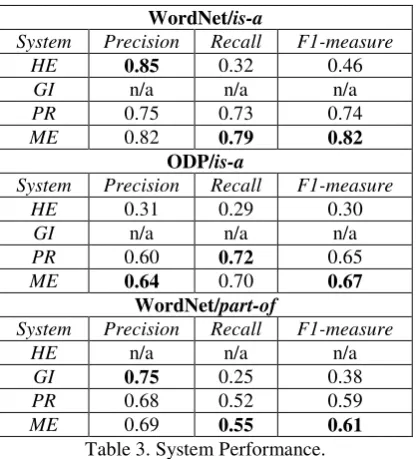
Table 3 shows precision, recall, and F1-measure of each system for WordNet hypernyms (is-a), WordNet meronyms (part-of) and ODP hypernyms (is-a). Bold font indicates the best performance in a column. Note that HE is not applicable to part-of, so is GI to is-a.
Table 3 shows that systems using heterogene-ous features (PR and ME) achieve higher F1-measure than systems only using patterns (HE and GI) with a significant absolute gain of >30%. Generally speaking, pattern-based systems show higher precision and lower recall, while systems using heterogeneous features show lower preci-sion and higher recall. However, when consider-ing both precision and recall, usconsider-ing heterogene-ous features is more effective than just using pat-terns. The proposed system ME consistently pro-duces the best F1-measure for all three tasks.
The performance of the systems for ODP/is-a is worse than that for WordNet/is-a. This may be because there is more noise in ODP than in
WordNet/is-a
System Precision Recall F1-measure HE 0.85 0.32 0.46
GI n/a n/a n/a
PR 0.75 0.73 0.74
ME 0.82 0.79 0.82
ODP/is-a
System Precision Recall F1-measure
HE 0.31 0.29 0.30
GI n/a n/a n/a
PR 0.60 0.72 0.65
ME 0.64 0.70 0.67 WordNet/part-of
System Precision Recall F1-measure
HE n/a n/a n/a
GI 0.75 0.25 0.38
PR 0.68 0.52 0.59
[image:7.595.73.283.72.302.2]ME 0.69 0.55 0.61
Table 3. System Performance.
Feature is-a sibling part-of
Benefited Relations
Contextual 0.21 0.42 0.12 sibling
Co-occur. 0.48 0.41 0.28 All
Patterns 0.46 0.41 0.30 All
Syntactic 0.22 0.36 0.12 sibling
Word Leng. 0.16 0.16 0.15 All but
limited Definition 0.12 0.18 0.10 Sibling but
limited
Best Features Co-occur., patterns
Contextual, co-occur.,
patterns
[image:7.595.295.546.72.229.2]Co-occur., patterns
WordNet. For example, under artificial intelli-gence, ODP has neural networks, natural lan-guage and academic departments. Clearly, aca-demic departments is not a hyponym of artificial intelligence. The noise in ODP interferes with the learning process, thus hurts the performance.
5.4 Features vs. Relations
This section studies the impact of different sets of features on different types of relations. Table 4 shows F1-measure of using each set of features alone on taxonomy induction for WordNet is-a, sibling, and part-of relations. Bold font means a feature set gives a major contribution to the task of automatic taxonomy induction for a particular type of relation.
Table 4 shows that different relations favor different sets of features. Both co-occurrence and lexico-syntactic patterns work well for all three types of relations. It is interesting to see that simple co-occurrence statistics work as good as lexico-syntactic patterns. Contextual features work well for sibling relations, but not for is-a and part-of. Syntactic features also work well for sibling, but not for is-a and part-of. The similar behavior of contextual and syntactic features may be because that four out of five syntactic features (Modifier, Subject, Object, and Verb overlaps) are just surrounding context for a term.
Comparing the is-a and part-of columns in Table 4 and the ME rows in Table 3, we notice a significant difference in F1-measure. It indicates that combination of heterogeneous features gives more rise to the system performance than a sin-gle set of features does.
5.5 Features vs. Abstractness
This section studies the impact of different sets of features on terms at different abstraction
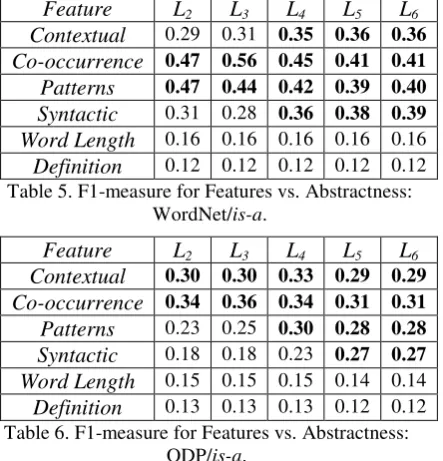
le-vels. In the experiments, F1-measure is evaluated for terms at each level of a taxonomy, not the whole taxonomy. Table 5 and 6 demonstrate F1-measure of using each set of features alone on each abstraction levels. Columns 2-6 are indices of the levels in a taxonomy. The larger the indic-es are, the lower the levels. Higher levels contain abstract terms, while lower levels contain con-crete terms. L1 is ignored here since it only
con-tains a single term, the root. Bold font indicates good performance in a column.
Both tables show that abstract terms and con-crete terms favor different sets of features. In particular, contextual, co-occurrence, pattern, and syntactic features work well for terms at L4
-L6, i.e., concrete terms; co-occurrence works well
for terms at L2-L3, i.e., abstract terms. This
differ-ence indicates that terms at different abstraction levels have different characteristics; it confirms our abstractness assumption in Section 4.1.
We also observe that for abstract terms in WordNet, patterns work better than contextual features; while for abstract terms in ODP, the conclusion is the opposite. This may be because that WordNet has a richer vocabulary and a more rigid definition of hypernyms, and hence is-a relations in WordNet are recognized more effec-tively by using lexico-syntactic patterns; while ODP contains more noise, and hence it favors features requiring less rigidity, such as the con-textual features generated from the Web.
6 Conclusions
This paper presents a novel metric-based tax-onomy induction framework combining the strengths of lexico-syntactic patterns and cluster-ing. The framework incrementally clusters terms and transforms automatic taxonomy induction into a multi-criteria optimization based on mini-mization of taxonomy structures and modeling of term abstractness. The experiments show that our framework is effective; it achieves higher F1-measure than three state-of-the-art systems. The paper also studies which features are the best for different types of relations and for terms at dif-ferent abstraction levels.
Most prior work uses a single rule or feature function for automatic taxonomy induction at all levels of abstraction. Our work is a more general framework which allows a wider range of fea-tures and different metric functions at different abstraction levels. This more general framework has the potential to learn more complex taxono-mies than previous approaches.
Acknowledgements
This research was supported by NSF grant IIS-0704210. Any opinions, findings, conclusions, or recommendations expressed in this paper are of the authors, and do not necessarily reflect those of the sponsor.
Feature L2 L3 L4 L5 L6
Contextual 0.29 0.31 0.35 0.36 0.36
Co-occurrence 0.47 0.56 0.45 0.41 0.41
Patterns 0.47 0.44 0.42 0.39 0.40
Syntactic 0.31 0.28 0.36 0.38 0.39
[image:8.595.65.287.75.306.2]Word Length 0.16 0.16 0.16 0.16 0.16 Definition 0.12 0.12 0.12 0.12 0.12 Table 5. F1-measure for Features vs. Abstractness:
WordNet/is-a.
Feature L2 L3 L4 L5 L6
Contextual 0.30 0.30 0.33 0.29 0.29
Co-occurrence 0.34 0.36 0.34 0.31 0.31
Patterns 0.23 0.25 0.30 0.28 0.28
Syntactic 0.18 0.18 0.23 0.27 0.27
Word Length 0.15 0.15 0.15 0.14 0.14 Definition 0.13 0.13 0.13 0.12 0.12 Table 6. F1-measure for Features vs. Abstractness:
References
M. Berland and E. Charniak. 1999. Finding parts in very large corpora. ACL’99.
S. Boyd and L. Vandenberghe. 2004. Convex optimization. In Cambridge University Press, 2004.
P. Brown, V. D. Pietra, P. deSouza, J. Lai, and R. Mercer. 1992. Class-based ngram models for natural language. Computational Linguistics, 18(4):468–479.
P. Buitelaar, P. Cimiano, and B. Magnini. 2005. Ontology Learning from Text: Methods, Evaluation and Applica-tions. Volume 123 Frontiers in Artificial Intelligence and Applications.
R. Bunescu and R. Mooney. 2007. Learning to Extract Relations from the Web using Minimal Supervision. ACL’07.
S. Caraballo. 1999. Automatic construction of a hypernym-labeled noun hierarchy from text. ACL’99.
T. Chklovski and P. Pantel. 2004. VerbOcean: mining the web for fine-grained semantic verb relations. EMNLP ’04.
P. Cimiano and J. Volker. 2005. Towards large-scale, open-domain and ontology-based named entity classification. RANLP’07.
P. Cimiano and J. Wenderoth. 2007. Automatic Acquisition of Ranked Qualia Structures from the Web. ACL’07.
D. Davidov and A. Rappoport. 2006. Efficient Unsuper-vised Discovery of Word Categories Using Symmetric Patterns and High Frequency Words. ACL’06.
D. Davidov and A. Rappoport. 2008. Classification of Se-mantic Relationships between Nominals Using Pattern Clusters. ACL’08.
D. Downey, O. Etzioni, and S. Soderland. 2005. A Probabil-istic model of redundancy in information extraction. IJ-CAI’05.
O. Etzioni, M. Cafarella, D. Downey, A. Popescu, T. Shaked, S. Soderland, D. Weld, and A. Yates. 2005. Un-supervised named-entity extraction from the web: an ex-perimental study. Artificial Intelligence, 165(1):91–134.
C. Fellbuam. 1998. WordNet: An Electronic Lexical Data-base. MIT Press. 1998.
M. Geffet and I. Dagan. 2005. The Distributional Inclusion Hypotheses and Lexical Entailment. ACL’05.
R. Girju, A. Badulescu, and D. Moldovan. 2003. Learning Semantic Constraints for the Automatic Discovery of Part-Whole Relations. HLT’03.
R. Girju, A. Badulescu, and D. Moldovan. 2006. Automatic Discovery of Part-Whole Relations. Computational Lin-guistics, 32(1): 83-135.
Z. Harris. 1985. Distributional structure. In Word, 10(23): 146-162s, 1954.
T. Hastie, R. Tibshirani and J. Friedman. 2001. The Ele-ments of Statistical Learning: Data Mining, Inference, and Prediction. Springer-Verlag, 2001.
M. Hearst. 1992. Automatic acquisition of hyponyms from large text corpora. COLING’92.
M. D. Hendy and D. Penny. 1982. Branch and bound algo-rithms to determine minimal evolutionary trees. Mathe-matical Biosciences 59: 277-290.
Z. Kozareva, E. Riloff, and E. Hovy. 2008. Semantic Class Learning from the Web with Hyponym Pattern Linkage Graphs. ACL’08.
D. Lin, 1998. Automatic retrieval and clustering of similar words. COLING’98.
D. Lin, S. Zhao, L. Qin, and M. Zhou. 2003. Identifying Synonyms among Distributionally Similar Words. IJ-CAI’03.
G. S. Mann. 2002. Fine-Grained Proper Noun Ontologies for Question Answering. In Proceedings of SemaNet’ 02: Building and Using Semantic Networks, Taipei.
P. Pantel and D Lin. 2002. Discovering word senses from text. SIGKDD’02.
P. Pantel and D. Ravichandran. 2004. Automatically labe-ling semantic classes. HLT/NAACL’04.
P. Pantel, D. Ravichandran, and E. Hovy. 2004. Towards terascale knowledge acquisition. COLING’04.
P. Pantel and M. Pennacchiotti. 2006. Espresso: Leveraging Generic Patterns for Automatically Harvesting Semantic Relations. ACL’06.
F. Pereira, N. Tishby, and L. Lee. 1993. Distributional clus-tering of English words. ACL’93.
D. Ravichandran and E. Hovy. 2002. Learning surface text patterns for a question answering system. ACL’02.
E. Riloff and J. Shepherd. 1997. A corpus-based approach for building semantic lexicons. EMNLP’97.
B. Roark and E. Charniak. 1998. Noun-phrase co-occurrence statistics for semi-automatic semantic lexicon construction. ACL/COLING’98.
R. Snow, D. Jurafsky, and A. Y. Ng. 2005. Learning syntac-tic patterns for automasyntac-tic hypernym discovery. NIPS’05.
R. Snow, D. Jurafsky, and A. Y. Ng. 2006. Semantic Tax-onomy Induction from Heterogeneous Evidence. ACL’06.
B. Rosenfeld and R. Feldman. 2007. Clustering for unsu-pervised relation identification. CIKM’07.
P. Turney, M. Littman, J. Bigham, and V. Shnayder. 2003. Combining independent modules to solve multiple-choice synonym and analogy problems. RANLP’03.
S. M. Harabagiu, S. J. Maiorano and M. A. Pasca. 2003. Open-Domain Textual Question Answering Techniques. Natural Language Engineering 9 (3): 1-38, 2003.
I. Szpektor, H. Tanev, I. Dagan, and B. Coppola. 2004. Scaling web-based acquisition of entailment relations. EMNLP’04.
D. Widdows and B. Dorow. 2002. A graph model for unsu-pervised Lexical acquisition. COLING ’02.