16
Emotion Impacts Speech Recognition Performance
Rushab Munot,
University of Pennsylvania [email protected]
Ani Nenkova,
University of Pennsylvania [email protected]
Abstract
It has been established that the performance of speech recognition systems depends on multiple factors including the lexical content, speaker identity and dialect. Here we use three English datasets of acted emotion to demon-strate that emotional content also impacts the performance of commercial systems. On two of the corpora, emotion is a bigger contributor to recognition errors than speaker identity and on two, neutral speech is recognized consid-erably better than emotional speech. We fur-ther evaluate the commercial systems on spon-taneous interactions that contain portions of emotional speech. We propose and validate on the acted datasets, a method that allows us to evaluate the overall impact of emotion on recognition even when manual transcripts are not available. Using this method, we show that emotion in natural spontaneous dialogue is a less prominent but still significant factor in recognition accuracy.
1 Introduction
Alexa and Google Home are becoming increas-ingly popular, their use spanning a range of ap-plications from reducing loneliness in the elderly (Reis et al., 2017; Ferland et al., 2018) to child entertainment and education (Druga et al.,2017). As these conversational agents become common-place, people are likely to express emotion dur-ing their interactions, either because of their per-ception of the agent or because of the emotion-eliciting situations in which the agent is deployed. In this paper, we set out to study the ex-tent to which emotional conex-tent in speech im-pacts speech recognition performanceof commer-cial systems. Similar studies have been con-ducted in the past to study how recognition varies with gender and dialect (Adda-Decker and Lamel, 2005; Tatman, 2017), lexical content (Goldwa-ter et al., 2010), topical domain (Traum et al.,
2015) and delivery style (Siegler and Stern,1995; Nakamura et al., 2008). A number of stud-ies have studied the impact of stress (Hansen and Patil,2007;Bou-Ghazale and Hansen,2000; Steeneken and Hansen,1999;Hansen,1996) and emotional factors (Polzin and Waibel,1998; Kos-toulas et al., 2008; Benzeghiba et al., 2007) on speech recognition. Multiple studies (Byrne et al., 2004; Athanaselis et al., 2005; Pan et al., 2006; Meng et al., 2007; Ijima et al., 2009;Sun et al., 2009; Sheikhan et al., 2012) tried to improve upon speech recognition accuracies for emotional speech. However, these studies were carried out with older recognition systems. Recently auto-matic speech recognition has seen unprecedented gains in accuracy. Yet our work shows that emotional content still poses problems to speech recognition systems.
In our work we seek to quantify the influence of emotion on recognition accuracy for three com-mercial systems, on several datasets. We start out with two datasets of acted emotion, which are in some respects ideal for the task because the spoken content is constrained to pre-selected utterances and thus manual transcription is not required. In addition, the lexical content for each emotion is identical, so no special adjustment for that con-founding factor is needed in the acted corpora.
reasonable approximation and it can be used for broader studies on factors influencing automatic speech recognition. Here, we apply the method to analyze data from a spontaneous emotional speech corpus.
2 Related Work
There has been much research in the field of emo-tion recogniemo-tion from speech. However, relatively less research has been conducted on how emotion affects Automatic Speech Recognition (ASR).
(Polzin and Waibel, 1998) study the varia-tion in word error rate with different emovaria-tions - NEUTRAL, ANGER, HAPINESS, AFRAID and SADNESS. They observed that SADNESS and AFRAID/FEAR perform worst while NEUTRAL
and ANGERperform best. They integrate prosodic features into the model using Hidden Markov Models to first disambiguate the emotional state of the speaker, and then use emotion specific ASR models for transcription. They report a significant increase in ASR performance.
(Kostoulas et al.,2008) conduct a similar study over a much wider range of emotions (About 15 emotions) on the Wall Street Journal database with Sphinx III as the ASR system and report a large variance in the WER across emotions, ranging from about 6% for NEUTRAL to about 44% for HOTANGER.
(Athanaselis et al., 2005) extract an emotion-allycoloredsubset of the British National Corpus (BNC) and append it multiple times to the BNC before training an emotionally-enhanced ASR sys-tem.
(Sheikhan et al.,2012) propose that the emotion in speech leads to changes in Mel-frequency cep-stral coefficients (MFCC) and thus propose neu-tralizing MFCCs by warping the first three for-mant frequencies and conduct their experiments to analyze improvement in ASR performance for the emotions ANGERand HAPPINESS.
In this work, we analyze the performance of multiple modern commercial ASR systems on emotional speech. We further quantify the corre-lation between the Word Error Rate and emotion. We also compare the dependence of ASR perfor-mance on other factors - speaker identity and spo-ken content with the dependence on emotion.
3 Datasets and APIs
We use three acted Emotion datasets: CREMA-D (Cao et al., 2014), RAVDESS (Steven R. Liv-ingstone1,2018) and MSP-IMPROV (Busso et al., 2017). CREMA-D has 12 sentences recorded by 91 actors in 6 different emotions (Anger, Disgust, Fear, Happy, Neutral and Sad), for a total of 7,442 utterances in the dataset.1
RAVDESS has just two sentences, which are very similar to each other (Kids are talking by the doorandDogs are sitting by the door), recorded by 24 actors in 8 emotions with the addition of Surprised and Calm. RAVDESS has a total of 1,440 utterances, and each sentence is recorded in two intensities with two repetitions of each.
In addition to actors recording sentences in a pre-specified emotion, the MSP-IMPROV dataset contains ‘improvised recordings’, where actors converse to induce the desired emotion. In these interactions, there is at least one emotional ren-dition of the target utterance but other utterances may be emotionally neutral. MSP-IMPROV is comprised of 1,272 utterances distributed over 20 target sentences and four emotions (Neutral, Anger, Happy, Fear). We refer to this part of the corpus as MSP-IMPROV Target, where we only concern ourselves with recognizing the target sen-tence. We refer to the set of complete conver-sations as the MSP-IMPROV Dialogue Corpus. Manual transcripts are not available for this part. MSP-IMPROV has 1,085 complete conversations. Commercial systems used for speech recog-nition are IBM Watson Speech-to-Text, Google Cloud Speech-to-Text and Amazon Transcribe. 2. We will denote the APIs simply by IBM, GCP and AWS respectively.
4 Evaluation Metrics
We report two measures of automatic speech recognition performance: the Word Error Rate (WER) and the percentage of completely recog-nized sentences (CR). Minor semantic and gram-matical errors are ignored by manually listing semantically equivalent sentences for computing CR. We report 1 −CR instead of CR to main-tain consistency withW ERinterpretation, lower
1One of the sentences is recorded in three different inten-sities.
2Websites:
https://www.ibm.com/watson/services/speech-to-text/, https://aws.amazon.com/transcribe/ and
the better. We then perform an ANOVA analysis to determine the statistical significance of each factor in determining the WER.
The dialogues in the MSP-IMPROV corpus do not contain manual transcripts. We propose a met-ric to analyze the relative performance of different systems with varying emotions when manual tran-scripts are not available.
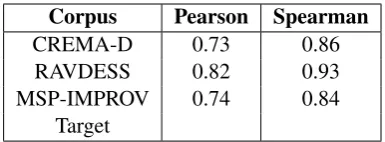
We calculate the performance of every system relative to other systems and then report the aver-age of these cross-comparisons. This method ac-curately predicts the relative performance on emo-tional and neutral speech consistent with WER/CR results on the other corpora for which transcripts are available.
Dataset Metric IBM AWS GCP
CREMA-D WER 10.00 13.09 18.80
1-CR 24.72 39.20 41.78
RAVDESS WER 5.08 13.31 6.19
1-CR 9.17 56.38 15.49
MSP-IMPROV WER 13.90 9.21 12.56
[image:3.595.320.513.61.132.2]Target 1-CR 38.76 35.72 39.54
Table 1: Overall Performance of IBM, AWS and GCP
5 Observations
5.1 Variations across various factors
The overall performance of the APIs on the three datasets is given in Table1. IBM performs best on 2 out of 3 datasets (CREMA-D and RAVDESS). AWS is, however, more consistent across datasets. Figure 1 shows how WER varies with emo-tion. On CREMA-D,NEUTRAL speech is recog-nized more accurately than emotional speech, with
ANGER most accurately recognized among the emotions, while SADNESS and FEAR are poorly recognized. Similarly on RAVDESS, FEAR has
the worst WER. NEUTRAL and ANGER are rec-ognized better than other emotions. On MSP-IMPROV Target, ANGER is recognized most
ac-curately, followed by NEUTRAL speech. Over-all NEUTRAL utterances for all datasets are more accurately recognized than the combined class of emotional speech. Further, there is a high vari-ation in performance between different emotions. Improving performance while focusing on poorly performing emotions like sadness and fear, which have an extremely bad performance, will help im-prove speech recognition.
Corpus Pearson Spearman
CREMA-D 0.73 0.86
RAVDESS 0.82 0.93
MSP-IMPROV 0.74 0.84
Target
Table 2: Spearman and Pearson Correlation between the cross-comparison WER and the observed WER
Performance varies largely with sentences— some show excellent performance while others do not. Performance also varies across APIs— sentences with good performance with one system may perform well with others.
RAVDESS has two similar sentences, and hence it does not make sense to look at performance variation with spoken content on RAVDESS. On MSP-IMPROV Target, the WER varies from lower than 5% for some sentences to above 30% for others. Similar variations are also observed with Speaker Identity.
Corpus IBM
AWS
IBM GCP
AWS GCP
CREMA-D 0.84 0.74 0.85
RAVDESS 0.84 0.63 0.84
MSP-IMPROV 0.67 0.69 0.65
[image:3.595.72.294.276.376.2]Target
Table 3: Spearman Correlation between two-system cross comparison WER and the observed WER
5.2 Evaluating Performance without Manual Transcripts
When manual transcripts are not available, we treat the output of one API as the reference and get WER for other APIs with respect to it. We re-fer to this as thecross-comparisonWER. We then change the reference API and repeat the process. The performance is reported as the average of all cross-reference WERs. In our case, we use three API’s. Thus the average cross-comparison WER is the average of 9 cross-comparison WERs.
[image:3.595.313.519.362.446.2](a) IBM: WER on CREMA-D, RAVDESS and MSP-IMPROV Target
(b) AWS: WER on CREMA-D, RAVDESS and MSP-IMPROV Target
[image:4.595.83.507.76.206.2](c) GCP: WER on CREMA-D, RAVDESS and MSP-IMPROV Target
Figure 1: Performance based on emotion
Dataset Improvisation F-value/ P-value Improvisation Sentence Emotion Actor
CREMA-D 2163 56.6 5.73
RAVDESS 0.02/0.87 12.96 12.54
MSP-IMPROV Target
Complete 71.78 6.99 13.37 32.42
Improvised 42.89 5.92 5.58
Unimprovised 48.37 2.78/0.04 18.75
[image:4.595.84.517.268.381.2]MSP-IMPROV Dialogue 0.11/0.73 0.81/0.48 2.43
Table 4: Statistical significance of various factors on speech recognition performance. For entries where the P-value is not mentioned, it is almost zero.
We also conduct experiments to check whether the metric can be based on two systems instead of three. The Spearman Correlations are tabulated in Table3. The two system cross-comparison metric is representative of the WER but the correlation is not as strong.
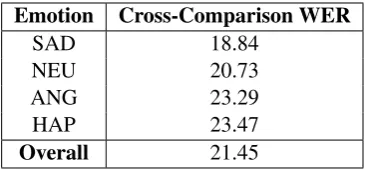
In Table 5, we report cross-comparison WER on the MSP-IMPROV Dialogue subcorpus which includes conversations used to evoke the desired emotion for the target sentence so that the re-quired emotion sounds natural rather than acted. Each conversation is between a male and a fe-male speaker. Emotions in natural speech are not as intense as they are in the acted versions. Also, only parts of the conversations contain tional speech (neutral speech with parts of emo-tional speech) and it is natural to expect that the influence on recognition rates will be attenuated. It is however still present: ANGER and HAPPI
-NESS have much worse recognition than NEU
-TRALspeech. Here however the best recognition is forSADspeech.
Emotion Cross-Comparison WER
SAD 18.84
NEU 20.73
ANG 23.29
HAP 23.47
Overall 21.45
Table 5: Cross-comparison WER for MSP-IMRPOV Dialogue
6 Statistical Significance of Emotion, Speaker and Spoken Content
[image:4.595.325.508.431.516.2]On CREMA-D, the F-value for spoken content is about 40 times that of Emotion. Nevertheless, the Emotion and Actor Identity factors are statis-tically significant. Emotion has a much larger im-pact than actor identity. On RAVDESS, Emotion is slightly more impactful than Speaker Identity.
On MSP-IMPROV Target, the impact of
Speaker Identity is more pronounced. However, on splitting the corpus based on whether the samples were improvised or not, on improvised speech, Emotion has a higher impact than ac-tor identity. For non-improvised speech, Speaker Identity becomes important. Recognizing impro-vised speech, which is closer to natural speech, is more difficult. The impact of Actor Identity is thus lower (in improvised speech) than non-improvised speech. Note that the WER is higher for improvised speech (13.5%) compared to non-improvised speech (10.4%). Surprisingly, the im-pact of Emotion is higher in improvised speech.
For dialogues, Spoken Content has low signif-icance, likely because factors are averaged out. Actor identity and gender of the interlocutor (to-gether) impact recognition most.
7 Conclusions
We quantified the impact of Emotion on speech recognition performance. We developed a metric to analyze performance for audio samples where manual transcripts are unavailable and showed empirically that this metric works. In future work, we plan to analyze whether acoustic fea-tures are predictive of what sentences are likely to be misrecognized and the characteristic features per emotion.
References
Martine Adda-Decker and Lori Lamel. 2005. Do speech recognizers prefer female speakers? In Ninth European Conference on Speech Communica-tion and Technology.
Theologos Athanaselis, Stelios Bakamidis, Ioannis Dologlou, Roddy Cowie, Ellen Douglas-Cowie, and Cate Cox. 2005. ASR for emotional speech: Clari-fying the issues and enhancing performance.Neural Networks, 18(4):437–444.
Mohamed Benzeghiba, Renato de Mori, Olivier Deroo, St´ephane Dupont, Teodora Erbes, Denis Jouvet, Luciano Fissore, Pietro Laface, Alfred Mertins, Christophe Ris, Richard Rose, Vivek Tyagi, and Christian Wellekens. 2007. Automatic speech
recognition and speech variability: A review. Speech Communication, 49(10-11):763–786.
Sahar E. Bou-Ghazale and John H. L. Hansen. 2000.
A comparative study of traditional and newly pro-posed features for recognition of speech under stress. IEEE Trans. Speech and Audio Processing, 8(4):429–442.
Carlos Busso, Srinivas Parthasarathy, Alec Burmania, Mohammed Abdel-Wahab, Najmeh Sadoughi, and Emily Mower Provost. 2017. MSP-IMPROV: an acted corpus of dyadic interactions to study emo-tion percepemo-tion. IEEE Trans. Affective Computing, 8(1):67–80.
William Byrne, David S. Doermann, Martin Franz, Samuel Gustman, Jan Hajic, Douglas W. Oard, Michael Picheny, Josef Psutka, Bhuvana Ramab-hadran, Dagobert Soergel, Todd Ward, and Wei-Jing Zhu. 2004. Automatic recognition of sponta-neous speech for access to multilingual oral history archives. IEEE Trans. Speech and Audio Process-ing, 12(4):420–435.
Houwei Cao, David G Cooper, Michael K Keutmann, Ruben C Gur, Ani Nenkova, and Ragini Verma. 2014. Crema-d: Crowd-sourced emotional multi-modal actors dataset.IEEE transactions on affective computing, 5(4):377–390.
Stefania Druga, Randi Williams, Cynthia Breazeal, and Mitchel Resnick. 2017. ”hey google is it ok if i eat you?”: Initial explorations in child-agent interac-tion. InProceedings of the 2017 Conference on In-teraction Design and Children, IDC ’17, pages 595– 600. ACM.
Libby Ferland, Ziwei Li, Shridhar Sukhani, Joan Zheng, Luyang Zhao, and Maria Gini. 2018. As-sistive ai for coping with memory loss.
Sharon Goldwater, Dan Jurafsky, and Christopher D Manning. 2010. Which words are hard to rec-ognize? prosodic, lexical, and disfluency factors that increase speech recognition error rates. Speech Communication, 52(3):181–200.
John H. L. Hansen. 1996. Analysis and compensation of speech under stress and noise for environmental robustness in speech recognition.Speech Communi-cation, 20(1-2):151–173.
John H. L. Hansen and Sanjay A. Patil. 2007. Speech under stress: Analysis, modeling and recognition. In Speaker Classification.
Theodoros Kostoulas, Iosif Mporas, Todor Ganchev, and Nikos Fakotakis. 2008. The effect of emotional speech on a smart-home application. InNew Fron-tiers in Applied Artificial Intelligence, 21st Interna-tional Conference on Industrial, Engineering and Other Applications of Applied Intelligent Systems, IEA/AIE 2008, Wroclaw, Poland, June 18-20, 2008, Proceedings, pages 305–310.
Hong Meng, Johannes Pittermann, Angela Pittermann, and Wolfgang Minker. 2007. Combined speech-emotion recognition for spoken human-computer in-terfaces. In 2007 IEEE International Conference on Signal Processing and Communications, pages 1179–1182. IEEE.
Masanobu Nakamura, Koji Iwano, and Sadaoki Furui. 2008. Differences between acoustic characteristics of spontaneous and read speech and their effects on speech recognition performance. Computer Speech & Language, 22(2):171–184.
YC Pan, MX Xu, LQ Liu, and PF Jia. 2006. Emotion-detecting based model selection for emo-tional speech recognition. InThe Proceedings of the Multiconference on” Computational Engineering in Systems Applications”, volume 2, pages 2169–2172. IEEE.
Thomas S. Polzin and Er Waibel. 1998. Pronunciation variations in emotional speech. InIn: Proc. of the ESCA Workshop Modeling Pronunciation Variation for Automatic Speech Recognition, pages 103–1008.
Ars´enio Reis, Dennis Paulino, Hugo Paredes, and Jo˜ao Barroso. 2017. Using intelligent personal assistants to strengthen the elderlies social bonds. In Interna-tional Conference on Universal Access in Human-Computer Interaction, pages 593–602. Springer.
Mansour Sheikhan, Davood Gharavian, and Farhad Ashoftedel. 2012. Using DTW neural-based MFCC warping to improve emotional speech recognition. Neural Computing and Applications, 21(7):1765– 1773.
Matthew A Siegler and Richard M Stern. 1995. On the effects of speech rate in large vocabulary speech recognition systems. InAcoustics, Speech, and Sig-nal Processing, 1995. ICASSP-95., 1995 Interna-tional Conference on, volume 1, pages 612–615. IEEE.
Herman J. M. Steeneken and John H. L. Hansen. 1999.
Speech under stress conditions: overview of the ef-fect on speech production and on system perfor-mance. In Proceedings of the 1999 IEEE Interna-tional Conference on Acoustics, Speech, and Signal Processing, ICASSP ’99, Phoenix, Arizona, USA, March 15-19, 1999, pages 2079–2082.
Frank A. Russo Steven R. Livingstone1. 2018.The ry-erson audio-visual database of emotional speech and song (ravdess): A dynamic, multimodal set of fa-cial and vocal expressions in north american english. PLoS ONE, 13(5): e0196391.
Yanqing Sun, Yu Zhou, Qingwei Zhao, and Yonghong Yan. 2009. Acoustic feature optimization for emo-tion affected speech recogniemo-tion. 2009 International Conference on Information Engineering and Com-puter Science, pages 1–4.
Rachael Tatman. 2017. Gender and dialect bias in youtube’s automatic captions. InProceedings of the First ACL Workshop on Ethics in Natural Language Processing, pages 53–59.