The Expert Group on Future
Skills Needs Statement of
Activity 2011
Foreword
Ireland’s labour market is facing a number of related challenges – returning to employment growth, achieving significant recovery in our labour market participation rates and equipping people for the jobs of tomorrow. Long term unemployment continues to rise, reflecting a significant structural element to employment losses in construction and traditional manufacturing. At the same time, the global demand for skills in key sectors such as ICT, Life Sciences and Internationally Traded Services remains strong, as evidenced by the nature of the significant foreign direct investment into Ireland in 2011.
During 2011, the EGFSN worked in consultation with enterprise to identify specific current and future skills needs in relation to the availability of high-level ICT skills for the ICT sector and other sectors such as International Financial Services, Banking and Business Services. The supply of high level ICT and engineering skills is important not only in terms of meeting current demand, but also in driving demand, growing new business and winning new projects from multinationals. The EGFSN worked actively to support the Department of Education and Skills and the Higher Education Authority on the range of initiatives to address the issues raised by enterprise, which are in the ICT
Action Plan: Meeting the High-Level Skills Needs of Enterprises in Ireland.
A number of cross-sectoral skills are in demand. The importance of foreign languages and relevant work experience as an integral part of the skills portfolio of jobseekers continues to arise in EGFSN research. Forthcoming research on skills required by enterprise for trading internationally show a strong demand for specific skills in areas such as international sales, channel management, export planning, market identification, negotiation, e-business, quality control and cultural awareness. Equally, the need for soft skills, particularly good written and verbal communication skills, teamwork and problem-solving skills, are in demand by employers.
Over the last 12 months the EGFSN continued to monitor skills trends and shortages through the
National Skills Bulletin 2011 and the Vacancy Overview 2011 and to provide an overview of the
supply of skills from the Irish education system in the Monitoring Ireland’s Skills Supply 2011 publication. In particular, these publications show small numbers of persisting shortages within the Science, Technology, Engineering and Maths (STEM) related occupations. It is encouraging that participation on STEM related programmes has increased notably in the past number of years. These sectors will be pivotal to Ireland’s long term economic prospects.
Prior Learning (RPL), published in 2011, considered the role RPL can play in progressing the
upskilling targets in the National Skills Strategy.
The dichotomy that has emerged between where employment losses have been sustained on the one hand and where the jobs of the future are on the other is one of the major challenges to be
addressed in providing interventions for those that are unemployed. It highlights the imperative to upskill and re-skill large numbers of people to sectors of the economy that will drive economic growth. Interventions may be needed before many of the long term unemployed are able to secure jobs. The education and training system needs to respond appropriately to this challenge.
Structured internships or work experience opportunities within enterprise are hugely valuable in improving the employability of job–seekers, new graduates and first time entrants into the labour market. Recent initiatives, such as Springboard and JobBridge, which provide opportunities to develop such skills, are welcomed in this regard. It is important that these measures are evaluated and best practice is expanded upon where appropriate.
The Expert Group on Future Skills Needs (EGFSN) welcomes the emphasis on education and training and aligning skills with the needs of enterprise in the Government’s recently published Action Plan
for Jobs 2012. Having the right skills and talent base will be a key driver of recovery in our economy
and labour market. It is vitally important now that key measures such as the Jobs Action Plan,
Pathways to Work and the establishment of SOLAS are implemented swiftly and effectively in order
to ensure that those seeking to re-enter the labour market have access to education and skills programmes that are relevant to enterprise and appropriate to the individual. Equally, our
education and training system has to be flexible and responsive to evolving skills requirements, with an emphasis on both specific skills needs and developing skills for employability that can help promote mobility within and between sectors. It is important that employers and education and training providers work together to ensure these goals are achieved.
The EGFSN continues to engage with a wide range of stakeholders to communicate its key findings and messages via our website www.egfsn.ie, direct mailing of our reports to interested parties, key note speakers at conferences and presenting its findings to guidance associations, further and higher education and training providers, industry groups and policy makers. The work of the EGFSN helps to inform education and training providers on the required alignment of programmes to meet enterprise skills needs, assist individuals to make an informed decision around employment
opportunities and career choice and underpin labour market activation programmes.
I would like to thank the members of the Expert Group on Future Skills Needs for their commitment to this important work. I would also like to thank Forfás and the Skills and Labour Market Research Unit, FÁS for the research and analysis support that they provide to the group.
Una Halligan
Members of the Expert Group on Future Skills Needs
Una Halligan Chairperson
Marie Bourke Head of Secretariat and Department Manager, Education, Skills and Labour Market Policy, Forfás
Inez Bailey Director, National Adult Literacy Agency
Peter Baldwin Assistant Secretary, Department of Education and Skills
George Bennett Departmental Manager, Clean Tech, IDA Ireland
Liz Carroll Training and Development Manager, ISME
Ned Costello Chief Executive, Irish Universities Association
Margaret Cox Managing Director, I.C.E. Group
Tony Donohoe Head of Education, Social and Innovation Policy, IBEC
Dr Bryan Fields Director, Curriculum Development / Programme Innovation, FÁS
Anne Forde Principal Officer, Department of Education and Skills
Garry Keegan Director, Acumen
Enda McDonnell Sectoral and Enterprise Development Policy, Enterprise Ireland
John Martin Director for Employment, Labour & Social Affairs, OECD
Frank Mulvihill Former President of the Institute of Guidance Counsellors
Dr Brendan Murphy President, Cork Institute of Technology
Dermot Nolan Department of Public Expenditure and Reform
Alan Nuzum CEO, Skillnets
Muiris O’Connor Higher Education Authority
Peter Rigney Industrial Officer, ICTU
Martin D. Shanahan Chief Executive, Forfás
Introduction
The Expert Group on Future Skills Needs (EGFSN) has the task of advising Government on future skills requirements and associated labour market issues that impact on enterprise and employment growth.
Specifically, the Group carries out analysis in order to:
Advise Government on projected skills needs at national and sectoral levels and make recommendations on how best to address identified needs;
Advise Government on associated priority education and training requirements and the most cost effective ways of responding to them;
Advise Government on any skills requirements that cannot be met internally at a given time and that so require to be met through inward migration;
Advise Government on the content, delivery and outcomes of education and training programmes elsewhere that support excellence and value for money and on adaptations necessary to incorporate such developments here;
Respond to any request for advice from the Minister for Education and Skills on training programmes that are supported through the National Training Fund; and
Report on progress made in the implementation of its recommendations.
The Group is composed of representatives of business, employees, education, training, Government departments and State agencies.
The following Statement of Activity provides details of the Group’s output and activity in 2011, forthcoming work in 2012, and information on the Group’s research and analysis resources.
Activities of the Expert Group in 2011
Addressing ICT Skills Recruitment Difficulties of Foreign Owned and Indigenous
Companies
Recruitment difficulties relating to high-level ICT skills, within both the ICT sector and from other sectors such as international financial services, banking and business services, have been raised through the work of the EGFSN. During 2011, the EGFSN (with the support of IDA Ireland and Enterprise Ireland) engaged in discussions with a selected range of foreign–owned and Irish
companies to establish the nature of positions involved, the reasons for recruitment difficulties and to identify measures to help address them.
The findings of the EGFSN research were compiled in a paper entitled Addressing High-Level ICT
Skills Recruitment Needs, published in January 2012. Current skills recruitment difficulties mainly
relate to high–level ICT Honours Bachelor Degree (NFQ Level 8) and above – both for graduate entry level positions and particularly for ICT professionals with experience. Companies are sourcing approximately 55% of their high-level ICT skills supply needs (for expansion and replacement needs) through inward migration, although with increasing difficulty, as these skills are also in high demand globally.
In response to these findings a working group, led by the Department of Education and Skills, and including the HEA and the EGFSN was established to identify more precisely what the high-level skills needs were and to develop a range of initiatives to meet these skills needs. In January 2012 the Action Plan to Address ICT Skills Needs was published, which outlines key actions around:
Upskilling and conversion actions that will be taken in the short-term to increase the domestic supply of ICT skills over the period 2012-2014;
Actions to ensure an increased output of appropriately skilled graduates in the medium term 2015-2018 by:
Increasing the number of students with good mathematical skills into ICT undergraduate programmes;
Increasing the mathematical proficiency of students leaving the second level system;
Improving retention levels on undergraduate ICT programmes;
Ensuring higher education programmes are aligned to changing needs of the ICT enterprise sector.
Springboard Higher Education Labour Market Activation Call
Springboard is a labour market activation measure announced by the Department of Education and Skills in December 2010. Its primary objective is to enable unemployed people, who have a previous history of employment, to access part-time flexible higher education and training
opportunities in order to upskill or reskill in areas where sustainable employment opportunities may arise as the economy recovers.
In January 2011 a call for proposals to provide relevant education courses was issued to public and private higher education providers. At the request of the Department of Education and Skills, guidelines were compiled, which accompanied the competitive call. The paper Guidance for higher
education providers on current and future skills needs of enterprise outlined, based on skills needs
identified by the EGFSN, specific enterprise skills demands around which training programmes could be designed. This ensured that provision is highly relevant to enterprise skills needs and therefore should have optimal labour market outcomes for participants.
Following the January Call for Proposals, an evaluation panel selected 210 part-time higher education courses targeted at unemployed jobseekers. The courses will be delivered by 34 higher education colleges, public, private and not-for-profit education and training providers, around the country.
On 25 May 2011, Springboard was launched by the Minister for Education and Skills. The website
www.bluebrick.ie/springboard includes information on courses available under the initiative. 5,885 places were made available, with a contract value of €19.7m.
The approved courses range across the seven areas of skills need as identified by the guidelines document, based on the skills needs identified by the EGFSN: the green economy; information and communications technology (ICT); the biopharma-pharmachem industry; international financial services; medical devices; food and beverage; and advanced business/management skills.
Springboard Courses by Skills Area
Skills Category Places Allocated Percentage
ICT 2084 35% Business/Management Skills 1486 25% Green Economy 725 12% Medical Devices 726 12% Bio-Pharmachem 438 7% Food & Beverage 266 5% International Financial
Services 150 3%
Grand Total 5875 100%
National Skills Bulletin 2011
The National Skills Bulletin 2011, published in July 2011, is the seventh in a series of reports produced annually by the Skills and Labour Market Research Unit in FÁS on behalf of the EGFSN. The report provides an overview of the Irish labour market at occupational level.
Vacancies
Despite the recession, and at a significantly lower level than in 2007, vacancies continue to arise, with an increase in the level of vacancies in the first quarter of 2011 compared with 2010. Most vacancies are for clerical, sales and service occupations, which are associated with high replacement and turnover rates. Vacancies are also found in the areas
of ICT, engineering, healthcare, finance and customer care (including technical support). Third level education, experience and languages are the most frequently mentioned requirements from prospective employers.
Skills Shortages
Although in general, the supply of labour is greater than demand, in some areas shortages continue to exist. They are small in terms of the number of persons required, unlikely to be greater than several hundred, and confined to individuals with high level skills, experience and/or niche area expertise. Areas where shortages have been identified include ICT (e.g. senior software developers, network engineers, project managers), engineering (e.g. product development in pharmaceuticals), healthcare (e.g. doctors), sales (e.g. multilingual telesales), transport (e.g. international supply chain managers), science (e.g. medical scientists) and finance (e.g. risk and regulatory experts).
Employment Permits
Sourcing of highly skilled workers (primarily in ICT and healthcare) from abroad continued during 2010, although the number of new employment permits issued to non-EEA citizens was significantly lower than at the peak recorded in 2007.
Cohorts at Greatest Risk of Unemployment
During 2010, males, under-25s, early school leavers, non-Irish nationals, residents of the South-East region and construction workers (craft persons and labourers) continued to be at a greater risk of unemployment than their counterparts.
Monitoring Ireland's Skills Supply 2011 - Trends in Education and Training
Outputs
This report, published in July 2011, is the sixth in a series of annual reports produced by the Skills and Labour Market Research Unit of FÁS on behalf of the Expert Group on Future Skills Needs.
The report provides an indication of the supply of skills to the Irish labour market from the formal education and training system by examining outflows from the education system across levels 1-10 of the National Framework of Qualifications (NFQ).
Demographic Profile
Inflows to the education and training system continued to grow across almost all sectors of the education and training system (except junior infants). New entrants to higher education rose by 5% between 2008 and 2009.
Education and Training
There were just over 200,000 awards made in 2009/2010 across all levels on the National
Framework of Qualifications, a 1.5% rise on the preceding year. 86,200 people received awards in further education & training (major awards) and higher education:
30% at level 8 (honours bachelor degree) which is almost the same as the previous year;
19% were for postgraduate awards, a 5% increase on the previous year;
The largest increase was at level 5 where the number of FETAC major awards increased by 18%.
There are promising signs for technology subjects at higher education. With the exception of construction, CAO level 8 acceptances increased for science and technology subjects which will impact positively on graduate output in the medium term. The number of PhD graduates in science increased by 26% between 2008 and 2009.
Lifelong Learning
Approximately 111,000 persons aged 25+ participated in lifelong learning (LLL) in quarter 4 2010, representing 4.5% of the adult population. Over the period quarter 4 2005 to quarter 4 2010, the number of LLL participants increased by 40% (or 32,000 learners).
Monitoring Ireland’s Skills Supply serves as a valuable tool in the EGFSN’s role in advising the Irish
Vacancy Overview 2010
Vacancy Overview 2010, published in March 2011, is the first annual
vacancy report by the EGFSN. The report is produced by the Skills and Labour Market Research Unit of FÁS and draws on a number of data sources held in the National Skills Database to provide an overview of the demand for labour as measured by trends in advertised job vacancies.
Overall Vacancies
Although the number of newly advertised vacancies is significantly lower than at the peak in 2007, vacancies continue to arise. The overall number of vacancies in 2010 was up on the previous year for both FÁS and Irishjobs.ie sources.
Newly Advertised Vacancies
Newly advertised vacancies in Irishjobs.ie and the Irish Times were mostly concentrated in
managerial, professional, associate professional occupations and jobs related to various aspects of customer care; newly advertised vacancies in FÁS Jobs Ireland were concentrated in personal services (e.g. care, catering and security) and sales (including customer care activities). Newly advertised vacancies for professionals spanned a range of fields: ICT, engineering (e.g. energy systems), health, finance and related vacancies.
Customer care related vacancies featured prominently in all sources; they spanned different sectors and levels of skill. Vacancies have continued to exist at the lower end of the skills scale with
numerous vacancies advertised monthly for security guards, catering staff, carers etc.
Language skills were a prerequisite for many of the newly advertised vacancies particularly in customer care activities; while the demand spanned a variety of languages, German, French and Nordic languages were most frequently mentioned as a requirement. The minimum education requirement for a significant share of all newly advertised vacancies was a third level qualification. The data suggests that the demand is mostly limited to experienced candidates.
Difficult to Fill Vacancies
Employers have vacancies that are proving difficult to fill with suitable candidates. Vacancies exist for a number of occupations (e.g. ICT professionals, financial experts, engineering experts,
healthcare professionals etc.). Data on employment permits issued to non-EEA nationals confirms that employers are sourcing some skills from outside the EEA area (e.g. ICT professionals, managers, nurses, doctors, etc.).
By highlighting areas where employment opportunities exist, the analysis of the Vacancy Overview
2010 data assists with career guidance, and the alignment of labour market activation measures
Developing Recognition of Prior Learning (RPL) in the context of the National
Skills Strategy Upskilling Objectives
The EGFSN was requested, by the Department of Education and Skills, to investigate the potential for the recognition of prior learning in assisting in the upskilling objectives of the National Skills Strategy. A paper prepared by the EGFSN, in conjunction with the National Qualifications Authority of Ireland (NQAI) Executive, was published in April 2011.
RPL is defined as: ‘the process by which prior learning is given a value. It is a means by which prior learning is formally identified, assessed and acknowledged’. Prior learning encompasses:
Formal learning which takes place through programmes of study or training that are delivered by education or training providers, and which attract awards;
Non-formal learning that takes place alongside the mainstream systems of education and training, such as learning and training activities undertaken in the workplace, voluntary sector or trade union and in community-based learning;
Informal learning that takes place through life and work experience.
RPL has a role in meeting the following objectives:
Labour Market Activation - the need to reduce unemployment, particularly those that are long-term unemployed and those with relatively low levels of qualifications;
Effective Resource Utilisation - the need to utilise education and training resources as effectively as possible at a time of unprecedented demand;
Upskilling - the need to continue to upskill the labour force (employed and unemployed), and facilitate access and participation in lifelong learning;
Learner-Focused Provision - the need to provide an education and training service for people and enterprises that is flexible, relevant and appropriate to their needs;
National Strategy Targets - contribute to targets to increase retention/participation rates in education and training, driven by the National Skills Strategy, the National Plan for Equity of Access in Higher Education and the National Plan for Social Inclusion.
The main finding of the report is that while significant experience of RPL has been developed in Ireland, a co-ordinated national policy approach is required. The development of RPL at NFQ levels 1-6 will require support from guidance services and from public employment services with regard to informing and directing individuals towards RPL.
Other Activities & Policy Inputs by the EGFSN in 2011
Joint submission (EGFSN/Forfas/NCC) to the NCCA consultation on the draft
Leaving Certificate Enterprise short course
In October 2011, a joint submission from the Expert Group on Future Skills Needs (EGFSN), Forfás, and the National Competitiveness Council (NCC) was made to the National Council for Curriculum and Assessment’s (NCCA) consultation on the draft Enterprise Leaving Certificate Short Course.
The submission welcomed the draft course as proposed, particularly the skills emphasised within the course such as self-directed learning, critical and creative thinking, information processing,
teamwork and project management which are highly relevant to the modern economy and workplace.
The submission made some suggestions as to how the course could be further enhanced based on the research findings of the EGFSN, Forfás and the NCC particularly around: placing greater emphasis on internationalisation and the need to ‘think globally’; the significance of management development, sales and marketing skills; the importance of foreign language skills and
understanding of world cultures and; the need for an increased emphases on developing the concepts of innovation within the course.
The key priorities that the EGFSN, Forfás, and the NCC emphasised for inclusion in the Enterprise course are in the following areas:
The course content could have more of an international dimension. At present it is heavily focussed on local and community enterprises. The need to ‘think globally’ is critical to
enterprise skills in Ireland, especially for a country that depends so significantly on its ability to compete globally.
The similarities and differences between different types of enterprise (e.g. SMEs/Large Companies, Multinationals, Indigenous, Manufacturing, Services, etc) could be explored. The importance of foreign languages and understanding of world cultures from an enterprise perspective could also be integrated.
References to ‘innovation’ are quite lacking in the proposed course. ‘Innovation’ has become a pervasive concept in the modern business environment and vocabulary and could perhaps be given greater profile within the course.
Some of the concepts of enterprise are not easily explained. It is important that the teaching of enterprise concepts and traits is related to real world examples. Case studies of famous
entrepreneurs could be useful in this regard.
Submission on the National Strategy to Improve Literacy and Numeracy among
Children & Young People 2011-2020
In February 2011, a joint submission from Forfás and the EGFSN was made to the consultation process for the National Strategy to Improve Literacy and Numeracy among Children and Young
People 2011-2020.
The main EGFSN/Forfás priorities highlighted were:
Ensure that the Strategy highlights the clear link between literacy and numeracy skills and their importance in the economy and the workplace;
The need to integrate literacy and numeracy across disciplines;
The need to improve CPD in literacy and numeracy for teachers and to raise CPD participation;
The need for more frequent assessment and use of resulting data to improve practice.
These priorities are strongly reflected in the final Strategy which was launched by the Minister for Education and Skills on 8 July 2011. Specifically, the Strategy strongly links literacy and numeracy to employability and economic prosperity.
National Skills Database
The National Skills Database (NSD), developed and maintained by the Skills and Labour Market Research Unit (SLMRU) of FÁS, collates all available information on the supply and demand of skills in Ireland. It represents an effective tool for timely analysis and forecasting of the labour market at sectoral and occupational level. Potential imbalances between the demand and supply of skills can be assessed using the wide range of indicators gathered in the NSD.
During 2011 the NSD was updated to include the latest statistics and information on the following:
Employment
Education and training output
Immigrant labour force
Notified job vacancies (for example: The Irish Times, Irish Jobs.ie, FÁS)
Labour force forecasting model
Occupational employment forecasting models
Implementation of Recommendations in EGFSN Reports
Ongoing monitoring of progress on implementation of recommendations, including a review of sectoral studies six months after completion, is undertaken by the EGFSN. Sectoral reports are widely disseminated to stakeholders. Those identified with the responsibility of implementing the recommendations are formally notified and invited to inform the EGFSN six months after publication of the report of progress on implementation.
A commentary on implementation is also included in the EGFSN’s Annual Activity Statement which is provided to both the Minister for Education and Skills and the Minister for Jobs, Enterprise and Innovation.
Future Skills Needs of Enterprise within the Green Economy in Ireland
The EGFSN report Future Skills Needs of Enterprise within the Green Economy in Ireland, published in November 2010, identifies the future skills needs of enterprises engaged within the ‘green economy’ in Ireland and proposes a range of measures to ensure that their future skills base will drive business and employment growth.
Launched by the Irish Government in May 2011, Springboard is a multi-annual fund which will provide free part-time higher education courses in areas of current and future skills need. A
document Guidance for higher education providers on current and future skills needs of enterprise, which accompanied the competitive tender under the fund, was based on identified areas of skills needs as compiled by the EGFSN. 750 places on green economy courses were awarded under Springboard in 2011.
Future Skills Requirements of the Biopharma-Pharmachem Sector
The EGFSN report Future Skills Requirements of the Biopharma-Pharmachem Sector, published in November 2010, assesses the demand for skills in the biopharma-pharmachem sector in the period 2010-2015, and identifies what actions needed to be taken to ensure that the supply of these skills is available to drive the future growth of the sector in Ireland.
Future Skills Requirements of the Food and Beverage Sector
The EGFSN report Future Skills Requirements of the Food and Beverage Sector, published in November 2009, provides an analysis of skills in the food and beverage industry, and identifies action required to deliver skills requirements that will underpin the industry’s future growth.
The Steering Group for the EGFSN food and beverage study was reconvened in May 2010 to review progress on implementation of the recommendations contained in the report, and progress on a number of issues was reported at that stage.
Further initiatives were noted in March 2011 and discussions took place with the VECs in relation to progressing implementation of basic skills for low skilled operatives in the food and beverage sector.
In April 2011 the EGFSN presented on its skills report and progress on implementation of the report recommendations to the Harvest 2020 Implementation Group, chaired by the Minister for
Agriculture, Food and the Marine, Simon Coveney, TD.
The Action Plan for Jobs 2012, published February 2012, calls for the provision of funding from the Workplace Basic Education Fund for up-skilling workers in sectors including the Food and Beverage Sector.
Future Skills Needs of the Wholesale and Retail Sector
The EGFSN report Future Skills Needs of the Wholesale and Retail Sector, published in May 2010, assesses the skills requirements of the wholesale and retail sector in Ireland over the period to 2016, and identifies actions required to meet these skills needs.
As part of the EGFSN’s role in monitoring progress on implementation, the Chair of the Expert Group convened a meeting of key stakeholders on 31 May 2011 to discuss development of the report recommendations and how implementation could be further progressed.
Progress was reported on a number of areas. One such area is the development of common awards standards for retail at Levels 4, 5 and 6 on the National Framework of Qualifications. Recognition of Prior Learning activity is increasing in the sector and the Springboard Initiative provided
approximately 12 programmes relevant to specialist professional occupations within the retail sector.
Dissemination of Future Skills Needs of Enterprise and
Other Labour Market Information
During 2011, the EGFSN continued to engage with stakeholders to ensure that key labour market information was disseminated to all relevant parties. The Group provided presentations on a wide range of labour market issues at conferences and fora throughout the year, including: OECD International conference: Building quality jobs in the recovery, Adult Education Officers
Association, Dundalk IT North East Further and Higher Education Alliance Workshop, DCU Careers Boot Camp, and IBEC/IGC Careers Conference. In addition, the Group’s output continues to be disseminated to guidance counsellors, students (secondary level, further education and training, and higher education), parents and teachers, through the targeted websites such as Careers Portal, Discover Science and Engineering, Qualifax and Career Directions to inform their target audiences.
Progress on the National Skills Strategy 2020 targets
The EGFSN is mandated, by the Department of Education and Skills, to report annually on progress made on reaching the targets set out in the National Skills Strategy for 2020.
The key proposals in the National Skills Strategy for 2020 are that:
48 percent of the labour force should have qualifications at National Framework of
Qualifications (NFQ) levels 6-10 – i.e. from higher/advanced certificate to PhD level;
45 percent should have qualifications at NFQ levels 4 and 5 – Awards equivalent to upper
secondary level education; and
The remaining 7 percent are likely to have qualifications at NFQ levels 1 to 3 (equivalent or below Junior Certificate) while aiming to make the transition to higher levels of educational attainment.
In order to achieve these objectives, action is required at a number of levels:
An additional 500,000 individuals within the workforce will need to progress by at least one level on the National Framework of Qualifications. More specifically, the targets will entail up-skilling 70,000 from NFQ levels 1 & 2 to level 3; 260,000 up to levels 4 & 5; and 170,000 to levels 6 to 10.
The proportion of the population aged 20-24 with NFQ level 4 or 5 awards should be increased to 94 percent, either through completion of the Leaving Certificate or through equivalent, more vocationally oriented programmes. The retention rate at Leaving Certificate should reach 90 percent by 2020.
The progression rate to third level education will have to increase from 55 to 72 percent.
Progress on headline target
Ireland continues to make progress towards achieving the National Skills Strategy (NSS)targets: During 2010, the share of third level graduates increased to 41%, while the share of the labour force with less than upper secondary education declined to below 20%. Further improvements are
Figure 1 Labour Force by Educational Attainment and NSS Target
Source: CSO Quarterly National Household Survey
The percentage of those in the labour force with Higher Education qualifications (NFQ Levels 6-10) has increased from 33% in 2005 to 41% in 2011. Specifically, there are 196,800 more people in the labour force in Q3 2011 with Higher Education Level qualifications than there were in 2005. The prospects for meeting the target of 48% of the labour force possessing a Higher Education Level qualification by 2020 set out in the National Skills Strategy would appear to be good based on current trends.
In relation to Levels 4 & 5 (Upper Secondary including Leaving Certificate), the percentage rate in 2011 remains at 40%, the same level as in 2005. In absolute terms, the number of those within the labour force with Upper Secondary/PLC level education has increased by 35,800 since 2005. This is the net effect of:
improvements in progression and retention rates:
the percentage rate for early school leavers has declined from 13% in 2006 to 9% in 20111.
the percentage of the population aged 20-24 with at least Upper Secondary or equivalent level education increased from 86% in 2005 to 89% by 20112, compared to the 2020 target of
94%.
1 CSO, QNHS, Educational Attainment Thematic Report, Q2 2011, Table 10a
27% 27% 26% 24%
22% 20% 19%
7% 40% 40% 40% 40% 40% 40% 40% 45%
33% 33% 34% 36%
38% 40% 41%
48% 0% 10% 20% 30% 40% 50% 60% 70% 80% 90% 100%
Q2 2005 Q2 2006 Q2 2007 Q2 2008 Q2 2009 Q2 2010 Q3 2011 National Skills Strategy Vision 2020
Progress towards the NSS targets Q2 2005‐Q1 2011
Third level and above
Upper secondary/PLC
retention at Leaving Cert for the latest available cohort of entrants (2004 entrants3) has
also risen from 81.3% (in 1996) to 87.7%, compared to a 2020 target of 90%.
Some people moving up from Levels 4 & 5 to higher levels and others moving up to Levels 4 & 5 from lower Levels.
There still remains a considerable challenge in closing the gap with the National Skills Strategy target at NFQ Level 4 & 5.
There has been some progress at Levels 1-3 (Junior Certificate and below) with the percentage of the labour force at these levels falling from 27% in 2005 to 19% in 2011. FETAC data shows there is historically a low level of participation at NFQ levels 1-2 relative to other levels. Awards at these levels have only recently been introduced, which will facilitate progression to subsequent levels.
Specifically, there are 151,500 less people in the Labour Force with only a Junior Cert qualification or below compared with 2005. Some of this decline is due to people moving up to higher levels in the National Framework of Qualifications, however, some is also due to older cohorts with a lower qualifications profile retiring from the labour force in addition to declining participation rates4
amongst those at these lower qualification levels in the past three years. The progress made so far indicates that the most significant challenge for the period to 2020 is upskilling those at Levels 1-3 to Levels 4 & 5. The following table summarises progress in each of the headline National Skills Strategy targets.
Progress towards achieving the National Skills Strategy targets
NSS Target
National Skills Strategy Baseline5
Current
Position Progress Data source
48 % of Labour Force at levels 6-10 33 % 41 % +8 % CSO QNHS Q3 2011
45 % of Labour Force at levels 4-5 40 % 40 % 0% CSO QNHS Q3 2011
7 % will be at levels 1-3 27 % 19% +8 % CSO QNHS Q3 2011
94% of 20-24 population should have at
least NFQ Levels 4/5 86% 89% +3%
CSO Q2 2011, Module on Educational Attainment
The retention rate at Leaving Certificate
should reach 90 % by 2020. 81.3% 87.7 % +6.4 %
Department of Education
The progression rate to Third Level should
increase to 72% 55% 65% +10%
Higher Education Authority (HEA)*
* Estimated figure provided by the HEA. Original data source relating to the progression rate to Third Level was taken from the ESRI School Leaver’s Survey (2007), which is no longer undertaken by the ESRI. The HEA proposes to publish a report in early 2013 on national education statistics, which will include an updated figure on progression rates to Third Level.
3 Department of Education and Skills Retention Rates of Pupils in Second Level Schools, May 2011 (Adjusted Leaving Certificate Retention Rate) 4 The particiaption rate for those with Lower Secondary level has decreased from 58.5% in 2005 to 51.6% in 2011. Source: CSO, QNHS, Q3 2011 5 NFQ Profile of the Labour Force Targets are measured from a baseline year of Q2 2005.
The 94 percent target for 20-24 year olds is from a baseline year of 2005 The retention rate target is from a baseline year of 1996
Upskilling 500,000 people within the Labour Force
At present, there is no data available which shows whether a person has moved up the National Framework of Qualifications in a given year. The most appropriate measurement of progress towards the National Skills Strategy is by the CSO Quarterly National Household Survey data on educational attainment presented previously, which reflects the output of education and training activity in the State. Other broad indicators are as follows:
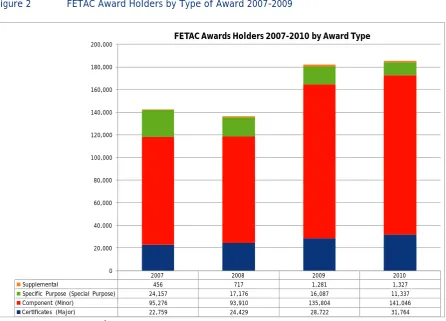
[image:20.595.76.523.291.612.2] Within Further Education and Training, there has been a substantial increase recently in the number of award holders. In 2010, there were just almost 176,600 award holders, an increase of almost 44,000 (35%) on 2008 and 48,000 (37%) compared to 2007. The increase is primarily accounted for by an increase in minor award holders, which have grown by 45,800 (48%) since 2007.
Figure 2 FETAC Award Holders by Type of Award 2007-2009
Source: FETAC Statistics6
There has also been a significant increase in the number of major award holders, increasing by just over 9,000 from 2007 to 2010, with the main increases occurring at NFQ Levels 3 and 5. There has also been relatively fast growth in the number of major awards at NFQ Levels 1 & 2 where awards have only recently been introduced, however, in numerical terms, there are comparatively few major awards at these levels compared to Level 3 and above.
6 Note, data does not include an estimated 10,000 non-FETAC awards that have been recently placed on the NFQ (e.g. City and Guilds). The total award holders figures from 2007-2009 are not the sum of the four award types holders shown above as some people achieve awards of more than one award type, e.g. a major award
2007 2008 2009 2010
Supplemental 456 717 1,281 1,327
Specific Purpose (Special Purpose) 24,157 17,176 16,087 11,337
Component (Minor) 95,276 93,910 135,804 141,046
Certificates (Major) 22,759 24,429 28,722 31,764
0 20,000 40,000 60,000 80,000 100,000 120,000 140,000 160,000 180,000
Further Education and Training Major Awards 2007-2010, NFQ Levels
Level 1 Level 2 Level 3 Level 4 Level 5 Level 6 Total
2007 - - 1,051 1,675 13,481 6,552 22,759
2008 12 53 1,417 1,777 14,196 6,974 24,429
2009 72 194 2,499 1,674 17,438 6,895 28,772
2010 170 281 2,602 1,373 20,504 6,834 31,764 Source: FETAC statistics
Within Higher Education institutes supported by the Higher Education Authority, overall graduate output declined slightly from 2007 to 2009. This is driven mainly by a decline in awards at levels 6/7 while there have been significant relative increases at levels 9 and 10.
Graduate output from Higher Education 2007-2009, NFQ Levels
Source: HEA
In addition, data does not include approximately 3,200 HETAC awards made by
private/independent colleges and approximately 6,000 awards made by professional institutes.
It must also be noted that despite a marginal decline in graduate output over these years, enrolments for higher education are at record numbers. CAO applications have increased by 20 percent in 2011 compared to 2006. This gives a positive outlook for the graduate pipeline, with the number of graduates set to increase considerably in the coming years. This, coupled with increasing numbers of Leaving Certificate candidates within the school population pipeline, should ensure further growth in higher education output in future years. The Department of
2005 2006 2007 2008 2009
Level 10 808 966 1,055 1,092 1,210
Level 9 12,075 12,600 13,597 14,085 14,762
Level 8 24,659 25,518 26,071 26,150 25,742
Level 7 10,284 9,468 9,340 9,178 8,734
Level 6 7,190 6,623 6,321 4,792 3,923
-10,000 20,000 30,000 40,000 50,000 60,000
Education and Skills project that from 2009 to 2018 the number of full time students enrolled in higher education is expected to increase from 155,000 to 204,000.
In summary:
There has been a significant increase in activity since 2007 within Further Education and Training, with the number of award holders increasing by 48,000 to 2010.
Within higher education, graduate output has remained relatively stable, with significant relative increases at levels 9-10. The demand for higher education is expected to grow
significantly in the next decade. Quarterly National Household Survey figures show the number of higher education graduates within the labour force continues to rise.
Forthcoming EGFSN Publications in 2012
Vacancy Overview 2011
Produced annually by the FÁS Skills and Labour Market Research Unit on behalf of the EGFSN, the report’s findings draw on a number of data sources held in the National Skills Databaseto provide an overview and analysis of the demand for labour as measured by trends in approximately 100,000 advertised job vacancies from three sources: FÁS Jobs Ireland, www.irishjobs.ie and the Irish Times.
Key findings:
Despite the recession, job vacancies continued to arise during 2011, although at a much lower level than at the peak in 2007;
The overall number of vacancies in 2011 was higher than in 2010 for both FÁS and Irishjobs.ie;
There were initial signs of a recovery in the number of jobs advertised for managerial, professional, associate professional and operative occupations;
The highest number of vacancies were found for roles in sales and ICT;
The vacancy market in 2011 was also strong for professionals with professional vacancies being predominantly for ICT and healthcare roles;
There were indications that Ireland is now competing with employers abroad in filling vacancies requiring high-end, specialised skill sets with several professional vacancies advertised for labour markets abroad;
Language skills continue to be important, particularly for sales and customer service roles, but also at professional level (e.g. ICT, engineering, finance);
Job vacancies at the lower end of the skills scale have also continued to arise, although confined to a limited number of occupations such as carers, process operatives, and truck drivers;
The findings from the vacancy data analysis is in general supported by the job announcements in the media with expansion demand confirmed in IDA announcements, especially for the highly skilled;
While third level qualifications are a prerequisite for the majority of advertised jobs, ICT vacancies also required candidates to have experience and additional skills developed in the workplace (e.g. software engineer with other industry experience);
There were also a number of vacancies that are proving difficult to fill with suitable candidates as highlighted in the:
results of the recruitment agency survey (ICT professionals, engineers, healthcare professionals);
Key Skills for Enterprise to Trade Internationally
The Government's Strategy for Trade, Tourism and Investment and the agencies' strategies include commitments to broaden export and investment markets to wider EU and emerging economies. Ensuring that we have the knowledge and skills to maximise Ireland's potential in the areas of trade, investment and tourism is a key requirement. The EGFSN study Key Skills for Enterprise to Trade
Internationally, on which research commenced in 2011, will build on the references to delivering
the necessary skills as outlined in the Government's Trade Strategy.
The focus of the EGFSN research is on identification of the key skills which enterprises require in order to trade internationally, specifically the need for entrepreneurship skills; export strategy and business planning; export marketing, negotiation and sales skills; foreign language fluency and cultural awareness of different traditions; e-business skills; logistics and distribution skills; purchasing and procurement skills, as well as any other key export skills requirements identified.
It is anticipated that the report will be published end April 2012.
The National Skills Bulletin 2012
Produced annually by the Skills and Labour Market Research Unit in FÁS, the National Skills Bulletin provides an overview of employment trends and demand for skills in Ireland. The Bulletin draws on data on employment, vacancies, job announcements and immigration and other qualitative
information held in the National Skills Database, to identify imbalances in the Irish labour market at occupational level.
The next edition of the National Skills Bulletin is scheduled for release mid-2012.
Monitoring Ireland’s Skill Supply: Trends in Education and Training Output 2012
Undertaken annually by the Skills and Labour Market Research Unit of FÁS on behalf of the EGFSN, this report examines the numbers of students entering and leaving the education/training system in Ireland and reports on: The demographic profile of the school age population
Junior and leaving cert trends
Further education and training awards
Higher education trends
Where graduates go
Adult lifelong learning participants
Research and Analysis
The work of the EGFSN is managed by Marie Bourke, Manager of the Education, Skills and Labour Market Policy Department in Forfás.
Research, analysis and administration support to the EGFSN is provided by Forfás and the Skills and Labour Market Research Unit, FÁS.
Appendix 1
Recent Publications by the Expert Group on Future Skills
Needs
Report Date of
Publication
Vacancy Overview 2011 February 2012
Addressing High–Level ICT Skills Recruitment Needs: Research Findings January 2012
Monitoring Ireland’s Skills Supply: Trends in Education and Training Outputs July 2011
National Skills Bulletin 2011 July 2011
Developing Recognition of Prior Learning: The Role of RPL In the Context of the National Skills Strategy Upskilling Objectives
April 2011
Vacancy Overview 2010 March 2011
Future Skills Needs of Enterprise within the Green Economy in Ireland November 2010
Future Skills Requirements of the Biopharma-Pharmachem Sector November 2010
Monitoring Ireland's Skills Supply - Trends in Education and Training Outputs 2010
July 2010
National Skills Bulletin 2010 July 2010
Future Skills Needs of the Wholesale and Retail Sector May 2010
Future Skills Requirements of the Food and Beverage Sector November 2009
Skills in Creativity, Design and Innovation November 2009
Monitoring Ireland’s Skill Supply – Trends in Education and Training Outputs 2009
November 2009
National Skills Bulletin 2009 July 2009
A Quantitative Tool for Workforce Planning in Healthcare: Example Simulations
June 2009
A Review of the Employment and Skills Needs of the Construction Industry in Ireland
December 2008
Statement on Raising National Mathematical Achievement December 2008
National Skills Bulletin 2008 November 2008
All-Island Skills Study October 2008
Monitoring Ireland’s Skills Supply: Trends in Education/Training Outputs 2008 July 2008
The Expert Group on Future Skills Needs Statement of Activity 2007 June 2008
Future Requirement for High-Level ICT Skills in the ICT Sector June 2008
Survey of Selected Multi-National Employers’ Perceptions of Certain Graduates from Irish Higher Education
December 2007
The Future Skills and Research Needs of the International Financial Services Industry
December 2007
National Skills Bulletin 2007 November 2007
Monitoring Ireland’s Skills Supply: Trends in Educational/Training Outputs June 2007