That's the way it goes ("it" being the Ampex TM-2 digital tape handler). On and on, with hardly a pause for main-tenance. Completely new servo and tape guide systems give the TM-2 extremely long term performance stability. Improved vacuum buffer col-umns gently hold the tape su,pply and take-up loops. Specially developed inertia brakes give reliable stop times and short stop distances at high tape speeds. Start time of 2.0 ms and stop time of 1.5 ms are consistent under the most rigorous programs. And the TM-2 has a 90 Kilocycle . character transfer rate. Why not send for all the facts: Ampex Computer Products Company, P. O. Box 329, Culver City, California.
AMPEX COMPUTER PRODUCTS COMPANY
ON
That's the way it goes ("it" being the AmpexTM-2 digital tape handler). On and on, with hardly a pause for main-tenance. Completely new servo and tape guide systems give the TM-2 extremely long term performance stability. Improved vacuum buffer col-umns gently hold the tape supply and take-up loops. Specially developed inertia brakes give reliable stop times and short stop distances at high tape speeds. Start time of 2.0 ms and stop time of 1.5 ms are consistent under the most rigorous programs. And the TM-2 has a 90 Kilocycle character transfer rate. Why not send for all the facts: Ampex Computer Products Company, P. O. Box 329, Culver City, California.
AMPEX COMPUTER PRODUCTS COMPANY
ON
That's the way it goes ("it" being the AmpexTM-2 digital tape handler). On and on, with hardly a pause for main-tenance. Completely new servo and tape guide systems give the TM-2 extremely"long term performance stability. Improved vacuum buffer col-umns gently hold the tape supply and take-up loops. Specially developed inertia brakes give reliable stop times and short stop distances at high tape speeds. Start time of 2.0 ms and stop time of 1.5 ms are consistent under the most rigorous programs. And the TM-2 has a 90 Kilocycle character transfer rate. Why not send for all the facts: Ampex Computer Products Company, P. O.Box 329, Culver City, California. T.M.
IAMn»EX III
AMP~X COMPUTER PROOUCTS COMPANY CIRCLE 1 ON READER CARDON
That's the way it goes ("it"
being the AmpexTM-2 digital tape handler). On and on, with hardly a pause for main-tenance. Completely new servo and tape guide systems give the TM-2 extremely long term performance stability. Improved vacuum buffer col-umns gently hold the tape supply and take-up loops. Specially developed inertia brakes give reliable stop times and short stop distances at high tape speeds. Start time of 2.0 ms and stop time of 1.5 ms are consistent under the most rigorous programs. And the TM-2 has a 90 Kilocycle character transfer rate. Why not send for all the facts: Ampex Computer Products Company, P. O. Box 329, Culver City, California. T.M.
Data Analysts
for Space Technology Leadership
. ....
_- ----
.. .. ::
~-~7-_:~-.- --~
_ ....
--
-._----_.-.
RErRI:-';TS OF TilE DRA,,'DICS CREATED FOR THIS SERIES, SUITABLE FOIl FRA:\II:-';C, AIlE AVAILABLE 0:-1 REQUEST.
In a discipline that follows the tradition,of Newton, Data Analysts at Space Technology Laboratories; Inc. are applying "prin·
ciples" to the evaluation of complex data as a means of accelerating man's conquest of space. At STL, those responsible for
Space Technology Leadership look to the Computation and Data Reduction Center to identify and evaluate applied mathe·
maticalprinciples from diverse observations. In so doing, STL Data Analysts daily employ advanced analog and digital
processing techniques and devices in solving problems concerned with analyzing 'data acquired from ballistic missile and
space vehicle testing. All qualified applicants, regardless of race, creed, color or national origin, who seek greater stimulus
and responsibility in this rewarding discipline are invited to communicate withl Dr. R. C. Potter, Manager of Professional Placement and Development.
SPACE TECHNOLOGY LABORATORIES, INC.
P.o. BOX 95005Y, LOS ANGELES 45, CALIFORNIA a subsidiary of Thompson Ramo Wooldridge Inc. •',; ( .
:,' .
.:I!:.:i .. ',,'.' ,; 1.1'.~I:r:IJ(:IIU,l . ~:,.;::~ ,.'./,O.,;i(llJi: ':iLLJ,',: CLL/\~L\III.;':~. IJL,'.;l{ ~)tll.n·UO':Hl •
PRECISE PROJECT PLANNING
WITH THE GE
'I,
AND
• To drastically reduce the need for managerial guesswork and to deliver precise data required for timely decision-making, General Electric now offers Critical Path Method (CPM) processing capa-bility on the GE 225 computer.
• A new, advanced technique for project planning, scheduling and control, CPM can pinpoint your critical jobs to prevent bottlenecks before they result in costly and unnecessary delays.
• CPM is based on a pictorial project representation-an "Arrow Diagram" or "Project Network"-which shows the relationship and sequence of work to be done.
*
As employed by the GE 225, the Critical Path Method can be" used for all types of project problems -from manufacturing, maintenance or construction planning to cor-porate planning, product launching and missile countdown. • The CPM program developed specifically for the GE 225 effi-ciently processes both COST and TIME information on each job in the project to obtain minimum time-cost schedules. As a result, man-agement and project personnel alike obtain pertinent and timely information on plans and schedules.• The GE 225 CPM application is an advance providing for
auto-matic event re-numbering and direct priority weighting of each project job in the most efficient manner.
• General Electric sales representatives, backed up by pew General Electric Computer Department Information Processing Centers, can further explain this exciting and flexible use for a GE 225 and are ready NOW, working with your consultants and management, to integrate information handling equipment into your business. • The application of the GE 225 to CPM represents one of many new advances pioneered by General Electric. It would be a wise move for you to investigate the benefits of the Critical Path Method, GECOM and other General Electric advances-all available for the GE 225. GECOM is the General Compiler which processes English language statements (COBOL), Algebraic expressions (ALGOL), Structured decision tables (TABSOL) and the File and Report In-formation Processing Generators (FRINGE).
For more information, write to General Electric Company, Computer Department, Section 6SJ7, Phoenix, Arizona, or contact your nearest General Electric Computer Department district office listed below.
Atlanta: 270 Peachtree St. N.W., 522-1611 • Boston: 140 Federal St., HU 2-1800, Ext. 311 • Chicago: 840 S. Canal St., WA 2-5611, Ext. 587· Cleveland: 215 Euclid Ave., SU 1-6822 • Dallas: 3200 Maple Ave., RI 8-0589 • Detroit: 680 Antoinette St., TR 2-2600 • Houston: 4219 Richmond Ave., MO 7-3301 • Kansas City, Mo.: 106 W. 14th St., GR 1-2919 • Los Angeles: 1010 S. Flower St., DU 1-3641 • Louisville: Bldg. 6, Appliance Pk., Gl 4-7511 • Minneapolis: 6th & Hennepin, FE 2-7569 • New York: 122 E. 42nd St., PL 1-1311, Ext. 2235 • Philadelphia: 2 Penn Center Ploza, lO 8-8085 • Phoenix: 3550 N. Central Ave., AM 4-3741 • Pittsburgh: 1634 Oliver Bldg., Mellon Sq., AT 1-6400, Ext. 566 • San Francisco: 235 Montgomery St., DO 2-3740 • Schenectady: Bldg. 2, 1 River Rd., FR 4-2211, Ext. 5·4405 • Seattle: 710 Second Ave., MA 4·8300 • St. Louis: 818 Olive St., GE 6-4343 • Syracuse: 1010 James St., GR 6-4411, Ext. 6141 • Washington, D.C. Area: 7401 Wisc. Ave., Bethesda, Md., OL 2·8100. In Canada: Canadian General Electric Co., ltd., Electronic Equip. and Tube Dept., 830 lansdowne Ave., Toronto, Ontario, Canada. Outside U.S.A. and Canada:
Producer Goods Export Dept., International General Electric Company Div., 150 E. 42nd St., New York City, N.Y., U.S.A.
•
INFORMATION PROCESSING
AUTOMATED BY GENERAL ELECTRIC
~---~~ CIRCLE 4 ON READER CARD
lhJgre$S /s
Ollr
Most
/mporl~nf
PnJtllla
*THIS METHOD WAS DEVELOPED BY MAUCHLY ASSOCIATES,
GENERAL
"
\How to convert perforated to lDagnetic tape
at a reasonable cost
(NOW)
Tally's new solid state Model 1433 Paper-to-Magnetic Tape Converter is not 10 years ahead of its time. You can solve today's media conversion problems with both integrity and economy.
Normally, input and output\data are completely identical in content. The output record is a bit for bit image of input data. A universal code conversion feature is, however, available.
Without changes or adjustments, the Tally converter will accept paper, foil, or plastic tapes in widths vary-ing from 5 through 8 levels. It writes data on mag-netic tape compatible with IBM 727, 729 Mod 1, and
Remington Rand computer formats. Other formats are also available.
Complete in itself, the system includes. a 120 cps paper tape reader, a Potter magnetic tape handler, and necessary electronics. Price of the Model 1433 begins at $26,500. Delivery is currently 120 days. More information can be obtained from your Tally engineering representative or by writing
TALLY
REGISTER CORPORATION >
CIRCLE 5 ON READER CARD
1310 Mercer Street • Seattle, Washington MAin 4·0760
OFFICES IN ALL MAJOR CITIES
volume
7,
numberStaff
Publisher FRANK D. THOMPSON
Vice President & General Mgr.
GARDNER F. LANDON
Publication Manager
RICHARD W. NIELSON
Editor HAROLD BERGSTEIN
Managing Editor & Art Director
CLEVE BOUTELL
Assistant Ed. G. PATRICK ANDERSON
European Editor ETIENNE J. GUERIN
Contributing Ed. DR. HERB GROSCH
Technical Consultant DON B. PRELL
Production Manager
MARILEE CORPIS
Circulation Mgr. ALGENE TRAINA
Editorial Advisers
DANIEL D. McCRACKEN C. L. WANLESS
Eastern District
RICHARD W. NIELSON
141 E. 44th St., New York 17, N.Y. MUrray Hill 7-5 180
New England District Manager
WARREN A. TIBBETTS
112 West Haven Rd., Manchester, N.H.
Cleveland District Manager
ALBERT PUDV AN
3537 Lee Road, Shaker Heights 20, Ohio WAshington 1-9370
Midwest District Manager
GILBERT THAYER
Midwest Representative
ROBERT W. HEATH
201 N. Wells St., Chicago 6, III. Financial 6-1026
Western District Manager
., HAMILTON S. STYRON
10373 W. Pica Blvd., Los Angeles 64, Cal. BRadshaw 2-2643
European ~1 anager
E. J. GUERIN
Box 824
Stockholm 1, Sweden
EDITORIAL OFFICES
10373 W. PICO BLVD.,
LOS ANGelES 64, CALIF.
the automatic handling
0/
in/ormationAriides
22 Tabular Form in Decision Logic 26 EDP Highlights at 1961 WESCON 30 How To Lose Money in Computing 32 Softwear in Sickness and Health 37 AGM Conference and Exhibit, Sept. 5-8
35 Computer Simulation of Human Thinking and Problem Solving-Part II, Conclusion
40 CODASYL O.K.'s Publication of COBOL-61
42 The Magnacard System for High-Speed Data Control 44 The 2400 System for 'Balanced I/O
46 The L-3060 for Real-Time Control
58 World's Largest Analog Installation at NASA 62 .Mergers and New Firms in DP
63 The 1301 To Step up 7000 Series' Storage Capacity
DepCtr~menis
8 Important Dates In Datamation 11 Datamation In Business and Science 17 The Editor's Readout
27 Datamation News Briefs 50 New Products In Datamation 59 People Moving Up In Datamation 60 New Datamation Literature 64 Book Capsules
66 Advertisers' Index
THIS ISSUE -
34,450 COPIES
DRTRMRTIIII.'IN
July
CD
(over
As a graphic expression of "Tabular Form," this month's cover design may not express its fullest potential in decision logic but never-theless, conveys a sprightly analogy to author Burton Grad's stimulating assessment begin-ment on page 22.
Circulation audited by Business Publications Audit
Member, National Business Publications
DATAMATION is circulated without charge by name and title to qualified manufacturers and users of automatic, information-handling equip-ment in all branches of business, industry, government and military installations. Quali-fied individuals in the United States and Canada are invited to request application on their com-pany letterhead, stating job function and firm's business. Available to others by SUbscription at the rate of $10.00 annually; single issue, $1.00 when available. No subscription agency is authorized to solicit or take orders for subscrip-tions in the United States, Canada or overseas.
6
SELECTED BY THE
NATION'S LEADING
COMPANIES
CIRCLE 6 ON READER CARD
For l71en of vision
Waiting for you at Burroughs Corporation are some of the industry's most challenging and rewarding career oppor-tunities. An extensive and purposeful research and development program has spurred the introduction of several major systems this year-including the pace setting new B 5000, the first computer specifically designed to implement problem oriented languages. There are more to come. A planned program of future releases will insure continuing growth opportunities. Substantial opportunities now await qualified personnel in the following positions:
Special computer representatives:
To promote the sale of this advanced data processing equipment, workingwith experienced account representatives. Opportunities to advance are wide open because of Burroughs practice of developing management personnel from within. Salary plus override will be attractive to experienced computer sales representatives.
Sales technical representatives:
To assist sales representatives in technical aspects of sales presentations andguide installations of systems. You will receive progressively more challenging assignments in either scientific or business data processing. You'll qualify with strong magnetic tape installation experience or sound punch card systems background, and receive a salary commensurate with experience.
Openings are available in major cities throughout the U.S. Call the manager of our office near you, or write in confidence to L. D. Staubach, Director of Marketing Placement, Burroughs Corporation,
Detroit 32, Michigan. Burroughs-TM
Burroughs
All qualified applit'ants will r('ceive t'onsideration for pmp\oyment
8
electronics, provides in· dividual transistorized
circuit plug·in cards.
peTTER
_
o
INSTRUMENT COMPANY, INC.,
PLAINVIEW, NEW YORKCIRCLE 7 ON READER CARD
1 961
IMPORTANT
D AT E 5
• The Northwest Computing Asso-ciation Annual Conference will be held July 21-22 in Vancouver, British Columbia, Canada. For information contact Northwest Computing Assoc., Box 836, Seahurst, Washington.
• A two week summer course in digital control systems engineering will be held at Case Institute of Technology July 31 through August 11. For infor-mation contact Dr. Harry Mergler, Case Institute of Technology, Univer-sity Circle, Cleveland 6.
• The G-15 Users Exchange Con-ference will be held August 10-12 at the Denver- Hilton, Denver, Colo.
• WESCON is scheduled for the Cow Palace in San Francisco, Calif., August 22-25. For information contact WES-CON Business Manager, 1435 La Cienega Blvd., Los Angeles, Calif.
• SHARE VII meeting will be held from Aug. 23-25 at the Statler Hilton Hotel, Washington, D.C. For informa-tion, contact Dr. Aaron Finerman, Computing and Data Processing Div., Republic Aviation, Farmingdale, Long Island, N.Y.
• The National Symposium on Space Electronics and Telemetry will be held in Albuquerque, N.M., September 6-8. For information contact Dr. B. L.
Basore, 2405 Parsifal, N. E., Albu-quesque, N.M.
• International Symposium on the Transmission and Processing of Infor-mation will be held at the Mass. Insti-tute of Technology, Cambridge, Mass. September 6-8. For information con-tact Peter Elias, RLE, MIT,
Cam-bridge 39, Mass. .
• The 1961 Annual Meeting of the the Association for Computing Machinery will be held at the Statler Hilton, Los Angeles, on September 5-8. For in-formation contact Benjamin Handy, Chairman Local Arrangements Com-mittee, Litton Industries, Inc., 11728 W. Olympic Blvd., Los Angeles, Calif.
• The Third International Congress on Cybernetics is scheduled for Namur, Belgium, September - 11-15. For in-formation contact Secretariat of The International Association for Cyberne-tics, 13 me Basse 'Marcelle, Namur, Belgium.
",
o
1=1 T R M R T ION
in business and science
1ST B-5000
TO FLY AT HUNTSVILLE
~
NEW GP ENTRY
FROM COMPUTER CONTROL
IMPACT OF U.S.
COMPUTERS IN ENGLAND
The first installation of the Burroughs B-5000 has
been set for the NASA's giant center at Huntsville,
Alabama in the fall of 1962, according to a letter
of scheduling issued by the computation center.
Hardly a newcomer to the Huntsville complex, Burroughs
maintains five, 205's at the computing center, plus
one at Cape Canaveral and two at Redstone. (see
DATA-MATION, July/Aug., 1960). Optimistic guesswork from
Burroughs hints at the sale of 100, 5000's during the
life-span of the system.
Early this Fall, count on Burroughs for announcement
of its third solid-state entry, the B-260. Aimed at
the business field, the 260 will be similar to the
270, a banking" machine announced this Spring. However,
the 260 will be sold without the 270's special
equip-ment for magnetic character reading and printer for
banking applications.
In the new hardware department, DATAMATION has learned
of a forthcoming entry in the small to medium-size
class of solid-state gp equipment to be introduced and
manufactured by Computer Control's Western Division
in Los Angeles. Tentatively dubbed the Digital Data
Processor (DDP) , the machine has a core memory of 4K
words expandable to 16K. It is a single address,
parallel, binary computer with a word size of 25
bits and average access time of 2.5 microseconds.
Complete memory cycle time between memory accesses is
5 microseconds. A Flexowriter will be used as the
basic I/O device although paper and magnetic tape,
IBM cards and other I/O devices will be available.
The DDP has a compiler and library of elementary
function routines in both floating and fixed pOint,
double and single precision arithmetic. The compiler
includes symbolic program assembly and algebraic
formula translation.
Scheduled for announcement within the next few
months, rental would be approx. $3,200 and sale
price about $150K.
A
~andidview of U.S. influence on computing in Great
Britain was voiced last month by the London firm,
Computer Consultants, Ltd. Their opinion: "Considering
the size of their organization, up to now IBM has made
little impact on the British computer market. They
have, however, been engaged in preparation work and
the outcome of this will become only too apparent in
the coming months. Between now and June, 1962, they
will be making over 80 installations of one computer
alone. This means that by this time next year the
balance of power, computerwise, will have shifted
radically in Britain.
12
LIGHTENING
FLASHES FROM RCA
C-E-I-R ORDERS
TWO STRETCH UNITS
10. G-20s
SET FOR '61 DELIVERY
view. Some merger of this company with another
com-pany, probably American, seems inevitable unless they
have a very closely guarded dark horse in some
un-disclosed stable.
"Americans are making more advances towards the
British market and it looks as if the computer field
is going to be yet one more activity which will be
dominated by our western cousins. Particularly as
Remington Rand have now made their first British sale
(Univac 80), which could open the flood gates for
others."
Project Lightening, occasionally mentioned, but rarely
described in detail, concerns government-subsidized
r&d in high speed circuitry which may see fruition in
advanced hardware from RCA within the not-too-distant
future. Other computer manufacturers involved in this
project are RemRand and IBM.
A core plus tunnel diode memory with access time in
the one millemicrosecond range (approx. 300 to 1,000
times faster than pr.esent models) is a concept which
has been reported to DATAMATION as having been
achieved in the laboratory. Still posing engineering
blocks, however, is the problem of microminiturization
aimed at improving reliability of a super high-speed
system.
In actual hardware development,speeds may be about
10 per cent slower but the cost of such a system could
be comparable to the 601 (approx. $32,000-$68,000 per
month). At present, about three years of research lies
ahead before a Lightening system could be ready for
delivery to the Bureau of Ships.
Following IBM's recent announcement of a substantial
price reduction for STRETCH, DATAMATION has learned
from C-E-I-R President Dr. Herbert Robinson that this
firm has ordered two STRETCH configurations. The first
installation is set for November, 1962 on the West
Coast. Provisionally scheduled for Los Angeles" Dr.
Robinson feels that it may be switched to another West
Coast location. The second STRETCH is due on the East
Coast in mid-1963. No specific location has been
an-nounced although New York City is probable.
As for work to occupy these super systems, Dr.
Robinson expects a large segment from the field of
economic data processing in addition to scientific dp.
He does not feel that success of the operation will
hinge on high speed data transmission although he did
state that developments "might break in this field"
prior to C-E-I-R's first STRETCH installation.
On software, Dr. Robinson felt that IBM would
deliver its promised set of programs although the
population of STRETCH programmers would be limited.
At Los Alamos, the world's first STRETCH
con-figuration is now OFFICIALLY on the air.
Two complete G-20 systems per month are expected to
roll off the Bendix production line this year,
accord-ing to Maurice Horrell, general manager of the
com-puter division. This new schedule amounts to a doubling
Of production with 10 systems planned for delivery by
the end of this year. Since the introduction of the
computer, total dollar'value of orders on hand has
increased 1,900 per cent. Bendix has also increased
its field force by 45 per cent in the past year largely,
to support the G-20.
FOR TEXAS INSTRUMENTS CIRCLE 8 ON READER CARD
+-S(
,
:~
,
~i---J~
This world-wide comn;mnication network will help Strategic Air Force leaders exercise command and control almost in response to events of the moment. Yet the forces involved are dispersed throughout the world, the volume and complexity of information unprecedented. ~l The SAC Control System will be a product of the new technology of automated infor-mation processing assistance. We have helped create this new technology, beginning with our work on SAGE. In projects such as SAACS and SAGE, we perform system analysis,
Scientists and engineers interested in joining an interdiscipli-nary approach to system development are invited to inquire
~bout our rapidly expanding efforts. Positions are open for Computers Programmers, Operations Research Scientists, Engineers, Human Factors Scientists at our Santa Monica, California, Lexington, :rvlassachusetts, Washington, D. C., and Paramus, New Jersey facilities. Please
address Mr. A. C. Granville, Jr., SDC, 2401 Colorado Avenue, Santa Monica, Cali-information processing system design, and training of per- fornia. All qualified applicants will receive
SYSTEM
sonnel in system use. And as a continuing effort, we carry considerat~,on for employment without re- DEVELOPMENT
on research into future generations of these control systems. gard to race, creed, color or national origin. COR~~ATION
CIRCLE 71 ON READER CARD
New
RECORDAK
DACOM System
translates computer language into plain English
Elt BReeds
up
to
2aOOO
characters per second!
' )
I
Name derivation ofRECORDAK DACOM System-DA.tascope Computer Output M"icrofilmer, DACOl\;l is a trademark.
The
RECORDAKDACOM System delivers incredible printout speeds which equal
or exceed computer speeds ... provides indexed microfilm records which are much easier
to file and use ... introduces important advances in point plotting and logic diagramming.
First, let's consider the importance of the RECORDAK DACOM System
as a Print Out Medium.
Its great advantage in speed over mechanical printers turns lag time into productive time, allows a more continuous work flow. And its in-creased versatility gives you still greater return on your investment in electronic computers. Look at just a few examples of how the RECORDAK
DACOM System can be applied to varied operations.
• It optically combines computer data with
any office form design . . . gives you, for example, a complete customer state-ment on a single film image. Paper facsimile copies of exceptional clarity can be produced at high speed from your microfilms by photographic and other rapid copying methods.
• It provides the fastest, most accurate
method of point plotting.
• It records on film logic diagrams of
elec-tronic circuits.
Graphic Arts quality
Along with increased speed and versatil-ity, the DACOM System provides graphic arts quality in any type style you select. Look at DACOM film in a RECORDAK Film Reader and you'll find it hard to believe that the images produced from invisible pulses on magnetic tape are even sharper than the type on this page.
How RECORDAK DACOM System simplifies data storage and
speeds reference
• The decoded information on as many as eight 2,400-ft. reels of magnetic tape
can be recorded on a single 100-ft. roll
of 16mm RECORDAK microfilm. • RECORDAK Microfilms (inserted in
magazines) can be "finger-tip" filed at convenient reference stations. Any rec-ord au t of millions viewed in seconds in RECORDAK LODESTAR Film
Read-ers. Compare with the time lost now
searching through voluminous paper records.
learn how the RECORDAK DACOM System may be applied to
your routines
Phone or write today for interesting de-tails on the programming of the RECORDAK DACOM for accounting, point plotting and logic diagramming. Arrangements can also be made for your group to see RECORDAK DACOM System in opera-tion. Write Recordak Corporation, 415 Madison Avenue, New York 17, N. Y.
(Subsidiary of Eastman Kodak Company)
originator of modern microfilming -now in its 34th year
- - - t
1
rlJ1N
Btt30B
Creat1ve talent is put to the test at Philco Computer Division, where a typical challenge was
to develop the world's first bilingLial printer . • If you are an experienced Computer Engineer
who thrives on genuine challenge ... there is an opportunity for you at Philco in the following
fields: Character Recognition, Advanced Memory Systems, Transistor Circuit Design, Digital
Pulse Techniques, Core Memory Design, Magnetic Circuit Development, Logical Design,
Elec-tronic Equipment Packaging, High Speed Logic Circuits . • Opportunities also exist for
Sales-men, Programmers, Systems Analysts, Instructors, Field Engineers and Technical Writers.
All qualified aPplicants will receive consideration for employment without regard to race, creed, color or national origin.
CONTACT Mr. John Felos
Professional Placement Mgr. PHILCO COMPUTER DIVISION Willow Grove, Pa.
Details on the bilingual printer available on requeJt.
PHILCO
!I=-~I
ya1lWllJ
lor
QaaIit;;
tk
lI/m&
r9ver
the automatic handling of information july
d
O" . ' ,e.· ,tor
£)
re
A PLEA FOR UNMUDDLING
A well-heated topic for after-dinner conversation, publication editorials, guest spots for industry affairs and for just ~pouting-off, has long centered about "automation and its effect on the working force." DATAMATION makes no bid to join the fracas but rather, an earnest plea for unmuddling an overly cloudy scene.
Prior to the advent of EDP, automation consisted of all things with sus-picious movement from ball bearings to electric pencil sharpeners. Since the computer shoved its console through the door, the meaning has been expanded somewhat and now includes all things movable and stationary, particularly those which are plugged in and hum.
ifhe ease with which an opinion may be ventured in this area (regardless of its value or point of view) is a frightening spectacle. In an industry barely out of the embryo stage and so rapidly accelerating as to leave a dearth of statistical introspection in its wake, labor statistics based on EDP installa-tions, are tossed about with careless abandon. Rarely is a viewpoint ex-pressed which implies the need for more reliable .information.
Two points of view are of course, predominant: "Yes, we have a prob-lem!" and "No, we ain't!" There is a third viewpoint which combines the best elements of the first two and subsequently, becomes equally ludicrous. The resultant chaos figuratively cries for clarification and a specific change in menu. To this end, we offer some basic hypotheses which should find general acceptance:
1. An electronic, digital computer performs a function differing substan-tially from a conveyor belt. Not only does the function differ, but the re-sulting labor problems or lack of them, are quite dissimilar and should be treated as such.
2. A telephone is not a computer nor is a photo-copying machine, a ball point pen, or a machine which gums labels. In addition, computers are not likely to replace these office tools or the people who use them.
3. Process control by computer is such a spanking new venture with so many variables that even the most astute labor economist would be hard pressed to speak with authority. The implication is that others considerably less qualified, should not speak at all.
4. The area of scientific and engineering study also utilizes EDP to the tune of several thousand installations throughout the country. The coin-cidental effect of this work accelerating the opening of new areas for em-ployment and business expansion might well be viewed with some interest. For this purpose, some intelligence and acumen are required.
5. Computers may perform with high reliability and acceptance in a number of areas. Other areas of limited application but nevertheless, re-cepients of much consumer-oriented publicity include: sausage manufac-turing, raisin growing, wine tasting, and stuffing tooth paste into tubes of varying dimension. These should not be viewed as threats to national em-ployment d~e to the encroachments of EDP.
It is not unreasonable to assume that computing in the future will have a profound impact on almost every aspect of our economy and culture. However, to attempt to predict the effect of this impact on our present labor force without substantial facts, is unreasonable.
Computer people will admit that when a general purpose machine is operating in an interpretiv~ mode it may spend most of its time doing non-productive work loosely called "house-keeping" functions. There's nothing wrong with this, as long as a user is willing to sacrifice efficiency for con-venience. However, there are users and users, and many of them resent having to accept penalties of any kind-for any reason. Others need to have a com-puter that will perform as efficiently in many different modes as it does in the characteristic mode for which it was designed. Ordinary interpretive sys-tems simply can't do this.
II
The basic trouble stems from the fact that computers and people (not counting programmers) don't speak the same language. The user often has to "command" his machine in codes archly called pseudo-instructions. The computer can't work from pseudo-instructions, but has to translate them into logic steps that will open gates, start counters, trigger flip-flops, and otherwise cause the machine to react to the problem.II
It is this roundabout way of doing things that gives interpretive systems their bad reputation. (Small wonder, when a routine may take an ordinary computer ten to fifteen times as long to run interpretively as it would if the computer were lucky enough to be working from instructions originally wired into its back panel!)II
It would be nice if all instructions could be wired into the computer in exactly the form that every present and future user would possibly desire. Of course, that's just dreaming. There are always new users and new problems.II
A practical approach is to wire in only the basic (or generic) elements of all instructions, in order to get machine efficiency-and store in the computer's memory the logic for putting together the endless varieties of instructions and routines that users inevitably. think up18
is for stored logic
Stored logic is a computer
design idea that gives users
the advantages of interpretive
mode operation without the
usual penalties
once they get their hands on a new computer . .
II
This is the approach used by Ramo-Wooldridge in the design of its "stored logic" computer. The first model in R-W's stored logic line is the AN / UYK-1, an inexpensive machine being built for the Navy for general ship-board· use. To illustrate its efficiency: the AN /UYK-I can do a IS-bit basic add in 12 microseconds; a 30-bit arith-metic sine instruction, composed from some 30 generic commands, will take about six milliseconds. With 54 types of basic command elements, most of which have 32 options, the AN/UYK-1 offers its users more than 1100 generic portions (called logands, from LOGic commANDS) from whi~h to composeCIRCLE 10 ON READER CARD
instructions. These tailor-made instruc-tions can be used directly by the pro-grammer to solve his problems.
II
Recent contract awards for stored logic computers have created oppor-tunities for adventurous programmers, systems analysts and circuit design engineers interested in helping to ex-ploit the inherent advantages of the Stored Logic concept.II
All qualified applicants will receive consideration for employment without regard to race, creed, color or national origin.~
contact Mr. Theodore Coburn at++
RAMO·WOOLDRIDGEA DIVISION OF
L~
Thompson Ramo Wooldridge Ino.B433 FALLBROOK AVENUE, CANOGA PARK, CALIFORNIA
20
DECEMBER 1960-Univac announces
major breakthrough-new Univac
490
Real-Time System
Distance and time gap no longer limit the effec-tiveness of data communications. For now Univac 490 Real-Time System takes questions from hundreds of remote points, updates master records, and transmits answers ina matter of seconds.
For example, data fed to the central system over a communications network from distant, far-flung sales points can be used simultaneous-ly to reduce your inventory, explode cost fac-tors, and even alter production schedules when necessary. Or, ill the case of an airline reserva-tion system, the transmitted data could be con-stantly updating the system's seat inventory or passenger records.
The new Univac 490 Real-Time System proc-esses all data, corrects its files, and answers the problems of each location as if it were in the adjoining room.
AUGUST 1960-Univac® Larc I,
world's most powerful computing system,
passes acceptance test
Univac Larc I has been operating since August 1960 at the Atomic Energy Commission's Law-rence Radiation Laboratory at the University of California. Only one other accepted computer in the Free World compares to Univac Larc I in size, speed, and power. The other computer: Univac Larc II-installed and now delivering results for the U.S. Navy, Bureau of Ships, David Taylor Model Basin. Univac Larc I and II are achievements which are equal in importance to the invention of the world's first electronic computer. All three, achievements of Univac.
DECEMBER 1960-World's first
commercial thin-film memory computer
introduced by Univac
Univac Division scientists have introduced ferro-magnetic film which is the fastest and most ad-vanced computer memory ever developed.
Coupled with this major advance came the first commercial computer of its type in the world, Univac 1107 Thin-Film M,emory Com-puter. This powerful system provides fantasti-cally fast access to stored information. Previous computers measured access time in millionths of a second. Now with Univac Thin-Film it is rated in nanoseconds-billionths of a second!
MAY
1960-Univac introduces a
high-performance, low-cost data
processing system: Univac III
Univac III offers large-scale performance at lower cost per unit of output than any other system in the market.
Developed by the men who invented the world's first electronic computer, Univac III
incorporates the most advanced solid-state cir-cuitry arid data processing concepts. For ex-ample: because of a new character packing technique, information which previously re-quired 20 reels of magnetic tape can be stored on only one reel of Univac III tape and read off at the rate of 200,000 digits every second.
No other commercial computer combines such great application flexibility, high-comput-ing speeds and accurate performance in a shigh-comput-ingle system!
MARCH
1960-New Compatible
High-Speed Printer provides complete
systems compatibility
From Univac, another giant step forward: the new Univac Compatible High-Speed Printer. Users of competitive equipment are no longer bound to one manufacturer.
Modell of the new Univac High-Speed Printer operates off-line with Univac systems. Model II operates off-line with computer systems of an-other leading manufacturer.
Both models have been thoroughly field tested and are already in use delivering dollar-saving advantages never before possible.
. ,l
AUGUST
1960-Univac announces
STEP-a computer plan that keeps
pace with your growing needs
STEP-a solid-state system designed to take a business across the crucial step from mecha-nized tabulating into electronic data processing -was announced to Business-America by Univac in August 1960.
Univac STEP (Simple Transition to Electronic Processing) is economical, versatile, and can be installed without disturbing normal work. Yet there is nothing unsophisticated about it. Built around four units-a Central Processor, a High-Speed Reader, High-High-Speed Printer, and a Punch Unit-STEP can perform many varied record-keeping jobs. Examples are payroll, sales analyses, and production scheduling. And STEP'S building-block concept permits the ad-dition of equipment options to meet increased data-processing needs.
OCTOBER
1960-Univac scores again
with development of Randex
super-capacity storage system
Randex, the new Univac super-capacity drum system, stores over 24 million easily accessible characters per unit. And up to 10 units can be utilized for a total of a quarter billion usable storage positions.
Another big plus for Univac Randex is its remarkably fast access time-as low as 35 milliseconds to read or write 48 10-digit words and signs.
Tabular form has shown promise of being an effective way to org'anize and present decision logic for systems analysis and computer programming. Experience to date clearly indicates the need for further exploration and de-velopment of tabular form to determine its range of appli-cation and assess [ts future potential. This report has the dual purpose of sketching the historical background on the development of tabular form, and indicating its pos-sible advantages.
MM. iMiiljWP'i'iiW.MiINi'YI!,
TABULAR
FORM
IN
DECISION LOGIC
by
BURTON GRAD, IBM Corporation,
Thomas
J.
Watson Research Center,
Yorktown Heights, N.Y.
Glancing around the office, I can see three young women busily engaged in the various duties of a typical work day. Let me tell you about them. Blond 'Marilyn is a chatterbox. Penelope and Theresa en-joy going to the movies. Marilyn is married, but the other two are single. Penelope has an attractive figure, while Marilyn is somewhat on the plump side. Theresa's quiet moods contrast to Penelope's happy ones, but they both seem to enjoy life in native Manhattan. Marilyn has dimples; Theresa may be recognized by her amber eyes and red hair. Unlike the others, Marilyn prefers Shakespeare and country living in Chappaqua.
Without looking back, can you recall all of Penelope's characteristics? Do you have a clear image of each girl and know what data is missing or where there are inconsis-tencies? To help answer these questions, let's rearrange the information. Displayed in tabular form, it would appear as in Figure 1:
Name Marilyn Penelope Theresa
Marital Status Married Single Single.
Hair Color Blond Red
Figure Plump Attractive
Enjoys Movies Yes Yes
Prefers
Shakespeare Yes No No
Residence Chappaqua Manhattan Manhattan
Features Dimples Amber Eyes
Characteristics Chatterbox Happy Quiet
Figure 1
22
From this illustration, some of the advantages of tables over narrative style for comparative data display can be readily appreciated: Conciseness and clarity is achieved by classify-ing data; Completeness is insured by revealclassify-ing areas where information is missing; Meaningful relationships are recog-nized quickly and easily with the two dimensional structure.
While recognizing these advantages many will point out that tables are merely a systematic way to present static data. Do fhey have a worthwhile function in a more dy-namic ,situation-that of decision making? Would tables be valuable in systems analysis and computer programming? Before we explore some preliminary answers to these ques-tions, let's look at a brief history of tables.
universality of tables
Tables, whether statistical, financial, or analytical, have gained widespread recognition; they 'seem to be a natural form for expressing relationships among variable factors where there are many possible patterns for arranging the significant information. This fact is substantiated by the pro-fusion of examples in everyday life:
The ubiquitous government reports with ponderous breakdowns of the GNP or a simple recap on
whooping cmne birth rates and population.
The multiplicity of financial reports showing the status and growth of businesses.
The economic forecasts of things to come ranging from hula-hoop production to manned' satellites in the burgeoning 60's and beyond.
The daily scratch sheet, the box scores of runs, hits and errors for the latest baseball games, and the highs, lows, and closing prices for stocks - all in the local newspaper.
And the list grows.
application to computers
Since the early days of computer development, program-mers have used analytical tables to convert arguments into precise functional values; they have also employed matrix structure and notation to handle common information with relatively complex structure. In the past few years, how-ever, there has been substantial interest in probing the po-tential applications of tabular fonTI for recording the sion logic itself. This exploratory work in developing deci-sion tables has involved consideration of man-to-machine as well as man-to-man communication.
In systems analysis and computer programming, decision tables, like conventional data tables, retain a two-dimen-sional structure to portray significant relationships. The form, however, is considerably more elaborate to show multiple conditions and actions interlocked through posi-tion. \Vithin a decision table any language from a business jargon to the most machine-oriented may be utilized to ex-press the decision logic.
There are other well-known methods to describe a busi-ness system: narrative, flow charts, and logical equations. Narrative form, unfortunately, is often wordy, requiring prepositions, conjunctions, and other superfluous elements for readability; there is a certain lack of form and physical relation which may lead to inaccuracy and inconsistency if
the user is not extremely careful. Flow charts require lines and connectors to show relationships; when these become too numerous, the logic may be difficult to follow and the layout may demand excessive space. 'Logical equations are symbolic and abstract as, for example, Boolean algebra ap-plied to computer programming. The main limitations are the need for special skills and background to algebraically describe decision rules and the attendant difficulty in com-municating equations in a business environment. Shortcom-ings in these well-known methods have encouraged systems analysts to take a harder look at other altematives.
Tabular form for decision logic seems likely to satisfy this search since it compensates for many of the limitations of the other forms by providing compact expression of decision rules, visually effective display of meaningful relationships, and straightforward indication of logical correspondence. The significant difference between tabular form and other
STUB
Age
CONDITIONS Health
Section of Country
ACTIONS Policy limit
STUB
Figure 3
methods is not in the notational scheme used, but rather in the physical layout for recording the systems description or programs.
Let's now examine the use of decision tables. It is not intended to suggest that this form is superior to· existing lanf,'1lages where they are appropriate for a specialized class of problems, e.g., FORTRAN for algebraic calculations, re-port generators for preparing output documents. Rather, the feeling is that no method today is well-designed for systems men to use for describing complex logical decisions; therefore, decision tables may well fill a current void in a total systems analysis and programming package.
extended entry tables
One type of decision table iscalled EXTENDED ENTRY. Figure 2 illustrates a simple application:
Rule 1 Rule 2 Rule 30
>25 >25
Age <35 <35 >65
Health Excellent Excellent Poor
Section of
Country East West West
RatellOOO 1.57 1.72 5.92
Policy limit 200,000 200,000 20,000
Figure 2
The first decision rule (columns 1 and 2) can be para-phrased: If age is greater than or equal to 25 and less than 35, and health is excellent, and section of country is East, then rate per thousand is 1.57 and policy limit is 200,000. The underlined 'Words are implied by the table layout. The other rules are alternatives to this one, so that logically, it does not matter which rule is examined first; only one rule can be satisfied in a single pass through this decision table. As in most disciplines, a vocabulary is needed to describe the special properties and characteristics of decision tables. Fortunately, a glossary of terms for tabular form is already
ENTRY
Rule Rule 2 Rule 30
~25 ~25
~65
<35 <35
Excellent Excellent Poor
East West West
1.57 1.72 5.92
200,000 200,000 20,000 .
[image:23.612.60.571.465.750.2]in existence from the statistical and financial fields; these supply an appropriate starting point.
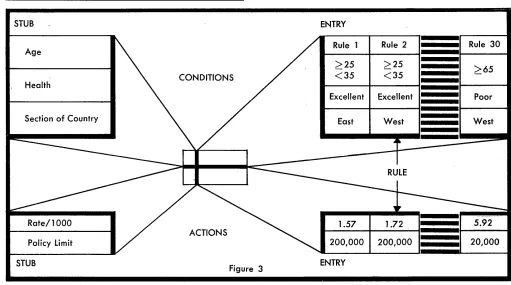
Using the information from the insurance example (Fig-ure 3), the decision table is shown in an exploded view, Figure 3 to show recommended titles: (see preceding page) ..
The double lines serve as demarcation: CONDITIONS are shown above the horizontal double line, ACTIONS be-low; the STUB is to the left of the vertical double line, EN-TRIES are to the right. Each vertical combination of con-ditions and actions is called a RULE. By adding to the elements shown a title section at the top .of the table which is called a TABLE HEADER, and a RULE HEADER over the entries, the essential nomenclature is complete.
limited entry tables
LIMITED ENTRY tables offer a different approach to stating the decision logic. This type of table is shown in Figure 4:
c
Credit Pay Special Return
limit Experience is Clearance Approve Order is OK Favorable is Obtained Order to Sales
-Rule 1 y y
-Rule 2 N y y
-Rule 3 N N y y
-Rule 4 N N N y
Figure 4
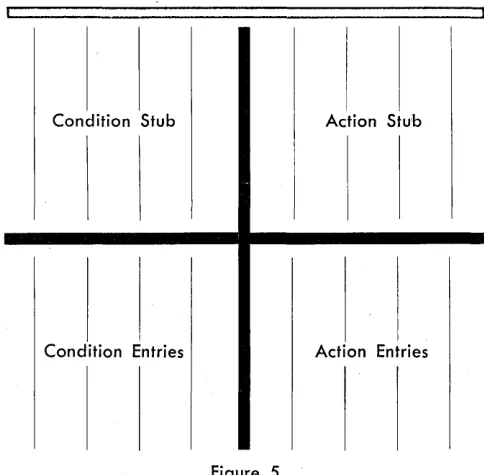
The first rule (rows 1· and 2) is read: If credit limit is OK then approve order. Again, the underlined words are implied by the form. In limited entry tables the entire con-dition or action must be written in the stub; the entry is "limited" to reversing a condition or ignoring a condition or action. In contrast, extended entry tables have a part of the condition or action "extended" directly into the entry. While this decision table (Figure 4) is arranged quite differ-ently, the same table elements are present. Structurally, the table appears as in Figure 5:
Condition Stub Action Stub
Condition Entries Action Entries
Figure 5
Limited entry permits only q few values in an entry:
24
Y = yes N=no
Blank = not pertinent (e.g., condition or acticn need . not be considered in the current rule)
business applications
Examples of successful applications of decision tables in business are as yet few in number, but some of the pioneer-ing work can be reviewed briefly.
Initial work on the use of tabular form for recording de-cision logic was performed by General Electric's Integrated Systems Project from the fall of 1957 through 1959; during that period, I was the project leader. Many individuals were involved in this development work which concentrated on the use of tabular form to express the logic of product de-sign, operation planning, cost determination, quality as-surance planning, etc. This project developed extended entry decision tables for man-to-machine communication.
Mr. T. F. Kavanagh, in commenting on this work at the 1960 Eastern Joint Computer Conference, (1) noted, "the
de-cision . . . table is a fundamental language concept . . . broadly applicable to many classes of information processing and decision making problems; . . . tables force a step-by-step analysis of the decision, . . . are easily understood by humans regardless of their functional background ... (they are) simple and straightforward (enough) that ... ' special-ists can write tables ... with very little training; ... tables are easy to maintain (and) errors are reported at the source language level."
From late 1958 to the present time, Sutherland Com-pany, a consulting finn in Peoria, Illinois, has been using tabular form for expressing what they call management de-cision rules. They have applied these techniques to a num-ber of their clients' problems (e.g., a logistics study for Norton Air. Force Base) with quite satisfactory results. In particular, they have used decision tables to record the logic for payroll, order processing, sales analysis, general ledger accounts, accounts payable, accounts receivable, and cost accounting. There has been no published material to date on the Sutherland work but available information indicates that limited entry decision tables are being used.
In 1959, Hunt Foods and Industries began experimenting with tabular fOlm for man-to-man communication in com-puter systems planning. Material on this approach was the first to be released, in late 1959, describing how limited entry tables were used for systems analysis. Explorations were also carried out on complex relationships among in-dividual decision using prior rule and sub-routine tech-niques. Many business systems' 'vere documented with decision tables: stock-control, credit analysis, sales analysis, and traffic.
In his report on the work at Hunt Foods, Mr. O. Y. Evans states,' "The tabular approach . . . aids ... in visual-izing the numerous relationships and alternatives . . . (and) permits data rules to be readily reviewed for omissions and inconsistencies; . . . (in addition it) provides flexibility in changing any portion of the analysis."
Since early 1960, IBM has been actively engaged in ex-ploring the value of tabular form both for systems analysis and for computer programming. The company has initiated joint projects with several customers to evaluate the effec-tiveness of various tabular forms, to explore alternative methods of implementation, and to investigate opportuni-ties for incorporating these developments as an adjunct to existing languages. Since there are many different aspects of tabular form which still need to be examined, language implementing programs have not been prepared. These studies have developed and formalized mixed limited and extended entry tables, stubless tables, and unconditional
decision tables.
The CODASYL Systems Group, which is part of the De-velopment Committee of the Conference on Data Systems Languages, . has been looking into the application and use of decision tables since late 1959. Their particular goal has been the creation of a systems-oriented language which would enable systems analysts to communicate their basic
[image:24.613.41.283.450.688.2].
,
clec.:isioll logic either to computer programmers or to auto-matic program compilers. This organization contends that tabular form is one currently known technique which would aid in achieving effective mutual understanding of business dec.:isions while maintaining machine independence. Their efforts have included research on generalizing tabular form to combine limited and extended entry format in a given table, as well as studies on more complex methods of sequence control, rule structure, and rule execution logic.
an example
To illustrate some of the possible advantages of decision tables, a composite tabular form is shown in Figure 6; these tables describe the logic. of a file maintenance pro-cedure. There are two input files (Detail and Master), each sequenced by identification number. The principal output is a similarly sequenced Master file incorporating additions and changes and omitting deleted records. The logic is based on having three internal areas: (1) Detail, (2) Master, and (3) New Master. "Read" as used here means "obtain the next record in the referenced file." "\Vrite" means ~'pro
duce an output Master record from the indicated source area." These are not detailed, precise tables for machine compilation, but rather the equivalent of a block diagram.
value of decision tables
So far, decision tables have been discussed in the light of known applications and attributed values and advantages.
TABLE 001 - Update
I
Rule No. 01 02Start y N
End of Detail N
End of Master N
Detail <Master
Detail an "Addition" Y
Do Error Routine
Move Master to New Master
Move Detail to New Master X
Set Addition Switch OFF ON
Write Master
Read Master X
Read Detail X X
GO TO TABLE 001 002
TABLE 002 - Change
Rule No. 01 02
Though many current developmcnts arc still in the realm of "company confidential," several projects have indicated results that enable us to discuss the value of tables in con-crete terms.
Recalling the three benefits mentioned previously, some studies claim that decision tables appear to be superior to other methods for representing complex decision logic in that they provide or encourage:
clarity and conciseness completeness
meaningful relationships
To indicate the potential results from use of tabular form, the following statements paraphrase various user opinions: Clarity and conciseness - Decision tables are easy to pre-pare, read, and teach to others; experience shows that non-programmers can learn to prepare satisfactory tables in less than a day. The amount of writing, or number of words, lines, and symbols used in describing complex de-cisions, is reduced by 2.5-.50% as compared to flow chart-ing. For certain specific cases, problem statement and pro-gramming time combined have been reduced significantly. Completeness - Tabular form allows effective visual or desk debugging both by the analyst and the reviewer. There are fewer errors to start with since the analyst tends to catch his own mistakes; moreover, the reviewer will typically detect a high percentage of the remaining errors
03 04 05 06 07 08
N N N N N ElSE
N N y y N
N y N y N
=Master >Master
Y
X X
X
OFF ON OFF OFF OFF OFF
X X
X X
X X
002 002 001 END 001 001
03 04 05 06 07
Detail <New Master >New Master >New Master =New Master =New Master =New Master ELSE
Addition Switch ON y N y N
Detail a "Change" y
Detail a "Delete" Y Y
Write New Master X X
Do Error Routine X X
Do Change Routine X
Do Delete Routine X X
Read Master X X
Read Detail X X X X X
GO TO TABLE 002 001 001 002 001 001 002
[image:25.617.55.567.310.755.2]