Inducing a Discriminative Parser to Optimize Machine
Translation Reordering
Graham Neubig1,2, Taro Watanabe2, Shinsuke Mori1 1Graduate School of Informatics, Kyoto University
Yoshida Honmachi, Sakyo-ku, Kyoto, Japan
2National Institute of Information and Communication Technology
3-5 Hikari-dai, Seika-cho, Soraku-gun, Kyoto, Japan
Abstract
This paper proposes a method for learning a discriminative parser for machine trans-lation reordering using only aligned par-allel text. This is done by treating the parser’s derivation tree as a latent variable in a model that is trained to maximize re-ordering accuracy. We demonstrate that efficient large-margin training is possible by showing that two measures of reorder-ing accuracy can be factored over the parse tree. Using this model in the pre-ordering framework results in significant gains in translation accuracy over standard phrase-based SMT and previously proposed unsu-pervised syntax induction methods.
1 Introduction
Finding the appropriate word ordering in the target language is one of the most difficult prob-lems for statistical machine translation (SMT), particularly for language pairs with widely di-vergent syntax. As a result, there is a large amount of previous research that handles the problem of reordering through the use of im-proved reordering models for phrase-based SMT (Koehn et al., 2005), hierarchical phrase-based translation (Chiang, 2007), syntax-based trans-lation (Yamada and Knight, 2001), or pre-ordering (Xia and McCord, 2004).
In particular, systems that use source-language syntax allow for the handling of long-distance reordering without large increases in
The first author is now affiliated with the Nara Institute of Science and Technology.
decoding time. However, these require a good syntactic parser, which is not available for many languages. In recent work, DeNero and Uszko-reit (2011) suggest that unsupervised grammar induction can be used to create source-sentence parse structure for use in translation as a part of a pre-ordering based translation system.
In this work, we present a method for inducing a parser for SMT by training a discriminative model to maximize reordering accuracy while treating the parse tree as a latent variable. As a learning framework, we use online large-margin methods to train the model to directly minimize two measures of reordering accuracy. We pro-pose a variety of features, and demonstrate that learning can succeed when no linguistic informa-tion (POS tags or parse structure) is available in the source language, but also show that this lin-guistic information can be simply incorporated when it is available. Experiments find that the proposed model improves both reordering and translation accuracy, leading to average gains of 1.2 BLEU points on English-Japanese and Japanese-English translation without linguistic analysis tools, or up to 1.5 BLEU points when these tools are incorporated. In addition, we show that our model is able to effectively max-imize various measures of reordering accuracy, and that the reordering measure that we choose has a direct effect on translation results.
2 Preordering for SMT
Machine translation is defined as transforma-tion of source sentence F = f1. . . fJ to target sentence E = e1. . . eI. In this paper, we take
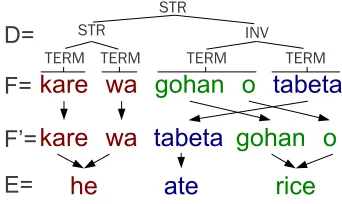
Figure 1: An example with a source sentenceF re-ordered into target order F0, and its corresponding target sentenceE. D is one of the BTG derivations that can produce this ordering.
the pre-ordering approach to machine transla-tion (Xia and McCord, 2004), which performs translation as a two step process of reordering and translation (Figure 1). Reordering first de-terministically transformsF intoF0, which con-tains the same words asF but is in the order of
E. Translation then transformsF0 intoE using a method such as phrase-based SMT (Koehn et al., 2003), which can produce accurate transla-tions when only local reordering is required.
This general framework has been widely stud-ied, with the majority of works relying on a syntactic parser being available in the source language. Reordering rules are defined over this parse either through machine learning tech-niques (Xia and McCord, 2004; Zhang et al., 2007; Li et al., 2007; Genzel, 2010; Dyer and Resnik, 2010; Khalilov and Sima’an, 2011) or linguistically motivated manual rules (Collins et al., 2005; Xu et al., 2009; Carpuat et al., 2010; Isozaki et al., 2010b). However, as building a parser for each source language is a resource-intensive undertaking, there has also been some interest in developing reordering rules without the use of a parser (Rottmann and Vogel, 2007; Tromble and Eisner, 2009; DeNero and Uszko-reit, 2011; Visweswariah et al., 2011), and we will follow this thread of research in this paper. In particular, two methods deserve mention for being similar to our approach. First, DeNero and Uszkoreit (2011) learn a reordering model through a three-step process of bilingual gram-mar induction, training a monolingual parser to reproduce the induced trees, and training
a reordering model that selects a reordering based on this parse structure. In contrast, our method trains the model in a single step, treat-ing the parse structure as a latent variable in a discriminative reordering model. In addition Tromble and Eisner (2009) and Visweswariah et al. (2011) present models that use binary clas-sification to decide whether each pair of words should be placed in forward or reverse order. In contrast, our method uses traditional context-free-grammar models, which allows for simple parsing and flexible parameterization, including features such as those that utilize the existence of a span in the phrase table. Our work is also unique in that we show that it is possible to di-rectly optimize several measures of reordering accuracy, which proves important for achieving good translations.1
3 Training a Reordering Model with Latent Derivations
In this section, we provide a basic overview of the proposed method for learning a reordering model with latent derivations using online dis-criminative learning.
3.1 Space of Reorderings
The model we present here is based on the bracketing transduction grammar (BTG, Wu (1997)) framework. BTGs represent a binary tree derivation D over the source sentence F
as shown in Figure 1. Each non-terminal node can either be a straight (str) or inverted (inv) production, and terminals (term) span a non-empty substringf.2
The ordering of the sentence is determined by the tree structure and the non-terminal labels
strandinv, and can be built bottom-up. Each subtree represents a source substring f and its reordered counterpart f0. For each terminal node, no reordering occurs andf is equal tof0.
1The semi-supervised method of Katz-Brown et al.
(2011) also optimizes reordering accuracy, but requires manually annotated parses as seed data.
2In the original BTG framework used in translation,
For each non-terminal node spanningf with its left child spanning f1 and its right child span-ning f2, if the non-terminal symbol is str, the reordered strings will be concatenated in order asf0 =f01f02, and if the non-terminal symbol is
inv, the reordered strings will be concatenated in inverted order asf0 =f02f01.
We define the space of all reorderings that can be produced by the BTG asF0, and attempt to find the best reorderingFˆ0 within this space.3
3.2 Reorderings with Latent Derivations
In order to find the best reorderingFˆ0given only the information in the source side sentenceF, we define a scoring function S(F0|F), and choose the ordering of maximal score:
˙
F0 =arg max F0
S(F0|F).
As our model is based on reorderings licensed by BTG derivations, we also assume that there is an underlying derivationDthat producedF0. As we can uniquely determine F0 given F and
D, we can define a scoring functionS(D|F)over derivations, find the derivation of maximal score
˙
D=arg max D
S(D|F)
and useD˙ to transformF intoF0.
Furthermore, we assume that the score
S(D|F)is the weighted sum of a number of fea-ture functions defined over Dand F
S(D|F,w) =∑
i
wiφi(D, F)
where φi is the ith feature function, and wi is its corresponding weight in weight vector w.
Given this model, we must next consider how to learn the weights w. As the final goal of our model is to produce good reorderings F0, it is natural to attempt to learn weights that will al-low us to produce these high-quality reorderings.
3BTGs cannot reproduce all possible reorderings, but
can handle most reorderings occurring in natural trans-lated text (Haghighi et al., 2009).
Figure 2: An example of (a) the ranking function r(fj), (b) loss according to Kendall’s τ, (c) loss
ac-cording to chunk fragmentation.
4 Evaluating Reorderings
Before we explain the learning algorithm, we must know how to distinguish whether the F0
produced by the model is good or bad. This section explains how to calculate oracle reorder-ings, and assign each F0 a loss and an accuracy
according to how well it reproduces the oracle.
4.1 Calculating Oracle Orderings
In order to calculate reordering quality, we first define a ranking functionr(fj|F, A), which indi-cates the relative position of source word fj in the proper target order (Figure 2 (a)). In or-der to calculate this ranking function, we define
A=a1, . . . ,aJ, where eachaj is a set of the in-dices of the words inE to whichfj is aligned.4 Given these alignments, we define an ordering function aj1 < aj2 that indicates that the
in-dices inaj1 come before the indices inaj2.
For-mally, we define this function as “the first index inaj1 is at most the first index inaj2, similarly
for the last index, and either the first or last index inaj1 is less than that of aj2.”
Given this ordering, we can sort every align-mentaj, and use its relative position in the sen-tence to assign a rank to its word r(fj). In 4Null alignments require special treatment. To do so,
the case of ties, where neither aj1 < aj2 nor
aj2 < aj1, both fj1 and fj2 are assigned the
same rank. We can now define measures of re-ordering accuracy forF0 by how well it arranges the words in order of ascending rank. It should be noted that as we allow ties in rank, there are multiple possible F0 where all words are in strictly ascending order, which we will call ora-cle orderings.
4.2 Kendall’s τ
The first measure of reordering accuracy that we will consider is Kendall’s τ (Kendall, 1938), a measure of pairwise rank correlation which has been proposed for evaluating translation re-ordering accuracy (Isozaki et al., 2010a; Birch et al., 2010) and pre-ordering accuracy (Talbot et al., 2011). The fundamental idea behind the measure lies in comparisons between each pair of elements fj01 and fj02 of the reordered sentence, wherej1< j2. Becausej1 < j2,fj01 comes before fj0
2 in the reordered sentence, the ranks should
be r(fj01) ≤ r(fj02) in order to produce the cor-rect ordering.
Based on this criterion, we first define a loss
Lt(F0)that will be higher for orderings that are further from the oracle. Specifically, we take the sum of all pairwise orderings that do not follow the expected order
Lt(F0) = J−1 ∑
j1=1 J ∑
j2=j1+1
δ(r(fj01)> r(fj02))
whereδ(·)is an indicator function that is 1 when its condition is true, and 0 otherwise. An exam-ple of this is given in Figure 2 (b).
To calculate an accuracy measure for ordering
F0, we first calculate the maximum loss for the sentence, which is equal to the total number of non-equal rank comparisons in the sentence5
max F0 Lt(F
0) = J∑−1
j1=1 J ∑
j2=j1+1
δ(r(fj01)6=r(fj02)).
(1)
5The traditional formulation of Kendall’s
τ assumes no ties in rank, and thus the maximum loss can be cal-culated asJ(J−1)/2.
Finally, we use this maximum loss to normalize the actual loss to get an accuracy
At(F0) = 1−
Lt(F0) max
˜ F0
Lt( ˜F0)
,
which will take a value between 0 (whenF0 has maximal loss), and 1 (when F0 matches one of the oracle orderings). In Figure 2 (b), Lt(F0) =
2and max
˜ F0
Lt( ˜F0) = 8, soAt(F0) = 0.75. 4.3 Chunk Fragmentation
Another measure that has been used in eval-uation of translation accuracy (Banerjee and Lavie, 2005) and pre-ordering accuracy (Talbot et al., 2011) is chunk fragmentation. This mea-sure is based on the number of chunks that the sentence needs to be broken into to reproduce the correct ordering, with a motivation that the number of continuous chunks is equal to the number of times the reader will have to jump to a different position in the reordered sentence to read it in the target order. One way to measure the number of continuous chunks is considering whether each word pair fj0 and fj0+1 is discon-tinuous (the rank offj0+1 is not equal to or one greater than fj0)
discont(fj0, fj0+1) =
δ(r(fj0)6=r(fj0+1)∧r(fj0) + 16=r(fj0+1))
and sum over all word pairs in the sentence to create a sentence-based loss
Lc(F0) = J−1 ∑
j=1
discont(fj0, fj0+1) (2) While this is the formulation taken by previ-ous work, we found that this under-penalizes bad reorderings of the first and last words of the sentence, which can contribute to the loss only once, as opposed to other words which can contribute to the loss twice. To account for this, when calculating the chunk fragmentation score, we additionally add two sentence bound-ary wordsf0 andfJ+1 with ranksr(f0) = 0 and r(fJ+1) = 1 +max
fj0∈F0r(f
0
procedure WeightUpdate(F,A,w)
D ←parse(F,w) . Create parse forest
˙
D←argmax
D∈D
S(D|F,w) +L(D|F, A)
.Find the model parse
ˆ
D←argmin
D∈D
L(D|F, A)−αS(D|F,w)
. Find the oracle parse
if L( ˆD|F, A)6=L( ˙D|F, A)then w←β(w+γ(φ( ˆD, F)−φ( ˙D, F)))
.Perform weight update
end if end procedure
Figure 3: An online update for sentenceF, alignment A, and weight vectorw. αis a very small constant, andβ andγ are defined by the update strategy.
Similarly to Kendall’s τ, we can also define an accuracy measure between 0 and 1 using the maximum loss, which will be at most J + 1, which corresponds to the total number of com-parisons made in calculating the loss6
Ac(F0) = 1−
Lc(F0)
J+ 1.
In Figure 2 (c), Lc(F0) = 3 and J + 1 = 6, so
Ac(F0) = 0.5.
5 Learning a BTG Parser for Reordering
Now that we have a definition of loss over re-orderings produced by the model, we have a clear learning objective: we would like to find reorderingsF0 with low loss. The learning algo-rithm we use to achieve this goal is motivated by discriminative training for machine transla-tion systems (Liang et al., 2006), and extended to use large-margin training in an online frame-work (Watanabe et al., 2007).
5.1 Learning Algorithm
Learning uses the general framework of large-margin online structured prediction (Crammer et al., 2006), which makes several passes through the data, finding a derivation with high model score (the model parse) and a derivation with
6It should be noted that for sentences of length one or
sentences with tied ranks, the maximum loss may be less thanJ+ 1, but for simplicity we use this approximation.
minimal loss (theoracleparse), and updatingw
if these two parses diverge (Figure 3).
In order to create both of these parses effi-ciently, we first create a parse forest encoding a large number of derivationsDi according to the model scores. Next, we find the model parseD˙i, which is the parse in the forest Di that maxi-mizes the sum of the model score and the loss
S(Dk|Fk,w) +L(Dk|Fk, Ak). It should be noted that here we are considering not only the model score, but also the derivation’s loss. This is necessary for loss-driven large-margin training (Crammer et al., 2006), and follows the basic intuition that during training, we would like to make it easier to select negative examples with large loss, causing these examples to be penal-ized more often and more heavily.
We also find an oracle parse Dˆi, which is se-lected solely to minimize the lossL(Dk|Fk, Ak). One important difference between the model we describe here and traditional parsing models is that the target derivationDˆkis a latent variable.
Because many Dk achieve a particular reorder-ing F0, many reorderings F0 are able to mini-mize the lossL(Fk0|Fk, Ak). Thus it is necessary to choose a single oracle derivation to treat as the target out of many equally good reorderings. DeNero and Uszkoreit (2011) resolve this ambi-guity with four features with empirically tuned scores before training a monolingual parser and reordering model. In contrast, we follow previ-ous work on discriminative learning with latent variables (Yu and Joachims, 2009), and break ties within the pool of oracle derivations by se-lecting the derivation with the largest model score. From an implementation point of view, this can be done by finding the derivation that minimizesL(Dk|Fk, Ak)−αS(Dk|Fk,w), where
α is a constant small enough to ensure that the effect of the loss will always be greater than the effect of the score.
Finally, if the model parse D˙k has a loss that is greater than that of the oracle parse Dˆk, we
we opted to use Pegasos (Shalev-Shwartz et al., 2007) as it allows for the introduction of regu-larization and relatively stable learning.
To perform this full process, given a source sentence Fk, alignment Ak, and model weights
w we need to be able to efficiently calculate scores, calculate losses, and create parse forests for derivations Dk, the details of which will be explained in the following sections.
5.2 Scoring Derivation Trees
First, we must consider how to efficiently assign scoresS(D|F,w)to a derivation or forest during parsing. The most standard and efficient way to do so is to create local features that can be cal-culated based only on the information included in a single node d in the derivation tree. The score of the whole tree can then be expressed as the sum of the scores from each node:
S(D|F,w) =∑
d∈D
S(d|F,w)
=∑
d∈D ∑
i
wiφi(d, F).
Based on this restriction, we define a number of features that can be used to score the parse tree. To ease explanation, we represent each node in the derivation as d = hs, l, c, c+ 1, ri, where s
is the node’s symbol (str,inv, orterm), while
l and r are the leftmost and rightmost indices of the span that d covers. c and c+ 1 are the rightmost index of the left child and leftmost index of the right child for non-terminal nodes. All features are intersected with the node la-bel s, so each feature described below corre-sponds to three different features (or two for features applicable to only non-terminal nodes).
• φlex: Identities of words in positionsfl,fr,
fc,fc+1,fl−1,fr+1,flfr, and fcfc+1. • φclass: Same as φlex, but with words
ab-stracted to classes. We use the 50 classes automatically generated by Och (1999)’s method that are calculated during align-ment in standard SMT systems.
• φbalance: For non-terminals, features indi-cating whether the length of the left span
(c−l+ 1) is lesser than, equal to, or greater than the length of the right span (r−c).
• φtable: Features, bucketed by length, that indicate whether “fl. . . fr” appears as a contiguous phrase in the SMT training data, as well as the log frequency of the number of times the phrase appears total and the number of times it appears as a contiguous phrase (DeNero and Uszkoreit, 2011). Phrase length is limited to 8, and phrases of frequency one are removed.
• φpos: Same as φlex, but with words ab-stracted to language-dependent POS tags.
• φcf g: Features indicating the label of the spans fl. . . fr, fl. . . fc, and fc+1. . . fr in a supervised parse tree, and the intersection of the three labels. When spans do not cor-respond to a span in the supervised parse tree, we indicate “no span” with the label “X” (Zollmann and Venugopal, 2006).
Most of these features can be calculated from only a parallel corpus, butφpos requires a POS tagger and φcf g requires a full syntactic parser in the source language. As it is preferable to have a method that is applicable in languages where these tools are not available, we perform experiments both with and without the features that require linguistic analysis tools.
5.3 Finding Losses for Derivation Trees
5.3.1 Factoring Kendall’s τ
For Kendall’sτ, in the case of terminal nodes,
Lt(d = hterm, l, ri|F, A) can be calculated by performing the summation in Equation (1). We can further define this sum recursively and use memoization for improved efficiency
Lt(d|F, A) =Lt(hterm, l, r−1i|F, A)
+
r−1 ∑
j=l
δ(r(fj)> r(fr)). (3)
For non-terminal nodes, we first focus on straight non-terminals with parent node d = hstr, l, c, c+ 1, ri, and left and right child nodes
dl=hsl, l, lc, lc+ 1, cianddr=hsr, c+ 1, rc, rc+
1, ri. First, we note that the loss for the subtree rooted atdcan be expressed as
Lt(d|F, A) =Lt(dl|F, A) +Lt(dr|F, A)
+
c ∑
j1=l r ∑
j2=c+1
δ(r(fj1)> r(fj2)).
In other words, the subtree’s total loss can be factored into the loss of its left subtree, the loss of its right subtree, and the additional loss contributed by comparisons between the words spanning both subtrees. In the case of inverted terminals, we must simply reverse the compari-son in the final sum to be δ(r(fj1)< r(fj2)). 5.3.2 Factoring Chunk Fragmentation
Chunk fragmentation loss can be factored in a similar fashion. First, it is clear that the loss for the terminal nodes can be calculated efficiently in a fashion similar to Equation (3). In order to calculate the loss for non-terminals d, we note that the summation in Equation (2) can be di-vided into the sum over the internal bi-grams in the left and right subtrees, and the bi-gram spanning the reordered trees
Lc(d|F, A) =Lc(dl|F, A) +Lc(dr|F, A)
+discont(fc0, fc0+1).
However, unlike Kendall’sτ, this equation re-lies not on the ranks offc andfc+1 in the
origi-nal sentence, but on the ranks of fc0 and fc0+1 in the reordered sentence. In order to keep track
of these values, it is necessary to augment each node in the tree to bed=hs, l, c, c+ 1, r, tl, tri
with two additional values tl and tr that indi-cate the position of the leftmost and rightmost words after reordering. Thus, a straight non-terminal parentdwith childrendl=hsl, l, lc, lc+
1, c, tl, tlrianddr=hsr, c+1, rc, rc+1, r, trl, tri will have loss as follows
Lc(d|F, A) =Lc(dl|F, A) +Lc(dr|F, A)
+discont(ftlr, ftrl)
with a similar calculation being possible for in-verted non-terminals.
5.4 Parsing Derivation Trees
Finally, we must be able to create a parse forest from which we select model and oracle parses. As all feature functions factor over single nodes, it is possible to find the parse tree with the high-est score in O(J3) time using the CKY
algo-rithm. However, when keeping track of target positions for calculation of chunk fragmentation loss, there are a total ofO(J5)nodes, an
unrea-sonable burden in terms of time and memory. To overcome this problem, we note that this set-ting is nearly identical to translation using syn-chronous CFGs with an integrated bigram LM, and thus we can employ cube-pruning to reduce our search space (Chiang, 2007).
6 Experiments
Our experiments test the reordering and trans-lation accuracy of transtrans-lation systems using the proposed method. As reordering metrics, we use Kendall’sτ and chunk fragmentation (Talbot et al., 2011) comparing the system F0 and oracle
F0calculated with manually created alignments. As translation metrics, we use BLEU (Papineni et al., 2002), as well as RIBES (Isozaki et al., 2010a), which is similar to Kendall’sτ, but eval-uated on the target sentenceEinstead of the re-ordered sentence F0. All scores are the average of three training runs to control for randomness in training (Clark et al., 2011).
en-ja ja-en
Chunk τ BLEU RIBES Chunk τ BLEU RIBES
orig 61.22 73.46 21.87 68.25 66.42 72.99 18.34 65.36
3-step 63.51 72.55 21.45 67.66 67.17 73.01 17.78 64.42
3-step+φpos 64.28 72.11 21.45 67.44 67.56 74.21 18.18 64.65
3-step+φcf g 65.76 75.32 21.67 68.47 67.23 74.06 18.18 64.93
lader 73.19 78.44 23.11 69.86 75.14 79.14 19.54 66.93
lader+φpos 73.97 79.24 23.32 69.78 75.49 78.79 19.89 67.24
[image:8.612.97.512.61.185.2]lader+φcf g 75.06 80.53 23.36 70.89 75.14 77.80 19.35 66.12
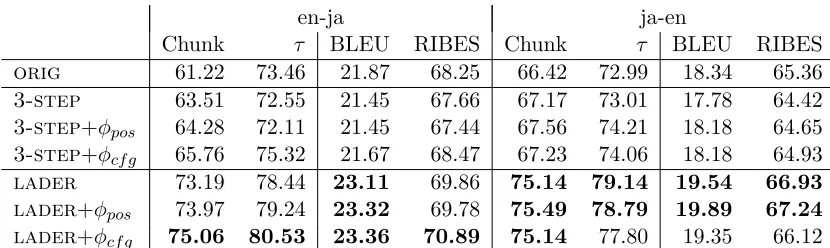
Table 2: Reordering (chunk, τ) and translation (BLEU, RIBES) results for each system. Bold numbers indicate no significant difference from the best system (bootstrap resampling withp >0.05) (Koehn, 2004).
sent. word (ja) word (en) RM-train 602 14.5k 14.3k RM-test 555 11.2k 10.4k TM/LM 329k 6.08M 5.91M Tune 1166 26.8k 24.3k Test 1160 28.5k 26.7k
Table 1: The number of sentences and words for training and testing the reordering model (RM), translation model (TM), and language model (LM).
of pre-ordering: original order with F0 ← F
(orig), pre-orderings learned using the 3-step process of DeNero and Uszkoreit (2011) ( 3-step), and the proposed model with latent derivations (lader).7 Except when stated oth-erwise, lader was trained to minimize chunk fragmentation loss with a cube pruning stack pop limit of 50, and the regularization constant of 10−3 (chosen through cross-validation).
We test our systems on Japanese-English and English-Japanese translation using data from the Kyoto Free Translation Task (Neubig, 2011). We use the training set for training translation and language models, the development set for weight tuning, and the test set for testing (Table 1). We use the designated development and test sets of manually created alignments as training data for the reordering models, removing sen-tences of more than 60 words.
As default features for lader and the mono-lingual parsing and reordering models in3-step, we use all the features described in Section 5.2
7Available open-source: http://phontron.com/lader
except φpos and φcf g. In addition, we test sys-tems with φpos and φcf g added. For English, we use the Stanford parser (Klein and Manning, 2003) for both POS tagging and CFG parsing. For Japanese, we use the KyTea tagger (Neu-big et al., 2011) for POS tagging,8 and the EDA word-based dependency parser (Flannery et al., 2011) with simple manual head-rules to convert a dependency parse to a CFG parse.
6.1 Effect of Pre-ordering
Table 2 shows reordering and translation results for orig, 3-step, and lader. It can be seen that the proposedladeroutperforms the base-lines in both reordering and translation.9 There are a number of reasons why lader outper-forms 3-step. First, the pipeline of 3-step
suffers from error propogation, with errors in monolingual parsing and reordering resulting in low overall accuracy.10 Second, as Section 5.1 describes, lader breaks ties between ora-cle parses based on model score, allowing easy-to-reproduce model parses to be chosen dur-ing traindur-ing. In fact, lader generally found trees that followed from syntactic constituency, while 3-step more often used terminal nodes
8In addition, following the example of Sudoh et al.
(2011a)’s reordering rules, we lexicalize all particles.
9It should be noted that our results for 3-step are
significantly worse than those of DeNero and Uszkoreit (2011). Likely reasons include a 20x difference in training data size, the fact that we are using naturally translated text as opposed to text translated specifically to create word alignments, or differences in implementation.
10When using oracle parses, chunk accuracy was up to
en-ja ja-en
Chunk τ BLEU RIBES Chunk τ BLEU RIBES
Lc 73.19 78.44 23.11 69.86 75.14 79.14 19.54 66.93
Lt 70.37 79.57 22.57 69.47 72.51 78.93 18.52 66.26
[image:9.612.111.502.62.132.2]Lc+Lt 72.55 80.58 22.89 70.34 74.44 79.82 19.21 66.48 Table 3: Results for systems trained to optimize chunk fragmentation (Lc) or Kendall’sτ (Lt).
that spanned constituent boundaries (as long as the phrase frequency was high). Finally, as Sec-tion 6.2 shows in detail, the ability of laderto maximize reordering accuracy directly allows for improved reordering and translation results.
It can also be seen that incorporating POS tags or parse trees improves accuracy of both
lader and 3-step, particularly for English-Japanese, where syntax has proven useful for pre-ordering, and less so for Japanese-English, where syntactic pre-ordering has been less suc-cessful (Sudoh et al., 2011b).
We also tested Moses’s implementation of hi-erarchical phrase-based SMT (Chiang, 2007), which achieved BLEU scores of 23.21 and 19.30 for English-Japanese and Japanese-English re-spectively, approximately matching lader in accuracy, but with a significant decrease in de-coding speed. Further, when pre-ordering with
laderand hierarchical phrase-based SMT were combined, BLEU scores rose to 23.29 and 19.69, indicating that the two techniques can be com-bined for further accuracy improvements.
6.2 Effect of Training Loss
Table 3 shows results when one of three losses is optimized during training: chunk fragmentation (Lc), Kendall’s τ (Lt), or the linear interpola-tion of the two with weights chosen so that both losses contribute equally (Lt+Lc). In general, training successfully maximizes the criterion it is trained on, andLt+Lcachieves good results on both measures. We also find thatLcandLc+Lt achieve the best translation results, which is in concert with Talbot et al. (2011), who find chunk fragmentation is better correlated with translation accuracy than Kendall’s τ. This is an important result, as methods such as that of Tromble and Eisner (2009) optimize pairwise
en-ja ja-en BLEU/RIBES BLEU/RIBES
orig 21.87 68.25 18.34 65.36
man-602 23.11 69.86 19.54 66.93
auto-602 22.39 69.19 18.58 66.07
[image:9.612.315.540.177.260.2]auto-10k 22.53 69.68 18.79 66.89
Table 4: Results based on data size, and whether manual or automatic alignments are used in training.
word comparisons equivalent to Lt, which may not be optimal for translation.
6.3 Effect of Automatic Alignments Table 4 shows the difference between using man-ual and automatic alignments in the training of
lader. laderis able to improve over theorig
baseline in all cases, but when equal numbers of manual and automatic alignments are used, the reorderer trained on manual alignments is significantly better. However, as the number of automatic alignments is increased, accuracy im-proves, approaching that of the system trained on a smaller number of manual alignments.
7 Conclusion
We presented a method for learning a discrim-inative parser to maximize reordering accuracy for machine translation. Future work includes application to other language pairs, develop-ment of more sophisticated features, investiga-tion of probabilistic approaches to inference, and incorporation of the learned trees directly in tree-to-string translation.
Acknowledgments
References
Satanjeev Banerjee and Alon Lavie. 2005. ME-TEOR: An automatic metric for MT evaluation with improved correlation with human judgments. InProc. ACL Workshop.
Alexandra Birch, Miles Osborne, and Phil Blunsom. 2010. Metrics for MT evaluation: evaluating re-ordering. Machine Translation, 24(1):15–26. Marine Carpuat, Yuval Marton, and Nizar Habash.
2010. Improving arabic-to-english statistical ma-chine translation by reordering post-verbal sub-jects for alignment. In Proc. ACL.
David Chiang. 2007. Hierarchical phrase-based translation. Computational Linguistics, 33(2). Jonathan H. Clark, Chris Dyer, Alon Lavie, and
Noah A. Smith. 2011. Better hypothesis test-ing for statistical machine translation: Control-ling for optimizer instability. InProc. ACL, pages 176–181.
Michael Collins, Philipp Koehn, and Ivona Kucerova. 2005. Clause restructuring for statistical machine translation. In Proc. ACL.
Michael Collins. 2002. Discriminative training meth-ods for hidden markov models: Theory and ex-periments with perceptron algorithms. In Proc. EMNLP, pages 1–8.
Koby Crammer, Ofer Dekel, Joseph Keshet, Shai Shalev-Shwartz, and Yoram Singer. 2006. Online passive-aggressive algorithms. Journal of Machine Learning Research, 7:551–585.
John DeNero and Jakob Uszkoreit. 2011. Induc-ing sentence structure from parallel corpora for reordering. InProc. EMNLP.
Chris Dyer and Philip Resnik. 2010. Context-free reordering, finite-state translation. InProc.
HLT-NAACL.
Daniel Flannery, Yusuke Miyao, Graham Neubig, and Shinsuke Mori. 2011. Training dependency parsers from partially annotated corpora. InProc. IJCNLP, pages 776–784, Chiang Mai, Thailand, November.
Dmitriy Genzel. 2010. Automatically learning source-side reordering rules for large scale machine translation. In Proc. COLING.
Aria Haghighi, John Blitzer, John DeNero, and Dan Klein. 2009. Better word alignments with super-vised ITG models. InProc. ACL.
Hideki Isozaki, Tsutomu Hirao, Kevin Duh, Kat-suhito Sudoh, and Hajime Tsukada. 2010a. Auto-matic evaluation of translation quality for distant language pairs. In Proc. EMNLP, pages 944–952.
Hideki Isozaki, Katsuhito Sudoh, Hajime Tsukada, and Kevin Duh. 2010b. Head finalization: A simple reordering rule for sov languages. InProc.
WMT and MetricsMATR.
Jason Katz-Brown, Slav Petrov, Ryan McDon-ald, Franz Och, David Talbot, Hiroshi Ichikawa, Masakazu Seno, and Hideto Kazawa. 2011. Train-ing a parser for machine translation reorderTrain-ing. In
Proc. EMNLP, pages 183–192.
Maurice G. Kendall. 1938. A new measure of rank correlation. Biometrika, 30(1/2):81–93.
Maxim Khalilov and Khalil Sima’an. 2011. Context-sensitive syntactic source-reordering by statistical transduction. InProc. IJCNLP.
Dan Klein and Christopher D. Manning. 2003. Ac-curate unlexicalized parsing. InProc. ACL, pages 423–430.
Phillip Koehn, Franz Josef Och, and Daniel Marcu. 2003. Statistical phrase-based translation. In
Proc. HLT, pages 48–54.
Philipp Koehn, Amittai Axelrod, Alexandra Birch Mayne, Chris Callison-Burch, Miles Osborne, and David Talbot. 2005. Edinburgh system descrip-tion for the 2005 IWSLT speech transladescrip-tion eval-uation. InProc. IWSLT.
Philipp Koehn, Hieu Hoang, Alexandra Birch, Chris Callison-Burch, Marcello Federico, Nicola Bertoldi, Brooke Cowan, Wade Shen, Christine Moran, Richard Zens, Chris Dyer, Ondrej Bojar, Alexandra Constantin, and Evan Herbst. 2007. Moses: Open source toolkit for statistical machine translation. InProc. ACL, pages 177–180. Philipp Koehn. 2004. Statistical significance tests
for machine translation evaluation. In Proc.
EMNLP.
Chi-Ho Li, Minghui Li, Dongdong Zhang, Mu Li, Ming Zhou, and Yi Guan. 2007. A probabilistic approach to syntax-based reordering for statistical machine translation. InProc. ACL.
Percy Liang, Alexandre Bouchard-Cˆot´e, Dan Klein, and Ben Taskar. 2006. An end-to-end discrimi-native approach to machine translation. In Proc. ACL, pages 761–768.
Graham Neubig, Yosuke Nakata, and Shinsuke Mori. 2011. Pointwise prediction for robust, adaptable Japanese morphological analysis. In Proc. ACL, pages 529–533, Portland, USA, June.
Graham Neubig. 2011. The Kyoto free translation task. http://www.phontron.com/kftt.
Kishore Papineni, Salim Roukos, Todd Ward, and Wei-Jing Zhu. 2002. BLEU: a method for auto-matic evaluation of machine translation. InProc. COLING, pages 311–318.
Kay Rottmann and Stephan Vogel. 2007. Word re-ordering in statistical machine translation with a pos-based distortion model. InProc. of TMI-2007. Shai Shalev-Shwartz, Yoram Singer, and Nathan Srebro. 2007. Pegasos: Primal estimated sub-gradient solver for SVM. In Proc. ICML, pages 807–814.
Katsuhito Sudoh, Kevin Duh, Hajime Tsukada, Masaaki Nagata, Xianchao Wu, Takuya Mat-suzaki, and Jun’ichi Tsujii. 2011a. NTT-UT statistical machine translation in NTCIR-9 PatentMT. In Proc. NTCIR.
Katsuhito Sudoh, Xianchao Wu, Kevin Duh, Ha-jime Tsukada, and Masaaki Nagata. 2011b. Post-ordering in statistical machine translation. In
Proc. MT Summit.
David Talbot, Hideto Kazawa, Hiroshi Ichikawa, Ja-son Katz-Brown, Masakazu Seno, and Franz Och. 2011. A lightweight evaluation framework for ma-chine translation reordering. In Proc. WMT. Ben Taskar, Carlos Guestrin, and Daphne Koller.
2003. Max-margin Markov networks. Proc. NIPS, 16.
Roy Tromble and Jason Eisner. 2009. Learning lin-ear ordering problems for better translation. In
Proc. EMNLP.
Karthik Visweswariah, Rajakrishnan Rajkumar, Ankur Gandhe, Ananthakrishnan Ramanathan, and Jiri Navratil. 2011. A word reordering model for improved machine translation. InProc.
EMNLP.
Taro Watanabe, Jun Suzuki, Hajime Tsukada, and Hideki Isozaki. 2007. Online large-margin train-ing for statistical machine translation. In Proc. EMNLP, pages 764–773.
Dekai Wu. 1997. Stochastic inversion transduction grammars and bilingual parsing of parallel cor-pora. Computational Linguistics, 23(3).
Fei Xia and Michael McCord. 2004. Improving a statistical MT system with automatically learned rewrite patterns. In Proc. COLING.
Peng Xu, Jaeho Kang, Michael Ringgaard, and Franz Och. 2009. Using a dependency parser to improve smt for subject-object-verb languages. In Proc.
NAACL.
Kenji Yamada and Kevin Knight. 2001. A syntax-based statistical translation model. InProc. ACL. Chun-Nam John Yu and Thorsten Joachims. 2009. Learning structural SVMs with latent variables. InProc. ICML, pages 1169–1176.
Yuqi Zhang, Richard Zens, and Hermann Ney. 2007. Chunk-level reordering of source language sen-tences with automatically learned rules for statis-tical machine translation. InProc. SSST.