Efficient Methods for Incorporating Knowledge into Topic Models
Yi Yang, Doug Downey
Electrical Engineering and Computer Science Northwestern University
Evanston, IL
[email protected] [email protected]
Jordan Boyd-Graber Computer Science University of Colorado
Boulder, CO
Jordan.Boyd.Graber @colorado.edu
Abstract
Latent Dirichlet allocation (LDA) is a pop-ular topic modeling technique for explor-ing hidden topics in text corpora. Increas-ingly, topic modeling needs to scale to larger topic spaces and use richer forms of prior knowledge, such as word correla-tions or document labels. However, infer-ence is cumbersome for LDA models with prior knowledge. As a result, LDA mod-els that use prior knowledge only work in small-scale scenarios. In this work, we propose a factor graph framework, Sparse Constrained LDA (SC-LDA), for efficiently incorporating prior knowledge into LDA. We evaluate SC-LDA’s ability to incorporate word correlation knowledge and document label knowledge on three benchmark datasets. Compared to several baseline methods, SC-LDA achieves com-parable performance but is significantly faster.
1 Challenge: Leveraging Prior Knowledge in Large-scale Topic Models
Topic models, such as Latent Dirichlet Alloca-tion (Blei et al., 2003, LDA), have been success-fully used for discovering hidden topics in text col-lections. LDA is an unsupervised model—it re-quires no annotation—and discovers, without any supervision, the thematic trends in a text collec-tion. However, LDA’s lack of supervision can lead to disappointing results. Often, the hidden topics learned by LDA fail to make sense to end users. Part of the problem is that the objective function of topic models does not always corre-late with human judgments of topic quality (Chang et al., 2009). Therefore, it’s often necessary to incorporate prior knowledge into topic models to
improve the model’s performance. Recent work has also shown that by interactive human feedback can improve the quality and stability of topics (Hu and Boyd-Graber, 2012; Yang et al., 2015). In-formation about documents (Ramage et al., 2009) or words (Boyd-Graber et al., 2007) can improve LDA’s topics.
In addition to its occasional inscrutability, scal-ability can also hamper LDA’s adoption. Conven-tional Gibbs sampling—the most widely used in-ference for LDA—scales linearly with the num-ber of topics. Moreover, accurate training usu-ally takes many sampling passes over the dataset. Therefore, for large datasets with millions or even billions of tokens, conventional Gibbs sampling takes too long to finish. For standard LDA, re-cently introduced fast sampling methods (Yao et al., 2009; Li et al., 2014; Yuan et al., 2015) en-able industrial applications of topic modeling to search engines and online advertising, where cap-turing the “long tail” of infrequently used topics requires large topic spaces. For example, while typical LDA models in academic papers have up to103topics, industrial applications with105–106
topics are common (Wang et al., 2014). Moreover, scaling topic models to many topics can also re-veal the hierarchical structure of topics (Downey et al., 2015).
Thus, there is a need for topic models that can both benefit from rich prior information and that can scale to large datasets. However, existing methods for improving scalability focus on topic models without prior information. To rectify this, we propose a factor graph model that encodes a potential function over the hidden topic variables, encouraging topics consistent with prior knowl-edge. The factor model representation admits an efficient sampling algorithm that takes advantage of the model’s sparsity. We show that our method achieves comparable performance but runs signifi-cantly faster than baseline methods, enabling
els to discover models with many topics enriched by prior knowledge.
2 Efficient Algorithm for Incorporating Knowledge into LDA
In this section, we introduce the factor model for incorporating prior knowledge and show how to efficiently use Gibbs sampling for inference.
2.1 Background: LDA and SparseLDA A statistical topic model represents words in doc-uments in a collection D as mixtures of T top-ics, which are multinomials over a vocabulary of size V. In LDA, each document dis associated with a multinomial distribution over topics, θd. The probability of a word type w given topic z
isφw|z. The multinomial distributionsθd andφz are drawn from Dirichlet distributions: α and β
are the hyperparameters forθandφ. We represent the document collectionDas a sequence of words
w, and topic assignments asz. We use symmetric priors α andβ in the model and experiment, but asymmetric priors are easily encoded in the mod-els (Wallach et al., 2009).
Discovering the latent topic assignmentszfrom observed wordswrequires inferring the the pos-terior distributionP(z|w). Griffiths and Steyvers (2004) propose using collapsed Gibbs sampling. The probability of a topic assignment z = t in document d given an observed word type w and the other topic assignmentsz−is
P(z=t|z−, w)∝(nd,t+α)nnw,t+β t+V β (1)
where z− are the topic assignments of all other
tokens. This conditional probability is based on cumulative counts of topic assignments:nd,tis the number of times topic t is used in document d,
nw,tis the number of times word typewis used in topict, andntis the marginal count of the number of tokens assigned to topict.
Unfortunately, explicitly computing the condi-tional probability is quite for models with many topics. The time complexity of drawing a sample by Equation 1 is linear to the number of topics. Yao et al. (2009) propose a clever factorization of Equation 1 so that the complexity is typically sub-linear by breaking the conditional probability into
three “buckets”: X
t
P(z=t|z−, w) =
X
t
αβ nt+V β
| {z }
s
(2)
+ X
t,nd,t>0
nd,tβ
nt+V β
| {z }
r
+ X
t,nw,t>0
(nd,t+α)nw,t
nt+V β
| {z }
q
.
The first term s is the “smoothing only” bucket—constant for all documents. The second termris the “document only” bucket that is shared by a document’s tokens. Bothsandrhave simple constant time updates. The last term q has to be computed specifically for each token, only for the few types with non-zero counts in a topic, due to the sparsity of word-topic count. Sinceqoften has the largest mass and few non-zero terms, we start the sampling from bucketq.
2.2 A Factor Model for Incorporating Prior Knowledge
With SparseLDA, inferring LDA models over large topic spaces becomes tractable. However, existing methods for incorporating prior knowl-edge use conventional Gibbs sampling, which hin-ders inference. We address this limitation in this section by adding a factor graph to encode prior knowledge.
LDA assumes that the hidden topic assignment of a word is independent from other hidden top-ics, given the document’s topic distribution θ. While this assumption facilitates computational efficiency, it loses the rich correlation between words. In many scenarios, users have external knowledge regarding word correlation, document labels, or document relations, which can reshape topic models and improve coherence.
Prior knowledge can constrain what models dis-cover. A correlation between two wordsv andw
indicates that they have a similar topic distribu-tion, i.e.,p(z|v) ≈p(z|w).1 Therefore, the
to assume that they are more likely than two ran-dom documents to share topics.
We denote the set of prior knowledge as M. Each prior knowledgem ∈M defines a potential functionfm(z, w, d)of the hidden topiczof word typewin documentdwith whichmis associated. Therefore, the complete prior knowledge M de-fines a score on the current topic assignmentsz:
ψ(z, M) =Y z∈z
expfm(z, w, d) (3)
If m is knowledge about word type w, then
fm(z, w, d) applies to all hidden topics of word
w. If m is knowledge about document d, then
fm(z, w, d) applies to all topics that are in docu-mentd. The potential function assigns large values to the topics that accord with prior knowledge but penalizes the topic assignments that disagree with the prior knowledge. In an extreme case, if a prior knowledgemsays word typewin documentdis Topic 3, then the potential functionfm(z, w, d)is zero for all topics but Topic 3.
Since the potential function ψ is a function of
z, and it is only a real-value score of current topic assignments, the potential can be factored out of the marginalized joint:
P(w,z|α, β, M) =P(w|z, β)P(z|α)ψ(z, M) (4)
=Z θ
Z
φp(w|z, φ)p(φ|β)p(z|θ)p(θ|α)ψ(z, M)dθdφ =ψ(z, M)Z
θ Z
φp(w|z, φ)p(φ|β)p(z|θ)p(θ|α)dθdφ.
Given the joint likelihood and observed data, the goal is evaluate the posterior P(z|w). Com-puting P(z|w) involves evaluating a probabil-ity distribution on a large discrete state space:
P(z|w) = P(z,w)/PzP(z,w). Griffiths and Steyvers (2004)—mirroring the original inspira-tions for Gibbs sampling (Geman and Geman, 1990)—draw an analogy to statistical physics, viewing standard LDA as a system that favors con-figurationszthat compromise between having few topics per document and having few words per topic, with the terms of this compromise being set by the hyperparametersαandβ. Our factor model representation of prior knowledge adds a further constraint that asks the model to also consider en-sembles of topic assignmentszthat are compatible with a standard LDA model and the given prior knowledge.
The collapsed Gibbs Sampling for inferring
topic assignmentzof wordwin documentdis:
P(z=t|w,z−, M) (5)
= P(w,P(zw,−, zz =t|α, β, M)
−|α, β, M)
= P(w,P(zw,−, zz =t)
−)
ψ(z−, z=t, M) ψ(z−, M)
∝
(nd,t+α)nnw,t+β t+W β
ψ(z−, z=t, M) ψ(z−, M)
∝
(nd,t+α)nnw,t+β t+W β
expfm(z=t, w, d).
The first term is identical to standard LDA, and admits efficient computation using SparseLDA. However, if the second term, expfm(z, w, d), is dense, we still need to compute it explicitly T
times (once for each topic) because we need the summation of P(z = t) for sampling. There-fore, the critical part of speeding up the sampler is finding a sparse representation of the second term. In the following sections, we show that natural, sparse prior knowledge representations are possi-ble. We first present an efficient sparse representa-tion of word correlarepresenta-tion prior knowledge and then one for document-label knowledge.
2.3 Word Correlation Prior Knowledge We now illustrate how we can encode word cor-relation knowledge as a set of sparse constraints
fm(z, w, d)in our model. In previous work (An-drzejewski et al., 2009; Hu et al., 2011; Xie et al., 2015), word correlation prior knowledge is repre-sented as word must-link constraints and cannot-link constraints. A must-cannot-link relation between two words indicates that the two words tend to be re-lated to the same topics, i.e. their topic probabil-ities are correlated. In contrast, a cannot-link re-lation between two words indicates that these two words are not topically similar, and they should not both be prominent within the same topic. For example, “quarterback” and “fumble” are both re-lated to American football, so they can share a must-link relation. But “fumble” and “bank” im-ply two different topics, so they share a cannot-link.
Let us say word w is associated with a set of prior knowledge correlations Mw. Each prior knowledge m ∈ Mw is a word pair(w, w0), and it has “topic preference” of w given its correla-tion word w0. The must-link set of w is Mm
w, and the cannot-link set of w is Mc
w, i.e., Mw =
Mc
{quarterback}, and Mc
fumble = {bank}, so
Mfumble = {quarterback, bank}. The topic as-signment of word “fumble” has higher conditional probability for the same topics as “quarterback” but lower probability for topics containing “bank”. The potential score of sampling topictfor word typew—ifMwis not empty—is
fm(z, w, d) = X
u∈Mwm
log max(λ, nu,z)+
X
v∈Mwc
logmax(λ, n1 v,z).
(6)
where λ is a hyperparameter, which we call the correlation strength. The intuitive explanation of Equation 6 is that the prior knowledge about the word type w will make an impact on the condi-tional probability of sampling the hidden topicz. Unlike standard LDA where every word’s hidden topic is independent of other words givenθ, Equa-tion 6 instead increases the probability that a word
wwill be drawn from the same topics as those of
w’s must-link word set, and decreases its probabil-ity of being drawn from the same topics as those ofw’s cannot-link word set.
The hyperparameter λcontrols the strength of each piece of prior knowledge. The smallerλis, the stronger this correlation is. For large λ, the constraint is inactive for topics except those with the large counts. As λ decreases, the constraint becomes active for topics with lesser counts. We can adjust the value of λfor each piece of prior knowledge based on our confidence. In our exper-iments, for simplicity, we use the same valueλfor all knowledge and setλ= 1.
From Equation 6 and Equation 5, the condi-tional probability of a topiczin documentdgiven an observed word typewis:
P(z=t|w,z−, M)
∝
αβ nt+V β +
nd,tβ
nt+V β +
(nd,t+α)nw,t
nt+V β
Y u∈Mwm
max(λ, nu,t) Y
v∈Mwc
1 max(λ, nv,t)
(7) As explained above, λcontrols the “strength” of the prior knowledge term. Ifλis large, the prior knowledge has little impact on the conditional probability of topic assignments.
[image:4.595.310.521.64.222.2]Let’s return to the question whether Equation 6 is sparse, allowing efficient computation of Equa-tion 7. Fortunately, nu,t and nv,t, which are the
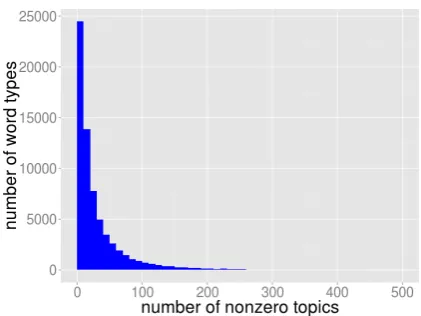
Figure 1: Histogram of nonzero topic counts for word types in NYT-News dataset after inference. 81.9% word types have fewer than 50 topics with nonzero counts. This sparsity allows our sparse constraints to speed inference.
topic counts for must-link word u and cannot-link word v, are often sparse. For example, in a 100-topic model trained on the NIPS dataset, 87.2% of word types have fewer than ten top-ics with nonzero counts. In a 500-topic model trained on a larger dataset like the New York Times News (Sandhaus, 2008), 81.9% of word types have fewer than 50 topics with nonzero counts. Moreover, the model becomes increasingly sparse with additional Gibbs iterations. Figure 1 shows the word frequency histogram of nonzero topic counts of NYT-News dataset.
Therefore, the computational cost of Equation 7 can be reduced. SparseLDA efficiently computes thes,r,q bins as in Equation 3. Then for words that are associated with prior knowledge, we up-dates,r,qwith an additional potential term. We only need to compute the potential term for the topics whose counts are greater thanλ. The col-lapsed Gibbs sampling procedure is summarized in Algorithm 1.
Algorithm 1Gibbs Sampling for word typewin documentd, givenw’s correlation setMw
1: computest, rt, qt with SparseLDA, (see Eq. 3)
2: fort←0toT do
3: updatest,rt,qt.∀u∈Mwifnu,t > λ 4: end for
5: p(t) =st+rt+qt
2.4 Other Types of Prior Knowledge
The factor model framework can also handle other types of prior knowledge, such as document la-bels, sentence lala-bels, and document link relations. We briefly describe document labels here.
Ramage et al. (2009) propose Labeled-LDA, which improves LDA with document labels. It as-sumes that there is a one-to-one mapping between topics and labels, and it restricts each document’s topics to be sampled only from those allowed by the documents label set. Therefore, Labeled-LDA can be expressed in our model. We define
fm(z, w, d) = (
1, ifz∈md
−∞, else (8) where md specifies document d’s label set con-verted to corresponding topic labels. Since
fm(z, w, d) is sparse, we can speed up the train-ing as well. Sentence-level prior knowledge (e.g., for sentiment or aspect models (Paul and Girju, 2010)) can be defined in a similar way.
Documents can be associated with other useful metadata. For example, a scientific paper and the prior work it cites might have similar topics (Di-etz et al., 2007) or friends in a social network might talk about the same topics (Chang and Blei, 2009). To model link relations, we can use Equa-tion 6 and replace the word-topic countsnv,zwith document-topic countsnd,z. By doing so, we en-courage related documents to have similar topic structures. Moreover, the document-topic count is also sparse, which fits into the efficient learning framework.
Therefore, for different types of prior knowl-edge, as long as we can defineψ(z, M) appropri-ately so thatf(z, w, d)are sparse, we are able to speed up learning.
3 Experiments
In this section, we demonstrate the effectiveness of our SC-LDA by comparing it with several baseline methods on three benchmark datasets. We first evaluate the convergence rate of each method and then evaluate the learned model parameterφ—the topic-word distribution—in terms of topic coher-ence. We show that SC-LDA can achieve results comparable to the baseline models but is signifi-cantly faster. We set up all experiments on a 8-Core 2.8GHz CPU, 16GB RAM machine.2
2Our implementation of SC-LDA is
avail-able at https://github.com/yya518/
DATASET DOCS TYPE TOKEN(APPROX)
NIPS 1,500 12,419 1,900,000
NYT-NEWS 3,000,000 102,660 100,000,000
20NG 18,828 21,514 1,946,000
Table 1: Characteristics of benchmark datasets. We use NIPS and NYT for word correlation exper-iments and 20NG for document label experexper-iments.
3.1 Dataset
We use the NIPS and NYT-News datasets from the UCI bag of words data collections.3 These
two datasets have no document labels, and we use them for word correlation experiments. We also use the 20Newsgroup (20NG) dataset,4which has
document labels, for document label experiments. Table 1 shows the characteristics of each dataset. Since NIPS and NYT-News have already been pre-processed, to ensure repeatability, we use the data “as they are” from the sources. For 20NG, we perform tokenization and stopword removal using Mallet (McCallum, 2002) and remove words that appear fewer than 10 times.
3.2 Prior Knowledge Generation
Word Correlation Prior Knowledge Previous work proposes two methods to automatically gen-erate prior word correlation knowledge from ex-ternal sources. Hu and Boyd-Graber (2012) use WordNet 3.0 to obtain synsets for word types, and then if a synset is also in the vocabulary, they add a must-link correlation between the word type and the synset. Xie et al. (2015) use a different method that takes advantage of an existing pre-trained word embedding. Each word embedding is a real-valued vector capturing the word’s semantic meaning based on distributional similarity. If the similarity between the embeddings of two word types in the vocabulary exceeds a threshold, they generate a must-link between the two words.
In our experiments, we adopt a hybrid method that combines the above two methods. For a noun word type, we first obtain its synsets from Word-Net 3.0. We also obtain the embeddings of each word from word2vec (Mikolov et al., 2013). If the synset is also in the vocabulary, and the similar-ity between the synset and the word is higher than a threshold, which in our experiment is 0.2, we generate a must-link between thee words.
Empir-sparse-constrained-lda.
ically, this hybrid method is able to obtain high quality correlated words. For example, for the NIPS dataset, the must-links we obtain for ran-domnessare{noise, entropy, stochasticity}. Document Label Prior Knowledge Since doc-uments in the 20NG dataset are associated with labels, we use the labels directly as prior knowl-edge.
3.3 Baselines
The baseline methods for incorporating word cor-relation prior knowledge in our experiments are as follows:
DF-LDA: incorporates word must-links and cannot-links using a Dirichlet Forest prior in LDA (Andrzejewski et al., 2009). Here we use Hu and Boyd-Graber (2012)’s efficient implementa-tionFAST-RB-SDWfor DF-LDA.
Logic-LDA: encodes general domain knowledge as first-order logic and incorporates it in LDA (An-drzejewski et al., 2011). Logic-LDA has been used for word correlations and document label knowledge.
MRF-LDA: encodes word correlations in LDA as a Markov random field (Xie et al., 2015).
We also use Mallet’s SparseLDA implementa-tion for vanilla LDA in the topic coherence exper-iment. We use a symmetric Dirichlet prior for all models. We setα= 1.0,β= 0.01. For DF-LDA,
η = 100. For Logic-LDA, we use the default pa-rameter setting in the package: a sample rate of 1.0and step rate of10.0. For MRF-LDA, we use the default setting withγ = 1.0. (Parameter se-mantics can be found in the original papers.)
3.4 Convergence
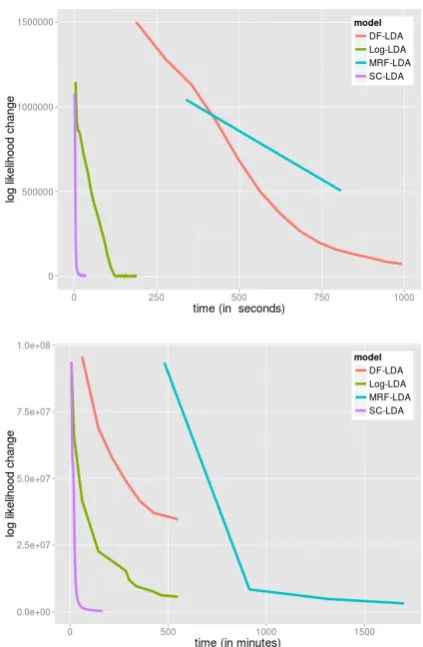
The main advantage of our method over other ex-isting methods is efficiency. In this experiment, we show the change of our model’s log likelihood over time. In topic models, the log likelihood change is a good indicator of whether a model has converged or not. Figure 2 shows the log like-lihood change over time for SC-LDA and three baseline methods on NIPS and NYT-News dataset. SC-LDA converges faster than all the other meth-ods.
[image:6.595.309.521.64.388.2]We also conduct experiments on SC-LDA with varying numbers of word correlations. Table 2 shows the Gibbs sampling iteration time on the 1st, 50th, 100th and the 200th iteration. We also incorporate different numbers of word correlations
Figure 2: Models’ log likelihood convergence on NIPS dataset (above) and NYT-News dataset (be-low). For NIPS, a 100-topic model with 100 must-links is trained. For NYT-News, a 500-topic model with 100 must-links is trained. SC-LDA reaches likelihood convergence much more rapidly than the other methods.
# Word Correlations
round C0 C100 C500 C1000
1st iteration 2.02 2.14 2.30 2.50
50th iteration 0.53 0.56 0.58 0.62
100th iteration 0.48 0.50 0.53 0.56
[image:6.595.307.522.514.597.2]200th iteration 0.48 0.49 0.52 0.56
Table 2: SC-LDA runtime (in seconds) in the 1st, 50th, 100th, and 200th iteration with different numbers of correlations.
in SC-LDA. SC-LDA runs faster as sampling pro-ceeds as the sparsity increases, but additional cor-relations slow the model.
3.5 Topic Coherence
of-ten at odds with human evaluations (Chang et al., 2009). Following Mimno et al. (2011), we em-ploy Topic Coherence—a metric that is consis-tent with human judgment—to measure a topic model’s quality. Topic t’s coherence is defined asC(t : V(t)) = PM
m=2Pml=1−1logF(v
(t)
m,vl(t))+
F(vl(t)) ,
where F(v) is the document frequency of word typev, F(v, v0) is the co-document frequency of
word type v andv0, andV(t) = (v(t)
1 , ..., v(Mt))is a list of the M most probable words in topic t. In our experiments, we choose the ten words with highest probability in the topic to compute topic coherence, i.e.,M = 10. Mimno et al. (2011) use
= 1, but R¨oder et al. (2015) show smaller(such as10−12) improves coherence stability, so we set = 10−12. Larger topic coherence scores imply
more coherent topics.
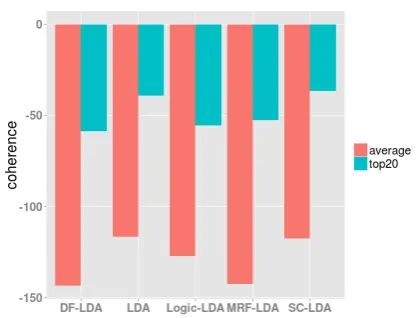
We train a 500-topic model on the NIPS dataset with different methods and compare the average topic coherence score and the average of the top twenty topic coherence scores. Since the topics learned by topic model often contain “bad” top-ics (Mimno et al., 2011) which do not make sense to end users, evaluating the top twenty topics re-flects the model’s performance. We let each model train for one hour. Figure 3 shows the topic co-herence of each method. SC-LDA has about the same average topic coherence with LDA but has higher coherence score (-36.6) for the top 20 top-ics than LDA (-39.1). This is because incorporat-ing word correlation knowledge encourages cor-related words to have high probability under the same topic, thus improving the coherence score. For the other methods, however, because they can-not converge within an hour, their topic coherence scores are much worse than SC-LDA and LDA. This again demonstrates the efficiency of SC-LDA over other baselines.
3.6 Document Label Prior Knowledge
SC-LDA can also handle other types of prior knowledge. We compare it with Labeled-LDA (Ramage et al., 2009). Labeled-LDA also uses Gibbs sampling for inference, allowing direct computation time comparisons.
[image:7.595.309.519.63.222.2]Table 3 shows the average running time per it-eration for Labeled-LDA and SC-LDA. Because document labels apply sparsity to the document-topic counts, the average running time per itera-tion decreases as the number of labeled document increases. SC-LDA exhibits greater speedup with
Figure 3: Average topic coherence and average top 20 topic coherence. The models are trained on NIPS dataset with 500-topic and 100 word corre-lations. SC-LDA achieves higher topic coherence than other methods.
# Topics
T50 T100 T200 T500
Labeled-LDA 0.93 1.89 3.60 8.05
SC-LDA 0.38 0.45 0.51 0.72
# Labeled Documents
C500 C1000 C2000 C5000
Labeled-LDA 1.95 1.88 1.75 1.48
[image:7.595.308.527.319.426.2]SC-LDA 0.51 0.45 0.41 0.31
Table 3: The average running time per iteration over 100 iterations, averaged over 5 seeds, on 20NG dataset. Experiments begin with 100 top-ics, 1000 labeled documents, and then vary one dimension: number of topics (top), or number of labeled documents (bottom).
more topics; whenT = 500,5SC-LDA runs more
than ten times faster than Labeled-LDA.
4 Related Work
This works brings together two lines of research: incorporating rich knowledge into probabilistic models and efficient inference of probabilistic models on large datasets. Both are common ar-eas of interest across many machine learning for-malisms: probabilistic logic (Bach et al., 2015), graph algorithms (Low et al., 2012), and proba-bilistic grammars (Cohen et al., 2008). However, our focus in this paper is the intersection of these lines of research with topic models.
Adding knowledge and metadata to topic mod-els makes the modmod-els richer, more understandable, and more domain-specific. A common distinc-tion is upstream (condidistinc-tioning on metadata) vs. downstream models (conditioning on variables al-ready present in a topic model to predict meta-data) (Mimno et al., 2008). Downstream models are typically better at prediction tasks such as pre-dicting sentiment (Blei and McAuliffe, 2007), ide-ology (Nguyen et al., 2014a), or links in a social network (Chang and Blei, 2009). In contrast, our approach—an upstream model—is often easier to implement and leads to more interpretable topics. Upstream models at the document level have been used to understand the labels in large document collections (Ramage et al., 2009; Nguyen et al., 2014b) and capture relationships in document net-works using Markov random fields (Daum´e III, 2009). At the word level, Xie et al. (2015) in-corporate word correlation to LDA by building a Markov Random Field regularization, similar to Newman et al. (2011), who use regularization to improve topic coherence. However, despite these exciting applications, the experiments in the above work are typically on small datasets.
In contrast, there is a huge interest in improving the scalability of topic models to large numbers of documents, numbers of topics, and vocabular-ies. Attempts to scale inference for topic mod-els have started from both variational inference and Gibbs sampling—two popular learning infer-ence techniques for topic modeling. Gibbs sam-pling is a popular technique because of its sim-plicitly and low latency. However, for large num-bers of topics, Gibbs sampling can become un-wieldy. Porteous et al. (2008) address this issue by creating an upper bound approximation that pro-duces accurate results, while SparseLDA (Yao et al., 2009) present an effective factorization that speeds inference without sacrificing accuracy. Just as our model builds on SparseLDA’s insights, SparseLDA has been incorporated into commer-cial deployments (Wang et al., 2014) and im-proved using alias tables (Li et al., 2014). Yuan et al. (2015) also presents an efficient constant time sampling algorithm for building big topic models. Variational inference can easily be paral-lelized (Nallapati et al., 2007; Zhai et al., 2012), but has high latency, which has been addressed by performing online updates (Hoffman et al., 2010) and taking stochastic gradients estimated by
MCMC inference (Mimno et al., 2012). In this paper, we only focus on single-processor learning, but existing parallelization techniques (Newman et al., 2009) are applicable to our model.
At the intersection lies models that improve the scalability of upstream topic model inference. In addition to our SC-LDA, Hu and Boyd-Graber (2012) speed Gibbs sampling in tree-based topic models using SparseLDA’s factorization strategy, and Hu et al. (2014) extend this approach by paral-lelizing global parameter updates using variational inference. Our work is more general (also encom-passing document-based constraints) and is faster. In contrast to these upstream models, Zhu et al. (2013) and Nguyen et al. (2015) improve inference of downstream models.
5 Conclusion
We present a factor graph framework for incorpo-rating prior knowledge into topic models. By ex-pressing the prior knowledge as sparse constraints on the hidden topic variables, we are able to take advantage of the sparsity to speed up training. We demonstrate in experiments that our model runs significantly faster than the other alternative mod-els and achieves comparable performance in terms of topic coherence. Efficient algorithms for incor-porating prior knowledge with large topic models will benefit several downstream applications. For example, interactive topic modeling becomes fea-sible because fast model updates reduce the user’s waiting time and thus improve the user experience. Personalized topic modeling is also an interesting future direction in which the model will generate a personalized topic structure based on the user’s preferences or interests. For all these applications, an efficient learning algorithm is a crucial prereq-uisite.
Acknowledgments
References
David Andrzejewski, Xiaojin Zhu, and Mark Craven. 2009. Incorporating domain knowledge into topic modeling via Dirichlet forest priors. InProceedings of the International Conference of Machine Learn-ing.
David Andrzejewski, Xiaojin Zhu, Mark Craven, and Benjamin Recht. 2011. A framework for incorpo-rating general domain knowledge into latent Dirich-let allocation using first-order logic. InInternational Joint Conference on Artificial Intelligence.
Stephen H. Bach, Bert Huang, Jordan Boyd-Graber, and Lise Getoor. 2015. Paired-dual learning for fast training of latent variable hinge-loss mrfs. In Pro-ceedings of the International Conference of Machine Learning.
David M. Blei and Jon D. McAuliffe. 2007. Super-vised topic models. InProceedings of Advances in Neural Information Processing Systems.
David M. Blei, Andrew Ng, and Michael Jordan. 2003. Latent Dirichlet allocation. Journal of Machine Learning Research, 3.
Jordan Boyd-Graber, David M. Blei, and Xiaojin Zhu. 2007. A topic model for word sense disambigua-tion. InProceedings of Empirical Methods in Natu-ral Language Processing.
Jonathan Chang and David M. Blei. 2009. Relational topic models for document networks. In Proceed-ings of Artificial Intelligence and Statistics.
Jonathan Chang, Jordan Boyd-Graber, Chong Wang, Sean Gerrish, and David M. Blei. 2009. Reading tea leaves: How humans interpret topic models. In Proceedings of Advances in Neural Information Pro-cessing Systems.
Shay B. Cohen, Kevin Gimpel, and Noah A. Smith. 2008. Logistic normal priors for unsupervised prob-abilistic grammar induction. InProceedings of Ad-vances in Neural Information Processing Systems. Hal Daum´e III. 2009. Markov random topic fields. In
Proceedings of Artificial Intelligence and Statistics.
Laura Dietz, Steffen Bickel, and Tobias Scheffer. 2007. Unsupervised prediction of citation influences. In Proceedings of the International Conference of Ma-chine Learning.
Doug Downey, Chandra Bhagavatula, and Yi Yang. 2015. Efficient methods for inferring large sparse topic hierarchies. InProceedings of the Association for Computational Linguistics.
S. Geman and D. Geman, 1990. Stochastic relaxation, Gibbs distributions, and the Bayesian restoration of images, pages 452–472. Morgan Kaufmann Pub-lishers Inc., San Francisco, CA, USA.
Thomas L. Griffiths and Mark Steyvers. 2004. Find-ing scientific topics. Proceedings of the National Academy of Sciences, 101(Suppl 1):5228–5235. Matthew Hoffman, David M. Blei, and Francis Bach.
2010. Online learning for latent Dirichlet allocation. In Proceedings of Advances in Neural Information Processing Systems.
Yuening Hu and Jordan Boyd-Graber. 2012. Efficient tree-based topic modeling. InProceedings of the As-sociation for Computational Linguistics.
Yuening Hu, Jordan Boyd-Graber, and Brianna Sati-noff. 2011. Interactive topic modeling. In Proceed-ings of the Association for Computational Linguis-tics.
Yuening Hu, Ke Zhai, Vlad Eidelman, and Jordan Boyd-Graber. 2014. Polylingual tree-based topic models for translation domain adaptation. In Asso-ciation for Computational Linguistics.
Aaron Q. Li, Amr Ahmed, Sujith Ravi, and Alexan-der J. Smola. 2014. Reducing the sampling com-plexity of topic models. In Knowledge Discovery and Data Mining.
Yucheng Low, Danny Bickson, Joseph Gonzalez, Car-los Guestrin, Aapo Kyrola, and Joseph M. Heller-stein. 2012. Distributed graphlab: A framework for machine learning and data mining in the cloud. Pro-ceedings of the VLDB Endowment, 5(8):716–727, April.
Andrew Kachites McCallum. 2002. Mal-let: A machine learning for language toolkit. http://www.cs.umass.edu/ mccallum/mallet. Tomas Mikolov, Ilya Sutskever, Kai Chen, Greg S
Cor-rado, and Jeff Dean. 2013. Distributed representa-tions of words and phrases and their compositional-ity. InProceedings of Advances in Neural Informa-tion Processing Systems.
David Mimno, Hanna Wallach, and Andrew McCal-lum. 2008. Gibbs sampling for logistic normal topic models with graph-based priors. InNIPS 2008 Workshop on Analyzing Graphs: Theory and Appli-cations.
David Mimno, Hanna Wallach, Edmund Talley, Miriam Leenders, and Andrew McCallum. 2011. Optimizing semantic coherence in topic models. In Proceedings of Empirical Methods in Natural Lan-guage Processing.
David Mimno, Matthew Hoffman, and David Blei. 2012. Sparse stochastic inference for latent Dirich-let allocation. In Proceedings of the International Conference of Machine Learning.
David Newman, Arthur Asuncion, Padhraic Smyth, and Max Welling. 2009. Distributed Algorithms for Topic Models.Journal of Machine Learning Re-search, pages 1801–1828.
David Newman, Edwin Bonilla, and Wray Buntine. 2011. Improving topic coherence with regularized topic models. InProceedings of Advances in Neural Information Processing Systems, December.
Viet-An Nguyen, Jordan Boyd-Graber, Philip Resnik, Deborah Cai, Jennifer Midberry, and Yuanxin Wang. 2014a. Modeling topic control to detect influence in conversations using nonparametric topic models. Machine Learning, 95:381–421.
Viet-An Nguyen, Jordan Boyd-Graber, Philip Resnik, and Jonathan Chang. 2014b. Learning a concept hierarchy from multi-labeled documents. InNeural Information Processing Systems.
Thang Nguyen, Jordan Boyd-Graber, Jeff Lund, Kevin Seppi, and Eric Ringger. 2015. Is your anchor go-ing up or down? Fast and accurate supervised topic models. InNorth American Association for Compu-tational Linguistics.
Michael Paul and Roxana Girju. 2010. A two-dimensional topic-aspect model for discovering multi-faceted topics. In Association for the Ad-vancement of Artificial Intelligence.
Ian Porteous, David Newman, Alexander Ihler, Arthur Asuncion, Padhraic Smyth, and Max Welling. 2008. Fast collapsed gibbs sampling for latent dirichlet al-location. InKnowledge Discovery and Data Mining.
Daniel Ramage, David Hall, Ramesh Nallapati, and Christopher Manning. 2009. Labeled LDA: A su-pervised topic model for credit attribution in multi-labeled corpora. InProceedings of Empirical Meth-ods in Natural Language Processing.
Michael R¨oder, Andreas Both, and Alexander Hinneb-urg. 2015. Exploring the space of topic coherence measures. In Proceedings of ACM International Conference on Web Search and Data Mining.
Evan Sandhaus. 2008. The New York Times annotated corpus. http://www.ldc.upenn.edu/Catalog/CatalogEntry.jsp? catalogId=LDC2008T19.
Hanna Wallach, David Mimno, and Andrew McCal-lum. 2009. Rethinking LDA: Why priors matter. In Proceedings of Advances in Neural Information Processing Systems.
Yi Wang, Xuemin Zhao, Zhenlong Sun, Hao Yan, Lifeng Wang, Zhihui Jin, Liubin Wang, Yang Gao, Jia Zeng, Qiang Yang, and Ching Law. 2014. Towards topic modeling for big data. CoRR, abs/1405.4402.
Pengtao Xie, Diyi Yang, and Eric P Xing. 2015. In-corporating word correlation knowledge into topic modeling. In Conference of the North American Chapter of the Association for Computational Lin-guistics.
Yi Yang, Shimei Pan, Yangqiu Song, Jie Lu, and Mer-can Topkara. 2015. User-directed non-disruptive topic model update for effective exploration of dy-namic content. InProceedings of the 20th Interna-tional Conference on Intelligent User Interfaces. Limin Yao, David Mimno, and Andrew McCallum.
2009. Efficient methods for topic model inference on streaming document collections. InKnowledge Discovery and Data Mining.
Jinhui Yuan, Fei Gao, Qirong Ho, Wei Dai, Jinliang Wei, Xun Zheng, Eric Po Xing, Tie-Yan Liu, and Wei-Ying Ma. 2015. Lightlda: Big topic models on modest computer clusters. InProceedings of the World Wide Web Conference.
Ke Zhai, Jordan Boyd-Graber, Nima Asadi, and Mo-hamad Alkhouja. 2012. Mr. LDA: A flexible large scale topic modeling package using variational in-ference in mapreduce. InProceedings of the World Wide Web Conference.