A Theme-Rewriting Approach for Generating Algebra Word Problems
Rik Koncel-Kedziorski Ioannis Konstas Luke Zettlemoyer Hannaneh Hajishirzi University of Washington
[email protected],{ikonstas, lsz, hannaneh}@cs.washington.edu
Abstract
Texts present coherent stories that have a par-ticular theme or overall setting, for example science fiction or western. In this paper, we present a text generation method called rewrit-ingthat edits existing human-authored narra-tives to change their theme without changing the underlying story. We apply the approach to math word problems, where it might help students stay more engaged by quickly trans-forming all of their homework assignments to the theme of their favorite movie with-out changing the math concepts that are be-ing taught. Our rewritbe-ing method uses a two-stage decoding process, which proposes new words from the target theme and scores the re-sulting stories according to a number of fac-tors defining aspects of syntactic, semantic, and thematic coherence. Experiments demon-strate that the final stories typically represent the new theme well while still testing the orig-inal math concepts, outperforming a number of baselines. We also release a new dataset of human-authored rewrites of math word prob-lems in several themes.
1 Introduction
Storytelling is the complex activity of expressing a plot, its events and participants in words meaning-ful to an audience. Automatic storytelling systems can be used for customized sport commentaries, en-riching video games with personalized or dynamic plot-lines (Barros and Musse, 2007), or providing customized learning materials which meet each indi-vidual student’s needs and interests (Bartlett, 2004). In this paper, we focus on generating narrative-style
Jim walked 0.2 of a mile from school to David’s house and 0.7 of a mile from David’s house to his own house. How many miles did Jim walk in all?
Star Wars
Uncle Owen walked 0.2 of a mile from hangar to Luke Skywalker’s room and 0.7 of a mile from Luke Sky-walker’s room to his own room. How many miles did Uncle Owen walk in all?
Cartoon
Finn squished 0.2 of a mile from cupboard to Melissa’s dock and 0.7 of a mile from Melissa’s dock to his own dock. How many miles did Finn squish in all?
Western
Duane strolled 0.2 of a mile from barn to Madeline’s camp and 0.7 of a mile from Madeline’s camp to his own camp. How many miles did Duane stroll in all?
Figure 1:An example story and rewrites in 3 themes.
math word problems (Figure 1) and demonstrate that it is possible to design an algorithm that can auto-matically change the overall theme of a text without changing its underlying story, for example to create more engaging homework that is in the theme of a student’s favorite movie.
A math word problem is a coherent story that provides the student with good clues to the cor-rect mathematical operations between the numerical quantities described therein. However, the particular
themeof a problem, whether it be about collecting
apples or traveling distances through space, can vary significantly so long as the correlation between the story and underlying equation is maintained. Stu-dents’ success at solving a word problem is tied to their interest in the problem’s theme (Renninger
et al., 2002), and personalizing word problems in-creases student understanding, engagement, and per-formance in the problem solving process (Hart, 1996; Davis-Dorsey et al., 1991).
Motivated by this need for thematically diverse, highly coherent stories, we address the problem
ofstory rewriting, or transforming human-authored
stories into novel, coherent stories in a new theme. Rather than synthesizing first a story plot (McIntyre and Lapata, 2009; McIntyre and Lapata, 2010) or script (Chambers and Jurafsky, 2009; Pichotta and Mooney, 2016; Granroth-Wilding and Clark, 2016) from scratch, we instead begin from an existing story and iteratively edit it towards a thematically novel but –most crucially– semantically compatible story. This approach allows us to reuse much, but not all, of the syntactic and semantic structure of the original text, resulting in the creation of more coher-ent and solvable math word problems.
We define a theme to be a collection of refer-ence texts, such as a movie script or series of books. Given a theme, therewritealgorithm constructs new texts by substituting thematically appropriate words and phrases, as measured with automatic metrics over the theme text collection, for parts of the orig-inal texts. This process optimizes for a number of metrics of overall text quality, including syntactic, semantics, and discourse scores. It uses no hand crafted templates and requires no theme-specific tuning data, making it easy to apply for new themes in practice. Tables 4–6 show example stories gener-ated from the rewrite system.
To evaluate performance, we collected a corpus of 450 rewrites of math word problems in Star Wars and Children’s Cartoon themes via crowdsourcing.1
Experiments with automated metrics and human evaluations demonstrate that the approach described here outperforms a number of baselines and can pro-duce solvable problems in multiple different themes, even with no in-domain tuning.
2 Related Work
Our approach is related to the previous work in story generation (e.g., McIntyre and Lapata (2010)) and sentence rewriting (e.g., text simplification (Xu et
1Data and code available at https://gitlab.cs.
washington.edu/kedzior/Rewriter/.
al., 2016)), as reviewed in this section. It has three major differences from all these approaches: First, we focus on multi-sentence stories where preserving the coherence, discourse relations, and solvability is essential. Previous work mainly focuses on rewrit-ing srewrit-ingle sentences. Second, we build a theme from a text corpus and show how the stories can be adapted to new themes. Third, our method leverages the human-authored story to capture the semantic skeleton and the plot of the current story, rather than synthesizing the story plot. To our knowledge, we are the first to introduce a text rewriting formulation for story generation.
Story generation has been of long interest to AI researchers (Meehan, 1976; Lebowitz, 1987; Turner, 1993; Liu and Singh, 2002; Mostafazadeh et al., 2016). Recent methods in story generation first syn-thesize candidate plots for a story and then compile those plots into text. Li et al. (2013) use crowd-sourcing to build plot graphs. McIntyre and Lap-ata (2009; 2010) address story generation through the automatic deduction and reassembly of scripts (Schank and Abelson, 1977), or structured represen-tations of events and their participants, and causal relationships involved. Leveraging the automatic script learning methods of Chambers and Jurafsky (2009), McIntyre and Lapata (2010) learn candidate entity-centered plot graphs, or possible events in-volving the entity and an ordering between these events, with the use of a genetic algorithm. Then plots are compiled into stories through the use of a rule-based text surface realizer (Lavoie and Ram-bow, 1997) and reranked using a language model.
Polozov et al. (2015) automatically generate math word problems tailored to a student’s interest us-ing Answer Set Programmus-ing to satisfy a collec-tion of pedagogical and narrative requirements. This method naturally produces highly coherent, person-alized story problems that meet pedagogical require-ments, at the expense of building the thematic on-tologies and discourse constraints by hand.2
Additionally, there is related work in text simpli-fication (Wubben et al., 2012; Kauchak, 2013; Zhu et al., 2010; Vanderwende et al., 2007; Woodsend and Lapata, 2011b; Hwang et al., 2015), sentence 2According to Polozov et al. (2015) building small thematic
compression (Filippova and Strube, 2008; Rush et al., 2015), and paraphrasing (Ganitkevitch et al., 2013; Chen and Dolan, 2011; Ganitkevitch et al., 2011). All these tasks are focused on rewriting sen-tences under a predefined set of constraints, such as simplicity. Different rule-based and data-driven ap-proaches are introduced by Petersen and Ostendorf (2007), Vickrey and Koller (2008), and Siddharthan (2004). Most data-driven approaches take advantage of machine translation techniques, use source-target sentence pairs, and learn rewrite operations (Yatskar et al., 2010; Woodsend and Lapata, 2011a), or use additional external paraphrasing resources (Xu et al., 2016).
Finally, this work is related to those on auto-matically solving math word problems. Specific topics include number word problems (Shi et al., 2015), logic puzzle problems (Mitra and Baral, 2015), arithmetic word problems (Hosseini et al., 2014; Roy and Roth, 2015), algebra word prob-lems (Kushman et al., 2014; Zhou et al., 2015; Koncel-Kedziorski et al., 2015a; Roy et al., 2016), and geometry word problems (Seo et al., 2015; Seo et al., 2014). Several datasets of word problems are available (Koncel-Kedziorski et al., 2016; Huang et al., 2016), though none address the need for thematic text.
3 Problem Formulation
Our system takes as input a story sand a themet,
and outputs the best rewrites∗ from generated
can-didatesS.
A theme tis defined as a textual corpus that
de-scribes a topic or a domain. This is an intentionally broad definition that allows a variety of textual re-sources to serve as themes. For example, the collec-tion of all Science Ficcollec-tion stories from the Project Gutenberg can be a theme, or the script of a single movie, or a sampling of fan fiction from the Inter-net. This flexibility adds to the utility of our work, as varying amounts of thematic text may be avail-able.
The generated candidate s∗ is the most
themati-cally fit problem that issyntactically and
semanti-callycoherent given the original problemsand the
new theme t. We represent a story in terms of the
words it contains, so thats={w1, w2, . . . wn}and
Samhad 2 dogs. Each had 3 puppies. Syntactic relations
Candidates (s’)
Semantic relations
Luke Skywalker had 2 ships. Each had 3 droids. Original (s)
Syn(s’|s)
SemPair(s’|s)
Th(s’|t)
[image:3.612.314.543.61.154.2]SemLex(s’|s)
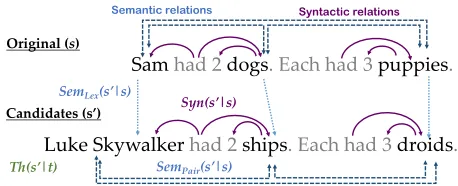
Figure 2:An overview of our method for scoring a candi-date storys0given a human-authored storysand a theme t. Syn(s0|s): compatibility of syntactic relations (purple
arrows), Sempair(s0|s): coherence of semantic relations (blue arrows), SemLex(s0|s): semantic mapping of indi-vidual words, andT h(s0|s, t): thematicity.
|s|=n. The new storys0 is defined as:
s0 =f(w1), f(w2), . . . f(wn)
where the functionf(w) :Vo→ VK
t ∪∅, rewrites a word from the vocabulary of the original problemVo to either a word, a trivial noun compound of length
K (e.g., multi-word named entity) from the
vocab-ulary of the the thematic vocabvocab-ularyVt, or reduces to the empty symbol, i.e., omits the input word en-tirely; hence the length ofs0 can differ from that of
the original problem.
Formally, our goal is to select the candidate
s0 ∈Sby maximizing a scoring functionRover the-matic, syntactic and semantic constraints, subject to a set of parametersθ:
s∗ = arg max s0∈SR(s
0|s, t;θ) (1)
In order to find the best story s∗, our problem
reduces to generating candidate storiess0 from the
space of possible rewrites of the human-authored story sin a new theme t(Section 5). Since there
are exponentially many rewrites, we follow a two-stage decoding approach: first we identify only the content wordswiin the input problem, and provide for each a list of the top-kmostsalientthematic
4 Scoring Stories
The scoring functionRdecomposes into three com-ponents, capturing aspects of syntactic compatibil-ity, semantic coherence, and thematicity:
R(s0|s, t;θ) =α×Sem(s0|s)
+β×Syn(s0|s) (2)
+γ×Th(s0|s, t)
The syntactic (Syn) and semantic (Sem) coherence components measure the coherence of the words in the new storys0, as well as their compatibility to the
syntactic and semantic relations in the original story
s. On the other hand, thematicity (Th) scores the
relevance and importance of words in the new story with respect to themet.
We describe each of these components and the de-coding process in the following sections.
4.1 Thematicity
Recall that a theme t is defined as a collection
of documents that share a common topic, such as books in the science fiction genre, or scripts of hor-ror movies. We define thematicity of a wordw0 as
the measure ofsalience, or how discriminative that word is to a given theme.3 For example,robot and
spaceship are expected to be highly thematic with
respect to Star Wars. In our setting we extend this definition to a candidate problems0givensandtas:
Th(s0|s, t) =
|s| X
i
Sal(wi0, t) (3)
wherew0iis a word from the candidate problem, and
Salis its salience score with respect to the theme.
In the context of this work we argue that the the-matic adaptation of the content words, i.e., nouns, verbs, named entities, and adjectives, plays the most important role in forming a new thematic problem. Therefore, we define their salience (except named entities) based on their tf-idf score over the themet,
and set it to zero for function words. Since named entities have relatively low frequencies in the theme corpus we set their salience to1−c(w10
i), wherec(w 0 i)
3We will be interchangeably referring tow0 as either the
word or the head of the multi-word noun compound that rewrites the equivalent wordwin the original problem.
is the number of times w0i occurs in the theme. In
the example story in Figure 2 the thematicity score is derived asSal(Luke Skywalker) +Sal(ships) +
Sal(droids).
4.2 Syntactic compatibility
This work offers a new method for syntactic and discourse coherence based on preserving human-authored syntactic structure in generated text (hence our use of the term rewriting). The syntactic con-structs in a document play a distinctive role in main-taining cohesion across sentences. We consider the human-authored syntax of the original story s as
gold standard, and use it to score a candidate prob-lems0 by considering how well the syntactic
rela-tions ofsapply tos0.
Formally, given a dependency triple (wi, wj, l) from a parse of a sentence in s, we compute the
likelihood for the corresponding triple(wi0, wj0, l)for
w0i, w0j in s0. We define the syntactic score for all
sentences ins0as:
Syn(s0|s) = X i,j,l|(wi,wj,l)∈Dep(s)
LDep(wi0, wj0, l) (4)
whereDep(s)are the dependency parse trees for all
sentences in s; LDep is a 3-gram language model
over dependency triples which gives the likelihood of an arc labellbeing used between a pair of words
(w0i, w0j). For example in Figure 2, the syntactic
compatibility score includes dependency likelihoods ofLDep(ship,2,num),LDep(had,ship,dobj).
Therefore, the Syn function prefers storiess0that
(a) have similar dependency structure to the origi-nal storysand (b) make use of a common syntactic
configuration.
4.3 Semantic Coherence
The semantic coherence component expresses how well a candidate s0 rewrites individual words and
realizes the semantic relationships that exist in the human-authored storys. Ideally, we would like to
preserve enough of the semantics of s in order to
produce a coherent storys0, yet we are populatings0
cross the sentence boundaries, promoting discourse coherence.
We decompose semantic relations in a story into a set of local, lexical relationships between pairs of words. Specifically, we consider semantic relations for noun-noun and verb-verb pairs as provided by WordNet (Miller, 1995). Since some relations are not directly outlined in these resources (e.g., the se-lectional preferences of nouns with regard to their adjectival modifiers), we also consider the word-embedding similarity between words. For example in Figure 2 the semantic relationships are denoted with blue arrows between pairs of content words in the story (e.g.,{Sam, dogs},{dogs, puppies}, etc).
More formally, we define the semantic coherence ofs0 with respect tosas:
Sem(s0|s) =
|s0|
X
i
SemLex(wi, w0i) (5)
+ X
i,j∈CW
SemP air({wi, wj},{w0i, wj0})
whereCW is the set of pairs of indices of content
words (nouns, verbs, adjectives, and named entities) froms. We focus on the content words of the orig-inal problem, as they carry most of the semantic in-formation. SemLex and SemP air functions are se-mantic adaptation scores for individual words and semantic relations respectively, described below.
Semantic Compatibility between words (SemLex) is defined as:
SemLex(wi, w0i) =cos(wi, w0i) +Resnik(wi, w0i) (6)
wherecos(wi, w0i)denotes the cosine similarity be-tween the vector space embeddings of two wordswi andw0i4, andResnik(wi, wi0)expresses the informa-tion content of the lowest subsumer of {wi, w0i}in WordNet. For example in Figure 2, the semantic compatibility score incorporates lexical similarities SemLex(dog,ship), etc.
Compatibility score between semantic relations (SemP air) is defined by adding two components:
P airSim andAnalogy that compute how
seman-tic relations between pairs of words are preserved in 4For the ease of notation, we represent the embedding of the
words withwias well.
the new story:
P airSim= cos(wi, wj)∗cos(w0i, w0j) (7)
Analogy = cos(wi0+wj−wi, wj0) (8)
P airSimpreserves the similarity between pairs of words {wi, wj} in s and the corresponding pair {w0i, w0j}in the new storys0. Intuitively, ifwiandwj are semantically close to each other, we would like the corresponding words to be close in the new story as well. For example in Figure 2, ‘dog’ and ‘puppy’ are similar in the original story, we expect the cor-responding words ‘ship’ and ‘droid’ to be similar in the new story. TheAnalogy function, inspired by
Mikolov et al. (2013), computes the analogy ofwj0
fromw0igiven the relationship that holds betweenwi andwjin the vector space. For example in Figure 2, the relation between ‘Sam’ and ‘dog’ is similar to the relation between ‘Luke Skywalker’ and ‘ship’.
5 Decoding
Our decoding process begins by first identifying the content wordswi (nouns, verbs, adjectives and named entities) in the original problemsthat will be
considered asinitial pointsfor rewriting. For each of these lexical classes we extract the top-k most
thematic words and trivial noun compounds from the theme t. For example, in Figure 2, candidate
nouns are: ‘ships’, ‘robots’, ‘droids’, etc., and for verbs: ‘blast’, ‘soar’, ‘command’, etc. Recall that the space of candidate rewrites is large, prohibiting an exhaustive enumeration. We therefore do approx-imate search with a beam by considering simultane-ously all possiblepathsthat start at the different ini-tial points. At each step the decoder considers an additional rewrite from the list of candidates, adds it to the existing hypothesis path, and scores it accord-ing to functionR(Equation 2).
All the counterpart scores are locally optimal, as they factor over each new word w0i or pair of
{w0i, w0j}, wherew0j is a rewritealready existing in
the hypothesis path. At any given step we may re-combine hypotheses that share the same prefix hy-pothesis path, and keep the top scoring one. The process terminates when there are no more rewrites left. We also experimented decoding with a variety of orderings of the text in the original problem s,
dependency tree of each sentence and then concate-nating these linearizations; we observed that consid-ering multiple paths achieves the best performance.
6 Data Collection
For the set of human-authored stories{s}, we use a
corpus of math word problems described in Koncel-Kedziorski et al. (2016). We select a subset of 150 problems targeting 5th and 6th grade levels, all of which involve a single equation in one variable. These problems have 2.7 sentences and 29.4 words on average, 12.6 of which are considered content words by our system. In order to tune and evaluate our model, we collect a corpus of human-authored rewrites produced by workers from Amazon Me-chanical Turk based on two themes: Star Wars, and Adventure Time (a children’s cartoon).
We experimented with different ways of helping to define the theme for the workers, including of-fering automatically generated word clouds or en-forcing that a response includes one of several key-words. In practice, we have found that using specific cultural elements as themes (such as famous movie or cartoon franchises) attracts workers who already have a strong knowledge of the theme, resulting in higher quality work.
To help explain the rewriting process, we show workers three examples of thematic rewrites with varying degrees of correlation to the original prob-lems. We then show workers a random problem from the original set{s}and a corresponding equa-tion for that problem. We instruct the workers to “rewrite” the problem according to the theme, en-suring that their rewritten problem can be solved by the provided equation. The final dataset collection comprises of 450 human-authored rewrites. We col-lect 3 rewrites for 100 of the original problems for the Star Wars theme (based on the popular Star Wars sequel movies), and 3 rewrites for the rest of the 50 original problems, for the Children Cartoons Theme (CARTOON), based on the Adventure Time TV show.
We keep 150 examples from the Star Wars theme for development (STARdev), and the rest 150 for testing
(STARtest).
We collected the STARdev and CARTOON data based on workers with the “master” designation and at least 95% approval rating. Then we
pro-ceeded collectingSTARtestby a subset of the authors of STARdev who self-identify as theme experts and whose quality of work is manually confirmed.
7 Experiments 7.1 Setup
Implementation Details We pre-process the themes using the Stanford CoreNLP tools (Man-ning et al., 2014) for tokenization, Named Entity Recognition (Finkel et al., 2005), and dependency parsing (Chen and Manning, 2014). For calculating salience scores, we use the ScriptBase dataset of movie scripts (Gorinski and Lapata, 2015). The Star Wars theme is constructed from the available script, roughly 7300 words. The Cartoon theme is constructed from fan-authored scripts of the first 10 episodes of the show (Springfield, 2016) totaling 1370 words. Since our thematic options are taken from arbitrary text, we use the lists of offensive terms published by The Racial Slur database (Database, 2016) and FrontGate Media (Media, 2016) to filter out offensive content. To prohibit overgeneration, we forbid the transformation of stop words or math-specific words (Survivors, 2013; Koncel-Kedziorski et al., 2015b).
For syntactic compatibility score Syn (Equa-tion 4) we use the English Fic(Equa-tion subset of the Google Syntactic N-grams corpus (Goldberg and Orwant, 2013) and train a 3-gram language model using KenLM (Heafield, 2011). For SemLex,
P airSim and Analogy (Equations 6-8) we use
the pretrained word embeddings of Levy and Gold-berg (2014). These embeddings are trained using dependency contexts rather than windows of ad-jacent words, allowing them to capture functional word similarity. Finally, we tune the parameters of our model (Equation 2) on the development set STARdev and pick those values5that maximize ME-TEOR score (Denkowski and Lavie, 2014) against 3 human references.
Evaluation We compare two ablated configura-tions of our method against our full model (FULL):
-SYNthat only uses semantic and thematicity
ponents and does not incorporate the syntactic com-patibility score, -SEMreplaces the semantic
Model STARdev STARtest CARTOON
FULL 31.82 29.16 32.08
-SEM 28.72 25.55 27.55
-SYN 31.92 29.14 32.04
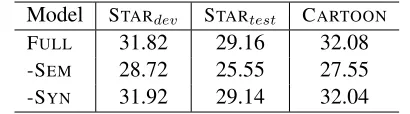
Table 1: METEOR results for different configu-ration of our model on STARdev, STARtest and CARTOONdatasets.
ence score with the simplercos(wi, w0i), effectively rewriting only single words, and not pairs. We re-frained from ablating the thematicity score as it is the core part of our model that drives the rewriting process into a new theme.
We evaluate our method using an automatic met-ric, and via eliciting human judgments on Ama-zon Mechanical Turk. For automatic evaluation, we compute the METEOR score, comparing the out-put of each model for a given problem and theme to the 3 human rewrites we collected, on STARdev,
STARtest and CARTOON. METEOR is a recall-oriented metric, widely used in the MT community; the additional stemming, synonym and paraphrase matching modules make it more applicable for our use, given the nature of our rewriting task.6
For human evaluation, we conduct pairwise com-parison tests, pairingFULLagainst a human rewrite
(HUMAN), FULL against -SYN, and FULL against
-SEM. Participants were given a short description
of the theme, and the output of each system. For each test we asked 40 subjects to select which prlem they preferred over 5 pairs of outputs; we ob-tained a total of 200 (5x40) responses forSTARtest andCARTOON.
In order to better understand the strengths and weaknesses of the generated stories, we conducted a more detailed human evaluation. 8 participants were presented with the output of the three automatic sys-tems, human rewrites (HUMAN), and a theme. The
participants were asked to rate the stories across three dimensions: coherence (how coherent is the text of the problem?), solvability (can elementary school students solve it?), and thematicity (how well does the problem express them?) on a scale from 1 to 5. We collected ratings over 16 outputs from
6The average METEOR score comparing 1 annotator
against the other 2 is 0.26, indicating that there are diverse cor-rect strategies for solving the rewriting problem.
Model STARtest CARTOON
FULL 65.0 57.9
-SYN 35.0 42.1
FULL 68.8 69.4
-SEM 31.2 30.6
FULL 17.9 10.0
HUMAN 82.1 90.0
Table 2: Human evaluation results on pairwise compar-isons between FULLand -SYN, and FULLand HUMAN,
on STARtestand CARTOONdatasets.
Model Thematicity Coherence Solvability
HUMAN 3.7 3.175 4.025
FULL 3.7 3.025 3.9
-SYN 3.375 3.075 3.825
-SEM 3.325 2.65 3.7
Table 3: Human evaluation results for FULL, -SYN,
-SEMand HUMAN on thematicity, coherence and solv-ability on STARtest.
STARtest, resulting in 128 responses.
[image:7.612.82.287.57.114.2]7.2 Results
Table 1 reports METEOR; we notice that removing the semantic coherence scores in-SEMhurts the
per-formance compared toFULL; this confirms our claim
that semantic compatibility is crucial for building coherent stories. On the other hand,-SYNperforms
similarly toFULL. Closer inspection of the-SYN
sys-tem’s output reveals a greater diversity in thematic elements as a result of the relaxed syntactic compat-ibility constraints. Hence it is more likely to have greater overlap with any of the reference rewrites, resulting in higher METEOR scores.
However, a pairwise comparison between FULL and -SYN (Table 2) reveals that human
sub-jects consistently prefer the output ofFULL instead
of -SYN both for STARtest and CARTOON. Table 2 also reports that HUMAN outperforms the output
of the FULL model, and a pairwise comparison of
FULLand-SEMwhich yields a result in line with the
METEOR scores.
pro-Star Wars
s1. Wendy bought 4 new chairs and 4 new tables for her house. If she spent 6 minutes on each piece fur-niture putting it together, how may minutes did it take her to finish?
s0
1. Leia bought 4 new ships and 4 new guns for her room. If she spent 6 minutes on each wasteland weapon putting it together, how many minutes did it take her to terminate?
s2. My car gets 20 miles per gallon of gas. How many miles can I drive on 5 gallons of gas?
s0
2. My cruiser gets 20 miles per gallon of light. How many miles can I drive on 5 gallons of light?
s3.Tyler had 15 dogs. Each dog had 5 puppies. How many puppies does Tyler now have?
s0
3. Biggs had 15 creatures. Each creature had 5 crea-tures. How many creatures does Biggs now have?
Table 4:Examples of the original storiessiand rewritten math word problemss0iin Star War theme.
duce overall more solvable and thematically satisfy-ing problems, although it can slightly affect coher-ence especially when automatic parses fail. Finally, the overall high ratings for human-authored stories across all three dimensions, confirm the high quality of the crowd-sourced stories.
7.3 Qualitative Examples
Table 4–6 shows some problems generated by our method. Recall that since our system needs no an-notated thematic training data, we can easily gen-erate from any theme where thematic text is avail-able. To demonstrate this fact, we include gener-ated examples in a Western theme from novels from the Project Gutenberg corpus. Many of the results of our system are very legible, with only minor agreement errors. Coherent, thematic semantic re-lations are evident in problems such as s01, where
ships, guns, and weapons combine to effect the Star Wars theme; this is also evident ins05, where people
with western sounding names like Kurt and Made-line trade in cigarettes, an old-fashioned pre-cursor to e-cigarettes.
In some cases, semantic inconsistencies result in weird sounding problems, such as in s0
6 where the main character receives “wheat of grub”. But be-cause of the syntactic compatibility component, our model scores this candidate higher because of the
Cartoon
s7. Dave was helping the cafeteria workers pick up lunch trays, but he could only carry 9 trays at a time. If he had to pick up 17 trays from one table and 55 trays from another, how many trips will he make?
s0
7. Finn was helping the cupboard men pick up candy bottles, but he could only carry 9 bottles at a time. If he had to pick up 17 bottles from one ring and 55 bottles from another, how many swords will he make?
s8. If books came from all the 4 continents that Bryan had been into and he collected 122 books per nent, how many books does he have from all 4 conti-nents combined?
s0
8. If dances came from all the 4 mountains that Finn had been into and he collected 122 dances per tain, how many dances does he have from all 4 moun-tains combined?
s9. A bucket contains 3 gallons of water. If Derek adds 6.8 gallons more, how many gallons will there be in all?
s09. A bottle makes 3 gallons of serum. If Finn adds 6.8 gallons more, how many gallons will there be in all?
Table 5:Examples of the original storiessiand rewritten math word problemss0
iin Cartoon theme.
connection between “wheat” and “graze”.
Semantic incoherence is less of a problem in the cartoon theme, where absurd interactions between characters are expected. However, a difficulty for our system is demonstrated ins07, where the physical
entity “swords” is substituted for the nominalization of an event “trips”. Improvements to the semantic coherence component could resolve such issues.
Table 7 shows some instances where the rewrite algorithm produces unusable results. An example of under-generation iss010. Here, too many words
are left untouched, resulting in both ungrammatical-ity and semantic incoherence. In s011, we witness
some limitations of using word vectors. The rare word “Ferris” is not close to anything in the Star Wars theme, and is thus mapped almost arbitrarily to “int” (movie script shorthand for an interior shot). Better treatment of noun compounds and the use of phrase vectors would reduce such errors.
8 Conclusion
Western
s4. Christians father and the senior ranger gathered firewood as they walked towards the lake in the park ...
s0
4. Christian ’s partner and the lone sheriff harvested barley as they strolled towards the hip in the orchard ...
s5. Sally had 27 cards. Dan gave her 41 new cards. Sally bought 20 cards. How many cards does Sally have now?
s0
5. Madeline had 27 cigarettes. Kurt gave her 41 new cigarettes. Madeline bought 20 cigarettes. How many cigarettes does madeline have now?
s6. For Halloween Megan received 11 pieces of candy from neighbors and 5 pieces from her older sister. If she only ate 8 pieces a day, how long would the candy last her?
s0
6. For Halloween Madeline received 11 wheat of grub from proprietors and 5 wheat from her nameless partner. If she only grazed 8 wheat a day, how long would the grub last her?
Table 6:Examples of the original storiessiand rewritten math word problemss0
iin Western theme.
altering the underlying story and developed an ap-proach for rewriting algebra word problems where the rewriting model optimized for a number of mea-sures of overall text coherence. Experiments on a newly gathered dataset demonstrated our model can produce themed texts that are usually solvable.
Future work could improve the thematicity and solvability components by incorporating domain-specific and commonsense knowledge, leveraging information extraction. Additionally, neural net-work architectures (e.g., LSTMs, seq2seq) can be trained to rewrite coherently with less reliance on brittle syntactic parses. Additionally, we plan to study rewriting in other domains such as children’s short stories and extend the model to generate math word problems directly from equations. Finally, we intend to incorporate the generated problems in ed-ucational technology and tutoring systems.
Acknowledgments
This research was supported by the NSF (IIS 1616112), Allen Institute for AI (66-9175), Allen Distinguished Investigator Award, DARPA (FA8750-13-2-0008) and a Google research faculty
Poor Rewrites
s10. It rained 0.9 inches on Monday. On Tuesday, it rained 0.7 inches less than on Monday. How much did it rain on Tuesday?
s0
10. It blasted 0.9 inches on Monday. On Tuesday, it blasted 0.7 inches less than on Monday. How much did it light on Tuesday?
s11. The Ferris wheel in Paradise Park has 14 seats. Each seat can hold 6 people. How many people can ride the Ferris wheel at the same time?
s0
11. The int grab in chewbacca mesa has 14 areas. Each area can hold 6 troops. How many troops can ride the int grab at the same time?
Table 7: Examples of the original storiessi and poorer rewritess0iin the Star Wars theme.
award. We thank the anonymous reviewers for their helpful comments.
References
Leandro Motta Barros and Soraia Raupp Musse. 2007. Planning algorithms for interactive storytelling. Com-puters in Entertainment (CIE), 5(1):4.
Lora Bartlett. 2004. Expanding teacher work roles: a re-source for retention or a recipe for overwork? Journal of Education Policy, 19(5):565–582.
Nathanael Chambers and Dan Jurafsky. 2009. Unsuper-vised Learning of Narrative Schemas and Their Par-ticipants. InProceedings of the Joint Conference of the 47th Annual Meeting of the ACL and the 4th Inter-national Joint Conference on Natural Language Pro-cessing of the AFNLP: Volume 2-Volume 2, pages 602– 610. Association for Computational Linguistics. David Chen and William B. Dolan. 2011. Collecting
highly parallel data for paraphrase evaluation. In Pro-ceedings of the Association for Computational Lin-guistics (ACL).
Danqi Chen and Christopher Manning. 2014. A fast and accurate dependency parser using neural networks. In Proceedings of the 2014 Conference on Empirical Methods in Natural Language Processing (EMNLP), pages 740–750, Doha, Qatar, October. Association for Computational Linguistics.
The Racial Slur Database. 2016. The racial slur database.
Judy Davis-Dorsey, Steven M Ross, and Gary R Morri-son. 1991. The role of rewording and context per-sonalization in the solving of mathematical word prob-lems. Journal of Educational Psychology, 83(1):61. Michael Denkowski and Alon Lavie. 2014. Meteor
Any Target Language. In Proceedings of the EACL 2014 Workshop on Statistical Machine Translation. K. Filippova and M. Strube. 2008. Dependency
tree based sentence compression. In Proceedings of the Fifth International Natural Language Generation Conference (INLG)).
Jenny Rose Finkel, Trond Grenager, and Christopher Manning. 2005. Incorporating non-local informa-tion into informainforma-tion extracinforma-tion systems by gibbs sam-pling. InProceedings of the 43rd Annual Meeting on Association for Computational Linguistics, ACL ’05, pages 363–370, Stroudsburg, PA, USA. Association for Computational Linguistics.
J. Ganitkevitch, C. Callison-Burch, C. Napoles, and B. Van Durme. 2011. Learning sentential paraphrases from bilingual parallel corpora for text-to-text genera-tion. InProceedings of the Conference on Empirical Methods in Natural Language Processing (EMNLP). Juri Ganitkevitch, Benjamin Van Durme, and Chris
Callison-Burch. 2013. PPDB: The paraphrase database. In Proceedings of the Conference of the North American Chapter of the Association for Com-putational Linguistics: Human Language Technolo-gies (NAACL HLT), pages 758–764, Atlanta, Georgia, June. Association for Computational Linguistics. Yoav Goldberg and Jon Orwant. 2013. A Dataset of
syntactic-Ngrams over Time from a Very Large Cor-pus of English Books. InSecond Joint Conference on Lexical and Computational Semantics (* SEM), vol-ume 1, pages 241–247.
Philip John Gorinski and Mirella Lapata. 2015. Movie script summarization as graph-based scene extraction. InHuman Language Technologies: The 2015 Annual Conference of the North American Chapter of the ACL. Mark Granroth-Wilding and Stephen Clark. 2016. What happens next? event prediction using a compositional neural network model. In Proceedings of the 30th AAAI Conference on Artificial Intelligence (AAAI-16), Phoenix, Arizona.
Janis M Hart. 1996. The Effect of Personalized Word Problems. Teaching Children Mathematics, 2(8):504– 505.
Kenneth Heafield. 2011. KenLM: Faster and smaller language model queries. InProceedings of the Sixth Workshop on Statistical Machine Translation, WMT ’11, pages 187–197, Stroudsburg, PA, USA. Associa-tion for ComputaAssocia-tional Linguistics.
Mohammad Javad Hosseini, Hannaneh Hajishirzi, Oren Etzioni, and Nate Kushman. 2014. Learning to Solve Arithmetic Word Problems with Verb Categorization. InEMNLP, pages 523–533.
Danqing Huang, Shuming Shi, Chin-Yew Lin, Jian Yin, and Wei-Ying Ma. 2016. How well do computers
solve math word probl ems? large-scale dataset con-struction and evaluation. In Proceedings of the 2016 North American Chapter of the ACL (NAACL HLT). William Hwang, Hannaneh Hajishirzi, Mari Ostendorf,
and Wei Wu. 2015. Aligning Sentences from Standard Wikipedia to Simple Wikipedia. InProceedings of the 2015 Conference of the North American Chapter of the Association for Computational Linguistics (NAACL). David Kauchak. 2013. Improving text simplification
lan-guage modeling using unsimplified text data. In Pro-ceedings of the Conference of the Association for Com-putational Linguistics (ACL).
Rik Koncel-Kedziorski, Hannaneh Hajishirzi, Ashish Sabharwal, Oren Etzioni, and Siena Ang. 2015a. Parsing Algebraic Word Problems into Equations. TACL, 3.
Rik Koncel-Kedziorski, Hannaneh Hajishirzi, Ashish Sabharwal, Oren Etzioni, and Siena Ang. 2015b. Parsing algebraic word problems into equations. Transactions of the Association for Computational Linguistics, 3:585–597.
Rik Koncel-Kedziorski, Subhro Roy, Aida Aimini, Nate Kushman, and Hannaneh Hajishirzi. 2016. MAWPS: A Math Word Problem Repository. In Proceedings of the Conference of the North American Chapter of the Association for Computational Linguistics: Hu-man Language Technologies (NAACL HLT).
Nate Kushman, Yoav Artzi, Luke Zettlemoyer, and Regina Barzilay. 2014. Learning to Automatically Solve Algebra Word Problems. InACL, pages 271– 281.
Benoit Lavoie and Owen Rambow. 1997. A Fast and Portable Realizer for Text Generation Systems. In Proceedings of the fifth conference on Applied natu-ral language processing, pages 265–268. Association for Computational Linguistics.
Michael Lebowitz. 1987. Planning Stories. In Proceed-ings of the cognitive science society, Hillsdale, pages 234–242.
Omer Levy and Yoav Goldberg. 2014. Dependency-Based Word Embeddings. InACL, pages 302–308. Boyang Li, Stephen Lee-Urban, George Johnston, and
Mark O. Riedl. 2013. Story generation with crowd-sourced plot graphs. InProceedings of AAAI Confer-ece on Artificial Intelligence (AAAI).
Hugo Liu and Push Singh. 2002. MAKEBELIEVE: Us-ing Commonsense Knowledge to Generate Stories. In AAAI/IAAI, pages 957–958.
Neil McIntyre and Mirella Lapata. 2009. Learning to Tell Tales: A Data-driven Approach to Story Gener-ation. In Proceedings of the Joint Conference of the 47th Annual Meeting of the ACL and the 4th Inter-national Joint Conference on Natural Language Pro-cessing of the AFNLP: Volume 1-Volume 1, pages 217– 225. Association for Computational Linguistics. Neil McIntyre and Mirella Lapata. 2010. Plot Induction
and Evolutionary Search for Story Generation. In Pro-ceedings of the 48th Annual Meeting of the Association for Computational Linguistics, pages 1562–1572. As-sociation for Computational Linguistics.
FrontGate Media. 2016. Terms to block.
James Richard Meehan. 1976. The Metanovel: Writing Stories by Computer. Technical report, DTIC Docu-ment.
Tomas Mikolov, Kai Chen, Greg Corrado, and Jef-frey Dean. 2013. Efficient Estimation of Word Representations in Vector Space. arXiv preprint arXiv:1301.3781.
George A Miller. 1995. WordNet: A Lexical Database for English. Communications of the ACM, 38(11):39– 41.
Arindam Mitra and Chitta Baral. 2015. Learning to au-tomatically solve logic grid puzzles. InEMNLP. Nasrin Mostafazadeh, Nathanael Chambers, Xiaodong
He, Devi Parikh, Dhruv Batra, Lucy Vanderwende, Pushmeet Kohli, and James Allen. 2016. A corpus and evaluation framework for deeper understanding of commonsense stories. InProceedings of the 2016 North American Chapter of the ACL (NAACL HLT). Sarah Petersen and Mari Ostendorf. 2007. Text
simpli-fication for langauge learners: A corpus analysis. In Proceedings of the Speech and Language Technology in Education Workshop (SLaTE).
Karl Pichotta and Raymond J. Mooney. 2016. Learn-ing statistical scripts with LSTM recurrent neural net-works. In Proceedings of the 30th AAAI Conference on Artificial Intelligence (AAAI-16), Phoenix, Arizona. Oleksandr Polozov, Eleanor ORourke, Adam M Smith, Luke Zettlemoyer, Sumit Gulwani, and Zoran Popovic. 2015. Personalized Mathematical Word Problem Generation. In Proceedings of the 24th In-ternational Joint Conference on Artificial Intelligence (IJCAI 2015). To appear.
KA Renninger, L Ewen, and AK Lasher. 2002. Indi-vidual interest as context in expository text and math-ematical word problems. Learning and Instruction, 12(4):467–490.
Subhro Roy and Dan Roth. 2015. Solving General Arith-metic Word Problems. InEMNLP.
Subhro Roy, Shyam Upadhyay, and Dan Roth. 2016. Equation parsing : Mapping sentences to grounded
equations. In Proceedings of the Conference on Empirical Methods in Natural Language Processing (EMNLP).
Alexander M Rush, Sumit Chopra, and Jason Weston. 2015. A neural attention model for abstractive sen-tence summarization. Proceedings of the Conference on Empirical Methods in Natural Language Process-ing (EMNLP).
Roger C Schank and Robert P Abelson. 1977. Scripts, Plans, Goals, and Understanding: An Inquiry into Hu-man Knowledge Structures. Hillsdale, NJ: Lawrence Erlbaum.
Min Joon Seo, Hannaneh Hajishirzi, Ali Farhadi, and Oren Etzioni. 2014. Diagram Understanding in Ge-ometry Questions. InAAAI.
Minjoon Seo, Hannaneh Hajishirzi, Ali Farhadi, Oren Et-zioni, and Clint Malcolm. 2015. Solving Geometry Problems: Combining Text and Diagram Interpreta-tion. InEMNLP.
Shuming Shi, Yuehui Wang, Chin-Yew Lin, Xiaojiang Liu, and Yong Rui. 2015. Automatically Solv-ing Number Word Problems by Semantic ParsSolv-ing and Reasoning. InEMNLP.
Advaith Siddharthan. 2004. Syntactic simplification and text cohesion. Research on Language and Computa-tion, 4(1):77–109.
Springfield. 2016. Adventure time with finn & jake episode scripts.
Ladder Survivors. 2013. Key words for math problems. Scott R Turner. 1993. Minstrel: A Computer Model of
Creativity and Storytelling.
Lucy Vanderwende, Hisami Suzuki, Chris Brockett, and Ani Nenkova. 2007. Beyond sumbasic: Task-focused summarization with sentence simplification and lexi-cal expansion. Information Processing and Manage-ment.
David Vickrey and Daphne Koller. 2008. Sentence sim-plification for semantic role labeling. InProceedings of the Conference of the Association for Computa-tional Linguistics (ACL), pages 344–352.
Kristian Woodsend and Mirella Lapata. 2011a. Learning to simplify sentences with quasi-synchronous gram-mar and integer programming. InProceedings of the Conference on Empirical Methods in Natural Lan-guage Processing (EMNLP).
Kristian Woodsend and Mirella Lapata. 2011b. Wikisim-ple: Automatic simplification of wikipedia articles. In Proceedings of the Association for Advancement of Artificial Intelligence Conference on Artificial Intelli-gence (AAAI), pages 927–932, San Francisco, CA. Sander Wubben, Antal Van Den Bosch, and Emiel
machine translation. In Proceedings of the Confer-ence of the Association for Computational Linguistics (ACL), pages 1015–1024.
Wei Xu, Courtney Napoles, Ellie Pavlick, Quanze Chen, and Chris Callison-Burch. 2016. Optimizing statisti-cal machine translation for text simplification. Trans-actions of Association of Computational Linguistics. Mark Yatskar, Bo Pang, Cristian
Danescu-Niculescu-Mizil, and Lillian Lee. 2010. For the sake of sim-plicity: Unsupervised extraction of lexical simplifica-tions from wikipedia. In Proceedings of the Confer-ence of the North American Chapter of the Associa-tion for ComputaAssocia-tional Linguistics: Human Language Technologies (NAACL HLT).
Lipu Zhou, Shuaixiang Dai, and Liwei Chen. 2015. Learn to Solve Algebra Word Problems Using Quadratic Programming. InEMNLP.