494
Towards Generating Math Word Problems from Equations and Topics
Qingyu Zhou∗
Harbin Institute of Technology [email protected]
Danqing Huang∗
Microsoft Research [email protected]
Abstract
A math word problem is a narrative with a specific topic that provides clues to the cor-rect equation with numerical quantities and variables therein. In this paper, we focus on the task of generating math word prob-lems. Previous works are mainly template-based with pre-defined rules. We propose a novel neural network model to generate math word problems from the given equations and topics. First, we design a fusion mechanism to incorporate the information of both equa-tions and topics. Second, an entity-enforced loss is introduced to ensure the relevance be-tween the generated math problem and the equation. Automatic evaluation results show that the proposed model significantly outper-forms the baseline models. In human evalu-ations, the math word problems generated by our model are rated as being more relevant (in terms of solvability of the given equations and relevance to topics) and natural (i.e., grammat-icality, fluency) than the baseline models.
1 Introduction
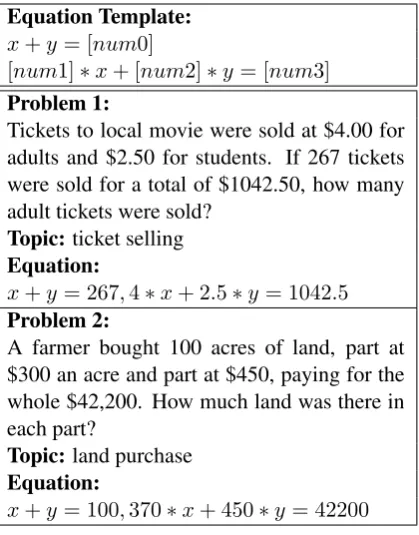
A math word problem is a narrative which de-scribes a story under a specific topic. Moreover, it provides clues to the correct equation interpret-ing mathematical relations of numerical quantities and variables. The two example problems in Ta-ble1belong to two different topics (ticket selling, land purchase) respectively. Meanwhile they share the same equation template interpreting the un-derlying mathematical relations between numbers and variables. To generate a math word problem, a system needs to produce a topic-specific story while maintaining the underlyingequation.
There is a surge of interest in automatic math word problem generation (K. and Elliot, 2002;
Deane and Sheehan, 2013; Polozov et al., 2015;
∗
Equal contribution.
Koncel-Kedziorski et al., 2016). Previous at-tempts are mainly based on templates. Polo-zov et al. (2015) consider several components (e.g., event graph construction, surface text real-ization), each with manual defined templates and rules. Koncel-Kedziorski et al. (2016) generate math problems by revising existing problems into a new topic. They use a problem as the verbal template and simply replace nouns and verbs with suitable words from the new topic. The genera-tion of template-based systems is based directly on existing items with high coherence. However, they have clear limitations. As templates are fixed, the possible outputs are limited to follow template patterns without too many grammatical and lexical options. Additionally, they require manual effort to construct domain-specific templates.
Recently, neural network approaches to auto-matic generation of questions (Du et al., 2017;
Zhou et al.,2017) and stories (Fan et al., 2018) have shown promising results. Despite their suc-cess, they cannot be directly applied to math word problem generation, since generation of math word problems need to maintain the underlying mathematical operations between quantities and variables, while at the same time ensuring the rel-evance of the output problem and a given topic.
Equation Template:
x+y= [num0]
[num1]∗x+ [num2]∗y= [num3] Problem 1:
Tickets to local movie were sold at $4.00 for adults and $2.50 for students. If 267 tickets were sold for a total of $1042.50, how many adult tickets were sold?
Topic:ticket selling Equation:
x+y= 267,4∗x+ 2.5∗y= 1042.5 Problem 2:
A farmer bought 100 acres of land, part at $300 an acre and part at $450, paying for the whole $42,200. How much land was there in each part?
Topic:land purchase Equation:
[image:2.595.78.288.61.329.2]x+y= 100,370∗x+ 450∗y= 42200
Table 1: Math word problems of the same equation template but with different topics.
from equations and topic words. To leverage both the equation and topic information, we design an equation-topic fusion mechanism to enable the de-coder to choose which information to use. Fur-thermore, to ensure that the generated math word problem is highly related to the given equations, we introduce a novel entity-enforced loss function which considers the correspondence between vari-ables in the given equations and entities in the out-put problem.
Large-scale annotated math problem datasets play a crucial role in developing neural math prob-lem generation systems. We propose to adapt Dolphin18K (Huang et al., 2016) as the train-ing, development and test sets, since it is one of the current largest math problem datasets with di-verse problem types. It contains 18,460 elemen-tary math problems from Yahoo! Answers1, with annotation of equations and answers.
Extensive experiments are conducted on the Dolphin18K dataset. We first propose three base-line methods: 1) a retrieve-based model that find the closest math problems in the training set; 2) a sequence-to-sequence model which takes only the equation as input (Equ2Math); 3) a neu-ral decoder model conditioned on topic words
1https://answers.yahoo.com/
(Topic2Math). We use three commonly used au-tomatic evaluation metrics in recent text gener-ation works, i.e., BLEU (Papineni et al., 2002), ROUGE (Lin, 2004) and METEOR (Denkowski and Lavie,2014). Evaluation results on all three metrics show that our MAGNET model outper-forms the baseline methods. To further examine the quality of generated math word problems, we also conduct human evaluations. Human evalua-tion results show that our MAGNET model
per-forms better than the baseline systems on three as-pects, i.e., 1) solvability to the given equation; 2) relevance to the given topic and 3) grammaticality and fluency of language.
Our contributions are three-folds:
1. We propose a novel end-to-end neural net-work model MAGNET to generate math word problems based on given equations and topics.
2. We introduce an Equation-Topic Fusion mechanism which helps the decoder incorpo-rate both the information from the equation and the topic.
3. We design an entity-enforced loss function to improve the relevance between the generated math word problem and the given equations.
2 Related Work
Automatic question generation from text aims to generate questions taking text as input, which has the potential value of education purpose (Heilman,
2011). Previous question generation works focus on generating natural language questions from a given piece of text. Heilman (2011) employs a syntactic parser to parse the input text into a tree and extract answer candidates. Then a rule-based system transforms the tree into the correspond-ing question. Recently, generative neural network methods are also applied to this area since large-scale manually annotated passage-question pairs become available.Du et al.(2017) andZhou et al.
(2017) propose to use SQuAD (Rajpurkar et al.,
tagging features. However, these methods cannot directly applied to math word problem generation. There are previous approaches specifically tar-geting math problem generation. Most of them are template based, such as natural language schemas (K. and Elliot,2002) and semantic frames of conceptual structures (Deane and Sheehan,
2013).Polozov et al.(2015) propose a pipeline in-cluding equation generation, plot generation and surface text realization, which requires manually defined ontology and templates. These approaches are ensured to maintain highly-coherent story, but with the manual cost of template construction, which is difficult to extend to more domains. Re-cently,Koncel-Kedziorski et al. (2016) propose a rewrite-based approach. They generate new prob-lems by simply replacing noun phrases and verbs in the existing math problems with words in the target topic. However, they do not consider global optimization of the whole problem that results in semantic incoherence.
Math problem solving, which can be format-ted as learning the mapping from math problem to equations, is also related to our work. In this paper, we adapt a math problem dataset Dol-phin18K for development. DolDol-phin18K (Huang et al., 2016) is constructed from Yahoo! Answer containing over 18,000 math problems. Previous to that, there are several datasets with size less than 2,000, such as VERB-375 (Hosseini et al.,
2014), ALG514 (Kushman et al., 2014) and Dol-phin1878 (Shi et al.,2015).
3 Problem Statement
Given an equation template and a target topic, our goal is to generate a math word problem in nat-ural language. In this section, we first define the equation template and the topic, and then give the formal introduction of our task.
3.1 Equation Template
Equation template, introduced in Kushman et al.
(2014), is a unique form of an equation system. For example, given an equation system as follows:
x+y = 20;x−4 =y
We replace the numbers with tokens and general-ize the equations as the following template:
x+y= [num0];x−[num1] =y
Equation is a solution for a specific math prob-lem, while an equation template can correspond to several math problems. Therefore, an equation template can be seen as an abstraction of a set of equations.
3.2 Topic
As pointed out inKoncel-Kedziorski et al.(2016), math problems are coherent stories with different topics (e.g., ticket selling or land purchase). In one math problem, there are words that act as topic indicators. For the problems in Table1, the corresponding topic indicators are:
Problem 1: {tickets, movie, adults, students,
sold}
Problem 2:{farmer, bought, dollar, land, pay}
Therefore, we extract the keywords of a math problem as its topic words for representing the topic. The details of topic words extraction will be described in Section3.4.
3.3 Math Problem Generation
Now we can formally define the task of math word problem generation. Given an equation template
E and a set of topic wordsT as input, the goal is to generate a math word problemP, satisfying: (1) P is a piece of natural language text whose topic isT;
(2) P maintains the mathematical operations be-tween numerical quantities and variables in the equation templateE.
3.4 Dataset Creation
We create the math word problem genera-tion dataset based on the Dolphin18K (Huang et al., 2016) dataset. Specifically, we construct (E, T, P)triple whereEis an equation,T is a set of topic words, and P is the corresponding math word problem. In the Dolphin18K dataset, the equationE and math word problemP are given. Therefore, we need to extract the topic words from the text ofP.
the scores of the words as follows:
tfij =
nij
P
knkj
(1)
idfi =log
|P| |j:ti∈Pj|+ 1
(2)
scoreij =tfij∗idfi (3)
wheretfij is the term frequency of wordiin prob-lemPj, andidfiis the inverse document frequency of wordi. We sort the score of each wordiinPj, and keep thetopntpwords as the problem’s topic words.
4 MAGNET
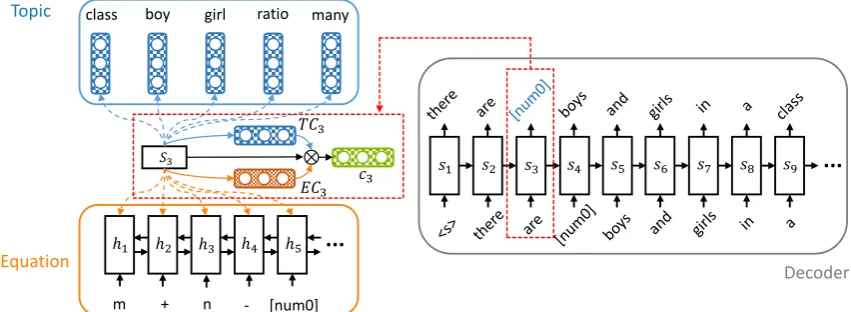
As shown in Figure1, our MAGNET model con-sists of three main parts, namely, the topic en-coder, the equation encoder and the math word problem decoder. The topic encoder and equation decoder are used to map topic words and equations to continuous vectors. The decoder is a single di-rectional recurrent neural network equipped with dual-attention mechanism which leverages by the equation-topic fusion mechanism.
4.1 Topic Encoder
The input topic T contains a set of keywords
t1, t2, . . . , tntp . Considering the fact that these
topic words do not have sequential or temporal re-lationships, we represent them as a set of word embeddingstp1, tp2, . . . , tpntp as shown in the
upper-left part of Figure1. Specifically, the topic encoder is a lookup table which maps input topic words to the corresponding real-valued vectors.
4.2 Equation Encoder
The encoder is implemented as a single-layer bidi-rectional GRU (Cho et al., 2014) (BiGRU). We concatenate all the equations together with a spe-cial delimiter “,” (indicates the end of an equa-tion). The BiGRU reads the input equation tokens one-by-one, producing a sequence of hidden states
hi = [~hi; i~h]with:
~hi =GRU(xi, ~hi−1)
~h
i =GRU(xi, ~hi+1)
(4)
(5)
The initial states of the BiGRU are set to zero vec-tors, i.e.,~h1 = 0and ~hn= 0.
4.3 Math Word Problem Decoder
At each time-step t, the decoder GRU holds its previous hidden statest−1, the embedding of pre-vious output word yt−1 and the previous context vector ct−1. With these previous states, the
de-coder GRU updates its states as given by Equa-tion6. To initialize the GRU hidden state, we use a linear layer with the last backward encoder hid-den state 1~h of equation as input:
st=GRU(wt−1, ct−1, st−1)
s0= tanh(Wd 1~h +b)
(6)
(7)
Then the decoder first generates a readout state
rt and passes it through a maxout hidden layer (Goodfellow et al.,2013) to predict the next word with a softmax layer over the output vocabulary.
rt=Wrwt−1+Urct+Vrst
rt0 = [max{rt,2j−1, rt,2j}]>j=1,...,d
p(yt|y<t) =softmax(Wort0)
(8)
(9)
(10)
whereWr,Ur,VrandWoare weight matrices.
wt−1is the word embedding of the previously gen-erated word yt−1. The readout state rt is a 2d -dimensional vector, and the maxout layer (Equa-tion9) picks the max value for every two numbers inrtand produces a d-dimensional maxout vector
rt0. We then apply a linear transformation onr0tto get a target vocabulary size vector and predict the next wordytwith the softmax operation.
4.4 Equation-Topic Fusion
equa-m
...
ℎ3 ℎ4 ℎ5ℎ2
ℎ1 Equation
+ n - [num0] class boy girl ratio many Topic
𝑠1 𝑠2 𝑠3 𝑠4 𝑠5
...
Decoder
𝑠6 𝑠7 𝑠8 𝑠9
𝑆3
𝑇𝐶3
𝐸𝐶3
[image:5.595.85.511.65.221.2]𝑐3
Figure 1: The overview diagram of MAGNET. For simplicity, we omit some units and connections. This figure shows the detail that the decoder is generating the third word by fusing the information from both the input equation and topic words.
tion and topic :
et,i =v>a tanh(Wast+Uarepr(·)i)
αt,i =
exp(et,i)
Pn
i=1exp(et,i)
c(·)t= n
X
i=1
αt,irepr(·)i
(11)
(12)
(13)
where repr(·)i represents the vector of encoded equation tokens or topic words, which can be hi ortpi. Theva>,WaandUaare learnable parame-ters. Since the equation and topic information are of different types, we use two sets of these param-eters for equation and topic attention modules.
We represent the equation context vector
c(equation)tand topic context vectorc(topic)tas
ECtandT Ctrespectively. To fuseECtandT Ct together, we predict a fusion coefficient gt using an MLP:
gt=sigmoid(Wfst+b) (14)
ct=gt·ECt+ (1−gt)·T Ct, (15)
wheregtis the fusion gate. Therefore, the context vectorctis the combination of equation template and topic which is determined by the current de-coding statest.
4.5 Entity-Enforced Loss
As we mention before, the generated math prob-lems should be highly relevant to the given equa-tion template. Theentities in the generated math problem should correspond to thevariablesin the equations (e.g., m, n, [num0]). To ensure high
relevance of equation template and the generated math problem, we propose an entity-enforced loss:
acce = L
X
t=1
gtαt,e
Le =
X
∀e∈equation
ReLU(1−acce)
(16)
(17)
where L is the length of output problem, and ReLU is rectifier function defined as:
ReLU(x) = max(0, x) (18)
The intuition behind the entity-enforced loss is that the model needs to attend to the entities in the given equations. In Equation 16, we accumulate the attention scores of variables in the equation for all the decoding time steps. Then a ReLU function is applied on(1−acce)to ensure that the entitye is attended for at least one time during decoding.
4.6 Objective Function
Given a training dataset with n
equation-topic-question triples D = {(E(1), T(1), P(1)), . . . ,(E(n), T(n), P(n))}, the training objective is to minimize the negative log likelihood loss L with respect to the model parameterθ:
L=− n
X
i
logp(Pi|Ei, Ti;θ) +λLe (19)
5 Experiment
In this section, we evaluate our model with both automatic and human evaluations.
5.1 Datasets
We conduct our experiments on the Dolphin18K dataset2. Since we need equation templates as in-put to generate math problems, we use its sub-set with equation annotation, which sums up to 10,644 problems with 5,738 equation templates. The average sentence length of a problem is 2.70. The average number of words in a problem is 32.72. We train on 8,515 examples and evaluate on 2,129 test examples, following the split setting inHuang et al.(2016).
As pre-processing, we obtain equation template and topic words for each problem as their input. We extract at most ntp = 10 words with high-est TF-IDF scores as the topic words in our ex-periments. According to the statistic, the average number of extracted topic words are 7.7 and 7.5 in the training and testing datasets respectively.
5.2 Baselines
We provide three baselines of math word problem generation, considering the input of equation tem-plate and topic words respectively3.
KNN finds the closest problem in the training set given the input topic words. It first nar-rows down training problems to those with the same input equation template. Then a TF-IDF vector for topic words was created and KNN is applied to retrieve the nearest train-ing problem.
Topic2Math generates math problems only given the input of topic words. Topics words are encoded by Topic Encoder component de-scribed in Section4.1.
Equ2Math generates math problems only given the input of equation template. Equation tem-plate is encoded by Equation Encoder com-ponent described in Section4.2.
2Other datasets are small and biased on problem types,
which can be seen as subsets of the dataset we used.
3
Previous works are not comparable: 1) The rules used in
Polozov et al.(2015) are not publicly available; 2) Koncel-Kedziorski et al.(2016) have a different input from us, that their system needs a full math word problem and then rewrite it. While our system tries to generate a problem from scratch.
5.3 Implementation Details
The dimension of encoder/decoder hidden state and embedding are set to 512. The hyper-parameter λin Equation19 is 0.7. Dropout rate is set to 0.6. All model parameters are initial-ized using a Gaussian distribution with Xavier scheme (Glorot and Bengio, 2010). We use the Adam (Kingma and Ba, 2015) optimizer with its hyper-parameters set as: learning rateα = 0.001, momentum parametersβ1 = 0.9andβ1 = 0.999, and = 10−8. We also apply gradient clip-ping (Pascanu et al.,2013) with range[−5,5]. The beam size is set to 3 in the decoding stage. We re-lease the source code at an anonymous URL for blind review.
5.4 Automatic Evaluation
Though the automatic evaluation methods have their limitations in natural language generation evaluation, we use them as important evaluation methods since they are easily reproducible. Fur-thermore, in the task of math word problem gener-ation, retaining some key information such as the quantities and entities can be well measured by the automatic evaluation methods.
5.4.1 Evaluation Metrics
We evaluate the performance of our model using three evaluation metrics following recent text gen-eration works (Du et al.,2017;Zhou et al.,2017;
Fan et al.,2018):
BLEU (Papineni et al., 2002) is a widely used evaluation method in machine translation and text generation.
ROUGE (Lin, 2004) is commonly to evalu-aten-gram overlap of summaries with gold-standard sentences.
METEOR (Denkowski and Lavie, 2014) is provided following previous work ( Koncel-Kedziorski et al.,2016).
5.4.2 Evaluation Results
Models BLEU ROUGE-1 ROUGE-2 ROUGE-L METEOR
KNN 11.97 43.93 23.08 36.14 16.78
Equ2Math 5.00 35.88 12.94 29.56 13.51
Topic2Math 12.26 53.97 28.79 42.19 23.90
MAGNET w/o Entity 12.28 54.28 28.77 42.88 24.73
[image:7.595.73.534.209.320.2]MAGNET 12.47 55.12 30.02 43.58 24.76
Table 2: Automatic evaluation results on Dolphin18K. MAGNET w/o Entity indicates the ablation model without entity-enforced loss.
Models Equation Relevance Topic Relevance Solvability Language Fluency
score Kappa score Kappa score Kappa score Kappa
KNN 1.65 0.75 1.80 0.90 2.07 0.90 2.92 0.80
Equ2Math 1.97 0.68 1.58 0.85 1.98 0.80 2.62 0.75
Topic2Math 1.63 0.58 2.88 0.85 1.50 0.55 1.98 0.52
MAGNET w/o Entity 1.85 0.40 2.90 0.90 1.73 0.65 2.35 0.50
MAGNET 2.08 0.43 2.90 0.90 2.07 0.65 2.57 0.77
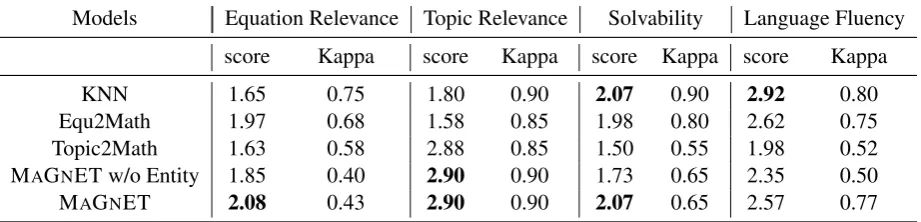
Table 3: Human evaluation results: the average scores from the three annotators together (ranged from 1 to 3, higher is better).
ROUGE-1, +1.23 ROUGE-2, +1.39 ROUGE-L) relative gain respectively. The improvement over the baselines demonstrates the usefulness of both equation and topic input. Moreover, without the entity-enforced loss, the performance drops on all metricsthe, which shows its effectiveness.
5.5 Human Evaluation
To better evaluate the performance of our system, we recruit three human annotators to judge the quality of the generated math problems, in addi-tion to the automatic metrics. We randomly select 50 instances in the test set, and show the equa-tion template and topic words with generated math problems from different models. We then ask the annotators to rate the outputs with scores ranged 1 to 3 from the following four aspects (detailed guidelines attached in supplementary):
1. Equation Relevance: the generated problem is relevant to the given equation;
2. Topic Relevance: the generated problem is relevant to the given topic words;
3. Solvability: the generated problem can be solved by an (given) equation;
4. Language Fluency: the generated problem is grammatical and fluent.
Table 3 reports the human evaluation results. As we can see, MAGNET has the highest scores across the three criteria of equation relevance (2.08), topic relevance (2.9), solvability (2.07), outperforming all the baselines and the ablation test. KNN performs the best in terms of language fluency, since as a retrieval-based method its out-puts are existing problems in the training data. The Kappa (Randolph,2005) values on all models range from 0.4 to 0.9, indicating relatively inter-mediate to excellent agreement among annotators. The human evaluation result is consistent with the automatic evaluation.
6 Discussion
To better understand the model, we show the at-tention visualization and qualitative analysis with some examples.
6.1 Effect of Model Fusion
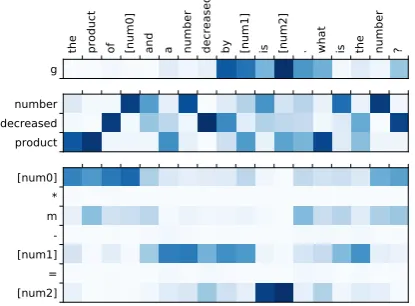
To illustrate how MAGNET leverages both inputs, we visualize the output fusion coefficientg(top), and attention of topic words (middle) and equation template (bottom) in Figure2.
We can see MAGNET generates a reasonable
Equation Template:m= [num0]/[num1]/60
Topic words: sun approximately light kilometer planet travels travel rate take minute KNN: what is [num0] of [num1] ?
Equ2Math: if i ran [num0] mile in [num1] minute , what is my meter per hour ?
Topic2Math: find the speed of the light [num0] kilometer in [num1] minute [num2] minute . MAGNET-Entity: a light travels [num0] kilometer at [num1] kilometer per h. how far would it
take to travel [num2] kilometer ?
MAGNET: if a man travels [num0] kilometer in [num1] minute , what is the speed in kilometer per h ?
[image:8.595.75.283.290.443.2]Ground truth: the sun is approximately [num0] kilometer from the planet saturn , and light from the sun travels to saturn at the rate of approximately [num1] kilometer per second. approximately how many minute does it take for light to travel from the sun to saturn?
Table 4: An example of generated math word problems.
the product of [num0] and a number decreased by [num1] is [num2] . what is the number ? g
number decreased product
[num0] * m -[num1] = [num2]
Figure 2: Fusion coefficientgand attention visualiza-tion example.
while the attention is focused on the equation tem-plate when generating the corresponding numbers ([num0],[num1], ...).
6.2 Qualitative Results
Table4 shows an example case from the test set. We can see that MAGNET generates a more
rea-sonable math problem, with respect to equation solvability and topic relevance. Please note that the equation template does not exist in the train-ing data. Surpristrain-ingly, MAGNET has captured the constant “60” in the equation template and gener-ates “kilometer per h” as unit conversion of minute to hour. The ablation model MAGNET-Entity does not generate reasonable problem as well as the baselines, while MAGNET generates “speed”
word problem, perfectly describing the division of two numbers. This further demonstrates the effec-tiveness of the entity-enforced loss which
encour-ages the relevance between the equation template and the output problem. Due to space limit, we attach more examples in the supplementary.
6.3 Error Analysis
Furthermore, we observe two main types of er-rors by our model (examples shown in Supple-mentary): (1) Problem soundness. The generated problem lacks semantic coherence. For example, the model generates “plants[num0]feet of fence to build a fence” that is non-comprehensive; (2) Equation matchness. The input equation template is partially correlated to the output, but not an ex-act solution of it. This is somewhat expected, since we use the entity-enforced loss only as a soft con-straint to ensure the relevance with equation.
7 Conclusion
In this work, we present MAGNET, a novel model for math word problem generation. It considers the input of both equations and topics using a fu-sion module. Additionally, an entity-enforced loss is introduced to ensure the relevance of equation and the problem during training. Experiments on a large-scale math problem dataset demonstrated our model can produce fluent math word problems that are highly relevant to the given equations and topics.
8 Acknowledgements
We would like to thank the annotators for their efforts in the evaluation process. Thanks to the anonymous reviewers for their helpful comments and suggestions.
References
David M. Blei, Andrew Y. Ng, and Michael I. Jordan. 2003. Latent dirichlet allocation. J. Mach. Learn. Res., 3:993–1022.
Kyunghyun Cho, Bart van Merrienboer, Caglar Gul-cehre, Dzmitry Bahdanau, Fethi Bougares, Holger Schwenk, and Yoshua Bengio. 2014. Learning phrase representations using rnn encoder–decoder for statistical machine translation. In Proceedings of the EMNLP 2014, pages 1724–1734, Doha, Qatar. Association for Computational Linguistics.
Paul Deane and Kathleen Sheehan. 2013. Automatic item generation via frame semantics: Natural lan-guage generation of math word problems. In Pro-ceedings of the Annual Meeting of the National Council on Measurement in Education, Chicago, America.
Michael Denkowski and Alon Lavie. 2014. Meteor universal: Language specific translation evaluation for any target language. InProceedings of the EACL 2014 Workshop on Statistical Machine Translation.
Xinya Du, Junru Shao, and Claire Cardie. 2017. Learn-ing to ask: Neural question generation for readLearn-ing comprehension. In Proceedings of the 55th ACL, pages 1342–1352, Vancouver, Canada. Association for Computational Linguistics.
Angela Fan, Mike Lewis, and Yann Dauphin. 2018. Hi-erarchical neural story generation. InProceedings of the 56th ACL, pages 889–898. Association for Com-putational Linguistics.
Xavier Glorot and Yoshua Bengio. 2010. Understand-ing the difficulty of trainUnderstand-ing deep feedforward neural networks. InAistats, volume 9, pages 249–256.
Ian J Goodfellow, David Warde-Farley, Mehdi Mirza, Aaron C Courville, and Yoshua Bengio. 2013. Max-out networks. ICML (3), 28:1319–1327.
Michael Heilman. 2011. Automatic factual question generation from text. Ph.D. thesis, Carnegie Mellon University.
Mohammad Javad Hosseini, Hannaneh Hajishirzi, Oren Etzioni, and Nate Kushman. 2014. Learning to solve arithmetic word problems with verb catego-rization. InProceedings of the 2014 Conference on Empirical Methods in Natural Language Process-ing.
Danqing Huang, Shuming Shi, Chin-Yew Lin, Jian Yin, and Wei-Ying Ma. 2016. How well do comput-ers solve math word problems? large-scale dataset construction and evaluation. In Proceedings of the 52nd Annual Meeting of the Association for Compu-tational Linguistics.
Singley Mark K. and Bennett Randy Elliot. 2002. Item generation and beyond: Applications of schema the-ory to mathematics assessment. In Irvine, Sidney H.; Kyllonen, Patrick C. (eds.) Item Generation for Test Development. Mahwah, NJ: Lawrence Erlbaum Associates.
Diederik Kingma and Jimmy Ba. 2015. Adam: A method for stochastic optimization. InProceedings of 3rd International Conference for Learning Repre-sentations, San Diego.
Rik Koncel-Kedziorski, Ioannis Konstas, Luke Zettle-moyer, and Hannaneh Hajishirzi. 2016. A theme-rewriting approach for generating algebra word problems. InProceedings of the 2016 Conference on Empirical Methods in Natural Language Pro-cessing, pages 1617–1628, Austin, Texas. Associ-ation for ComputAssoci-ational Linguistics.
Nate Kushman, Yoav Artzi, Luke Zettlemoyer, and Regina Barzilay. 2014. Learning to automatically solve algebra word problems. InProceedings of the 52nd Annual Meeting of the Association for Compu-tational Linguistics.
Chin-Yew Lin. 2004. Rouge: A package for auto-matic evaluation of summaries. InText summariza-tion branches out: Proceedings of the ACL-04 work-shop, volume 8. Barcelona, Spain.
Kishore Papineni, Salim Roukos, Todd Ward, and Wei-Jing Zhu. 2002. Bleu: a method for automatic eval-uation of machine translation. In Proceedings of the 40th annual meeting on association for compu-tational linguistics, pages 311–318. Association for Computational Linguistics.
Razvan Pascanu, Tomas Mikolov, and Yoshua Bengio. 2013. On the difficulty of training recurrent neural networks. ICML (3), 28:1310–1318.
Oleksandr Polozov, Eleanor O’Rourke, Adam M. Smith, Luke Zettlemoyer, Sumit Gulwani, and Zo-ran Popovi´c. 2015.Personalized mathematical word problem generation.
Pranav Rajpurkar, Jian Zhang, Konstantin Lopyrev, and Percy Liang. 2016. Squad: 100,000+ questions for machine comprehension of text. InProceedings of the 2016 Conference on Empirical Methods in Natu-ral Language Processing, pages 2383–2392, Austin, Texas. Association for Computational Linguistics.
Shuming Shi, Wang Yuehui, Chin-Yew Lin, Xiaojiang Liu, and Yong Rui. 2015. Automatically solving number word problems by semantic parsing and rea-soning. InProceedings of the 2015 Conference on Empirical Methods in Natural Language Process-ing.
Qingyu Zhou, Nan Yang, Furu Wei, Chuanqi Tan, Hangbo Bao, and Ming Zhou. 2017. Neural ques-tion generaques-tion from text: A preliminary study.