Statistical Ranking in Tactical Generation
Erik Velldal
University of Oslo (Norway) [email protected]
Stephan Oepen University of Oslo (Norway)
and CSLI Stanford (CA) [email protected]
Abstract
In this paper we describe and evaluate several statistical models for the task of
realization ranking, i.e. the problem of
discriminating between competing surface realizations generated for a given input se-mantics. Three models (and several vari-ants) are trained and tested: an n-gram
language model, a discriminative maxi-mum entropy model using structural in-formation (and incorporating the language model as a separate feature), and finally an SVM ranker trained on the same feature set. The resulting hybrid tactical generator is part of a larger, semantic transfer MT system.
1 Introduction
This paper describes the application of several dif-ferent statistical models for the task of
realiza-tion ranking in tactical generarealiza-tion, i.e. the problem
of choosing among multiple paraphrases that are generated for a given meaning representation. The specific realization component we use is the open-source chart generator of the Linguistic Knowl-edge Builder (LKB; Carroll, Copestake, Flickinger, & Poznanski, 1999; Carroll & Oepen, 2005). Given a meaning representation in the form of Minimal Recursion Semantics (MRS; Copestake, Flickinger, Malouf, Riehemann, & Sag, 1995), the generator outputs English realizations in ac-cordance with the HPSG LinGO English Resource Grammar (ERG; Flickinger, 2002).
As an example of generator output, a sub-set of alternate realizations that are produced for a single input MRS is shown in Figure 1. For the two data sets considered in this paper, the aver-age number of realizations produced by the gen-erator is 85.7 and 102.2 (the maximum numbers are 4176 and 3408, respectively). Thus, there is immediate demand for a principled way of choos-ing a schoos-ingle output among the generated candi-dates. For this task we train and test three differ-ent statistical models: ann-gram language model,
a maximum entropy model (MaxEnt) and a (lin-ear) support vector machine (SVM). These are all models that have proved popular within the NLP community, but it is usually only the first of these three that has been applied to the task of ranking in sentence generation. The latter two models that we present here go beyond the sur-face information used by the n-gram model, and
are trained on a symmetric treebank with features defined over the full HPSG analyses of compet-ing realizations. Furthermore, such discriminative models are suitable for ‘on-line’ use within our generator—adopting the technique of selective
un-packing from a packed forest (Carroll & Oepen,
2005)—which means our hybrid realizer obviates the need for exhaustive enumeration of candidate outputs. The present results extend our earlier work (Velldal, Oepen, & Flickinger, 2004)—and the related work of Nakanishi, Miyao, & Tsu-jii (2005)—to an enlarged data set, more feature types, and additional learners.
The rest of this paper is structured as follows. Section 2 first gives a general summary of the var-ious statistical models we will be considering, as well as the measures used for evaluating them. We then go on to define the task we are aiming to solve in terms of treebank data and feature types in Sec-tion 3. By looking at different variants of the Max-Ent model we review some results for the relative contribution of individual features and the impact of frequency cutoffs for feature selection. Keeping these parameters constant then, Section 4 provides an array of empirical results on the relative perfor-mance of the various approaches.
2 Models
In this section we briefly review the different types of statistical models that we use for ranking the output of the generator. We start by describing the language model, and then go on to review the framework for discriminative MaxEnt models and SVM rankers. In the following we will usesand
rto denote semantic inputs and generated
realiza-tions respectively.
Remember that dogs must be on a leash. Remember dogs must be on a leash. On a leash, remember that dogs must be. On a leash, remember dogs must be. A leash, remember that dogs must be on. A leash, remember dogs must be on. Dogs, remember must be on a leash.
Table 1: A small example set of generator out-puts using theERG. Where the input semantics is no specified for aspects of information structure (e.g. requesting foregrounding of a specific entity), paraphrases include all grammatically legitimate topicalizations. Other choices involve, for exam-ple, the optionality of complementizers and rela-tive pronouns, permutation of (intersecrela-tive) modi-fiers, and lexical and orthographic alternations.
2.1 Language Models
The use of n-gram language models is the most
common approach to statistical selection in gen-eration (Langkilde & Knight, 1998; and White (2004); inter alios). In order to better assert the relative performance of the discriminative mod-els and the structural features we present below, we also apply a trigram model to the ranking problem. Using the freely available CMU SLM Toolkit (Clarkson & Rosenfeld, 1997), we trained a trigram model on an unannotated version of the British National Corpus (BNC), containing roughly 100 million words (using Witten-Bell dis-counting and back-off). Given such a model p
n,
the score of a realization r
i with surface form w
k i1
=(w i1
;:::;w ik
)is then computed as
(1) F(s;r i )= k X j=1 p n (w i;j jw i;j n ;:::;w
i;j 1 )
Given the scoring function F, the best
realiza-tion is selected according to the following decision function:
(2) r^=argmax
r 0
2Y(s)
F(s;r 0
)
Although in this case scoring is not conditioned on the input semantics at all, we still include it to make the function formulation more general as we will be reusing it later.
Note that, as the realizations in our symmet-ric treebank also include punctuation marks, these are also treated as separate tokens by the language model (in addition to pseudo-tokens marking sen-tence boundaries).
2.2 Maximum Entropy Models
Maximum entropy modeling provides a very flex-ible framework that has been widely used for a range of tasks in NLP, including parse selection (e.g. Johnson, Geman, Canon, Chi, & Riezler, 1999; Malouf & Noord, 2004) and reranking for machine translation (e.g. Och et al., 2004). A model is specified by a set of real-valued feature
functions that describe properties of the data, and
an associated set of learned weights that determine the contribution of each feature.
Let us first introduce some notation before we go on. LetY(s
i )=fr
1 ;:::;r
m
gbe the set of
re-alizations licensed by the grammar for a semantic representation s
i. Now, let our (positive) training
data be given asX p
= fx 1
;:::;x N
gwhere each x
i is a pair (s
i ;r
j
) for whichr j
2 Y(s i
)and r j
is annotated in the treebank as being a correct re-alization of s
i. Note that we might have several
different members of Y(s i
) that pair up with s i
inX
p. In our set-up, this is the case where
multi-ple HPSG derivations for the same input semantics project identical surface strings.
Given a set of d features (as further described
in Section 3.2), each pair of semantic inputsand
hypothesized realization r is mapped to a feature
vector (s;r) 2 < d
. The goal is then to find a vector of weights w 2 <
d
that optimize the like-lihood of the training data. A conditional MaxEnt model of the probability of a realization r given
the semanticss, is defined as
p w (rjs)= e Fw(s;r) Z w (s) (3)
where the function F
w is simply the sum of the
products of all feature values and feature weights, given by
(4) F
w
(s;r)= d X i=1 w i i
(s;r)=w(s;r)
The normalization termZ
wis defined as
(5) Z w (s)= X r 0 2Y(s) e Fw(s;r)
When we want to find the best realization for a given input semantics according to a modelp
w, it
comes to estimating1 the parameters w, the
pro-cedure seeks to maximize the (log of) a penalized likelihood function as in
(6) w^ =argmax w logL(w) P d i=1 w 2 i 2 2
whereL(w)is the ‘conditionalized’ likelihood of
the training data X
p (Johnson et al., 1999),
com-puted as L(w) = Q N i=1 p w (r i js i
). The second
term of the likelihood function in Equation (6) is a penalty term that is commonly used for reducing the tendency of log-linear models to over-fit, es-pecially when training on sparse data using many features (Chen & Rosenfeld, 1999; Johnson et al., 1999; Malouf & Noord, 2004). More specifically it defines a zero-mean Gaussian prior on the fea-ture weights which effectively leads to less ex-treme values. After empirically tuning the prior on our ‘Jotunheimen’ treebank (training and test-ing by 10-fold cross-validation), we ended up us-ing
2
=0:003for the MaxEnt models applied in
this paper.
2.3 SVM Rankers
In this section we briefly formulate the optimiza-tion problem in terms of support vector machines. Our starting point is the SVM approach introduced in Joachims (2002) for learning ranking functions for information retrieval. In our case the aim is to learn a ranking function from a set of preference relations on sentences generated for a given input semantics.
In contrast to the MaxEnt approach, the SVM approach has a geometric rather than probabilistic view on the problem. Similarly to the the MaxEnt set-up, the SVM learner will try to learn a linear scoring function as defined in Equation (4) above. However, instead of maximizing the probability of the preferred or positive realizations, we try to maximize their value forF
wdirectly.
Recall our definition of the set of positive train-ing examples in Section 2.2. Let us here analo-gously define X
n = fx
1 ;:::;x
Q
gto be the
neg-ative counterpart, so that for a given pair x =
(s i
;r j
) 2 X
n, we have that r
j
2 Y(s i
) but r j is
not annotated as a preferred realization ofs i.
Fol-1We use the TADM open-source package (Malouf, 2002) for training the models, using its limited-memory variable metric as the optimization method and experimentally deter-mine the optimal convergence threshold and variance of the prior.
lowing Joachims (2002), the goal is to minimize
(7) V(w;)=
1
2
ww+C X
i;j;k
subject to the following constraints,
8ijks.t.(s k
;r i
)2X p
^(s k
;r j
)2X n
:
(8)
w(s k
;r i
)w(s k
;r j
)+1 i;j;k
8ijk: i;j;k
0
(9)
Joachims (2002) shows that the preference con-straints in Equation (8) can be rewritten as
(10) w((s
k ;r i ) (s k ;r j
))1 i;j;k
so that the optimization problem is equivalent to training a classifier on the pairwise difference vec-tors (s k ;r i ) (s k ;r j
). The (non-negative)
slack variables
i;j;kare commonly used in SVMs
to make it possible to approximate a solution by allowing some error in cases where a separating hyperplane can not be found. The trade-off be-tween maximizing the margin size and minimizing the training error is governed by the constant C.
Using the SVMl ight
package by Joachims (1999), we empirically specifiedC=0:005for the model
described in this paper. Note that, for the ex-periments reported here, we will only be mak-ing binary distinctions of preferred/non-preferred realizations, although the approach presented in (Joachims, 2002) is formulated for the more gen-eral case of learning ordinal ranking functions.
Finally, given a linear SVM, we score and se-lect realizations in the same way as we did with the MaxEnt model, according to Equations (4) and (2). Note, however, that it is also possible to use non-linear kernel functions with this set-up, since the ranking function can be represented as a linear combination of the feature vectors as in
(11) w(s;r i )= X j;k (s j ;r k )(s;r i )
2.4 Evaluation Measures
if several realizations are given the top rank by the model. We also include the exact match accu-racy for the five best candidates according to the models (see then-best columns of Table 6).
The simple measure of exact match accuracy of-fers a very intuitive and transparent view on model performance. However, it is also in some respects too harsh as an evaluation measure in our setting since there will often be more than just one of the candidate realizations that provides a reason-able rendering of the input semantics. We there-fore also include WA as similarity-based evalua-tion metric. This measure is based on the
Lev-ensthein distance between a candidate string and
a reference, also known as edit distance. This is given by the minimum number of deletions, sub-stitutions and insertions of words that are required to transform one string into another. If we letd,s
andirepresent the number of necessary deletions,
substitutions and insertions respectively, and letl
be the length of the reference, thenWA is defined as
(12) WA=1
d+s+i
l
The scores produced by similarity measures such as WA are often difficult to interpret, but at least they provide an alternative view on the relative performance of the different models that we want to compare. We could also have used several other similarity measures here, such as the BLEU
score which is a well-established evaluation metric within MT, but in our experience the various string similarity measures usually agree on the relative ranking of the different models.
3 Data Sets and Features
The following sections summarize the data sets and the feature types used in the experiments.
3.1 Symmetric Treebanks
Conditional parse selection models are standardly trained on a treebank consisting of strings paired with their optimal analyses. For our discriminative realization ranking experiments we require train-ing corpora that provide the inverse relation. By assuming that the preferences captured in a stan-dard treebank can constitute a bidirectional rela-tion, Velldal et al. (2004) propose a notion of sym-metric treebanks as the combination of (a) a set of pairings of surface forms and associated seman-tics; combined with (b) the sets of alternative
anal-Jotunheimen
Bin Items Words Trees Gold Chance
100n 396 21.7 367.4 20.7 0.083 50n<100 246 18.5 73.7 11.5 0.160 10n<50 831 14.8 24.2 6.3 0.277 5n<10 426 10.1 7.0 3.0 0.436 1<n<5 291 11.2 3.3 1.6 0.486
Total 2190 15.1 85.7 8.2 0.287
Rondane
Bin Items Words Trees Gold Chance
100n 107 21.8 498.4 17.8 0.060 50n<100 63 19.1 72.9 12.0 0.162 10n<50 244 15.2 23.4 4.9 0.234 5n<10 119 11.9 7.2 2.7 0.377 1<n<5 101 9.3 3.21 1.5 0.476
[image:4.595.307.526.72.271.2]Total 634 15.1 102.2 6.8 0.263
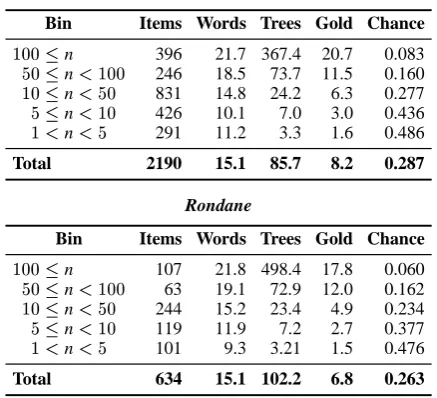
Table 2: Some core metrics for the symmetric tree-banks ‘Jotunheimen’ (top) and ‘Rondane’ (bot-tom). The former data set was used for devel-opment and cross-validation testing, the latter for cross-genre held-out testing. The data items are aggregated relative to their number of realizations. The columns are, from left to right, the subdivi-sion of the data according to the number of real-izations, total number of items scored (excluding items with only one realization and ones where all realizations are marked as preferred), aver-age string length, averaver-age number of realizations, and average number of references. The rightmost column shows a random choice baseline, i.e. the probability of selecting the preferred realization by chance.
yses for each surface form, and (c) sets of alter-nate realizations of each semantic form. Using the semantics of the preferred analyses in an ex-isting treebank as input to the generator, we can produce all equivalent paraphrases of the original string. Furthermore, assuming that the original surface form is an optimal verbalization of the cor-responding semantics, we can automatically label the preferred realization(s) by matching the yields of the generated trees against the original strings in the ‘source’ treebank. The result is what we call a generation treebank, which taken together with the original parse-oriented pairings constitute a full symmetrical treebank.
We have successfully applied this technique to the tourism segments of the LinGO Redwoods treebank, which in turn is built atop the ERG.2
fur-Table 2 summarizes the two resulting data sets, which are both comprised of instructional texts on tourist activities, the application domain of the background MT system.
3.2 Feature Templates
For the purpose of parse selection, Toutanova, Manning, Shieber, Flickinger, & Oepen (2002) and Toutanova & Manning (2002) train a dis-criminative log-linear model on the Redwoods parse treebank, using features defined over
deriva-tion trees with non-terminals representing the con-struction types and lexical types of the HPSG
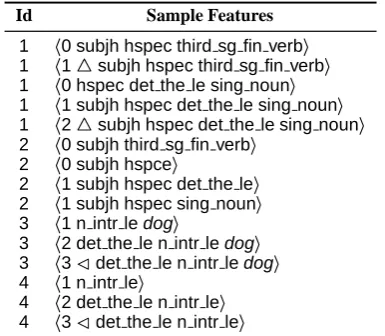
grammar (see Figure 1). The basic feature set of our MaxEnt realization ranker is defined in the same way (corresponding to thePCFG-Smodel of Toutanova & Manning, 2002), each feature captur-ing a sub-tree from the derivation limited to depth one. Table 3 shows example features in our Max-Ent and SVM models, where the feature template # 1 corresponds to local derivation sub-trees. To reduce the effects of data sparseness, feature type # 2 in Table 3 provides a back-off to derivation sub-trees, where the sequence of daughters is re-duced, in turn, to just one of the daughters. Con-versely, to facilitate sampling of larger contexts than just sub-trees of depth one, feature template # 1 allows optional grandparenting, including the upward chain of dominating nodes in some fea-tures. In our experiments, we found that grandpar-enting of up to three dominating nodes gave the best balance of enlarged context vs. data sparse-ness.
subjh
hspec
det the le
the
sing noun
n intr le
dog
third sg fin verb
v unerg le
barks
Figure 1: Sample HPSG derivation tree for the sentence the dog barks. Phrasal nodes are la-beled with identifiers of grammar rules, and (pre-terminal) lexical nodes with class names for types of lexical entries.
In addition to these dominance-oriented fea-tures taken from the derivation trees of each re-alization, our models also include more
surface-ther information and download pointers.
Id Sample Features
1 h0 subjh hspec third sg fin verbi 1 h14subjh hspec third sg fin verbi 1 h0 hspec det the le sing nouni 1 h1 subjh hspec det the le sing nouni 1 h24subjh hspec det the le sing nouni 2 h0 subjh third sg fin verbi
2 h0 subjh hspcei
2 h1 subjh hspec det the lei 2 h1 subjh hspec sing nouni 3 h1 n intr le dogi
3 h2 det the le n intr le dogi 3 h3det the le n intr le dogi 4 h1 n intr lei
[image:5.595.321.514.62.230.2]4 h2 det the le n intr lei 4 h3det the le n intr lei
Table 3: Examples of structural features extracted from the derivation tree in Figure 1. The first col-umn identifies the feature template corresponding to each example; in the examples, the first integer value is a parameter to feature templates, i.e. the depth of grandparenting (types 1 and 2) orn-gram
size (types 3 and 4). The special symbols4and
denote the root of the tree and left periphery of the yield, respectively.
oriented features, viz. n-grams of lexical types
with or without lexicalization. Feature type # 3 in Table 3 defines n-grams of variable size, where
(in a loose analogy to part of speech tagging) se-quences of lexical types capture syntactic cate-gory assignments. Feature templates # 3 and # 4 only differ with regard to lexicalization, as the for-mer includes the surface token associated with the rightmost element of eachn-gram. Unless
other-wise noted, we used a maximum n-gram size of
three in the experiments reported here, again due to its empirically determined best overall perfor-mance.
The number of instantiated features produced by the feature templates easily grows quite large. For the ‘Jotunheimen’ data the total number of dis-tinct feature instantiations is 312,650. For the ex-periments in this paper we implemented a simple frequency based cutoff by removing features that are observed as relevant less thantimes. We here
follow the approach of Malouf & Noord (2004) where relevance of a feature is simply defined as taking on a different value for any two competing candidates for the same input. A feature is only included in training if it is relevant for more than
items in the training data. Table 4 shows the
[image:5.595.101.266.518.620.2]Cutoff Features Accuracy
312,650 71.18 1 264,455 71.18 2 112,051 70.03 3 66,069 70.28 4 46,139 69.30 5 35,295 67.93 10 16,036 65.36 20 7,563 63.05 50 2,605 59.10
100 889 54.21
200 261 50.11
[image:6.595.81.283.252.342.2]500 34 34.70
Table 4: The effects of frequency-based feature se-lection with respect to model size and accuracy.
model configuration match WA
basic model of (Velldal et al., 2004) 63.09 0.904 basic plus partial daughter sequence 64.64 0.910 basic plus grandparenting 67.54 0.923 basic plus lexical type trigrams 68.61 0.921 basic plus all of the above 70.28 0.927 basic plus language model 67.96 0.912 basic plus all of the above 72.28 0.928
Table 5: Performance summaries of best-performing realization rankers using various fea-ture configurations, when compared to the set-up of Velldal et al. (2004). These scores where com-puted using a relevance cutoff of 3 and optimizing the variance of the prior for individual configura-tions.
compacted quite aggressively without sacrificing much in performance. For all models presented below we use a cutoff of=3.
4 Results
In this section we present contrastive results for the models defined in Section 2 above, evaluated against the exact match accuracy and word accu-racy as described in Section 2.4.
As can be seen in Table 6, both the MaxEnt and SVM learner does a much better job than then-gram model at identifying the correct
refer-ence strings. The two discriminative models per-form very similarly, however, although the Max-Ent model often seems to do slightly better.
When working with a cross-validation set-up the difference between the learners can conve-niently be tested using an approach such as the cross-validated paired t-test described by
Diet-terich (1998). We also tried this approach using the Wilcoxon Matched-Pairs Signed-Ranks test as a non-parametric alternative without the
assump-tion of normality of differences made in thet-test.
However, none of the two tests found that the dif-ferences between the MaxEnt model and the SVM model were significant for = 0:05 (using
two-sided tests).
Note that, due to memory constraints, we only included a random sample of maximum 50 non-preferred realizations per item in the training data used for the SVM ranker. Even so, the SVM trained on the full ‘Jotunheimen’ data had a to-tal of 66,621 example vectors in its training data, which spawned a total of 639,301 preference con-straints with respect to the optimization problem of Equations 8 and 10. We did not try to maxi-mize performance on the development data by re-peatedly training with different random samples, but this might be one way to improve the results.
Although we were only able to present results using linear kernels for the SVM ranker in this pa-per, preliminary experiments using a polynomial kernel seem to give promising results. Due to memory constraints and long convergence times, we were only able to train such a model on half of the ‘Jotunheimen’ data. However, when testing on the remaining half, it achieved an exact match accuracy of 71:03%. This is comparable to the
performance achieved by the linear SVM through full 10-fold training and testing. Moreover, there is reason to believe that these results will improve once we manage to train on the full data set.
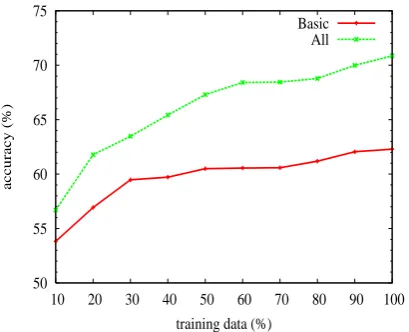
In order to assess the effect of increasing the size of the training set, Figure 3 presents learning curves for two MaxEnt configurations, viz. the ba-sic configurational model and the one including all features but the language model. Each data point
0 10 20 30 40 50 60 70 80 90
1-5 5-10 10-50 50-100 100-4176
[image:6.595.319.516.566.721.2]Baseline BNC LM SVM MaxEnt
Jotunheimen Rondane
Model accuracy n-best WA accuracy n-best WA
[image:7.595.160.439.63.128.2]BNC LM 53.24 78.81 0.882 54.19 77.19 0.891 SVM 71.11 84.69 0.922 63.64 83.12 0.906 MaxEnt 72.28 84.59 0.927 64.28 83.60 0.903
Table 6: Performance of the different learners. The results on the ‘Jotunheimen’ treebank for the discrim-inative models are averages from 10-fold cross-validation. A model trained on the entire ‘Jotunheimen’ data was used when testing on ‘Rondane’. Note that the training accuracy of the SVM learner on the ‘Jotunheimen’ training set is 91.69%, while it’s 92.99% for the MaxEnt model.
50 55 60 65 70 75
10 20 30 40 50 60 70 80 90 100
accuracy (%)
training data (%) Basic
All
Figure 3: Learning curves for two MaxEnt model configurations (trained without cutoffs). Al-though there appears to be a saturation effect in model performance with increasing amounts of ‘Jotunheimen’ training data, for the richer config-uration (using all features but the language model) further enlarging the training data still seems at-tractive.
corresponds to average exact match performance for 10-fold cross-validation on ‘Jotunheimen’, but restricting the amount of training data presented to the learner to between 10 and 100 per cent of the total. At 60 per cent training data, the two mod-els already perform at60:6%and68:4%accuracy,
and the learning curves are starting to flatten out. Somewhat remarkably, the richer model including partial daughter back-off, grandparenting, and lex-ical type trigrams already outperforms the baseline model by a clear margin with just a small fraction of the training data, so the MaxEnt learner appears to make effective use of the greatly enlarged fea-ture space.
When testing against the ‘Rondane’ held-out set and comparing to performance on the ‘Jotunheimen’ cross-validation set, we see that the performance of both the MaxEnt model and the
SVM degrades quite a bit. Of course, some drop in performance is to be expected as the estimation parameters had been tuned to this development set. Furthermore, as can be seen from Table 2, the baseline is also slightly lower for the ‘Rondane’ test set as the average number of realizations is higher. Also, while basically from the same do-main, the two text collections differ noticeably in style: ‘Jotunheimen’ is based on edited, high-quality guide books; ‘Rondane’ has been gathered from a variety of web sites. Note, however, that the performance of the BNCn-gram model seems
to be more stable across the different data sets.
In any case we see that, for our realization rank-ing task, the use of discriminative models in com-bination with structural features extracted from treebanks, clearly outperforms the surface ori-ented, generativen-gram model. This is in spite of
the relatively modest size of the treebanked train-ing data available to the discriminative models. On the ‘Rondane’ test set the reduction in error rate for the combined MaxEnt model relative to then
-gram LM, is22:03%. The error reduction for the
SVM over the LM on ‘Rondane’ is20:63%.
Another factor that is likely to be important for the differences in performance is the fact that the treebank data is better tuned to the domain of ap-plication or the test data. The n-gram language
[image:7.595.79.284.214.380.2]in-model error ties correct
BNC LM 253 68 313
MaxEnt (sans LM) 222 63 349 MaxEnt (combined) 225 3 404
Table 7: Exact match error counts for three mod-els, viz. the BNC LM only, the MaxEnt model by itself (using all feature types except the LM prob-ability), and the combined MaxEnt model. The intermediate column corresponds to ties or partial errors, i.e. the number of items for which multiple candidates were ranked at the top, of which some were actually preferred and some not. Primarily this latter error type is reduced by including the LM feature in the MaxEnt universe.
terpolated model failed to improve on the results achieved by just using the larger general-domain model alone. This is probably due to the small amount of domain specific data that we presently have available for training.
Another observation about ourn-gram
experi-ments that is worth a mention is that we found that ranking realizations according to non-normalized log probabilities directly resulted in much bet-ter accuracy than using a length normalized score such as the geometric mean.
Finally, Table 7 breaks down per-item exact match errors for three distinct ranking configura-tions, viz. the BNC LM only, the structural Max-Ent model only, and the combined MaxMax-Ent model, which includes the LM probability as an addi-tional feature; all numbers are for application to the held-out ‘Rondane’ test set. Further contrast-ing the first two of these, the BNC LM yields 129 unique errors, in the sense that the structural Max-Ent makes the correct predictions on these items, contrasted to 98 unique errors in the structural MaxEnt model. When compared to the only 124 errors made equally by both rankers, we conclude that the different approaches have partially com-plementary strengths and weaknesses. This ob-servation is confirmed in the relatively substan-tial improvement in ranking performance of the combined model on the ‘Rondane’ test: The ex-act match accuracies of then-gram model, the
ba-sic MaxEnt model and the combined model are
54:19%,59:43%and64:28%, respectively.
5 Summary and Outlook
Applying three alternate statistical models to the realization ranking task, we found that
discrimi-native models with access to structural informa-tion substantially outperform the tradiinforma-tional lan-guage model approach. Using comparatively small amounts of annotated training data, we were able to boost ranking performance from around
54% to more than 72%, albeit for a limited,
rea-sonably coherent domain and genre. The incre-mental addition of feature templates into the Max-Ent model suggests a trend of diminishing return, most likely due to increasing overlap in the portion of the problem space captured across templates, and possibly reflecting limitations in the amount of training data. The comparison of the Max-Ent and SVM rankers suggest comparable perfor-mance on our task, not showing statistically signif-icant differences. Nevertheless, in terms of scala-bility when using large data sets, it seems clear that the MaxEnt framework is a more practical and manageable alternative, both in terms of training time and memory requirements.
As further work we would like to try to train an SVM that takes full advantage of the ranking po-tential of the set-up described in (Joachims, 2002). Instead of just making binary (right/wrong) dis-tinctions, we could grade the realizations in the training data according to theirWA scores toward the references and try to learn a similar ranking. So far we have only been able to do preliminary experiments with this set-up on a small sub-set of the data. When evaluated with the accuracy mea-sures used in this paper the results were not as good as those obtained when training with only two ranks, however this might very well look dif-ferent if we evaluate the full rankings (e.g. number of swapped pairs) instead of just focusing on the top ranked candidates. Note that it is also possible to use such graded training data with the MaxEnt models, by letting the probabilities of the empiri-cal distribution be based on similarity scores such asWAinstead of frequencies.
Acknowledgments
References
Carroll, J., Copestake, A., Flickinger, D., & Poz-nanski, V. (1999). An efficient chart generator for (semi-)lexicalist grammars. In Proceedings
of the 7th European Workshop on Natural Lan-guage Generation. Toulouse.
Carroll, J., & Oepen, S. (2005). High-efficiency re-alization for a wide-coverage unification gram-mar. In R. Dale & K. fai Wong (Eds.),
Proceed-ings of the 2nd International Joint Conference on Natural Language Processing (Vol. 3651,
pp. 165 – 176). Jeju, Korea: Springer.
Chen, S. F., & Rosenfeld, R. (1999). A Gaussian
prior for smoothing maximum entropy mod-els (Tech. Rep.). Carnegie Mellon University.
(Technical Report CMUCS-CS-99-108)
Clarkson, P., & Rosenfeld, R. (1997). Statistical language modeling using the CMU-Cambridge Toolkit. In Proceedings of ESCA Eurospeech.
Copestake, A., Flickinger, D., Malouf, R., Riehe-mann, S., & Sag, I. (1995). Translation using minimal recursion semantics. In Proceedings
of the Sixth International Conference on The-oretical and Methodological Issues in Machine Translation. Leuven, Belgium.
Dietterich, T. G. (1998). Approximate statisti-cal test for comparing supervised classifica-tion learning algorithms. Neural Computaclassifica-tion,
10(7), 1895–1923.
Flickinger, D. (2002). On building a more effi-cient grammar by exploiting types. In S. Oepen, D. Flickinger, J. Tsujii, , & H. Uszkoreit (Eds.),
Collaborative language engineering: A case study in efficient grammar-based processing
(pp. 1–17). CSLI Press.
Joachims, T. (1999). Making large-scale svm learning practical. In B. Sch¨olkopf, C. Burges, & A. Smola (Eds.), Advances in kernel methods
- support vector learning. MIT-Press.
Joachims, T. (2002). Optimizing search engines using clickthrough data. In Proceedings of the
ACM conference on knowledge discovery and data mining (KDD). ACM.
Johnson, M., Geman, S., Canon, S., Chi, Z., & Riezler, S. (1999). Estimators for stochastic ‘unification-based’ grammars. In Proceedings
of the 37th Meeting of the Association for Com-putational Linguistics (pp. 535 – 541). College
Park, MD.
Langkilde, I., & Knight, K. (1998). The practical value of n-grams in generation. In International
natural language generation workshop.
Malouf, R. (2002). A comparison of algorithms for maximum entropy parameter estimation. In
Pro-ceedings of the 6th Conference on Natural Lan-guage Learning (pp. 49–55). Taipei, Taiwan.
Malouf, R., & Noord, G. van. (2004). Wide cov-erage parsing with stochastic attribute value grammars. In Proceedings of the IJCNLP
work-shop Beyond Shallow Analysis. Hainan, China.
Nakanishi, H., Miyao, Y., & Tsujii, J. (2005). Probabilistic models for disambiguation of an HPSG-based chart generator. In Proceedings
of the 9th International Workshop on Pars-ing Technologies (pp. 93 – 102). Vancouver,
Canada: Association for Computational Lin-guistics.
Och, F. J., Gildea, D., Khudanpur, S., Sarkar, A., Yamada, K., Fraser, A., Kumar, S., Shen, L., Smith, D., Eng, K., Jain, V., Jin, Z., & Radev, D. (2004). A smorgasbord of features for statistical machine translation. In Proceedings of the 5th
Conference of the North American Chapter of the ACL. Boston.
Toutanova, K., & Manning, C. D. (2002). Feature selection for a rich HPSG grammar using deci-sion trees. In Proceedings of the 6th Conference
on Natural Language Learning. Taipei, Taiwan.
Toutanova, K., Manning, C. D., Shieber, S. M., Flickinger, D., & Oepen, S. (2002). Parse dis-ambiguation for a rich hpsg grammar. In First
workshop on treebanks and linguistic theories.
Sozopol, Bulgaria.
Velldal, E., Oepen, S., & Flickinger, D. (2004). Paraphrasing treebanks for stochastic realiza-tion ranking. In Proceedings of the 3rd
work-shop on Treebanks and Linguistic Theories.
T ¨ubingen, Germany.
White, M. (2004). Reining in CCG chart realiza-tion. In Proceedings of the 3rd International
Conference on Natural Language Generation.