Learning with Compositional Semantics as Structural Inference for
Subsentential Sentiment Analysis
Yejin Choi and Claire Cardie
Department of Computer Science Cornell University
Ithaca, NY 14853
{ychoi,cardie}@cs.cornell.edu
Abstract
Determining the polarity of a sentiment-bearing expression requires more than a sim-ple bag-of-words approach. In particular, words or constituents within the expression can interact with each other to yield a particu-lar overall poparticu-larity. In this paper, we view such subsentential interactions in light of composi-tional semantics, and present a novel learning-based approach that incorporates structural in-ference motivated by compositional seman-tics into the learning procedure. Our exper-iments show that (1) simple heuristics based on compositional semantics can perform bet-ter than learning-based methods that do not in-corporate compositional semantics (accuracy of 89.7% vs. 89.1%), but (2) a method that integrates compositional semantics into learn-ing performs better than all other alterna-tives (90.7%). We also find that “content-word negators”, not widely employed in pre-vious work, play an important role in de-termining expression-level polarity. Finally, in contrast to conventional wisdom, we find that expression-level classification accuracy uniformlydecreasesas additional, potentially disambiguating, context is considered.
1 Introduction
Determining the polarity of sentiment-bearing ex-pressions at or below the sentence level requires more than a simple bag-of-words approach. One of the difficulties is that words or constituents within the expression can interact with each other to yield a particular overall polarity. To facilitate our discus-sion, consider the following examples:
1: [I did [not]¬have any [doubt]−about it.]+
2: [The report [eliminated]¬my [doubt]−.]+
3: [They could [not]¬[eliminate]¬my [doubt]−.]−
In the first example, “doubt” in isolation carries a negative sentiment, but the overall polarity of the sentence is positive because there is anegator“not”, which flips the polarity. In the second example, both “eliminated” and “doubt” carry negative sentiment in isolation, but the overall polarity of the sentence is positive because “eliminated” acts as a negator for its argument “doubt”. In the last example, there are effectively two negators – “not” and “eliminated” – which reverse the polarity of “doubt” twice, result-ing in the negative polarity for the overall sentence.
These examples demonstrate that words or con-stituents interact with each other to yield the expression-level polarity. And a system that sim-ply takes the majority vote of the polarity of indi-vidual words will not work well on the above exam-ples. Indeed, much of the previous learning-based research on this topic tries to incorporate salient in-teractions by encoding them as features. One ap-proach includes features based on contextual va-lence shifters1 (Polanyi and Zaenen, 2004), which are words that affect the polarity or intensity of sen-timent over neighboring text spans (e.g., Kennedy and Inkpen (2005), Wilson et al. (2005), Shaikh et al. (2007)). Another approach encodes frequent sub-sentential patterns (e.g., McDonald et al. (2007)) as features; these might indirectly capture some of the subsentential interactions that affect polarity.
How-1For instance, “never”, “nowhere”, “little”, “most”, “lack”,
“scarcely”, “deeply”.
ever, both types of approach are based on learning models with a flat bag-of-features: some structural information can be encoded as higher order features, but the final representation of the input is still a flat feature vector that is inherently too limited to ade-quately reflect the complex structural nature of the underlying subsentential interactions. (Liang et al., 2008)
Moilanen and Pulman (2007), on the other hand, handle the structural nature of the interactions more directly using the ideas fromcompositional seman-tics(e.g., Montague (1974), Dowty et al. (1981)). In short, the Principle of Compositionalitystates that the meaning of a compound expression is a func-tion of the meaning of its parts and of the syntac-tic rules by which they are combined (e.g., Mon-tague (1974), Dowty et al. (1981)). And Moilanen and Pulman (2007) develop a collection of compo-sition rules to assign a sentiment value to individual expressions, clauses, or sentences. Their approach can be viewed as a type of structural inference, but their hand-written rules have not been empirically compared to learning-based alternatives, which one might expect to be more effective in handling some aspects of the polarity classification task.
In this paper, we begin to close the gap between learning-based approaches to expression-level po-larity classification and those founded on composi-tional semantics: we present a novel learning-based approach that incorporates structural inference mo-tivated by compositional semantics into the learning procedure.
Adopting the view point of compositional seman-tics, our working assumption is that the polarity of a sentiment-bearing expression can be determined in a two-step process: (1) assess the polarities of the con-stituents of the expression, and then (2) apply a rela-tively simple set of inference rules to combine them recursively. Rather than a rigid application of hand-written compositional inference rules, however, we hypothesize that an ideal solution to the expression-level polarity classification task will be a method that can exploit ideas from compositional seman-tics while providing the flexibility needed to handle the complexities of real-world natural language — exceptions, unknown words, missing semantic fea-tures, and inaccurate or missing rules. The learning-based approach proposed in this paper takes a first
step in this direction.
In addition to the novel learning approach, this paper presents new insights forcontent-word nega-tors, which we define as content words that can negate the polarity of neighboring words or con-stituents. (e.g., words such as “eliminated” in the example sentences). Unlike function-word nega-tors, such as “not” or “never”, content-word nega-tors have been recognized and utilized less actively in previous work. (Notable exceptions include e.g., Niu et al. (2005), Wilson et al. (2005), and Moilanen and Pulman (2007).2)
In our experiments, we compare learning- and non-learning-based approaches to expression-level polarity classification — with and without com-positional semantics — and find that (1) simple heuristics based on compositional semantics outper-form (89.7% in accuracy) other reasonable heuris-tics that do not incorporate compositional seman-tics (87.7%); they can also perform better than sim-ple learning-based methods that do not incorporate compositional semantics (89.1%), (2) combining learning with the heuristic rules based on compo-sitional semantics further improves the performance (90.7%), (3) content-word negators play an impor-tant role in determining the expression-level polar-ity, and, somewhat surprisingly, we find that (4) expression-level classification accuracy uniformly decreases as additional, potentially disambiguating, context is considered.
In what follows, we first explore heuristic-based approaches in§2, then we present learning-based ap-proaches in§3. Next we present experimental results in§4, followed by related work in§5.
2 Heuristic-Based Methods
This section describes a set of heuristic-based meth-ods for determining the polarity of a sentiment-bearing expression. Each assesses the polarity of the words or constituents using a polarity lexicon that indicates whether a word has positive or negative polarity, and finds negators in the given expression using a negator lexicon. The methods then infer the expression-level polarity using voting-based heuris-tics (§ 2.1) or heuristics that incorporate composi-tional semantics (§2.2). The lexicons are described
2
VOTE NEG(1) NEG(N) NEGEX(1) NEGEX(N) COMPO
type of negators none function-word function-word & content-word
maximum # of negations applied 0 1 n 1 n n
[image:3.612.104.544.61.122.2]scope of negators N/A over the entire expression compositional
Table 1: Heuristic methods. (nrefers to the number of negators found in a given expression.)
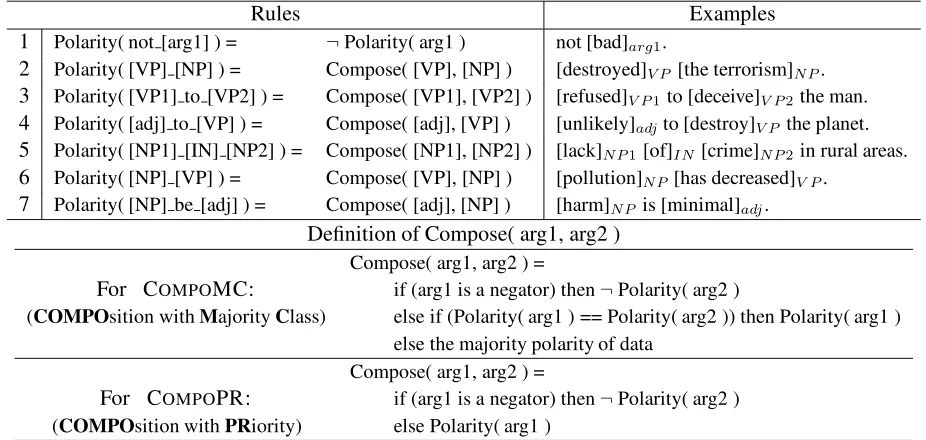
Rules Examples
1 Polarity( not [arg1] ) = ¬Polarity( arg1 ) not [bad]arg1.
2 Polarity( [VP] [NP] ) = Compose( [VP], [NP] ) [destroyed]V P [the terrorism]N P.
3 Polarity( [VP1] to [VP2] ) = Compose( [VP1], [VP2] ) [refused]V P1to [deceive]V P2the man.
4 Polarity( [adj] to [VP] ) = Compose( [adj], [VP] ) [unlikely]adjto [destroy]V P the planet.
5 Polarity( [NP1] [IN] [NP2] ) = Compose( [NP1], [NP2] ) [lack]N P1[of]IN[crime]N P2in rural areas.
6 Polarity( [NP] [VP] ) = Compose( [VP], [NP] ) [pollution]N P[has decreased]V P.
7 Polarity( [NP] be [adj] ) = Compose( [adj], [NP] ) [harm]N P is [minimal]adj.
Definition of Compose( arg1, arg2 )
Compose( arg1, arg2 ) =
For COMPOMC: if (arg1 is a negator) then¬Polarity( arg2 )
(COMPOsition withMajorityClass) else if (Polarity( arg1 ) == Polarity( arg2 )) then Polarity( arg1 ) else the majority polarity of data
Compose( arg1, arg2 ) =
For COMPOPR: if (arg1 is a negator) then¬Polarity( arg2 ) (COMPOsition withPRiority) else Polarity( arg1 )
Table 2: Compositional inference rules motivated by compositional semantics.
in§2.3.
2.1 Voting
We first explore five simple heuristics based on vot-ing. VOTE is defined as the majority polarity vote
by words in a given expression. That is, we count the number of positive polarity words and negative polarity words in a given expression, and assign the majority polarity to the expression. In the case of a tie, we default to the prevailing polarity of the data.
ForNEG(1), we first determine the majority polar-ity vote as above, and then if the expression contains
any function-word negator, flip the polarity of the majority vote once. NEG(N)is similar toNEG(1), ex-cept we flip the polarity of the majority votentimes after the majority vote, where n is the number of function-word negators in a given expression.
NEGEX(1)andNEGEX(N)are defined similarly as
NEG(1) and NEG(N) above, except both function-word negators and content-function-word negators are con-sidered as negators when flipping the polarity of the
majority vote. See Table 1 for summary. Note that a word can be both a negator and have a negative prior polarity. For the purpose of voting, if a word is de-fined as a negator per the voting scheme, then that word does not participate in the majority vote.
For brevity, we refer toNEG(1)and NEG(N) col-lectively asNEG, andNEGEX(1)andNEGEX(N) col-lectively asNEGEX.
2.2 Compositional semantics
Whereas the heuristics above use voting-based in-ference, those below employ a set of hand-written rules motivated by compositional semantics. Table 2 shows the definition of the rules along with moti-vating examples. In order to apply a rule, we first detect a syntactic pattern (e.g., [destroyed]V P [the
terrorism]N P), then apply theComposefunction as
defined in Table 2 (e.g., Compose([destroyed], [the terrorism]) by rule #2).3
3Our implementation uses part-of-speech tags and
[image:3.612.74.537.157.377.2]Composefirst checks whether the first argument is a negator, and if so, flips the polarity of the second argument. Otherwise,Composeresolves the polar-ities of its two arguments. Note that if the second argument is a negator, we do not flip the polarity of the first argument, because the first argument in gen-eral is not in the semantic scope of the negation.4 In-stead, we treat the second argument as a constituent with negative polarity.
We experiment with two variations of the Com-posefunction depending on how conflicting polari-ties are resolved: COMPOMCuses aCompose func-tion that defaults to the Majority Class of the po-larity of the data,5whileCOMPOPRuses aCompose
function that selects the polarity of the argument that has higher semanticPRiority. For brevity, we refer toCOMPOPRandCOMPOMCcollectively asCOMPO.
2.3 Lexicons
The polarity lexicon is initialized with the lexicon of Wilson et al. (2005) and then expanded using the General Inquirer dictionary.6 In particular, a word contained in at least two of the following categories is considered as positive: POSITIV, PSTV, POSAFF, PLEASUR, VIRTUE, INCREAS, and a word contained
in at least one of the following categories is consid-ered as negative: NEGATIV, NGTV, NEGAFF, PAIN, VICE, HOSTILE, FAIL, ENLLOSS, WLBLOSS, TRAN -LOSS.
For the (function- and content-word) negator lex-icon, we collect a handful of seed words as well as General Inquirer words that appear in eitherNOTLW
or DECREAS category. Then we expand the list of
content-negators using the synonym information of WordNet (Miller, 1995) to take a simple vote among senses.
based on parse trees might further improve the performance.
4
Moilanen and Pulman (2007) provide more detailed dis-cussion on the semantic scope of negations and the semantic priorities in resolving polarities.
5The majority polarity of the data we use for our
experi-ments is negative.
6Available at http://www.wjh.harvard.edu/∼inquirer/.
When consulting the General Inquirer dictionary, senses with less than 5% frequency and senses specific to an idiom are dropped.
3 Learning-Based Methods
While we expect that a set of hand-written heuristic rules motivated by compositional semantics can be effective for determining the polarity of a sentiment-bearing expression, we do not expect them to be per-fect. Interpreting natural language is such a com-plex task that writing a perfect set of rules would be extremely challenging. Therefore, a more ideal solution would be a learning-based method that can exploit ideas from compositional semantics while providing the flexibility to the rigid application of the heuristic rules. To this end, we present a novel learning-based approach that incorporates inference rules inspired by compositional semantics into the learning procedure (§3.2). To assess the effect of compositional semantics in the learning-based meth-ods, we also experiment with a simple classifica-tion approach that does not incorporate composi-tional semantics (§3.1). The details of these two approaches are elaborated in the following subsec-tions.
3.1 Simple Classification (SC)
Given an expression x consisting of n words x1, ..., xn, the task is to determine the polarity y ∈
{positive, negative} of x. In our simple binary classification approach, x is represented as a vec-tor of featuresf(x), and the predictionyis given by argmaxyw·f(x, y), wherewis a vector of parameters learned from training data. In our experiment, we use an online SVM algorithm called MIRA (Margin Infused Relaxed Algorithm) (Crammer and Singer, 2003)7for training.
For eachx, we encode the following features:
• Lexical: We add every wordxi inx, and also
add the lemma of xi produced by the CASS
partial parser toolkit (Abney, 1996).
• Dictionary: In order to mitigate the problem of unseen words in the test data, we add features that describe word categories based on the Gen-eral Inquirer dictionary. We add this feature for eachxithat is not a stop word.
• Vote: We experiment with two variations of voting-related features: for SC-VOTE, we add
7
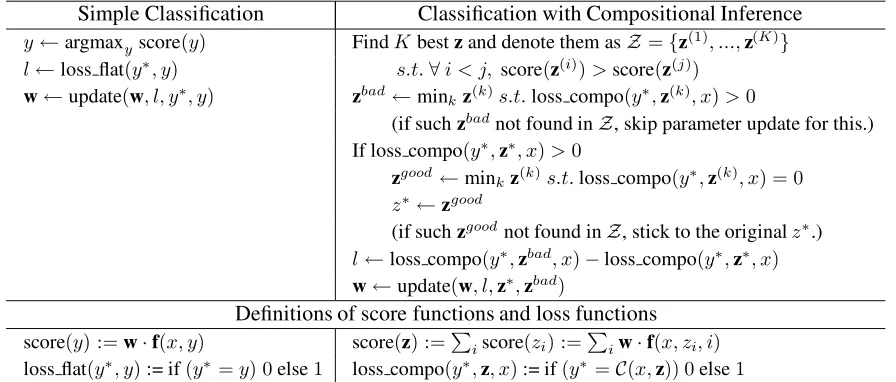
Simple Classification Classification with Compositional Inference
y←argmaxyscore(y) FindKbestzand denote them asZ={z(1), ...,z(K)}
l←loss flat(y∗, y) s.t.∀i < j, score(z(i))>score(z(j))
w←update(w, l, y∗, y) zbad←min
kz(k)s.t.loss compo(y∗,z(k), x)>0
(if suchzbad
not found inZ, skip parameter update for this.) If loss compo(y∗,z∗, x)>0
zgood←min
kz(k)s.t.loss compo(y∗,z(k), x) = 0
z∗←zgood
(if suchzgood
not found inZ, stick to the originalz∗.) l←loss compo(y∗,zbad, x)−loss compo(y∗,z∗, x)
w←update(w, l,z∗,zbad)
Definitions of score functions and loss functions
score(y) :=w·f(x, y) score(z) :=Piscore(zi) :=
P
iw·f(x, zi, i)
[image:5.612.83.531.61.252.2]loss flat(y∗, y):= if(y∗=y) 0else1 loss compo(y∗,z, x):= if(y∗=C(x,z)) 0else1
Figure 1: Training procedures.y∗∈ {positive, negative}denotes the true label for a given expressionx=x1, ..., xn.
z∗denotes the pseudo gold standard for hidden variablesz.
a feature that indicates the dominant polarity of words in the given expression, without consid-ering the effect of negators. For SC-NEGEX,
we count the number of content-word nega-tors as well as function-word neganega-tors to de-termine whether the final polarity should be flipped. Then we add a conjunctive feature that indicates the dominant polarity together with whether the final polarity should be flipped. For brevity, we refer toSC-VOTE and SC-NEGEX
collectively asSC.
Notice that in this simple binary classification set-ting, it is inherently difficult to capture the compo-sitional structure among words inx, becausef(x, y)
is merely a flat bag of features, and the prediction is governed simply by the dot product off(x, y)and the parameter vectorw.
3.2 Classification with Compositional
Inference (CCI)
Next, instead of determining y directly from x, we introduce hidden variables z = (z1, ..., zn)
as intermediate decision variables, where zi ∈
{positive, negative, negator, none}, so that zi
represents whether xi is a word with
posi-tive/negative polarity, or a negator, or none of the above. For simplicity, we let each intermediate de-cision variablezi (a) be determined independently
from other intermediate decision variables, and (b)
For each tokenxi,
ifxiis a word in the negator lexicon
thenz∗
i ←negator
else ifxiis in the polarity lexicon as negative
thenz∗
i ←negative
else ifxiis in the polarity lexicon as positive
thenz∗
i ←positive
else thenz∗
i ←none
Figure 2: Constructing Soft Gold Standardz∗
depend only on the inputx, so thatzi=argmaxziw·
f(x, zi, i), where f(x, zi, i)is the feature vector
en-coding around theith word (described on the next page). Once we determine the intermediate decision variables, we apply the heuristic rules motivated by compositional semantics (from Table 2) in order to obtain the final polarityyofx. That is,y=C(x,z), where C is the function that applies the composi-tional inference, eitherCOMPOPRorCOMPOMC.
rule based on the creation of asoftgold standard for
z. In particular, we exploit the fact that in our task, we can automatically construct a reasonably accu-rate gold standard forz, denoted asz∗: as shown in
Figure 2, we simply rely on the negator and polar-ity lexicons. Becausez∗ is not always correct, we
allow the training procedure to replacez∗ with
po-tentially better assignments as learning proceeds: in the event that the soft gold standardz∗leads to an
in-correct prediction, we search for an assignment that leads to a correct prediction to replacez∗. The exact
procedure is given in Figure 1, and will be discussed again shortly.
Figure 1 shows how we modify the parameter up-date rule of MIRA (Crammer and Singer, 2003) to reflect the aspect of compositional inference. In the event that the soft gold standardz∗leads to an
incor-rect prediction, we search forzgood, the assignment
with highest score that leads to a correct prediction, and replace z∗ with zgood. In the event of no such zgoodbeing found among theK-best assignments of
z, we stick withz∗.
The second issue is finding the assignment of z
with the highest score(z) = Piw·f(x, zi, i) that
leads to an incorrect prediction y = C(x,z). Be-cause the structure of compositional inference C
does not allow dynamic programming, finding such an assignment is again intractable. We resort to enu-merating only over K-best assignments instead. If none of theK-best assignments ofzleads to an in-correct predictiony, then we skip the training in-stance for parameter update.
Features. For eachxiinx, we encode the
follow-ing features:
• Lexical: We include the current wordxias well
as the lemma ofxi produced by CASS partial
parser toolkit (Abney, 1996). We also add a boolean feature to indicate whether the current word is a stop word.
• Dictionary: In order to mitigate the problem with unseen words in the test data, we add fea-tures that describe word categories based on the General Inquirer dictionary. We add this fea-ture for each xi that is not a stop word. We
also add a number of boolean features that pro-vide following properties ofxi using the
polar-ity lexicon and the negator lexicon:
–whetherxiis a function-word negator
– whetherxiis a content-word negator
– whetherxiis a negator of any kind
– the polarity of xi according to Wilson et
al. (2005)’s polarity lexicon
– the polarity ofxiaccording to the lexicon
derived from the General Inquirer dictio-nary
– conjunction of the above two features
• Vote: We encode the same vote feature that we use forSC-NEGEXdescribed in§3.1.
As in the heuristic-based compositional semantics approach (§2.2), we experiment with two variations of this learning-based approach: CCI-COMPOPR
and CCI-COMPOMC, whose compositional infer-ence rules are COMPOPR and COMPOMC respec-tively. For brevity, we refer to both variations col-lectively asCCI-COMPO.
4 Experiments
The experiments below evaluate our heuristic- and learning-based methods for subsentential sentiment analysis (§ 4.1). In addition, we explore the role of context by expanding the boundaries of the sentiment-bearing expressions (§4.2).
4.1 Evaluation with given boundaries
For evaluation, we use the Multi-Perspective Ques-tion Answering (MPQA) corpus (Wiebe et al., 2005), which consists of 535 newswire documents manually annotated with phrase-level subjectivity information. We evaluate on all strong (i.e., inten-sity of expression is ‘medium’ or higher), sentiment-bearing (i.e., polarity is ‘positive’ or ‘negative’) ex-pressions.8 As a result, we can assume the bound-aries of the expressions are given. Performance is reported using 10-fold cross-validation on 400 doc-uments; a separate 135 documents were used as a development set. Based on pilot experiments on the development data, we set parameters for MIRA as follows: slack variable to 0.5, and the number of incorrect labels (constraints) for each parameter up-date to 1. The number of iterations (epochs) for training is set to1for simple classification, and to4
8We discard expressions with confidence marked as
Heuristic-Based Learning-Based
VOTE NEG NEG NEG NEG COMPOCOMPO SC SC CCI CCI (1) (N) EX EX MC PR VOTE NEG COMPOCOMPO
(1) (N) EX MC PR
[image:7.612.125.491.60.125.2]86.5 82.0 82.2 87.7 87.7 89.7 89.4 88.5 89.1 90.6 90.7
Table 3: Performance (in accuracy) on MPQA dataset.
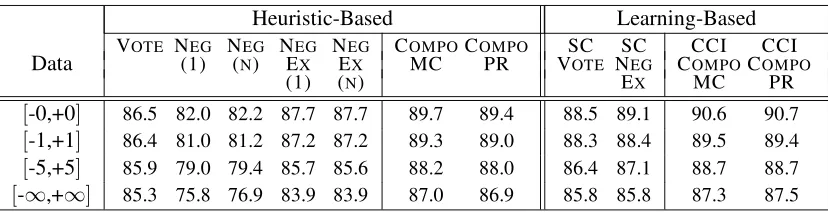
Heuristic-Based Learning-Based
VOTE NEG NEG NEG NEG COMPOCOMPO SC SC CCI CCI
Data (1) (N) EX EX MC PR VOTE NEG COMPOCOMPO
(1) (N) EX MC PR
[-0,+0] 86.5 82.0 82.2 87.7 87.7 89.7 89.4 88.5 89.1 90.6 90.7
[-1,+1] 86.4 81.0 81.2 87.2 87.2 89.3 89.0 88.3 88.4 89.5 89.4
[-5,+5] 85.9 79.0 79.4 85.7 85.6 88.2 88.0 86.4 87.1 88.7 88.7
[-∞,+∞] 85.3 75.8 76.9 83.9 83.9 87.0 86.9 85.8 85.8 87.3 87.5
Table 4: Performance (in accuracy) on MPQA data set with varying boundaries of expressions.
for classification with compositional inference. We use K = 20 for classification with compositional inference.
Results. Performance is reported in Table 3.
In-terestingly, the heuristic-based methods NEG (∼ 82.2%) that only consider function-word negators perform even worse thanVOTE(86.5%), which does
not consider negators. On the other hand, theNEGEX
methods (87.7%) that do consider content-word negators as well as function-word negators perform better than VOTE. This confirms the importance of
content-word negators for determining the polari-ties of expressions. The heuristic-based methods motivated by compositional semantics COMPO
fur-ther improve the performance overNEGEX,
achiev-ing up to 89.7% accuracy. In fact, these heuris-tics perform even better than theSC learning-based methods (∼89.1%). This shows that heuristics that take into account the compositional structure of the expression can perform better than learning-based methods that do not exploit such structure.
Finally, the learning-based methods that in-corporate compositional inference CCI-COMPO (∼ 90.7%) perform better than all of the previous methods. The difference between CCI-COMPOPR
(90.7%) andSC-NEGEX(89.1%) is statistically
sig-nificant at the .05 level by paired t-test. The dif-ference betweenCOMPOand any other heuristic that
is not based on computational semantics is also
statistically significant. In addition, the difference betweenCCICOMPOPR (learning-based) and COM
-POMC (non-learning-based) is statistically signifi-cant, as is the difference betweenNEGEXandVOTE.
4.2 Evaluation with noisy boundaries
One might wonder whether employing additional context outside the annotated expression boundaries could further improve the performance. Indeed, con-ventional wisdom would say that it is necessary to employ such contextual information (e.g., Wilson et al. (2005)). In any case, it is important to determine whether our results will apply to more real-world settings where human-annotated expression bound-aries are not available.
To address these questions, we gradually relax our previous assumption that the exact boundaries of expressions are given: for each annotation bound-ary, we expand the boundary by x words for each direction, up to sentence boundaries, where x ∈ {1,5,∞}. We stop expanding the boundary if it will collide with the boundary of an expression with a different polarity, so that we can consistently re-cover the expression-level gold standard for evalua-tion. This expansion is applied to both the training and test data, and the performance is reported in Ta-ble 4. From this experiment, we make the following observations:
[image:7.612.99.513.158.264.2]perfor-mance for any method. This shows that most of relevant context for judging the polarity is con-tained within the expression boundaries, and motivates the task of finding the boundaries of opinion expressions.
• TheNEGEXmethods perform better thanVOTE
only when the expression boundaries are rea-sonably accurate. When the expression bound-aries are expanded up to sentence boundbound-aries, they perform worse thanVOTE. We conjecture
this is because the scope of negators tends to be limited to inside of expression boundaries.
• The COMPO methods always perform better
than any other heuristic-based methods. And their performance does not decrease as steeply as the NEGEX methods as the expression
boundaries expand. We conjecture this is be-cause methods based on compositional seman-tics can handle the scope of negators more ade-quately.
• Among the learning-based methods, those that involve compositional inference (CCI-COMPO)
always perform better than those that do not (SC) for any boundaries. And learning with compositional inference tend to perform bet-ter than the rigid application of heuristic rules (COMPO), although the relative performance
gain decreases once the boundaries are relaxed.
5 Related Work
The task focused on in this paper is similar to that of Wilson et al. (2005) in that the general goal of the task is to determine the polarity in context at a sub-sentence level. However, Wilson et al. (2005) for-mulated the task differently by limiting their evalua-tion to individual words that appear in their polarity lexicon. Also, their approach was based on a flat bag of features, and only a few examples of what we call content-word negators were employed.
Our use of compositional semantics for the task of polarity classification is preceded by Moilanen and Pulman (2007), but our work differs in that we integrate the key idea of compositional seman-tics into learning-based methods, and that we per-form empirical comparisons among reasonable al-ternative approaches. For comparison, we
evalu-ated our approaches on the polarity classification task from SemEval-07 (Strapparava and Mihalcea, 2007). We achieve88.6%accuracy withCOMPOPR,
90.1%with SCNEGEX, and 87.6%with CCICOM
-POMC.9 There are a number of possible reasons for
our lower performance vs. Moilanen and Pulman (2007) on this data set. First, SemEval-07 does not include a training data set for this task, so we use 400 documents from the MPQA corpus instead. In addition, the SemEval-07 data is very different from the MPQA data in that (1) the polarity annotation is given only at the sentence level, (2) the sentences are shorter, with simpler structure, and not as many negators as the MPQA sentences, and (3) there are many more instances with positive polarity than in the MPQA corpus.
Nairn et al. (2006) also employ a “polarity” prop-agation algorithm in their approach to the semantic interpretation of implicatives. However, their notion of polarity is quite different from that assumed here and in the literature on sentiment analysis. In partic-ular, it refers to the degree of “commitment” of the author to the truth or falsity of a complement clause for a textual entailment task.
McDonald et al. (2007) use a structured model to determine the sentence-level polarity and the document-level polarity simultaneously. But deci-sions at each sentence level does not consider struc-tural inference within the sentence.
Among the studies that examined content-word negators, Niu et al. (2005) manually collected a small set of such words (referred as “words that change phases”), but their lexicon was designed mainly for the medical domain and the type of nega-tors was rather limited. Wilson et al. (2005) also manually collected a handful of content-word nega-tors (referred as “general polarity shifters”), but not extensively. Moilanen and Pulman (2007) collected a more extensive set of negators semi-automatically using WordNet 2.1, but the empirical effect of such words was not explicitly investigated.
9For lack of space, we only report our performance on
in-stances with strong intensities as defined in Moilanen and Pul-man (2007), which amounts to only208test instances. The
6 Conclusion
In this paper, we consider the task of determining the polarity of a sentiment-bearing expression, con-sidering the effect of interactions among words or constituents in light of compositional semantics. We presented a novel learning-based approach that in-corporates structural inference motivated by compo-sitional semantics into the learning procedure. Our approach can be considered as a small step toward bridging the gap between computational semantics and machine learning methods. Our experimen-tal results suggest that this direction of research is promising. Future research includes an approach that learns the compositional inference rules from data.
Acknowledgments
This work was supported in part by National Science Foundation Grants BCS-0624277 and IIS-0535099 and by Department of Homeland Security Grant N0014-07-1-0152. We also thank Eric Breck, Lil-lian Lee, Mats Rooth, the members of the Cornell NLP reading seminar, and the EMNLP reviewers for insightful comments on the submitted version of the paper.
References
Steven Abney. 1996. Partial parsing via finite-state cascades. Journal of Natural Language Engineering, 2(4):337344.
Koby Crammer and Yoram Singer. 2003. Ultraconserva-tive online algorithms for multiclass problems. JMLR 3:951.
David R. Dowty, Robert E. Wall and Stanley Peters. 1981.Introduction to Montague Semantics.
Andrea Esuli and Fabrizio Sebastiani. 2006. SentiWord-Net: A Publicly Available Lexical Resource for Opin-ion Mining. InProceedings of 5th Conference on Lan-guage Resources and Evaluation (LREC),.
Percy Liang, Hal Daum´e III and Dan Klein. 2008. Struc-ture Compilation: Trading StrucStruc-ture for FeaStruc-tures. In International Conference on Machine Learning. Minqing Hu and Bing Liu. 2004. Mining and
sum-marizing customer reviews. In Proceedings of the ACM SIGKDD International Conference on Knowl-edge Discovery & Data Mining (KDD-2004).
Alistair Kennedy and Diana Inkpen. 2005. Senti-ment Classification of Movie and Product Reviews Us-ing Contextual Valence Shifters. In Proceedings of
FINEXIN 2005, Workshop on the Analysis of Infor-mal and ForInfor-mal Information Exchange during Nego-tiations.
Soo-Min Kim and Eduard Hovy. 2004. Determining the sentiment of opinions. InProceedings of COLING. Ryan McDonald, Kerry Hannan, Tyler Neylon, Mike
Wells and Jeff Reynar. 2007. Structured Models for Fine-to-Coarse Sentiment Analysis. InProceedings of Association for Computational Linguistics (ACL). George A. Miller. 1995. WordNet: a lexical database for
English. InCommunications of the ACM, 38(11):3941 Richard Montague. 1974. Formal Philosophy; Selected
papers of Richard Montague. Yale University Press. Karo Moilanen and Stephen Pulman. 2007. Sentiment
Composition. InProceedings of Recent Advances in Natural Language Processing (RANLP 2007). Rowan Nairn, Cleo Condoravdi and Lauri Karttunen
2006. Computing relative polarity for textual infer-ence. InInference in Computational Semantics (ICoS-5).
Yun Niu, Xiaodan Zhu, Jianhua Li and Graeme Hirst. 2005. Analysis of polarity information in medical text. InProceedings of the American Medical Informatics Association 2005 Annual Symposium (AMIA). Livia Polanyi and Annie Zaenen. 2004. Contextual
lex-ical valence shifters. InExploring Attitude and Affect in Text: Theories and Applications: Papers from the 2004 Spring Symposium, AAAI.
Mostafa Shaikh, Helmut Prendinger and Mitsuru Ishizuka. 2007. Assessing sentiment of text by se-mantic dependency and contextual valence analysis. InProc 2nd Int’l Conf on Affective Computing and In-telligent Interaction (ACII’07).
Carlo Strapparava and Rada Mihalcea. 2007. Semeval-2007 task 14: Affective text. InProceedings of Se-mEval.
Janyce Wiebe, Theresa Wilson and Claire Cardie. 2005. Annotating expressions of opinions and emotions in language. In Language Resources and Evalua-tion (formerly Computers and the Humanities), 39(2-3):165210.