Bilingually-constrained Synthetic Data for Implicit Discourse Relation
Recognition
Changxing Wu1,2, Xiaodong Shi1,2∗, Yidong Cheng1,2, Yanzhou Huang1,2, Jinsong Su3 Fujian Key Lab of the Brain-like Intelligent Systems, Xiamen University, China1
School of Information Science and Technology, Xiamen University, China2 School of Software, Xiamen University, China3
{wcxnlp, huangyanzhou163}@163.com
{mandel, ydchen, jssu}@xmu.edu.cn
Abstract
To alleviate the shortage of labeled data, we propose to use bilingually-constrained syn-thetic implicit data for implicit discourse re-lation recognition. These data are extracted from a bilingual sentence-aligned corpus ac-cording to the implicit/explicit mismatch be-tween different languages. Incorporating these data via a multi-task neural network model achieves significant improvements over baselines, on both the English PDTB and Chi-nese CDTB data sets.
1 Introduction
Discovering the discourse relation between two sen-tences is crucial to understanding the meaning of a coherent text, and also beneficial to many down-stream NLP applications, such as question answer-ing and machine translation. Implicit discourse re-lation recognition (DRRimp) remains a challenging
task due to the absence of strong surface clues like discourse connectives (e.g. but). Most work
re-sorts to large amounts of manually designed features (Soricut and Marcu, 2003; Pitler et al., 2009; Lin et al., 2009; Louis et al., 2010; Rutherford and Xue, 2014), or distributed features learned via neural net-work models (Braud and Denis, 2015; Zhang et al., 2015; Ji and Eisenstein, 2015). The above methods usually suffer from limited labeled data.
Marcu and Echihabi (2002) attempt to create la-beled implicit data automatically by removing con-nectives from explicit instances, as additional train-ing data. These data are usually called as
syn-∗Corresponding author.
thetic implicit data (hereafter SynData).
How-ever, Sporleder and Lascarides (2008) argue that
SynData has two drawbacks: 1) meaning shifts
in some cases when removing connectives, and 2) a different word distribution with the real implicit data. They also show that usingSynDatadirectly
degrades the performance. Recent work seeks to de-rive valuable information fromSynDatawhile
fil-tering noise, via domain adaptation (Braud and De-nis, 2014; Ji et al., 2015), classifying connectives (Rutherford and Xue, 2015) or multi-task learning (Lan et al., 2013; Liu et al., 2016), and shows promising results.
ch: [社会 认为 有 青少年 问题,]Arg1
en: [society reckons the existence of youth problems, ]Arg1
implicit=但是 [很多 青少年 认为 自己 没 问题.]Arg2
but [many young people do not think there is anything wrong with them.]Arg2
society reckon existence youth problems,
but many young people think themselves no problems.
Figure 1: An example illustrating the implicit/explicit mis-match between Chinese (ch) and English (en). A Chinese im-plicit instance is translated into an English exim-plicit one. In the PDTB, a discourse instance is defined as a connective (e.g.but) taking two arguments (Arg1andArg2).
Different from previous work, we propose to con-structbilingually-constrained synthetic implicit data
(calledBiSynData) forDRRimp, which can
alle-viate the drawbacks of SynData. Our method is inspired by the findings that a discourse instance ex-pressed implicitly in one language may be exex-pressed explicitly in another. For example, Zhou and Xue
(2012) show that the connectives in Chinese omit much more frequently than those in English with about 82.0% vs. 54.5%. Li et al. (2014a) further argue that there are about 23.3% implicit/explicit mismatchs between Chinese/English instances. As illustrated in Figure 1, a Chinese implicit instance where the connective ´ is absent, is translated
into an English explicit one with the connectivebut.
Intuitively, the Chinese instance is a real implicit one which can be signaled by but. Hence, it could
potentially serve as additional training data for the ChineseDRRimp, avoiding the different word
dis-tribution problem ofSynData. Meanwhile, for the
English explicit instance, it is very likely that remov-ingbutwould not lose any information since its Chi-nese counterpart ´can be omitted. Therefore it
could be used for the EnglishDRRimp, alleviating
the meaning shift problem ofSynData.
We extract our BiSynData from a
Chinese-English sentence-aligned corpus (Section 2). Then we design a multi-task neural network model to in-corporate theBiSynData(Section 3).
Experimen-tal results, on both the English PDTB (Prasad et al., 2008) and Chinese CDTB (Li et al., 2014b), show thatBiSynData is more effective than SynData
used in previous work (Section 4). Finally, we re-view the related work (Section 5) and draw conclu-sions (Section 6).
2 BiSynData
Formally, given a Chinese-English sentence pair
(Sch, Sen), we try to find an English explicit
in-stance (Arg1en, Arg2en, Connen) in Sen1, and a
Chinese implicit instance(Arg1ch, Arg2ch)inSch,
where (Arg1en, Arg2en, Connen) is the
transla-tion of (Arg1ch, Arg2ch). In most cases,
dis-course relations should be preserved during trans-lating, so the connective Connen is potentially
a strong indicator of the discourse relation be-tween not only Arg1en and Arg2en, but also
Arg1ch and Arg2ch. Therefore, we can
con-struct two synthetic implicit instances labeled by
Connen, denoted as h(Arg1en, Arg2en), Conneni
andh(Arg1ch, Arg2ch), Conneni, respectively. We
refer to these synthetic instances asBiSynData
be-1In our experiments, we use the pdtb-parser toolkit (Lin et
al., 2014) to identify English explicit instances.
cause they are constructed according to the bilingual implicit/explicit mismatch.
Conn. Freq. Conn. Freq.
and 14294 while 1031
if 2580 bef ore 822
as 1951 also 552
when 1521 since 511
[image:2.612.320.533.96.181.2]but 1122 because 503
Table 1:Top 10 most frequent connectives in ourBiSynData.
In our experiments, we extract our BiSynData
from a combined corpus (FBIS and HongKong Law), with about 2.38 million Chinese-English sen-tence pairs. We generate 30,032 synthetic En-glish instances and the same number of Chinese in-stances, with 80 connectives, as ourBiSynData. Table 1 lists the top 10 most frequent connec-tives in our BiSynData, which are roughly
con-sistent with the statistics of Chinese/English im-plicit/explicit mismatches in (Li et al., 2014a). Ac-cording to connectives and their related relations in the PDTB, in most cases, and and also
indi-cate the Expansion relation, if and because the Contigency relation, bef ore the T emporal
rela-tion, and but the Comparison relation.
Connec-tives as, when, while and since are ambiguous.
For example, whilecan indicate the Comparison
or T emporal relation. Overall, our constructed BiSynData covers all four main discourse
rela-tions defined in the PDTB.
With our BiSynData, we define two
connec-tive classification tasks: 1) given(Arg1en, Arg2en)
to predict the connective Connen, and 2) given (Arg1ch, Arg2ch)to predictConnen. We
incorpo-rate the first task to help the EnglishDRRimp, and
the second for the Chinese DRRimp. It is worthy
to note that we use English connectives themselves as classification labels rather than mapping them to relations in both tasks.
3 Multi-Task Neural Network Model
We design a Multi-task Neural Network Model (de-noted as M T N), which incorporates a connective
classification task on BiSynData (auxiliary task) to benefitDRRimp(main task). In general, the more
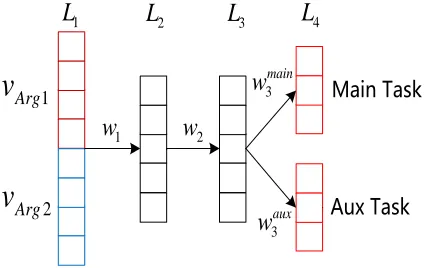
two tasks are essentially the same, just with differ-ent output labels. Therefore, as illustrated in Fig-ure 2,M T N shares parameters in all feature layers
(L1-L3) and uses two separate classifiers in the
clas-sifier layer (L4). For each task, given an instance (Arg1, Arg2), M T N simply averages embeddings
of words to represent arguments, asvArg1andvArg2.
These two vectors are then concatenated and trans-formed through two non-linear hidden layers. Fi-nally, the corresponding sof tmax layer is used to
perform classification.
3
main
w
3
aux
w
1
w
w
2Main Task
Aux Task
1
L
L
2L
3L
41
Arg
v
2
Arg
[image:3.612.79.291.219.353.2]v
Figure 2:M T Nwith four layersL1-L4.
M T N ignores the word order in arguments and
uses two hidden layers to capture the interactions between two arguments. The idea behindM T N is
borrowed from (Iyyer et al., 2015), where a deep averaging network achieves close to the state-of-the-art performance on text classification. Though
M T N is simple, it is easy to train and efficient on
both memory and computational cost. In addition, the simplicity ofM T N allows us to focus on
mea-suring the quality ofBiSynData.
We use the cross-entropy loss function and mini-batch AdaGrad (Duchi et al., 2011) to optimize pa-rameters. Pre-trained word embeddings are fixed. We find that fine-tuning word embeddings during training leads to severe overfitting in our experi-ments. Following Liu et al. (2016), we alternately use two tasks to train the model, one task per epoch. For tasks on both the PDTB and CDTB, we use the same hyper-parameters. The dimension of word em-bedding is 100. We set the size of L2 to 200, and
L3 to 100. ReLU is used as the non-linear
func-tion. Different learning rates 0.005 and 0.001 are used in the main and auxiliary tasks, respectively. To avoid overfitting, we randomly drop out 20% words
in each argument following Iyyer et al. (2015). All hyper-parameters are tuned on the development set.
4 Experiments
We evaluate our method on both the English PDTB and Chinese CDTB data sets. We tokenize English data and segment Chinese data using the Stanford CoreNLP toolkit (Manning et al., 2014). The En-glish/Chinese Gigaword corpus (3rd edition) is used to train the English/Chinese word embeddings via
word2vec(Mikolov et al., 2013), respectively. Due
to the skewed class distribution of test data (see Sec-tion 4.1), we use the macro-averagedF1 for
perfor-mance evaluation.
4.1 On the PDTB
Following Rutherford and Xue (2015), we perform a 4-way classification on the top-level discourse rela-tions: T emporal (T emp), Comparison (Comp), Contigency(Cont) andExpansion(Expa). Sec-tions 2-20 are used as training set, secSec-tions 0-1 as development set and sections 21-22 as test set. The training/test set contains 582/55 instances for
T emp, 1855/145 for Comp, 3235/273 for Cont
and 6673/538 forExpa. The top 20 most frequent
connectives in our BiSynData are considered in
the auxiliary task, with 28,013 synthetic English in-stances in total.
ST N M T Nbi
T emp P 33.33 34.48
R 14.55 18.18 F1 20.25 23.81
Comp P 38.54 42.11
R 25.52 33.10 F1 30.71 37.07
Cont P 38.36 44.22
R 41.03 40.66
F1 39.65 42.37
Expa P 59.60 62.56 R 66.36 71.75 F1 62.80 66.84
[image:3.612.323.531.456.652.2]macro F1 38.35 42.52
Table 2:Results of 4-way classification on the PDTB.
ST N means we train M T N with only the main
task. On themacro F1,M T Nbigains an
improve-ment of 4.17% overST N. The improvement is
sig-nificant under one-tailed t-test (p<0.05). A closer
look into the results shows that M T Nbi performs
better across all relations, on the precision, recall and F1 score, except a little drop on the recall of
Cont. The reason for the recall drop of Cont is
not clear. The greatest improvement is observed on
Comp, up to 6.36%F1 score. The possible reason
is that only while is ambiguous about Comp and T emp, while as, whenand sinceare all ambigu-ous aboutT empandCont, among top 10
connec-tives in our BiSynData. Meanwhile the amount
of labeled data forCompis relatively small. Over-all, usingBiSynData under our multi-task model
achieves significant improvements on the English
DRRimp. We believe the reasons for the
improve-ments are twofold: 1) the added synthetic English instances from our BiSynData can alleviate the
meaning shift problem, and 2) a multi-task learning method is helpful for addressing the different word distribution problem between implicit and explicit data.
Considering some of the English connectives (e.g.,while) are highly ambiguous, we compare our
method with ones that uses only unambiguous con-nectives. Specifically, we first discard as, when, while and since in top 20 connectives, and get
22,999 synthetic instances. Then, we leverage these instances in two different ways: 1) using them in our multi-task model as above, and 2) using them as ad-ditional training data directly after mapping unam-biguous connectives into relations. Both methods using only unambiguous connectives do not achieve better performance. One possible reason is that these synthetic instances become more unbalanced after discarding ones with ambiguous connectives.
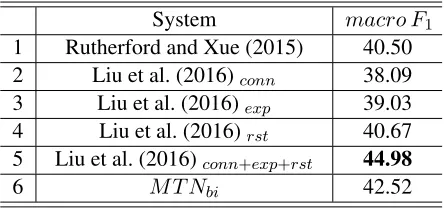
We also compareM T Nbiwith recent systems
us-ing additional trainus-ing data. Rutherford and Xue (2015) select explicit instances that are similar to the implicit ones via connective classification, to enrich the training data. Liu et al. (2016) use a multi-task model with three auxiliary tasks: 1)conn:
connec-tive classification on explicit instances, 2) exp: re-lation classification on the labeled explicit instances in the PDTB, and 3)rst: relation classification on
the labeled RST corpus (William and Thompson,
System macro F1
1 Rutherford and Xue (2015) 40.50 2 Liu et al. (2016)conn 38.09
3 Liu et al. (2016)exp 39.03
4 Liu et al. (2016)rst 40.67
5 Liu et al. (2016)conn+exp+rst 44.98
[image:4.612.316.539.57.161.2]6 M T Nbi 42.52
Table 3:Comparison with recent systems on the PDTB.conn+ exp+rstmeans using three auxiliary tasks simultaneously.
1988), which defines different discourse relations with that in the PDTB. The results are shown in Ta-ble 3. Although Liu et al. (2016) achieve the state-of-the-art performance (Line 5), they use two ad-ditional labeled corpora. We can find thatM T Nbi
(Line 6) yields better results than those systems in-corporatingSynData(Line 1, 2 and 3), or even the labeled RST (Line 4). These results confirm that
BiSynDatacan indeed alleviate the disadvantages
ofSynDataeffectively.
4.2 On the CDTB
Four top-level relations are defined in the CDTB, includingT ransition(T ran),Causality(Caus), Explanation (Expl) and Coordination (Coor). We use instances in the first 50 documents as test set, second 50 documents as development set and re-maining 400 documents as training set. We conduct a 3-way classification because of only 39 instances forT ran. The training/test set contains 682/95
in-stances forCaus, 1143/126 forExpland 2300/347 for Coor. The top 20 most frequent connectives
(excluding and)2 in our BiSynData are
consid-ered in the auxiliary task, with 13,899 synthetic Chi-nese instances in total. The results are shown in Table 4. Compared withST N, M T Nbi raises the
macro F1 from 55.44% to 58.28%. The
improve-ment is significant under one-tailed t-test (p<0.05).
Therefore,BiSynData is also helpful for the
Chi-neseDRRimp.
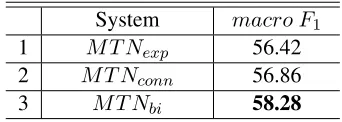
Because of no reported results on the CDTB, we useM T Nwith two different auxiliary tasks as base-lines: 1)exp: relation classification on the labeled
2Includinganddegrades the performance slightly. A
ST N M T Nbi
Caus P 47.92 52.94 R 24.21 28.42 F1 32.17 36.99
Expl P 54.62 53.47
R 56.35 61.11 F1 55.47 57.04
Coor P 74.36 78.02 R 83.57 83.86 F1 78.70 80.83
[image:5.612.82.289.57.211.2]macro F1 55.44 58.28
Table 4:Results of 3-way classification on the CDTB.
explicit instances in the CDTB, including 466 in-stances forCaus, 201 forExpl and 974 forCoor.
2) conn: connective classification on explicit
in-stances from the Xinhua part of the Chinese Giga-word corpus. We collect explicit instances with the top 20 most frequent Chinese connectives and sam-ple 20,000 instances for the experiment. Bothexp
andconncan be considered as tasks onSynData.
The results in Table 5 show thatM T N
incorporat-ingBiSynData(Line 3) performs better than using SynData(Line 1 and 2), for the task on the CDTB.
System macro F1
1 M T Nexp 56.42
2 M T Nconn 56.86
3 M T Nbi 58.28
Table 5:M T Nwith different auxiliary tasks on the CDTB.
5 Related Work
One line of research related to DRRimp tries to
take advantage of explicit discourse data. Zhou et al. (2010) predict the absent connectives based on a language model. Using these predicted connec-tives as features is proven to be helpful. Biran and McKeown (2013) aggregate word-pair features that are collected around the same connectives, which can effectively alleviate the feature sparsity prob-lem. More recently, Braud and Denis (2014) and Ji et al. (2015) consider explicit data from a different domain, and use domain adaptation methods to ex-plore the effect of them. Rutherford and Xue (2015) propose to gather weakly labeled data from explicit instances via connective classification, which are
used as additional training data directly. Lan et al. (2013) and Liu et al. (2016) combine explicit and implicit data using multi-task learning models and gain improvements. Different from all the above work, we construct additional training data from a bilingual corpus.
Multi-task neural networks have been success-fully used for many NLP tasks. For example, Col-lobert et al. (2011) jointly train models for the Part-of-Speech tagging, chunking, named entity recogni-tion and semantic role labeling using convolurecogni-tional network. Liu et al. (2015) successfully combine the tasks of query classification and ranking for web search using a deep multi-task neural network. Lu-ong et al. (2016) explore multi-task sequence to sequence learning for constituency parsing, image caption generation and machine translation.
6 Conclusion
In this paper, we introduce bilingually-constrained synthetic implicit data (BiSynData), which are
generated based on the bilingual implicit/explicit mismatch, into implicit discourse relation recogni-tion for the first time. On both the PDTB and CDTB, usingBiSynDataas the auxiliary task significantly
improves the performance of the main task. We also show thatBiSynDatais more beneficial than
the synthetic implicit data typically used in previous work. Since the lack of labeled data is a major chal-lenge for implicit discourse relation classification, our proposed BiSynData can enrich the training
data and then benefit future work.
Acknowledgments
[image:5.612.99.270.403.464.2]References
Or Biran and Kathleen McKeown. 2013. Aggregated Word Pair Features for Implicit Discourse Relation Disambiguation. InProceedings of ACL (Volume 2: Short Papers), pages 69–73, Sofia, Bulgaria.
Chlo´e Braud and Pascal Denis. 2014. Combining Natural and Artificial Examples to Improve Implicit Discourse Relation Identification. In Proceedings of COLING, pages 1694–1705, Dublin, Ireland.
Chlo´e Braud and Pascal Denis. 2015. Comparing Word Representations for Implicit Discourse Relation Clas-sification. In Proceedings of EMNLP, pages 2201– 2211, Lisbon, Portugal.
Ronan Collobert, Jason Weston, L´eon Bottou, Michael Karlen, Koray Kavukcuoglu, and Pavel Kuksa. 2011. Natural Language Processing (Almost) from Scratch. Journal of Machine Learning Research, 12(1):2493– 2537.
John Duchi, Elad Hazan, and Yoram Singer. 2011. Adaptive Subgradient Methods for Online Learning and Stochastic Optimization. The Journal of Machine Learning Research, 12:2121–2159.
Mohit Iyyer, Varun Manjunatha, Jordan Boyd-Graber, and Hal Daum´e III. 2015. Deep Unordered Com-position Rivals Syntactic Methods for Text Classifi-cation. InProceedings of ACL-IJCNLP, pages 1681– 1691, Beijing, China.
Yangfeng Ji and Jacob Eisenstein. 2015. One Vector is Not Enough: Entity-Augmented Distributed Seman-tics for Discourse Relations. In Transactions of the Association for Computational Linguistics, volume 3, pages 329–344.
Yangfeng Ji, Gongbo Zhang, and Jacob Eisenstein. 2015. Closing the Gap: Domain Adaptation from Explicit to Implicit Discourse Relations. In Proceedings of EMNLP, pages 2219–2224, Lisbon, Portugal.
Man Lan, Yu Xu, and Zhengyu Niu. 2013. Leveraging Synthetic Discourse Data via Multi-task Learning for Implicit Discourse Relation Recognition. In Proceed-ings of ACL, pages 476–485, Sofia, Bulgaria.
Junyi Jessy Li, Marine Carpuat, and Ani Nenkova. 2014a. Cross-lingual Discourse Relation Analysis: A Corpus Study and a Semi-supervised Classification System. InProceedings of COLING : Technical Pa-pers, pages 577–587, Dublin, Ireland.
Yancui Li, Wenhe Feng, Jing Sun, Fang Kong, and Guodong Zhou. 2014b. Building Chinese Dis-course Corpus with Connective-driven Dependency Tree Structure. In Proceedings of EMNLP, pages 2105–2114, Doha, Qatar.
Ziheng Lin, Min-Yen Kan, and Hwee Tou Ng. 2009. Recognizing Implicit Discourse Relations in the Penn
Discourse Treebank. In Proceedings of EMNLP, pages 343–351, PA, USA.
Ziheng Lin, Hwee Tou Ng, and Min-Yen Kan. 2014. A PDTB-styled End-to-end Discourse Parser. Natural Language Engineering, 20(02):151–184.
Xiaodong Liu, Jianfeng Gao, Xiaodong He, Li Deng, Kevin Duh, and Ye-Yi Wang. 2015. Representation Learning Using Multi-task Deep Neural Networks for Semantic Classification and Information Retrieval. In Proceedings of NAACL, pages 912–921, Denver, Col-orado.
Yang Liu, Sujian Li, Xiaodong Zhang, and Zhifang Sui. 2016. Implicit Discourse Relation Classification via Multi-Task Neural Networks. InProceedings of AAAI, pages 2750–2756, Arizona, USA.
Annie Louis, Aravind Joshi, Rashmi Prasad, and Ani Nenkova. 2010. Using Entity Features to Classify Implicit Discourse Relations. InProceedings of SIG-DIAL, pages 59–62, PA, USA.
Minh-Thang Luong, Quoc V. Le, Ilya Sutskever, Oriol Vinyals, and Lukasz Kaiser. 2016. Multi-task Se-quence to SeSe-quence Learning. In Proceedings of ICLR, pages 1–10, San Juan, Puerto Rico.
Christopher D. Manning, Mihai Surdeanu, John Bauer, Jenny Finkel, Steven J. Bethard, and David McClosky. 2014. The Stanford CoreNLP Natural Language Pro-cessing Toolkit. In Proceedings of ACL (System Demonstrations), pages 55–60, Maryland, USA. Daniel Marcu and Abdessamad Echihabi. 2002. An
Un-supervised Approach to Recognizing Discourse Rela-tions. In Proceedings of ACL, pages 368–375, PA, USA.
Tomas Mikolov, Kai Chen, Greg Corrado, and Jeffrey Dean. 2013. Efficient Estimation of Word Represen-tations in Vector Space. CoRR, abs/1301.3781. Emily Pitler, Annie Louis, and Ani Nenkova. 2009.
Au-tomatic Sense Prediction for Implicit Discourse Rela-tions in Text. InProceedings of ACL-IJCNLP, pages 683–691, PA, USA.
Rashmi Prasad, Nikhil Dinesh, Alan Lee, Eleni Milt-sakaki, Livio Robaldo, Aravind Joshi, and Bonnie Webber. 2008. The Penn Discourse TreeBank 2.0. In Proceedings of LREC, volume 24, pages 2961–2968, Marrakech, Morocco.
Attapol T. Rutherford and Nianwen Xue. 2014. Dis-covering Implicit Discourse Relations Through Brown Cluster Pair Representation and Coreference Patterns. InProceedings of EACL, pages 645–654, Gothenburg, Sweden.
Radu Soricut and Daniel Marcu. 2003. Sentence Level Discourse Parsing Using Syntactic and Lexical Infor-mation. In Proceedings of NAACL, pages 149–156, PA, USA.
Caroline Sporleder and Alex Lascarides. 2008. Using Automatically Labelled Examples to Classify Rhetori-cal Relations: An Assessment. Natural Language En-gineering, 14(3):369–416.
Mann William and Sandra Thompson. 1988. Rhetorical structure theory: Towards a Functional Theory of Text Organization. Text, 8(3):243–281.
Biao Zhang, Jinsong Su, Deyi Xiong, Yaojie Lu, Hong Duan, and Junfeng Yao. 2015. Shallow Convolu-tional Neural Network for Implicit Discourse Relation Recognition. InProceedings of EMNLP, pages 2230– 2235, Lisbon, Portugal.
Yuping Zhou and Nianwen Xue. 2012. PDTB-style dis-course annotation of Chinese text. InProceedings of ACL, pages 69–77, Jeju Island, Korea.