Adjoining Grammar
K.
Vijay-Shanker*
University of Delaware
This paper describes a new interpretation of Tree Adjoining Grammars (TAG) that allows the embedding of TAG in the unification framework in a manner consistent with the declarative approach taken in this framework. In the new interpretation we present in this paper, the objects manipulated by a TAG are considered to be descriptions of trees. This is in contrast to the traditional view that in a TAG the composition operations of adjoining and substitution combine trees. Borrowing ideas from Description Theory, we propose quasi-trees as a means to represent partial descriptions of trees. Using quasi-trees, we are able to justify the definition of feature structure- based Tree Adjoining Grammars (FTAG) that was first given in Vijay-Shanker (1987) and Vijay- Shanker and Joshi (1988). In the definition of the FTAG formalism given here, we argue that a grammar manipulates descriptions of trees (i.e., quasi-trees); whereas the structures derived by a grammar are trees that are obtained by taking the minimal readings of such descriptions. We then build on and refine the earlier version of FTAG, give examples that illustrate the usefulness of embedding TAG in the unification framework, and present a logical formulation (and its associated semantics) of FTA G that shows the separation between descriptions of well-formed structures and the actual structures that are derived, a theme that is central to this work. Finally, we discuss some questions that are raised by our new interpretation of the TAG formalism: questions dealing with the nature and definition of the adjoining operation (in contrast to substitution), its relation to multi-component adjoining, and the distinctions between auxiliary and initial structures.
1. I n t r o d u c t i o n
A number of grammatical systems and linguistic theories, such as Functional Unifi- cation Grammars (FUGs), Lexical Functional Grammars (LFGs), Generalized Phrase Structure Grammars (GPSGs), and Head-driven Phrase Structure Grammars (HPSGs), are said to take the unification-based approach to grammars. A common aspect shared by these grammars or theories is that they are based on specifying constraints that de- fine well-formed structures. This work discusses viewing Tree Adjoining Grammars (TAG) in such a manner and embedding it in a unification-based framework.
Tree Adjoining Grammars (TAG) were first introduced by Joshi, Levy, and Taka- hashi (1975). A preliminary study of this formalism, from the point of view of its formal properties and linguistic applicability, was carried out by Joshi (1985). A de- tailed study of the linguistic relevance of TAG was done by Kroch and Joshi (1985). Abeille et al. (1990) discuss a fairly substantial grammar for English using the lexi- calized approach to TAG that was originally proposed by Schabes, Abeille, and Joshi (1988).
Computational Linguistics Volume 18, Number 4
TAG is defined as a tree rewriting system. In the definition given
traditionally,
a TAG is defined by a finite set of trees and an operation called adjoining to com- pose trees. One of the basic intuitions underlying the use of the TAG formalism is that these trees provide a large enough structure that most cooccurrence restrictions (dependencies) can be stated over (localized within) these trees. Predicate-argument, wh-dependencies, and filler-gap dependencies are examples of dependencies that can be localized in a TAG.Our aim is to view a TAG as defining constraints on well-formed structures (ac- cording to the linguistic intuitions being instantiated in the grammar). In this paper, we argue that if we chose to interpret the objects manipulated by a TAG as trees (as is done currently) then it is not possible to embed TAG in a unification framework in a straightforward manner. We show that this follows from the fact that the adjoin- ing operation on trees is such that it does not preserve the structural relationships that have been specified in the structures being combined. We argue that instead we should view the objects
manipulated (to be distinguished from
derived) by a TAG as
(partial) descriptions of trees. In particular, these descriptions include the partial spec- ification of domination, as in description theory or D-theory (Marcus, Hindle, and Fleck 1983), in addition to the specification ofimmediate domination. We argue that this is a
well-motivated interpretation that is consistent with certain assumptions made in the lexicalized approach to TAG. We introduce quasi-trees as a means to structurally de- pict partial specifications of trees. Using this interpretation, we show that the resulting structure obtained after adjoining preserves the structural relationships described in the structures being composed.1.1 Outline of the Paper
For the sake of contrasting the two definitions, we start by giving the currently used definition of TAG. In Section 2, we show that this definition is not consistent with the assumptions made in the unification framework. We propose a novel w a y of interpret- ing the basic objects of a TAG, borrowing ideas from description theory (D-theory). By means of an example, we introduce the notion of quasi-trees. We then show how TAG can be embedded in a unification-based framework. This interpretation of the objects manipulated by a TAG grammar as quasi-trees not only leads to our current definition of FTAG, but also explains the earlier definition (Vijay-Shanker 1987; Vijay- Shanker and Joshi 1988). In Section 3, we give examples to show w h y the introduction of feature structures and unification adds to the descriptive capabilities of TAG. In particular, we focus on the implementation of the so-called adjoining constraints (that determine locally which structures can be used for adjoining and whether adjunction is mandatory). We will show that not only can adjoining constraints be specified in a linguistically more appealing manner now, but also that in several cases redundant specifications of structural descriptions can be avoided.
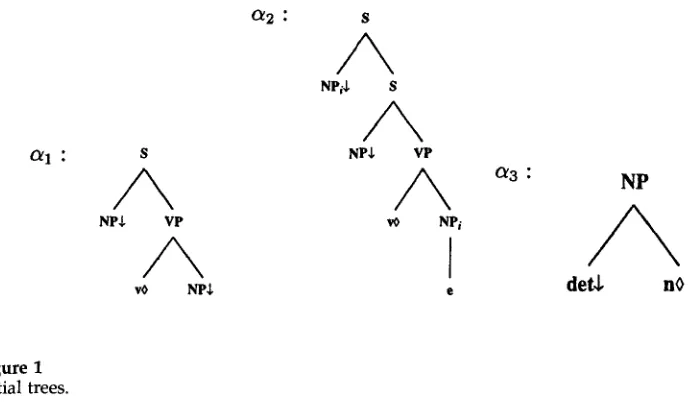
O~ 1 :
0~2 :
S
NP,~ s
S NP$ VP
~ 0~3: NP
NP$
~ V P
v~
NPil
v, NP,~ , det$ nO
Figure 1 Initial trees.
though we provide no definitive answers to these questions, these topics are raised in this paper because they are brought out by the new interpretation of the TAG formalism that we propose.
In Section 4, we propose a logical formulation of FTAG grammars (along the lines of the logical formulation of Functional Unification Grammars given by Rounds and Manaster-Ramer [1987]) and then show how the denotation of a b-TAG grammar can be obtained. The logical formulation is given, in part, to show the separation between the descriptions of well-formed structures (as specified in a FTAG grammar) and the models that satisfy these descriptions.
We would like to note that the work presented in this paper concerns a formalism and not linguistic issues. A deliberate attempt has been made to only discuss the TAG formalism in general terms rather than focusing on linguistic issues. By doing so, our intent is to pay closer attention to the formalism itself and uncover the aspects of the definition of TAG that are stipulations and those that fall out as a corollary of a formalism that tries to localize dependencies. The use of linguistic examples in this paper by no means indicates the suitability of any linguistic theories. The only assumption that we make is that a grammar will attempt to localize dependencies to the extent possible.
1.2 Introduction to Tree Adjoining Grammars
A Tree Adjoining Grammar (TAG) as
defined traditionally
is said to be specified by a fi- nite set of elementary trees. Unlike the string rewriting formalisms that write recursion into the rules that generate the phrase structure, a TAG factors recursion and depen- dencies into a finite set of elementary trees. The elementary trees in a TAG correspond tominimal
linguistic structures that localize the dependencies such as subcategoriza- tion, and filler-gap. There are two kinds of elementary trees: initial trees and auxiliary trees. Originally, initial trees (e.g., c~1 and OL 2 in Figure 1) were defined to correspond to minimal sentential structures. Therefore, the root of an initial tree was required to be labeled by the symbol S. With the advent of lexicalized TAG and the use of the substitution operation, this assumption is no longer made (see c~3). [image:3.468.46.394.54.259.2]Computational Linguistics Volume 18, Number 4
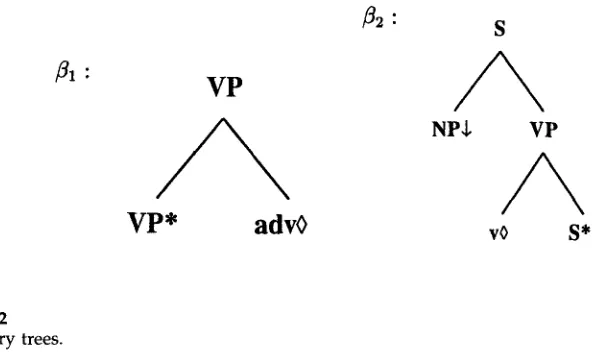
f12 : S
w
v
A
V P *
adv
vo
s*
Figure 2 Auxiliary trees.
symbol, A, then there is a distinguished node, called the foot node, in the frontier of this tree that is also labeled by A. The foot nodes of auxiliary trees, fll and /32, are indicated with an asterisk.
The adjoining operation is used to compose trees. An auxiliary tree, whose root and foot node are labeled A, can be adjoined at a node that is also labeled A. Adjoining may be described as follows: the subtree below the node of adjunction is excised; the auxiliary tree is inserted in its place; and the excised subtree is substituted at the foot node of the inserted auxiliary tree.
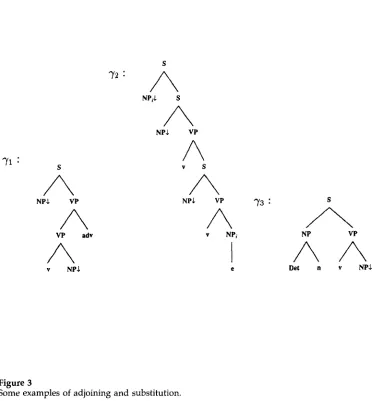
Figure 3 shows the result of adjoining fll at the VP node in OL 1 (to yield 3'I) as well as the adjunction of t32 in O~ 2 t o yield ~2. The latter example illustrates a key feature of
TAG, i.e., localization of dependencies. The tree oL 2 indicates the topicalization of the object, localizing the filler-gap dependency. Notice that although the dependent nodes
(the two nodes labeled NPi) are stretched apart in 3`2, the adjoining operation does not
alter any dependency present in the original trees being composed.
1.2.1 Lexicalized Approach to TAG and Substitution. In the traditional approach
to TAG, adjunction was the only operation used to compose trees. In the lexicalized approach to TAG as proposed by Schabes, Abeille, and Joshi (1988), the substitution operation is also used. In this approach, elementary trees are associated with lexical items. These lexical items (indicated by ~) are said to be the anchors of the trees. These trees define the arguments required by the anchor. Figure 1 shows two initial trees ~1 and c~2 whose anchors are transitive verbs. The two trees specify the arguments required by the anchor (a transitive verb) and describe the structure for the simple declarative form and for the case where the object is topicalized. Note in both these
trees, the argument (subject and object NP) nodes are not elaborated any further. This
elaboration is done instead by substituting other initial trees at these nodes. The tree 3'3 (Figure 3) is the result of substituting o~ 3 at the subject NP node in el. In a lexicalized TAG, frontier nodes labeled by nonterminals (with the exception of foot nodes) are marked for substitution (specified by ~).
[image:4.468.81.384.53.230.2]71 :
S
NP~. VP
VP adv
/ k
v NP$
72 :
S
NPi$ S
NP$ VP
A
v S
NP,I, vP 7 3 : s
v NPi NP VP
• Det n v N P $
Figure 3
Some examples of adjoining and substitution.
a node. In a TAG, associated with each n o d e is a list of auxiliary trees that can be adjoined at that node. This specification of a set of auxiliary trees with each n o d e is called the Selective A d j o i n i n g (SA) constraints of the nodes. A n o d e is said to have a N u l l A d j o i n i n g (NA) constraint if no auxiliary tree is allowed to be adjoined at that node. An N A constraint is specified b y associating an e m p t y set with a node. In current TAG literature N A constraints are therefore said to be a special case of SA constraints. In addition, for some n o d e s it is necessary to insist that adjunction is m a n d a t o r y at a node. In such a case, we say that the n o d e has an O b l i g a t o r y A d j o i n i n g (OA) constraint.
[image:5.468.37.412.81.482.2]Computational Linguistics Volume 18, Number 4
ities at that node. On the other hand, we will see that: in the version of FTAG we define here, decisions such as the choice of auxiliary trees that can be adjoined at a node or whether adjunction is mandatory at a node follows from the assertions (stated in terms of feature structures) about the linguistic features of individual nodes, rather than being specific to the adjoining operation. In fact, in this paper, we would like to highlight this issue while addressing the usefulness of this "unification-based approach" to TAG.
2. A Unification-Based Approach to Tree Adjoining Grammars (FTAG)
In the unification-based approach to grammars, the rules of a grammar are viewed as constraints that define well-formedness. At any point during derivation, the structures built reflect the information known at (or the constraints specified up to) that point. Further derivation leads to more constraints being specified. We begin this section by illustrating w h y the traditional definition of TAG is incompatible with this aspect of the unification-based approach to grammars.
2.1 Adjoining of Trees
Given al (Figure 1), we can state that there is a relationship between the S node and the v node that is fixed by the fact that we have stated that al is a tree. For instance, one of the assertions we can make is that (since we consider al as a tree) following two immediate domination (ID) links from the S node leads us to the v node. Now consider the tree "yl (Figure 3) obtained by adjoining at the VP node (of al) that lies along the path from the S node to the v node. In "Yl, although the S and v node are still present, the v node is no longer the grandchild (two ID links) of the root node. This example illustrates that, in general, the adjoining operation on trees nullifies certain assertions that can be made about the component trees (that are composed). The reason that the traditional definition of TAG is not compatible with the unification approach is that it defines that the grammar manipulates (composes) fully specified structures (trees in this case) rather than partially specified structures. The composition operation of adjoining creates a new structure that does not maintain all of the properties that held in the original (fully specified) structures of which it is composed.
In the rest of the paper we will discuss an alternate definition of TAG and argue that our proposed definition is more compatible with the unification approach. Unlike the traditional definition of TAG, we do not consider the objects manipulated by a grammar to be trees. Rather, we will say that although the elementary objects do specify tree structures, they do so only in a partial fashion.
2.2 A N e w Interpretation of TAG Objects
We start by examining the nature of objects that are manipulated by a TAG. The only assumption we will make about these objects is that the elementary objects of the grammar give a sufficiently enlarged domain of locality that allows localization of statements of dependencies such as subcategorization, and filler-gap.
(1): S --* NP VP. Also, notice that a VP that captures the combination of the lexical an- chor with the other obligatory arguments must be formed. In the case of a transitive verb, such information can be captured by a rule (2): VP ---* vNP. Thus we can see that the essential information captured by c~l includes the simultaneous use of the two rules and can be described by stating the relationships between the six entities (three for each rule) involved in the rules.
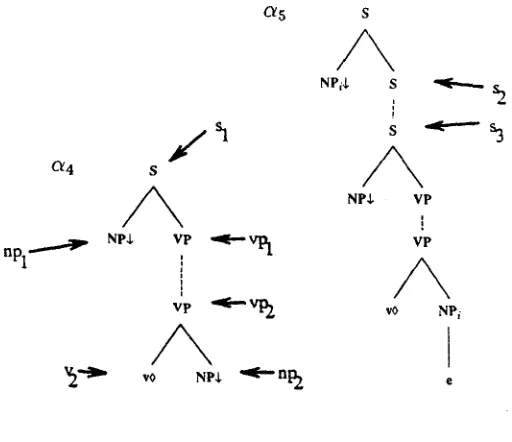
These relationships can be stated by means of some assertions about the indi- vidual entities. At this point it is useful to use some names (identifiers) to refer to these entities) Let these names be Sl, npl, vpl (for the three symbols in rule (1)) and
vp2, v2, np2 (for the three symbols in rule (2)). The assertions given below (that can be captured by the structural representation, ~4, given in Figure 4) can be stated to minimally describe a structure anchored by a transitive verb.
1. The label of the entity referred by Sl is S. It immediately dominates the entities referred to by npl and vpl. npl and vpl correspond to the occurrences of NP and VP in the right-hand side of rule (1) and hence the immediate domination.
2. npl refers to the subject of v2 and is labeled by the symbol NP. It is one of the obligatory arguments required by the anchor.
3. vpl is labeled by VP and is used to indicate the combination with the subject (i.e., npl) to yield a sentence.
4. vp2 (also labeled VP), corresponds to the occurrence of VP in the left-hand side of rule (2). It immediately dominates v2 and np2. vp2 is used to indicate the result of the combination of the transitive verb with
the obligatory object argument (given by np2).
5. Since the combination of the anchor with the subcategorized arguments (given by npl and np2) will yield a sentence, the sl dominates v2 by a path of length at least two. Furthermore, the nodes named vpl and vp2
lie on the path from the v2 node to the Sl node. Since vpl must dominate v2, we can conclude that the node named vpl must dominate the node named vp2 (indicated by a dashed link in c~6) and thus, in turn the v2 node. Immediate domination, on the other hand, is represented in the usual fashion.
Here we define the domination relation to be reflexive (i.e., a node dominates itself) in addition to being transitive and antisymmetric. Therefore, we are not stating that the nodes named as vpl and vp2 are necessarily different. Notice that the above assertions have been made independent of TAG or the commitment to use trees for the elementary objects. In TAG, given the decision to use trees, a (minimal) tree that satisfies these assertions will be used. It is due to this minimality requirement that the nodes named as vpl and vp2 are assumed to be the same.
On the other hand, the only decision we have committed to is to use structures large enough to localize subcategorization. In this case, we have given some assertions that describe the structure for simple declarative sentences anchored b y a transitive verb. Although compatible (though different) assertions have been made about the
Computational Linguistics Volume 18, Number 4
C~ 4
n P l - - - - ' ~
j h
s
NP$ VP ~ v ~
vv " ~ - v h
vo NP,k ~ rip 2
S
/ \
NPi4. S
S
NP$ VP
VP
vO NPi
Figure 4
The domination relations.
nodes referred by vpl and vp2, (from these assertions) we cannot conclude whether these nodes are different or are the same node. In fact, this is the reason that structures such as ")/1 (which represents the case where the two are different) in Figure 3 as well
a s O~1 (where vpl and vp2 both refer to the same node), given in Figure 1, can both be derived. The structure given by c~4 (with the dashed link indicating possible separation) partially describes the phrase structure tree for both cases. Since vpl and vp2 can both refer to the same node, to avoid confusion, henceforth we will call them quasi-nodes. Thus a node such as the VP node in ~1 (Figure 1) is represented by a pair of quasi-
nodes in ~4. We will refer to these quasi-nodes as the top (for example, vpl) quasi-node
and the bottom (vp2) quasi-node. Structures such as ~4 will be called quasi-trees to indicate that they are not trees but (partial) descriptions of trees.
A second example that also motivates the proposed interpretation of TAG where the elementary objects are taken to be descriptions of trees (quasi-trees with domina- tion and immediate domination links) rather than trees involves the tree structure in the case of topicalization. The topicalization of the object of a transitive verb can be described by the quasi-tree ~5 (in Figure 4), which is the counterpart of ~2 (Figure 1) used traditionally in TAG. If the elementary structures in a TAG are supposed to de- pict the localization of dependencies such as those arising due to subcategorization and movement, then we claim structures like ~5 are indeed the appropriate structures to consider. For instance, no treatment of topicalization can justify the identification of the nodes referred to by s2 and s3. Thus, a pair of quasi-nodes is appropriate for their representation. As in the case of vpl and vp2 quasi-nodes in ~4, one can only claim that s2 quasi-node dominates s3 quasi-node (again, by domination, we also allow for the possibility that s2 and s3 can refer to the same node). It may be interesting to contrast this lack of information in ~5 (whether or not they refer to the same node) with the use of functional uncertainty in LFG (Kaplan and Maxwell 1988) to account for long-distance dependency.
[image:8.468.116.372.56.277.2]$
E~' 6 :
++
['.,,=">Cl
,',[,....,= [...h,=
[.,;<,>|
I
I
VP[head:
<2> [1S O/,/ :
[h,.: <I~t
[image:9.468.35.424.55.198.2]• + [h=a= <I> [l ~*
Figure 5
Associating feature structures with quasi-nodes.
initial quasi-tree, auxiliary quasi-tree, quasi-root, and quasi-foot in place of initial tree, auxiliary tree, root node, a n d foot node, respectively.
2.3 Associating Feature Structures with Quasi-Nodes
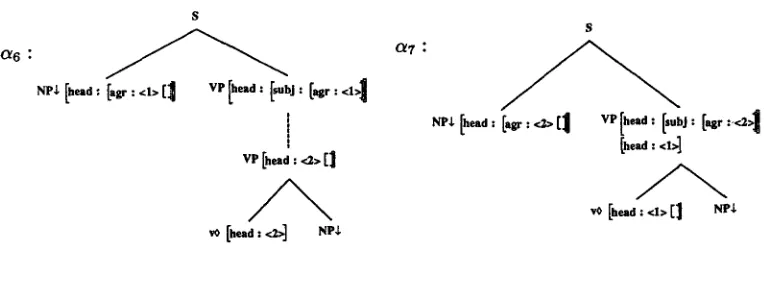
Let us n o w consider a4 given in Figure 4 and the pair of V P quasi-nodes. In the version of FTAG formalism we define here, the feature structure that w e associate with quasi- n o d e s simply reflects the assertions that w e m a k e a b o u t them. For instance, s u p p o s e a constraint VP.head.subj.agr = NP.head.agr was used in conjunction with the rule
S --* N P VP; and the constraint VP.head = v.head was used with the rule V P --* v NP.
These two rules (and associated constraint equations) w h e n used together p r o d u c e ~6, s h o w n in Figure 5. Notice that the feature structure associated with a top quasi-node can be considered as constraints on it (and hence a constraint on the nature of tree that is rooted at this quasi-node) that are m a d e on the basis of its ancestors and siblings. Similarly, the feature structure associated with a b o t t o m quasi-node reflects the nature of tree that is rooted at this quasi-node (that is its descendants).
Instead of explicitly using a pair of quasi-nodes a n d d r a w i n g the d o m i n a t i o n (dashed) link b e t w e e n them, w e can also depict it in a m o r e traditional m a n n e r f o u n d in TAG literature (see ol 7 in Figure 5). In such a case a node, such as the V P n o d e in c~7, will have two feature structures (the ones associated with the two quasi-nodes) associated with it. This matches the previous definition of feature s t r u c t u r e - b a s e d Tree Adjoining G r a m m a r s w h e r e these two feature structures were called the top and b o t t o m feature structures associated with a node. In fact, this c o r r e s p o n d e n c e was i n d e p e n d e n t l y observed b y H e n d e r s o n (1990) and was used in the translation of an FTAG to a Structure Unification Grammar. W h e n convenient, w e will use "a n o d e with two associated feature structures" instead of "a pair of quasi-nodes (with one feature structure associated with each quasi-node)."
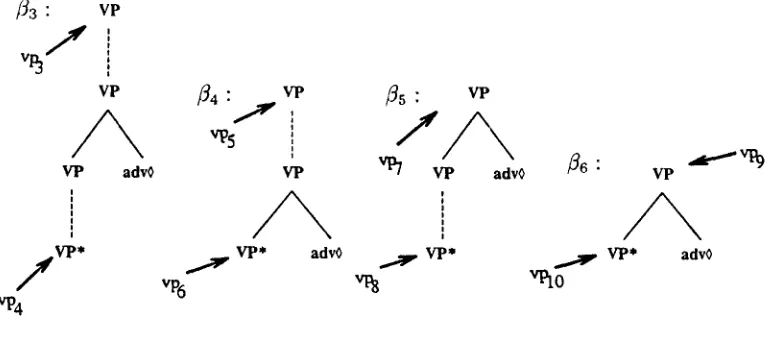
If the objects m a n i p u l a t e d by a TAG are considered as quasi-trees, a natural ques- tion arises w h e n one considers w h a t w o u l d be a n o d e in a tree as a pair of quasi-nodes. For o u r current purposes, this aspect is not relevant. For instance, the auxiliary quasi- trees, f13, f14, fls,/36 in Figure 6, are equally acceptable (well-formed structures) in the formalism. N o m a t t e r which one is used, for an auxiliary quasi-tree, we have to state the quasi-root n o d e and the quasi-foot node. As s h o w n in Figure 6, for the auxiliary q u a s i - t r e e s , f13~ f14~ f15~ f16, they are given b y the pairs of n a m e s vp3, vp4; vps, vp6; vp7~ vps;
Computational Linguistics Volume 18, Number 4
f13 " VP
7
,%
vP
VP advO
flS" VP
/ / ' \
VP7 VP advO
f14: VP
7
vP
VP* advO
,%
VP* ~ VP*
,a,4
Figure 6
Some possible auxiliary quasi-trees.
f16 : vp ' ~ ' " v t ' 9
VP* advO
~ o
2.4 T h e A d j o i n i n g O p e r a t i o n
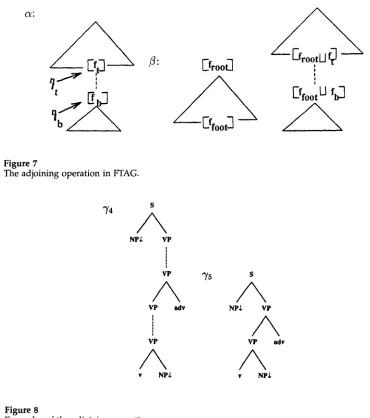
We will n o w define the adjoining operation on quasi-trees a n d see that (unlike pre- viously) this operation has the p r o p e r t y that in the resulting structure all the struc- tural relations specified in the objects being c o m p o s e d are preserved. We will see that this, in turn, allows for a straightforward e m b e d d i n g of TAG in the unification-based f r a m e w o r k . Recall that b y considering a pair of quasi-nodes w e allow for possible separation. We n o w define the operation of adjoining as the o p e r a t i o n that achieves this separation. Consider a quasi-tree, as s h o w n in Figure 7, with a pair of top and b o t t o m quasi-nodes referred b y the names, say ~t a n d ~/b respectively. In this figure, w e have deliberately chosen to indicate that feature structures
(ft
a n dfb)
as labeling quasi- n o d e s (~/t a n d ~/b respectively). Consider a auxiliary quasi-tree, fl, with the quasi-root n o d e a n d quasi-foot n o d e referred b y the n a m e sroot~
a n dfoot~
as s h o w n in Figure 7. Adjoining fl at the pair of quasi-nodes 0/t, ~b) in ~ is n o w defined b y stating that the d o m i n a t i o n relation b e t w e e n the pair of quasi-nodes is specified to be the same domi- nation relation that exists b e t w e e n the quasi-root n o d e of fl a n d the quasi-foot n o d e of ft. Thus, the pair of quasi-nodes (referred b y the n a m e s ~t a n d ~b) get separated w h e n the quasi-nodes referred b y ?lt(~b)
a n droot~ (foot/~)
are identified. Adjunction is thus defined as a pair of simultaneous substitutions. 2 N o t e that the adjoining operation is defined only if the point of adjunction is specified as a pair of quasi-nodes.We stated that the feature structure associated with a quasi-node is an e n c o d i n g of the assertions (in terms of feature-value pairs) that are m a d e a b o u t it. Let
ft, fb, froot,
a n dffoot
be the feature structures that satisfy the constraints stated a b o u t the quasi-nodesreferred b y
rh, 71b, rootfl,
a n dfootfl
respectively. Then, because adjunction is d e f i n e d as identifying the quasi-nodes referred b y 7/t a n droot~
(as well as those referred b y ~/b a n dfoot~), ft
andfroot (fb
a n dffoot)
satisfy the constraints expressed a b o u t the same quasi-node. Thus they have to be unified (as s h o w n in Figure 8). N o t e that w e have m o t i v a t e dft
as a reflection on the constraints a b o u t the tree b e l o w the c o r r e s p o n d i n g [image:10.468.52.436.52.222.2]c'3~;
fl:
Ffroo
%
;
I I !
Dfoot u fl~
Figure 7
The adjoining operation in FTAG.
"/4 S
NP~, VP
ve Ts
VP adv
VP
v NP,I.
S
/X
NP$ VP
VP adv
A
v NP$
Figure 8
Examples of the adjoining operation.
quasi-node, one that possibly arises d u e to the relationship of this quasi-node with its ancestors a n d siblings in % The feature s t r u c t u r e
froot
also reflects the nature of the treeb e l o w the quasi-root node. Since these two quasi-nodes are n o w required to be the same, the unification of
ft
withfroot
gives a feature structure that reflects all constraints w h e n the quasi-nodes are identified.Figure 8 shows the result of adjoining at the paired
VP
quasi-nodes in c~4 b y the auxiliary quasi-trees t3 (resulting inq/4)
andt6 (75)"
2.5 The Substitution Operation
[image:11.468.32.402.52.470.2]Computational Linguistics Volume 18, Number 4
[image:12.468.97.383.56.166.2]E
foot-1
Figure 9
The substitution operation.
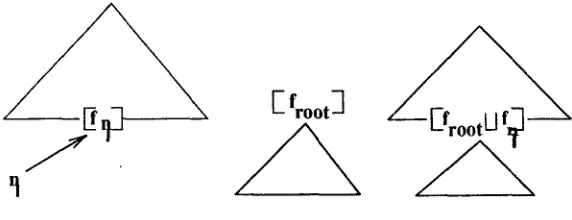
(of the substitution operation) node appearing in the frontier of the other tree. Due to this identification, the feature structures associated with the two nodes in question are unified.
A similar definition will be used to define the substitution operation here. Let refer to a quasi-node in the frontier (see Figure 9). The substitution of "~ at the quasi- node ~ is defined as the quasi-tree obtained by identifying the quasi-nodes ~ and the quasi-root of % Thus the feature structures associated with these quasi-nodes get unified as shown in Figure 9.
2.6 Some Observations
We can make the following observations at this stage. The dashed link between a pair of quasi-nodes indicates that it is possible for the two to be the same. However it is possible to insist that such a pair of quasi-nodes are distinct. This is possible, by stating incompatible assertions about them. On the other hand, as was noted by Marcus, Hindle, and Fleck (1983), without explicitly stating so, we cannot make assertions about a pair of quasi-nodes that will indicate that they are the same. These observations will be further elaborated in Section 3 to capture obligatory adjoining
(OA)
constraints.Another point that can be noted is that the adjoining operation and its use of auxiliary trees can itself be motivated from the definition of quasi-trees. Notice that we have introduced the concept of quasi-trees simply from the motivation of considering structures with enlarged domains of locality in order to localize dependencies such as subcategorization and filler-gap. In defining quasi-trees we stated that pairs of quasi- node can be separated (i.e., they need not be the same node). If a pair of associated quasi-nodes are to be separated by the use of a composition operation, it is easy to see that it can only be done by an operation like adjunction, and the kind of structure that can fit between them must have the general form of an auxiliary tree. Of course, with the use of the new notation, the insistence that the root and foot nodes (of auxiliary trees) be labeled by the same nonterminal symbol (as well as for the target of adjunction) is only a
stipulation
(and not required by the formalism). Let us considerthe labeling of nodes (quasi-nodes) by atomic symbols (such as S,
NP).
In contrastingthe quasi-root of this auxiliary tree and the quasi-foot must also be labeled the same. Thus the above-mentioned stipulation is a statement that recursion is factored out of elementary trees. In fact, as we will see, if instead of nonterminal symbols we consider category structures (as specified in GPSG) as labeling nodes then almost all pairs of quasi-nodes in the trees we will consider here will be labeled differently (by compatible or incompatible categories). In fact, it is the relationship between the two labels that will determine the subset of auxiliary trees that can be adjoined at a node. Further discussion on this matter can be found in Section 3.
In the definition here, since we do not start by assuming that trees are composed, there is no need to make such an assumption that a pair of quasi-nodes separated by the domination (dashed) link must be labeled the same, unless if it follows from some linguistic principle/intuition being expressed using the TAG formalism. At this point we would like to note that enforcing such a stipulation has significant consequences on the definition of the formalism. Some of these consequences are noted in Section 5, where we contrast multi-component adjoining with adjoining.
2.7 Objects Derived by a Grammar
We have stated that an FTAG grammar
manipulates
(partial) descriptions of trees (i.e., quasi-trees). We will now state that a grammarderives
trees (with nodes labeled by feature structures).The composition operations of adjoining and substitution compose quasi-trees to build more complex (and more specific) quasi-trees. Each quasi-tree obtained during the derivation process specifies a set of trees. The set of trees
derived
can be obtained by taking thecircumscriptive
reading of the domination relation indicated in the quasi-trees obtained. The domination link between a pair of quasi-nodes represents the situation that they may or may not refer to the same object. In the absence of further information (for instance at the end of the derivation process) we shall consider that the pair of quasi-nodes refer to the same (single) node. Thus, given a quasi-tree, its minimal reading leads to the derived tree that is obtained by explicitly equating the related top and bottom quasi-nodes for each pair of quasi-nodes (since by the domination relation specified here any quasi-node dominates itself). Thus, in a derived tree (such as c~2, in Figure 1, obtained by taking the circumscriptive reading of the domination relationship specified by the quasi-tree c~5 given in Figure 4) only one feature structure is associated with each node.The discussion given above justifies the unification (or coindexing) of the top and bottom feature structures of a node at the end of the derivation process as specified in the previous definition of FTAG. Of course, due to the associativity of the unification operation, the coindexing of the top and bottom feature structures for all nodes does not have to be delayed until the end of the derivation process. Such unifications for a node can be done whenever one decides that there will be no more adjunctions at that particular node.
In the traditional definition of TAGs, a derived tree cannot have nodes with
OA
constraints, even though intermediate trees can have nodes with
OA
constraints. ThisComputational Linguistics Volume 18, Number 4
ously this should be the case, since incompatible assertions about a pair of quasi-nodes indicates that they do refer to different nodes (and hence specify
OA
constraints).2.8 Using One (Rather than Two) Feature Structure
A question arises whether (as in standard CFG-based unification grammars) one could associate just one (rather than two) feature structure per node, i.e., whether it is neces- sary to consider pairs of quasi-nodes. In fact, Harbusch (1990) defined such a treatment of TAG where only one feature structure is associated with each node.
One could argue that it may be inefficient (for instance, when implementing the formalism as defined here) to start with the pairs of quasi-nodes and then try to merge them eventually when possible. Strategies to improve processing may be considered particularly if we believe that, on an average, a relatively small proportion of potential sites will become actual targets of adjunctions during a derivation of a sentence. Then (to improve performance) we could specify that
by defimlt
the associated pair of top and bottom quasi-nodes are to be identified. That is, we will not consider a node as a pair of quasi-nodes unless there is reason to believe it is necessary (if adjunction has to be performed). So we can even state that there is just one feature structure per node, which has to be the one obtained by unifying the feature structures associated with the top and bottom quasi-nodes. Now if adjunction takes place at a node in some tree that has been derived, then the "unification" that has been performed has to be undone to recover the top (relating it with its ancestors and siblings) and bottom (based on the structure it dominates) feature structures. This undoing can be quite complex, especially if the pair of quasi-nodes in question is a part of a derived object rather than an elementary structure specified by the grammar. The above description essentially captures the definition of the formalism presented by Harbusch (1990).Another point can be made about the scheme presented above. Consider a node whose top and bottom feature structures are incompatible and hence nonunifiable. If we were to insist that only one feature structure were to be associated with every node then we can only unify the compatible parts of the top and bottom feature structures and somehow (perhaps with the use of a device like ANY) retain (effectively) the OA constraint machinery.
3. Feature Structures and Adjoining Constraints
In the traditional definition of a TAG, the adjoining possibilities at a node is deter- mined by the association of adjoining constraints with each node. In this section we consider how such constraints may be captured by the use of feature structures and then contrast the two methods of determining the adjoining possibilities. Since we attempt to contrast the adjoining possibilities, in this section we will make correspon- dences between nodes in trees (used in the traditional definition of TAG) with pairs of quasi-nodes that are linked by the domination (dashed) link. That is, we talk of such pairs of quasi-nodes as the target of adjunction. Also, if we have a pair of quasi-nodes given by ~/1 and r/2 where ?]1 quasi-node dominates ~/2, we will say that the 72 is the bottom quasi-node paired with ~/1 or that ~/1 quasi-node is the top quasi-node paired with 7/2.
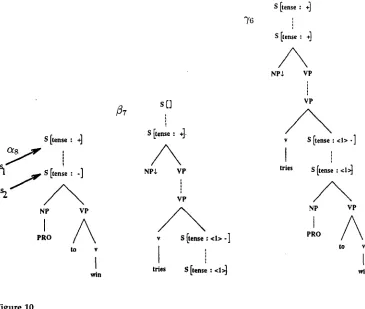
3 . 1 0 A Constraint
37 s []
S[tense. q
S [tense ." +].
5 / I
S[tense: -]
NP*
VP
VP
NP VP / ~ ~
P R O v S [tense : <1>
-]
tO V ]
I
!
I
tries S [tense'
: <1~]win
Sltense : + 1
I
S[,e.se: *]
NP$ VP
i
i
,
vp
v $ [tense : <1> .]
I
!
i tries S [ t e n s e : <1>]NP VP
PRO
to v
I
win
Figure 10
"OA" constraints.
of quasi-nodes are i n d e e d distinct, i.e., there m u s t be some feature that distinguishes them. H e n c e the linguistic basis for m a k i n g the claim that the n o d e has an O A con- straiht m u s t be stated in such a w a y that the feature structures on the two quasi-nodes are incompatible. As an example, consider c~8 given in Figure 10. The feature structure of the quasi-root of c~8 has a value of + for the tense attribute to specify that a n y tree rooted at this quasi-node m u s t satisfy the constraint that it describes a tensed sen- tence. O n the other hand, the feature structure of the paired b o t t o m quasi-node has a value of - for the tense attribute since it only reflects the descendants. Since these two feature structures are incompatible, this pair of quasi-nodes has an "OA constraint" (since it is not possible to stop the derivation process and identify the top with the b o t t o m quasi-node). H o w e v e r , % that results from the adjoining of/37 does not h a v e a n y pair of quasi-nodes with an "OA constraint."
3.2 SA C o n s t r a i n t s
[image:15.468.40.405.56.365.2]Computational Linguistics Volume 18, Number 4
C~ 0 "
J
S[t,ns,: q
i i i t
S[,eos,: q
NP~. VP
VP
v NP$
m e t
rid"
S[tense: +]
i
s [t,,,~ :
+]
/N
NP$ VP
VP
,, s [re.s, : <~> +]
I
'
ii !
[image:16.468.118.365.53.267.2]thinks S [tense : <1>]
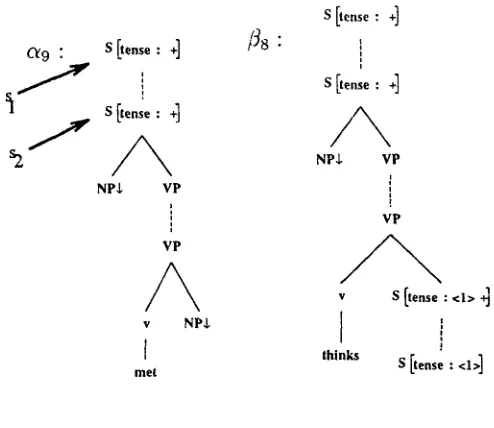
Figure 11 "SA" constraints.
where adjunction is attempted) a n d the feature structure of the quasi-root (of the auxiliary quasi-tree) are unified, as are the feature structure associated with the bottom quasi-node (in the pair where adjunction is attempted) a n d the feature structure of the quasi-foot (of the quasi-tree being adjoined). If at least one of these unifications fails then adjunction is not possible.
Consider f18 given in Figure 11. This quasi-tree cannot be adjoined at the pair
(s],
s2) in c~8 (Figure 10) but can be adjoined at the pair (sl, s2) of ag. On the other hand, we saw that f17 can be adjoined at the pair (sl, s2) of a8. Thus we can say that the pair (sl, s2) of a8 has an "SA constraint" that includes/37 but not f18.3.3 N A C o n s t r a i n t s
Recall that a node with an N A constraint cannot be the target of an adjunction. Tradi- tionally, this is specified b y stating that the set of auxiliary trees that can be adjoined at such a node is the e m p t y set. For this reason, it is often stated that N A constraints are special form of SA constraints.
There are two possible w a y s of interpreting " N A constraints" in the quasi-tree framework. Firstly, a pair of quasi-nodes with an " N A constraint" m a y be interpreted as a
stipulation
that insists that no quasi-tree can be adjoined at this pair; a statement m a d e regardless of the nature of the auxiliary quasi-trees in the grammar. This m a y for instance be m a d e if we wish to allow only certain derivation sequences. One could argue that the reason for insisting that foot nodes ofcomplement 3
auxiliary trees have N A constraints, as is the case in most TAG accounts, is to avoid certain derivation sequences (Kroch a n d Joshi 1985).On the other hand, we m a y also interpret the association of " N A constraint" with a pair of quasi-nodes as a statement that none of the auxiliary quasi-trees in the g r a m m a r matches the requirements of the type of auxiliary quasi-trees that can be
adjoined at this pair (as determined by the associated feature structures). Unlike the previous case, adjunction is not barred per se. Instead, attempting to adjoin at such a pair will never yield well-formed structures. This is because of the nature of such a pair and of the auxiliary quasi-trees in the given grammar. In the TAG formalism, both these interpretations are captured by the same
operational
mechanism.The first kind of NA constraint is easily stated. According to this interpretation, for each pair of quasi-nodes with an "NA constraint," the two quasi-nodes are indeed the same node (since we are stating that there is no possible separation). Since the two quasi-nodes are to be identified, the feature structure associated with the resulting quasi-node must reflect both the relationship of the quasi-node with its ancestor (which we assume stands for the top feature structure) as well as its relationship with its descendants (the bottom feature structure).
Earlier we had stated that the target of an adjunction operation must be a pair of quasi-nodes that have not been identified (i.e., merged). Suppose that a pair of quasi-nodes (71,72) were merged. Let the quasi-root and quasi-foot of some auxiliary quasi-trees fl be given by r and f. Adjoining fl at the pair given by 71 and ~2 (after they have been identified) will result in the identification of 71 with r and 72 with f and thus r with f. If we stipulate that in all auxiliary quasi-trees, the quasi-root and quasi-foot do not refer to the same node (i.e., the quasi-root
properly
dominates the quasi-foot), then no adjunction can occur at a pair of quasi-nodes that have been identified. Thus the identification of a pair of quasi-nodes captures "NA constraints" of the first kind. As far as the second kind of "NA constraints" is concerned, we note that it is only a specific case of "SA constraints." Therefore, given a pair of quasi-nodes, if the associated feature structures are such that no auxiliary quasi-tree can be adjoined at this pair then it has an "NA constraint" (of the second kind). However, because of the nature of feature structures (in that they capture only partial information), it is hard to detect if a pair of quasi-nodes has such an "NA constraint." In Section 3.4, we will consider such an example.3.4 Comparing the Implementation of Adjoining Constraints
In the TAG formalism, selective adjoining constraints are specified by enumeration, and hence are stipulations stating which trees can be adjoined at a node. Hence, specifying adjoining constraints in such a way is not a linguistically appealing solution. Obviously, such stipulations are needed because the information content of the labels of nodes in a TAG is often insufficient to determine the trees that can be adjoined at
various nodes. In the case of FFAG, labeling of quasi-nodes by symbols such as
NP, S
isonly a part of information contained in the feature structures associated with them. We associate with a pair of quasi-nodes feature structures that describe the features of the top and bottom quasi-nodes. The fact that only appropriate quasi-trees get adjoined is a corollary of the fact that only those consistent with these declarations are acceptable. Additionally, in a FTAG, "adjoining constraints" can be dynamically instantiated and are not pre-specified as in a TAG.
Computational Linguistics Volume 18, Number 4
99 :
"/r : !
NP.I. vP
S[,e°,e. +3
S[,e,,,e-÷] " I " I
h
JvP
,,i
~9 :
:,
~
S[,e.,° : ÷] , .i--" ~2
s[,,,,.
+] • ~I, ... 1 "i"'s3/%
I
,
t r i . S [tease : .~ " ~ " s 4 NPL VP
t NP,I. VP / ~
i
i
/ \VP 1 Np* vP
vP
v
S [,ense : "l
/~
v NP,I.
I v NP,~
i
I
I
tries S [] m e t ta,t
Figure 12
Comparison of adjunction constraints--Example 1.
In a TAG grammar, the SA constraints at the root of tree corresponding to a9 w o u l d be given to disallow this adjunction. In the case of FTAG, as s h o w n in Figure 12, this adjunction is allowed, because the associated unifications did not fail. N o w suppose (as one might expect) the auxiliary quasi-trees in the g r a m m a r were such that none of them had their quasi-root with a feature structure compatible with t e n s e : - a n d
quasi-foot with a feature structure compatible with t e n s e : + . In this case, although
the adjunction of/39 was permitted, no tree can ever be derived from the result of adjunction. In fact, until we try all possible adjunctions at the node ~ in 77, we cannot realize that adjunction of f19 at the root of a9 can result in a final acceptable tree. Thus, the pair (s3, s4) has an N A constraint of the second kind.
N o w we will consider an example where specification of constraints in TAG suf- fers in comparison with the implementation of "constraints" in FTAG. Consider the following well-formed sentences
(1) W h o did John see?
(2) W h o did Peter think John saw? (3) I w o n d e r w h o John saw.
(4) I w o n d e r w h o Peter t h o u g h t John saw. (5) Peter t h o u g h t John saw Mary.
a n d the following, which are not well-formed sentences.
[image:18.468.51.428.54.317.2](~10 "
fllo :
S
NPI S
w h o NP VP
A
J o h n v NPI
$11W e
S
fl11:
NiP Vl'
I v S *
I
w o n d e r
C g l l :
$
NP VP
Peter v $*
J
think
$
NP ~
John •
taw Mary
i l l 2 " s
A
StCt S e
[image:19.468.90.363.53.344.2]J
didFigure 13
Comparison of adjunction constraints--Example 2.
(7) I w o n d e r w h o did John see? (8) W h o Peter t h o u g h t John saw.
We will first consider a TAG account (in traditional style). The trees (without consid- ering adjoining constraints) given in Figure 13 have been suggested in literature to account for the well-formed sentences above. We h a v e d r a w n these trees accounting for substitution at the N P nodes.
F r o m the well-formedness of (1) a n d ill-formedness of (6) it follows that the n o d e 7/of eel 0 m u s t have an OA constraint with fl12 in its SA constraint. On the other hand, from the well-formedness of (3) a n d ill-formedness of (6) it follows that the root of ~10 m u s t have an OA constraint with fit0 in its SA constraint. H o w e v e r , the r e q u i r e m e n t of an OA constraint on these two n o d e s in ~10 is m u t u a l l y exclusive. Because of this, a TAG g r a m m a r that accounts for the sentences above m u s t have two trees, that h a v e exactly the same tree structure b u t only differ in the adjoining constraints attached at the nodes.
Computational Linguistics Volume 18, Number 4
again we will need two trees (corresponding to fl11), with identical tree structure but differing in the adjoining constraints.
We will see that such replication of tree structure is not necessary. N o w consider the FTAG fragment (inspired by similar treatment in Abeille [1991]) given in Figure 14. If the feature structures of sl and s2 quasi-nodes of c~12 are unified then the other pair
813 :
~ 1 2 :
s [main : +]
I i I
Nv,
S[m,:<l>]
I
who
S[in,.
"1
NP ~
' A
John
v NP i
I
1
SaW •
s En,-'. • ÷] I i I I
s [ , , , . -I
NP ~
[wh: +
81a :
wonder
Cg13 : S [tu,la: ~]
I
I~ Irp
' A
J ~
I I
saw Mary
s [ . . , ° : ,]
I
s 6.-." q
I A
think
815 :
s[]I
u . s 0 . . . . ]
I
did
F i g u r e 1 4
[image:20.468.67.409.140.624.2]of quasi-nodes labeled S will obtain an "OA constraint" and vice versa as required (hence (6) can not be derived). In fact, if fl13 w e r e adjoined at the root of Oq2 (and thus s h o w i n g (3) is well formed) then it will no longer be possible to derive (7). Likewise, b y adjoining ills at the pair of s3 a n d s4 quasi-nodes in a~2, w e can derive (1) b u t will no longer be able to derive (7).
Proceeding in this m a n n e r w e can s h o w the well-formedness of (1)-(5) a n d the ill- f o r m e d n e s s of (6)-(8). Thus w e h a v e s h o w n that if a p p r o p r i a t e assertions can be stated a b o u t the individual n o d e s then a m o r e succinct g r a m m a r can be given: one that does not require replication of tree structures, d u e to the fact that adjoining constraints are not pre-specified as in a TAG.
4. A Logical Formulation
A central t h e m e in o u r definition of FTAG has been the view that the objects m a n i p - ulated b y a g r a m m a r are descriptions of trees (rather than trees). This separation of descriptions of trees from the trees (models) d e r i v e d has been crucial in e m b e d d i n g TAG in the unification framework. The question of w h i c h language to use to describe trees (together with its semantics) arises. We h a v e used quasi-trees (as the descriptions themselves) in o r d e r to focus on TAG, a n d have not i n t r o d u c e d some general formal f r a m e w o r k for describing trees. The discussion b e l o w does not constitute a suggestion a b o u t h o w such general descriptions m a y be given, b u t is one w a y to specify an FTAG that will be c o n v e n i e n t for o u r p u r p o s e s here.
In this section, we describe a logical f o r m u l a t i o n of the unification-based a p p r o a c h to TAGs. The p u r p o s e of p r o v i d i n g a logical f o r m u l a t i o n of FTAG is so that w e can find the d e n o t a t i o n of an FTAG g r a m m a r (the set of structures generated) as well as contrast it with context-free g r a m m a r - b a s e d unification grammars. To define the d e n o t a t i o n of an FTAG grammar, w e will first describe h o w an FTAG g r a m m a r can be represented. This representation uses the logical f o r m u l a t i o n of feature structures as given b y Kasper and R o u n d s (1986) and Johnson (1988) a n d is similar in a p p r o a c h to the logical f o r m u l a t i o n of Functional Unification G r a m m a r (FUG) given b y R o u n d s and Manaster-Ramer (1987).
In the f r a m e w o r k of R o u n d s and Manaster-Ramer (1987), an FUG (or a n y context- free g r a m m a r with associated unification equations as in, say PATR-II) can be rep- resented b y m e a n s of a set of equations, using the f o r m u l a e of K a s p e r - R o u n d s to represent feature structures. For example, a context-free g r a m m a r rule S --* N P V P can be represented as s ::= C A T : S A 1 : np A 2 : vp. H e r e s, np, a n d vp are type variables.
The attributes 1 and 2 are used to indicate the first and second children respectively. Using s t a n d a r d techniques to derive fixed points from a set of recursive rules, the d e n o t a t i o n of type variables are obtained. The d e n o t a t i o n of the t y p e variables gives the set of structures d e r i v e d from the c o r r e s p o n d i n g nonterminals.
N o w s u p p o s e w e wish to express r e e n t r a n c y in feature structures b y using vari- ables; it is clear that w e have to use individual variables a n d not t y p e variables. As in Johnson (1988), w e use individual variables a n d equalities to express reentrancy. The syntax we a d o p t to describe attribute-value structures is as follows. Firstly, the set of terms is defined as
t::= a x l(tl)
w h e r e a is an atomic v a l u e w h e r e x is an individual variable
Computational Linguistics Volume 18, Number 4
The set of formulae is defined as
0::=
tl ~ t2 01 A 020~
v02
where tl,t2 are terms where 01,02 are formulae where 01~ 02 are formulae.
For example, (l(x) = y) A (h(x) = z) A (g(y) = z) A (z = a) describes (among others) the following feature structure.
1 : g : [-i-~ ] h : [~a
Note that individual variables (that stand for individual feature structures) are being used to capture reentrancy, whereas t y p e d variables play a role analogous to the role of nonterminals in g r a m m a r s (such as CFGs) a n d stand for a set of feature structures. For the purpose of describing an FTAG, we need individual variables to specify reentrancy (as well as to refer to quasi-nodes) a n d " t y p e d " variables to denote the set of structures derived from elementary quasi-trees. To distinguish between these two kinds of variables, in our framework, we will use monadic predicate instead of t y p e d variables.
4.1 Expressing an FTAG
Firstly, we note that quasi-initial trees are analogous to nonterminals in CFGs. Thus, as indicated above, quasi-initial trees will be represented b y monadic predicates. If a is a quasi-initial tree, then we will use a predicate symbol ~ to represent this quasi-tree. If a structure ,,4 is derivable in the g r a m m a r starting from a then we w o u l d like to have .4 to belong to the set denoted by ~. For example, a n y structure described by Ot14 can be a s s u m e d to satisfy the requirements on the variable x in
cat(x) ~ S A D o m ( x , y ) A cat(y) ~ S A l(y) ~ z A count(y) ~ zero A cat(z) ~, c.
This description is intended to not only describe the features of nodes, but also the structure of the subtrees rooted at each node (with attributes 1 , 2 , . . . used to specify the first, second, . . . child of a node). In the formula given above, x represents the quasi-root node. Therefore, we will define ~14 by
~14(X) K===~ cat(x) ~ S A D o m ( x , y ) A cat(y) ~ S A l(y) ~ z A count(y) ,~ zero A cat(z) ~ c.
In this case, Dom(x, y) is used to indicate that the quasi-root (x) dominates the associ- ated bottom quasi-node (given b y y).
N o w if we view the definition of 0t14 i n d e p e n d e n t of the rest of the grammar, then
D o m ( x , y ) represents domination in a n y arbitrary manner. However, the rest of the g r a m m a r specifies the constraints on the domination relation b y defining the actual possibilities for the domination. This is because a pair of quasi-nodes (say as given b y x a n d y in c~14) is intended to m e a n that either they are the same objects or are different nodes that are related b y proper domination. In our definition, the separation can take place only by adjunction. So given a grammar, we can specify that the d o m i n a t i o n relationship is actually defined by
D o m ( x , y ) 4==~ x ~ y V f l l ( x ~ y ) V . . . V
-'fin(X~y)
of the quasi-auxiliary tree ft. Since the actual definition of the domination between a pair of quasi-nodes is determined b y the quasi-trees of the grammar, it is appropriate to consider fixed-point semantics to define the denotation of a grammar.
Before we discuss the fixed point we will complete our discussion about h o w we can specify a grammar. Let us define another monadic predicate Inittree by
Inittree(x) 4=~ ~ l ( x ) V . . . V ~m(X)
where { a l , . . . ,OLm} is the set of initial trees. If we further wish to stipulate that a structure is derived in a FTAG if it is derived from some quasi-initial tree a n d is rooted in S we can define
Grammar(x) 4=~ Inittree(x) A cat(x) = S.
Note that for a quasi-node (referred to as x) where substitution can take place, we can specify Inittree(x) to specify the substitution.
We will n o w illustrate the representation of an FTAG grammar, s h o w n pictorially in Figure 15. This g r a m m a r contains c~14 a n d fl16. Apart from the cat information, the only other attribute used in the feature structures are count (counts the n u m b e r of adjoining operations used in deriving a tree), one (used in counting), and attributes 1,2, 3 (which are used for specifying the children of a node).
To compare our representational scheme for FTAG with that for FUG given by Rounds a n d Manaster-Ramer (1987), we have used predicate symbols instead of type variables. The use of monadic predicates alone is sufficient to represent FUG (or ac- tually a CFG-based unification grammar) since only "substitution" is used. Binary
I n i t t r e e ( x )
Dora(z, y)
?G(x, y)
s[] .~.-.- x I
C~14 : S [count: [o .. . . I> [~ ~ z
s[]
y . . . . ~ s
Dnnt, o]
. s[con.,,,~,]
b,
\
, ~ c S[~ou.t,,,~d %
~-..y
I n i t t r e e ( x ) A cat(x) ~ S
4==~ cat(x) ,~ S A Dom(;G y) A cat(y) ~. S A
l(y) ~ z A count(y) ,~ zero A cat(z) ~ c
~ , ~ ( x , y) v (x ~ y)
~ .
c.t(x) ~. s A Dora(x. z) A cat(~) ~
s ^on,(coast(z)) ~ co~,,t(z.2
^ I ( ~ ) ~ z, ^ 2 0 ) ~ z~ A 3(2) ~ :~ ^ c~t(z,) ~. a
ADorn(z2, y) A cat(z2) ~ S A cat(z3) ~ b A cat(y) ~ S
Aco~nt(z2) ~ count(y)
Figure 15
[image:23.468.36.420.374.618.2]Computational Linguistics Volume 18, Number 4
predicates are u s e d to c a p t u r e adjunction (which is d e f i n e d as a p a i r of substitutions) in FTAG.
4.2 F i x e d - P o i n t S e m a n t i c s ( D e n o t a t i o n o f an FTAG G r a m m a r )
As m e n t i o n e d before, the set of t e r m s is d e f i n e d recursively as
t::= a x
l ( h )
w h e r e a is an a t o m i c v a l u e w h e r e x is a n i n d i v i d u a l v a r i a b l e w h e r e I is a label a n d tl is a term.
H o w e v e r the set of f o r m u l a e is n o w d e f i n e d b y
¢::=
tl ~ t2P ( t l , . . . , t n ) ¢1 A ¢2 41 V ¢2
w h e r e tl, t2 are t e r m s
w h e r e tl,. •., tn are t e r m s a n d P is a n - a r y p r e d i c a t e s y m b o l w h e r e ¢1, ¢2 are f o r m u l a e
w h e r e ¢1, ¢2 are f o r m u l a e .
F r o m the discussion g i v e n in the p r e v i o u s section a n y FTAG can be stated as
P l ( t l , 1 , . . . , tin,l) ": ~." 01
P n ( h , n , . . . , tm,n) ~ ¢~
w h e r e ¢ 1 , . . . , Cn are f o r m u l a e a n d t1,1,.. • tm,1, tl,n • .., tm,n are t e r m s s u c h that for 1 _<
i,j < n, if i ¢ j t h e n the s y m b o l Pi ~ Pj. Of course for describing a n FFAG, m o n a d i c a n d b i n a r y predicates are e n o u g h .
The structures that t e r m s d e n o t e are the finite state a u t o m a t a (actually e q u i v a - lence classes containing such a u t o m a t a ; for details, w e refer to M o s h i e r [1988] for a discussion a b o u t these structures) as d e f i n e d b y K a s p e r a n d R o u n d s (1986) a n d u s e d in defining the satisfiability of f o r m u l a e in their logic. We can give a fixed p o i n t s e m a n t i c s of a g r a m m a r in the s t a n d a r d way.
D e f i n i t i o n
Let p be a function that m a p s each variable to an a u t o m a t o n . We define a Value function as a partial function that r e t u r n s the d e n o t a t i o n of a t e r m (an a u t o m a t o n ) relative to an e n v i r o n m e n t ( m a p p i n g variables to automata)•
• Valuep(x) = p(x) w h e r e x is a variable•
• Valuep(a) = . G w h e r e a is an a t o m , w h e r e Aa is the a t o m i c structure that c o r r e s p o n d s to the a t o m a.
• Valuep(l(t)) -- fit~l, if fit/l is defined, w h e r e 1 is a n attribute, t is a t e r m a n d Valuep(t) = fit. If Valuep(t) is not d e f i n e d or Valuep(t) = fit b u t fit/l is not d e f i n e d t h e n Valuep(l(t)) is n o t defined.