Towards Constructive Text, Diagram,
and Layout Generation for
Information Presentation
John
Bateman*
Bremen UniversityJOrg Kleinz t
GMD-IPSI, DarmstadtT h o m a s K a m p s t
Intelligent Views, Darmstadt
Klaus Reichenberger t
Intelligent Views, DarmstadtCombining elements appropriately within a coherent page layout is a well-recognized and crucial
aspect of sophisticated information presentation. The precise function and nature of layout has
not, however, been sufficiently addressed within computational approaches; attention is often
restricted to relatively local issues of typography and text-formatting, leaving broader issues of
layout unaddressed. In this paper we focus on the selection and function of layout in pages that
appropriately combine textual and graphical representation styles to yield coherent presentation
designs. We demonstrate that layout offers a rich resource for achieving presentational coherence,
alongside more traditional resources such as text-formatting and the text-internal marking of
discourse connections. We also introduce an integrated approach to layout, text, and diagram
generation. Our approach is developed on the basis of a preliminary empirical investigation
of professionally produced layouts, followed by implementation within a prototype information
system in the area of art history.
1. I n t r o d u c t i o n
The desirability of combining text, layout, graphics, diagrams, punctuation, and type- setting in order to present information most effectively is uncontroversial--indeed, in traditional graphic design and publishing, they could scarcely be conceived of as sep- arate. It is therefore natural that
computational
attempts to synthesize texts, diagrams, and layout automatically should also n o w converge. In this paper, we argue that effec- tive and coherent information presentation is best supported by adopting a common framework for physical layout and language/diagram generation. Whereas previous research has made this point convincingly for graphical and textual representations-- particularly, for example, in the WIP (Andr4 et al. 1993), COMET (Feiner and McK- eown 1993), and SAGE (Kerpedjiev et al. 1997; Green, Carenini, and Moore 1998) s y s t e m s - - w e take this further and demonstrate that the same commonalities extend to include overall page layout, an area that has not previously received sufficient attention.• FBIO, Sprach-und Literaturwissenschaften, University of Bremen, 28334 Breman, Germany, E-mail: [email protected].
Computational Linguistics Volume 27, Number 3
The paper focuses on two aspects of automatic information presentation new in our work:
• a general mechanism for organizing presentations around informational regularities in the data to be expressed--the regularities then inform the presentational strategies used for natural language, diagrarn, and layout generation;
• the construction of an indirect relationship between structured communicative intentions (typically represented in both mono- and multimodal work by some kind of rhetorical structure) and their expression in page layout.
The former allows us to ensure broad consistency of perspective and informational organization across elements presented using different media e.g., across diagram and text; the latter allows us to draw closer to the kind of sophisticated layout that is observable in human-produced presentations.
We organize the paper as follows. We first introduce the mechanism for data- driven aggregation that we have developed, since this underlies our approach to both natural language generation and diagram design (Section 2). We then sketch the place of layout as an organizing framework within our approach as a whole (Section 3), setting out b y means of examples some of the issues focused upon in the empirical in- vestigation (Section 4). We then summarize the results of the empirical study in terms of an abstract specification for performing page layout (Section 5) and provide a first il- lustration of its application within the prototype multimodal information-presentation system
DArtbio
(Dictionary of Art: biographies) (Section 6). We conclude by summa- rizing the main contributions of our work and some of the follow-up research and development to which it is now leading (Section 7).2. Data-driven Aggregation for Visualization and Natural Language Generation
It is commonly recognized in work on multimodal information presentation that much of the true value of such presentations lies in appropriate juxtapositions of non- identical but overlapping information. Textual presentations and graphical presen- tations have differing strengths and weaknesses and so their combination can achieve powerful synergies. Conversely, simply placing textual and graphical information to- gether is no guarantee that one view is supportive of another: if the perspective on the data taken in a graphic and that taken in a text have no relation (or, worse, even clash), then the result is incoherence rather than synergy--cf, the discussions by authors such as Arens, Hovy, and Vossers (1993), Fasciano and Lapalme (1996), Green et al. (1998), and Fasciano and Lapalme (2000).
Bateman, Kamps, Kleinz and Reichenberger Constructive Page Generation
presentation plan might express textually an instruction that must be carried out
(turn
the dial),
while another part of the plan elaborates on that instruction by showing a diagram in which the location of the action to be performed is identified graphically. This has been explored extensively in systems such as WIP (Andr~ et al. 1993), PPP (AndrG Rist, and Mfiller 1998), and COMET (Feiner and McKeown 1993).While both of these approaches are essentially
top-down,
or goal driven, effective presentations can also be produced by responding to regularities found in the data to be presented. Such regularities are difficult to predict as they are strongly contin- gent on what set of data happens to have been selected. "Data-driven" methods of this kind are commonly found in automatic visualization, where the goal is to present users with some comprehensible view of large collections of data. Utilizing regularities in the data is essential for effective visualization. In previous work (Reichenberger, Kamps, and Golovchinsky 1995), a set of techniques for generative diagram design were developed for precisely this task, i.e., for presentingoverviews
of datasets. We subsequently recognized that this approach also has applications to the task of ag- gregation in natural language generation, and we thus adapted it for use across both textual and graphical presentation modes. This provides a further technique for en- suring consistency between graphical and textual presentations--if both the graphical and textual presentations express the same regularities, or redundancies, that have been found in a dataset, then they are necessarily compatible in this respect. This al- lows us to use contingent data-driven organizations for generating information while nevertheless preserving coherent and mutually supportive views across presentation modalities.2.1 Data-driven Aggregation: the Mechanism
The original generative diagram-design algorithms developed by Reichenberger, Kamps, and Golovchinsky (1995) built on the landmark work of Mackinlay (1986). Here, a data-classification algorithm flexibly links relational data with elements of a graphical language. These elements are allocated particular degrees of expressiveness so that appropriate graphical resources can be selected as required to capture the data being described. Reichenberger et al. extended this approach by employing a general type hierarchy of data properties to determine algorithmically the
most specific property
subtype
(e.g., transitive, acyclic directed graph, inclusion, etc.) that accurately describes a dataset to be visualized. This subtype allows in turn selection of the particular forms of diagrammatic representation (e.g., trees, nested boxes, directed arrows, etc.) that are expressively adequate, but not over-expressive, for that dataset.The theoretical basis of these methods is given in detail in Kamps (1997; 1998). They rest on a new application of Formal Concept Analysis (FCA) (Wille 1982). FCA is an applied mathematical discipline based on a formal notion of concepts and concept hierarchies and allowing the exploitation of mathematical reasoning for conceptual data analysis and processing. In particular, FCA permits the efficient construction of dependency lattices that effectively represent the functional and set-valued dependen- cies established among the domains of some data relation. Such dependency lattices can then motivate the differential selection of appropriate graphical presentations.
Computational Linguistics Volume 27, Number 3
Urban Architect Designer Planner
Gropius X
Breuer X
A. Albers J. Albers Moholy-Nagy
Hilberseimer X
X
X X
X
X
({Groplus, Breuer, A. Albers,J.Albers, Moholy-Nagy,Hllberselmer}, 0)
{Gropius, Breuer,
[image:4.468.56.440.59.183.2]( Hilberseimer} / ~ ({A. Albers},
[Architect] ) .AI
({Groplus, K /
Breuer}, - ~ /
[Architect, ~ . ~
Urban Planner] )
(0, [Architect, Designer, Urban Planner] )
Figure 1
Example of a one-valued context and its corresponding lattice.
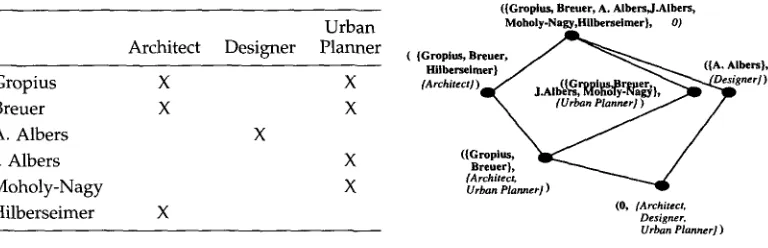
traditional theory of concepts, and consist of an extension and an i n t e n s i o n . The extension is a subset A of the set of objects G and the intension is a subset B of the set of attributes M. We call the pair (A,B) a formal concept if each object of the extension has all the properties of the intension. Thus, for the data shown in Figure 1, the pair ({Gropius, Breuer}, {Urban Planner, Architect}) represents a for- mal concept: each of the members of the extension possesses all the attributes men- tioned in the intension. The set of all concepts for some formal context can be com- puted effectively using the Next Closure algorithm developed by Ganter and Wille (1996).
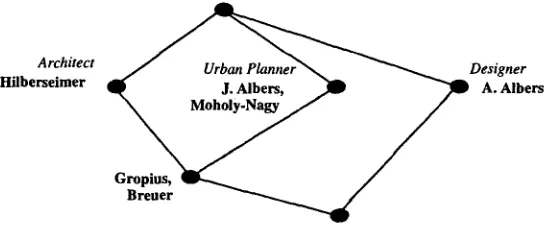
The main theorem of concept analysis then shows that the set of concepts for a formal context can be organized into a complete lattice structure under the follow- ing definition of the subconcept relation: a concept (A,B) is a subconcept of (A*,B*) if and only if A c A* ~ B* _c B (Wille 1982). The concept lattice m a y be con- structed by starting from the top concept (the one that has no superconcepts) and proceeding top-down recursively. In each step we compute the set of direct subcon- cepts and link them to the respective superconcept until we reach the greatest lower bound of the lattice itself (the existence of which is always guaranteed for finite-input data structures). An efficient implementation of this algorithm is given in Kamps (1997). The lattice corresponding to our example one-valued context is given to the right of Figure 1. This lattice shows the full labeling of formal concepts in order to ease comparison with the originating table. Much of this information is redun- dant, however, and so we generally use variations on the abbreviated, more concise, form shown in Figure 2. Such lattices naturally capture similarities and differences between the values of the specified attributes of objects: each concept of the lattice indicates objects with some set of values in common. Moreover, the generalizations are organized by subsumption, which supports the selection of most-specific sub- types.
Bateman, Kamps, Kleinz and Reichenberger Constructive Page Generation
Architect
Hilberseimer
•
__ Designer [image:5.468.33.313.60.174.2]Breuer ~
Figure 2
Concept lattice example, more succinctly labeled. Here, the extension label for each node consists of just those elements which are added at that node moving up the lattice; conversely the members of the intensions are shown moving down the lattice, again adding just those elements that are new for that node. For example, the node labeled simply Gropius, Breuer
[image:5.468.31.406.338.440.2]corresponds to the full form ({Gropius, Breuer}, {Architect, Urban Planner}) since both Gropius and Breuer are newly added to the extension at that node, while no new elements are added to the intension--'Architect' and 'Urban Planner' are both inherited from above.
Table 1
A collection of facts concerning artists and their professions drawn from the frame-based domain model used for the Dictionary of Art: biographies and re-expressed as a table of facts and attributes. (The facts are for illustrative purposes only and should not be taken as reliable statements of art history!)
Person Profession School Workperiod
gl Gropius Architect Harvard 1937-1951
g2 Breuer Architect Harvard 1937-1946
g3 A. Albers Designer Black Mountain College 1933-1949 g4 J. Albers Urban Planner Black Mountain College 1933-1949 g5 Moholy-Nagy Urban Planner New Bauhaus 1937-1938 g6 Hilberseimer Architect Illinois Institute of Technology 1938-1967
w h i c h are, in contrast to the o n e - v a l u e d - c o n t e x t case, not trivially either true or false, applicable or not. To identify the v a l u e w c W of attribute m E M for an object g E G, w e a d o p t the notation rn(g) = w a n d read this as attribute m of object g has value w.
Computational Linguistics Volume 27, Number 3
Person Profession School Workperiod
~
ProfessionScho
m(gl)=m(g6)
glg2
X
X
m(g4)=m(gS)m(g2)=m(g6)
glg6 X
gag6 x Period
]_
[ m(gl):m(g2)
g3g4 X X
m(g3)=m(g4)
~ ' ~ L
_
[image:6.468.56.424.54.159.2]g4g5 X t ' e r s o n
Figure 3
Example dependency context and corresponding lattice.
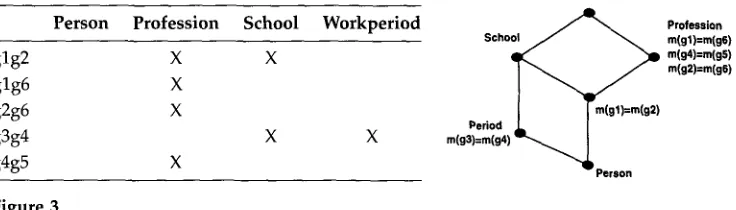
value for both the facts identified in the object labels of the leftmost column: for exam- ple, gl and g2 share the values of their Profession and School attributes. This provides a wholistic view of the dependency structure of the original data and is, moreover, computationally simple to achieve.
It is then straightforward to construct a dependency lattice as described above; this is shown to the right of Figure 3. The arcs in this lattice now represent the functional dependencies between the involved domains, and the equalities (e.g., m(gl)=m(g2)) represent the redundancies present in the data. For example, the lower left node labeled
Period
indicates not only that the third- and fourth-row entries underPeriod
(g3 and g4) are identical but also, following the u p w a r d arc, that these entries are equal with respect toSchool;
similarly, following u p w a r d arcs, the middle node (m(gl)=m(g2)) indicates that the first- and second-row entries (e.g., gl and g2) are equal with respect to bothSchool
andProfession. The
lattice as a whole indicates that there are functional relationships from the set of persons into the set of professions, the set of periods, and the set of schools. A further functional relationship exists from the set of periods into the set of schools.Once such a lattice has been constructed, we also have as a consequence a set of classifications of the original relational input, or dataset. This can directly drive visualization as follows. For graphics generation, it is important that all domains of the relation become graphically encoded: this means the encoding is complete. Kamps (1997) proposes a corresponding graphical encoding algorithm that starts encoding the bottom domain and walks up the lattice employing a bottom-up/left-to-right strategy for encoding the upper domains. The idea of this model, much abbreviated, is that the cardinality of the bottom domain is the largest, whereas the domains further up in the lattice contain fewer elements. Thus, the bottom domain is graphically encoded using so-called graphical elements (rectangle, circle, line, etc.), whereas the upper domains are encoded using graphical attributes (color, width, radius) and set-valued attributes that must be attached to graphical elements. In general, it is preferable to maximize graphical attributes over set-valued attributes as this keeps graphical complexity moderate.
Bateman, Kamps, Kleinz and Reichenberger Constructive Page Generation
', [ [ a.Albers i E l Uan'ard
[image:7.468.35.294.56.148.2]'_ ... ...
... ~_ _~_..p.q~_ _ _ ~ [Z3 ~,c
[- . I J.Aibe~ lib ,rr
[ ] Mohoiy-Nagy
. . . : a r c t ~ m c t s . . . . . .
[ J Breuer I I Gropius
Hiiberseir~r
. . .
(a)
Figure 4
J.Albers i [ ] ~ F . ~
,. ~ _ , .~o,y~.g.L. _:
193Q 1940 Z950 I ~ 19/0
(b)
Example diagrams generated for the example data. Alternatives are produced by two distinct traversals of the aggregation lattice.
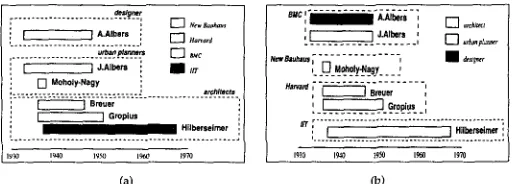
graphical attribute of the
length
of the rectangle. This is motivated by the equivalence of the properties of temporal intervals in the data and the properties of the graphical relationship of spatial intervals on the page. Two paths are then open: following the functional relationship first to either a set of schools or to a set of professions. Diagram (a) in Figure 4 adopts the first path and encodes the school relationship by means of the further graphical attribute of thecolor
of the rectangle, followed by a nesting rectangle for the relationship to Professions; diagram (b) illustrates the second path, in which the selection of graphical encodings is reversed. Both the selection of color and of nesting rectangles are again motivated by the correspondence between the formal properties of the graphical relations and those of the dependencies observed in the data. Reinstating the multiple professions of Gropius and Breuer mentioned in Figure 1 gives rise to a rather different dependency lattice in which the second solution is no longer possible.All of these mechanisms were implemented and used extensively for visualization in the context of an Editor's Workbench for supporting editorial decisions during the design of large-scale publications such as encyclopedias (Rostek, M6hr, and Fischer 1994; Kamps et al. 1996). 1
2.2 The Partial Equivalence of Diagram Design and Text Design
A selection of particular graphical elements entails the expression of particular func- tional dependencies. This is similar to decisions that need to be made when generating text. For instance, the equality rn(gl) = re(g2) in the lattice of Figure 3 above can also motivate a particular grouping of information in a corresponding linguistic presenta- tion. That is, whereas graphically the equality motivates an association of both Gropius and Breuer with the graphical attributes allocated to Professions and Schools, textually we m a y connect both artists in a single sentence: i.e., gl (concerning Gropius) and g2 (concerning Breuer) can be compactly expressed by collapsing their (identical) school and profession attributes:
Both Gropius and Breuer were architects and taught at Harvard.
A similar phenomenon holds for the grouping re(g3) = rn(g4); here, g3 (concerning A. Albers) and g4 (concerning J. Albers) may be succinctly expressed by collapsing their identical period and school attributes.
1 I n i t i a l l y d e v e l o p e d w i t h i n t h e E u r o p e a n U n i o n R e s e a r c h a n d D e v e l o p m e n t i n A d v a n c e d
Computational Linguistics Volume 27, Number 3
Combining these considerations motivates the following approximate textual re- rendering of diagram (b):
Anni Albers (who was a designer) and J. Albers (who was an urban planner) both taught at the BMC from 1933 until 1949. Moholy-Nagy (who was also an urban planner) taught from 1937 until 1938 at the New Bauhaus. Gropius and Breuer (both architects) were, at partially overlapping times (1937-1951 and 1937-1946 respectively), at Harvard. Hilberseimer (who was an architect too) taught at the IIT from 1938 until 1967.
A textual re-rendering of diagram (a) w o u l d reflect the contrasting groupings entailed there: i.e., Breuer, Gropius, and Hilberseimer w o u l d be grouped at top level whereas the two Albers w o u l d not.
A dependency lattice extracts partial commonalities that remain constant over subsets of the data to be presented and this is closely related to the problem of ag- gregation in NLG (cf., Dalianis [1999]). The functional redundancies captured b y the lattice construction are precisely those redundancies that indicate opportunities for structurally induced aggregation. Selecting a particular graphical element or attribute to realize some aspect of the data is in fact an aggregation step. In Bateman et al. (1998), we have shown this in terms more familiar to NLG b y re-interpreting in de- pendency lattice terms some of the standard examples of aggregation discussed in the literature. Below, we show that mutual consistency between textual fragments produced b y our NLG component and graphical elements produced b y the automatic visualization component can be enforced b y driving both from a common dependency lattice.
3. Preliminaries for Layout: Inputs and Outputs for the Layout Determination Task
Page layout, more properly termed
typographic design,
is usually divided into three levels:microtypography, macrotypography
(layout proper), and style. Here we are most concerned with macrotypography--the segmentation of a page of information into more or less closely related "visual blocks." Macrotypography is a central com- ponent of professional document design; indeed,Every designer knows that how elements are put together on a page communicates a powerful message (Adobe Inc., InDesign product in- formation sheet).
Unfortunately, with some valuable exceptions (cf., for example Schriver [1996], Waller [1988] and Bernhardt [1985]), the professionals do not then go on to tell us just what that message might be.
Bateman, Kamps, Kleinz and Reichenberger Constructive Page Generation
3.1 Layout structure
Issues of layout were already present within the visualization framework discussed above. For example, the relationship of the graphical blocks representing particular artists, or the positioning of the diagrams' legends with respect to the diagrams them- selves, all involve decisions of layout. The solution developed as part of the automatic visualization component used in the Editor's Workbench was to consider layout itself as a particular class of diagrams, with their own particular properties and concerns. An automatic page-layout component (APALO) was accordingly implemented as a specialization of the general visualization task.
Fully specified layout diagrams specify the physical placement and appearance of elements on a page. In order to generalize across such layouts we define an abstract level of representation called
Layout Structure.
Layout structure abstracts across the precise details of physical layouts to focus on classes of layouts that are visually "equivalent." Visually equivalent layouts suggest the same page blocks, with similar inter-block relationships of perceived prominence and similarity.Our view of layout structure draws heavily on Southall (1992), who defines a re- stricted set of typographical relation types. These include: containment, i.e. recursive block structure; reading order, i.e., generally left-to-right, top-to-bottom reading paths in Western cultures;
similarity,
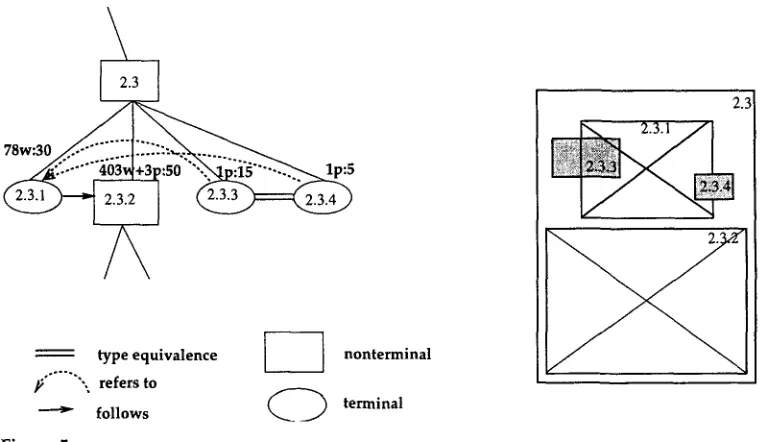
describing blocks that share some visual properties such as size, typeface selection, structure, etc.; and reference, where a connection be- tween visual blocks is suggested by physical proximity. We represent layout structures in terms of a tree structure (representing containment) augmented by a restricted set of possible additional annotations corresponding to the remaining typographical rela- tion types. The annotations thus serve either to further constrain the possible physical layouts that may render the layout structure, or to place mutual constraints on the ren- dering possibilities--for example, a type-equivalence annotation requires consistency in rendering decisions across the units declared to be type-equivalent.A simple example of layout structure and its correspondence to a physical layout is shown in Figure 5. Here we see that annotations also provide a numerical summary of the information to be displayed in any layout element (which may be either descriptive or denote a target): for example, node 2.3.2 in the figure is annotated 403w+3p:50, indicating that it consists of a block of text with 403 words and 3 pictures, and is allocated an importance score of 50%. 2 These scores impose target visual weights for corresponding page elements (i.e., more important nodes should be more prominent, which can be achieved by larger surface area combined with less but more heavy type, by use of prominent colors, etc.). More information concerning layout structure and its motivation is given in Reichenberger et al. (1996).
Given a fully specified layout structure as input, APALO renders it as a physical page by mapping constituency to nested boxes (i.e., inclusion diagrams), and strength of connection and sequence to spatial displacement: the boxes included within an en- closing box are arrayed two-dimensionally to influence reading order. Typographic attributes, such as type size, specific type face within the family (bold, italic etc.), arrangement of the type (ragged right, flush matter, etc.), leading, coloring and orien- tation, are all assigned at this stage, respecting any constraints on presentation given in the abstract layout structure. Since it is rarely the case that a layout structure is so tightly specified that only one physical layout is possible, the implementation uses progressive refinement and allows a user either to stop the process at any point or
Computational Linguistics Volume 27, Number 3
typeequivalence
I
] nonterminal
]J"
... "\refers to
follows
% _ ~ )terminal
[image:10.468.48.435.56.277.2]2.3
Figure 5
Example layout structure and its correspondence to a segment of page layout (adapted from Reichenberger et al. 1996). The "follows" annotation requires a page rendition where the reader will encounter 2.3.1 before 2.3.2, and the "refers to" links attract the type equivalent units 2.3.3 and 2.3.4 towards 2.3.1 without establishing a further visual block contrasting with 2.3.2.
to continue searching for better layouts until a stable state is achieved. The rendering aspect of APALO corresponds broadly to other components that have been designed for page layout (e.g., Feiner [1988] or Graf [1995]), b u t differs from these in that it is not restricted to a n y particular page model (e.g., a grid system).
Our subsequent considerations of layout motivation a d o p t fully specified layout structures as their target. Such structures will include presentation content as p r o d u c e d b y the natural-language-generation a n d automatic-diagram-generation components in their terminal elements, a n d are responsible for enforcing communicatively effective layouts.
3.2 Communicative-Functional Structure and its Relationship to Layout Structure
For automatic information presentation we also require a representation of the com- municative intentions to be fulfilled b y a presentation. For this, w e a d o p t " s t a n d a r d " rhetorical structure theory (RST) as set out in M a n n a n d T h o m p s o n (1986). RST is se- lected for two reasons: first, it is one of the most elaborated a n d w i d e l y u s e d forms of analysis of communicative intentions a n d has been applied to a w i d e variety of texts; a n d second, it is well established in NLG a n d has already been applied to m u l t i m o d a l information presentation (cf., Andr6 a n d Rist [1993]).
Originally, RST sought to describe the recursive structure of a n y text in terms
of
rhetorical relations
w h i c h hold b e t w e e n the segments (called spans) of the text.Bateman, Kamps, Kleinz and Reichenberger Constructive Page Generation
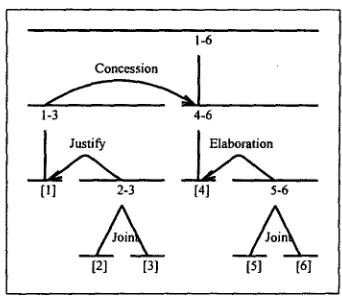
[1] There are many reasons that the Bauhaus movement spread to the U.S. [2] For example, more people became aware of their work in mag- azines. [3] Also, Bauhaus-designed objects came onto the market in increasing numbers. [4] But there were two main reasons. [5] First, many ex- Bauhaus members emigrated to the U.S. [6] And second, they started teaching Bauhaus methods in U.S. colleges.
1-6
I-3
[1] 2-3
_A
[2] [314-6
[4] 5-6
_A
[image:11.468.245.416.57.205.2][51 [6]
Figure 6
An example text representing both itself and its underlying propositions, and the corresponding communicative-intentional text plan represented in terms of RST.
realization. RST's functional orientation s u p p o r t e d a f u r t h e r re-interpretation of RST in w h i c h rhetorical relations b e c o m e p l a n operators for text construction (cf., M o o r e and Paris [1993]; H o v y [1993]). F r o m this perspective, rhetorical structures represent a plan for achieving some goal via linguistic means. The i n f o r m a t i o n m a i n t a i n e d at the leaves of such RST text p l a n structures is thus not pre-existing text, b u t rather chunks of i n f o r m a t i o n that are to receive textual realizations.
If, as is c o m m o n in NLG, w e consider the information-presentation task to involve the expression, or realization, of a text plan expressed according to RST and, further, w e see the l a y o u t u s e d in that i n f o r m a t i o n presentation as one of the decisions that n e e d s to be m a d e , then w e face the question as to w h e t h e r the text p l a n can also m o t i v a t e the necessary l a y o u t decisions. In Figure 6, w e s h o w a simple i n v e n t e d text f r a g m e n t and a c o r r e s p o n d i n g RST analysis. We will use this text in t w o ways: First, it stands as a s h o r t h a n d for a set of propositions from the k n o w l e d g e base or d o m a i n m o d e l - - d u r i n g NLG, a n d following text planning, the rhetorical structure is as s h o w n b u t the leaves identify the propositions indicated rather than textual elements. Second, the text stands as one possible
result
of the s u b s e q u e n t N L G process, w h e r e the propositions g r o u p e d in the text p l a n h a v e already received their linguistic realization. This d o u b l e use is harmless because w e d o not use the textual version to m o t i v a t e a n y of the decisions taken d u r i n g the N L G process w h o s e task it is to p r o d u c e it.Computational Linguistics Volume 27, Number 3
present the information in the nucleus (i.e., in this case, the claim that there are many reasons for the Bauhaus spreading is backed up by the examples offered in (2) and (3)); and the elaboration relationship holds when further specifying information concerning some aspect of the nucleus is given. There are approximately 25 RST relations in the standard set and space precludes giving more details of them here: their definitions and examples of use are given, however, in numerous places in both the computational and (text-)linguistic literature.
The realization of an RST structure as a natural language text involves many important issues which we will also not address here. Instead, we focus on the rela- tionship between an RST-style presentation plan, and layout decisions; in particular, given our goal of determining a layout structure that can then be rendered as a physi- cal page layout, we ask how the information in a rhetorical structure may be placed in correspondence with appropriate layout structures. In the text of the previous figure, for example, one layout decision that could be made is that there is no particular lay- out to be done--this is then equivalent to a straightforward, monomodal NLG system producing text only. The text in the figure is already an example. Another possible decision, lying at the opposite extreme, is to say that every node of the RST structure should find some direct correspondence in a node of the layout structure. This w o u l d be to require that the entire constituency structure of the RST tree be signaled visually in the layout. While both options are possible, it should be clear that there are many others. For example, span (1-3) could be represented as a single layout element (i.e., a single visual block consisting of a text paragraph) with span (4-6) breaking d o w n into, perhaps, a single layout element for the nucleus (6) and two further layout elements, one for each of the members of the satellite.
The situation is made yet more complex by the presence of a steady trade-off between information expressed via layout and information expressed via text. For example, if the spans (1-3) and (4-6) are allocated to distinct layout units, allowing them to vary independently of one another in terms of microtypography and physical placement, then it is considerably less likely that the RST concession relationship will be preserved linguistically. Similar considerations arise within the two spans: the more the RST structure is decomposed, resulting in typographical distinctions, the less use is made of explicit linguistic discourse marking. A compelling illustration of this can be seen in the complex graphic-text combination discussed in Kerpedjiev et al. (1998) in which a text fragment is re-expressed graphically.
This variability needs to be brought under motivated control. Information pre- sented together, or in similar styles, is perceived as related regardless of whether this was intended b y the page designer or not; conversely, information presented in differ- ent styles, or separated widely on the page, is interpreted as unrelated. Critical work in professional document design demonstrates that failure to respect such entailments of layout makes a page or diagram difficult to interpret and possibly misleading: see, for example, Schriver (1996) and the numerous references cited there. But it is also well known that not all of the possible details of document structure are normally presented in layout: the relationship is substantially more flexible. This presents a problem for any approach to multimodal presentation that adopts too close a relationship between presentation-plan elements and layout--as most previous systems have in fact done.
4. A Methodology for the Empirical Investigation of Communicative-Functional Page Layout
Bateman, Kamps, Kleinz and Reichenberger Constructive Page Generation
a representation such as RST--and a fully specified layout structure that passes on intention-appropriate constraints to a page-rendering engine, we embarked on an em- pirical investigation of the kinds of variability that occur in real documents. For this, we developed a methodology for exploring the functional basis of page layout in general. Two caveats are required here: first, our experimental method was exploratory--as one of the first studies of its kind, we needed to respond with flexibility to the results of the analysis; and second, since our aim was to move quickly from first analysis results to prototype system in order to evaluate the feasibility and value of the entire scenario in practice, the study was deliberately restricted in scope.
4.1 Method of Analysis
The provision of appropriate multimedia corpora for supporting the kind of empirical analysis we required is still, several years later, very much in its infancy. 3 The main criteria for the selection of pages for our investigation were (a) that the entire page be concerned with a single topic, while nevertheless presenting various aspects of that topic by means of varied text structuring and typographical and layout decisions, and (b) that the page demonstrate "interesting" layout. This led us to consider pages drawn from popular magazines, since these exhibit highly varied typographical and layout decisions in the hope of being eye-catching and maintaining interest.
The detailed structure of our study was as follows. We took a set of pages selected according to criteria (a) and (b), and asked for each page w h y it was set out as it was. We answered this question by:
°
2.
.
.
.
providing a layout structure representation for each page;
constructing a single "text" out of the entire "content" of the page (including headings, picture captions, pictures, etc.) that captured as far as possible the perceived purpose of the page;
performing a "functional text structure analysis" of the constructed text respecting the perceived purpose of the page (and therefore of the constructed text);
considering whether the page-layout structure could be derived straightforwardly from the text structure;
deriving and informally evaluating alternative "possible" layouts on the basis of a progressively refined set of layout principles.
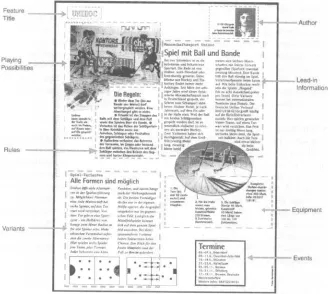
We illustrate our approach by setting out in detail one round of analysis concerning a single illustrated page. The page used is shown in Figure 7 and is drawn from the German illustrated sport and health magazine Fit for Fun (1995 (5), 92). The article describes various aspects of the game Unihoc, presenting background information con- cerning how the game is played, where it is popular, and w h y it is popular, as well as some pointers to further information and the equipment needed to play it. The page was typical of a series of feature articles being run in the magazine at that time. Particular elements expressed using layout in the page are indicated in the figure: significant here is solely the physical layout of the page, not the content.
Computational Linguistics Volume 27, Number 3
. . .
Feature , .;- ;~;. ,,; ; : . : -'. ... :
Title
Playing Possibiliti,
. . .
~Sp el mit Ball und Bande
Bei de. Schwcden ist n die tt ¢~en 5ic~ 5~¢h$¢I. M~n n. I b¢l~ (~ ~ t = ~ bck=nnt~= a r l ~ K e m mY r~tem Totw=.
s p o o n D~ 2.ee t . r e . S e S ~ b e ISpLe=¢Jt: =w~,=~ •
I fnnelt~ndy t I m a ~ t . Oiu¢ h=h ~ . ~ l p=~tl~ i ~ Spid ,
M Z ~ r a = H~kcy =rid EIs~ V ¢ ~ h f l a u t ' ~ ¢~tm kt~m ~ •
/ ~ l t lnK~, Seit Mine d ~ ~h(- d u d~¢ Sple~e .m¢se.d- - . IIg~ Jah~ wlrd d l ~ r d y = Fol$ ~ tcht A m w ~ h = ~
m ~ a e Ma v,t~chu~spe~ a ~ h pm TcamL O l ~ Vartlnt~
' tn IK-~Ichl=~ i~uptdt, dcr kommt I~4 i n ¢ ¢ ~ o n ~ l e n
b~,~r. Un~b~¢ ffl,~et. Je ~ c b ID~J~he U n t k ~ v c f ~ n ~
I ]
I
| , Alle Formen sind miiglich "N ' ~ - - - - ~ - . . . ~ . ' : ~ . ~
d--T~;~t,¢laeSp~. ~henr¢ld*Lcd,tli¢hdie ": { 8 1 o ( 1 ~ ek~ U l l ' , ~ .
I ~ =ktltcht~ V¢.¢andms er[or, spostn~#,rca Vta.ft~ L de.,hezweltral:er~v¢, h~b~ScJ.,~acnk~qae .
p.T.m.plusT.~a~ .ftl*ienMl~pltttru.ddt. Tcrmlne
. . . Author
. . . Lead-in Information
~ Equipment
~ Events
Figure 7
An original page for analysis. Source: 'Fit for Fun' 5:p92 (1995). The page is annotated here to show the major layout units.
4.2 An Illustrative Round of Analysis: Preparation
The starting point for our analysis w a s provided by our initial page-selection criteria, i.e., that there is some body of material that the author(s) of the page w i s h to present. It is then relevant (and necessary) to ask h o w this information is to be broken up for effective presentation. To do this, w e set out the content of each page as a single constructed text: The constructed text for the Unihoc page is given in Figure 8. Note that this text already reflects our understanding of the function of the page in its context of use: w e assume that the page has the main functions of informing readers about a game that they might not be familiar with and telling them that the game is in fact finding increasing support both internationally and nationally.
[image:14.468.72.402.56.350.2]Bateman, Kamps, Kleinz and Reichenberger Constructive Page Generation
[0] Astrid Frula, captain of the German National Unihoc team, writes: [1] A m o n g the Swedes it is the most popular and best-known branch of sport. [2] We are talking about Unihoc, also called Floorball or Indoor Bandy. [3] This mixture of hockey and ice hockey is attracting ever more supporters. [4a] Since the middle of the eighties, this dynamic team sport has also been played in Germany and [4b] the step to becoming a school sport is imminent. [5] Unihoc can be played in the g y m as well as outside, on grass or ice. [6a] Because the ball can be played with both sides of the stick, [6b] it is much easier to master than normal hockey. [7] One can continue playing behind the goal (four metres up to the board) and [8] there is no offside rule. [9] Stopping the ball with the stick and the foot is allowed, as well as playing via the board. [10] Raising the blade of the stick above knee height, or lifting, hitting, or holding the opponent's stick is not allowed. [11] Entering the goal area, playing the ball while lying or kneeling, moving the stick between the legs of the opponent, or engaging in hard b o d y contact is also prohibited. [12] Unihoc allows m a n y alternatives in h o w it is played. [13] One possibility: [14] each team has six players, and no goalie. [15a] In front of the goal there is a no- go area - [15b] no players are allowed within a semicircle of almost 2 meters in radius. [16] The second alternative requires more tactical insight: [17] here there are 6 players per team, plus a goalie. [18] Each receives a clear function, which determines their effective playing area. [19a] The two defenders m a y only act within their o w n half; [19b] in contrast, the two attackers m a y only play within their opponents' half. [20] Only the midfield players can run as they wish over the entire playing field. [21] In this exciting variant solo artists have no chance. [22] Spotting a free team member and passing the ball on are essential. [23] Two variants have become dominant. [24] On the large field (forty metres long, twenty metres wide) two six-person teams with fixed goalie oppose each other (Playing time: two times twenty minutes). [25a] A board keeps the ball continuously in play; [25b] rest periods hardly ever occur. [26] As in ice hockey, a player substituting for another does not lead to an interruption of play (up to eight substitute players per team). [27] This is the variant that is used in international matches. [28] The German Unihoc Union (0421/4984255) frequently goes back to the small field variant: [29] where mixed 4-person teams play without a goalie. [30] The playing field is only thirty metres long and sixteen metres wide, while the playing time is halved. [31] The goals are also smaller than on the large field. [32] The goals (60 x 90 centimeters) are collapsible. [33] In the gym, light holed plastic balls (20 grams, 8 centimeter diameter) are used. [34] The sticks (Kevlar 95 Mark, plastic 10 Mark) are 100 to 120 centimeters in length. [35] Complete sets of Unihoc equipment cost around 450 Marks. [36] Info: 05357/18181. [37] 05.- 07.5., D~isseldorf, [38] 09.-11.6., Clausthal~Zellerfeld, [39] 16.-18.6., Mfinchen, [40] 23.-25.6., Halle/Saale, [41] 03.-05.11., Bremen, [42] 10.-21.11., GOteborg, [43] 17.-19.11., Bremen, Deutsche Meisterschaften. [44] Further Info: 0421/23 94 01.
Additional graphical material:
A: Astrid Frula (photograph): 'authorial voice'
B: Player positions (diagram): two variations, B1 and B2
C: Unihoc equipment (photograph)
D: Unihoc being played on ice (photograph)
E: Unihoc being played in the g y m (photograph)
Figure 8
Constructed Unihoc text and graphical material used. Independent clauses (or major
Computational Linguistics Volume 27, Number 3
structed text. Text spans corresponding to sibling nuclei a n d satellites are considered unordered; a n y ordering in the text is only partial, as given b y the RST presentation plan.
This is d o u b l y appropriate here because w e cannot generally provide a unique linear text that re-expresses precisely the information that is given in an original two- dimensional page, a n d so this is not the constructed text's function here. The text simply provides a s h o r t h a n d for the content that m u s t necessarily be p r e s u m e d to un- derlie the page's production. Moreover, it is necessary in a n y case to reconstruct the intended content of the page because the page itself is u n s u i t e d to stand as the basis for an RST analysis. A page's most salient features are visual--i.e., t y p o g r a p h i c a l - - a n d part of our claim is that this is not directly indicative of rhetorical organization: relationships b e t w e e n visual blocks on the page are at a different level of abstraction than rhetorical relations. A s s u m i n g an equivalence of levels w o u l d probably lead to rhetorical analyses that primarily involve joint schemas conjoining the (many) top- level visual blocks of a n y page such as the Unihoc page; a n d at the same time it w o u l d leave the alternations across differing b u t communicatively similar layouts un- explained.
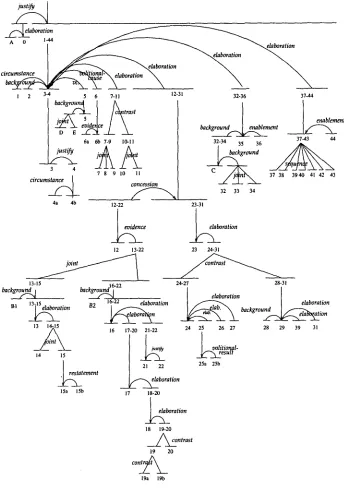
The RST analysis for the constructed Unihoc text, a n d hence of the page, is s h o w n in Figure 9. The RST analyses that we use were arrived at following the standard tech- niques of cross-coder checking, consultation a n d consensus. The RST d i a g r a m follows the conventions illustrated above in Figure 6 b u t uses considerably more rhetorical relations. Again, space precludes listing the definitions of the RST relations f o u n d in the analysis, b u t the definitions e m p l o y e d are exactly as given in the literature. The analysis in the figure also includes the information presented in the original page as p h o t o g r a p h s or diagrams. These have been labeled alphabetically (A, B, etc.) as iden- tified in Figure 8 a n d have been anchored into the RST-tree at appropriate places w i t h plausible relations. 4
The RST analysis makes our interpretation of the function of the t e x t / p a g e fully explicit. The central nucleus for the page as a whole is unit [3], i.e., This mixture of hockey and ice hockey is attracting ever more supporters. We are therefore considering the p r i m a r y purpose of the page to be a statement that Unihoc is becoming v e r y popular (and so the reader should be well up on it). The segments i m m e d i a t e l y following the nuclear span, [5] a n d [6], give some of the reasons w h y the sport is becoming so popular (with rhetorical relation volitional cause), a n d then segment [7-11] gives an overview of the do's a n d don'ts of the game. The main bulk of the constructed text consists of a concession that, a l t h o u g h Unihoc allows many alternatives in how it is played
[12], two variants have become dominant [23]. The existence of alternatives is s u p p o r t e d b y the two possibilities presented in segments [13-15] a n d [16-22], both related b y the relation evidence to the nuclear [12]; the two m a i n alternatives are elaborated in the explicit contrast d r a w n in segments [24-27] a n d [28-31]. Finally, the segments [32-36] a n d [37-44] provide additional elaborating material concerning where a n d w h e n the game can be seen a n d w h a t e q u i p m e n t is necessary to play it.
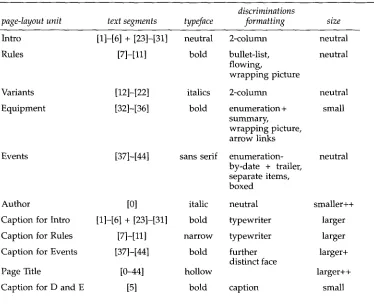
A page such as this presents a considerable challenge for models of automatic layout. A closer indication of this complexity is p r o v i d e d b y Table 2, which shows the correspondence b e t w e e n i n f o r m a t i o n a l segments identified in the RST presentation
Bateman, Kamps, Kleinz and Reichenberger Constructive Page Generation
..~,~aboration
•
~
x'~ lab°rati°n
~
circumstance
b a ¢ ~
/ - ' ~ K A _ ~ " ~ _ _ orati°n
elaboration
NNN .
~
1 2 3-4 5 6 7-11 12-31 32-36
..~ ~t 1 /c~trast
6a 6b 7-9 I0-II
"'*°
4
7 8 9 10 11
circu m $ 1 ~
concession
4a 4b 12-22
12 13-22
13-15
b a c ~
b a c k ~ o ~ 6-22BI
~ t i o n
B2
14 15
15a 15b
16-22
elaboration
16 17-20 21-22
I 21 22
elaboration
17 18-20
~
ration
18 19-20//~ontrast
19 20COI~t~
19a 19b Figure 9
32-34 35 36
32 33 34 23-31
...2~.~ rati°n
23 24-31
24-27 28-31
elaboration
I ~
[
elaboration
L b a c k g r ° u ~
i°n
24 25 26 27 28 29 39 31
I volitiwrlol-
...2,~'~ esult
25a 25b
37-44
37-43 44
37 38 3 9 4 0 41 42 43
Rhetorical structure theory analysis of the constructed Unihoc text.
p l a n a n d the l a y o u t e l e m e n t s identifiable in the p a g e ) We d o n o t believe that it will be possible in general to p r e d i c t precisely w h i c h aspects of a p r e s e n t a t i o n p l a n will be r e n d e r e d as distinctions in l a y o u t a n d w h i c h will be p a s s e d on for linguistic or g r a p h i -
[image:17.468.35.379.60.550.2]Computational Linguistics Volume 27, Number 3
Table 2
Distribution of information and layout forms for the original layout. Here: "flowing" with respect to a bullet or other list item indicates that items are run on within single lines and do not form separate paragraphs; relative font sizes are indicated by +. All text units are left-justified and right-ragged.
discriminations
page-layout unit text segments t y p e f a c e formatting size
Intro [1]-[6] + [23]-[31] neutral 2-column neutral
Rules [7]-[11] bold bullet-list, neutral
flowing,
wrapping picture
Variants [12]-[22] italics 2-column neutral
Equipment [32]-[36] bold enumeration + small
summary, wrapping picture, arrow links
Events [37]-[44] sans serif enumeration- neutral by-date + trailer,
separate items, boxed
Author [0] italic neutral smaller++
Caption for Intro [1]-[6] + [23]-[31] bold typewriter larger
Caption for Rules [7]-[11] narrow typewriter larger
Caption for Events [37]-[44] bold further larger+ distinct face
Page Title [0-44] hollow larger++
Caption for D and E [5] bold caption small
cal presentation. The p u r p o s e of our empirical investigation was therefore a s o m e w h a t different one: we sought to constrain this process of producing layout structures as far as possible, a n d to examine w h e t h e r certain allocations of informational units to layout units could be ruled out on general principles.
4.3 Alternative Renderings of the Constructed Text and their Evaluation
[image:18.468.53.427.120.424.2]Bateman, Kamps, Kleinz and Reichenberger Constructive Page Generation
~ e ~ m s s p o r t u n ~ , o ~
[image:19.468.39.412.52.306.2]G a ' r ~ v ~ a n d l ~
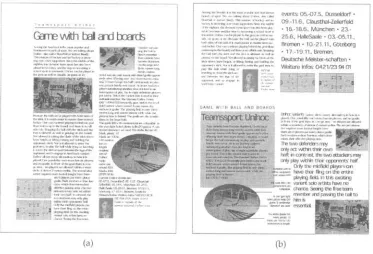
Figure 10
(a)
event:s: 05...07.5~ D ( . i S ~ • 09.-11.6., CtausthabZellerfeld • 16.-18.6., M O n c h e n * 2 3 . - 25,6.. HalleSaale • 0 3 . - 0 5 . 1 1 . ,
Bremen • 10.-21.11. C _ ~ • 17.-19.11., Bremen, D e u t : s ~ Me~ter.-schaften •
Weitere In~,s: 0 4 2 1 / ' 2 3 94 01
G&M[ WlFH BALL ANO BOARDS
Jn cor~ast. U'e t'~o atmc~rs rnay
On~ me mlar~eu p ~ T S Cm
vaiant s ~ ~rdsts I ~ e no ~ S ~ j ~re rre~ t ~
(b)
Contrasting page layouts decomposing the source text: (a) Page rendition with minimal layout decisions, (b) Page rendition with random layout decisions.
First, for example, we can note that if the aim of the a u t h o r / e d i t o r / m u l t i m o d a l presentation system were not to present an interesting page design, then a layout such as that shown in Figure 10(a) might suffice. This presentation contains almost no lay- out decisions that subdivide the text into segments or establish relations of similarity and difference among those segments. The only subdivisions are the heading, text- body, and author divisions; the pictures of the original have been inset into the main text block approximately where their content is touched upon in the text. Neverthe- less, this would seem a perfectly possible (if, by current tastes, dull) rendering of the material to be presented. It could be appropriate, for example, in an extremely densely presented lexicon or encyclopedia where space constraints and tradition suppress lay- out variation. This layout therefore serves to represent one endpoint in a continuum of possible layouts that need to be accommodated in any general account. It is also a further illustration of the trade-off between information that is expressed linguistically through explicit textual realization and information that is carried by the layout: our constructed Unihoc text needs to do more explicit linguistic signalling of discourse re- lations and communicative function than does the version employing layout. A reader should be able to recover this information from reading the text but it is not supported by an explicit layout encoding; we return to this issue below.
Computational Linguistics Volume 27, Number 3
i T 'ii
[image:20.468.48.234.59.142.2]J
Figure
11Example of a "non-natural" division of an RST structure.
in which choices, we w o u l d argue, have not been made coherently. The unmotivated decisions that make this layout incomprehensible include: the Unihoc variants section breaks d o w n into two parts of differing visual appearance; additional information
(events) becomes excessively important due to its prominent position and font size; and the information about the author is related only to the first textblock and not to the entire article. Such problems are identical to those arising in the NLG task: w h e n more flexibility of expression/presentation is made available---for example, by considering generation with respect to a grammar with broader coverage--it is essential to control this flexibility appropriately in order to avoid wrong decisions.
The problematic nature of the layout of Figure 10(b) can be succinctly stated: it violates our initial hypothesis concerning the desired correspondence between RST structure and layout structure: the constituency structure of the layout and that of the RST tree are in direct opposition at several points. For example, there is no distinc- tion drawn in type face between page elements introducing the game and describing the rules (which are relatively more nuclear), and elements describing some of the variants, whereas other variants are presented as a separate element with a larger, more prominent type face; these decisions are not, therefore, motivatable on the basis of the RST structure. Most serious, however, is the w a y in which the division into two elements describing the game variants has been done: these elements involve segments which do not correspond to RST-subtrees at all. Indeed, the second segment (corresponding to [19a]-[22] in the RST tree) goes further and breaks the RST structure at two points: segment [19a]-[20] is related b y elaboration to unit [18] while segment [21]-[22] is related, also b y elaboration, to unit [16]. The combined segment, [19a]-[22], is therefore composed of two completely disjoint and unrelated parts of the RST tree; we show this graphically in Figure 11. In general, such layout structures are indeed found to be difficult to interpret coherently (cf., Schriver [1996]).
The simplest strategy for producing an appropriate layout is therefore to restrict layout decomposition and constituency to the "natural divisions" established in the RST analysis. Any subtree is then, at least in principle, a candidate for selection as a layout unit. Accordingly, we suggest that the constructed layout shown in Figure 12 does fulfill the tasks of rendering the communicative intentions of the original page quite well. A relatively large number of layout decisions have been taken--for instance, the most important statements form a block of their o w n at the top of the page, additional peripheral information is placed in a vertical gray margin bar, and the main text is divided in two sections: The rules and Unihoc variants. Despite this diversity, the page remains coherent by virtue of the congruence of its layout structure with the RST structure; this is summarized in Table 3.
Bateman, Kamps, Kleinz and Reichenberger Constructive Page Generation
w e d e s i~ is t t e m o ~ popular a n d b e s r 4 ~ o w n
x r - W e a - e t a ! , , k ~ a b o ~ L ~ o c , atso caaecl
F k ~ i ~ ~r k~rx~r Bardy. Tl~s r n i x t ~ e o r I ~ a m t e h m : ~ y m a m a : U r m e m r m0re ~ ~ n c e t h e n ~ l e o f t t e
~ , t ~ s ~
tJmm Sl~rt has also
tram rm~, c~many
and m e s t ~ t o be~o- ~ spcct m m+ltmerm ++ ~ a y e d in l+e ~ + n as I~ e n ~ a s s e r ic~
al and
~ xeliarls ~ o c am, win rn~y ~ m U + m d+.ye~ told Im g ~ , tn fir++t a tae ~ denp ~+.
¢;~de ~r a ~ , z 2 r,~'e~ rar~u~ "I've ~ t ahprna~.
~ "n m P..~ dc~l~,m n my + + m t Wl~+ tl mA-
owl Jlam m +~ltra~ die t-~+ m may m + it=.y
i i ~ ~ tJ~ e,mre lJay~ 0ekl ~)
nm ~r++~nm On tke ~lg+ Plc~ {rrmy,+~ Imlp, t~ . ~ + + m+ m . m tem+m v~lth ~xod
im)~- lv.~ tmtm.s t...~ ~ i,~ ~m::st A
a I~.~P++ mJ~m~¢~ anc~Pr dc~ nm k.~d to an
¢ ~ . T I ~ ~ dm ~ ttlat is u~d tn b ~ ' r ~ u o l ~
~ Tt'~ c ~ ~ Un~+ ~ z W~PA2r~
In~ ~ d m mtly If~y n m I~g ard ~,.~,gre~ m-:res
~ ~ e=m ~ tie ~a~e P.dd
Figure 12
An example constructed page layout respecting natural divisions in the rhetorical structure.
Table 3
Distribution of information for a simple, coherent layout.
page layout unit text segments discriminations nuclearity
lead-in [1]-[5] larger type face x/
rules [6a]-[11] neutral
variants [12]-[31] neutral
equipment info [32]-[36] small, sans seriL on margin bar x events [37]-[44] small, sans serif, on margin bar x
authorship [A+0] small, italic, on margin bar x
[image:21.468.44.278.56.377.2] [image:21.468.38.420.446.533.2]Computational Linguistics Volume 27, Number 3
Figure 13
Correspondence between layout units and rhetorical structure in the original page. All of the blocks shown end up as siblings in the top-level layout structure because they are all visually quite distinct and variably moveable: they adopt differing typefaces, have no common left or right margins, are more or less evenly distributed over the page, etc.
ically in Figure 13 w h e r e the l a y o u t d e c o m p o s i t i o n is explicitly c o n t r a s t e d w i t h the RST structure; here w e can see that, a l t h o u g h the d e c o m p o s i t i o n generally respects RST subtrees, it is not the case that w e can t r a n s p a r e n t l y m a p this to a c o r r e s p o n d i n g recursive l a y o u t structure. This rather c o m m o n situation led us to accept that render- ing the i n f o r m a t i o n in an RST-structure is not a simple decomposition, b u t is itself a p l a n n e d activity. I n f o r m a t i o n is t a k e n from the RST-structure for v a r i o u s p u r p o s e s and, as a consequence, b o t h differing degrees of detail a n d v a r y i n g d e c o m p o s i t i o n s m u s t be s u p p o r t e d .
5. Towards Automatic Page Layout: An Algorithm for Communicatively Motivated Layout
Bateman, Kamps, Kleinz and Reichenberger Constructive Page Generation
We divide the mapping procedure into a core component, which supports the full range of layout options that appear possible given our corpus study, and a set of further heuristics that guide the translation process in particular cases. Most of the heuristics are concerned with the question of whether decomposition of the RST structure should stop at some point or continue to produce a more specific layout structure. In contrast, the core component is straightforward--mostly because the layouts observed exhibit such flexibility that few hard constraints seem to apply.
5.1 Core Translation Procedure: Recursive Descent
At any point in an RST structure, we can consider the correspondence between the RST subtree descending from that point and an appropriate layout structure. The translation procedure assumes strong locality in that, when decomposing a subtree, it does not look outside of that tree to make its decisions. As the layout structure is constructed, layout units can be either open, in which case they are still accepting additional material from the RST structure as recursive descent continues, or closed, in which case the extent of their content has been fixed. Translation begins by positing a single layout unit that will hold all of the content of the RST-subtree, and a single, at that point empty, open descendant layout unit. If the mapping process decides that there is no need for any further layout decomposition--as in a monomodal, traditional NLG environment with neither graphics nor headings--then the open layout unit is closed off containing the entire RST tree being considered. This content (and its rhetorical organization) would then be passed off to the natural language generator in the usual way.
In most documents, however, layout decomposition occurs, and so the layout structure has to be grown further. This is achieved by partitioning the set of RST- structure segments available at the current level of RST structure (segments are indi- cated in RST diagrams by the horizontal lines: cf., Figures 6 and 9) into those that are to be accepted into the current layout unit and those that are not. When any segment is not accepted, the RST relational link is cut at that point, the accepted segments are added to the current layout unit (which remains open), and the cut segment is added to a new, closed layout unit inserted parallel to the original layout unit. The accepted partition must include at least the nucleus at that level of RST structure; this means that it is not possible to include satellites in the current layout unit and then exclude the nucleus--this would correspond to the unnatural division shown in Figure 11 above. Crucially, it is quite possible for all of the segments to be accepted and for recursive descent to continue without having closed the current layout unit. Both closed and open layout units are then further developed according to the recursive structure of their respective RST segments.
When a decision is made to cut an RST link, and the segments to be partitioned belong to a multinuclear relation or joint schema, then all the related segments are extracted and associated with sibling layout units. The layout units thus introduced are also annotated with type-equivalence links, while reference annotations are added between pictures and text within single RST-structure segments. The weight annota- tions are allocated in direct proportion to the nucleus and satellite distinctions: the nucleus receives the highest weight, with the remaining distributed over the satellites (see Section 3). We have not yet been able to explore appropriate weightings in any sophisticated manner, and so their effect on alternative layouts remains a subject for further investigation.