Facilitating Evolution during
Design and Implementation
Richard McClatchey
Centre for Complex Cooperative Systems, UWE, Bristol BS16 1QY, UK
Tel: +44 (0)117 3283176 Fax: +44 (0)117 3283134 Email: [email protected]
Abstract: The volumes and complexity of data that companies need to handle are increasing at an accelerating rate. In order to compete effectively and ensure their commercial sustainability, it is becoming crucial for them to achieve robust traceability in both their data and the evolving designs of their systems. This is addressed by the CRISTAL software which was originally developed at CERN by UWE, Bristol, for one of the particle detectors at the Large Hadron Collider, which has been subsequently transferred into the commercial world. Companies have been able to
demonstrate increased agility, generate additional revenue, and improve the efficiency and cost-effectiveness with which they develop and implement systems in various areas, including business process management (BPM), healthcare and accounting applications. CRISTAL’s ability to
manage data and its semantic provenance at the terabyte scale, with full traceability over extended timescales, together with its description-driven approach, has provided the flexible adaptability required to future proof dynamically evolving software for these businesses.
Background to the CRISTAL System
Organisations of many types increasingly operate within environments that dictate
unforeseeable changes. Systems need to be able to evolve dynamically in response to
changes in technology and consequently there must be full traceability between the
design and the evolving system specification. Research at UWE’s Centre for Complex
Cooperative Systems (CCCS) from 1997 onwards (see [1] and [2]), has addressed the
need to be able to develop software whose specifications evolve beyond its design phase
and may have no definite endpoint. CCCS has developed an approach that allows systems
to reconfigure themselves dynamically, enabling software to be versioned and rolled out
into production to sit seamlessly alongside existing live systems without designer
intervention. Following such a semantic-based approach it has been shown [2] that
flexibility, interoperability, adaptability and simplicity of maintenance can be optimized.
This approach has been applied, in collaboration with CERN (Switzerland) and CNRS
(France), to the creation of a new software development environment called CRISTAL
Item
Workflow History
Current versions pointed to Properties
Name
State Type Collection
Typed Slot
Typed Slot
Item Item
Outcome Viewpoint
Activity Event
Generates Contains
Legend
Container
Object
Simple Value
[image:2.595.156.490.70.281.2] [image:2.595.168.485.482.725.2]Event Viewpoint Activity Outcome Collection
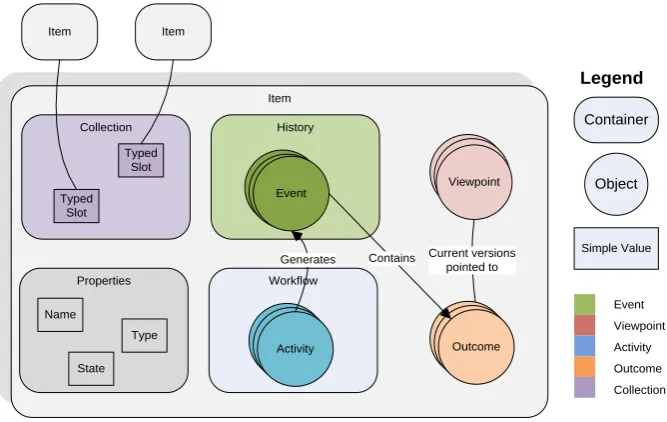
Figure 1. The components of adescription-driven Item in CRISTAL
CRISTAL embodies a “description-driven” approach [2]: all logic and data structures are
described by metadata, whose semantics are captured in a model which can be modified
and versioned online as the design of the system (in this case the experiment’s particle
detector) changes (see figure 1). Our research has shown that the creation of a flexible
system can be facilitated by modelling the metadata: the resulting software is reusable
across applications and can handle complexity, version control and system evolution.
CRISTAL was used to calibrate CMS and helped in its apparent discovery of the Higgs
Boson in 2012 (figure 2). The advantages of separating design, implementation and
During the construction period of the CMS Electromagnetic Calorimeter (ECAL [3])
from 1999 to 2008, over 70,000 individual lead tungstate crystals were characterised
(each yielding 3-5 Mbytes of data) and their data provenance captured in CRISTAL with
only minimal interruptions to round-the-clock operation. CRISTAL only needed to be
upgraded seven times during this period of near-continuous operation, and of those only
one was a required update that effected end-users.The underlying semantic model used to
store CMS construction data evolved many times between 2000 and 2008 but CRISTAL
provided uninterrupted data taking for the scientists and ease of system maintenance.
After the production-oriented workflows of CMS, CRISTAL was targeted at capturing
and storing scientific data provenance and workflow orchestration [6] in the EC-funded
neuGRID project (2008-2011) and its follow up neuGRIDforUsers project (N4U,
2012-2015). Clinical researchers in Italy, Netherlands and Sweden have been using CRISTAL
on the neuGRID infrastructure to support ongoing studies of Alzheimer’s Disease
biomarkers using CRISTAL to orchestrate their analysis procedures and to log outcomes
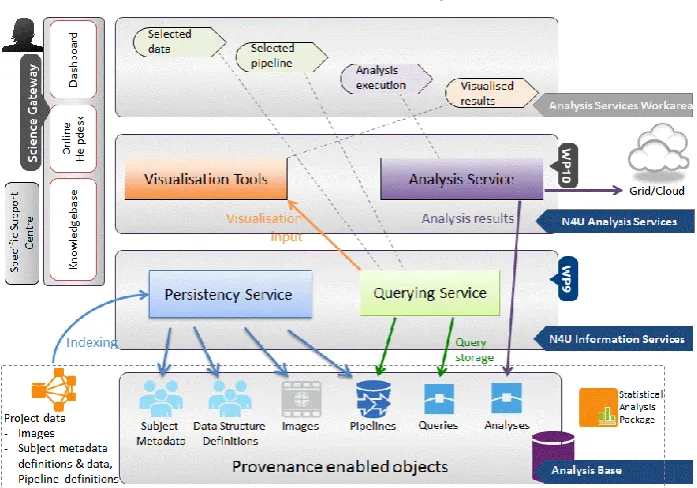
as part of their “Virtual Laboratory” (shown in Figure 3). The richness of the CRISTAL
model in terms of its knowledge representation enables the integration of heuristic-based
searches and the potential for the use of machine learning techniques for the optimization
[image:3.595.151.500.436.680.2]of analysis procedures in clinical research.
Transfer to Industry
The development of CRISTAL for managing workflows and product-related data was
conducted in close consultation with user communities – initially physicists and engineers
at CERN and latterly health practitioners. CRISTAL was made available by UWE to the
CMS ECAL user community from 2003; it also became the basis for a programme of
external exploitation by M1i, France, in Business Process Management (BPM). At M1i it
has demonstrated its ability to be responsive to changing user requirements and to support
on-the-fly system evolution over extended product lifecycles, due to the flexibility of its
underlying model. This has enabled M1i to supply its customers with guaranteed system
response and the ability to cater for changing requirements as well as flexibility in data
management and simplicity in system support. CRISTAL can handle the complexity of
data-intensive systems and provide the flexibility to adapt to the changing scenarios
typical of any production management system, or indeed any process in which workflow
and data traceability is crucial, including those employing AI solutions.
Via the product name Agilium it has been sold by M1i into the retail, finance and
manufacturing sectors of European industry, for use in the area of Business Process
Management (BPM) (see figure 3). Agilium used the CRISTAL kernel for workflow and
process traceability, and also for the integration and co-operation of multiple business
processes – especially in business-to-business applications. The M1i product enables
business processes to be harmonised and orchestrated in operation using a CRISTAL
database. It tracks their workflows and integrates multiple potentially heterogeneous
processes, such as order processing, stock control, sales management and business
logistics thus providing enterprise-wide data and information management. This has
found application in real-world industrial contexts, for example the systems used by
Nexcis for photovoltaic cell production, by the Ville de Lyon (France) for managing its
purchasing /ordering and operational procedures, and by the STTS specialist aerospace
painting/sealing for managing its internal business process controls. In particular Agilium
enables these customers to trace their data across applications and to adapt to system
evolution with little or no disruption to their live systems.
CRISTAL-Agilium also integrates the management of data coming from different sources
and unites Business Process Management with Business Activity Management (BAM)
and Enterprise Application Integration (EAI) through the capture and management of
Techniologies, SoTRADEL and Midor. The software is used to manage the business
processes of and between these commercial companies enabling M1i to gain a unique
position in the BPM market (as recognised by the Gartner Group, 2009). Income
generated by CRISTAL-Agilium licence sales by M1i in 2008-2013 top €1.6M.
Further Exploitation
CRISTAL has been recently further exploited by the Technoledge start-up company in
Switzerland. Starting early 2012, Technoledge has been working closely with UWE to
adapt CRISTAL to domains outside of BPM. Amongst other things, application of
CRISTAL by Technoledge has demonstrated, for the first time, full traceability from raw
materials to final product facilitated by the use of CRISTAL in manufacturing execution
systems. This has led to the following outcomes:
• Building on the way CRISTAL was used for experiment at CERN to integrate
different data structure versions together, Technoledge have deployed it to provide the
support environment for the development of production lines to manufacture
next-generation sustainable fuel cells for future electric vehicles.
• Technoledge has exploited CRISTAL to integrate previously outsourced software packages for a major French accountancy firm, taking advantage of CRISTAL’s
ability to manage several contrasting models in the same workspace.
• Since 2008 CRISTAL has been used by the neuGRIDforUsers (N4U) project to
provide a system for clinicians investigating complex 3D-imaging techniques to study
cortical thickness as a biomarker for Alzheimer’s disease. They have used CRISTAL
to track the analysis of complex algorithms and large data sets to help identify patients
who may be susceptible to mild cognitive impairment that could lead to the onset of
dementia. Early identification of such conditions is enabling doctors in medical
centres across Europe to diagnose Alzheimer’s Disease and thereby to prescribe
suitable drug therapies to slow its onset. CRISTAL plays an essential role in providing
a ‘Virtual Laboratory ’ as shown in figure 3 for supporting and logging the ongoing developments in Alzhemier’s Disease research (see [6] and [7]). CRISTAL has
enabled them to systematically manage their semantic data and processes in a
maintainable, more flexible and evolvable, and thus profitable, manner.
CRISTAL is being released in Q3 of 2014 under a LGPL V3.0 Open Source licence. The
software is available from the CRISTAL-ISE project web pages at www.cristal-ise.org or
via contact with the author of this paper. The software will be supported by an Open
Source community of users who are free to develop its Kernel or application ‘modules’
Futures
CRISTAL-iSE is an ongoing (2012-2016) project about fostering collaboration between
industrial partners and academia and the development of individual researchers in the
project. The partners involved in the project are from UWE, M1i (Annecy, France) and
Alpha-3i (Rumilly, France) [8]. At the end of the project it is foreseen that there will be
three final pieces of software developed. These will be a new open source version of
CRISTAL, a new version of Agilium based on this version of CRISTAL and Cimag-RA
(Alpha3i) which will be built upon both the work developed by UWE and M1i.In the
Cimag-RA application, both the new versions of Aglium and CRISTAL will be used to
create a Resource Allocation application. From the large datasets that are available
already, a PROV-compliant provenance model will be created to foster collaboration
between the wider provenance research communities in order to maximise the
commercial impact of the CRISTAL developments.
Acknowledgements : The development of CRISTAL has been made possible by the support of CERN, CNRS and UWE and colleagues therefrom and in the context of projects supported by the European Commission.
References
[1] Support for Product Data from Design to Production Z Kovacs, R. McClatchey & J-M le Goff Computer Integrated Manufacturing Systems DOI 10.1016/S0951-5240(98)00026-3. Elsevier Publishers 1998.
[2] A Distributed Workflow & Product Data Management Application for the Construction of Large Scale Scientific Apparatus R McClatchey et al., NATO ASI Series F : Computer & Systems Sciences DOI: 10.1007/978-3-642-58908-9_2. Springer- Verlag 1998.
[3] The CMS Experiment at the CERN LHC. The CMS Collaboration, Chatrchyan, S et al. The Journal of Instrumentation Vol: 3 DOI:10.1088/1748-0221/3/08/S08004 Institute of Physics Publishing 2008
[4] Pattern Reification as the Basis for Description-Driven Systems F. Estrella et al., Journal of Software and System Modeling DOI: 10.1007/s10270-003-0023-0 Springer-Verlag, 2003. [5] CRISTAL : A Practical Study in Designing Systems to Cope with Change A. Branson, R. McClatchey, J-M Le Goff & J Shamdasani Information Systems 42 (2014), DOI 10.1016/ j.is.2013.12.009 Elsevier Publishers 2014.
[6] Providing Traceability for Neuroimaging Analyses R McClatchey et al., International Journal of Medical Informatics DOI:10.1016/j.ijmedinf.2013.05.005 Elsevier publishers 2013.
[7] Intelligent Grid Enabled Services for Neuroimaging Analysis A. Anjum et al.,
Prof. McClatchey has been research active for the past
30 years and has led many projects funded by industry
and by the EC in the areas of large-scale distributed
data and knowledge management, in data modelling
and in systems design and integration. Currently a
Fellow of both the British Computer Society and the
Institute of Engineering and Technology with a PhD in
Physics (Sheffield, 1982) and DPhil in Computer
Science (West of England, UWE 1999), McClatchey has published over 200 papers and
has held the Chair of Applied Computer Science at UWE since2000. His current research
interest lies in Cloud data and knowledge representation and management and particularly
in its application in medicine and smart cities. He currently leads the Centre for Complex
Cooperative Systems at UWE and is active in
collaborative projects at CERN, and with many
international partners in numerous EC projects including Health-e-Child, SHARE,
neuGRID/N4U and CRISTAL-ISE. He has chaired several international conferences,