inorganic papers
Acta Cryst.(2007). E63, i73–i74 doi:10.1107/S1600536807007507 Lianget al. LiNi
0.66Fe0.34PO4
i73
Acta Crystallographica Section EStructure Reports
Online
ISSN 1600-5368
LiNi
0.66Fe
0.34PO
4Gan Liang,aRonald E. Benson,b* Jiying Li,cDavid Vaknincand Lee M. Danielsb
aDepartment of Physics, Sam Houston State
University, Huntsville, Texas 77341, USA, bRigaku Americas Corporation, 9009 New Trails
Drive, The Woodlands, TX 77381, USA, and cAmes Laboratory and Department of Physics &
Astronomy, Iowa State University, Ames, Iowa 50011, USA
Correspondence e-mail: [email protected]
Key indicators
Single-crystal X-ray study
T= 150 K
Mean(P–O) = 0.002 A˚ Disorder in main residue
Rfactor = 0.020
wRfactor = 0.043 Data-to-parameter ratio = 8.0
For details of how these key indicators were automatically derived from the article, see http://journals.iucr.org/e.
Received 30 January 2007 Accepted 13 February 2007
#2007 International Union of Crystallography All rights reserved
Lithium nickel(II) iron(II) phosphate, LiNi0.66Fe0.34PO4, was
crystallized from an LiCl melt. The structure is closely related
to the known phase LiFePO4but with mixed occupancy at the
metal atom site of approximately 66% nickel and 34% iron. The Ni/Fe atom is octahedrally coordinated by six O atoms. The P atoms are tetrahedrally coordinated by four O atoms.
Comment
The solid-state phase LiFePO4 was first structurally
char-acterized by X-ray diffraction in 1938 (Bjo¨rling & Westgren, 1938). However, the potential use of this olivine phase as a
cathode material was not reported until 1997 (Padhi et al.,
1997). Currently, the material is the focus of research and development of lithium ion batteries. The late arrival of
LiFePO4 and related structures as candidates for possible
cathode materials is primarily due to their low inherent elec-trical conductivity. Most prior scientific investigations were focused on materials with edge-shared transition metal octa-hedra, often exhibited in spinel structures (Tarascon & Armand, 2001). Transition metal oxides with edge-shared octahedra are more efficient ion conductors and tend to retain
their structure better during reduction. Although LiFePO4
contains both edge-shared and corner-shared polyhedra, marked increases in conductivity are observed by intercalating
LiFePO4with multivalent cations such as Mg, Ti, W, and Al
[image:1.610.207.459.509.691.2](Thackeray, 2002). A partially nickel-substituted compound,
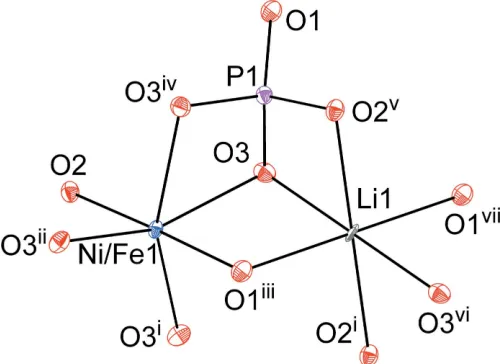
Figure 1
The asymmetric unit of LiNi0.66Fe0.34PO4 with additional atoms to complete the coordination environments. Displacement ellipsoids are drawn at the 80% probability level. [Symmetry codes (i)x+1
2,y,z 1 2, (ii)x+1
2,y+ 1 2,z
1
2, (iii)x,y,z1, (iv)x,y+ 1
2,z, (v)x 1 2,y+
1 2,
z+1
LiNi0.66Fe0.34PO4has been characterized and its structure is
presented here.
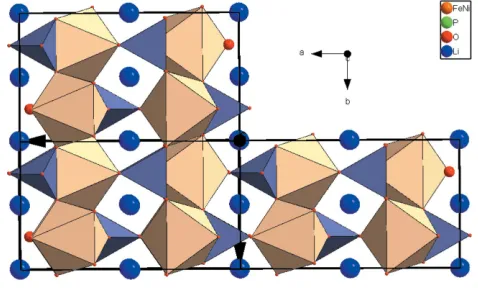
The title compound is isostructural with LiFePO4. It
featuresMO6octahedra (M= Fe, Ni) and PO4tetrahedra that
form alternating ‘chains’ of corner-sharing and edge-sharing polyhedra along the [100] and [001] directions. Conversely, in the (010) plane there is a discrete layer of edge-sharing polyhedra followed by a discrete layer of corner-sharing polyhedra as one moves down the [100] axis. Lithium cations
reside in the cavities between the polyhedra, yielding LiO6
octahedra. Approximately 66 (4)% of the metal-atom sites in the structure are occupied by Ni, which is somewhat lower than the 80 mol-% in the starting mixture. In the flux growth,
the chemical reaction of the NiCl2in certain portions of the
starting mixture might not be fully completed, resulting in an Ni concentration in the analyzed crystal which is different from that in the starting mixture.
TheMO6 octahedra are severely distorted [cis-O—Ni—O
angles between 68.53 (8) and 114.22 (9)]. Even the LiO
6
octahedra are rather distorted [cis-O—Li—O 71.82 (7)–
108.18 (7)]. Similar distortions, albeit to a lesser extent, are
observed in the PO4 tetrahedra, with angles in the range
102.69 (2)–113.90 (8)The site occupation factors of Fe and
Ni were refined with the constraintxNi= 1xFe.
Experimental
Synthesis: LiNi0.66Fe0.34PO4 single crystals were grown in sealed platinum crucibles by standard flux-growth techniques with LiCl as the flux. High purity FeCl2 (99.999% Aldrich), NiCl2 (99.999% Aldrich) and Li3PO4(99.999% Aldrich) powders were mixed with a molar ratio of 1:4:5. A small hole of about 50mm diameter was drilled in the crucible to release the pressure from the high vapor pressure of LiCl. The mixture was pre-melted at 800 K for 2 h, heated to 890 K over 5 h, soaked at 890 K for 10 h, slowly cooled to 710 K at a rate of 0.7 K h1and then further cooled to 650 K at 1.5 K h1. The furnace was turned off at 650 K. The crystals were extracted from the mixture
red–brown color and a volume of about 0.1 mm3. Powder X-ray diffraction of the crushed single crystals revealed a single-phase product.
Crystal data
LiNi0.66Fe0.34PO4
Mr= 159.63
Orthorhombic,Pnma a= 10.0871 (16) A˚
b= 5.8845 (10) A˚
c= 4.6820 (8) A˚
V= 277.91 (8) A˚3
Z= 4
MoKradiation
= 6.84 mm1
T= 150 (2) K 0.190.180.14 mm
Data collection
Rigaku SCXmini diffractometer Absorption correction: multi-scan
(ABSCOR; Higashi, 1995)
Tmin= 0.568,Tmax= 0.692
(expected range = 0.309–0.376)
2026 measured reflections 345 independent reflections 328 reflections withI> 2(I)
Rint= 0.033
Refinement
R[F2> 2(F2)] = 0.020
wR(F2) = 0.044
S= 1.18 345 reflections
43 parameters
max= 0.37 e A˚
3 min=0.47 e A˚
3
Table 1
Selected bond lengths (A˚ ).
Ni1—O2 2.051 (2) Ni1—O3i
2.0557 (15) Ni1—O1ii
2.111 (2) Ni1—O3iii 2.1599 (15)
P1—O1 1.523 (2)
P1—O2iv 1.538 (2) P1—O3iii
1.5572 (16) Li1—O2iv
2.0844 (15) Li1—O3v 2.1327 (15) Li1—O1vi
2.1464 (16)
Symmetry codes: (i) xþ1 2;y;z
1
2; (ii) x;y;z1; (iii) x;yþ 1 2;z; (iv)
x1 2;yþ
1 2;zþ
1
2; (v)x;y;z; (vi)x;y;zþ1.
Data collection: PROCESS-AUTO (Rigaku, 1998); cell refine-ment:SCXmini Benchtop Crystallography System Software(Rigaku, 2006); data reduction:CrystalStructure (Rigaku, 2005); program(s) used to solve structure: SHELXS97(Sheldrick, 1997); program(s) used to refine structure: SHELXL97 (Sheldrick, 1997); molecular graphics:SCXmini Benchtop Crystallography System Software; soft-ware used to prepare material for publication:CrystalStructure.
The work at Sam Houston State University is supported by a grant from the SHSU EGR program. The work at Ames Laboratory is supported by the Department of Energy, Office of Basic Energy Sciences under contract number W-7405-Eng-82.
References
Bjo¨rling, C. O. & Westgren, A. (1938).Stockholm Fo¨rhandlingar60, 67–72. Higashi, T. (1995).ABSCOR. Rigaku Corporation, Tokyo, Japan.
Padhi, A. K., Najundaswamy, K. S. & Goodenough, J. B. (1997). J.
Electrochem. Soc.144, 1188–1194.
Rigaku (1998).PROCESS-AUTO. Rigaku Corporation, Tokyo, Japan. Rigaku (2005).Crystal Structure. Version 3.7. Rigaku Americas Corporation,
The Woodlands, Texas, USA.
[image:2.610.51.290.72.216.2]Rigaku (2006).SCXmini Benchtop Crystallography System Software, Version 1.0. Rigaku Americas Corporation, The Woodlands, Texas, USA. Sheldrick, G. M. (1997).SHELXS97andSHELXL97. Unversity of Go¨ttingen,
Figure 2
supporting information
sup-1 Acta Cryst. (2007). E63, i73–i74
supporting information
Acta Cryst. (2007). E63, i73–i74 [https://doi.org/10.1107/S1600536807007507]
LiNi
0.66Fe
0.34PO
4Gan Liang, Ronald E. Benson, Jiying Li, David Vaknin and Lee M. Daniels
Lithium ferrous nickel phosphate
Crystal data
LiNi0.66Fe0.34PO4
Mr = 159.63
Orthorhombic, Pnma
Hall symbol: -P 2ac 2n
a = 10.0871 (16) Å
b = 5.8845 (10) Å
c = 4.6820 (8) Å
V = 277.91 (8) Å3
Z = 4
F(000) = 416
Dx = 3.815 Mg m−3
Dm = 3.749 Mg m−3
Dm measured by floatation Mo Kα radiation, λ = 0.71075 Å Cell parameters from 50 reflections
θ = 1.0–27.5°
µ = 6.84 mm−1
T = 150 K
Block, dark amber-brown 0.19 × 0.18 × 0.14 mm
Data collection
Rigaku SCXmini diffractometer
Radiation source: fine-focus sealed tube Graphite monochromator
Detector resolution: 4900 pixels mm-1 data collected from ω scans
Absorption correction: multi-scan (ABSCOR; Higashi, 1995)
Tmin = 0.568, Tmax = 0.692
2026 measured reflections 345 independent reflections 328 reflections with I > 2σ(I)
Rint = 0.033
θmax = 27.5°, θmin = 4.0°
h = −13→12
k = −7→7
l = −6→5
Refinement
Refinement on F2 Least-squares matrix: full
R[F2 > 2σ(F2)] = 0.020
wR(F2) = 0.044
S = 1.18 345 reflections 43 parameters 0 restraints
Primary atom site location: structure-invariant direct methods
Secondary atom site location: difference Fourier map
w = 1/[σ2(F
o2) + (0.0162P)2 + 0.3281P] where P = (Fo2 + 2Fc2)/3
(Δ/σ)max < 0.001 Δρmax = 0.37 e Å−3 Δρmin = −0.47 e Å−3
Special details
Experimental. high-temperature flux
Geometry. All e.s.d.'s (except the e.s.d. in the dihedral angle between two l.s. planes) are estimated using the full covariance matrix. The cell e.s.d.'s are taken into account individually in the estimation of e.s.d.'s in distances, angles and torsion angles; correlations between e.s.d.'s in cell parameters are only used when they are defined by crystal symmetry. An approximate (isotropic) treatment of cell e.s.d.'s is used for estimating e.s.d.'s involving l.s. planes.
Refinement. Refinement of F2 against ALL reflections. The weighted R-factor wR and goodness of fit S are based on F2, conventional R-factors R are based on F, with F set to zero for negative F2. The threshold expression of F2 > σ(F2) is used only for calculating R-factors(gt) etc. and is not relevant to the choice of reflections for refinement. R-factors based on F2 are statistically about twice as large as those based on F, and R- factors based on ALL data will be even larger.
Fractional atomic coordinates and isotropic or equivalent isotropic displacement parameters (Å2)
x y z Uiso*/Ueq Occ. (<1)
Ni1 0.27649 (4) 0.2500 −0.01877 (8) 0.0034 (2) 0.66
Fe1 0.27649 (4) 0.2500 −0.01877 (8) 0.0034 (2) 0.34
P1 0.09411 (8) 0.2500 0.41781 (17) 0.0041 (2)
O1 0.0988 (2) 0.2500 0.7429 (5) 0.0058 (5)
O2 0.4521 (2) 0.2500 0.2019 (5) 0.0051 (5)
O3 0.16550 (14) 0.0433 (3) 0.2782 (3) 0.0058 (4)
Li1 0.0000 0.0000 0.0000 0.0050 (11)
Atomic displacement parameters (Å2)
U11 U22 U33 U12 U13 U23
Ni1 0.0031 (3) 0.0022 (3) 0.0048 (3) 0.000 −0.00022 (14) 0.000
Fe1 0.0031 (3) 0.0022 (3) 0.0048 (3) 0.000 −0.00022 (14) 0.000
P1 0.0040 (4) 0.0033 (4) 0.0049 (4) 0.000 0.0003 (3) 0.000
O1 0.0061 (11) 0.0050 (10) 0.0063 (11) 0.000 −0.0006 (9) 0.000
O2 0.0043 (11) 0.0043 (10) 0.0067 (11) 0.000 0.0005 (9) 0.000
O3 0.0070 (8) 0.0044 (7) 0.0060 (7) 0.0007 (6) 0.0014 (6) 0.0001 (5)
Li1 0.006 (3) 0.005 (2) 0.004 (3) −0.004 (2) −0.0009 (18) −0.0013 (18)
Geometric parameters (Å, º)
Ni1—O2 2.051 (2) O1—Li1vi 2.1464 (16)
Ni1—O3i 2.0557 (15) O2—P1vii 1.538 (2)
Ni1—O3ii 2.0557 (15) O2—Li1viii 2.0844 (15)
Ni1—O1iii 2.111 (2) O2—Li1ix 2.0844 (15)
Ni1—O3iv 2.1599 (15) O3—Fe1x 2.0557 (15)
Ni1—O3 2.1600 (15) O3—Ni1x 2.0557 (15)
Ni1—P1 2.7501 (10) O3—Li1 2.1327 (15)
Ni1—Li1 3.1544 (5) Li1—O2v 2.0844 (15)
Ni1—Li1iv 3.1544 (5) Li1—O2xi 2.0844 (15)
P1—O1 1.523 (2) Li1—O3xii 2.1327 (15)
P1—O2v 1.538 (2) Li1—O1xiii 2.1464 (16)
P1—O3iv 1.5572 (16) Li1—O1iii 2.1464 (16)
supporting information
sup-3 Acta Cryst. (2007). E63, i73–i74
P1—Li1iv 2.6253 (7) Li1—Li1xiv 2.9423 (5)
O1—Fe1vi 2.111 (2) Li1—Ni1xii 3.1544 (5)
O1—Ni1vi 2.111 (2) Li1—Fe1xii 3.1544 (5)
O2—Ni1—O3i 89.26 (5) Fe1x—O3—Ni1x 0.000 (19)
O2—Ni1—O3ii 89.26 (5) P1—O3—Li1 89.30 (7)
O3i—Ni1—O3ii 114.22 (9) Fe1x—O3—Li1 113.88 (7)
O2—Ni1—O1iii 178.34 (8) Ni1x—O3—Li1 113.88 (7)
O3i—Ni1—O1iii 89.84 (5) P1—O3—Ni1 94.03 (7)
O3ii—Ni1—O1iii 89.84 (5) Fe1x—O3—Ni1 128.53 (7)
O2—Ni1—O3iv 97.09 (6) Ni1x—O3—Ni1 128.53 (7)
O3i—Ni1—O3iv 156.63 (7) Li1—O3—Ni1 94.59 (6)
O3ii—Ni1—O3iv 88.42 (4) O2v—Li1—O2xi 180.00 (9)
O1iii—Ni1—O3iv 84.28 (6) O2v—Li1—O3 71.82 (7)
O2—Ni1—O3 97.09 (6) O2xi—Li1—O3 108.18 (7)
O3i—Ni1—O3 88.42 (4) O2v—Li1—O3xii 108.18 (7)
O3ii—Ni1—O3 156.63 (7) O2xi—Li1—O3xii 71.82 (7)
O1iii—Ni1—O3 84.28 (6) O3—Li1—O3xii 180.0
O3iv—Ni1—O3 68.53 (8) O2v—Li1—O1xiii 90.04 (6)
O2—Ni1—P1 101.74 (6) O2xi—Li1—O1xiii 89.96 (6)
O3i—Ni1—P1 122.29 (4) O3—Li1—O1xiii 95.91 (7)
O3ii—Ni1—P1 122.29 (4) O3xii—Li1—O1xiii 84.09 (7)
O1iii—Ni1—P1 79.92 (6) O2v—Li1—O1iii 89.96 (6)
O3iv—Ni1—P1 34.39 (4) O2xi—Li1—O1iii 90.04 (6)
O3—Ni1—P1 34.39 (4) O3—Li1—O1iii 84.09 (7)
O2—Ni1—Li1 138.57 (4) O3xii—Li1—O1iii 95.91 (7)
O3i—Ni1—Li1 82.70 (4) O1xiii—Li1—O1iii 180.00 (10)
O3ii—Ni1—Li1 131.01 (4) O2v—Li1—P1 35.84 (6)
O1iii—Ni1—Li1 42.62 (4) O2xi—Li1—P1 144.16 (6)
O3iv—Ni1—Li1 77.66 (4) O3—Li1—P1 36.38 (4)
O3—Ni1—Li1 42.37 (4) O3xii—Li1—P1 143.62 (4)
P1—Ni1—Li1 52.252 (16) O1xiii—Li1—P1 97.70 (5)
O2—Ni1—Li1iv 138.57 (4) O1iii—Li1—P1 82.30 (5)
O3i—Ni1—Li1iv 131.01 (4) O2v—Li1—P1xii 144.16 (6)
O3ii—Ni1—Li1iv 82.70 (4) O2xi—Li1—P1xii 35.84 (6)
O1iii—Ni1—Li1iv 42.62 (4) O3—Li1—P1xii 143.62 (4)
O3iv—Ni1—Li1iv 42.37 (4) O3xii—Li1—P1xii 36.38 (4)
O3—Ni1—Li1iv 77.66 (4) O1xiii—Li1—P1xii 82.30 (5)
P1—Ni1—Li1iv 52.252 (16) O1iii—Li1—P1xii 97.70 (5)
Li1—Ni1—Li1iv 55.597 (13) P1—Li1—P1xii 180.0
O1—P1—O2v 113.17 (13) O2v—Li1—Li1iv 45.11 (4)
O1—P1—O3iv 113.90 (8) O2xi—Li1—Li1iv 134.89 (4)
O2v—P1—O3iv 106.12 (8) O3—Li1—Li1iv 83.13 (4)
O1—P1—O3 113.90 (8) O3xii—Li1—Li1iv 96.87 (4)
O2v—P1—O3 106.12 (8) O1xiii—Li1—Li1iv 133.27 (4)
O3iv—P1—O3 102.69 (12) O1iii—Li1—Li1iv 46.73 (4)
O1—P1—Li1 139.12 (5) P1—Li1—Li1iv 55.919 (11)
O3iv—P1—Li1 106.98 (7) O2v—Li1—Li1xiv 134.89 (4)
O3—P1—Li1 54.32 (6) O2xi—Li1—Li1xiv 45.11 (4)
O1—P1—Li1iv 139.12 (5) O3—Li1—Li1xiv 96.87 (4)
O2v—P1—Li1iv 52.53 (6) O3xii—Li1—Li1xiv 83.13 (4)
O3iv—P1—Li1iv 54.32 (6) O1xiii—Li1—Li1xiv 46.73 (4)
O3—P1—Li1iv 106.98 (7) O1iii—Li1—Li1xiv 133.27 (4)
Li1—P1—Li1iv 68.16 (2) P1—Li1—Li1xiv 124.082 (11)
O1—P1—Ni1 136.23 (9) P1xii—Li1—Li1xiv 55.918 (11)
O2v—P1—Ni1 110.61 (9) Li1iv—Li1—Li1xiv 180.0
O3iv—P1—Ni1 51.58 (6) O2v—Li1—Ni1xii 96.07 (5)
O3—P1—Ni1 51.58 (6) O2xi—Li1—Ni1xii 83.93 (5)
Li1—P1—Ni1 71.82 (2) O3—Li1—Ni1xii 136.96 (4)
Li1iv—P1—Ni1 71.82 (2) O3xii—Li1—Ni1xii 43.04 (4)
P1—O1—Fe1vi 123.70 (13) O1xiii—Li1—Ni1xii 41.77 (6)
P1—O1—Ni1vi 123.70 (13) O1iii—Li1—Ni1xii 138.23 (6)
Fe1vi—O1—Ni1vi 0.000 (18) P1—Li1—Ni1xii 124.08 (2)
P1—O1—Li1xv 123.10 (8) P1xii—Li1—Ni1xii 55.92 (2)
Fe1vi—O1—Li1xv 95.61 (8) Li1iv—Li1—Ni1xii 117.799 (7)
Ni1vi—O1—Li1xv 95.61 (8) Li1xiv—Li1—Ni1xii 62.201 (7)
P1—O1—Li1vi 123.10 (8) O2v—Li1—Fe1xii 96.07 (5)
Fe1vi—O1—Li1vi 95.61 (8) O2xi—Li1—Fe1xii 83.93 (5)
Ni1vi—O1—Li1vi 95.61 (8) O3—Li1—Fe1xii 136.96 (4)
Li1xv—O1—Li1vi 86.53 (8) O3xii—Li1—Fe1xii 43.04 (4)
P1vii—O2—Ni1 128.37 (13) O1xiii—Li1—Fe1xii 41.77 (6)
P1vii—O2—Li1viii 91.63 (8) O1iii—Li1—Fe1xii 138.23 (6)
Ni1—O2—Li1viii 122.50 (7) P1—Li1—Fe1xii 124.08 (2)
P1vii—O2—Li1ix 91.63 (8) P1xii—Li1—Fe1xii 55.92 (2)
Ni1—O2—Li1ix 122.50 (7) Li1iv—Li1—Fe1xii 117.799 (7)
Li1viii—O2—Li1ix 89.79 (8) Li1xiv—Li1—Fe1xii 62.201 (7)
P1—O3—Fe1x 126.39 (9) Ni1xii—Li1—Fe1xii 0.000 (16)
P1—O3—Ni1x 126.39 (9)