On Maximal Subgroups of Free Idempotent
Generated Semigroups
R. Gray∗, N. Ruskuc July 20, 2010
Abstract
We prove the following results: (1) Every group is a maximal sub-group of some free idempotent generated semisub-group. (2) Every finitely presented group is a maximal subgroup of some free idempotent gen-erated semigroup arising from a finite semigroup. (3) Every group is a maximal subgroup of some free regular idempotent generated semi-group. (4) Every finite group is a maximal subgroup of some free regular idempotent generated semigroup arising from a finite regu-lar semigroup. As a technical prerequisite for these results we es-tablish a general presentation for the maximal subgroups based on a Reidemeister–Schreier type rewriting.
2000 Mathematics Subject Classification: 20M05, 20F05.
1 Introduction and summary of results
LetSbe a semigroup, and letE= E(S)be the set of idempotents ofS. The free idempotent generated semigrouponEis defined by the following presen-tation:
IG(E) =hE|e·f =e f (e,f ∈E, {e,f} ∩ {e f,f e} 6=∅)i. (1)
(It is an easy exercise to show that if, say, f e ∈ {e,f}then e f ∈ E. In the defining relatione·f = e f the left hand side is a word of length 2, ande f is the product ofe and f in S, i.e. a word of length 1.) These semigroups arose in [13, 4], where abstract characterisations of the sets of idempotents of semigroups via structures calledbiordered setswas undertaken. We will not need the formal definition of a biordered set here, but an interested reader may consult [10] for an accessible introduction.
The semigroupIG(E)has the following properties:
∗Supported by an an EPSRC Postdoctoral Fellowship, and partially supported by FCT
(IG1) There exists a natural homomorphismφfromIG(E)into the subsemi-groupS0 ofSgenerated byE.
(IG2) The restriction of φ to the set of idempotents ofIG(E)is a bijection ontoE(and an isomorphism of biordered sets). Thus we may identify those two sets.
(IG3) φ maps theR-class (respectively L-class) of e ∈ E onto the corre-sponding class ofe in S0; this induces a bijection between the set of allR-classes (resp. L-classes) in theD-class of e in IG(E)and the corresponding set inS0.
(IG4) The restriction ofφto the maximal subgroup ofIG(E)containinge ∈ E (i.e. to the H-class of e in IG(E)) is a homomorphism onto the maximal subgroup ofS0containinge.
The assertion(IG1) is obvious;(IG2) is proved in [13] and [4];(IG3) is a corollary of [6];(IG4)follows from(IG2). The basics concerning Green’s relations and their relationship with maximal subgroups will be reviewed in Section 2. The maximal subgroup of a semigroupScontaining an idem-potentewill be denoted byH(S,e).
If Sis a regular semigroup, one also defines thefree regular idempotent generated semigroup RIG(E)on E as follows. Thesandwich set of a pair of idempotentse, f ∈ Eis defined as
S(e,f) ={h∈ E : eh f =e f, f he=h}.
The semigroupRIG(E)is then the homomorphic image ofIG(E)obtained by adding the relations
eh f =e f (e,f ∈E, h∈S(e,f))
to the presentation (1). This semigroup also satisfies the properties(IG1)– (IG4), and also:
(RIG1) RIG(E)is regular ([13]).
(RIG2) The natural homomorphismIG(E) → RIG(E)induces an isomor-phism between the maximal subgroups of any e ∈ E in IG(E) and RIG(E)([1, Theorem 3.6]).
the maximal subgroup of the free idempotent generated semigroup aris-ing from a certain 72-element semigroup. The same authors report further counterexamples to appear in [2], where they show that the multiplicative groupF∗of a fieldFarises as a maximal subgroup ofIG(E(M3(F))), where M3(F) is the semigroup of all 3×3 matrices over F. Related work con-cerning periodic elements in free idempotent generated semigroups may be found in [5].
In this paper we prove:
Theorem 1. Every group is a maximal subgroup of some free idempotent gener-ated semigroup.
Theorem 2. Every finitely presented group is a maximal subgroup of some free idempotent generated semigroup arising from a finite semigroup.
Theorem 3. Every group is a maximal subgroup of some free regular idempotent generated semigroup.
Theorem 4. Every finite group is a maximal subgroup of some free regular idem-potent generated semigroup arising from a finite regular semigroup.
We remark that Theorem 2 provides a complete characterisation of groups appearing as maximal subgroups of free idempotent generated semigroups arising from finite semigroups. (And of course, trivially, Theo-rems 1 and 3 provide such characterisations with the finiteness assumption removed.) Indeed, every maximal subgroup in a free idempotent gener-ated semigroup arising from a finite semigroup must be finitely presented. To see this, observe that in this case the presentation (1) is finite, and also that the set ofL-classes in the D-class of anye ∈ Eis finite by(IG3). The assertion then follows from Proposition 2.1 below. By way of contrast, The-orem 4 leaves us with the following unresolved question: Is every finitely presented group a maximal subgroup of some free regular idempotent generated semigroup arising from a finite regular semigroup?
Theorems 1–4 will be proved by means of two explicit constructions de-scribed in Sections 5 and 6. Preceding this, we prove a general presentation result based on the so called singular squares in Section 3, and introduce the features common to both constructions in Section 4.
2 Preliminaries
2.1 Green’s relations and maximal subgroups
LetSbe a semigroup. We useS1to denote the semigroupSwith an identity element 1 6∈ Sadjoined to it. This notation will be extended to subsets of S, i.e. X1 = X∪ {1}. Green’s relations, originally introduced in [7], are equivalence relations which reflect the ideal structure of a semigroup. For u,v∈ Swe define
uRv ⇔ uS1 =vS1, uLv ⇔ S1u= S1v,
H =R∩L, D =R◦L =L ◦R.
Each of these relations is an equivalence relation on S; their equivalence classes are called theR-,L-,H- andD-classes, respectively. Moreover,L is a right congruence and duallyRis a left congruence. The corresponding equivalence classes of an elementa ∈ Swill be denoted by Ra, La,Ha and Da respectively.
Letebe an idempotent of a semigroupS. The seteSeis a submonoid of Sand is the largest submonoid whose identity ise. The group of unitsGe ofeSe(i.e. the group of elements of eSethat have two-sided inverses with respect toe) is the largest subgroup of Swhose identity is e, and is called the maximal subgroup ofScontaininge.
We now list some fundamental facts about Green’s relations and maxi-mal subgroups, for proofs we refer the reader to [11, Section 2].
(G1) If s,t ∈ S are such that stRs then the mapping ρt : x 7→ xt is an H-class preserving bijection between theL-classesLsandLst.
(G2) Furthermore, if stu = s, then the mappings ρt and ρu : Lst → Ls, x7→ xu, are mutually inverse bijections.
(G3) There are left/right dual statements to(G1)and(G2).
(G4) The maximal subgroups ofSare precisely theH-classes that contain idempotents.
(G5) For any two s,t ∈ S with sDt we have st ∈ Rs∩Lt if and only if Rt∩Lscontains an idempotent.
(G6) Ifs,t∈ Sare such thatst =s(resp. ts= s) thenxt= x(resp. tx = x) for allx∈ Ls(resp. x∈ Rs).
(G7) In particular every idempotent is a left identity in its R-class and a right identity in itsL-class.
(G9) In a regular D-class every R-class and every L-class contains an idempotent.
(G10) Lete,f ∈ E(S). If f e= ethene f ∈ E(S)ande fRe. Dually, if f e= f thene f ∈E(S)ande fL f.
2.2 A Reidemeister–Schreier type presentation for maximal subgroups As a consequence of(G1), a semigroup acts on theH-classes in anR-class in a way similar to a group acting on the cosets of a subgroup. This anal-ogy was exploited in [20] to obtain a presentation for an arbitrary maximal subgroup of a semigroup, closely resembling the classical Reidemeister– Schreier presentation in group theory. Let us now review this presentation. Let Sbe a semigroup, and let H be a maximal subgroup ofS. Denote byethe identity of H(so H = He, theH-class ofe). LetRbe theR-class of e, and let Hj (j ∈ J)be theH-classes contained in R. Without loss of generality assume 1∈ J andH1= H.
The natural action ofSon itself by right multiplication induces an action onR∪ {0}(where 0 is a new symbol intuitively meaning ‘undefined’). This action respects theH-classes inR by(G1), and so can be represented by an action(j,s)7→ j·sofSonJ∪ {0}where
j·s= (
l ifj,l∈ J andHjs= Hl, 0 otherwise.
Suppose now thatSis generated by a setA. Letrj(j∈ J)be elements ofS1 such that
H1rj= Hj (or equivalently, 1·rj = j) (2)
for allj∈ J. By(G1),(G2)there existr0j(j∈ J)such that
hrjr0j =h, h0r0jrj =h0 (h ∈ H, h0 ∈ Hj). (3) A (group) generating set forHis given by
{erjar0j·a :j∈ J, a ∈ A, j·a6=0}, (4)
see [20, Theorem 2.7].
Now suppose further thatSis given by a presentationhA|Ri. Accord-ingly, suppose that the elementse,rj,r0j (j ∈ J)are given as words over A. Introduce a new alphabet
B={[j,a]: j∈ J, a∈ A, j·a6=0} (5)
representing the generators (4). Denote by e the empty word. Define a rewriting mapping
inductively by
φ(j,e) =e, φ(j,aw) = [j,a]φ(j·a,w). (6)
Next suppose, without loss of generality, that the words rj (j ∈ J)form aSchreier system, i.e. every prefix of everyrj is equal to some otherrk (in particular this forcesr1=e). A (group) presentation forHis now given by
H=hB|[j,a] =1(j∈ J, a∈ A, j·a6=0, rj·a =rja), (7) φ(j,u) =φ(j,v) (j∈ J, (u=v)∈ R, j·u6=0)i, (8)
see [20, Corollary 2.15]. Intuitively, this presentation for His obtained by rewriting the defining relations ofSwith respect to the action onH-classes in R, and equating certain generators to 1. An immediate consequence of this presentation is the following:
Proposition 2.1. [20, Corollary 2.8] Let S be a semigroup and let H be a maximal subgroup of S. If S is finitely presented, and the number ofH-classes in the R-class of H is finite, then H is finitely presented.
3 Singular squares and a presentation for maximal subgroups in free idempotent generated semigroups
We are now going to employ the Reidemeister–Schreier type presenta-tion described above to exhibit a ‘canonical’ presentapresenta-tion for the maxi-mal subgroup H(IG(E(S)),e)wheree ∈ E. That this is a presentation for H(RIG(E(S)),e)(Sregular) was established by Nambooripad in [13] using different methods, and utilised in [1, 2].
LetSbe an arbitrary semigroup, letE= E(S), and form the free idem-potent generated semigroupIG(E)as described in Section 1. Clearly, with-out loss of generality we may assume thatSis generated byE(i.e.S=S0in the terminology of(IG1)-(IG4)). Lete11 ∈ Ebe arbitrary. We seek to obtain a presentation for the maximal subgroup H = H(IG(E),e11). A major sig-nificant point here is the following: the action of any generatore ∈Eon the H-classes contained in theR-class of e11 inIG(E)is equivalent to the ac-tion ofeon theH-classes contained in theR-class ofe11inS. This follows from(IG3). Thus, in the presentation (7), (8), the relations to be rewritten come from the presentation (1) forIG(E), but the underlying action may be taken to come fromS.
expressed as a product of idempotents from Dof the form ei1j1ei2j2. . .einjn
where(iq+1,jq) ∈ K for allq = 1, . . . ,n−1. It is then easy to verify that we can choose our Schreier system{rj : j ∈ J}to consist entirely of such products.
Keeping in mind the defining presentation (1) forIG(E)and the defini-tion (6) of the rewriting mappingφ, the presentation (7), (8) has generators
B={[j,e]: j∈ J, e ∈E, j·e6=0} (9)
and relations
[j,e] =1 (j∈ J, e∈ E, j·e 6=0, rj·e =rje), (10) [t,e][t·e, f] = [t,e f] (t∈ J, e,f ∈E, {e, f} ∩ {e f,f e} 6=∅, t·e f 6=0).
(11)
Denote this presentation byP.
In what follows we will first deduce some consequences of the relations (10), (11), leading to a new presentation, ultimately given in Theorem 5. Then we will show that this new presentation actually implies all of the relations (10), (11) and therefore it definesH.
Let us partition the generatorsBinto two types:
B1 ={[t,e]:e =eij ∈D&(i,t)∈K}, B2 =B\B1.
We remark that the condition rj·e = rje appearing in (10) is an equality of two words over E∗, and so, because of the way in which we chose the Schreier system{rj : j∈ J}, all the generators appearing in (10) belong to B1.
Let us, for every i ∈ I, fix j(i) ∈ J such that (i,j(i)) ∈ K, which is possible by(G9).
Lemma 3.1. If[t,eij]∈ B1then the relation
[t,eij] = [j(i),eit]−1[j(i),eij] (12) is a consequence of the presentationP.
Proof. From[t,eij]∈ B1it follows that(i,t)∈ K. The idempotentseitandeij areR-related, and so the relationeiteij =eijis in presentation (1) forIG(E). Also(i,j(i)) ∈ K, and soei,j(i)eij = eij, implying j(i)·eij = j 6= 0 by(G5). Hence the relation[j(i),eit][t,eij] = [j(i),eij]is in (11), and it clearly implies the desired relation.
Lemma 3.2. For any(i,t)∈ K the relation
[t,eit] =1 (13)
Proof. Putj=tin Lemma 3.1.
Lemma 3.3. Suppose[t,e]∈ B2with t·e =j∈ J.
(i) There exists i∈ I such that(i,t),(i,j)∈K and ex=x for all x∈ Ri.
(ii) For any such i the relation
[t,e] = [t,eij] (14)
is a consequence ofP.
Proof. (i) Pick any idempotentekj ∈ Lj (it exists by(G9)). Fromt·e = jit follows that Lte = Lj, and hencee stabilises Lj pointwise on the right by (G6). In particular, ekje = ekj, and it follows by (G10)that eekj is also an idempotent in Lj, sayeij. Note that necessarily (i,j) ∈ K. Now we have eeij = eeekj =eekj = eij, and henceex= xfor allx∈Riby(G6). Also
H1teij = H1teeij = H1jeij = H1j,
by(G7), and so(G5)implies that(i,t)∈K.
(ii) From eeit = eit it follows that eite is an idempotent in Ri. Also, eite ∈ Lte = Lt·e = Lj, and henceeite = eij, a defining relation ofIG(E). Its rewritten form is[t,eit][t·eit,e] = [t,eij]which belongs to (11). By Lemma 3.2 the relation[t,eit] =1 is a consequence ofP. Also, clearlyt·eit=t, and the result follows.
Relations in Lemma 3.3 allow us to replace any generator fromB2by a generator fromB1. We observed earlier that no generator fromB2appears in (10), so these relations remain unaltered by this substitution. Relations in Lemma 3.1 allow us to express all the generators fromB1in terms of the subset
{[j(i),eij] : (i,j)∈ K}.
Let us introduce a new notation for these generators:
fij = [j(i),eij] ((i,j)∈K).
The relations from Lemma 3.1 become:
[t,eij] = fit−1fij ((i,t),(i,j)∈K); (15)
they tell us how to replace any generator from B1 in terms of the fij. In order to do the same for generators fromB2we first need to use Lemma 3.3 to find a corresponding generator fromB1, and then use (15).
Definition 3.4. A quadruple (i,k;j,l) ∈ I × I × J × J is a square if (i,j),(i,l),(k,j),(k,l) ∈ K. It is a singular squareif, in addition, there ex-ists an idempotent e ∈ E such that one of the following dual conditions holds:
eeij =eij, eekj =ekj, eije =eil, ekje= ekl, or (16) eije=eij, eile=eil, eeij = ekj, eeil =ekl. (17)
We will say thate singularisesthe square. LetΣLR(respectivelyΣUD) be the set of all singular squares for which condition (16) (resp. (17)) holds, and letΣ=ΣLR∪ΣUD, the set of all singular squares. We call the members ofΣLRtheleft-rightsingular squares, and those ofΣUDtheup-downsingular squares.
Lemma 3.5. For every singular square(i,k;j,l)∈Σthe relation
fij−1fil = fkj−1fkl (18)
is a consequence ofP.
Proof. Suppose first that (16) holds. By Lemma 3.3 (ii) and (15) we have
fij−1fil = [j,eil] = [j,e] = [j,ekl] = fkj−1fkl
as a consequence ofP.
Consider now the case where (17) holds. The relationeeij =ekj belongs to the presentation (1), its rewritten form is
[l,e][l·e,eij] = [l,ekj], (19)
and it belongs to (11). Fromeeij = ekj it follows thateekj = ekj and hence ex = x for all x ∈ Rk. From eile = eil we have l·e = l. Hence, by Lemma 3.3 (ii) and 3.2, we have [l,e] = [l,ekl] = 1. The relation (19) is now equivalent to[l,eij] = [l,ekj], which, keeping in mind (15), is precisely the relation we sought to deduce.
Lemma 3.6. Every relation
[t,e][t·e,f] = [t,e f] (e,f ∈E, t·e f 6=0, {e,f} ∩ {e f,f e} 6=∅) (20)
from (11) is a consequence of relations (12) (equivalently, (15)), (14), (18) from Lemmas 3.1, 3.3, 3.5.
Proof. We distinguish eight cases depending on whether each of the three generators belongs toB1orB2.
f = ekl for some k ∈ I, and that(k,j) ∈ K. From (k,j) ∈ Kand(G5)we havee f = eijekl ∈ Hil, and so(i,l) ∈ K. By(G5)we have f e ∈ Hkj, and, since f eis an idempotent, f e=ekj. Now{e, f} ∩ {e f,f e}implies thati=k orj=l(or both). Ifi=k, using (15), we have
[t,e] = [t,eij] = fit−1fij, [t·e,f] = [j,eil] = fij−1fil, [t,e f] = [t,eil] = fit−1fil,
and (20) follows readily. Similarly, if j= l, we have[t,e] = [t,e f] = fit−1fij and[t·e,f] = [j,ekj] =1 (by (13)), and (20) follows again.
Case 2: [t,e],[t·e,f]∈ B1,[t,e f]∈ B2. In Case 1 we have only used the assumptions that[t,e],[t·e,f]∈B1, and it then followed that[t,e f]∈B1as well. Hence the present case cannot occur.
Case 3: [t,e],[t,e f]∈B1,[t·e, f]∈ B2.Utilise[t,e],[t,e f]∈ B1to get:
e =eij, (i,t)∈K, t·e =j, e f =eil, j·f =l.
Frome f f = e f it follows that f e f is an idempotent L-related to e f, say f e f = ekl. Now f ekl = ekl, and hence f x = x for allx ∈ Rk. Furthermore, notice thatH1jekl = H1jf e f = H1le f = H1l; hence by(G5)we have(k,j)∈ K. From Lemma 3.3 (ii) we have[j, f] = [j,ekl]. Using (15) we have
[t,e] = [t,eij] = fit−1fij,
[t·e, f] = [j,f] = [j,ekl] = fkj−1fkl, [t,e f] = [t,eil] = fit−1fil.
Recall that we have{e,f} ∩ {e f,f e} 6= ∅. Ife f =ewe havej= land (20) follows immediately. The casee f = f does not occur, as (i,j) ∈ K would imply[t·e,f] = [j, f]∈ B1. Iff e=ewe havei=kand (20) follows. Finally, the case f e= f would imply f =ekjandl= j, and hence[j,f]∈B1, which is impossible.
Case 4: [t,e] ∈ B2,[t·e,f],[t,e f] ∈ B1. Lett·e = j. From[t·e,f] ∈ B1 it follows that f = eil for somel ∈ J and that(i,j) ∈ K. Since[t,e f] ∈ B1 we havee f ∈ Lte f = Lt·e f = Ll, hence e f = ekl for somek ∈ I, and also (k,t) ∈ K. From eeil = e f = ekl it follows by(G1), (G3)that eHij = Hkj. Furthermoreeije = eij and soeeij is an idempotent by(G10); hence(k,j)∈ K. Note that e, (k,t) and (k,j)satisfy the condition from Lemma 3.3 (i). Hence Lemmas 3.3 (ii) and 3.1 give
As usual, we have{e, f} ∩ {e f,f e} 6= ∅. We cannot havee f = eas it im-plies[t,e]∈ B1. Neither can we have f e= e, as it impliese fRe(by(G10)), and again[t,e] ∈ B1. Ife f = f then i = k and (20) follows immediately. If f e = f it follows thatl·e = l, so that(i,k;j,l)is a singular square (be-longing toΣUD, singularised by e), and hence the relation fij−1fil = fkj−1fkl belongs to (18). Now we have:
[t,e][t·e,f] = fkt−1fkjfij−1fil = fkt−1fkjfkj−1fkl = fkt−1fkl = [t,e f].
Case 5: [t,e],[t·e,f] ∈ B2,[t,e f] ∈ B1. Let t·e = jandj· f = l. From e f ∈ B1 it follows thate f ∈ Lte f = Ll so thate f = eil, and also(i,t) ∈ K. Sinceee f = e f it follows thatex = xfor allx ∈ Ri, and thus (i,j)∈ Kand eite = eij by(G10). Frome f f = e f and(G10)it follows that f e f = f eil = ekl ∈Llfor somek ∈ I. Next note thatH1jekl = H1jf e f = H1le f = H1l, since e f ∈Lland(G7). It follows by(G5)that(k,j)∈K. Regardinge f and f ethe following cases cannot occur: e f = ebecause it implies[t,e]∈ B1;e f = f because it implies[t·e,f]∈ B1; f e= f because it implies f = f e f = ekland so[t·e,f]∈ B1. In the remaining case f e= ewe haveekl = f e f =e f = eil so thati=k, and then the customary combination of (14) and (15) gives
[t,e][t·e,f] = [t,eij][j,ekl] = fit−1fijfkj−1fkl = fit−1fijfij−1fil = fit−1fil = [t,e f].
Case 6: [t,e],[t,e f] ∈ B2, [t·e,f] ∈ B1. Lett·e = j. Use [t·e,f] ∈ B1 to deduce f = eil for some l ∈ J, and also(i,j) ∈ K. Fromeije = eij and (G10)deduceeeij = ekj for somek ∈ I. By(G1),(G3), we havee f = eeil ∈ Hkl. But e f is an idempotent, and so(k,l) ∈ K ande f = ekl. Next note H1tekl = H1te f = H1jf = H1l, so that by (G5)we have(k,t) ∈ K. This in turn implies[t,e f]∈ B1, a contradiction.
Case 7: [t,e] ∈ B1,[t·e,f],[t,e f] ∈ B2. From[t,e] ∈ B1 deducee = eij and(i,t) ∈ K. Let j· f = l ∈ J. Thene f ∈ Hijf = Hil. But e f ∈ E, so (i,l)∈Kande f =eil. But that implies[t,e f]∈ B1, a contradiction.
Case 8: [t,e],[t·e,f],[t,e f] ∈ B2. Lett·e = jandj· f = l. By Lemma 3.3 there existsi ∈ I such thate f x = x for allx ∈ Ri,(i,t),(i,l) ∈ Kand [t,e f] = [t,eil]. Sincee f stabilises Ri pointwise on the left, it follows that e does so as well. By(G10)the element eite ∈ Hij is an idempotent, thus (i,j) ∈ K, and[t,e] = [t,eij]by Lemma 3.3. Since f stabilisesLl pointwise on the right, it follows by(G10)that f eil = ekl for somek ∈ I. Next note that H1jekl = H1jf eil = H1leil = H1l, and so (k,j) ∈ Kby(G5). Also from ekl = f eil we have that f stabilisesRk pointwise on the left, andekjf = ekl, so that[t·e, f] = [j,f] = [j,ekl]by Lemma 3.3. So now we have:
[t,e] = fit−1fij, [t·e,f] = fkj−1fkl, [t,e f] = fit−1fil.
8.1: e f = e. We havej = j·e = j·e f = l, so that[t·e,f] =1, and (20) follows.
8.2: e f = f . From Ri = e f Ri = f Ri = Rk we have i = k, and (20) follows easily by cancellation of terms.
8.3: f e = e. We again have Ri = eRi = f eRi = f Ri = Rk and (20) follows as in 8.2.
8.4: f e= f .Now we havel·e= j·f e= j·f =l. Hence(k,i;j,l)∈ΣUD
(singularised bye), and the relation fkj−1fkl = fij−1filis in (14). Now we have
[t,e][t·e,f] = fit−1fijfkj−1fkl = fit−1fijfij−1fil = fit−1fil = [t,e f].
This exhausts all the cases and completes the proof of the lemma.
Now we are going to use Lemmas 3.1–3.6 to transform the presentation (9), (10), (11) for H to an equivalent presentation. First use Lemmas 3.1, 3.3, 3.5 to add all the relations (15), (14), (18) to our presentation. Then use Lemma 3.6 to remove the redundant relations (11).
Next we would like to use relations (14) to eliminate all the genera-tors fromB2. However, note that there may be more than one relation (14) involving the same generator[t,e] ∈ B2. Suppose we have two such re-lations [t,e] = [t,eij] and [t,e] = [t,ekj], and that we decide to use the former to eliminate [t,e]. This yields a new relation [t,eij] = [t,ekj], i.e. fit−1fij = fkt−1fkj. Recall that hereiandkboth satisfy the condition of part (i) of Lemma 3.3, which is easily seen to imply that(i,k;t,j)∈ΣLR, and so the above relation belongs to (18). Therefore we may indeed eliminate all the generators fromB2and all the relations from (14). Moreover, since no other remaining relations contain generators from B2, they remain unchanged after this elimination.
Next we turn to eliminating the generators from B1 other than the fij. This is done using (15). The only relations that remain from this group are those wheret = j(i), and they are clearly equivalent to fi,j(i) = 1 (i ∈ I).
Also, after this substitution, every relation [j,eil] = 1 from (10) becomes fij = fil.
We have completed the proof of the following main theorem of this sec-tion, which essentially says that the maximal subgroups of free idempotent generated semigroups are defined by the relations arising from singular squares:
notation as introduced throughout this section, a presentation for H is given by
hfij ((i,j)∈K) | fij = fil ((i,j),(i,l)∈K, rjeil =rj·eil), (21)
fi,j(i) =1 (i∈ I), (22)
fij−1fil = fkj−1fkl ((i,k;j,l)∈Σ)i. (23)
4 Outline of the method
The environment semigroupBI,J
There are two ways to compose mappings from a setXinto itself: from left to right and from right to left; we denote the two resulting semigroups by TX and TXop respectively (or Tn and Tnop if X = {1, . . . ,n}). All the semi-groups we are going to construct will be subsemisemi-groups of some
BI,J =TIop×TJ.
A typical element ofβ ∈ BI,J has the formβ = (β(1),β(2)). To aid remem-bering the different orders in which compositions are formed we will write β(1)to the left of its argument, andβ(2)to the right. The semigroupBI,Jhas a unique minimal ideal
RI,J ={ρij = (ρi,ρj) : i∈ I, j∈ J},
where
ρi : I → I, x7→i,
ρj : J → J, x7→ j,
are the constant maps. The multiplication inRI,Jworks as follows:
ρijρkl =ρil,
i.e.RI,Jis anI×Jrectangular band. The semigroupBI,Jis in fact the transla-tional hullofRI,J(see [17]), an important background fact for our discussion, even though it will not be explicitly used in any of the arguments.
Maximal subgroups in the minimal ideal
In each of the two constructions to be described in Sections 5, 6 we work with a semigroupSsatisfying:
In each instance we will want to determine the maximal subgroup H of IG(E(S))containingρ11.
The fact that ρ11 is in a rectangular band minimal ideal of S implies some further simplifications to the general presentation given in Theorem 5, which we outline here. First note that nowK = I×J, and so our gener-ating set is simply
fij (i∈ I, j∈ J). (24)
Next, note that for everyi ∈ I the element j(i)can be simply taken to be 1, whereupon relations (22) become fi1 = 1 (i ∈ I). The words r1 = e, rj = ρ1j (16= j∈ J) clearly form a Schreier system of representatives. With this system, relations (21) become 1 = f11 = f1l (1 6= l ∈ J). So the group H=H(IG(E(S)),ρ11)is defined by the presentation
hfij (i∈ I, j∈ J) | f1j = fi1 =1 (i∈ I, j∈ J), (25)
fij−1fil = fkj−1fkl ((i,k;j,l)∈Σ))i. (26)
Since our semigroups consist of (pairs of) mappings and the D-class under consideration consists of (pairs of) constant mappings, the definition of singular squares can be conveniently recast as follows:
Σ=ΣLR∪ΣUD
ΣLR ={(i,k;j,l)∈ I×I×J×J :
(∃β∈ E(S))(β(1)(i) =i&β(1)(k) =k&jβ(2) =lβ(2) =j)}
ΣUD ={(i,k;j,l)∈ I×I×J×J :
(∃β∈ E(S))(β(1)(i) = β(1)(k) =i&jβ(2)= j&lβ(2)= l)}. (27)
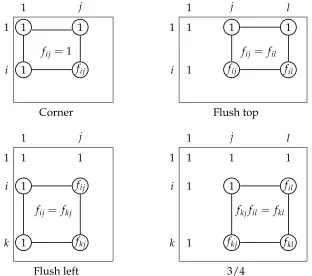
To aid understanding of the forthcoming considerations, let us high-light the relations produced by certain distinguished types of singular squares. For example, a square(1,i; 1,j) ∈ Σyields the relation f11−1f1j = fi−11fij, which, keeping in mind (25), is equivalent to fij = 1. A singular square of the form (1,i;j,l) yields the relation fij = fil, while the square (i,k; 1,j)yields fij = fkj. Let us call these three types thecorner, flush top andflush leftsquares, respectively.
One further type of square will be utilised: Suppose that(i,k;j,l) ∈ Σ
and that we already know that fij = 1 (e.g. by virtue of a corner square involvingiand j). Then the relation (26) becomes fkjfil = fkl. Let us call this a 3/4square. All four different types of singular squares are illustrated in Figure 1.
The method
1 1 fij 1 i 1 1 j
fij =1
1 1 fij 1 fil 1 i 1
1 j l
fij = fil
Corner Flush top
1 1
fij 1
1 fkj
i k 1 1 j
fij = fkj
1 1
1 1
1 fkj fkl
fil 1 i k 1
1 j l
fkjfil = fkl
[image:15.612.144.456.259.535.2]Flush left 3/4
arising from some semigroupS. In each instance we will introduce an aux-iliary matrix
Y= (yij)I×J, (28)
with entries from a generating set for G. Aided by this auxiliary matrix, we define a collection of idempotents fromBI,J, which, together withRI,J, generateS. We then examine the presentation given in (25), (26) and prove that it indeed defines our initial group G. This we do by performing the following steps. First we consider certain idempotents fromS\RI,J such that the (corner and flush) squares singularised by them allow us to prove:
(Rel1) fij = fklwheneveryij =ykl.
At this stage we may identify each letterfijwith the corresponding entryyij (considered also as a letter, and not as a group element). Then we consider certain further idempotents such that:
(Rel2) The (3/4) squares singularised by these idempotents yield (after the identification above) a set of relations which defineG.
The argument is completed by a ‘bookkeeping step’, which ensures that we do get the groupGand not a proper homomorphic image:
(Rel3) Check (by considering every idempotent and every square singu-larised by it) that every other relation from (25), (26) holds inG.
It in fact turns out that the auxiliary matrix Y yields a natural Rees matrix representation (see [11, Section 3.2])M[H11;I,J;P]for the minimal idealDofIG(E), with the structure matrixP= (pji)J×I given bypji=y−ij1.
5 First construction
In this section we present our first construction, which proves Theorems 1 and 2. In fact, we will present the construction in the finitely presented case (Theorem 2), and then remark that obvious trivial changes adapt it to the general case (Theorem 1).
So letGbe any finitely presented group. It is well known thatGcan be defined by a presentation of the form
G=ha1, . . . ,ap|b1c1=d1, . . . ,bqcq= dqi, (29)
Let us set
m=1+2q, n=1+p+2q, I ={1, . . . ,m}, J ={1, . . . ,n}. (30)
The auxiliary matrix (see Section 4) is:
Y= (yij)m×n=
1 1 1 . . . 1 1 1 1 1 . . . 1 1 1 a1 a2 . . . ap 1 c1 1 1 . . . 1 1 1 a1 a2 . . . ap b1 d1 1 1 . . . 1 1 1 a1 a2 . . . ap 1 1 1 c2 . . . 1 1 1 a1 a2 . . . ap 1 1 b2 d2 . . . 1 1
..
. ... . .. ...
1 a1 a2 . . . ap 1 1 1 1 . . . 1 cq 1 a1 a2 . . . ap 1 1 1 1 . . . bq dq
. (31) Next we define a family of idempotents which, together withRm,n, will be used to generateS:
σu= (σu(1),σu(2)) (u=2, . . . ,m),
τu = (τ
(1)
u ,τu(2)) (u=1, . . . ,q),
(32)
where
σu(1)(x) =
1 ifx=1
u ifx6=1 (33)
xσu(2) =
x if 1≤ x≤ p+1
r+1 ifx> p+1 andyu,x = ar (34)
(with the convention thata0=1), and
τu(1)(x) =
2u+1 ifx =2u+1
2u ifx 6=2u+1 (35)
xτu(2) =
p+2u ifx= p+2u,p+2u+1
1 otherwise. (36)
Let us interrupt our exposition at this point in order to illustrate the construction thus far by means of a concrete example. Let us takeGto be the Klein bottle group
G=ha,b|a−1ba =b−1i.
By introducing a redundant generatorc= bawe obtain the following pre-sentation
which has the form (29). Thus here p = 3, q = 2, m = 5, n = 8, and the auxiliary matrix is
Y=
1 1 1 1 1 1 1 1 1 a b c 1 a 1 1 1 a b c b c 1 1 1 a b c 1 1 1 b 1 a b c 1 1 c a
.
The only definition from (33)–(36) that is perhaps not entirely straight-forward is (34). So let us computeσ3(2). Its image is{1, 2, 3, 4}, and it acts identically on it. Each of the remaining columns is mapped into that im-age column which has the same 3rd entry. The 3rd entries for columns 5, 6, 7, 8 are b, c, 1, 1 respectively, and so 5, 6, 7, 8 are mapped to 3, 4, 1, 1 respectively.
The complete list of our idempotents is:
σ2(1) =
1 2 3 4 5 1 2 2 2 2
σ2(2)=
1 2 3 4 5 6 7 8 1 2 3 4 1 2 1 1
σ3(1) =
1 2 3 4 5 1 3 3 3 3
σ3(2)=
1 2 3 4 5 6 7 8 1 2 3 4 3 4 1 1
σ4(1) =
1 2 3 4 5 1 4 4 4 4
σ4(2)=
1 2 3 4 5 6 7 8 1 2 3 4 1 1 1 3
σ5(1) =
1 2 3 4 5 1 5 5 5 5
σ5(2)=
1 2 3 4 5 6 7 8 1 2 3 4 1 1 4 2
τ1(1) =
1 2 3 4 5 2 2 3 2 2
τ1(2)=
1 2 3 4 5 6 7 8 1 1 1 1 5 5 1 1
τ2(1) =
1 2 3 4 5 4 4 4 4 5
τ2(2)=
1 2 3 4 5 6 7 8 1 1 1 1 1 1 7 7
.
Returning to our general argument, letSbe the subsemigroup of Bm,n generated by the idempotentsσu(u= 2, . . . ,m),τu(u=1, . . . ,q) andRm,n. We start working towards accomplishing(Rel1)(see Section 4) by identify-ing the squares sidentify-ingularised by the idempotent σu (u = 2, . . . ,m) and the relations these squares yield. Beginning with the left-right squares, notice that im(σu(1)) = {1,u}, and so a typical square singularised has the form (1,u;r+1,l)where 0 ≤ r ≤ p,l > p+1 andyu,l = ar. This is a flush top square, and yields the relation
ful = fu,r+1(2≤u≤m, p+1< l<n, 0≤r≤ p, yul =ar). (37)
The up-down squares singularised byσ2are of the form(2,i;j,l)(2 < i≤ m, 1 ≤ j < l ≤ p+1). Forj = 1 we obtain a flush left square (2,i; 1,l), which yields the relation
A general up-down square singularised by anyσu has the form (u,i;j,l) (2≤ i ≤ m, i 6= u, 1≤ j< l≤ p+1) and the relation it yields is an easy consequence of (38):
fuj−1ful = f2−j1f2l = fij−1fil.
We see that the squares singularised byσu (2 ≤ u ≤ m) allow us pre-cisely to deduce(Rel1): A typical generator fij is equal to an appropriate fi,j1 (with 1 ≤ j1 ≤ p+1) by (37), which in turn is equal to its ‘canonical representative’ f2,j1 by (38). So from now on we identify each generator fij withyij.
Let us now examine the squares singularised byτu (u = 1, . . . ,q). The most important such square is(2u, 2u+1;p+2u,p+2u+1). It is a left-right 3/4 square, since under our identification f2u,p+2u=y2u,p+2u=1, and yields the relation
bucu=du(u=1, . . . ,q). (39)
Every other left-right square forτuis flush left(2u, 2u+1; 1,j)(j6=1, 2u, 2u+ 1), yielding eitheraj−1 = aj−1 (forj ≤ p+1) or 1 = 1 (for j> p+1). The up-down squares have the form(2u,i; 1,p+2u)(i6=2u+1), and yield the trivial relation 1=1.
At this stage we have accomplished step (Rel2), and have precisely a presentation definingG. Furthermore we have examined all the squares singularised byσ2, . . . ,σm,τ1, . . . ,τq. So, to verify(Rel3), i.e. prove that no further relations are introduced, it is sufficient to prove thatScontains no further idempotents:
E(S) =Rm,n∪ {σ2, . . . ,σm,τ1, . . . ,τq}. (40)
In order to prove (40), let us examine products ofσs andτs of length 2. Clearly,σu(1)σv(1)=σu(1)for anyu,v∈ {2, . . . ,m}. Next note that im(σu(2)) =
{1, . . . ,p+1}, and that σv(2) acts identically on it. Hence σu(2)σv(2) = σu(2), and we conclude that
σuσv =σu. (41)
Let us now examine the productτuτv (1 ≤ u,v ≤ q). Ifu = vthen of courseτuτv = τu; so let us supposeu 6= v. Since im(τv(1)) = {2v, 2v+1}, and both these points are mapped to 2uby τu(1), it follows thatτu(1)τv(1) = ρ2u, the constant mapping with value 2u. A similar argument shows that
τu(2)τv(2)=ρ1, the constant 1. Hence
τuτv=
τu ifu= v
ρ2u,1 ifu6=v. (42)
A very similar argument shows that
Finally, let us consider the productτuσv. On the left we have
τu(1)σv(1) =
ρ2u ifv 6=2u+1
µ ifv =2u+1,
where
µ(x) =
2u ifx=1 2u+1 ifx6=1.
Note thatµis not an idempotent, since
µ(µ(1)) =2u+16=2u=µ(1).
On the rightτu(2)σv(2)is either constantρ1, or else it maps{p+2u,p+2u+ 1}onto somer ∈ {2, . . . ,p+1}, and everything else, includingr, to 1, in which case it is not an idempotent. So we conclude that
τuσv =ρ2u,1 ∈Rm,norτuσv 6∈E(S). (44)
From (41)–(44) we see that the only products of length 2 of generators ofSthat are not inRm,n∪ {σ2, . . . ,σm,τ1, . . . ,τq}are some ofτuσv, and that these products are not idempotent. It is now straightforward to see that no product of length greater than 2 is going to produce any further new elements ofS, and hence that (40) indeed holds. This completes the proof of(Rel3), and we can conclude that
H(IG(E(S)),ρ11)∼=G,
proving Theorem 2.
Theorem 1 is proved in exactly the same way. We just omit the assump-tion thatGbe finitely presented, at the expense of allowing the presentation (29) to become infinite. This in turn makes the index setsIandJ, the family of idempotentsσu, τv, and ultimately the semigroup S, infinite. Alterna-tively, Theorem 1 can be deduced as a corollary of Theorem 3, which will be proved in the next section.
6 Second construction
The semigroupSconstructed in Section 5 is not regular: the non-constant products τuσv are easily seen to be non-regular. Furthermore, there does not exist a regular semigroup S0 with the same set of idempotents as S. Indeed, forτuandσv as above, the sandwich setS(τu,σv)is easily seen to be empty, implying thatE(S)is not a regular biordered set; see [13] or [11, Proposition 2.5.1]. So, in order to prove Theorems 3 and 4 we introduce a new construction.
semigroup. Its main disadvantage is that the constructed semigroup is fi-nite if and only if the input group is fifi-nite.
LetGbe an arbitrary group, letNbe its (possibly infinite) order, and let n= N2. We will work inside the semigroupB3,n=T3op×Tn, which has the 3×nrectangular bandR3,nas its minimal ideal. The corresponding gener-ators for the maximal subgroup containingρ11, as introduced in Section 4, are
fij (i=1, 2, 3;j=1, . . . ,n) (45)
with
f1j = fi1=1(i=1, 2, 3;j=1, . . . ,n). (46)
The auxiliary matrix this time is
Y = (yij)3×n=
1 1 1 . . . 1 1 y22 y23 . . . y2n 1 y32 y33 . . . y3n
.
Its entries are the elements ofG, arranged arbitrarily subject to the condi-tion that every possible column appears (once and only once):
{(1,y2j,y3j) : j=1, . . . ,n}= {(1,g,h) : g,h∈G}. (47)
In fact, in what follows we will sometimes identify the index setJ ={1, . . . ,n}
and the set{(1,g,h) : g,h ∈ G}of all columns ofY. When we do want to distinguish between the two sets we will writeYj for the jth column: Yj = (1,y2j,y3j). The index set Iis, of course, just{1, 2, 3}.
Now we proceed to define our extra idempotents. There are six of them
σu= (σu(1),σu(2)) (u=1, . . . , 6), (48)
and are given by
σ1(1)=
1 2 3 1 2 2
σ1(2):(1,g,h)7→ (1,g,g)
σ2(1)=
1 2 3 1 2 1
σ2(2):(1,g,h)7→ (1,g, 1)
σ3(1)=
1 2 3 1 1 3
σ3(2):(1,g,h)7→ (1, 1,h)
σ4(1)=
1 2 3 1 3 3
σ4(2):(1,g,h)7→ (1,h,h)
σ5(1)=
1 2 3 2 2 3
σ5(2):(1,g,h)7→ (1, 1,hg−1)
σ6(1)=
1 2 3 3 2 3
Note that onlyσ5(2)andσ6(2)actually depend on the groupG. Let us illustrate this with an example. We take
G= K4=ha,b|a2 =b2=1, ab=bai={1,a,b,c},
the Klein four-group. The index sets are I = {1, 2, 3}and J = {1, . . . , 16}, and the auxiliary matrix is
Y =
1 1 1 1 1 1 1 1 1 1 1 1 1 1 1 1 1 1 1 1 a a a a b b b b c c c c 1 a b c 1 a b c 1 a b c 1 a b c
.
If we want to compute, say,(12)σ6(2) we proceed as follows. Take the 12th column ofY – that is (1,b,c). Transforming it via (1,g,h) 7→ (1,gh−1, 1) yields(1,a, 1), which is column 5. Thus(12)σ6(2) =5.
The full list of all the mappings is:
σ1(1)=
1 2 3 1 2 2
σ1(2)=
1 2 3 4 5 6 7 8 9 10 11 12 13 14 15 16 1 1 1 1 6 6 6 6 11 11 11 11 16 16 16 16
σ2(1)=
1 2 3 1 2 1
σ2(2)=
1 2 3 4 5 6 7 8 9 10 11 12 13 14 15 16 1 1 1 1 5 5 5 5 9 9 9 9 13 13 13 13
σ3(1)=
1 2 3 1 1 3
σ3(2)=
1 2 3 4 5 6 7 8 9 10 11 12 13 14 15 16 1 2 3 4 1 2 3 4 1 2 3 4 1 2 3 4
σ4(1)=
1 2 3 1 3 3
σ4(2)=
1 2 3 4 5 6 7 8 9 10 11 12 13 14 15 16 1 6 11 16 1 6 11 16 1 6 11 16 1 6 11 16
σ5(1)=
1 2 3 2 2 3
σ5(2)=
1 2 3 4 5 6 7 8 9 10 11 12 13 14 15 16 1 2 3 4 2 1 4 3 3 4 1 2 4 3 2 1
σ6(1)=
1 2 3 3 2 3
σ6(2)=
1 2 3 4 5 6 7 8 9 10 11 12 13 14 15 16 1 5 9 13 5 1 13 9 9 13 1 5 13 9 5 1
.
If we were to change the group G, say to G = C4 = ha|a4 = 1i = {1,a,a2,a3} = {1,a,b,c}, the cyclic group of order 4, only the mappings
σ5(2)andσ6(2)would change:
σ5(2)=
1 2 3 4 5 6 7 8 9 10 11 12 13 14 15 16 1 2 3 4 4 1 2 3 3 4 1 2 2 3 4 1
σ6(2)=
1 2 3 4 5 6 7 8 9 10 11 12 13 14 15 16 1 13 9 5 5 1 13 9 9 5 1 13 13 9 5 1
.
σu (u = 1, . . . , 6) themselves, three elementsρ11, ρ21, ρ31 belonging to the minimal idealR3,n, and twelve further elements:
σ7 =σ1σ3 = (
1 2 3 1 1 2
,(1,g,h)7→(1, 1,g))
σ8 =σ2σ5 = (
1 2 3 2 2 1
,(1,g,h)7→(1, 1,g−1))
σ9 =σ3σ6 = (
1 2 3 3 1 3
,(1,g,h)7→(1,h−1, 1))
σ10 =σ4σ2 = (
1 2 3 1 3 1
,(1,g,h)7→(1,h, 1))
σ11 =σ5σ4 = (
1 2 3 2 3 3
,(1,g,h)7→(1,hg−1,hg−1))
σ12 =σ6σ1 = (
1 2 3 3 2 2
,(1,g,h)7→(1,gh−1,gh−1))
σ13 =σ1σ3σ6 = (
1 2 3 2 1 2
,(1,g,h)7→(1,g−1, 1))
σ14 =σ2σ5σ4 = (
1 2 3 2 1 1
,(1,g,h)7→(1,g−1,g−1))
σ15 =σ3σ6σ1 = (
1 2 3 3 1 1
,(1,g,h)7→(1,h−1,h−1))
σ16 =σ4σ2σ5 = (
1 2 3 3 3 1
,(1,g,h)7→(1, 1,h−1))
σ17 =σ5σ4σ2 = (
1 2 3 2 3 2
,(1,g,h)7→(1,hg−1, 1))
σ18 =σ6σ1σ3 = (
1 2 3 3 3 2
,(1,g,h)7→(1, 1,gh−1)).
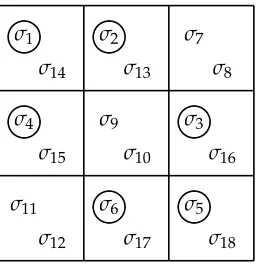
The elements{σ1, . . . ,σ18}form a singleD-classDillustrated in Figure 2. It follows that the semigroup
S=hR3,n∪ {σ1, . . . ,σ6}i= R3,n∪D≤ B3,n
has the following properties:
• Sis regular;
• Shas twoD-classes: R3,nandD;
• Shas precisely six idempotents (σ1, . . . ,σ6) outsideR3,n;
σ1
σ14 σ2
σ13 σ7
σ8
σ4
σ15 σ9
σ10 σ3
σ16
σ11
σ12 σ6
σ17 σ5
[image:24.612.234.362.124.256.2]σ18
Figure 2: TheD-classD, with the idempotents circled.
We now follow the process outlined in Section 4 to prove that the max-imal subgroup ofIG(E(S))containingρ11 ∈ R3,nis isomorphic toG. So far we have got the generators (45) and relations (46). Any further relations arise from the squares singularised byσu,u=1, . . . , 6.
Since im(σ1(1)) ={1, 2}it follows that the left-right squares singularised byσ1are of the form(1, 2;j,l), whereYj = (1,g,g),Yl = (1,g,h)for some g,h∈G. These are flush top squares yielding the relations
f2j = f2l (whenevery2j =y2l). (49)
The left-right squares singularised byσ2 yield exactly the same relations, while those singularised byσ3andσ4yield
f3j = f3l (whenevery3j =y3l). (50)
Next note that im(σ1(2)) ={(1,g,g) : g∈ G}; so the up-down squares sin-gularised byσ1have the form(2, 3;j,l), whereYj = (1,g,g),Yl = (1,h,h). Forj=1 we obtain the flush left square(2, 3; 1,l), yielding the relation
f2l = f3l (whenevery2l =y3l). (51)
The relation f2−j1f2l = f3−j1f3lproduced from a general square(2, 3;j,l)is an easy consequence of (51).
Combining (49), (50), (51) together gives us precisely the relations
fij = fkl (wheneveryij = ykl), (52)
i.e. we have completed step(Rel1), and can identify each generator fijwith the entryyijof the auxiliary matrix (considered as a formal symbol).
byσ5 andσ6. From im(σ5(1)) = {2, 3}it follows that the left-right squares singularised by σ5 are of the form (2, 3;j,l), where Yj = (1, 1,hg−1) and Yl = (1,g,h). This is a 3/4 square yielding the relation (hg−1)·g = h. Clearly, asgandhrange throughG, we obtain the Cayley table ofG (con-sidered as a presentation), accomplishing(Rel2). The up-down squares for σ5have the form(2, 1;j,l), whereZj = (1, 1,g)andZl = (1, 1,h), and yield the trivial relation 1 = 1. Likewise, σ6 yields no further relation. SinceS has no further idempotents, we have accomplished(Rel3). This completes the proof of Theorems 3 and 4.
7 Concluding remarks
During the work on this project we have implemented inGAP[3] the Rei-demeister–Schreier type rewriting process described in Section 2 and used in Section 3. This has enabled us to gather considerable ‘experimental data’ and test several early conjectures. The output from any Reidemeister– Schreier type rewriting has a large number of generators and defining rela-tions. Thus, the Tietze Transformations programme, which is a part of the standardGAPdistribution, and which is in theGAPmanual credited back to the work of Havas, Robertson et al. [8, 9, 18], proved an invaluable tool. It is well known that there exists a finitely presented group with an unsolvable word problem. Combining such a group with Theorem 2 yields:
Corollary. There exists a free idempotent generated semigroup F arising from a finite semigroup such that the word problem for F is unsolvable.
Such a free idempotent generated semigroupFwould be non residually finite and non-automatic as well.
The main open question remaining, as mentioned in the Introduction, is:
Problem 1. Is it true that every finitely presented group is a maximal sub-group of some free regular idempotent generated semisub-group arising from a finite semigroup?
All our examples were obtained by first fixing a rectangular bandR, and then constructing our semigroupSas an ideal extension of R. We remark that for any fixed finiteRwe can obtain only finitely many maximal sub-groups in free idempotent semisub-groups arising from ideal extensions from R. Indeed, R determines the generators of the maximal subgroups, and the relators arise from singular squares, and there are only finitely many of them. Thus we are lead to ask:
Acknowledgements. The authors would like to thank an anonymous ref-eree, whose comments led them to state and prove Theorem 5 in its present form. We would also like to thank Stuart W. Margolis for insightful corre-spondence and helpful suggestions.
References
[1] M. Brittenham, S.W. Margolis, J. Meakin, Subgroups of free idempo-tent generated semigroups need not be free, J. Algebra 321 (2009), 3026–3042.
[2] M. Brittenham, S.W. Margolis, J. Meakin, Free idempotent-generated semigroups associated with the monoid of all matrices over a field, in preparation.
[3] The GAP Group,GAP – Groups, Algorithms, and Programming, Version 4.4.12; 2008,(http://www.gap-system.org).
[4] D. Easdown, Biordered sets come from semigroups, J. Algebra 96 (1985), 581–591.
[5] D. Easdown, M. Sapir, M. Volkov, Periodic elements of the free idem-potent generated semigroup on a biordered set, Internat. J. Algebra Comput., to appear.
[6] D.G. Fitz-Gerald, On inverses of products of idempotents in regular semigroups, J. Austral. Math. Soc. 13 (1972), 335–337.
[7] J. A. Green. On the structure of semigroups. Ann. of Math. (2), 54:163– 172, 1951.
[8] G. Havas, Symbolic and algebraic calculation, Basser Computing Dept., Technical Report 89, Basser Department of Computer Science, University of Sydney, Sydney, Australia, 1969.
[9] G. Havas, P.E. Kenne, J.S. Richardson and E.F. Robertson, A Ti-etze transformation program, in M.D. Atkinson (ed.), Computa-tional Group Theory, Proceedings LMS Symposium on ComputaComputa-tional Group Theory, Durham 1982, Academic Press, 1984.
[10] P.M. Higgins, Techniques of Semigroup Theory, The Clarendon Press, New York, 1992.
[12] B. McElwee, Subgroups of the free semigroup on a biordered set in which principal ideals are singletons, Comm. Algebra 30 (2002), 5513– 5519.
[13] K.S.S. Nambooripad, Structure of regular semigroups. I, Memoirs Amer. Math. Soc. 224 (1979).
[14] K.S.S. Nambooripad, F.Pastijn, Subgroups of free idempotent gener-ated regular semigroups, Semigroup Forum 21 (1980), 1–7.
[15] F. Pastijn, Idempotent generated completely 0-simple semigroups, Semigroup Forum 15 (1977), 41–50.
[16] F. Pastijn, The biorder on the partial groupoid of idempotents of a semigroup, J. Algebra 65 (1980), 147–187.
[17] M. Petrich, The translational hull of a completely 0-simple semigroup, Glasgow Math. J. 9, 1–1, 1968.
[18] E.F. Robertson, Tietze transformations with weighted substring search, J. Symbolic Comput. 6, 59–64, 1988.
[19] D.J.S. Robinson, A Course in the Theory of Groups, Springer, New York, 1996.
[20] N. Ruˇskuc, Presentations for subgroups of monoids, J. Algebra 220 (1999), 365–380.
Centro de ´Algebra da Universidade de Lisboa Av. Prof. Gama Pinto 2
1649-003 Lisboa, Portugal.
School of Mathematics and Statistics University of St Andrews
St Andrews KY16 9SS Scotland, U.K.