A More Effective Technique of Design Synthesis for MEMS
with Expected Performance
Shuxun Chen
Department of Mechanical Engineering, Guangxi University, Nanning, China E-mail: [email protected]
Received December 17, 2009; revised January 23, 2010; accepted February 26, 2010
Abstract
A design synthesis technique based on sensitivity for Micro-Electro-Mechanical Systems (MEMS) proposed. This new technique can be called Sensitivity-Based Direct Solution Algorithm (DSA) of design synthesis for MEMS with expected performance. Design synthesis with expected performance is regarded as a reverse problem of MEMS analysis. Behavior equation group can be educed from analysis equations. Solving the behavior equation group only need L design variables, L is number of desired behaviors. This behavior equa-tion group can be solved using any soluequa-tion algorithm of non-linear equaequa-tion group. Newton Iteraequa-tion Method based on sensitivity is adopted. Comparing with Genetic Optimization Algorithm (GA) and Simu-lated Annealing Optimization Algorithm (SA), computational workload of DSA is greatly decreased. For instance, synthesis computation of a meandering resonator only needs 4 iterations (17 analyses); computa-tional time is decreased from 7~8 hours to less than 30 seconds.
Keywords:MEMS, Design Synthesis, Direct Solution Algorithm, Genetic Algorithms, Simulated, Annealing, Comparing
1. Introduction
Estimating Micro-Electro-Mechanical Systems (MEMS) are miniaturized mechanical devices and components, often integrated or interfaced with electronics and fabri-cated on silicon wafers. They are systems in multi energy domains including electrical, mechanical, thermal etc. So their analysis and design is more complex than simple systems in single energy domain e.g. structural systems or circuit system. With rapid development of micro- electronic industry, techniques of analysis, synthesis and optimization of MEMS are in great demand to automate the MEMS design process.
MEMS synthesis usually begins with high-level speci-fications that describe the expected behaviors of devices [1]. This kind of design synthesis problem of MEMS devices can be described as: design variables are physi-cal configuration and geometries; it is design objectives to find values of the design variables so that same be-haviors equal expected values; it is design constraints that values of design variables are not allowed beyond given bounds.
Optimization problem of MEMS can be described as:
design variables are physical configuration and geome-tries; it is design objective to find values of the design variables so that some behavior achieves it’s the opti-mum value; design constraints are bounds of the design variables and some performance restriction.
There has been some progress on MEMS device Syn-thesis [2–5]. However, the present synSyn-thesis methods are tailored to specific tasks, are not general-purpose synthe-sis tools.
From 1998, research group leaded by Prof. Alice M. Agogino have developed an analysis simulation tool for MEMS devices–SUGAR [6–8]. It is based on nodal analysis techniques from the world of integrated circuit simulation, includes beams, anchor, electrostatic gaps, circuit elements, etc. MEMS are modeled as coupled systems of differential equations. Using SUGAR, static, dynamic, and steady-static and transient analyses simula-tion of performance behaviors of MEMS devices can be conveniently processed. So SUGAR is a good base of advanced techniques of general-purpose synthesis and optimization of MEMS devices.
Because the problem of design synthesis can be re-garded as the optimization problem in which it is design objectives to find values of the design variables so that difference of same behaviors and their expected values
S. X. CHEN 205
achieves it’s the minimum values–zeros. On the basis of SUGAR, the research group firstly developed some op-timization algorithms to solve the design synthesis prob-lem of MEMS devices. Dr. Zhou etc. adopted Genetic Algorithm (GA) [9]. Kamalian etc. adopted Simulated Annealing Algorithm (SA) [11]. They can be called Simulated Nature Algorithms (SNA). It is shown by en-gineering examples that these SNA are effective for de-sign synthesis problems with many variables including topological variables, but its computational workload are enormous.
Regarding the above-mentioned design synthesis prob-lem as a design probprob-lem of MEMS devices with ex-pected performance behaviors, Prof. Chen proposes a Direct Solution Algorithm (DSA) of based ob sensitivity. For the same engineering example, comparing SNA, computational workload of the Direct Solution Algo-rithm is greatly decreased from thousands analysis to less than 30 analysis, Its computational time is greatly re-duced from hours to less than 30 seconds, and only a few design variables are necessary, other design parameters can be decided according to convenience.
In this paper, we introduce the above-mentioned analysis method and analysis tool, SNA design synthesis Algorithms, proposes the Direct Solution Algorithm (DSA), compare them through an engineering example, and discuss various design strategy and their develop-ment.
2. Analysis Method and Analysis Tool
2.1. Analysis Equation
In multi energy domains, such as electrical circuits, me-chanical, thermal etc., analysis equation group of mi-cro-electro-mechanical systems can be described as the following modified nodal equation group:
M q” + C q’ + K q = Σ F (1) where the three dimensional node vector and excitation vectors for a system of N nodes (6N freedom degree) are:
1 1 2 2 3 3 4 4 , , , xi x yi y zi z i i xi x yi yi
N N zi
q F q
q F q
q F q
q F
q F q
q M
q F q
q F i zi F F F M M (2)
Any electrical elements are appended onto these me-chanical elements, creating vectors of length 6N Me-chanical +N Electrical. The q is node vector that con-sists of unknown node variables, such as mechanical displacements, electrical potentials and thermal
tem-peratures etc. q” and q’ is the second derivative and the first derivative of q to time respectively. The F is excita-tion vector that consists of known external loads, such as forces, currents and heat flux. The equation group ex-presses: At each node of MEMS, sum of forces equals zero, sum of currents equals zero, sum of heat flux equals zero.
The coefficients M, C, and K represent the mass ma-trix, damping matrix and stiffness matrix respectively. They are composed of element mass matrices Mi,
ele-ment damping matrices Ci and element stiffness matrices Ki after coordinate transformation. Literature [8]
pre-sented Mi, Ci, andKi of a linear beam element, and
pre-sented modified computational expressions of F and q for current thermal expansion, residual stress, electro-static gap andaccelerating base.
2.2. Analysis Algorithm
2.2.1. Static Analysis
Given a system subject to nonlinear excitations of vari-ous energy domains (e.g. thermal, electrical and me-chanical), when the system is in static equilibrium state, the equation group (1) is tenable. It can be briefly ex-pressed as:
f ( q ) = 0 (3) where the function f (q) contains the modified nodal equation for all energy domain. To solve the nonlinear equation group, Newton-Raphson algorithm is adopted. Its iteration formula is:
q (n+1)= q(n)− [ f(q) / q ]–1 f ( q (n)) (4) where [ f(q) / q ] is Jacobian matrix composed of sensitivities.
2.2.2. Steady-State Analysis
To determine the steady-state response, firstly linearize the system of ordinary differential equation at the point of static equilibrium. The high order system is then con-verted into the first order form given by
x ’ = Ax + Bu y = Cx + Du (5) where x is the system dynamic state variable, u is the sinusoidal excitation, and y is the system dynamic re-sponse. A, B, C, and D are the system, input coupling, output, and feed forward matrices respectively. The solu-tion of Equasolu-tion (5) provides Bode plots as well as mo-dal analysis.
2.2.3. Transient Analysis
solvers can be available. These numerical methods in-clude an implicit second order Rosenbrock solver for stiff problems where low accuracy is acceptable, an ex-plicit Runge-Kutta 4th-5th order solver for non-stiff sys-tems, an implicit multi-step integration method of vary-ing order for stiff problems requirvary-ing higher accuracy, and a simple explicit Euler algorithm. The transient solvers require the modified nodal equations to be in first order form. We do this in the standardized way [12] by introducing a new state vector Q where
' ' q d
Q f
q dt
( , )t q (6)
where t is time.
2.3. Analysis Software – SUGAR
From 1998, on the basis of the above-mentioned analysis equation and analysis algorithm, the research group de-veloped a general-purpose analysis simulation software system of MEMS devices–SUGAR.
SUGAR is a collection of MATLAB algorithms that take a netlist description of MEMS devices and perform static, steady-state, model, and transient analyses of three-dimensional mechanical structures and electrical circuits. The code, demo files and manual of the newest version SUGAR are downloadable from the Berkeley Sensor and Actuator Center at the University of Califor-nia at Berkeley.
3. Design Synthesis Using Simulated Nature
Algorithms
3.1. Design Synthesis Problem of a Resonator
[image:3.595.317.528.75.259.2]Design synthesis problem of MEMS devices can be de-scribed as: To find values of the design variables (physi-cal configuration and geometry), so that same of values of performance behaviors equal expected values, subject to bound constraints of design variables.
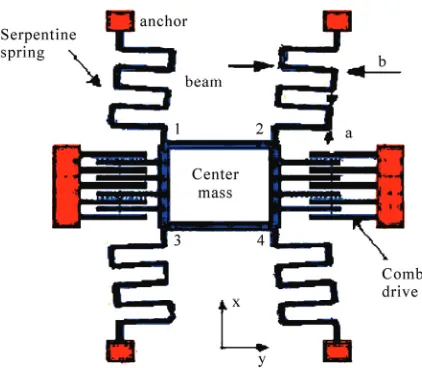
Figure 1 shows a micro-resonator with a center mass (length L, width W) supported by four serpentine springs at 1, 2, 3, 4 node. Each spring is composed of N beams and fixed by an anchor at end of the spring. There are two sets of electrostatic comb drives on both sides to drive this resonator vibrating horizontally.
Design synthesis problem of the meandering resonator is described as: Design variables are lengths li, widths wi
and angles iof every beam, and total number N of beam
in every spring. Design objectives are as: the lowest fre-quency f equals 93723 Hz; x-directional Stiffness Kx equals 1.90 N/m. y-directional stiffness Ky equals 0.56 N/m. Bound constraints of design variables are as Table 1:
[image:3.595.307.539.306.339.2]Figure 1. A MEMS resonator with four meandering springs.
Table 1. Design constraints for meandering resonator.
wmin wmax lmax min max Nmax
2 um 20 um 400 um -90 90 6
3.2. Synthesis Using Genetic Algorithm
Because this synthesis problem of the serpentine resona-tor can be regarded as the multi-objective optimization problem in which it is objectives to find values of the design variables so that difference of same behaviors and their expected values achieves it’s the minimum values – zeros. To solve this synthesis problem, Dr. Zhou adopted Genetic Algorithm (GA) [9] used in Multi-Objective optimization. The basis of GA synthesis is the coding scheme that represents the features of a problem. Many devices can be represented as a rooted acyclic tree of building blocks. ‘Rooted’ means that there exists a dis-tinguished node as the reference node. All other struc-tures are laid out with respect to this node. MEMS GA building blocks are connected together at their nodes to form a tree. A building block is fully described by the following information: • A building block type identifier; • A list of ports or nodes through which this block can be connected to others; • Governing parameters.
This design of the serpentine resonator is encoded as a 53 cell array as follows.
[Center mass] [1 2 3 4] [L W]
S. X. CHEN 207
The second column of the cell represents the building block node connection. The third column represents the building block parameters. Crossover and mutations op-erators are carried out. The arithmetic crossovers are defined as the linear combination of two parents. This crossover ensures that each offspring will maintain the required functional configuration of one mass and four springs. Results of GA synthesis are as follows:
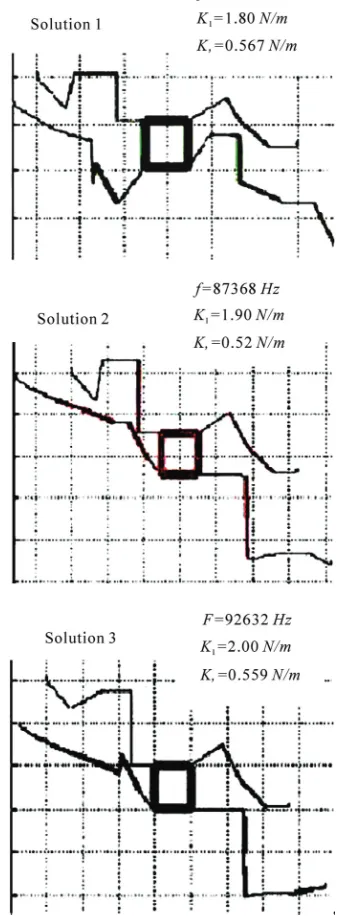
The initial design parameters are: center mass beam 12012.52 um, each spring beam cross-section 22 um, a = 60 um, b = 80 um, their material is poly with 2 um thickness. The GA configuration parameters were taken as: the population size npop=400, the number of genera-tion ngen =30, the crossover probability Pc =0.7, the total percentage of elite Pe =5%, the mutation probability and Pm=0.1, λ=0.3. No significant improvement was found in performance after 25–30 iterations taking about ten thousands analyses and 4–5 hours. A Pareto optimal set of 26 designs is found. Figure 2 shows some of the ‘equally good’ results. Designers will choose the right design from the Pareto set that reflects their multiple objective trade-offs.
3.3. Synthesis Using Simulated Annealing Algorithm
Kamalian etc. adopted the Simulated Annealing Algo-rithm (SA) [11] to solve the design synthesis problem of the serpentine resonator. As the name implies, simulated annealing exploits an analogy between the way in which a heated metal cools into a minimum energy state and a stochastic optimization algorithm that slowly “lowers the temperature” in stages to eventually “freeze” at the global optimum. SA randomly perturbs a given initial design, whose variations are accepted as the new design with a threshold probability, known as the Metropolis Condition that decreases as the computation proceeds. The slower the rate of probability decrease, the more likely the algorithm is to find an optimal or near optimal solution.
Generally, SA is only applicable to a single objective optimization. It is the design objective for this example to have a lowest natural frequency f = 93723.
For the SA implementation, the probability of chang-ing any schang-ingle beam parameter was set to 10%, as was the probability of adding or deleting a beam segment from each of the four springs. Maximum number of it-erations was set to 5000, but a conditional statement can stop the synthesis if the objective error is below an ac-cepted value (frequency error < 100 Hz).
[image:4.595.338.507.92.550.2]Using SA, a single objective design result (shown in
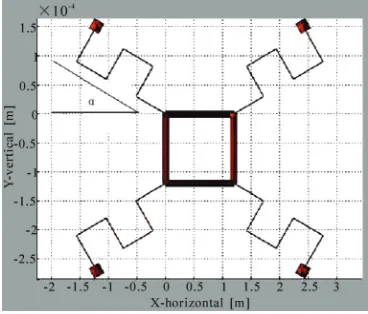
Figure 3) of the meandering resonator was reached quickly, only taking approximately 1hour. For different starting points, the average time was in the range of 4 to 5 hours. Figure4 shows a result with forced Manhattan geometry and symmetry.
[image:4.595.333.512.583.714.2]Figure 2. Synthesis results of a serpentine resonator using the Genetic Algorithm (GA).
Figure 4. Result 2 of SA.
The results show that Simulated Annealing can in some cases synthesize valid designs faster than Genetic Algorithms. However its dependence on a single objec-tive function and the difficulty in finding the global op-timum indicate that it is a less robust method for many MEMS synthesis problems.
4. Design Synthesis Using Direct Solution
Algorithms
4.1. Analysis Equations and Design Equations
Regarding the above-mentioned design synthesis prob-lem as a design probprob-lem of MEMS devices with ex-pected performance behaviors, Prof. Chen proposes a Direct Solution Algorithm (DSA) of MEMS devices. DSA is a solution technique of equations based on sensi-tivity analysis.
Analysis Equation (1) of MEMS can be expresses as: M(X) q” + C(X) q’ + K(X) q = Σ F(X) (7) where q is the node variables; X is the design variables describing physical configuration and geometries of MEM design. Mass matrix M, damping matrix C, stiff-ness matrix K, even force vector F are functions of de-sign variables X. Brief expression of (7)) is:
f ( X, q ) = 0 (8) When Xis given, to find q, these equations are analy-sis equations. When q is given, to find X, these equations are a base of design equations. 1987, Prof. Chen educed and solved linear design equations of truss structures:
D (q ) X = F, X = [D ( q )]-1 . F (9) A relative paper [13] was embodied by EI 8809- 091423.
Any performance behavior of MEMS can be expresses as function of design variables si (X). It is task of design synthesis of MEMS to make every behavior si (X) equals its expected value si0. All of L expected behaviors de-cides the following behavior equation group:
s1 ( X ) / s10 = 1 s2 ( X ) / s20 = 1
………. (10) sL( X ) / sL0 = 1
Its brief expression is:
S ( X ) = I (11) The behavior equation group of the meandering resona-tor can be expressed as follows:
s1 ( X ) = f ( X ) / 93723 = 1
s2 ( X ) = K x ( X ) /1.90 = 1 (12) s3 ( X ) =K y ( X ) / 0.56 = 1
4.2. Selection of Design Variables
L design variables are enough to solve the equation group composed of L behavior equations. For instance, in behavior equation group (12) of the meandering reso-nator, L equals 3. So the necessary design variables are few.
L independent continuous design parameters are gen-erally selected as design variables from all design pa-rameters. Design variables selected should be mainly related to the expected behaviors. Other design parame-ters can be decided according to convenience.
Design variables of the meandering resonator can have many selection schemes. For instance, the first selection is as:
x1 = a = lxi ,…lxiis length of all x directional beams;
x2= b = lyi ,…lyi is length of all y directional beams.
x3 = c = w i ,…wiis width of all spring beam .
Given parameters are: N = 6, θi { 00, 900, -900, 1800}.
Center mass beams is: l = 120 um, w = 12.5 um, h = 2 um; In Figure 5, an initial design is shown: x 1 = 60 um,
x 2 = 80 um, x3 = 2 um. The second selection is:
x1= a = b = li , …..li is length of all spring beams;
x2 = c = wi ,…… wi. is width of all spring beams;
x3 = , ….. is spring angle shown in Figure 6.
[image:5.595.331.515.551.708.2]S. X. CHEN 209
Figure 6. The second section of design variables.
Given parameters are: N = 6, θi{00 , 900 , -
900 , 1800 }.In Figure 6, initial design is shown: x1 = 60 um, x2 = 2 um, x3 = 300.
4.3. Solution Algorithm of Behavior Equation Group
Generally behavior equation group is nonlinear; it can be solved using any algorithm of nonlinear equation group. Of cause, they can be solved them using Newton method iteratively:
X(n+1) = X(n)+ [ S ( X(n)) / X]–1[ I- S ( X(n))] (13) [S/X] is Jacobian matrix that is composed of sensitivi-ties i.e. derivatives of the behaviors to the design vari-ables.
There two kind of computational methods of sensitiv-ity analysis: analytic sensitivsensitiv-ity analysis and difference sensitivity analysis. Analytic sensitivity analysis is often used in structural optimization, is real derivatives of be-haviors to design variables. We provisionally adopt dif-ference sensitivity analysis. It is approximate derivatives: [ s/ xi] s/ xi = [s(xi+ xi ) - s( xi )] / xi (14)
It is merit of: difference sensitivity analysis that program is simple and reliable. It is disadvantage that its compu-tational workload is more than analytic sensitivity analy-sis. Difference sensitivity analysis of every design vari-able needs a re-analysis.
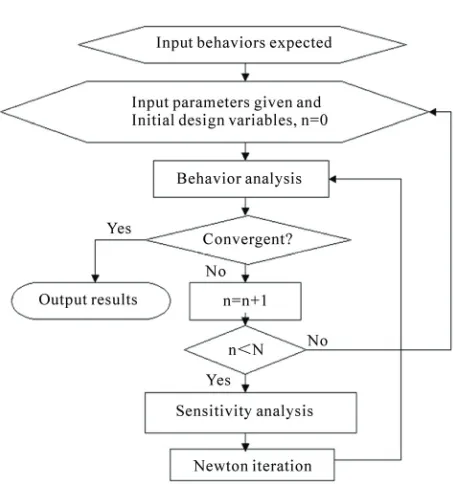
Flow chart of the direct solution algorithm (DSA) is shown in Figure 7.
The total number of necessary analysis of DSA can be calculated with the following formulate:
Na = (1+Nd ) Ni + 1 (15)
where Na is number of necessary analysis; Nd is number
of the design variables; Ni is number of necessary
itera-tion.
Figure 7. Flow chart of DSA.
4.4. Result of the Meandering Resonator Using DSA
On the basis of SUGAR, program software CSX 1.0 of direct solution algorithm (DSA) of MEMS synthesis has already developed.
For the first selection scheme of design variables, when the initial design is as Figure 5, i.e.x1 = 60 um, x2
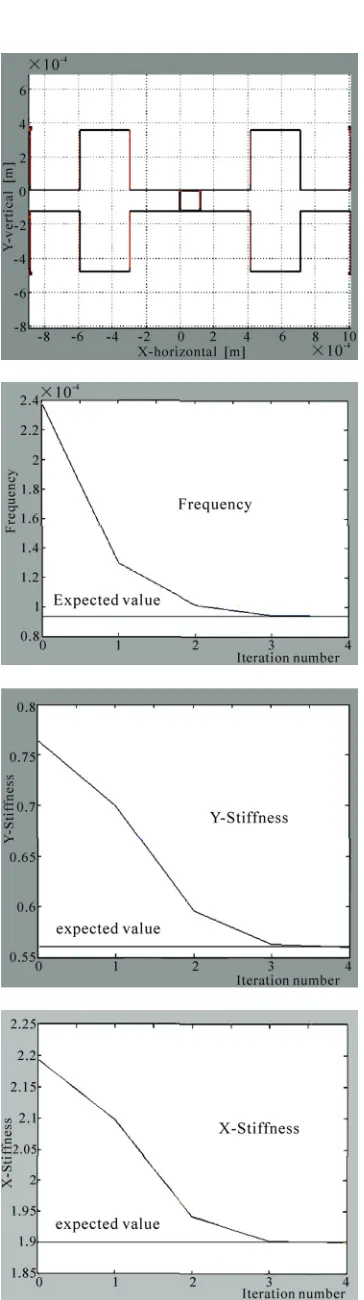
= 80 um, x3 =2 um. After 4 iterations i.e. 17 analysis’s,
the iteration is convergent. Its synthesis results shown in the up-left figure of Figure 8 are:
x1 = 295.30 um, x2 = 360.39 um, x3 = 8.7651 um
If the initial design is as: x1 = 20 um, x2 = 60 um, x3 =
2 um, after 7 iterations, 29 analysis, the iteration is con-vergent to the above-mentioned results too. Can get the same result from different starts, Robustness of DSA is validated. The behaviors of the above-mentioned results equal their expected values exactly. Relative computa-tional error is less than 0.0001:
f = 93723 Hz,K x = 1.90 N/m ,K y = 0.56 N/m In Figure 8, up-right, down-left and down-right figure is iteration history of frequency, x-stiffness and y-stiffness respectively.
For the second selection scheme of design variables, the initial design is as Figure 6 i.e.x1 = 60 um, x2 = 2 um, x3 = 300. After 5 iterations i.e. 21 analysis’s, the it-eration is convergent. Its synthesis results are shown Fig-ure 9. If the initial design is as: x1 = 60 um, x2 = 2 um, x3
[image:6.595.70.271.77.245.2]Figure 8. Synthesis result of design variable scheme 1.
x1= 312.76 um x2 = 8.158 um x3 = 15.1241 o
[image:7.595.306.538.76.229.2]f = 93723 Hz Kx = 1.90 N/m Ky = 0.56 N/m
Figure 9. Synthesis result of design variable scheme 2.
For the meandering resonator, computational time of a synthesis is less than 30 seconds, using Pentium III PC.
5. Discussion
While MEMS designers often resort to back-of-the -envelope calculations, SUGAR provides a quick effec-tive analysis tool. Development of synthesis algorithms provides tools of automatic design of MEMS devices.
However, Genetic Algorithm, Simulated Annealing Algorithm, Nerve Net Algorithm, and Mini Wave rithm etc. can only be called as Simulated Nature Algo-rithms (SNA). It is main merit of SNA that objectives and constraints functional relationship and sensitivity analysis are not necessary. SNA is more applicable to global optimization and topology optimization etc. com-plex optimization problems. When it is difficult to solve these complex optimization problems using traditional algorithms based on sensitivity analysis, SNA have to be adopted. Deathful disadvantage of SNA consists in its enormous computational workload. In design synthesis of MEMS, objectives and constraints functional rela-tionship and sensitivities of to few design variables can be gotten. So algorithms based on sensitivity are more applicable to it.In engineering example of the meander-ing resonator, it is shown that Direct Solution Algorithm proposed here is very effective to design synthesis of MEMS. Its main merit is that computational workload is greatly decreased from thousands analysis’s to less than 30 analysis’s, computational time is greatly decreased from hours to less than 30 seconds.
S. X. CHEN 211
can be adopted. Guide-Weight Method [14] proposed by Prof. Chen is very effective one of them, and has already been adopted on electronic mechanical, civil, aeronauti-cal and astronautiaeronauti-cally structural optimization.
6. References
[1] N. Zhou and M. Agogino, “Automated design synthesis for Micro-Electro-Mechanical Systems (MEMS),” The Proceedings of the ASME Design Automation Confer-ence, Montreal, Canada, 2002.
[2] Q. Jing, H. Luo, T. Mukherjee, L. R. Carley, and G. Fed-der, “CMOS micro-mechanical bandpass filter design using a hierarchical MEMS circuit library,” Proceedings IEEE Thirteenth Annual International Conference on Mi-cro Electro Mechanical Systems, Miyazaki, Japan, pp. 187–192, 2000.
[3] E. Goldberg, “Genetic algorithms in search, optimization, and machine learning,” Addison-Wesley, 1989.
[4] H. Li and E. Antonsson, “Evolutionary techniques in MEMS synthesis,” Proceedings of DETC’98, 1998 ASME Design Engineering Technical Conferences, At-lanta, GA, 1998.
[5] T. Lacksonen, “Empirical comparison of search algo-rithms for discrete event simulation,” Computers & In-dustrial Engineering, Vol. 40, No. 1–2, pp. 133–48, June 2001.
[6] N. Zhou, V. Clark, and K. Pister, “Nodal simulation for MEMS design using SUGER v.0.5,” In 1998 Interna-tional Conference on Modeling and Simulation of
Mi-crosystems Semiconductors, Sensors and Actuators Santa Clara, CA, April 6–8, pp. 308–313, 1998.
[7] J. Clark, N. Zhou, S. Bhave, Z. Bai, J. Demmel, and K. Pister, “Sugar: Advancements in a 3D multi-domain simulation package for MEMS,” In Proceedings of the Microscale Systems: Mechanics and Measurements Symposium, Portland, OR, June 4, 2001.
[8] J. Clark, N. Zhou, D. Bindel, L. Schenato, W. Wu, J. Demmel, and K. Pister, “3D MEMS simulation modeling using modified nodal” In Proceedings of the Microscale Systems: Mechanics and Measurements Symposium, pp. 68–75, 2005.
[9] N. Zhou, B. Zhu, A. Agogino, K. Pister, “Evolutionary systhesis of micro-electro-mechanical systems (MEMS),” Proceedings of ANNIE 2001: IEEE Neural Networks Council and Smart Engineering Systems Laboratory. ASME Press, St. Louis, Missouri, Vol. 11, pp. 197–202, November 4–7, 2003.
[10] S. Narayanan and S. Azarm, “On improving multi-objec-tive genetic algorithms for design optimization,” Struc-tural Optimization, Vol. 18, pp. 146–155, 1999.
[11] S. Chen, “Design & optimization of truss with expected deformed shape,” China Civil Engineering Journal, Vol. 20, No. 2, pp. 1–9, 1987.
[12] S. Chen and S. Ye, “A guide-weight criterion method for the optimum design of antenna structures,” Engineering Optimization, Vol. 10, No. 3, pp. 199–127, 1987.