Published Online May 2009 in SciRes (http://www.SciRP.org/journal/ijcns/).
Hierarchical Hypercube Based Pairwise Key Establishment
Scheme for Sensor Networks
Lei WANG1,2
1
College of Software, Hunan University, Changsha, Hunan, China
2
Department of Computer Science, Lakehead University, Thunder Bay, Canada Email: [email protected]
Received November 27, 2008; revised January 17,2009; accepted February 12,2009
Abstract
Security schemes of pairwise key establishment, which enable sensors to communicate with each other se-curely, play a fundamental role in research on security issue in wireless sensor networks. A general frame-work for key predistribution is presented, based on the idea of KDC (Key Distribution Center) and
polyno-mial pool schemes. By utilizing nice properties of H2 (Hierarchical Hypercube) model, a new security
mechanism for key predistribution based on such model is also proposed. Furthermore, the working per-formance of tolerance resistance is seriously inspected in this paper. Theoretic analysis and experimental fig-ures show that the algorithm addressed in this paper has better performance and provides higher possibilities for sensor to establish pairwise key, compared with previous related works.
Keywords: Pairwise Key, Sensor Networks, Key Pool, Key Predistribution, H2 Framework
1. Introduction
The security issue in wireless sensor networks has be-come research focus because of their tremendous appli-cation available in military as well as civilian areas. However, constrained conditions existent in such net-works, such as hardware resources and energy consump-tion, have made security research more challenging compared with that in traditional networks.
Current research focus on such security schemes as authentication and key management issues, which are essential to provide basic secure service on sensor com-munications. Pairwise key establishment enables any two sensors to communicate secretly with each other. How-ever, due to the characteristics of sensor nodes, it is not feasible to utilize traditional pairwise key establishment schemes.
Eeschnaure et al. [1] presented a probablitic key pre-distribution scheme for pairwise key establishment. This scheme picks a random pool (set) of keys S out of the total possible key space. For each node, m keys are ran-domly selected from the key pool S and stored into the
node’s memory so that any two sensors have a certain probability of sharing at least one common key. Chan [2] presented two key predistribution techniques: q-com-posite key predistribution and random pairwise keys scheme. The q-composite scheme extended the per-formance provided by [1], which requires at least q pre-distributed keys any two sensor should share. The ran-dom scheme ranran-domly pickes pair of sensors and assigns each pair a unique random keys. Liu et al. [3] developed the idea addressed in previous works and proposed a general framework of polynomial pool-based key predis-tribution. Based on such a framework, they presented random subset assignment and hypercube-based assign-ment for key predistribution.
FOR SENSOR NETWORKS not ensure any two nodes to establish a key path if they
do not share a common key. Though the hypercube- based assignment can make sure that there actually exist a key path, however, the possibilities of direct pairwise key establishment are not perfect, leading to large com-munication overhead.
In order to improve possibilities of direct pairwise key establishment, and depress communication overhead on indirect key establishment, we propose a H2 (Hierar-chical Hypercube) framework, combined with a new key predistribution scheme. Moreover two new fault tolerance model and corresponding indirect pairwise key establish-ment schemes are also proposed, by applying nice proper-ties on tolerance resistance H2 model has provided. The schemes has better working performance on probabilities of pairwise key establishment between any two sensors.
2. Preliminaries
2.1.
Notations and Definitions
Definition1(key predistribution): Cryptographic algo-rithms are pre-loaded in sensors before node deployment phase.
Definition2 (pairwise key): When any two nods share a common key denoted as E, we call that the two nodes share a pairwise key E.
Definition 3 (key path): Given two nodes A0 and Ak,
which do not share a pairwise key, if there exists a path in sequence described as A0, A1, A2,……, Ak-1, Ak and any
two nodes Ai, Aj (0≤i≤k-1,1≤j≤k) share at least one
pairwise key, we call that path as a key path.
Definition 4 (n-dimensional hypercube interconnec-tion network): n-dimensional hypercube interconnection network Hn(abbreviation as n-cube) is a kind of network
topology that has the following characteristics: 1) It is consisted with 2n nodes and n·2n-1 links; 2) Each node can be coded with a different binary string with n bits such as b1b2…bn; 3) For any pair of nodes, there is a link
between them if there is just one bit different between their corresponding binary strings.
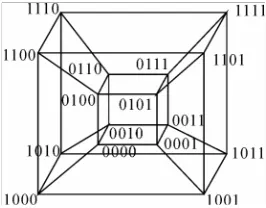
Figure 1 illustrates the topology of a 4-dimensional hypercube interconnection network, which is consisted with 24=16 nodes and 4·24-1=32 links. And the nodes are coded from 0000 to 1111.
2.2.
Related Works [1-3]
2.2.1.
Polynomial-based Key Predistribution
In the scheme of polynomial-based key predistribution, the key setup server randomly generates a t-degree bivariate polynomial f(x,y)= over a
, 0
t
j i y a xij i j
[image:2.595.357.490.90.194.2]
Figure 1. A 4-dimensional hypercube interconnection net-work.
finite field Fq, Notes that q is fairly large prime number
and for any variables x and y, f(x,y)= f(y,x) is always held. Then the key server computes a share of f(x,y), denoted as f(i,y) for each node, where i is assumed to be a unique ID for any sensor node. Every node is pre-loaded with its own share before node-deployment phase. Thus for any two nodes i and j, node i can compute the common key f(i,j) by evaluating f(i,y) at point j, and vice visa.
To predistribute pairwise key with such a scheme as addressed above, node i's storage overhead includes two parts: One is (t+1)log q storage space for storing a t- degree polynomial f(i,y), the other is the storage space for its own ID information. [4] shows that this scheme has ability of t-collusion resistant. That is, if there exists no more than t compromised nodes in the network, the scheme can ensure the pairwise key is secure between any two normal nodes.
2.2.2.
Polynomial Pool-based Key Predistribution Pairwise key establishment in this scheme is processed in the following three phase: polynomial pool generation and key predistribution, direct key establishment, and path key establishment.
1) polynomial pool generation and key predistribution: This phase is mainly concerned with t-degree bivariate polynomial pool (F) generation over a finite field Fq.
Then a subset FiF is selected and the shares of all of
the polynomials in this subset are assigned to the node i. 2) direct key establishment: Assume that node i and j wants to establish pairwise key, if they have a common share on a same polynomial, they can establish pairwise key by utilizing the polynomial-based scheme. This phase is performed as follows: node i may broadcast an encryption list, , ( )
v
K
E
, v=1,2,…, |Fi|, where Kv isthe share of the vth polynomial at point j. If node j can decrypts any one of these correctly, that means there exists a common share between the two nodes.
this path.
2.2.3.
Random Subset Assignment and Hyper- cube-Based Assignment
1) Random Subset Assignment: Different from polyno-mial scheme, the main idea of this assignment is to pick a random subset of polynomial pool, denoted as Fi
F,and assign the share of this subset to node i.
2) Hypercube-based Assignment: Based on the con-cept of random subset, this assignment generates poly-nomial pool by utilizing hypercube model, and assign subsets to nodes according to node’s ID.
3. H2 (Hierarchical Hypercube) Model
Definition 5 (H2 diagram): Assume that there exist 2n nodes, the construction algorithm of n-dimension H2(n) is illustrated as follows:
1) Each nodes are connected as a di-mensional hypercube, in which nodes are coded from
- , and such kind of node code is called In-ner-Hypercube-Node-Code. As a result, different such kind of dimensional hypercubes can be formed, where represents the upper integer opera-tion, and means the lower integer operation.
/2
2n
1
n/
n/2
2
/ 2
00...0 n
/ 2
11... n
/
2n
2
2) The obtained 2n/2 different such kind of
n/2
/ 2
11...1 n
dimensional hypercubes are codes from
-/ 2
00...0 n
/2
, and such kind of node code is called Outer-Hyper-cube-Node-Code. And then, the nodes in the dif-ferent such kind of dimensional hypercubes with the same Inner-Hypercube-Node-Code are connected as a dimensional hypercube, so we can obtain
different such kind of dimensional hy-percubes.
2n
n/2
n/2n/2
2
n/23) The graph constructed through the above two steps is called a H2 graph. And it is obvious that each node in the H2 graph is coded as (r,h), where r ( ≤r≤
)is the node’s Inner-Hypercube-Node-Code, and h ( ≤h≤ ) is the node’s Outer- Hypercube- Node-Code.
/ 2
00...0 n
/ 2
11...1 n
/ 2
00...0 n
/ 2
11...1 n
Theorem 1: There exist 2nin H2(n) diagram.
Proof: The conclusion is naturally held as 2n=
* .
/2
2n 2n/2
Theorem 2: The diameter of H2 (n) is n.
Proof: As the diameter of dimension
hyper-cube is
n/2
n/2
, and it is naturally held for the case of
n/2
dimension hypercube. Thus the diameter of H2(n) is
n/2
+
n/2
=n according to definition5.Theorem 3: The distance of any two nodes A(r1,h1)
and B(r2,h2) in H2(n) is expressed as d (A,B)= dh(r1,
r2)+dh(h1, h2)+1 where dh is Hamming distance.
Proof: Since the distance of any two nodes is the Hamming distance of their corresponding codes, it is held according to definition5.
4. Pairwise Key Establishment Scheme
Based on H2 Model
As addressed above, polynomial-based and polyno-moial-based schemes have some limitations. In this sec-tion we propose a new pairwise key establishment and predistribution scheme based on H2 model. The new algorithm is composed of three phases: polynomial pool generation and key predistribution, direct key establish-ment, and path key establishment.
4.1.
Polynomial Pool Generation and Key Pre-distribution
Assume that there are N nodes in a wireless sensor net-work, where 2n-1< N 2n. A n-dimension H2(n) is then generated and we construct a polynomial pool with the following method:
1) The key setup server randomly generates n*2n bivariate t-degree polynomial pool over a finite fields Fq ,denoted as F={
1,2,..., n/ 21
i
i i i
f
(x,y),
1, 2,..., n/ 21
j
j j j
f
(x,y)| 0
i1i2...in/21 1,1 i n/ 2 ,0 j1 j2... jn/21 1,1 j n/ 2}.
2) The /2 1
2
n bivariate polynomials, denoted as {1, 2,...,jn/ 21 j
j j
f
(x,y)| 0 j1 j2... jn/2 1}, where 1j n/ 2 )
,...,in/2
, are assigned to the jth dimension of the th hypercube in H2(n).
, (i1i2
3) The /2 1
2
n bivariate polynomials, denoted as{1,2,..., n/ 21
i i i
i
f
(x,y)| 0i1i2...in/21 1} where1i n/ 2
,...,jn/2
j
j n
1 ,...,
2 / 2
jn
,..., 1 2 /
, are assigned to the ith dimension of the th hypercube in H2(n).
)
, (j1 j2
f
f
nj/2,j 2 1 4) For any nodes ( , ) in
H2(n), the polynomial shares, denoted as
{ (x,y), (x,y),…,
(x,y)} { (x,y),
)
,..., ,
(i1i2 in/2
f
2j,j1
f
ii in
1 ,..., ,3 /2 2
)
,..., ,
(j1 j2 jn/2
jn
,..., 2 /
3
f
ii in
FOR SENSOR NETWORKS (x,y),…, (x,y)}, are assigned and
pre-loaded before deployment phase.
f
nii in
2 /
,..., ,2 /2 1 1
n/2) (j1,j2
5) The server assigns a unique ID, denoted as
( , , to every node in
se-quence, where 0 ,...,
,
(i1 i2 i ,...,jn/2)
i
i1 2...in/2 1, 0
1.
jn/2
, (i1
)
,...,in/2 (j1 j
j1 2...
4.2.
Direct Key Establishment
If any two nodes A( , ) and
B( , ) want to establish
pairwise key, the node A can achieve the pairwise key with B by processing the following procedures:
)
,..., /2
2 i
i n
,...,
,j2 jn/
)
,..., ,
(j1 j2 jn/2
)
2
, (i1 i2
Node A first computes the Hamming distance between B and itself, as d1=dh((i1,i2,...,in/2), (i1,i2,...,in/2)
)
2
), d2=dh((j1,j2,...,jn/2),(j1,j2,...,jn/ ). If d1=1 or
d2=1, the node can establish the pairwise with the peer
according to the conclusion of the Theorem 4.
Theorem 4: For any two nodes A( , ) and B(
)
,..., ,
(i1i2 in/2
)
,..., ,i2 i n/2
/2)
jn
,..., ,
(j1 j2 (i1
2)
/
in
, ), If the Hamming distance
dh( ,
/2)
jn
)
,..., /2
2 in
,..., , (j1 j2
,
(i1 i (i1,i2,..., )=1, or
dh( , ) =1, then there
exists certainly pairwise key between A and B.
)
,...,jn/2 (j
,..., , (i1 i2
t
i
in/2
,
(j1 j2 1,j2,...,jn/2)
Proof: 1) dh( , )=1:
As-sume that it= , where 1 t -1. Since
( ,
/2)
in
f
nii in
2 /
,..., ,2
1
)
,..., ,
(i1i2 in/2
n/2/21
in/2
in/2
in/2 )= ( , ). So, There exists a
pairwise key ( , ) between A
and B.
in/21 in/2
f
ni i
i n
2 /
,..., ,
2 / 2 1
,...,
, 2 /2
1 j j
j n
i
2 ,..., ,2
f ni/
1
i
n/2 1
i
n/
2
i
n/22) dh(( ), (j1,j2,...,jn/2))=1:
Imitat-ing the step 1), it is easy to prove that there exists a pairwise key between A and B.
4.3.
Indirect Key Establishment
If dh( (i1,i2,...,in/2) , (i1,i2,...,in/2)
)
,..., /2
2 j n
)>1 and dh
((j1,j2,...,jn/2) ,(j1,j ) >1 then node A
establish indirect pairwise key with B according to Theorem 5. In order to make it clear, we will provide a lemma before the illustration of Theorem 5.
Lemma1: For any two nodes A( ,
) and B(
)
,..., ,
(i1 i2 in/2
)
,..., ,
(j1 j2 jn/2 (i1,i2,...,in/2) ,
)
,..., ,
(j1 j2 jn/2 ), assume that dh=k, then there exists a
k-distance path denoted as I0(=A), I1,…,Ik-1, Ik(=B),
where dh (Ii,Ij)=1.
Proof: According to Theorem 3, dh can be expressed
as
dh((i1,i2,...,in/2),(i1,i2,...,in/2))+dh((j1,j2,...,jn/2),
)
,..., ,
(j1 j2 jn/2 )=k. Assume that dh((i1,i2,...,in/2),
)
,..., ,
(i1 i2 in/2 )=h, then dh( (j1,j2,...,jn/2) ,
)
,..., ,
(j1 j2 jn/2 )=k-h. According to definition5, node C((i1,i2,...,in/2), (j1,j2,...,jn/2)) and A are located
in a n/ 2 -dimensional hypercube H, and node C and
B are located in a n/ 2-dimensional hypercube H. According to the properties of hypercube [5,6], there exist a path described as I0(=A), I1,…, Ih-1, Ih(=C) in H,
where dh(Ii, Ij)=1. Similarly, another path with the same
property is existed in H, denoted as Ih(=A), Ih+1, …, Ik-1,
Ik(=B), where dh (Ii,Ij)=1.
Thus there exist a integrated path in H2 diagram from node A to B, described as I0(=A), I1,…,Ik-1, Ik(=B) where
dh (Ii, Ij)=1.
Theorem 5: Assume that any two nodes can communicate directly in a wireless sensor networks, and there is no compro-mised node in the networks, then there exist a key path for any
node A( , ) and node B
(
n/2)
,..., , (i1 i2
)
,..., ,
(i1i2 i n/2
i (j1,j2,...,jn/2)
, (j1,j2,...,jn/2)).
Proof: According to Lemma1, there exist a path for any two nodes where dh=k in H2 diagram. Thus the
con-clusion is held.
We propose the algorithm for indirect key establish-ment as follows. Assume the two nodes A( ,
) and node B(
,..., , (i1 i2 in/
)
,..., ,
(i1 i2 i n/2
)
2
)
,..., ,
(j1 j2 jn/2 ,
,..., ,
(j1 j2 jn/2)) want to establish indirect pairwise
key in the network, we propose the algorithm for indirect key establishment illustrated as follows.
Indirect_Key_Establishing_Algorithm(){
1) Node A computes a set L which records the dimen-sions in which node A and B have different sub-indexes. The set can be expressed as L={(d1,d2,…,dk),(g1,g2,…,gw)}
where d1< d2<…< dk, g1<g2<…<gw.
2) Node A maintains a path set P with initial vale of P={A}.
3) Assume that U((u1,u2,...,un/2),(u1,u2,...,un/2)) =A; s=1.
4) Node A computes intermediate nodes expressed as V=(( ,u u1 2,...
u
1,i
, 1,..., /2)s s s
n
u d
u
d
d , ). AndP=P {V}.
)
,..., ,u2 un/2
(u1
inition 10: Any binary string … with
gi ensional s
n algorithm of Hk, it is easy to
[image:5.595.340.518.547.657.2]kn
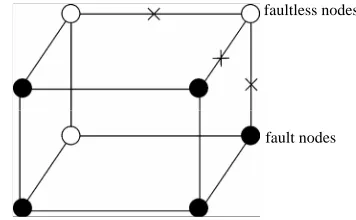
Figure 2. A 3-dimensional hypercube H3 with fault nodes
5) Assume that U =V.
6) If s<k, then s=s+1, and repeats the step 4, other-wise turns to step7).
7) Node A computes intermediate nodes V=
( , ), and
let P=P{V}.
)
,..., ,
(u1 u2 un/2 ( 1, 2,... 1, , 1,..., /2)
s s s
n
u u
u
gj
gu
g u 8) Let U =V.
9) If s<w, then s=s+1, and repeats step7); otherwise go on step10).
10) Let P=P{B}. }
According to Theorem 5, any node can compute a key path to it destination when there is no compromised node in the network. Once the path P is achieved, the two nodes can exchange secret information to generate pair-wise key between themselves.
For example, the node A((001), (0101)) and the node B((100), (1100)) can establish pairwise key along the following key path: A((001), (0101)) ((101), (0101)) ((100), (0101)) ((100), (1101)) B((100), (1100)).
According to the algorithm described above, the fol-lowing conclusion is naturally held.
Theorem 6: Assume that any two nodes can commu-nicate with each other directly, and there is no compro-mised node in a network. If the distance between the two nodes is k, then there exists a key path with distance of k. That is, the two nodes can establish pairwise key through k-1 intermediate nodes.
4.4.
Dynamic Key Path Establishment
The Indirect_Key_Establishing_Algorithm() illustrated in Subsection 4.3 can only deal with the situation that there is no compromised node in the network. However, in case of some existent compromised nodes, the algo-rithm would fail to find fungible intermediate node to help establish pairwise key.
We further analyze the example addressed in Subsection 4.3. When the node ((101),(0101)) is compromised, the node A and B can utilize the following path to establish pairwise key: A((001), (0101)) ((000),(0101)) ((100), (0101)) ((100), (1101)) B((100), (1100)).
When the node ((100),(1101)) is compromised, the two nodes can use the path: A((001), (0101)) ((101), (0101)) ((100), (0101)) ((100), (0100)) B((100), (1100)).
In case that the nodes ((101),(0101)),((100),(1101)) are compromised, there still exists a key path denoted as A((001),(0101)) ((000),(0101)) ((100),(0101)) ((100),(0100))B((100),(1100)).
4.4.1.
Relative Definitions of Local Weak Connectivity Definition 6: The nodes A and B in a n-dimensional
hy-percube Hn are called neighbors, if that there exists only
one different bit in their binary strings.
Definition 7: The node A in an m-dimensional hyper-cube/sub-hypercube Hm is m-disconnected, iif that all
links between A and every faultless node in Hm are fault.
The node A in an m-dimensional hypercube/sub- hyper-cube Hm is reachable, iif that A is faultless and not
m-disconnected.
Definition 8 (k-dimensional local-weak-connectivity): A n-dimensional hypercube Hn is k-dimensional
lo-cal-weak-connected, if all reachable nodes in each k-dimensional sub-hypercube Hk (k 1) of Hn forms a
connected graph, and the number of reachable nodes in Hk is bigger than .
2k1
Definition 9 (general local-weak-connectivity): An n- dimensional hypercube Hn is general local-weak-
con-nected, if there exists a h-dimensional sub-hypercube Hh
(h
k), which is local-weak-connected and includes Hk,as for each k-dimensional sub-hypercube Hk (k
1) ofHn.
Figure 2 presents a 3-dimensional hypercube H3 with
two fault nodes and a 3-disconnected node. According to the above two kinds of local-weak-connectivity concepts, it is easy to prove that all reachable nodes in H3 is global
connected.
4.4.2.
Global Connectivity of Local-Weak-Connected Hypercube
An n-dimensional hypercube Hnhas nodes, in which
each node can be represented by a binary string and has n different links. So Hnhas n 2n fferent links totally.
Def
2n di
1
b1b2 bnk
u ven length n-k corresponds a k-dim b-hy-percube Hk with 2k nodes, and the nodes in Hk can be
represented by suc binary strings as b1 b2…bnk*…*,
where * can be 0 or 1. From the constructio
h
ow that all k-dimensional sub-hypercubesare isomor-
fault nodes faultless nodes
FOR SENSOR NETWORKS es all of the k-dimensional
reachable nodes in any two ne
Hk and are two neighboring
k-d
phic, and Hn includ
sub-hypercubes that is isomorphic with Hk. And it is easy
to prove that Hn includes 2nk-1 k-dimensional sub-
hypercubes that is isomorphic with Hk and has no
com-mon nodes with Hk also.
Lemma 2: All of the
ighboring k-dimensional sub-hypercubesof the Local- Weak-Connected n-dimensional Hypercube Hn form a
connected graph.
Proof: Let that Hk
es, a
k
imensional sub-hypercub ccording to definition 10, we can utilize binary strings b1b2…bnk*…* to
represent the nodes in Hk, where * ca 1. Since
Hk and Hk are neighboring, so there exists at least one
common de between Hk and H k the nodes in
Hk can be represented as bt1 * bt1 …
*…* ds *…* and b1 … bt …
*…* …*
Hk. 1 … …*…*d *
Hn be 0
… b or bt 1
bt
no
d
s
b1
bnk
bnk
bnk
1 bt1
bt1 s *
*…
b t
Hk . Considering that the
num
2k1 *ds
ber of reacha n n Hk is bigger than
2k1 there exists at least on ode A in those s represented by b1…bt1bt bt1…bnk *…
*…* is reachable. Since de
ble odes i
A
e n no
H A and all of th eachable nodes inHk form a c ected graph. And
in addition, since A
k Node A and all of thereachable nodes inH connected graph also. So, all of the reachable nodes in Hk and Hk form a
con-nected graph. Theorem 7: n onn Node e r H form k
a
All of the reachable nodes in n -dimen-sio
f: From Theorem 2, it is easy to prove that the co
n obtain the following de-du
If n-dimensional Hypercube Hn satisfies
the
i atisfies
the
P deduce if ensional Hypercube Hn
-h
nal Hypercube Hn, which satisfies the conditions of
k-dimensional local-weak-connectivity, form a connected graph.
Proo
nclusion stands.
From Theorem 7, we ca ces easily.
Deduce 1:
conditions of k-dimensional local-weak-connectivity, then all of the reachable nodes in any h-dimensional sub-hypercube Hh(h
k) form a connected graph.Deduce 2: If n-d mensional Hypercube Hn s
conditions of k-dimensional local-weak-connectivity, then there exists at least a pair of connected reachable nodes a1 … aj1 0 aj1 … ank nk1 … n and
a1… a aj n een a pair
k-d s l su es a1… aj10 aj1…
ank*…* and a1… aj11 aj1… an …*
roof: From 1, n-dim
1
j 1
men
1
… a
na
k n
-hyperc
1 k
u …n
b of betw
k* .
ny
of i io b
satisfies the conditions of k-dimensional lo-cal-weak-connectivityAll of the reachable nodes in
any h-dimensional sub ypercube Hh(h
k) form acon-nected graph All of the reachabl nodes in any (k+1)-dimensional sub-hypercube a1… aj1* aj1…
ank*…* form a connected graph. A d s th
of unreachable nodes in k-dimensional sub-hypercubes a1 … aj1 0 aj1 … ank *…* and
a1… aj11 aj1… k*… re than a alf of the
be f t al es respectively. So, there exists reachable node a1… aj10 aj1… ank nk1…n in
a1… aj10 aj1… k*…*, a th ble
… aj1 aj1 … ank nk1 …
e n e ex ince h ists reac e nu ha bers num node a t a n no n 1
* a les
d s er r o a1 o d n
n in
a1… aj nk n addition,
se two nodes a aj10 aj1… ank nk1…n and
a1… aj11 aj1… k
aj11 1… a
a
*…* certainly. And i
tho 1
n
… nk1
of
ensional
orem 8
cal-W
c_Ke rk Hn
,..., 2 j … s e y_ w
n ted
Th 8: the eachable nodes
is
perc
that
ak-Connectiv
2)
con ub the _Estab ult no nec
e Hn
hy ity Ba lishing des . is local-ercubes sed _Alg d fa eorem
-b S
,i2
7 K-Dimensio ased ens ,...,i Al d The na ( l im nam two j l Lo i 1 r Hy how Path ith fa /
jn
in , o- ult n-d we tha 4.4. LWC lin 1 i
imensional Hypercube Hn, which satisfies the
condi-tions of general local-weak-connectivity, form a con-nected graph.
Proof: Since n
and
Dy or ne
n/2),
ak-connected, and there exists no other sub-hyper-cubes that include itself in Hn. So, from definition 9, it is
easy to know that Hn is n-dimensional local-weak-con-
nected. And in addition, from definition 8, we can know that all of the reachable nodes in Hn form a connected
graph.
Theorem p
an t satisfy the conditions of the proposed two kinds of local-weak-connectivity, must be global connected.
3.
Dynamic Key Path Establishment Algorithm
K rithm(){
Input:
ks (The links, whose length are bigger than the trans-mitting radius). And two reachable nodes A( (i1,i2,...,in/2) , (j1,j2,...,jn/2) ) and
B( ( , ) in
e
A to T=( (
Hn.
nt_1
B, t , 2 1 i
i
Output: to B in H
P=
If P A c Dynam is a orr co ect key K rrect path Path key pat ine P _Es from t h fr the node A ablishm om n. T
A,T);
hen exit,
,...,in/2
1) Compute and determine the node =
T, ( ( 2) B); ) oth (j ) ,..., , 2 /2
1 i i
i n , (j1,j2,...,jn/2)) in Hn/2;
ic_ ey_ (
3) P=P
Dynamic_Key_Path_Establishment_2 ( 4erwise turn to step 5);
5) Compute and determ ),
)
,..., , 2 /2
1 j jn
6) P=Dynamic_Key_Path stablishment_2 (A,T); T, B)
s a
Al hm Dynamic_Key_Path_Establishment_1(A,T): : _E
7) P=P
Dynamic_Key_Path_Establishment_1 ( ;8) If P i correct key path from A to B, then exit, otherwise turn to step 9);
9) Report A, failure to establish a key path from A to B.
} rit go
1) Obtain the codes of nodes A and T A
( (i1,i2,...,in/2) , (j1,j2,...,jn/2) ), T
((i1,i2,...,in/2), (j1,j2,...,jn/2));
/* From definition 10, we can suppose that the k-d
2) I lize P A;
po binary string C: C=
FOR(j=1;
j++){ccordin lemma2 and deduce 1, a pair of con-ne
), D=(
wh
② e p f
③C D;
After the above steps, a correct key path from node A
from node ((
imensional sub-hypercube that includes T is ((i1i2…in/2k*…*), (j1,j2,...,jn/2)).*/
nitia ath P: P
3) Initialize tem rary((c1,c2,...,cn/2),(j1,j2,...,jn/2))
A;4) j
n/2 ; IF(i
j
i
j){①A g to
cted reachable nodes C and D can be found through discovering in neighboring k-dimensional sub- hyper-cubes:
C=(
)
,..., , , ,... ,
(c1 c2
c
j1c
jc
j1 cn/2 ,(j1,j2,...,jn/2)1 2 1 , 1,..., /2
( ,i i ,...
i
j,i x
j j xn ),c
t=i
t (t
[1, j]); )
,..., ,
(j1 j2 jn/2 ),
ere
Join th ath rom (( ,i i 1 2,...
i
j1,i i
j, j1,...,in/2),node D into P;
)
,...,
,j2 jn/2 ) to
(j1
} } /* (1 i2…in/2
ll be c structe
)
,..., ,
(i1 i2 in/2 ,(j1,j2,...,jn/2)) to the reachable node
((i k n/2),(j1,j2,...,jn/2))
wi on
5) Join the path
n/2k1… d. */
1 2... n/ 2 k
i i i
node T in the
So, a correct
/ 2 1
n k
…n/2), (j1,j2,...,jn/2)) to
-h i2 … in/2k **),
)
,..., ,
(j1 j2 jn/2 ) into P. And then key to node T is discovered.
Algorithm Dynamic_Key_Path_Establishm
k-dimensional
path from
sub
de A
ypercube (( i1
exit. no
ent_2(T, B): 1) Obtain the codes of nodes B and T: T ( (i1,i2,...,in/2) , (j1,j2,...,jn/2) ); B
((i1,i2,...,in/2),(j1,j2,...,jn/2));
ppose that the /* From definition 10, we can su
k-dimensional sub-hypercube that includes B is ((i1,i2,...,in/2),( j1 j2…jn/2k*…*)).*/
2) Initialize Path P: P
T;porary binary string C: 3) Initialize tem
C=((i1,i2,...,in/2),(c1,c2,...,cn/2))
T;4) FOR(l=1; l
n/2 ; l++){ IF( jl
jl){① According to
/2
2
1 i i
i n
,..., ,
(i1 i2 in/
lemma2 and dedu
, , ,... ,
( 1 2
c
l1 l 2 , (j1,j2,...
j
l1ce 1, a pair of con-nected reachable nodes C and D can be found through discovering in neighboring k-dimensional sub-hyper-cubes:
C=(( , ,..., ), c c
c
c
1,...,c ));2 /
l n
D=( ) 1 )
/2
, ,...,
, l
l xn
j x
),where
c
t=j
t (t
[1, .p om (
l])
② Join he ath frt (i1,i2,...,in/2) ,
1 2 1 1
/2
, ,...,
, ,... , )
l l l
j j
jnj
(j j
) to node D into P;③ C
D;ter the above
,.. , (i1 i2 i
} }
/* Af steps, a correct
n/2)
, ( j
key path from node T((i1,i2,...,in/2),(j1,j2,...,jn/2) ) to the reachable
node ( ., 1 j2 … jn/2k
n/2k1…n/2)) Joi the p
will be constructed. */ n ath from node ( (i1,i 5)
( j
)
,..., /2 2 in
,
1 j2…jn/2k n/2k1…n/2)) to e
k-dim ub (i1,i2,...,in/2) , ( j
node B in th ensional sub-hyperc e (
1 j2…jn/2k**))into P. And th t
ke h fr e T to node B is discovered. From the above description, we can know tim
en
( k)
2
= ( k-1) n2
Dy mic_Ke lexity of the k-Dim
ercentag of the f
exit. So, a correc y
com
sor
pat om nod
) k
+ plexity of algorithm
e comp
p
that the
, and the time e complexity of algorithm Dynamic_Key_Path_ Es-tablishment_1 is
(( n/ 2 -k 2)
na _Path_Establish- ment_2 is (
))y
(
ault nodes in
sen-2 k -2
/ k
n
+(2k)=(n2k-1), so
the total tim en cal-
Weak-Connectivity based Dynamic Key Path Establish-ment Algorithm is (n2k).
Considering the e
sional Lo
Estab-FOR SENSOR NETWORKS
cal-Weak-Connectivity Based Dynamic Key Path Establishment Algorithm
GLWC Algorithm(){
Input: Sensor network H with fault nodes and fault s-mi
lishment Algorithm will be (n) only. Figure 3 illus-trates the relationship of dimension n and the scale of the sensor networks.
4.4.4.
General Lo
-based Dynamic_Key_Path_Establishing_
n
links (The links, whose length are bigger than the tran tting radius). And two reachable nodes A((i1,i2,...,in/2),(j1,j2,...,jn/2)) and B((i1,i2,...,in/2),
) ,..., ,
(j j j ) in H ect key p d determine
/2
2
1 n n.
Output: A corr ath P from A to B in H. 1) Compute an the node T=(
n
)
,..., ,
(i1 i2 in/2 ,
)
,..., , 2 /2
1 j jn ) in
H
n/2;ic_Ke th_Es Dyn
(j
2)P=Dynam y_Pa tablishment_3(A, T);
3)P=P amic_Key_Path_Establishment_4(T,
B)
s a c
rwise turn to step 5);
;
4)If P i orrect key path from A to B, then exit, othe
5)Compute and determine the node T=((i1,i2,...,in/2),(j1,j2,...,jn/2)) in
)P=P Dynamic_Key_Path ablish T,
B)
s a c
rwise turn to step 9);
Al hm Dynamic_Key_Path_Establishment_3(A, T): )Obtain the codes of nodes A and T:
/* From definition 10, we can pose that the dim nsional sub-h percube that includes T is ((
3)In lize rary binary string C: C=
FOR(j=1; n; j++){ ){
= ;
ccordin heorem 8, a pair of connected
rea s n be found through
discov-eri
/2
n
H
6)P=Dynamic_Key_Path_Establishment_4(A, T);
7 _Est ment_3(
;
;
8)If P i orrect key path from A to B, then exit, othe
9)Report A, failure to establish a key path from A to B.
} gorit
1
A
( (i1,i2,...,in/2) , (j1,j2,...,jn/2) ),T
,i2,..., ,(j,j ,...,j ); supk- e y
( (i1 in/2) 1 2 n/2)
i1i2…in/2k*…*),(j1,j2,...,jn/2)).*/
2)Initialize Path P: PA; itia tempo
(
(
c
1,
c
2,...,
c
n/2)
,(j1,j2,...,jn/2)) A;4) IF(
j
i
j
i
j(k 1 k -j; k++){
FOR
nIF(A g to T
chable node C and D ca
ng in neighboring k-dimensional sub-hypercubes: C=(
) ,..., , , ,... ,
( 1
2 / 1
2
1 c c
c
c
jc
jc
j n ,(j1, j2,..., jn/2)),D=(
)
,..., , , ,... ,
(i1 i2
i
j1i
jx
j1 xn/2 , (j1,j2,...,jn/2) ),where
c
t=i
t (t
[1,j]);①Jo (
,..., , , ,
( 1
2 / 2
1 i i
i
i
ji
j nin the path from
)
,...
1i
j ,
(( 1 , )
2 / 1
2
1 i x
i j j
x
j n )
,..., ,
(j1 j2 jn/2 ) to node
,... , , ,...
,
i
i
,(j1,j2,...,jn/2)) into P;
②C (
)
,..., , , ,... ,
( 1
2 / 1
2
1i x
i
i
ji
jx
j n , /
2 n
③Break;
) ,..., ,
(j1 j j 2 );
}
LE( }
IF(k >n-j){ WHI k
n){imensional hypercube
), there exists no
fau ) k++;
}
neral lo-cal-weak-connected, and we cannot find a correct key
a
P; }
xit. And a correct key path from A to T is discov-ered.
Obtain the codes of nodes T and B: T IF(In the k-d
((c1,c2,...
c
n/2k*...*),(j1,j2,...,jn/2)ltless key path from node C to node T }
IF( k > n) exit. Then
H
n/2 is not ge p th from node A to T.ELSE Join the path from C to T in the k-dimensional hypercube ((c1,c2,...
c
n/2k*...*),(j1,j2,...,jn/2)) into} 5) E
Algorithm Dynamic_Key_Path_Establishment_4(T, B): 1)
( (i1,i2,...,in/2) , (j1,j2,...,jn/2) ) and B
((i1,i2,...,in/2),(j1,j2,...,jn/2));10 se that the
-hy in
/* From definition , we can suppo
k-dimensional sub percube that cludes B is ( (i1,i2,...,in/2),( j1 j2…jn/2k*…*)).*/
2) Initialize Path P: P
T;e por
3) Initializ tem ary binary string C: C=((i1,i2,...,in/2),(c1,c2,...,cn/2)) T;
4) FOR(l=1; l
n; l++){ IF( jl
jl){FOR(k=1; k
n-j; k++){IF(According to Theorem 8, a pair of connected
rea s n be found through
discov-eri
chable node C and D ca
e ( 1,j]);
①Join the path from ( D=((i1,i2,...,in/2),
) ,..., ( 1 2 / 1 x j l n , ,... , , ), 1 2
j
j
x
l
l
j
wher [
n/2
c
t=i
t t
) ,..., ,
(i1 i2 i ,(j 1,j2,...
)
,...,i n/2 1
1,
j j
l, l ,...,j / 2) ) to nodel n
j
((i1,i2 )) into P;
, ,..., , , ,... 2 / x n
); , ( 1 1 2 1 jj
j
j
x
ll
l
②C
} }
W ( n){
In the k-dimensional hypercube
, there exists no fau
}
neral lo-cal-weak-connected, and we cannot find a correct key pa
to B in
. And a correct key path from T to B is d
From the above description, we can know that the tim complexity of algorithm Dynamic_Key_Path_ Es-tab
vity based Dy mic Key Path Establishment Al
asib f the Algorithm
ur algorithm, the possibility of direct key xpressed as
(
(
i
1,
i
2,...,
i
n/2)
, ) ,..., , , ,... , ( 1 2 / 1 2
1 j x
j
j
j
x
ll n
l
③Break;
IF(k >n-j){ HILEk
IF(((i1,i2,...,in/2),(c1,c2,...
c
n/2k*...*))ltless key path from node C to node B) k++; }
IF(k > n) exit. Then
H
n/2 is not ge th from node T to B.ELSE Join the path from C the k-dimensional hy-percube ((i1,i2,...,in/2),(c1,c2,...
c
n/2k*...*)) into P;} }
5) Exit iscovered.
e
lishment_3 is (
n/2
2kmin)+ (2kmin)=
)(n/2 2kmin
, where
k
minis the smallest integer thatsatisfies the con
o-. e complexity of
namic_K ath_Establishment_4 is
)(n/2 2kmin
+(2kmin)= (
n/2 2kmin), so thetotal time complexity of the general Local-Weak- Con-nectivity based Dynamic Key Path Establishment Algo-rithm is (
n/2 2 min).Considering the percentage of the fault nodes in sen-sor networks, when applying the general Local- Weak-
Connecti na
dition
And the tim ey_P
of k-dimensional l cal-weak-connectivity
algorithm Dy
k
gorithm actually, we can set k=1,2,3. Then the total time complexity of the General Local-Weak- Connec-tivity based Dynamic Key Path Establishment Algorithm will be ( )n only.
5. Analysis
5.1.
Fe ilities o
Theorem 9: In o
establishment for any two nodes can be e PH2
(/2 /2
2
n 2
n )/(N-1).Proof: As the algorithm has assigned any node, de-noted as ((i1,i2,...,in/2) ,(j1,j2,...,jn/2) ), shares of
poly omn ials expressed as FA = {
f
j jn
,..., /2
2
(j1,y),
f
j j j n 2 ,..., , 2 / 3 1 f
n jn/2,y)}
{
f
1 (i1,y),f
21
(i2,y
n/ 2
clear that t /2
no wh ablish direct pai se key wi
Thus 1 j j j n 2 / ,..., , 1 2 / 2 1 ( in ,..., 2 /
),…,
f
here are rwi th
(j2,y),…,
2 i,i3
)}. It’s est i i2,..., n/
(in/2,y
ich can PH2
1 2 des A. n
i i i 2 / ,..., , 1 /2
2
n2
nthe node
( /22
n/22
n within the area 2n-1< N
)/(N-1) as the network scale is 2n.
Suppose that a sensor network has N=10000 sensor nodes, then n=14. The possibility of direct key establish is about PH2
2.56% a cording to the conclusion drawnby Theorem 6. owev r, th c
H e e possibility decreases to PH
0.14% if the algorithm addressed in [3] is used.Theroem10: Assume that the possibility of direct key establishment in H2-based scheme is defined as PH2,
while the possibility in hypercube is denoted as PH, then
PH2>>PH.
Proof: Suppose the number of a network is within the area of 2n-1< N 2n, and PH
1
N n
as addressed in [3]. Thus 2 lim H n H P P
=lim /2 /2 2n 2n
n n =0.
5.2.
Overhead Analysis
ode’s Storage Overhead
tore t-degree bivariate poly-he finite fields q, which N
1) Any node is required to s nomials whose number is n over t occupies n(t+1)log q bits.
FOR SENSOR NETWORKS
hemes have t e same storage head.
e result is certainly he
a route. In case of no compromised node existent 3) Also the node’s own ID information occupies about
n bits storage space, as it is expressed as
((i1,i2,...,in/2),(j1,j2,...,jn/2)).
All of the storage overhead address above sum up to n(t+1)log q+nt+n= n(t+1)log 2qbits.
Theorem 11: The H2-based and the hypercube-based
sc h over
Proof: According to the analysis on storage overhead addressed in Subsection 5.4 in [3], th
ld.
Communication Overhead
In a sensor network, sending a unicast message between two arbitrary nodes may involve the overhead of estab-lishing
in the network, any one node can communicate with the others directly. Assume that the overhead for a hop is defined as 1, then for two arbitrary nodes whose Ham-ming distance is L, the minimum communication over-head is L. We further inspect average communication overhead on H2-based path key establishment.
Suppose there are two nodes A( (i1,i2,...,in/2) ,
)
,..., ,
(j1 j2 jn/2 ) and B((i1,i2,...,in/2), (j1,j2,...,jn/2))
In the formal part of node’s code, the probability o larly, the prob s also 1/2 in th f e
i
eability of
j
e=
ha i dif re dif
=
i
e, e
{1,…, n/ 2} is 1/2; Simi-j
e, e
ilatter code part. Thus the probability for the two nodes to ve fe nt sub- in the formal part is expressed
as P[i fer b-index former part]=
{1,…, n/ 2}
ndex
u s in
i ent s
/2
( / !
1
!( / 2 )!
2
nn
i n i
. In the latter part, we also have:
P[j ifferent sub-indexs in later part]=
2 )
d 1/2 ( / 2 )!
!( / 2 )!
2n n
j n j
. rage communication overhead c
Thus the ave an be
L=
the H2-based scheme is less than that in the hyper-be-based scheme.
Analysis
adversary may compromise two nodes or prevent them to ) The adversary may focus its
summarized as:
n/2
] part former in indexs -sub different i
[ ) 1 (
i P] part former in indexs -sub different j
[ ) 1
( .
oem12: The average communication overhead in
1
i
+
/2
n j P1
j
Ther cu
Proof: According to the analysis on communication overhead addressed in Subsection 5.4 in [3], the result is certainly held.
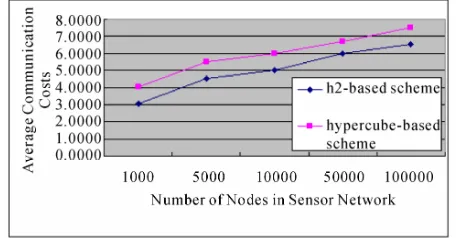
Figure 5 shows that the comparison on communica-tion overhead between the H2-based scheme and the hypercube-based scheme.
5.3.
Security
Here we put focus on two types of attacks against H2-based scheme: 1) An
pairwise key between any stablish a pairwise key. 2 e
power to attack against the whole network, for purpose of lowering the probability of pairwise key establishment, or in creasing communication cost.
[image:10.595.310.535.232.349.2]5.3.1.
Attacks against Pairwise Key between Two Nodes [image:10.595.309.537.393.512.2]
Figure 3. The relationship of dimension n and the scale of the sensor networks.
Figure 4. The comparison of probability to establish direct key between H2-based and Hypercube-based algorithms.
[image:10.595.309.537.556.675.2]