Noisy SMS Machine Translation in Low-Density Languages
Vladimir Eidelman†, Kristy Hollingshead†, and Philip Resnik†‡ †
UMIACS Laboratory for Computational Linguistics and Information Processing ‡
Department of Linguistics University of Maryland, College Park
{vlad,hollingk,resnik}@umiacs.umd.edu
Abstract
This paper presents the system we developed for the 2011 WMT Haitian Creole–English SMS featured translation task. Applying stan-dard statistical machine translation methods to noisy real-world SMS data in a low-density language setting such as Haitian Creole poses a unique set of challenges, which we attempt to address in this work. Along with techniques to better exploit the limited available train-ing data, we explore the benefits of several methods for alleviating the additional noise inherent in the SMS and transforming it to better suite the assumptions of our
hierarchi-cal phrase-based model system. We show
that these methods lead to significant improve-ments inBLEUscore over the baseline.
1 Introduction
For the featured translation task of the Sixth Work-shop on Statistical Machine Translation, we devel-oped a system for translating Haitian Creole Emer-gency SMS messages. Given the nature of the task, translating text messages that were sent during the January 2010 earthquake in Haiti to an emergency response service called Mission 4636, we were not only faced with the problem of dealing with a low-density language, but additionally, with noisy, real-world data in a domain which has thus far received relatively little attention in statistical machine trans-lation. We were especially interested in this task be-cause of the unique set of challenges that it poses for existing translation systems. We focused our re-search effort on techniques to better utilize the lim-ited available training resources, as well as ways in
which we could automatically alleviate and trans-form the noisy data to our advantage through the use of automatic punctuation prediction, finite-state raw-to-clean transduction, and grammar extraction. All these techniques contributed to improving trans-lation quality as measured byBLEUscore over our baseline system.
The rest of this paper is structured as follows. First, we provide a brief overview of our baseline system in Section 2, followed by an examination of issues posed by this task and the steps we have taken to address them in Section 3, and finally we con-clude with experimental results and additional anal-ysis.
2 System Overview
Our baseline system is based on a hierarchical phrase-based translation model, which can formally be described as a synchronous context-free gram-mar (SCFG) (Chiang, 2007). Our system is imple-mented in cdec, an open source framework for align-ing, trainalign-ing, and decoding with a number of differ-ent translation models, including SCFGs. (Dyer et al., 2010). 1 SCFG grammars contain pairs of CFG rules with aligned nonterminals, where by introduc-ing these nonterminals into the grammar, such a sys-tem is able to utilize both word and phrase level re-ordering to capture the hierarchical structure of lan-guage. SCFG translation models have been shown to produce state-of-the-art translation for most lan-guage pairs, as they are capable of both exploit-ing lexical information for and efficiently comput-ing all possible reordercomput-ings uscomput-ing a CKY-based de-coder (Dyer et al., 2009).
1
http://cdec-decoder.org
One benefit of cdec is the flexibility allowed with regard to the input format, as it expects either a string, lattice, or context-free forest, and subse-quently generates a hypergraph representing the full translation forest without any pruning. This forest can now be rescored, by intersecting it with a lan-guage model for instance, to obtain output transla-tions. These capabilities of cdec allow us to perform the experiments described below, which may have otherwise proven to be quite impractical to carry out in another system.
The set of features used in our model were the rule translation relative frequency P(e|f), a target
n-gram language model P(e), lexical translation probabilitiesPlex(e|f)andPlex(f|e), a count of the total number of rules used, a target word penalty, and a count of the number of times the glue rule is used. The number of non-terminals allowed in a synchronous grammar rule was restricted to two, and the non-terminal span limit was 12 for non-glue grammars. The hierarchical phrase-based transla-tion grammar was extracted using a suffix array rule extractor (Lopez, 2007).
To optimize the feature weights for our model, we used an implementation of the hypergraph minimum error rate training (MERT) algorithm (Dyer et al., 2010; Och, 2003) for training with an arbitrary loss function. The error function we used wasBLEU (Pa-pineni et al., 2002), and the decoder was configured to use cube pruning (Huang and Chiang, 2007) with a limit of 100 candidates at each node.
2.1 Data Preparation
The SMS messages were originally translated by English speaking volunteers for the purpose of pro-viding first responders with information and loca-tions requiring their assistance. As such, in order to create a suitable parallel training corpus from which to extract a translation grammar, a number of steps had to be taken in addition to lowercasing and tok-enizing both sides of training data. Many of the En-glish translations had additional notes sections that were added by the translator to the messages with either personal notes or further informative remarks. As these sections do not correspond to any text on the source side, and would therefore degrade the alignment process, these had to be identified and re-moved. Furthermore, the anonymization of the data
resulted in tokens such asfirstnameand phonenum-ber which were prevalent and had to be preserved as they were. Since the total amount of Haitian-English parallel data provided is quite limited, we found additional data and augmented the available set with data gathered by the CrisisCommons group and made it available to other WMT participants. The combined training corpus from which we ex-tracted our grammar consisted of 123,609 sentence pairs, which was then filtered for length and aligned using the GIZA++ implementation of IBM Model 4 (Och and Ney, 2003) to obtain one-to-many align-ments in either direction and symmetrized using the grow-diag-final-and method (Koehn et al., 2003).
We trained a 5-gram language model using the SRI language modeling toolkit (Stolcke, 2002) from the English monolingual News Commentary and News Crawl language modeling training data pro-vided for the shared task and the English portion of the parallel data with modified Kneser-Ney smooth-ing (Chen and Goodman, 1996). We have previ-ously found that since the beginnings and ends of sentences often display unique characteristics that are not easily captured within the context of the model, explicitly annotating beginning and end of sentence markers as part of our translation process leads to significantly improved performance (Dyer et al., 2009).
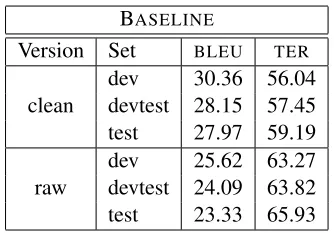
A further difficulty of the task stems from the fact that there are two versions of the SMS test set, a raw version, which contains the original messages, and a clean version which was post-edited by humans. As the evaluation of the task will consist of translating these two versions of the test set, our baseline sys-tem consisted of two syssys-tems, one built on the clean data using the 900 sentences in SMS dev clean to tune our feature weights, and evaluated using SMS devtest clean, and one built analogously for the raw data tuned on the 900 sentences in SMS dev raw and evaluated on SMS devtest raw. We report results on these sets as well as the 1274 sentences in the SMS test set.
3 Experimental Variation
trans-BASELINE
Version Set BLEU TER
clean
dev 30.36 56.04
devtest 28.15 57.45
test 27.97 59.19
raw
dev 25.62 63.27
devtest 24.09 63.82
[image:3.612.102.269.55.172.2]test 23.33 65.93
Table 1: Baseline systemBLEUandTERscores
lation quality in the 2011 WMT shared translation task,2and significantly outperforms the raw version, despite the content of the messages being identical. This serves to underscore the importance of proper post-processing of the raw data in order to attempt to close the performance gap between the two versions. Through analysis of the raw and clean data we iden-tified several factors which we believe greatly con-tribute to the difference in translation output. We examine punctuation in Section 3.2, grammar post-processing in Section 3.3, and morphological differ-ences in Sections 3.4 and 3.5.
3.1 Automatic Resource Confidence Weighting
A practical technique when working with a low-density language with limited resources is to du-plicate the same trusted resource multiple times in the parallel training corpus in order for the transla-tion probabilities of the duplicated items to be aug-mented. For instance, if we have confidence in the entries of the glossary and dictionary, we can dupli-cate them 10 times in our training data to increase the associated probabilities. The aim of this strat-egy is to take advantage of the limited resources and exploit the reliable ones.
However, what happens if some resources are more reliable than others? Looking at the provided resources, we saw that in the Haitisurf dictionary, the entry for paske is matched with for, while in glossary-all-fix, paske is matched withbecause. If we then consider the training data, we see that in most cases, paske is in fact translated as because. Motivated by this type of phenomenon, we em-ployed an alternative strategy to simple duplication which allows us to further exploit our prior knowl-edge.
2
http://matrix.statmt.org/matrix
First, we take the previously word-aligned base-line training corpus and for each sentence pair and wordei compute the alignment link count c(ei, fj)
over the positionsjthateiis aligned with, repeating
for c(fi, ej) in the other direction. Then, we
pro-cess each resource we are considering duplicating, and augment its score byc(ei, fj)for every pair of
words which was observed in the training data and is present in the resource. This score is then normal-ized by the size of the resource, and averaged over both directions. The outcome of this process is a score for each resource. Taking these scores on a log scale and pinning the top score to associate with 20 duplications, the result is a decreasing number of duplications for each subsequent resources, based on our confidence in its entries. Thus, every entry in the resource receives credit, as long as there is evidence that the entries we have observed are reliable. On our set of resources, the process produces a score of 17 for the Haitisurf dictionary and 183 for the glos-sary, which is in line with what we would expect. It may be that the resources may have entries which occur in the test set but not in the training data, and thus we may inadvertently skew our distribution in a way which negatively impacts our performance, however, overall we believe it is a sound assumption that we should bias ourselves toward the more com-mon occurrences based on the training data, as this should provide us with a higher translation probabil-ity from thegoodresources since the entries are re-peated more often. Once we obtain a proper weight-ing scheme for the resources, we construct a new training corpus, and proceed forward from the align-ment process.
Table 2 presents theBLEUandTERresults of the standard strategy of duplication against the confi-dence weighting scheme outlined above. As can be
CONF. WT. X10
Version Set BLEU TER BLEU TER
clean
dev 30.79 55.71 30.61 55.31
devtest 27.92 57.66 28.22 57.06
test 27.97 59.65 27.74 59.34
raw
dev 26.11 62.64 25.72 62.99
devtest 24.16 63.71 24.18 63.71
[image:3.612.313.537.590.691.2]test 23.66 65.69 23.06 66.78
seen, the confidence weighting scheme substantially outperforms the duplication for the dev set of both versions, but these improvements do not carry over to the clean devtest set. Therefore, for the rest of the experiments presented in the paper, we will use the confidence weighting scheme for the raw version, and the standard duplication for the clean version.
3.2 Automatic Punctuation Prediction
Punctuation does not usually cause a problem in text-based machine translation, but this changes when venturing into the domain of SMS. Punctua-tion is very informative to the translaPunctua-tion process, providing essential contextual information, much as the aforementioned sentence boundary markers. When this information is lacking, mistakes which would have otherwise been avoided can be made. Examining the data, we see there is substantially more punctuation in the clean set than in the raw. For example, there are 50% more comma’s in the clean dev set than in the raw. A problem of lack of punctuation has been studied in the context of spo-ken language translation, where punctuation predic-tion on the source language prior to translapredic-tion has been shown to improve performance (Dyer, 2007). We take an analogous approach here, and train a hid-den 5-gram model using SRILM on the punctuated portion of the Haitian side of the parallel data. We then applied the model to punctuate the raw dev set, and tuned a system on this punctuated set. How-ever, the translation performance did not improve. This may have been do to several factors, including the limited size of the training set, and the lack of in-domain punctuated training data. Thus, we ap-plied a self-training approach. We apap-plied the punc-tuation model to the SMS training data, which is only available in the raw format. Once punctuated, we re-trained our punctuation prediction model, now including the automatically punctuated SMS data
AUTO-PUNC
Version Set BLEU TER
raw
dev 26.09 62.84
devtest 24.38 64.26
[image:4.612.345.510.418.534.2]test 23.59 65.91
Table 3: Automatic punctuation prediction results
as part of the punctuation language model training data. We use this second punctuation prediction model to predict punctuation for the tuning and eval-uation sets. We continue by creating a new parallel training corpus which substitutes the original SMS training data with the punctuated version, and build a new translation system from it. The results from using the self-trained punctuation method are pre-sented in Table 3. Future experiments on the raw version are performed using this punctuation.
3.3 Grammar Filtering
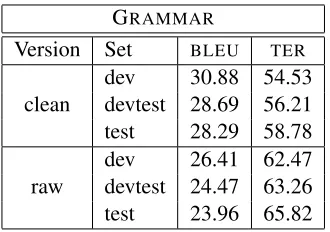
Although the grammars of a SCFG model per-mit high-quality translation, the grammar extraction procedure extracts many rules which are formally li-censed by the model, but are otherwise incapable of helping us produce a good translation. For example, in this task we know that the tokenfirstnamemust al-ways translate asfirstname, and never as phonenum-ber. This refreshing lack of ambiguity allows us to filter the grammar after extracting it from the train-ing corpus, removtrain-ing any grammar rule where these conditions are not met, prior to decoding. Filtering removed approximately 5% of the grammar rules.3 Table 4 shows the results of applying grammar fil-tering to the raw and clean version.
GRAMMAR
Version Set BLEU TER
clean
dev 30.88 54.53
devtest 28.69 56.21
test 28.29 58.78
raw
dev 26.41 62.47
devtest 24.47 63.26
test 23.96 65.82
Table 4: Results of filtering the grammar in a post-processing step before decoding
3.4 Raw-Clean Segmentation Lattice
As noted above, a major cause of the performance degradation from the clean to the raw version is re-lated to the morphological errors in the messages. Figure 1 presents a segmentation lattice with two versions of the same sentence; the first being from
3
[image:4.612.100.270.615.690.2]the raw version, and the second from the clean. We can see that thatIlavach has been broken into two segments, whileki souhas been combined into one. Since we do not necessarily know in advance which segmentation is the correct one for a better quality translation, it may be of use to be able to utilize both segmentations and allow the decoder to learn the appropriate one. In previous work, word segmentation lattices have been used to address the problem of productive compounding in morphologi-cally rich languages, such as German, where mphemes are combined to make words but the or-thography does not delineate the morpheme bound-aries. These lattices encode alternative ways of seg-menting compound words, and allow the decoder to automatically choose which segmentation is best for translation, leading to significantly improved re-sults (Dyer, 2009). As opposed to building word segmentation lattices from a linguistic morphologi-cal analysis of a compound word, we propose to uti-lize the lattice to encode all alternative ways of seg-menting a word as presented to us in either the clean or raw versions of a sentence. As the task requires us to produce separate clean and raw output on the test set, we tune one system on a lattice built from the clean and raw dev set, and use the single system to decode both the clean and raw test set separately. Table 5 presents the results of using segmentation lattices.
3.5 Raw-to-Clean Transformation Lattice
As can be seen in Tables 1, 2, and 3, system per-formance on clean text greatly outperforms system performance on raw text, with a difference of almost 5BLEUpoints. Thus, we explored the possibility of automatically transforming raw text into clean text, based on the “parallel” raw and clean texts that were provided as part of the task.
One standard approach might have been to train
SEG-LATTICE
Version Set BLEU TER
raw
dev 26.17 61.88
devtest 24.64 62.53
test 23.89 65.27
Table 5: Raw-Clean segmentation lattice tuning results
FST-LATTICE
Version Set BLEU TER
raw
dev 26.20 62.15
devtest 24.21 63.45
[image:5.612.342.510.55.130.2]test 22.56 67.79
Table 6: Raw-to-clean transformation lattice results
a Haitian-to-Haitian MT system to “translate” from raw text to clean text. However, since the training set was only available as raw text, and only the dev and devtest datasets had been cleaned, we clearly did not have enough data to train a raw-to-clean translation system. Thus, we created a finite-state transducer (FST) by aligning the raw dev text to the clean dev text, on a sentence-by-sentence basis. These raw-to-clean alignments were created using a simple mini-mum edit distance algorithm; substitution costs were calculated according to orthographic match.
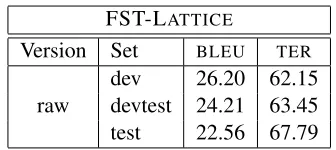
One option would be to use the resulting raw-to-clean transducer to greedily replace each word (or phrase) in the raw input with the predicted transfor-mation into clean text. However, such a destructive replacement method could easily introduce cascad-ing errors by removcascad-ing text that might have been translated correctly. Fortunately, as mentioned in Section 2, and utilized in the previous section, the cdec decoder accepts lattices as input. Rather than replacing raw text with the predicted transformation into “clean” text, we add a path to the input lat-tice for each possible transform, for each word and phrase in the input. We tune a system on a lattice built from this approach on the dev set, and use the FST developed from the dev set in order to create lattices for decoding the devtest and test sets. An example is shown in Figure 3.4. Note that in this example, the transformation technique correctly in-serted new paths for ilavach and ki sou, correctly retained the single path forzile, but overgenerated many (incorrect) options fornan. Note, though, that the original path fornanremains in the lattice, laying the ambiguity resolution until later in the de-coding process. Results from creating raw-to-clean transformation lattices are presented in Table 6.
[image:5.612.101.270.614.690.2]1 Eske 2
Éske 3
nou ap kite nou mouri nan zile
4 ila
5 Ilavach
vach
6 la
7 kisou
9
[image:6.612.85.526.147.263.2]ki sou okay 8 la 10
Figure 1: Partial segmentation lattice combining the raw and clean versions of the sentence:
Are you going to let us die on Ile `a Vaches which is located close the city of Les Cayes.
15
16 a
m
pa te l
17 an
nan
lan nan
18 nanak
19 zile 20
tant
21 ila
22 ilavach
nan vach
23 e
24 sa
la
lanan 25 ki
26 kisou
[image:6.612.316.535.302.417.2]sou
Figure 2: Partial input lattice for sentence in Figure 3.4, generated using the raw-to-clean transform technique described in Section 3.5.
gains of adding new phrases for tuning.
4 System Comparison
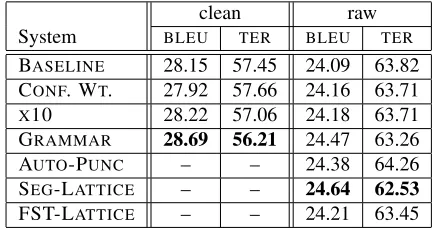
Table 7 shows the performance on the devtest set of each of the system variations that we have pre-sented in this paper. From this table, we can see that our best-performing system on clean data was the GRAMMARsystem, where the training data was multiplied by ten as described in Section 3.1, then the grammar was filtered as described in Section 3.3. Our performance on clean test data, using this sys-tem, was 28.29 BLEUand 58.78TER. Table 7 also demonstrates that our best-performing system on raw data was the SEG-LATTICE system, where the training data was confidence-weighted (Section 3.1), the grammar was filtered (Section 3.3), punctuation was automatically added to the raw data as described in Section 3.2, and the system was tuned on a lattice created from the raw and clean dev dataset. Our per-formance on raw test data, using this system, was 23.89BLEUand 65.27TER.
5 Conclusion
In this paper we presented our system for the 2011 WMT featured Haitian Creole–English translation task. In order to improve translation quality of low-density noisy SMS data, we experimented with a number of methods that improve performance on both the clean and raw versions of the data, and help
clean raw
System BLEU TER BLEU TER
BASELINE 28.15 57.45 24.09 63.82
CONF. WT. 27.92 57.66 24.16 63.71
X10 28.22 57.06 24.18 63.71
GRAMMAR 28.69 56.21 24.47 63.26
AUTO-PUNC – – 24.38 64.26
SEG-LATTICE – – 24.64 62.53
FST-LATTICE – – 24.21 63.45
Table 7: Comparison of all systems’ performance on devtest set
close the gap between the post-edited and real-world data according to BLEU and TER evaluation. The methods employed were developed to specifically address shortcomings we observed in the data, such as segmentation lattices for morphological ambigu-ity, confidence weighting for resource utilization, and punctuation prediction for lack thereof. Overall, this work emphasizes the feasibility of adapting ex-isting translation technology to as-yet underexplored domains, as well as the shortcomings that need to be addressed in future work in real-world data.
6 Acknowledgments
References
Stanley F. Chen and Joshua Goodman. 1996. An empir-ical study of smoothing techniques for language
mod-eling. InProceedings of the 34th Annual Meeting of
the Association for Computational Linguistics, pages 310–318.
David Chiang. 2007. Hierarchical phrase-based trans-lation. In Computational Linguistics, volume 33(2), pages 201–228.
Chris Dyer, Hendra Setiawan, Yuval Marton, and Philip Resnik. 2009. The University of Maryland statistical machine translation system for the Fourth Workshop
on Machine Translation. InProceedings of the
EACL-2009 Workshop on Statistical Machine Translation. Chris Dyer, Adam Lopez, Juri Ganitkevitch, Jonathan
Weese, Ferhan Ture, Phil Blunsom, Hendra Setiawan, Vladimir Eidelman, and Philip Resnik. 2010. cdec: A decoder, alignment, and learning framework for finite-state and context-free translation models. In Proceed-ings of ACL System Demonstrations.
Chris Dyer. 2007. The University of Maryland
Trans-lation system for IWSLT 2007. In Proceedings of
IWSLT.
Chris Dyer. 2009. Using a maximum entropy model to build segmentation lattices for MT. InProceedings of NAACL-HLT.
Liang Huang and David Chiang. 2007. Forest rescoring: Faster decoding with integrated language models. In
Proceedings of the 45th Annual Meeting of the Associ-ation of ComputAssoci-ational Linguistics, pages 144–151. Philipp Koehn, Franz Josef Och, and Daniel Marcu.
2003. Statistical phrase-based translation. InNAACL ’03: Proceedings of the 2003 Conference of the North American Chapter of the Association for Computa-tional Linguistics on Human Language Technology, pages 48–54.
Adam Lopez. 2007. Hierarchical phrase-based trans-lation with suffix arrays. InProceedings of EMNLP, pages 976–985.
Franz Och and Hermann Ney. 2003. A systematic
com-parison of various statistical alignment models. In
Computational Linguistics, volume 29(21), pages 19– 51.
Franz Josef Och. 2003. Minimum error rate training in statistical machine translation. InProceedings of the 41st Annual Meeting of the Association for Computa-tional Linguistics, pages 160–167.
Kishore Papineni, Salim Roukos, Todd Ward, and
Wei-Jing Zhu. 2002. BLEU: a method for automatic
eval-uation of machine translation. InProceedings of 40th Annual Meeting of the Association for Computational Linguistics, pages 311–318.
Andreas Stolcke. 2002. SRILM- an extensible language
modeling toolkit. InIntl. Conf. on Spoken Language