Towards semi-automatic methods for improving WordNet
Nervo Verdezoto University of Trento & LOA-ISTC-CNR, Trento
Laure Vieu IRIT-CNRS, Toulouse & LOA-ISTC-CNR, Trento
Abstract
WordNet is extensively used as a major lexical resource in NLP. However, its quality is far from perfect, and this alters the results of applications using it. We propose here to complement previous efforts for “cleaning up” the top-level of its taxonomy with semi-automatic methods based on the detection of errors at the lower levels. The methods we propose test the coherence of two sources of knowledge, exploiting ontological principles and semantic constraints.
1
Introduction
WordNet (Princeton WordNet (Fellbaum, 1998), henceforth WN) is a lexical resource widely used in a host of applications in which language or linguistic concepts play a role. For instance, it is a cen-tral resource for the quantification of semantic relatedness (Budanitsky and Hirst, 2006), in turn often exploited in applications. The quality of this resource therefore is very important for NLP as a whole, and beyond, in several AI applications. Neel and Garzon (2010) show that the quality of a knowledge resource like WN affects the performance in recognizing textual entailment (RTE) and word-sense dis-ambiguation (WSD) tasks. They observe that the new version of WN induced improvements in recent RTE challenges, but conclude that WN currently is not rich enough to resolve such a task. What is more, its quality may be too low to even be useful at all. Bentivogli et al. (2009) discuss the results1 of 20 “ablation tests” on systems submitted to the main RTE-5 task in which WN (alone) was ablated: 11 of these tests demonstrated that the use of this resource has a positive impact (up to 4%) on the performance of the systems but 9 showed a negative (up to 2% improvement when ablated) or null impact.
In the area of automatic recognition of part-whole relations, Girju and Badulescu (2006) proposed a learning method relying on WN’s taxonomy. Analyzing the classification rules obtained, we could see that WN taxonomical errors lead to absurd rules, which can explain wrong recognition results. For instance, the authors obtain pairs such as⟨shape,physical phenomenon⟩and⟨atmospheric phenomenon,
communication⟩as positive constraints for part-whole recognition, while sentences likea curved shape is part of the electromagnetic radiationorrain is part of this documentwould make no sense.
Some semantic problems of WN are well-known: confusion between concepts and individuals (in principle solved since WN 2.1), heterogeneous levels of generality, inappropriate use of multiple in-heritance, confounding and missing senses, and unclear glosses (Kaplan and Schubert, 2001; Gangemi et al., 2003; Clark et al., 2006). Nevertheless, the number of applications where WN is used as an on-tology has been increasing. In fact, apart from the synonymy relation on which synsets are defined, the hyponymy/hypernymy relation is WN’s semantic relation most exploited in applications; it generates WN’s taxonomy, which can be seen as a lightweight ontology, something it was never designed for, though. Several works tried to address these shortcomings. Gangemi et al. (2003) proposed a manual restructuring through the alignment of WN’s taxonomy and the foundational ontology DOLCE2, but this restructuring just focused on the upper levels of the taxonomy. Applying formal ontology principles
1http://www.aclweb.org/aclwiki/index.php?title=RTE5_-_Ablation_Tests 2
(Guarino, 1998) and the OntoClean methodology (Guarino and Welty, 2004) have also been suggested for manually “cleaning up” the whole resource. This however is extremely demanding, because the philosophical principles involved require a deep analysis of each concept, and as a result, is unlikely to be achieved in a near future. Clark et al. (2006) also gave some general suggestions as design criteria for a new WN-like knowledge base and recommended that WN should be cleaned up to make it logically correct, but did not provide any practical method for doing so. Two other more extensive works rely on manual interventions, either the mapping of each synset in WN to a particular concept in the SUMO ontology (Pease and Fellbaum, 2009), or the tagging of each synset in WN with “features” from the Top Concept Ontology (Alvez et al., 2008) to substitute or contrast the original WN taxonomy. Such approaches are clearly very costly, as each synset needs to be examined. In addition, the ontological value of these additional resources themselves remains to be proven. The method used in (Alvez et al., 2008) has though helped pointing out a large number of errors in WN 1.6.
Our purpose in this paper is to show that automatic methods to spot errors, especially in the lower levels of WN’s taxonomy, can be developed. Spotting errors can then efficiently direct the manual correction task. Such methods could be used to complement a manual top-level restructuring and could be seen as an alternative to fully manual approaches, which are very demanding and in principle require validation between experts. Here, we explore methods based on internal coherence checks within WN, or on checking the coherence between WN and annotated corpora such as those of Semeval-2007 Task 4 (Girju et al., 2007).
The paper is structured as follows: Section 2 presents the data used and the methodology; Section 3 discusses the results; Section 4 concludes, exploring how the method could be extended and applied.
2
Methodology
To spot errors in WN, our basic idea is to contrast two sources of knowledge and automatically check their coherence. Here, we contrast part-whole data with WN taxonomy structure, on the basis of constraints stemming from the semantics of the part-whole relations and ontological principles. The part-whole data used is taken either from the meronymy/holonymy relations of WN or from available annotated corpora. An incoherence between two sources of knowledge may be caused by an error in either one (or both). Contrasting part-whole data with the taxonomy will indeed help detecting errors in the taxonomy —the most numerous— but errors are also found in the part-whole data itself (see Section 3.3).
2.1 Extracting the Dataset
We started extracting WN taxonomy from the hypernym relations in the current version of WN (3.0), a network of 117,798 nouns grouped in 82,155 synsets. We also extracted WN meronymy relations, i.e., 22,187 synset pairs, split into 12,293 “member”, 9,097 “part” and 797 “substance”, to constitute the first part-whole dataset. In order to replicate our methodology, we also extracted 89 part-whole relation word pairs annotated with WN senses from the SemEval-2007 Task 4 datasets (Girju et al., 2007). We kept the positive examples from the training and test datasets,3excluding redundant pairs, and correcting a couple of errors. This data is also annotated with the meronymy sub-relations inspired from the classification of Winston et al. (1987), but five subtypes instead of WN’s three, although “member-collection” can safely be assumed to correspond to WN’s “member” meronymy. We will call this sub-relationMember, be it from WN or from SemEval.
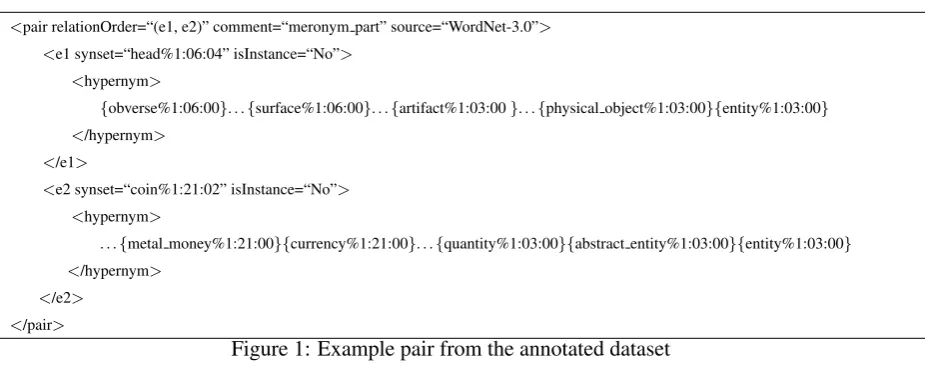
We also tried to get similar datasets from the SemEval-2010 Task 8 but, not being annotated with WN senses, they are useless for our purposes. Figure 1 illustrates a WN-extracted meronymy pair from our corpus4, encoded in our own xml format. Synsets are presented with the standard WN sense keys for each word, the recommended reference for stability from one WN release to another.5
3http://nlp.cs.swarthmore.edu/semeval/tasks/task04/data.shtml 4Available athttp://www.loa-cnr.it/corpus/corpus.tar.gz
5
<pair relationOrder=“(e1, e2)” comment=“meronym part” source=“WordNet-3.0”> <e1 synset=“head%1:06:04” isInstance=“No”>
<hypernym>
{obverse%1:06:00}. . .{surface%1:06:00}. . .{artifact%1:03:00}. . .{physical object%1:03:00}{entity%1:03:00} </hypernym>
</e1>
<e2 synset=“coin%1:21:02” isInstance=“No”> <hypernym>
. . .{metal money%1:21:00}{currency%1:21:00}. . .{quantity%1:03:00}{abstract entity%1:03:00}{entity%1:03:00} </hypernym>
</e2>
[image:3.595.72.535.89.276.2]</pair>
Figure 1: Example pair from the annotated dataset
2.2 The Tests
2.2.1 Ontological constraints
The semantics of the part-whole relation on which the meronymy/holonymy relations are founded in-volves ontological constraints: in short, the part and the whole should be of a similar nature. Studies in Mereology show that part-whole relations occur on all sub-domains of reality, concrete or abstract (Simons, 1987; Casati and Varzi, 1999). As a few cognitively oriented works explicitly state, the part and the whole should nevertheless belong to the same subdomain (Masolo et al., 2003; Vieu and Aur-nague, 2007). Other work, e.g., the influential (Winston et al., 1987), more or less implicitly exploit this homogeneity constraint. Our tests examine and compare the nature of the part and the whole in attested examples of meronymy, looking for incoherences. Here we use only a few basic ontological distinctions, namely, the distinction between:
• endurants (ED) or physical entities (like a dog, a table, a cave, smoke),
• perdurants (PD) or eventualities (like a lecture, a sleep, a downpour), and
• abstract entities (AB— like a number, the content of a text, or a time).
These are only three of the four topmost distinctions in DOLCE (Masolo et al., 2003), that is, we actually group qualities (Q, the fourth top-level category) into abstract entities here.
Tests 1–3 are directly aimed at detecting ontological heterogeneity in meronymy pairs that mix the three categories ED,PDandAB, as just explained. The tests are queries on our corpus to extract and count meronymy pairs (pairs of synsets of the form⟨e1,e2⟩ wheree1 is the part and e2is the whole) that involve an ontological heterogeneity. Test 1focuses on pairs mixing endurants and abstract entities (pairs of type⟨ED,AB⟩or⟨AB,ED⟩),Test 2on endurants and perdurants (⟨ED,PD⟩or⟨PD,ED⟩) andTest 3on perdurants and abstract entities (⟨PD,AB⟩or⟨AB,PD⟩).
However, WN 3.0’s top-level is not as simple as DOLCE’s, so to recover the three basic categories we had to group several classes from different WN branches. In particular perdurants are found both underphysical entity%1:03:00(process%1:03:00) and underabstraction%1:03:00(event%1:03:00and
state%1:03:00). The map we first established was then as follows:
• ED=physical entity%1:03:00\process%1:03:00;
• PD=process%1:03:00∪event%1:03:00∪state%1:03:00;
• AB=abstraction%1:03:00\(event%1:03:00∪state%1:03:00).
Since all groups in WordNet are underabstraction%1:03:00irrespective of the nature of the members, it was obvious from the start that most “member” meronymy pairs would be caught by Tests 1 or 3. This is the reason why groups were actually removed fromABso the final map posited:
• AB=abstraction%1:03:00\(event%1:03:00∪state%1:03:00∪group%1:03:00).
2.2.2 Semantic constraints
Two more tests were designed to check basic semantic constraints involved in meronymy relations. Test 0 is related to the problem of confusion between classes and individuals evoked above and checks for meronymy pairs between an individual and a class. Meronymy in WN applies to pairs of classes and to pairs of individuals, but mixed pairs are also found, either between a class and an individual or between an individual and a class. The semantics of WN meronymy is not precisely described in Fellbaum (1998), but observing the data, the following appears to fit the semantics of “is a meronym of” between two classesAandB: the disjunction of the formulas “for all/most instancesaofA, there is an instancebofBsuch thatP(a, b)” and “for all/most instancesbofB, there is an instanceaofAsuch that
P(a, b)”, wherePis the individual-level part-whole relation. On this basis, a meronymy between a class
Aand an individualbwould simply mean: “for all/most instancesaofA,P(a, b)”, while a meronymy between an individualaand a classBwould mean: “for all/most instancesbofB,P(a, b)”. The former can make sense, cf.⟨sura%1:10:00,koran%1:10:00⟩(all suras are part of the Koran). However, the latter would imply that all (most) instances of the class would share a same part, i.e., they would overlap. That the instances of a given class all overlap is of course not logically impossible, but it is highly unlikely for lexical classes. The purpose of Test 0 is to check for such cases, expected to reveal confusion between individuals and classes, that is, errors remaining after the introduction of the distinction in WN 2.1.6
Test 4is dedicated to the large number ofMemberpairs in WN and SemEval data, somehow disre-garded by the removal of groups fromABabove. The semantics of this special case of meronymy clearly indicates that the whole denotes some kind of group, e.g., a collection or an organization, and that the part is a member of this group (Winston et al., 1987; Vieu and Aurnague, 2007). Group concepts in WN are hyponyms ofgroup%1:03:00. A last coherence check, done by Test 4, thus extracts theMemberpairs in which the whole is not considered a group because it is not an hyponym (or instance) ofgroup%1:03:00.
[image:4.595.179.413.469.569.2]3
Results, Analysis and Discussion
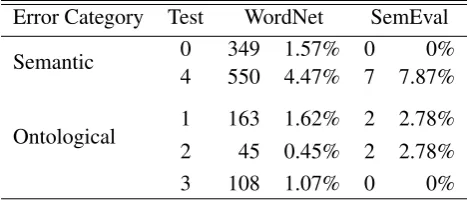
Table 1: Number of pairs extracted by the tests Error Category Test WordNet SemEval
0 349 1.57% 0 0%
Semantic
4 550 4.47% 7 7.87%
1 163 1.62% 2 2.78% Ontological
2 45 0.45% 2 2.78%
3 108 1.07% 0 0%
The number of pairs extracted by our queries are summarized on Table1. The error rates are quite low, ranging from 0 to 7.87% depending on the data set of meronymy pairs (WN or SemEval). The highest error rate is provided by Test 4: 550 (4.47%) of the 12,293 WN Memberpairs and 7 (7.87%) of 19 Memberpairs in SemEval dataset were identified as semantic errors because the whole is not a group in WN taxonomy. Test 0 has the lowest rate, just 349 (1.57%) of 22,187 WN meronymy pairs are suspected of confusing classes and individuals. More important than the error rate is that the tests achieved maximal precision. After manual inspection of all the suspect pairs extracted, it turns out all the pairs indeed suffered from some sort of error or another. Of course, the few tests proposed here cannot aim at spotting all the taxonomy errors in WN, i.e., recall surely is low, but their precision is a proof of the effectiveness of the method proposed, which can be extended by further tests to uncover more errors. For Tests 1–3, since the three categoriesED,PDandABare large and diverse, the analysis of the errors started with looking for regularities among the taxonomic chains of hypernyms of the synsets in
6
the pairs. In particular, we looked for taxonomic generalizations of sets of pairs to divide the results in meaningful small sets. These sets were manually examined in order to check the intended meaning of the meronymy relations and determine the possible problems, either in the taxonomy or in the meronymy; for this we used all the information provided by WordNet as synset, synonymy, taxonomy, and glosses. For Tests 0 and 4, similar regularities could be observed. Several regularities denote a few systematic errors relatively easily solved using standard ontological analysis, described in the Sections 3.1–3.5.
3.1 Confusion between class and group
Several individual collections e.g., new testament%1:10:00 , organizations e.g., palestine liberation organization%1:14:00, and genera e.g., genus australopithecus%1:05:00 are considered as classes in WN instead of groups (errors extracted with Test 0). The first example, new testament%1:10:00, is glossed as “the collection of books ...”, but is not considered as an instance of group, it is a subclass of
document%1:10:00.7 The latter two are seen as subclasses instead of instances of group; this would mean that all instances of palestine liberation organization%1:14:00 (whatever these could be) and all instances of genus australopithecus%1:05:00 (which makes more sense) actually are groups. But if there are instances of the genus Australopithecus at all, these are individual hominids, not groups. In fact, the hesitation of the lexicographer is visible here, since lucy%1:05:00is both a Member of
genus australopithecus%1:05:00and an instance ofaustralopithecus afarensis%1:05:00, a subclass of
hominid%1:05:00(not of group). To show further the confusion here,australopithecus afarensis%1:05: 00itself also is aMemberofgenus australopithecus%1:05:00, which, with the semantics ofMember
between classes, would mean that instances ofaustralopithecus afarensis%1:05:00are members of in-stances ofgenus australopithecus%1:05:00, which is clearly not adequate.
Despite this confusion, dealing with collections, organizations and groups as individuals poses no real problem. TheMembermeronymy is adequately used elsewhere in WN to relate individuals (e.g.,
balthazar%1:18:00, an instance ofsage%1:18:00, is a Memberofmagi%1:14:00, an instance of col-lection%1:14:00). Dealing with biological genera is arguably more complex, as one can see them both as classes whose instances are the individual organisms, and as individuals which are instances of the classgenus%1:14:00. A first-order solution to this dilemma, which applies more generally to socially defined concepts, proposes to consider concepts (and genera) as individuals, and to introduce another sort of instance relation for them (Masolo et al., 2004). Beyond genera, related problems occur with the classification of biological orders, divisions, phylums, and families, most of which are correctly consid-ered as groups (e.g.,chordata%1:05:00), except for a few, pointed out by Test 4 (e.g.,amniota%1:05:00,
arenaviridae%1:05:00). All these though should be group individuals, not group classes as now in WN.
3.2 Confusion between class and individual which is a specific instance of the class
Test 0 also points at a few errors where a class is confused with a specific instance of this class. This error corresponds to a missing sense of the word, used with a specific sense. Examples include the individual-class pairs⟨great divide%1:15:00,continental divide%1:15:00⟩,8 ⟨saturn%1:17:00, so-lar system%1:17:00⟩,⟨renaissance%1:28:00,history%1:28:00⟩, in which the continental divide at stake is not any one but that of North America, the solar system, ours, and the history, the history of mankind. Sometimes the gloss itself makes it clear that the lexicographer wanted to do two things at a time; cf. for
continental divide%1:15:00: “the watershed of a continent (especially the watershed of North America formed by a series of mountain ridges extending from Alaska to Mexico)”.
7
This particular error doesn’t show again with Test 4 because the meronyms of new testament%1:10:00 are “part” meronyms, notMembermeronyms.
8
3.3 Confusion between meronymy and other relations
The meronymy relation itself can be wrong, that is, it is confused with other relations, especially “is lo-cated in”⟨balkan wars%1:04:00,balkan peninsula%1:15:00⟩(Test 2),⟨nessie%1:18:00,loch ness%1: 17:00⟩ (Test 1); “participates in” ⟨feminist%1:18:00, feminist movement%1:04:00⟩, ⟨air%1:27:00,
wind%1:19:00⟩(Test 2); “is a quality of”⟨personality%1:07:00,person%1:03:00⟩,⟨regulation time% 1:28:00, athletic game%1:04:00⟩ (Test 3); or still other dependence relations such as in ⟨operating system%1:10:00, platform%1:06:03⟩ (Test 1). Diseases and other conditions regularly give rise to a confusion with “participates in” or its inverse, as with ⟨cancer cell%1:08:00, malignancy%1:26:00⟩,
⟨knock-knee%1:26:00,leg%1:08:01⟩, and⟨acardia%1:26:00,monster%1:05:00⟩(Test 2).
3.4 Confusion between property (AB) and an entity (EDorPD) having that property
A regular confusion occurs between an entity and a property of that entity, for instance a shape, a quantity or measure, or a location. Similarly, confusions occur between a relation and an EDor PDbeing an argument of that relation. Examples are extracted mostly with Tests 1 and 3, but a few examples are also found with Tests 2 and 4, when several problems co-occurred. Such confusions lead to wrong taxonomic positions: coin%1:21:02, haymow%1:23:00 andtear%1:08:01 are attached under quantity%1:03:00
(AB), while the intuition as well as the glosses make it clear that a coin is a flat metal piece and a haymow a mass of hay, that is, concrete physical entities under ED; similarly, corolla%1:20:00 and
mothball%1:06:00are attached undershape%1:03:00(AB), while there are clearlyED.
Regularities group together some cases, e.g., many hyponyms ofhelping%1:13:00(drumstick,fillet,
sangria...) are spotted because helping%1:13:00 is under small indefinite quantity%1:23:00 (AB). It turns out that small indefinite quantity%1:23:00 and its direct hypernym indefinite quantity%1:23:00
cover more physical entities of a certain quantity rather than quantities themselves. The tests reveal similar errors at higher levels in the hierarchy: possession%1:03:00 “anything owned or possessed” is attached underrelation%1:03:00“an abstraction belonging to or characteristic of two entities or parts together” (AB), that is, the object possessed is confused with the relation of possession. Test 1 points at this error 16 times (e.g.,credit card%1:21:00andhacienda%1:21:00, clearly not abstracts, are spotted this way). Another important mid-level error of this kind is thatpart%1:24:00, while glossed “something determined in relation to something that includes it”, is attached underrelation%1:03:00(AB) as well. As a result, all its hyponyms, for instance, news item%1:10:00, and notably,substance%1:03:00“the real physical matter of which a person or thing consists” and all its hyponyms (e.g., dust%1:27:00,
beverage%1:13:00) are considered abstract entities.9
3.5 Confusion between two senses of a word
All the tests yield errors denoting missing senses of some words in WN. Test 4 shows thatMemberis systematically used between a national of a country and that individual country, e.g.⟨ethiopian%1:18:00,
ethiopia%1:15:00⟩, thus referring to the sense ofcountryas “people of that nation”. But while the word
countryhas both the “location” and the “people” senses (among others) in WN, individual countries do not have multiple senses and are all instances ofcountry%1:15:00, the “location” sense.
Similarly, hyponyms ofnatural phenomenon%1:19:00(PD) are often confused with the object (ED) involved, i.e., the participant to the process, revealing missing senses (examples extracted with Test 2).
Precipitation has (among others) two senses, precipitation%1:23:00 “the quantity of water falling to earth” (a quantity,AB), andprecipitation%1:19:00“the falling to earth of any form of water” (a natural phenomenon,PD). The actual water fallen (ED), is missing, as revealed by the pair⟨ice crystal%1:19:00,
precipitation%1:19:00⟩(from Test 2).
Other errors of this kind are more sporadic, as with⟨golf hole%1:06:00,golf course%1:06:00⟩(golf holehas only a “playing period” sense, its “location” sense is missing, from Test 1), and⟨coma%1:17:00,
9
comet%1:17:00⟩(comahas only a “process” sense, its “physical entity” sense is missing, from Test 2).
3.6 Polysemy in WordNet
The last two types of error, 3.4 and 3.5, point at polysemy issues, as well as the few cases of 3.2. There are two strategies to address polysemy in WN. The main one is the distinction of several synsets for the different senses of a word, but there is also the use of multiple inheritance that gives several facets to a single synset. The literature on WN doesn’t make it clear why and when to use multiple inheritance rather than multiple synsets, and it appears that lexicographers have not been methodical is its use. Some cases of “dot objects” (Pustejovsky, 1995) have been accounted this way. For instance,letter%1:10:00inherits both its abstract content from its hypernymtext%1:10:00(AB) and its physical aspect from its hypernym
document%1:06:00(ED). However, the polysemy ofbook, the classical similar case, is not accounted for in this way:book%1:10:00only isED. And whiledocumenthas two separate senses,document%1:10:00
(AB) and document%1:06:00 (ED), there is no separate abstract sense for book. Test 1 points at this problem with the pair⟨book of psalms%1:10:01,book of common prayer%1:10:00⟩, where the part is a sub-class (rather than an instance, but this is an additional problem pointed by Test 0) ofbook%1:10:00
(ED), while the whole is an instance ofsacred text%1:10:00, acommunication%1:03:00(AB).
As far as polysemy standardly accounted with multiple senses goes, our tests point at a need for a more principled use there as well. In particular, the polysemy accounted for at a given level is often not reproduced at lower levels, as just observed fordocumentandbook. We also have seen above that the polysemy of the word countryis not “inherited” by individual countries. Similarly the polysemy ofprecipitationhas no repercussion on that of rain, which has a senserain%1:19:00under precipita-tion%1:19:00, and none under precipitation%1:23:00 (on the other hand, the material sense of rain,
rain%1:27:00“drops of fresh water that fall”, anED, lacks forprecipitation).
A few pairs extracted with Test 4 show the hesitation of the lexicographer between the classifica-tion of a collecclassifica-tion as a group, and a classificaclassifica-tion that accounts for the nature of the collecclassifica-tion ele-ments. For instanceconstellation%1:17:00andarchipelago%1:17:00have members but areED, while
galaxy%1:14:00 is a group. This could be properly addressed by splitting the group category, erro-neously situated among abstract entities anyway, into different group categories (e.g., one for each of
ED,PDandAB), or exploit multiple inheritance if compatible with its regimentation.
3.7 Difficult ontological issues
Although all the pairs retrieved by our tests point at (one or several) errors, in a few cases, these are not solved easily. In particular, difficult ontological issues are faced with fictional entities. WN classifies most of these underpsychological feature%1:03:00(AB). However, these fictional entities often show very similar properties to those of concrete entities. As a result, some of them are classified asEDor
PD, e.g.,acheron%1:17:00is an instance ofriver%1:17:00 (ED), while being somehow recognized as fictional since it is a meronym ofhades%1:09:00, a subclass (here again, not an instance, an additional problem) ofpsychological feature%1:03:00(AB), something pointed out by Test 1. Others have concrete parts, e.g. we find the pair ⟨wing%1:05:00, angel%1:18:00⟩ among the cases of ⟨ED,AB⟩, i.e. Test 1 results. Angel wings (and feathers, etc.) are of course of a different nature than bird wings, and hellish rivers are not real rivers, but how to distinguish them without duplicating most concrete concepts under
psychological feature%1:03:00(AB) is unclear.10
Another regular anomaly is found with roles and relations, e.g., with pairs like⟨customer%1:18:00,
business relation%1:24:00⟩, an⟨ED,AB⟩case (Test 1). A straightforward analysis saying that meronymy has been confused with participation (cf. 3.3) would overlook the fact that the customer role is defined by the business relation itself, i.e., that the dependence is even tighter. Since currently in WN, cus-tomer%1:18:00simply is a sub-class ofperson%1:03:00(ED), in any case the classical issues related to 10Although the ontological nature of fictional entities is discussed in metaphysics (see, e.g., (Thomasson, 1999)), how to deal
the representation of roles are not addressed, and a more general solution should be looked for, perhaps along the lines of (Masolo et al., 2004).
3.8 Small errors
Finally, our tests identify a few isolated WN errors, which can be seen as small slips, such as for in-stance a wrong sense selected in the meronymy, e.g., ⟨seat%1:06:01, seating area%1:06:00⟩ where
seat%1:15:01(the area, not the chair) should have been selected,11or a wrong taxonomical attachment, that is, a wrong sense selected for an hypernym, e.g.,infrastructure%1:06:01is an hyponym of struc-ture%1:07:00, a property, instead ofstructure%1:06:00, an artifact (from the pair⟨infrastructure%1:06: 01,system%1:06:00⟩extracted with Test 1).
3.9 Types of solutions
As can be observed, tests do not all point at a unique type of problem, nor suggest a unique type of solution. Basically, there are five kinds of formal issues underlying the types of errors analyzed above, each calling for different modifications of WN:
• a synset is considered as a class but should be an individual (3.1): need to change its direct hyper-nym link into an instance-of link, possibly changing as well the attachment point in the taxonomy;
• a synset is not attached to the right place in the taxonomy (3.4, 3.8): need to move it in the taxonomy;
• a synset mixes two senses (3.2, 3.5): need to introduce a missing sense, either attached elsewhere in the taxonomy or as instance of the synset at hand;
• the meronymy relation is confused with another one (3.3): need to remove it (or change it for another sort of relation when this is introduced in WN);
• the meronomy relation is established between the wrong synsets (3.8): need to change one of the two synsets related by another sense of a same word.
In some cases, the problems should be addressed through more general cures, at a higher level in the taxonomy (3.4) or by imposing more systematic modeling choices (3.6, 3.7).
4
Looking forward
We showed in this paper that automatic methods can be developed to spot errors in WN, especially in the hyperonymy relations in the lower levels of the taxonomy. The query system based on ontological principles and semantic constraints we proposed was very effective, as all the items retrieved did point to one or more errors. With such generic tests though, a manual analysis of the extracted examples by lexicographers, domain or ontological experts is necessary to decide on how the error should be solved. However, this same analysis showed many regularities pointing at standard ontological errors, which suggested that the tests can be much refined to limit the variety of issues caught by a single test and that simple repair guidelines can be written.
This work can therefore be developed in several directions. On the one hand, the same tests can be exploited further by expanding the meronymy datasets, for instance if some annotated corpus similar to the SemEval2007 datasets becomes available. The range of tests can be extended as well. For in-stance, one can make further coherence tests exploiting meronymy data, refining or complementing the Tests 0–4 presented here. The class of abstract entitiesABgroups a variety of concepts, so incompatible combinations of subclasses are certainly present in⟨AB,AB⟩pairs (e.g., acrossrelation%1:03:00, psycho-logical feature%1:03:00, ormeasure%1:03:00), suggesting new tests. Without considering to remove groups from abstract entities, cases of incoherence involving groups could also be addressed by checking
11
the compatibility of the ontological categories of their members. Among the class of physical entities
ED, we disregarded the presence of location entities, so new tests could also examine incompatible com-binations of subclasses ofED. Finally, we could check whether the “substance” meronym relation indeed involves substances, in a similar way as Test 4 for groups. Additional tests can be considered using other knowledge sources than meronymy data. Within WN, we could exploit the semantics of tagged glosses (cf. Princeton WordNet Gloss Corpus) in order to check the coherence with the taxonomy. And since WN is more than a network of nouns, others relations can be exploited, for instance between nouns and verbs. Similarly, SemEval datasets deal with other relations than the one exploited here: from other sub-types of meronymy (e.g., “place-area”), to any of the semantic relations analyzed in the literature (e.g., “instrument-agency”). In particular, relations involving thematic roles are quite easily associated with ontological constraints and so can constitute the basis for further tests.
On the other hand, methods aiming at improving the quality of WN can be concretely built on the basis of these tests. A semi-automatic tool for “cleaning-up” WN could be fully developed, which could contribute to the next, improved, version of WN. The analysis of regular errors made in WN could simply lead toguidelinesto help lexicographers avoid classical ontological mistakes. Such guidelines could be used for the extension of Princeton WN, e.g., for new domains. They could be used also during the cre-ation of new WordNets for other languages, suggesting at the same time to abandon the common practice of simply importing the taxonomy of Princeton WN, importing also its errors. These two ideas could be combined in creating a tool to assist the development of WordNets by automatically checking errors and pointing out them in the development phase. This could well complement the TMEO methodology, based on ontological distinctions, used during the creation of the Sensocomune computational lexicon (Oltramari et al., 2010).
Acknowledgements
We wish to thank Alessandro Oltramari for his contribution to the initial stages of this work, Laurent Pr´evot for fruitful discussions on this topic and comments on a previous draft, Emanuele Pianta and three anonymous reviewers for their comments. This work has been supported by the LOA-ISTC-CNR and the ILIKS joint European laboratory.
References
Alvez, J., J. Atserias, J. Carrera, S. Climent, E. Laparra, A. Oliver, and G. Rigau (2008). Complete and consistent annotation of WordNet using the Top Concept Ontology. InProceedings of LREC2008, pp. 1529–1534.
Bentivogli, L., I. Dagan, H. T. Dang, D. Giampiccolo, and B. Magnini (2009). The Fifth PASCAL Recognizing Textual Entailment Challenge. InProceedings of TAC 2009 Workshop, Gaithersburg, Maryland, USA.
Budanitsky, A. and G. Hirst (2006). Evaluating WordNet-based Measures of Lexical Semantic Related-ness. Computational Linguistics 32(1), 13–47.
Casati, R. and A. Varzi (1999). Parts and Places - The Structures of Spatial Representation. Cambridge, MA: MIT Press.
Clark, P., P. Harrison, T. Jenkins, J. Thompson, and R. Wojcik (2006). From WordNet to a Knowlege Base. In C. Baral (Ed.),Formalizing and Compiling Background Knowledge and Its Applications to Knowledge Representation and Question Answering. Papers from the 2006 AAAI Spring Symposium, pp. 10–15. AAAI Press.
Gangemi, A., N. Guarino, C. Masolo, and A. Oltramari (2003). Sweetening WordNet with DOLCE. AI Magazine 24(3), 13–24.
Girju, R. and A. Badulescu (2006). Automatic Discovery of Part-Whole Relations. Computational Linguistics 32(1), 83–135.
Girju, R., V. Nastase, and P. Turney (2007). SemEval-2007 Task 04: Classification of Semantic Rela-tions between Nominals. InProceedings of the 4th International Workshop on Semantic Evaluations (SemEval-2007), pp. 13–18. Association for Computational Linguistics.
Guarino, N. (1998). Some ontological principles for designing upper level lexical resources. In A. Rubio, N. Gallardo, R. Castro, and A. Tejada (Eds.),First International Conference on Language Resources and Evaluation, pp. 527–534. European Language Resources Association.
Guarino, N. and C. Welty (2004). An overview of OntoClean. In S. Staab and R. Studer (Eds.),Handbook on Ontologies, pp. 151–159. Springer-Verlag.
Kaplan, A. N. and L. K. Schubert (2001). Measuring and Improving the Quality of World Knowledge Extracted From WordNet. Technical Report 751, University of Rochester.
Masolo, C., S. Borgo, A. Gangemi, N. Guarino, and A. Oltramari (2003). The WonderWeb library of foundational ontologies and the DOLCE ontology. WonderWeb (EU IST project 2001-33052) deliverable D18, LOA-ISTC-CNR.
Masolo, C., L. Vieu, E. Bottazzi, C. Catenacci, R. Ferrario, A. Gangemi, and N. Guarino (2004). Social roles and their descriptions. In D. Dubois and C. Welty (Eds.),Proceedings of the 9th Int. Conf. on Principles of Knowledge Representation and Reasoning (KR 2004), pp. 267–277. Menlo Park (CA): AAAI Press. Whistler June, 2-5, 2004.
Neel, A. and M. Garzon (2010). Semantic Methods for Textual Entailment: How Much World Knowl-edge is Enough? InProceedings of FLAIRS 2010, pp. 253–258.
Oltramari, A., G. Vetere, M. Lenzerini, A. Gangemi, and N. Guarino (2010). Senso comune. In N. Calzo-lari, K. Choukri, B. Maegaard, J. Mariani, J. Odijk, S. Piperidis, M. Rosner, and D. Tapias (Eds.), Pro-ceedings of the Seventh conference on International Language Resources and Evaluation (LREC’10), Valletta, Malta, pp. 3873–3877. European Language Resources Association (ELRA).
Pease, A. and C. Fellbaum (2009). Formal ontology as interlingua: the SUMO and WordNet linking project and Global WordNet. In C.-R. Huang, N. Calzolari, A. Gangemi, A. Lenci, A. Oltramari, and L. Pr´evot (Eds.),Ontology and the Lexicon. A Natural Language Processing Perspective, pp. 31–45. Cambridge University Press.
Pustejovsky, J. (1995). The generative lexicon. Cambridge (MA): MIT Press.
Simons, P. (1987). Parts - A study in ontology. Oxford: Clarendon Press.
Thomasson, A. (1999). Fiction and Metaphysics. Cambridge University Press.
Vieu, L. and M. Aurnague (2007). Part-of relations, functionality and dependence. In M. Aurnague, M. Hickmann, and L. Vieu (Eds.),The Categorization of Spatial Entities in Language and Cognition, pp. 307–336. Amsterdam: John Benjamins.