Detecting Restriction Class
Correspondences in Linked Open Data
A thesis submitted to the
University of Dublin, Trinity College
for the degree of
Doctor of Philosophy
Brian Walshe
Knowledge and Data Engineering Group (KDEG) School of Computer Science
Trinity College, Dublin, [email protected]
Supervised by Prof. Declan O’Sullivan Co-supervised by Dr. Rob Brennan
Declaration
I, the undersigned, declare that this work has not been previously submitted as an exercise for a degree at this or any other University, and that, unless otherwise stated, it is entirely my own work.
Permission to lend or copy
I, the undersigned, agree that the Trinity College Library may lend or copy this thesis upon request.
Acknowledgements
I would like to thank my supervisor Declan O’Sullivan for his excellent planning skills, and for showing great patience with me over the years. I would like to thank my second supervisor, Rob Brennan, for talking me out of some very bad ideas I had for evaluation section.
Abstract
The Linked Open Data (LOD) project has made a broad range of knowledge available on the World Wide Web as open datasets, using a common format and linked in such a manner that it is a simple task to explore and integrate data from different sources. The links between the datasets are one to one relationships between named URIs, but these simple links are not always sufficient to describe many relationships between data in the sets. Sometimes it is more appropriate to use a complex correspondence to describe the relationship – a correspondence which involves one or more entities in a logical formulation. This thesis discusses an approach to detecting complex correspondences between ontologies associated with LOD.
There are several challenges associated with this task. First, the datasets can be very large and the number of potential complex correspondences is a combinatorial function of their size. Secondly, many of the datasets in the LOD cloud may have large amounts of missing information or invalid entries. Our approach focuses on detecting correspondences between named classes and logically constructed restriction classes. An extensional approach – that is, one which uses instance data shared by the datasets – is employed to discover appropriate restriction classes for the correspondences. Unlike other extensional approaches, ours focuses on using methods which will perform well with only a small number of example instances – as finding matched instances is not usually a trivial task.
To evaluate the approach we first demonstrate that it can be used to detect complex correspondences between the DBpedia and YAGO2 datasets. We then show that a small sample of 15 matched instances can be as effective as using a sample in the order of 104
instances. Further to this we show that as the level of missing data increases, a selection metric which takes the open world assumption into account can consistently outperform the Information Gain metric, popular in the field of machine learning. Finally we compare our approach to a leading extensional approach to detecting complex correspondences, and show that our approach can produce more accurate correspondences, while using significantly less input data.
Contents
Declaration ... i
Permission to lend or copy ... ii
Acknowledgements ... iii
Abstract ... v
Contents ... vii
List of Figures ... xiii
List of Tables ... xv
1 Introduction ... 1
1.1 Motivation ... 1
1.2 Research Question ... 4
1.2.1 Research objectives ... 4
1.2.2 Thesis Contributions ... 5
1.3 Technical Approach ... 5
1.4 Evaluation Strategy ... 6
1.5 Thesis Outline ... 7
1.5.1 Chapter 2: Background ... 7
1.5.2 Chapter 3: State of the Art ... 8
1.5.3 Chapter 4: Requirements for a system for finding complex correspondences .... 8
1.5.4 Chapter 5: Design and implementation ... 8
1.5.5 Chapters 6 - 9: Detection Method Evaluation ... 9
1.5.6 Chapter 10: Conclusions ... 9
2 Background ... 11
2.2 Ontology alignment ... 12
2.2.1 Ontology Matching ... 12
2.2.2 Ontology Mapping ... 13
2.2.3 Ontology Alignment Format ... 13
2.2.4 Complex correspondences ... 14
2.3 Semantic web ontologies ... 14
2.3.1 DBPEDIA ... 14
2.3.2 YAGO2 ... 16
2.3.3 GeoNames ... 17
2.3.4 FOAF and the VCard Ontology ... 18
2.3.5 SUMO ... 18
2.4 Summary ... 18
3 State of the art in Complex Correspondence detection ... 20
3.1 Correspondence Detection Methods ... 21
3.2 Approaches to detecting complex correspondences ... 24
3.2.1 Clio and IMB Infosphere Data Architect framework ... 24
3.2.2 Tupelo: A General Framework for Effective Solutions to the Data Mapping Problem 27 3.2.3 COMA Match System Enhancement Engine framework ... 29
3.2.4 Use of multi-relation data mining techniques to find complex correspondences in ontologies ... 29
3.2.5 Common extension comparison method for complex correspondence detection 31 3.2.6 Other approaches ... 34
3.3 Pattern based complex correspondence detection ... 34
3.3.1 Correspondence Patterns ... 35
3.3.3 Complex Correspondences in Publicly available ontologies ... 39
3.3.4 The Explicit Declarative Ontology Alignment Language ... 41
3.3.5 Pattern matching approach to detecting complex correspondences ... 42
3.4 Comparison of approaches ... 44
3.4.1 Taxonomy ... 45
3.4.2 Use of Correspondence Patterns to Guide Complex Correspondence Detection 49 3.5 Summary ... 50
4 Requirements ... 52
4.1 Requirements List ... 52
4.2 Analysis of Class Restriction correspondences in YAGO and DBpedia ... 54
4.3 Defining an optimal Class Restriction correspondence ... 56
4.3.1 Graph Representation of Linked Data Knowledge Bases ... 56
4.3.2 Local Completeness and Well-defined Classes ... 57
4.3.3 Set size based optimal class by attribute value correspondence ... 57
4.4 Summary ... 58
5 Design and Implementation ... 60
5.1 Domain Model ... 60
5.2 Complex correspondence detection use case ... 64
5.3 Complex correspondence detection as an feature selection problem ... 67
5.3.1 Representing triple data as feature vectors ... 68
5.3.2 Information Gain ... 68
5.3.3 Beta-binomial class prediction metric ... 69
5.4 Implementation ... 71
5.4.1 CAVDetector ... 73
5.4.2 Feature Ranker ... 74
6 Detecting Class Restriction Correspondences in DBpedia and YAGO2 ... 78
5.6 Hypothesis ... 78
5.7 Methodology ... 79
5.7.1 Procedure ... 80
5.7.2 Metrics ... 82
5.7.3 Test Case Selection ... 82
5.8 Results ... 86
5.9 Analysis ... 90
5.10 Conclusions ... 91
6 Detection of complex correspondences with samples of instance data ... 92
6.1 Hypothesis ... 92
6.2 Methodology ... 92
6.2.1 Procedure ... 93
6.2.2 Metrics ... 94
6.2.3 Test Case Selection ... 94
6.3 Results ... 97
6.4 Analysis ... 98
6.5 Conclusions ... 99
7 Comparison of feature selection measures for Linked Open Data. ... 100
7.1 Hypothesis ... 101
7.2 Methodology ... 101
7.2.1 Hypothesis test ... 101
7.2.2 Test correspondence creation ... 102
7.2.3 Test ontology creation ... 102
7.2.4 Metrics ... 103
7.4 Analysis ... 105
7.5 Conclusions ... 108
8 Comparison of FS2 with a state of the art common extension based CAV detection method ... 109
8.1 Hypothesis ... 109
8.2 Methodology ... 110
8.2.1 Data Sets ... 111
8.2.2 Results ... 115
8.3 Analysis ... 115
8.4 Conclusions ... 118
9 Conclusions ... 120
9.1 Research Objectives ... 120
9.1.1 Identifying common patterns of complex correspondence ... 120
9.1.2 Survey of existing complex correspondence detection techniques ... 121
9.1.3 Improved techniques for detecting complex correspondences ... 122
9.1.4 Evaluate the ability of the techniques to detect complex correspondences in real world ontologies, using LOD as a case study. ... 123
9.2 Contributions ... 124
9.3 Further Work ... 127
9.4 Final Remarks ... 127
References ... 128
Appendix ... 134
Appendix A. Notation Glossary ... 134
Appendix B. Evaluation data ... 135
Test sets ... 135
Evaluation Log for Chapter 7 ... 135
Appendix C. Inventory of Complex Correspondences ... 137
Complex correspondences between DBPedia and YAGO2 ... 137
List of Figures
Figure 1: Ontology matching as a black-box process ... 13
Figure 2: Wikipedia info-box for the Westwood Mall Bus Terminal ... 15
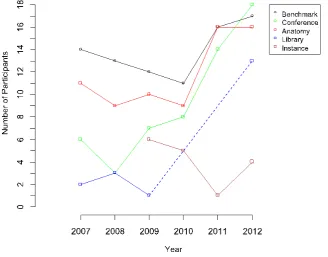
Figure 3: Participation levels for five representative OAEI tracks. ... 22
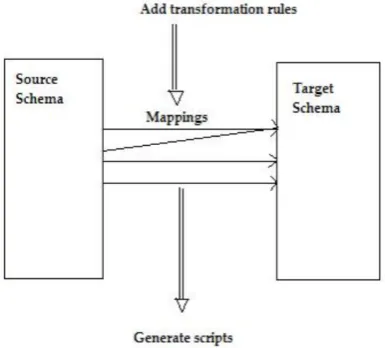
Figure 4. Generating executable code for exchanging data ... 25
Figure 5. Adding a transformation expression ... 26
Figure 6: Converting the detection of complex correspondences to a multi relation data mining problem and generate a set of rules describing the complex correspondences. ... 30
Figure 7: Level of support in the instance data for a restriction correspondence ... 32
Figure 8: Exploring and pruning the space of correspondences ... 33
Figure 9: Partial correspondence pattern hierarchy ... 36
Figure 10. Class by Attribute Value Correspondence ... 37
Figure 11. Class by Attribute Type Correspondence. ... 37
Figure 12. Attribute Value Transformation Correspondence ... 38
Figure 13. Path Correspondence ... 38
Figure 14.Complex correspondence between DBpedia class Country and a restriction class in GeoNames ... 40
Figure 15. Merging YAGO2 classes into the SUMO hierarchy ... 40
Figure 16. Detecting a Class by Attribute Type correspondence through structural and syntactic analysis ... 44
Figure 17. A taxonomy of the detection approaches ... 46
Figure 18. Type of relations detected by each of the approaches surveyed. ... 47
Figure 19. Search strategy used by each of the approaches surveyed. ... 48
Figure 20.Types of correspondence found between from YAGO2 classes to DBpedia. ... 55
Figure 21. Domain model for class restriction correspondences. ... 61
Figure 22. Domain model of the relationship between complex correspondence detection and more general ontology mapping. ... 63
Figure 23. The Detect Complex Correspondences use case. ... 65
Figure 25. The CAVDetector and classes implementing the FeatureRanker interface. ... 72
Figure 26. Messages passed between a client, the CAVDetector, FeatureRanker and ontology SPARQL endpoint. ... 73
Figure 27. An activity diagram of the process followed in experiment 1. ... 81
Figure 28. Top 5 ranked conditions for refining yago:PersonFromToronto ⊑ dbpedia-owl:Person... 87
Figure 29. Top 5 ranked conditions for refining yago:Actor ⊑ dbpedia-owl:Person. ... 87
Figure 30. Top 5 ranked conditions for refining yago:Musician ⊑ dbpedia-owl:Person. ... 88
Figure 31. Top 5 ranked conditions for refining yago:Director ⊑ dbpedia-owl:Person. .... 89
Figure 34. Top 5 ranked conditions for refining yago:Politician ⊑ dbpedia-owl:Person. ... 89
Figure 33: ROC curve for using the IG score to determine if the ranking is correct. ... 90
Figure 34. Evaluation procedure. ... 93
Figure 35: The hierarchy of the target ontology ... 95
Figure 36. The process used to create the 50 classes with known CPV correspondences. .. 97
Figure 37. The TP and FP rates for the FS1 detection method. ... 98
Figure 38. Procedure for Evaluation 3. ... 104
Figure 39. Mean Reciprocal Rank using FS1 and FS2 as a function of missing data. ... 105
Figure 40. Pair-wise difference in FS1 and FS2 rankings. ... 105
Figure 41. Distribution of ranking differences at 0, 30 and 50% missing data ... 107
Figure 42. Class hierarchy that results from treating GeoNames feature class and feature code values as classes. ... 112
List of Tables
Table 1. A partial list of the triples describing the Westwood Mall Bus Terminal. ... 16
Table 2: A comparison of correspondence detection approaches ... 48
Table 3. Relationship between requirements, design, and evaluation. ... 76
Table 4. Test case classes. ... 85
Table 5. Correspondence Conditions. ... 86
Table 6. Mean reciprocal rank for each test case. ... 86
Table 7. CAV correspondences detected using the HTS detection method. ... 113
Table 8. CAV correspondences detected using the FS2 detection method. ... 117
Table 9. CAV correspondences between DBpedia and YAGO2 ... 137
Table 10. CAE correspondences between DBpedia and YAGO2 ... 137
1
Introduction
1.1
Motivation
On the 2ndof May 1956, Richard Feynman gave an address at California Institute of Technology where he said “In this age of specialisation men who thoroughly know one field are often incompetent to discuss another.”1
Fifty years later, in 2006, Tim Berners-Lee published a note2
in which he outlined four simple rules for Linked Data which promised to make the sum total of human knowledge available in a browsable, linked format which could easily be interpreted by both humans and machines. With all this knowledge available, the age of specialisation was sure to end.
Berners-Lee’s rules for linked data are as follows: 1. Use URIs as names for things
2. Use HTTPURIs so that people can look up those names.
3. When someone looks up a URI, provide useful information, using the standards such as RDF and RDFS- XML based languages for describing ontologies – and SPARQL – a language for querying RDF
4. Include links to other URIs, so that they can discover more things.
These rules focus on making data accessible, and on making it easy to find related information. They do not however say much about how the information is related. Simple links cannot always describe how different fields of knowledge are related. It is still the case that a thoroughly versed expert in one field cannot easily integrate information from another field without investing time to understand the new domain of knowledge.
Ontologies provide a method of formally describing a domain of knowledge. They allow for the description of hierarchies of concepts and relationships. Understanding the correspondences between ontologies, allows us to understand how different domains of knowledge relate to one another. At a more practical level, many Linked Open Data knowledge bases have ontologies associated with them and correspondences between these ontologies can enable mediation between the datasets. Three common mediation tasks are ontology merging, query answering, and data translation.[1]. Ontology Merging can be used to create a single coherent ontology from information gathered from multiple independent
sources [2]. Query rewriting can be used, for example, to allow a system to chose from multiple sources to best answer a given query [3]. Instance transformation can be used by mediation services to pass the output of one process to the input of another [4].
However, heterogeneity issues such as differences in class scope or hierarchy granularity mean that simple one to one correspondences between atomic classes are not always enough to describe the relationships between ontologies. YAGO2 [5], for example, contains a rich hierarchy based on WordNet [6], and includes many professions described as classes. An instance of a person in YAGO2 who is a film director, should have this fact described using an rdf:type declaration. In contrast, DBpedia [7] has a shallower class hierarchy, with professions described as attribute-values, not classes. If one to one mappings between atomic classes is the only mechanism available, then we could say that yago:Director maps to dbpedia:Person with a subsumption relationship; but this is not very satisfactory. If, instead, non-atomic classes defined by restrictions can be used then it could be said that yago:Director corresponds with the set of instances of Person in DBpedia with the attribute dbpedia-owl:occupation set to Director.
More formally, correspondences where at least one of the linked entities is non-atomic are known as complex correspondences [8]. Research has been undertaken to provide a common framework to describe and use complex correspondences. This includes Correspondence Patterns [9] which provide a categorisation of the forms of complex correspondence that can exist. It provides a high level description of the correspondence problem and is analogous to design patterns [10] used in software development. On a lower level, EDOAL [11] has become the de-facto language for describing complex correspondences.
The task of discovering complex correspondences however, is still an emergent topic in the field of ontology matching. For example, 2012 was the first year that the Ontology Alignment Evaluation Initiative (OAEI) [12] campaign asked for entries capable of detecting complex correspondences. However all 16 entrants only addressed one-to-one correspondences. Similarly, in 2013 there were no entrants that addressed complex correspondences. The OAEI is held in conjunction with the Ontology Matching (OM) workshop3
. In 2012, of the 6 technical papers accepted to the workshop, only one could be considered to address complex correspondences, discussing a method for transforming string values in Linked Open Data [13]. In 2013 a paper [14] was accepted that described how complex correspondences fitting
the Correspondence Pattern scheme could be used to rewrite SPARQL queries. Use of this technique requires first finding the complex correspondences, which is not a simple task. The focus on one to one correspondences means that the schemas used by LOD collections remain mostly unaligned [15].
As techniques for automating the process of discovering complex correspondences is still an emergent topic, there are relatively few published articles addressing it. Of the methods that have been discussed (see section 3.2), it is possible to broadly categorise them into structural methods [8] and common extension methods [15], [16]. Structural methods use only information about an ontology’s structure to search for correspondences between classes. Common extension methods use information about the shared instances of classes to find their correspondences. Both approaches have their relative merits and the choice of which approach to use depends on the properties of the ontologies being aligned.
The LOD cloud comprises 295 individual datasets containing a total of more than 3×10¹⁰
triple statements, of which approximately 5×10⁸
are interlinks between the datasets4
. Interlinks between instances in many pairs of these sets are frequent – DBpedia and YAGO2, for example, share over 2.5×10⁶
instances linked with owl:sameAs relationships. Other datasets which share large numbers of instances with DBpedia include Geonames and Freebase. The large amounts of matched instance data would suggest that common extension methods should be suitable for discovering complex correspondences between ontologies used by LOD datasets.
For most ontology alignment tasks it is likely that few, if any, instance matches will be provided at the start of the alignment task. Typically during the alignment process, matches must be approved by a human before they are considered valid mappings [17]. This makes it difficult to generate a large number of accurate mappings quickly. Even in cases such as the LOD, where published matches are provided, they may still need to be approved by hand as they are not reliably accurate [18]. Therefore, any common extension method which requires a large amount of matched instance data is unlikely to succeed.
Structural methods for detecting complex correspondences may appear attractive as they do not require any matched instances. However, in a large scale analysis of linked data [19] it was found that the utilization of RDF vocabularies by data publishers can often differ from the intended application envisioned by ontology engineers. Intuitively, there is a danger that
if complex correspondences produced using only structural information are used to perform mediation on instance data, they might not perform as expected.
Current approaches to discovering complex correspondences assume that either large amounts of the common instances shared by the ontologies are known, or that the structure of each ontology accurately reflects the data that it describes. As can be seen above, there are real world applications where these assumptions break down. Therefore, this thesis investigates methods for discovering complex correspondences which do not require large amounts of common instance data, and which are not entirely reliant on rich schema data.
1.2
Research Question
The research question addressed in this thesis is as follows: To what extent is it possible to use small samples of accurately matched instance data to detect complex correspondences between classes in their related ontologies?
In this context, accurately matched instance data means a set of paired URIs from the ontologies that have a high probability of referencing the same entity. The process of creating these instance matches is considered outside the scope of this thesis.
In addressing this question it is assumed that the ontologies are lightweight. That is, ontologies which contain concepts and taxonomies, the relationships and properties of the concepts; but which do not contain not axioms and constraints which clarify the intended meaning of the terms in the ontology. It is assumed that these ontologies have non-empty ABoxes, and that some elements from these ABoxes can be matched to one another. It is also assumed that the ontologies are described in RDF or OWL, and can be queried through a SPARQL endpoint.
1.2.1 Research objectives
This thesis describes an improved approach for detecting complex correspondences between ontologies using extensional information. Current methods for detecting complex correspondences rely on either an ontology with a schema which fits with a narrowly defined pattern, or which contains large amounts of shared instances between the ontologies. The new approach described in this thesis should be more tolerant to discrepancies between schema structure and instance data, while requiring less instance data than other extensional approaches. In order to address the research question the following objectives were defined: 1. Evaluate which forms of complex correspondence exist between ontologies, and therefore
2. Study existing correspondence discovery techniques to establish the capability of state of the art matching technologies to detect the correspondences highlighted from the survey resulting from objective 1.
3. Develop improved techniques for discovering complex correspondences between classes in ontologies using common extensional information.
4. Evaluate the ability of the common extensional based techniques to detect complex correspondences in real world ontologies, using LOD as a case study.
1.2.2 Thesis Contributions
The major contribution of this thesis is the development of methods for detecting complex correspondences between ontologies that share instance data. The approach is novel in that it does not analyse the ontologies schema structure, and only requires a small sample of interlinked instance data. This allows the method to detect correspondences between ontologies which would not be detectable using current state of the art complex correspondence detection methods, which require well defined ontologies or large amounts of matched instance data.
This thesis demonstrates that the detection of complex correspondences can be seen as a feature selection task. It shows that using a commonly used feature selection metric known as information gain (IG) a sample of 20 training instances per class can produce similar detection results as using all instance data in the ontology. This thesis also shows that the beta-binomial distribution can produce more accurate results than IG when there is missing data. With 25% of triples removed from the training set, the beta-binomial based metric ranked a set of gold standard correspondences on average one place higher than when using IG. To the author’s knowledge, beta-binomial based metrics have not been used to perform feature selection before. The complex correspondence detection methods developed in this thesis outperform the state of the art detectors producing more accurate correspondences in one third of the cases tested.
A minor contribution of this work is the development of methods and metrics for evaluating the quality of complex correspondences between data sources.
1.3
Technical Approach
ontologies and database schema.. Schemes for classifying correspondences were also analysed. The objective of this analysis was to discover the types of complex correspondence our approach should be capable of detecting.
Having carried out these studies it was necessary to develop design parameters for a system for detecting complex correspondences. This included analysing several prominent data-sets such as DBpedia [7], YAGO2 [5] and GeoNames5
to establish which kinds of complex correspondence occur most often. It was necessary to develop a set of gold standard complex correspondences between these sets which could be used to evaluate any complex correspondence detection method and choose a metric for comparing the results of the detection method with this gold standard.
Having identified the most common correspondence patterns, methods for detecting these forms of correspondence were developed and implemented. The initial implementation, Feature Selection 1 (FS1), used an off the shelf feature selection method provided by the Weka [20] machine learning toolkit. A second implementation, Feature Selection 2 (FS2), was also created which uses a beta binomial conjugate prior probability distribution to perform feature selection. This distribution was chosen as it can more accurately model the distribution of relationships in linked data. To the author’s knowledge this distribution has not been used to perform feature selection previously. These implementations were evaluated against the gold standard described above to establish if the algorithms were producing appropriate results. The best performing of the algorithms was then compared with state of the art complex correspondence detection methods produced by Parundekar et al [15].
1.4
Evaluation Strategy
To evaluate the research in this PhD, the following strategy was used:
• Estimate the most common complex correspondence patterns in a sample of prominent LOD data-sets. In this step a sample of classes from two prominent LOD data-sets was selected, and complex correspondences between these classes were created by an expert. Each of these correspondences was classified by hand against the Correspondence Pattern [9] classification scheme.
• Develop an implementation of the correspondence detection approach. In this step an extensible implementation of the correspondence detection approach was developed. Initially this implementation used a feature selection method known as
Information Gain to perform the detection. This version of the implementation is referred to as FS1. A second feature selection method based on density estimation was later added to the implementation. This version of the implementation is referred to as FS2
• Initial proof of concept. An initial proof of concept evaluation was carried out using FS1 to perform complex correspondence detection on two prominent LOD ontologies. This evaluation is described in chapter 6.
• Further analysis of the effects of matched instance sample size. Following a successful proof of concept, an evaluation was carried out to more precisely determine the effects of the size of the instance data sample on the performance of FS1. This evaluation is described in chapter 7
• Comparison of potential attribute selection measures. This experiment compared results of using the FS1 and FS2 correspondence detection methods to perform complex correspondence detection as the level of missing attribute data increased. The experiment is described in chapter 8.
• Comparison with state of the art Common Extension Comparison Method. In this experiment the results of using the FS2 method to detect complex correspondences between the DBpedia and Geonames ontologies was compared with published results of a state of the art complex correspondence detector [15]. This evaluation is described in chapter 9.
1.5
Thesis Outline
The thesis is structured as follows.
1.5.1 Chapter 2: Background
1.5.2 Chapter 3: State of the Art
This chapter provides a description of existing correspondence detection and ontology mapping approaches, and the methods used to evaluate these approaches. In particular it discusses the Ontology Alignment Evaluation Initiative (OAEI), this is one of the main driving forces in the field of ontology mapping, but is very focused on the development of approaches for detecting one to one correspondences.
Several existing approaches to detecting complex correspondences in database schema and ontologies are then described. These include IBM InfoSphere Architect [21], Tupelo[22], COMA [23], multi-relational data mining [16], common extension comparison [15] and pattern matching [8]. These methods are compared to discover their common elements, as well as their relative strengths and weaknesses.
The state of the art in methods of describing patterns of complex correspondences is also described. Understanding the forms that correspondences may take allows us to determine which forms are most common and which we should focus our approach on. A survey of published complex correspondences is described in this chapter, comparing them with the Correspondence Pattern [9] classification framework. In addition chapter 3 discusses using Correspondence Patterns as a guide for detecting complex correspondences.
1.5.3 Chapter 4: Requirements for a system for finding complex
correspondences
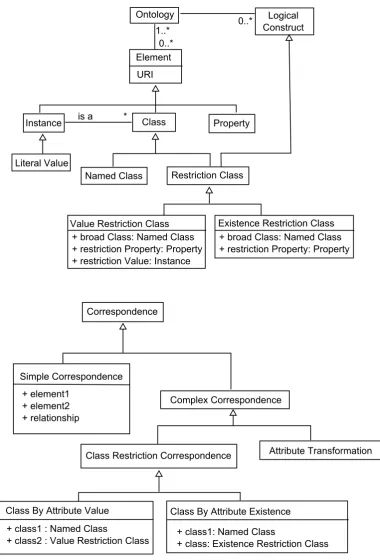
This chapter describes the five requirements of our approach, which were developed from the research question and the state of the art analysis. The requirements specify the type of complex correspondence that our approach will focus on detecting and the form of input data that the approach will use. Our approach will detect Class by Attribute Value (CAV)
correspondences. It must be tolerant to incorrect data and values missing by ommision, and be capable of using a choice of scoring metrics for detecting the correspondences.
In addition, this chapter provides an objective, set based definition of what constitutes a “good” Class by Attribute Correspondence, which can be used when evaluating the metrics used in our approach.
1.5.4 Chapter 5: Design and implementation
correspondences which use the simple correspondences as a base. The approach converts the correspondence detection problem into a feature selection approach. Two feature selection metrics are described: Information Gain which is commonly used in the field of machine learning; and a beta-binomial probability density estimator which we developed to be more suited to the field of semantic web.
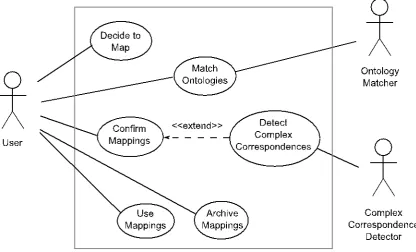
Chapter 5 includes a domain model which describes the components of the complex correspondence detection problem and its solution. It provides a use case which describes how complex correspondence detection can be used as part of the overall ontology mapping process. It then describes the process used to convert the correspondence detection task into an attribute detection task, and the metrics which our approach uses to perform attribute selection. Finally it provides a UML description of the implementation of our approach.
1.5.5 Chapters 6 - 9: Detection Method Evaluation
Chapters 6 to 9 describe four evaluations that were carried out to test our approach in different conditions. Chapter 6 describes an initial evaluation to show that it is possible to detect Class by Attribute Value correspondences in the LOD datasets YAGO2 and DBpedia.
Chapter 7 describes a further evaluation which examines the effect of the size of the set of matched instances on the detection approach’s performance, and demonstrates that for a sample of 20 instances per correspondence, the performance is comparable to using all available matched instances.
Chapter 8 describes an evaluation which compares the use of the beta-binomial metric and the information gain metric in our approach. This evaluation shows that as the level of missing data increases the beta binomial metric shows the least drop in performance.
Chapter 9 describes an evaluation where our approach was compared with a leading restriction class correspondence detection approach [13]. Both approaches were used to detect CAV correspondences between the DBpedia and GeoNames ontologies, and their outputs were compared. This evaluation showed that while both approaches detect the same number of CAV correspondences, in one third of the cases the CAV detected by our approach was more accurate.
1.5.6 Chapter 10: Conclusions
2
Background
This chapter gives a brief outline of ontology alignment and correspondence detection. Previously ontology alignment was focused on discovering one to one correspondences, but more recently complex correspondences have been recognised as necessary for some alignments. The goal of this chapter is to give precise definitions of what is meant when the words ontology, alignment, mapping, correspondence and complex correspondence are used. This chapter also discusses the properties of some semantic web knowledge bases and ontologies that are used in the running examples of complex correspondences, and in the evaluations carried out in this thesis.
2.1
Ontologies
In a broad sense, ontologies provide a formal description of knowledge within a domain. Uschold and Jasper [24] state that An ontology may take a variety of forms, but necessarily it will include a vocabulary of terms, and some specification of the meaning. This includes definitions and an indication of how concepts are interrelated, which collectively impose a structure on the domain and constrain the possible interpretations of terms. Commonly,
ontologies are classed as either lightweight or heavyweight [25]. Lightweight ontologies describe concepts, taxonomies for these concepts, the relationships between the concepts as well as their properties. Heavyweight ontologies additionally include axioms and constraints which clarify the intended meaning of the terms in the ontology.
A further distinction can be made between ontologies described using natural language, and those described using formally defined language such as OWL [26]. Uschold and Gruninger [27] distinguish between four kinds of ontology:
• highly informal ontologies – expressed in a natural language
• semi-informal ontologies – expressed in a restricted and structured form of natural language
• semi-formal ontologies – expressed in an artificial and formally derived language • rigorously formal ontologies, which include meticulously defined terms with
The majority of the ontologies in the LOD cloud can be classified as lightweight, semiformal ontologies. They are typically described in RDF and contain a taxonomy of concepts with relations and properties. Section XX provides a detailed description of a selection of prominent LOD ontologies. The techniques for detecting complex correspondences described in this thesis will focus on ontologies of this form.
2.2
Ontology alignment
Using ontologies is the preferred way to achieve interoperability among heterogeneous systems in the semantic web [11]. Ontologies are not always directly compatible with each other and often require alignment if they are to be used together. An alignment consists of a set of mappings or, more generally, correspondences between the entities, e.g. classes, objects and properties of the ontologies [28].
The OISIN framework characterises the ontology alignment process into five phases [17]: 1. Characterisation phase: In this phase the ontologies are selected, and analysed for
their amenability to be mapped
2. Matching phase: Here a set of candidate matches are identified, either manually or by some automated process.
3. Mapping phase: The set of candidate matches is evaluated and if a candidate is accepted is then converted to a mapping which may be used to execute tasks such as query rewriting
4. Management phase: This includes the sharing of mapping information with third parties, the integration of mapping into other mapping applications and can include a conflict or consistency check as well as the altering of mappings if basic preconditions have changed.
2.2.1 Ontology Matching
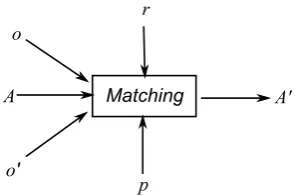
Figure 1: Ontology matching as a black-box process. The primary inputs are the ontologies o and o' which will be matched as well as A, a set of known mathces. The goal is to produce A’, a more complete set of mathces. Addtional inputs to the process may be p, a set of parameters for the matcher, and r, which represents backdround information such as theasauri for eample.
There are many different techniques which may be used to automate this process of matching [29], and these can include structural, terminological and semantic based techniques.
2.2.2 Ontology Mapping
Older definitions [29] of what constituted an alignment specified that they are a collection
of mapping elements, which are 5-tuples of the form 𝑖𝑑, 𝑒, 𝑒&, 𝑛, 𝑅 , where: • id is a unique identifier of a given mapping element
• e and e’ are the entities (classes, objects or properties) • n is a confidence measure
• R is a relation (e.g., equivalence (=); more general (⊑); disjointness (⊥)) holding between the entities e and e’.
Whichever technique is used to perform alignment, the end result is to produce a set of these 5-tuple mappings, and these tuples are typically exchanged using a format known as Alignment Format.
2.2.3 Ontology Alignment Format
This format consists of a header section which describes, among other things, the ontologies being aligned, the arity of the mappings, and if the alignment is injective, surjective and total or partial on both sides. This is then followed by a list of cell elements which describe the individual mappings in the alignment. Each cell specifies a URI for the first entity in the mapping, a URI for the second entity, a relation string (with “=” as the default), and a confidence measure between 0, and 1. The cell element may also have an identifier label.
2.2.4 Complex correspondences
Elementary correspondences, as defined in section 2.2.2, describe relationships between single named entities such as classes, objects or properties. If the correspondence involves one or more entities in logical formulation then it is called a complex correspondence [14], [31].
For example, the relationship Film ⊑ Work stating that work is a more general class than film, is a simple correspondence, but the relationship ∀x, Short Film(x) = Film(x) ∧ duration(x, y) ∧ y < 60, stating that short films are equivalent to films with a duration of less than sixty, is a complex correspondence.
In practice, complex correspondences can often be seen to conform to certain patterns, and these patterns are discussed in section 3.3.
2.3
Semantic web ontologies
In this thesis, semantic web ontologies are used in the running examples of complex correspondences that occur in reality. In addition, these are used in the evaluation of complex correspondence detection methods developed in the thesis. In this section DBPEDIA [7], YAGO2 [5], GEONAMES6, FRIEND OF A FRIEND [32], VCARD7, and THE SUGGESTED UPPER MERGED ONTOLOGY (SUMO) [33] are described.
2.3.1 DBPEDIA
DBPEDIA [7] is a multi-domain knowledge-base that is populated automatically by extracting structured information from Wikipedia8
. This automated process is used as Wikipedia is continually being updated and expanded, and so this allows DBPEDIA to
6 www.GEONAMES.org/ontology 7 http://www.w3.org/TR/vcard-rdf
continually update and expand with much less effort than for a manually created knowledge-base.
Each article in Wikipedia creates an instance in DBPEDIA with the instance name being derived from the English language article name. The properties of this instance are taken from the article and include a label based on the article title, an abstract based on the first 500 words in the article, and a classification based on the SKOS9
[image:31.595.190.420.326.565.2]category of the article. More specific properties about the instance are extracted from the info-box of the article. Info-boxes display an article’s most relevant facts as a table of attribute-value pairs on the top right-hand side of the Wikipedia page. Figure 2 illustrates the info box for the Wikipedia page on the Westwood Mall Bus Terminal, which is a “station” type info-box. This info-box lists the address, coordinates, lines, structure, number of platforms, parking availability, and who owns the terminal.
Figure 2: Wikipedia info-box for the Westwood Mall Bus Terminal
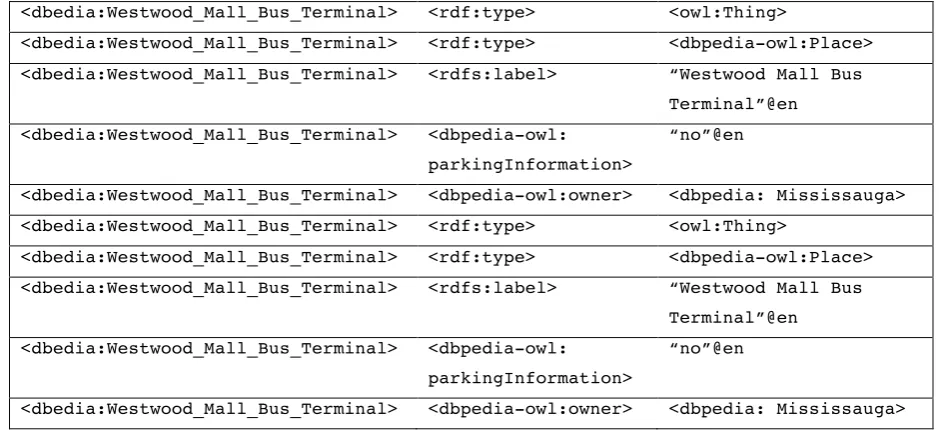
DBPEDIA has an underlying information model based on triples. A partial list of the triples describing the Westwood Mall Bus Terminal, are shown in table 1.
Several ontologies are used in parallel to classify the instances in DBPEDIA. All instances are classified using the DBPEDIA ontology, but for many instances additional classification information is available using classes from YAGO2 and SKOS. The DBPEDIA ontology is relatively shallow with 359 classes which form a subsumption hierarchy that is a directed acyclic graph. The classes were selected from the most commonly occurring types of info-box. There are 1,775 different properties, some of which have well defined domain and ranges, but many do not. New versions (whole dot iterations) of DBPEDIA are released approximately every 1-2 years, but smaller iterations are continually released which include new information that is added to Wikipedia. There is also a live version of the knowledge base which is automatically added to each time a new piece of information is added to Wikipedia.
2.3.2 YAGO2
[image:32.595.67.537.118.333.2]YAGO2 [5], [34] is another ontology that uses Wikipedia as a source of information. While DBPEDIA aims to be as complete as possible, YAGO2 concentrates on accuracy. YAGO2 has a deep class hierarchy based on WordNet [6], and information taken from the GEONAMES ontology. The underlying knowledge model used by YAGO2 consists of a set of 4-tuple of information with an id element, subject, predicate and object. This means that YAGO2 allows reification or, in other words, statements about statements. For example, in
Table 1. A partial list of the triples describing the Westwood Mall Bus Terminal.
<dbedia:Westwood_Mall_Bus_Terminal> <rdf:type> <owl:Thing>
<dbedia:Westwood_Mall_Bus_Terminal> <rdf:type> <dbpedia-owl:Place>
<dbedia:Westwood_Mall_Bus_Terminal> <rdfs:label> “Westwood Mall Bus
Terminal”@en
<dbedia:Westwood_Mall_Bus_Terminal> <dbpedia-owl:
parkingInformation>
“no”@en
<dbedia:Westwood_Mall_Bus_Terminal> <dbpedia-owl:owner> <dbpedia: Mississauga>
<dbedia:Westwood_Mall_Bus_Terminal> <rdf:type> <owl:Thing>
<dbedia:Westwood_Mall_Bus_Terminal> <rdf:type> <dbpedia-owl:Place>
<dbedia:Westwood_Mall_Bus_Terminal> <rdfs:label> “Westwood Mall Bus
Terminal”@en
<dbedia:Westwood_Mall_Bus_Terminal> <dbpedia-owl:
parkingInformation>
“no”@en
YAGO2 it is possible to state that Elvis won a Grammy Award, and additionally state that this event took place in 1967 in a very simple manner with the following two 4-tuples:
#1: Elvis hasWonPrize Grammy Award
#2: #1 inYear 1967
The same information can be expressed using triples, but it requires a more convoluted process. YAGO2 also has a greater focus on temporal information than DBpedia. The use of 4-tuple representation with an id element instead of anonymous triples, allows YAGO2 to easily express temporal properties upon facts. Creating a correspondence between the fact that Elvis won a Grammy in 1967 as expressed above and a triple representation would require some complex process where blank nodes were created.
YAGO2 has an extremely deep hierarchy, containing 224,391 classes, largely taken from WordNet [6]. This is many more than the 359 classes in DBPEDIA. Many of these classes are very specific. For example the class People Murdered in Hawaii is included.
YAGO2 has an iteration cycle which can last several years and therefore correspondences between YAGO2 and more rapidly changing ontologies could become incompatible and need to be repaired, or re-discovered.
2.3.3 GeoNames
The GEONAMES ontology10
, which describes geographic features, is available as a standalone ontology in RDF format in addition to being included as part of YAGO2. This ontology is interesting as it has an unusual structure. Almost all instance data in the ontology have the type geo:Feature. There are no classes in the ontology which would typically be associated with the field of geography. Instead two attributes, geo:Class and geo:Code, provide broad and narrow classification of the individual instances of feature. The classes in the range of these attributes do not have particularly meaningful names – “A” is used for administrative regions, and “A.ADM1” is a country. This meaning of the classes is not specified in the ontology and must be deciphered from a separate table with English language descriptions for each code.
2.3.4 FOAF and the VCard Ontology
Both the Friend of a Friend (FOAF) [32] and VCard11
ontologies provide a method for describing contact details and connections between people. The schema for these ontologies are small, with well specified domains and ranges for properties. FOAF contains 6 classes, and 12 properties, VCard has 77 classes and 67 properties. These ontologies are not subject to regular change, though VCard is still only a working draft. Unlike the previous ontologies, there is no real central repository of instance data for these ontologies. They are used to provide structure for exchanging personal data. It should be noted that while the structure of these ontologies is well defined, in practice instance data quite often does not conform to the schema [19].
2.3.5 SUMO
The Suggested Upper Merged Ontology (SUMO) is a broadly scoped ontology which can be used as a common point to integrate information from different ontologies. It has been used [33] as a “starter document” in the IEEE Standard Ontology Effort. SUMO is defined in Standard Upper Ontology Knowledge Interchange Format (SUO-KIF), a Lisp-like language which allows full propositional logic statements. Facts may be stated as n-ary tuples this means that when aligning with ontologies specified in the more common format of RDF which uses triples, it may be necessary to use complex correspondences to describe how these n-ary tuples can be converted into triples.
2.4
Summary
This chapter discussed the relationship between alignments and correspondences. Older definitions of alignments describe them as a collection of 5-tuples called mappings, which describe a relationship between named entities in two ontologies. A simple correspondence is one where elements in a mapping are classes, objects or singular relations. Complex correspondences extend mappings and allow relationships to be expressed between logically constructed entities in the ontologies.
There are many knowledge bases available on the semantic web with overlapping domains. Some of these knowledge bases are even created from the same sources. Still despite their overlapping domains and common sources, they do not model information in the same way
3
State of the art in Complex Correspondence detection
The objective of this chapter is to summarise the current direction of research in the field of correspondence detection, with particular focus on complex correspondence detection. Section 3.1 will show that the current focus is on developing methods which detect simple one to one correspondences between named classes or relations in ontologies. A large portion of development has been focused on scoring well in standardised tests, but section 3.1 will shows these standardised tests do not cover all possible correspondences and that complex correspondences should also be considered.
Section 3.2 gives a detailed description of the approaches which can be used for detecting and refining complex correspondences. There are a limited number of complex correspondence detection approaches currently available. As a result this section presents a result of analysing: two approaches for finding correspondences in database schemas and three approaches for detecting complex correspondences in ontologies. These are compared to see what commonalities they share and how they differ. The goal is to show that certain steps in detecting complex correspondences are fundamental, but other elements of detecting complex correspondences can be undertaken in a number of different ways.
Correspondence patterns are discussed in section 3.3. These patterns provide a classification system for describing the different forms of complex correspondences each of the approaches discussed in section 3.2 address. Examples of different correspondence patterns are provided in section 3.2.2. Section 3.3.3 discusses the forms of correspondences that have been found to occur in the semantic web. Section 3.3.4 introduces the EDOAL format which is used to describe and share complex correspondences, and section 3.3.5 outlines a correspondence detection approach which uses correspondence patterns to search for complex correspondences.
scheme can be used when choosing an appropriate detection method is analysed. This analysis will show that the current approaches have poor support for some of the most commonly occurring patterns of complex correspondences.
3.1
Correspondence Detection Methods
One of the primary driving forces in the field of correspondence detection is the annual Ontology Alignment Evaluation Initiative (OAEI) [12], [35]–[38]. This annual event consists of a public evaluation (as part of the Ontology Matching (OM) workshop at the International Semantic Web Conference (ISWC)) of the state of the art ontology alignment tools. Each year a set of evaluation ontologies are published and alignment tool developers submit tools which are designed to align these ontologies automatically. The tools are run on a common set of hardware, and their results are compared against a set of gold standard reference alignments. The alignment tools are assessed on their precision and recall against the correspondences contained in each of the gold standard alignments as well as on their running time.
This competition is a large driving force in the field of ontology alignment, and the specific tests performed as part of this competition have a large influence on which capabilities of ontology alignment tools developers focus upon. These tests focus almost exclusively on one to one equivalence relationships between named classes and relationships, and as such this means that tool developers and researchers typically focus on detecting correspondences of this kind.
Each year the competition is broken into several tracks. In 2013 these were:
Benchmark: A systematic benchmark series of tests, designed to identify the areas in which each alignment algorithm is strong and weak.
Anatomy: A real world test case based on matching the Adult Mouse Anatomy and the NCI Thesaurus describing the human anatomy.
Conference: This track is based on finding alignments within a collection of ontologies describing the domain of organising conferences. This track is notable in that it includes complex correspondences.
Library: This track is a real-world task to match the Standard Thesaurus for Economics and the Thesaurus for the Social Sciences.
Interactive matching evaluation: This track covers matching tools that require user interaction.
Large Biomedical Ontologies: This track consists of finding alignments between the Foundational Model of Anatomy (FMA), SNOMED CT, and the National Cancer Institute Thesaurus (NCI).
Instance Matching: The instance data matching track evaluates tools able to identify similar instances among different RDF and OWL datasets.
[image:38.595.142.471.384.641.2]When submitting an alignment tool for evaluation, teams are free to select which tracks they take part in. The tracks are subject to change each year, but the Benchmark, Conference, and Anatomy tracks have been a consistent feature since 2007. Instance Matching has featured since 2009, and Library was featured in 2007 to 2009, and then again in 2012 and 2013. Figure 3 shows the levels of participant tools in these tracks over the years 2007 to 2012.
Figure 3: Participation levels for five representative OAEI tracks.
equivalence relationships between named classes and properties, and no complex correspondences are considered in the evaluation. The authors of the 2012 evaluation report [12], note that there was no significant improvement in this track over the previous year. Subsequently in 2013 there was a drop in performance of the tools in this track. The organisers of the competition theorise [39] that this was because tool developers have stopped focusing on this track to concentrate on the tracks which are based on real world problems – such as Library and Conference.
The Library track measures the alignment tools’ ability to process thesauri. This section was new for 2012, but a similar track ran from 2007-2009. The thesauri used in this section are the SWT Thesaurus for Economics and the Thesaurus for Social Sciences. Both these thesauri are described in SKOS, and have been transformed to OWL for the evaluation. The reference alignment used for the evaluation was generated independently by the KoMoHe [40] project. This tool produces correspondences of the form skos:exactMatch, skos:broaderMatch and skos:narrowerMatch, but only skos:exactMatch correspondences are used for the OAEI evaluation. This shows that the evaluation track is very focused on one to one equivalences, even in a dataset where a tool has been demonstrated to be capable of finding other forms of relationships.
The Conference track is interesting as while the automated evaluation of this section only includes one to one matches, as of 2013, complex correspondences are considered for manual evaluation. Unfortunately in 2013, no tool that entered in this track actually produced any complex correspondences. As the reference alignments used to score this track are all one to one equivalences there is little incentive to detect complex correspondences which are evaluated separately in an ad-hoc manner. Previously in 2009, a pattern matching based tool [8] did demonstrate the ability to detect complex correspondences in these data-sets – though this tool was not put forward for evaluation at the OAEI.
complex correspondences, but as yet none of the current entrants have attempted to demonstrate the capability to detect complex correspondences.
3.2
Approaches to detecting complex correspondences
As illustrated in section 3.1 most approaches developed for the Ontology Matching (OM) workshop focus on discovering one to one correspondences between named ontology entities, however there have been several approaches that demonstrated separately that they can address the issue of complex correspondences.
There are two complex correspondence detection methods which have been presented at OM that are particularly relevant to the work presented in this thesis. These are the Enhancement Engine of the COMA system [41] which is described in more detail in section 3.2.3 and the Pattern Matching approach [8] which is described in more detail in section 3.2.6.
The following sections describe tools which can be used to detect and refine complex correspondences. As there are so few directly comparable approaches available in the specific field of ontology matching, two schema matching tools are included. These are included as schema matching is considered to be closely related to ontology matching [29]. There are many schema matching tools which could be considered, however these Infosphere Data Architect [21] and TUPELO [22] were selected in particular as Infosphere is a leading commercial product and TUPELO is an advanced piece of work capable of automatically finding complex relationships in schemata.
These tools described in this section are compared to determine which common elements the detection process contains, and in what ways they differ. By noting the differences, it should be possible to provide insight into where possible improvements could be made.
3.2.1 Clio and IMB Infosphere Data Architect framework
IBM Infosphere Data Architect is a suite of tools which assists with discovering, modelling, relating, standardizing and integrating diverse and distributed data assets. Included in this suite are tools based on research developed for the Clio [42] project. Clio was developed to facilitate mapping between database or XML schemas and creating rules which can be used to exchange data from one site to another.
which should allow the meaning of their contents to be inferred, however this is not always the case. In a survey of schema based mapping approaches [29] the authors note that “In real-world applications, schemas/ontologies usually have both well defined and obscure labels (terms), and contexts [in which] they occur, therefore, solutions from both problems would be mutually beneficial”. Therefore Infosphere Data Architect is an important piece of
technology in the state of the art, as it represents a leading production level toolkit which is widely used in commercial settings to map between schemas.
Using InfoSphere Data Architect to map between schemas is essentially a four step process:
1. Discover relationships; 2. Map relationships; 3. Build expressions; 4. Generate scripts.
[image:41.595.208.401.526.700.2]In the first step, relationships are detected automatically by the system. These relationships are one-to-one matches between elements in the schema. In the second step, these relationships are displayed visually and the user can add to or remove from this set of mappings. In the third step, the user has the option to add expressions, such as filter or join operations to the mappings. The mappings combined with the additional expressions are then used to automatically generate scripts which can transfer data from one schema representation to the other. Figure 4 illustrates the process.
The expressions which can be added to a mapping are composed from elements chosen from a pre-defined set of operations. These operations include: filters – which build WHERE clauses – sort, join and transformation functions. The transformation functions include:
• Date and Time functions;
• String operations such as concatenation;
• Cast;
• Aggregate functions on columns such as MAX and SUM;
• Math;
• The predicates and operators: *, /, +, -, \ <, >, =, %, BETWEEN, NOT, LIKE, NULL, IN and EXISTS.
[image:42.595.125.480.382.618.2]For example if the system were used to model the relationship between two university student databases, then the system might find that the first name field of the student information must be converted to upper case in one of the databases. Figure 5 illustrates an example of the expression builder.
Figure 5. Adding a transformation expression to the FIRST_NAME field of the database. [21]
In summary, this is a mature system which is used in commercial environments. It provides the ability to automatically detect one to one matches between schema elements, and provides a visual environment for viewing and refining these matches into confirmed mappings. This system supports the creation of complex correspondences in the form of transformation expressions, but these correspondences must be specified manually by a user.
3.2.2 Tupelo: A General Framework for Effective Solutions to the Data
Mapping Problem
The Tupelo framework [22] is a more generalised analysis of the data mapping problem that takes into account the need to find transformation expressions. This framework provides a calculus for describing the common recurring problems that are encountered when mapping data and lists the solutions that can be used. An important aspect of Tupelo is that it emphasises treating mapping discovery as an example-driven search in a space of transformations. This approach allows it to generate queries encompassing a wide range of structural and semantic heterogeneities encountered in relational data mapping.
Tupelo combines a number of principles which create a useful perspective on the problem of detecting complex correspondences. The first of these principles is that examples of common instance data can be analysed in order to discover what transformation process is needed to convert from one representation of the instance to another. In Tupelo this is referred to as the Rosetta Stone principle. This principle states that there are critical instances in the databases under comparison which can be used to understand the relationship between the schemas of the databases. If the common instances which exist in both databases can be found and it can be understood exactly how these particular instances are related to each other, then this understanding can be used to generate mappings which generalise to the schema and the other instances in the database.
In [22], the authors of Tupelo present a method for vectorising databases, and a selection of different metrics that may be applied to this vectorisation. They then demonstrate several search strategies based on variants of tree search. This formalism is interesting as it shows that different components may be combined to form a method for detecting complex relationships between schemas.
Two different algorithms are presented which can be used to search the space of representations of the databases. Both of these are based on tree searches.
• Iterative Deepening A* (IDA): A depth-bounded, depth-first search of the space where the depth is iteratively increased until a path from one representation to the other has been found.
• Recursive Best-First Search (RBFS): A localised, recursive best-first exploration of the state space, keeping track of a locally optimal set of transformations to get to a given state and backtracking if a more efficient path is found.
The authors present three different types of metrics which may be used to compare representations of databases. These metrics are used in the search algorithm to estimate how close a given transformation will bring the current database state to the goal state. These classes of metrics are:
Set based: These metrics count the overlap of values in the database states;
String based: Here the vectortisation of the database is viewed as a string. This allows the use of metrics such as the Levenshtein distance, which measures the number of single character insertions, deletions and substitutions required to transform one string to the other;
Euclidian distance: Here the database state is viewed as a document vector over a set of terms, and a standard Euclidian norm is used to compare them.
In the evaluation of the Tupelo framework, the authors demonstrate that it is capable of detecting complex correspondences in the Inventory and Real Estate II data sets from the Illinois Semantic Integration Archive12
. These correspondences include scaling numerical values, converting nouns to ID numbers, and concatenation of string values.
In summary, the Tupelo framework is interesting in that it goes beyond the capability of IBM InfoSphere Data Architect. While InfoSphere could only detect one to one matches, Tupelo is capable of automatically detecting complex correspondences. Tupelo is also
notable in the way it breaks the problem into several parts and allows for different search strategies and metrics to be combined. One issue with Tupelo is that in order for the search to be effective, a suitable set of Rosetta Stone instances are needed.
3.2.3 COMA Match System Enhancement Engine framework
The COMA Match system was first designed as a framework for combining schema matching approaches [43] and was subsequently extended to match ontologies [23]. The COMA toolset has seen continual development, and as of 2011 includes the Enhancement Engine component [41] which can take the one to one mappings produced by the schema matching approaches and use these to create complex correspondences.
The Enhancement Engine is capable of detecting correspondences which relate multiple entities together, and which use transformation operations including (but not limited to) string functions, numerical functions, date/time functions, and logical operations. COMA operates in an interactive manner and allows a user to refine the correspondences during this process. COMA uses a combination of matched instance data, analysis of the structure of the ontologies and analysis of the element names.
The search strategy it uses is to first examine possible correspondences involving sets of elements which are close together in the ontology graphs, to determine if any transformation correspondences can be found. It then uses external linguistic oracles to discover additional correspondences using the element names.
Like Tupelo, this approach allows for the selection of different components to handle different parts of the process. There is also an option for which linguistic oracles can be used.
3.2.4 Use of multi-relation data mining techniques to find complex
correspondences in ontologies
used to help find more matches between the classes and relations, which in turn are used to find more shared instances.
[image:46.595.118.486.220.445.2]Figure 6 illustrates the steps used by Qin et al to convert the detection of complex correspondences to a multi relation data mining problem and generate a set of rules describing the complex correspondences. The first step is to generate one to one matches in a manner similar to a traditional ontology matcher. Then object reconciliation is used to find the common instances in the ontologies.
Figure 6: The steps used by Qin et al [16] to convert the detection of complex correspondences to a multi relation data mining problem and generate a set of rules describing the complex correspondences.
Once a sufficient number of matching candidates and reconciled instances have been detected, the matching candidates are grouped so that the classes and relations in a given group are independent of the classes and relations in any other group. Each of these groups is then sent to a multi-relational data mining system. As the matches in each group are independent of t

![Figure 5. Adding a transformation expression to the FIRST_NAME field of the database. [21]](https://thumb-us.123doks.com/thumbv2/123dok_us/997197.614233/42.595.125.480.382.618/figure-adding-transformation-expression-first-name-field-database.webp)
![Figure 6: The steps used by Qin et al [16] to convert the detection of complex correspondences to a multi relation data mining problem and generate a set of rules describing the complex correspondences](https://thumb-us.123doks.com/thumbv2/123dok_us/997197.614233/46.595.118.486.220.445/detection-correspondences-relation-problem-generate-describing-complex-correspondences.webp)