warwick.ac.uk/lib-publications
Original citation:
Zhang, Qiang and Bhalerao, Abhir (2016) Loglet SIFT for part description in deformable part
models : application to face alignment. In: British Machine Vision Conference (BMVC 2016),
York, UK, 19-22 Sep 2016. Published in: Proceedings of BMVC 2016
Permanent WRAP URL:
http://wrap.warwick.ac.uk/80626
Copyright and reuse:
The Warwick Research Archive Portal (WRAP) makes this work by researchers of the
University of Warwick available open access under the following conditions. Copyright ©
and all moral rights to the version of the paper presented here belong to the individual
author(s) and/or other copyright owners. To the extent reasonable and practicable the
material made available in WRAP has been checked for eligibility before being made
available.
Copies of full items can be used for personal research or study, educational, or not-for-profit
purposes without prior permission or charge. Provided that the authors, title and full
bibliographic details are credited, a hyperlink and/or URL is given for the original metadata
page and the content is not changed in any way.
A note on versions:
The version presented here may differ from the published version or, version of record, if
you wish to cite this item you are advised to consult the publisher’s version. Please see the
‘permanent WRAP URL’ above for details on accessing the published version and note that
access may require a subscription.
ZHANG, BHALERAO: LOGLET SIFT FOR PART DESCRIPTION
Loglet SIFT for Part Description in
Deformable Part Models: Application to Face
Alignment
Qiang Zhang
Abhir Bhalerao
Department of Computer Science University of Warwick
Coventry, UK
Abstract
We focus on a novel loglet-SIFT descriptor for the parts representation in the De-formable Part Models (DPM). We manipulate the feature scales in the Fourier domain and decompose the image into multi-scale oriented gradient components for computing SIFT. The scale selection is controlled explicitly by tiling Log-wavelet functions (loglets) on the spectrum. Then oriented gradients are obtained by adding imaginary odd parts to the loglets, converting them into differential filters. Coherent feature scales and domain sizes are further generated by spectrum cropping. Our loglet gradient filters are shown to compare favourably against spatial differential operators, and have a straightforward and efficient implementation. We present experiments to validate the performance of the loglet-SIFT descriptor which show it to improve the DPM using a supervised descent method by a significant margin.
1
Introduction
Deformable part models (DPMs) have emerged as the leading approach for accurate land-mark detection in applications such as face alignment. A DPM describes an object by local parts with a shape capturing the spatial relationships among parts. The facial landmark fitting is conducted by local feature searching followed by a shape regularisation. The per-formance has therefore been continually improved by employing part descriptors [16,23] as well as shape modelling [1,24] and fitting algorithms [15,22,23]. Part descriptors seek a representation of local structures which preserves intrinsic properties and discriminative information, while exhibiting invariance to changes such as illumination, scale, and varia-tions in appearance across instances. The most successful part descriptors in DPMs are those based on oriented gradients such as SIFT [13]. The power of SIFT lies in its robustness to illumination and noise through neighbourhood pooling, and its invariance to scale achieved by salient scale selection. When SIFT descriptors are used as part "experts" in DPMs, e.g., in [22,23, 24], the scale is selected by assigning a patch size without salience detection, therefore salient local features may not be captured. In this paper we focus on capturing wider scale ranges, so preserving richer information in SIFT descriptors. We propose multi-scale filter banks designed directly in the Fourier domain which are complementary in multi-scale.
c
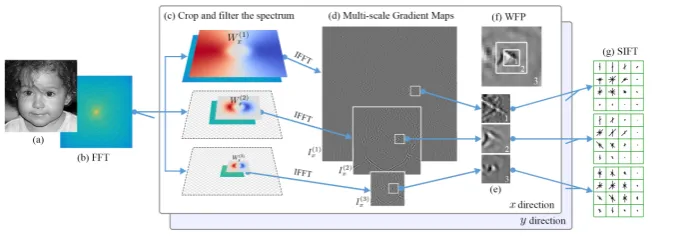
Figure 1: Overview of extracting a loglet-SIFT part descriptor.
Logarithmic wavelets (loglets) are chosen as the scale selection functions because of their superior signal processing properties [11]. Each resultant gradient map represents features at a certain scale, on which the SIFT is calculated, see an overview in Fig.1. The new feature descriptor combines the pooling power of SIFT and scale selection of loglets and is therefore termed loglet-SIFT (L-SIFT).
Several original contributions are included in the proposed descriptor, namely: (i) We design differential filters directly in the Fourier domain with explicit scale selection; (ii) A high pass gradient filter is generated by accumulating a group of adjacent loglets, which achieves a uniform coverage towards the Nyquist frequency and is able to preserve the sharpest gradients without aliasing; (iii) Coherent feature scales and domain sizes are im-plemented efficiently by cropping the Fourier spectrum, which offers a more comprehensive feature descriptor, at a low computational burden.
We integrate the L-SIFT descriptor into a DPM driven by a supervised descent method (SDM) [23] and validate its performance in the face alignment scenario. We compare the performance of our Fourier domain designed filters with spatially-designed filters, and com-pare L-SIFT with conventional SIFT descriptors on popular face datasets. We further present the comparison against several state-of-the-art methods on two popular datasets: HELEN and 300-W. Experimental results show that L-SIFT as a part descriptor improves the performance of the DPM by a significant margin. The combined L-SIFT descriptor and SDM fitting al-gorithm achieves state-of-the-art performance on HELEN and 300-W common dataset, and comparable performance on the 300-W challenging dataset.
2
Related work
2.1
Multi-scale SIFT descriptors
ZHANG, BHALERAO: LOGLET SIFT FOR PART DESCRIPTION
matching applications, the computational burden is the main obstacle when adopting them for DPMs. For example in Domain-Size Pooling (DSP) [6], scales are densely sampled and pooled (at 12 intervals in one octave) in order to marginalise the scale changes, and the computation is proportional to the number of scales. We show that pooling across adjacent scales can be approximated in the Fourier domain as filter accumulation, the implementation of which is efficient irrespective to the number of scales employed.
2.2
Wavelets
The idea of designing and tiling filters in the Fourier domain has led to efficient decomposi-tion of local structures at multiple resoludecomposi-tions and orientadecomposi-tions, e.g., steerable pyramids [20], Gabor filters [9,14,17], log-Gabor filters [7,8], curvelets [21], contourlets [5], loglets [11], to name but a few. A Gabor function is a complex oscillation multiplied by a Gaussian en-velope and in the Fourier domain manifests as a Gaussian function shifted away from the origin. A log-Gabor filter is a Gaussian on a logarithmic frequency scale, which has a wider bandwidth towards the higher frequencies and leads to a compact form under scaling trans-formations when compared with Gabor filters. A generalisation to the log-Gabor function is the loglet, as proposed by Knutsson [11], with enhanced properties such as a uniform cov-erage of the spectrum and an infinite number of vanishing moments (smoothness). Loglets have invariance to illumination, but because they are invariant also to sample shift they suffer less distortion caused by the limited resolution of discrete images.
We show how loglets can be converted to differential filters to generate oriented gradi-ents with explicit scale selection, based on the fact that all differential filters take the form of imaginary odd-windows in the Fourier space. We then design a bundle of loglets filters hav-ing a large bandwidth and coverhav-ing the spectrum uniformly towards the maximum frequency, therefore the resultant gradient map preserves greater textural details than one generated by spatial filters. Moreover, we incorporate additional low pass filters for capturing informa-tion from larger scale image variainforma-tion. Coherent larger domain sizes are chosen to contain these features and together they give a more comprehensive description of the local features. Our idea differs from previous wavelets-based methods in that our wavelets are designed as optimal gradient filters (imaginary odd filters) with explicit scale selection, and are further integrated into a feature descriptor such as SIFT.
3
Method
In this section we detail how to generate loglet-SIFT part descriptors for DPMs.
3.1
Feature scales
Figure 2: Filters in the Fourier domain. (a) A loglet function. (b) A loglet filterbank. Filters at higher resolution (red dashed) are accumulated to form the first scale filter (red solid). Additional lower scale filters are shown in blue. Thexcoordinate, which is the radius of the polar coordinate, becomes the scale dimension. The gray dashed-line indicates the sum-mation of all the filters, which covers the pass-spectrum uniformly. The lines at the bottom show that each filter covers octaves of the lower frequency range. (c) The 2D high pass filter. (d) The first band pass filter. The checker-board area indicates the discarded frequencies.
A loglet function is defined by,
W(u;s) =erf
αlog
βs+ 1 2 ρ
ρ0
−erf
αlog
βs− 1 2 ρ
ρ0
(1)
which is a band pass filter, see Fig.2(a). erf is an error function equals twice the integral of a normalised gaussian function. αcontrols the radial bandwidth,sis an integer defining the scale of the filter, andβ>1 sets the relative ratio of adjacent scales – set to two for one octave intervals.ρ0is the peak radial frequency of the filter with scales=0.
To preserve sharp (small scale) textures of an image, the optimal filter should cover the higher frequency components. Note that a single filter is band pass, so we need to accumulate a group of filters successively having one-octave higher central frequencies,
W(1)=
∑
s=0,−1,...W(u;s) (2)
This achieves an even coverage towards the highest frequency benefiting from the unifor-mity property of loglets, see the red curve in Fig.2(b). The resultant 2D filter is shown in Fig.2(c). The filter accumulation enables a much larger radial bandwidth making it insensi-tive to scale changes. It is worth noting that the accumulation process is similar to the scale pooling used by DSP [6], where local features across adjacent spatial scales are accumulated. The reason behind the better performance of DSP is that it marginalises the feature scales, which corresponds to a wider coverage of the frequency range. This is done in our approach explicitly with much lower computation burden. We prove the equivalence ofFourierfilter accumulation andspatialscale pooling under certain approximations in Appendix A in the supplementary materials.
To obtain a more comprehensive description, we extract local features at additional larger spatial scales by using filters covering the complementary lower frequency range,
W(s)(u) =W(u;s−1) (3)
ZHANG, BHALERAO: LOGLET SIFT FOR PART DESCRIPTION
As the image filtering can be implemented in the Fourier domain by multiplication, the filters can be efficiently applied in the standard way,
I(s)=F−1(I · W(s)), s={1,2, ...}, (4)
in whichFrepresents the Fourier Transform andIthe spectrum of the imageI. The image is thus decomposed into multiple channels{I(s)}.
3.2
Domain sizes
Given a fiducial landmark, local patches can be extracted from the image channels to obtain a multi-scale description. Larger scale textures should be described at coherently larger domain sizes and lower resolutions. We show that this is evident in the Fourier domain and can be achieved straightforwardly.
Note in Fig.2(b) that the two larger scale filters attenuate towards high frequency and the filter magnitude beyondπ/2 andπ/4 is almost zero, which means little or no frequency higher than these values is preserved in the subband channels. Therefore we can cut off these areas of the spectrum, which results in an efficient image downsampling without information loss or aliasing effect.1With the cropping process, equation (4) becomes,
I(s)=F−1(I(s)· W(s)),s={1,2, ...}, (5)
in which I(s) is the cropped spectrum centred at the low frequency with 1/2(s−1) size of
the whole spectrum, W(s) is the filter of same size asI(s), see Fig.1(c). As a result, the
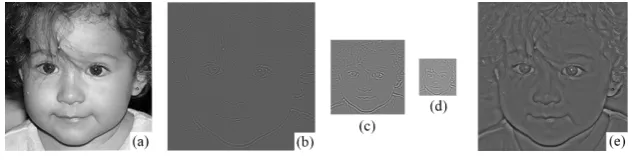
resolution of the image channels is reduced by 2sat scalesand a subband image pyramid is obtained, see an example in Fig.3. Note that the lowest frequency component is not covered in any of these channels as it represents the slowly varying, local mean-level containing mostly the illumination information.
At a given landmark, local patches of the same size are extracted from each of the chan-nels, giving a multi-scale feature description (Fig.1(e)). Although of same size in pixels, each patch represents twice the domain size and preserves one octave lower frequency com-ponents compared with its previous level. In this way a coherence between the domain size and the feature scale is achieved and the Wavelet Feature Pyramid (WFP) built (Fig.1(f)).
Figure 3: (a) The original image. (b)(c)(d) Pyramid of multi-scale channels with increasing scales and reducing dimensions. (e) Summation of the three channels showing the image information captured. Note that the illumination (low varying components) is suppressed as the lowest frequency band of the spectrum is discarded.
[image:6.408.50.370.429.509.2]3.3
Orientations
Figure 4: Filters in the Fourier domain. (a) The imaginary parts of the oriented filter banks. The real parts are zero. (b) The real and imaginary part of the first scale filter after half-pixel shift. Note that the filter is now periodically continuous. (c) For comparison, spectra (imaginary parts) of spatially defined filters.
The WFP built on multi-scale image channels can be applied to a number of intensity-based part descriptors in DPMs. Here we focus on integrating the scale selection property of loglets with the pooling power of SIFT descriptors. As SIFT performs a neighbourhood pooling on oriented gradients, we explain how to generate multi-scale gradient maps by further decomposing the non-oriented image channels intoxandycomponents. The easiest way may seem to be by applying differential operators spatially on these channels. However the fact that differential filters take the form of animaginary anti-symmetricalwindow in the Fourier domain (explained in appendix C in the supplementary materials), we can neatly generate the oriented gradient maps directly by converting the loglets to imaginary odd-windows.
Specifically, imaginary sinusoidal functions at orthogonal orientations are added as di-rectional parts, decomposing the spectrum intoxandycomponents,
Wx(s)(u) =jcos(θ)· W(s)(u)
Wy(s)(u) =jsin(θ)· W(s)(u)
(6)
whereθ is the orientation of vectoru. The oriented filters are shown in Fig. 4(a). One problem which arises is that the high pass filter (scale one) in Fig.4(a) has larger magnitude around the Nyquist frequency (the margin of the Fourier spectrum), and its antisymmetri-cal shape givesWx(−π) =−Wx(π), therefore the spectrum is discontinuous across periods, which results in significant aliasing. For this reason most differential filters are designed to have zero magnitude at the boundaries to prevent aliasing, but with the penalty of losing the highest frequency components thus sacrificing precision, see Fig.4(c). In our differential fil-tering, the highest frequency can be utilised without aliasing. The discontinuity is removed by adding a phase term to the odd filters,
Wx(u) =ejux/2·j·cos(θ)· W(u)
Wy(u) =ejuy/2·j·sin(θ)· W(u)
(7)
which results in aπ/2 rotation in phase at one sideux=πand a−π/2 rotation at the other sideux=−π, corresponding to a half-pixel shift in the spatial domain. The filters are now complex-valued and with continuity across periods, i.e.,Wx(−π) =Wx(π), see Fig.4(b).
ZHANG, BHALERAO: LOGLET SIFT FOR PART DESCRIPTION
Figure 5: Illustrative comparison of differential filters. Shown are the ydirection gradients produced by: (b)[−1,0,1], (c)[−1,1]and (d) our loglets bundle.
L-SIFT descriptor is then obtained by calculating SIFTs on the resultant multi-scale gradient maps having equal block sizes in pixels. Because larger scale channels are down-sampled, the L-SIFT features represent real domain size and scales at octave intervals.
3.4
Loglet SIFT as part experts in DPM
We integrate the L-SIFT descriptor with the SDM algorithm [23] for facial landmark detec-tion. Denote the L-SIFT descriptors at all landmarks ash(I,s), withIbeing the image,sthe landmarks, andh(·)the L-SIFT extracting function. In order to deduce the true landmark locations∗given an initial estimation ˆs, we extract the descriptorh(I,sˆ)at ˆsand learn the mappingh(I,ˆs)→∆s∗, in which∆s∗=s∗−ˆs. The direct mapping function satisfying all the cases in the dataset is non-linear in nature and can be over-fitted. So we adopt the SDM algo-rithm and approximate the non-linear mapping with a sequence of linear mapping{R(i),b(i)}
and landmark updating steps,
(
Mapping: ∆s(i)=R(i)h(I,sˆ(i)) +b(i),
Updating: ˆs(i+1)=sˆ(i)+∆s(i).
(8)
The descriptorh(I,sˆ(i))is extracted and updated at each iteration. Further details on SDM can be found at [23].
4
Experiments
We report the performance of the L-SIFT descriptor on the problem of face alignment with DPM. We compare our filters with spatial domain gradient filters, evaluate the improvement brought to the DPM by the proposed L-SIFT descriptors, and report the performance against state-of-the-art methods. The evaluation metric used for all the face datasets is the error normalised by the inter-pupil distance, as proposed in [2]. The parameters of the filter banks in all experiments are set asρ0=0.3π,α=2.
4.1
Evaluation
Comparison with other differential filters. To demonstrate the contributions of the ad-vanced gradient filters and the multi-scale features, we first compare the single scale gradient maps generated by our first scale filterW(1)(Fig.4(a)) with conventional first order
differen-tial filters which can be used in SIFT descriptors, on the HELEN dataset with 68 landmarks annotated by the iBUG group. We show an example of a gradient map generated by these filters in Fig.5. We can see that the proposed filter better preserves sharper local structures. The SIFTs are calculated on these gradients and used as the part descriptors in SDM. The results are given in Table1. The result of the single scale filterW(1) shows that simply
We believe this benefits from the superior properties of the loglets over spatial-designed fil-ters, as well as the larger bandwidth achieved by the filter accumulation. We further evaluate the performance of the proposed multi-scale L-SIFT descriptor with coherent feature scales and domain sizes. The result in Table.1shows an additional significant improvement.
Filters [-1 0 1] [-1 1] Sobel Prewitt W(1) L-SIFT
Error 6.05 6.24 5.93 5.92 5.72 5.21
Table 1: Comparison of SIFT built on spatial filters and our filters, on Helen (68) dataset
[image:9.408.16.380.268.361.2]For efficiency purposes, the filter banks can be pre-calculated and stored. The most ex-pensive computation for generating the feature is computing the gradient maps by applying filter banks in the Fourier domain. For the single level feature, there is no additional compu-tation comparing to a conventional SIFT based on a spatial defined operators. For a feature pyramid withslevels, the computation includes a Fourier Transform,selement-wise matrix products and inverse Fourier Transforms, both with reduced dimensions. This computation only need to be performed once before iteratively fitting the DPM to an image. Our MAT-LAB implementation for 3-scale features takes 9.7 ms on an image of size 400×400 using a 3.2GHz quad-core machine.
Figure 6: Improvement brought to the SDM by L-SIFT on: (a) Helen (194 landmarks), (b) Helen (68 landmarks), (c) LFPW (68 landmarks). Deshed line: SDM with SIFT; Solid line: SDM with L-SIFT.
Helen (194) Helen(68) LFPW(68)
SDM(SIFT) 5.85 6.05 5.32
SDM(L-SIFT) 5.30 5.21 4.90
Improvement 9.4% 13.9% 7.7%
Table 2: Average error of landmark fitting. Improvement brought to the SDM.
We evaluate the improvement brought to the SDM by the L-SIFT descriptor on several datasets including the orig-inal HELEN [12] annotated with 194 landmarks, and the HELEN and LFPW dataset annotated by iBUG group using 68 landmarks. The results are shown in
Fig.6and summarised in Table2. We can see an improvement brought to the SDM in all datasets.
4.2
Comparison with state of the art
ZHANG, BHALERAO: LOGLET SIFT FOR PART DESCRIPTION
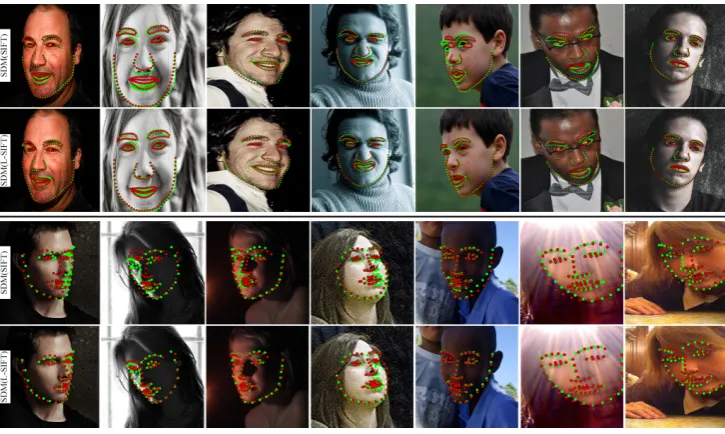
Figure 7: Qualitative results from HELEN (top row) and 300-W challenging dataset (bottom row). The SDM with L-SIFT descriptors is compared against the one with SIFT. Green points show the ground truth, and the red points the fitting results.
Method RCPR[3] ESR[4] LBF fast[16] LBF[16] SDM(SIFT)[23] SDM(L-SIFT)
Error 6.50 5.70 5.80 5.41 5.85 5.30
Table 3: Average error of methods compared on HELEN dataset
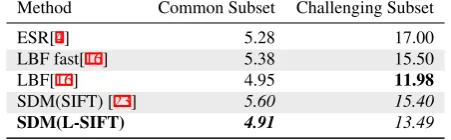
HELEN, XM2VTS and the new iBUG dataset. We follow the parameter settings given in [16]. The training set consists of AFW, the training set of LFPW and the training set of HELEN. The testing set is divided into a ‘challenging’ subset consisting of iBUG data and a ‘common’ subset consisting of the testing sets from HELEN and LFPW. The results are reported in table3and4. For comparison with other methods,we list the original results in the literature.
[image:10.408.43.370.328.354.2]Method Common Subset Challenging Subset
ESR[4] 5.28 17.00
LBF fast[16] 5.38 15.50
LBF[16] 4.95 11.98
SDM(SIFT) [23] 5.60 15.40
[image:11.408.87.313.33.103.2]SDM(L-SIFT) 4.91 13.49
Table 4: Average error of methods compared on 300-W dataset
5
Conclusions
This paper presents a part descriptor combining loglets and SIFT. The uniform coverage of the highest frequency gives no resolution loss and preserves the sharpest textures. Additional low frequency components are extracted, with coherently larger domain sizes achieved by cropping the Fourier spectrum, resulting in a more comprehensive feature description.
The combination of loglets and SIFT can be interpreted as an enhancement to a number ofinvariances, i.e, the invariance to illumination by the local pooling of SIFT and the sup-pression of slow varying mean level by the wavelets, as well as the invariances to noise by SIFT, and to sample shift by loglets. These properties improve the robustness of the descrip-tor to extrinsic variations. The proposed L-SIFT can be readily integrated in other gradient and SIFT based Deformable Part Models. Further work includes validating the proposed L-SIFT in computer vision tasks such as feature detection and matching. We provide a public domain version of our loglets filters and a L-SIFT toolbox for the research use, which will be made available athttps://sites.google.com/site/logletsift/.
References
[1] Epameinondas Antonakos, Joan Alabort-i Medina, and Stefanos Zafeiriou. Active pic-torial structures. In Proceedings of the IEEE Conference on Computer Vision and Pattern Recognition, pages 5435–5444, 2015.
[2] Peter N Belhumeur, David W Jacobs, David J Kriegman, and Narendra Kumar. Lo-calizing parts of faces using a consensus of exemplars. Pattern Analysis and Machine Intelligence, IEEE Transactions on, 35(12):2930–2940, 2013.
[3] Xavier P Burgos-Artizzu, Pietro Perona, and Piotr Dollár. Robust face landmark esti-mation under occlusion. InComputer Vision (ICCV), 2013 IEEE International Confer-ence on, pages 1513–1520. IEEE, 2013.
[4] Xudong Cao, Yichen Wei, Fang Wen, and Jian Sun. Face alignment by explicit shape regression.International Journal of Computer Vision, 107(2):177–190, 2014.
[5] Minh N Do and Martin Vetterli. The contourlet transform: an efficient directional multiresolution image representation. Image Processing, IEEE Transactions on, 14 (12):2091–2106, 2005.
ZHANG, BHALERAO: LOGLET SIFT FOR PART DESCRIPTION
[7] David J Field. Relations between the statistics of natural images and the response properties of cortical cells.JOSA A, 4(12):2379–2394, 1987.
[8] Sylvain Fischer, Filip Šroubek, Laurent Perrinet, Rafael Redondo, and Gabriel Cristóbal. Self-invertible 2D log-Gabor wavelets. International Journal of Computer Vision, 75(2):231–246, 2007.
[9] Markus H Gross and Rolf Koch. Visualization of multidimensional shape and texture features in laser range data using complex-valued Gabor wavelets. Visualization and Computer Graphics, IEEE Transactions on, 1(1):44–59, 1995.
[10] Tal Hassner, Viki Mayzels, and Lihi Zelnik-Manor. On SIFTs and their scales. In Computer Vision and Pattern Recognition (CVPR), 2012 IEEE Conference on, pages 1522–1528. IEEE, 2012.
[11] Hans Knutsson and Mats Andersson. Loglets: Generalized quadrature and phase for local spatio-temporal structure estimation. InImage Analysis, pages 741–748. Springer, 2003.
[12] Vuong Le, Jonathan Brandt, Zhe Lin, Lubomir Bourdev, and Thomas S Huang. In-teractive facial feature localization. InComputer Vision–ECCV 2012, pages 679–692. Springer, 2012.
[13] David G Lowe. Distinctive image features from scale-invariant keypoints.International journal of computer vision, 60(2):91–110, 2004.
[14] Oscar Nestares, Rafael Navarro, Javier Portilla, and Antonio Tabernero. Efficient spatial-domain implementation of a multiscale image representation based on Gabor functions.Journal of Electronic Imaging, 7(1):166–173, 1998.
[15] Chengchao Qu, Hua Gao, Eduardo Monari, Jürgen Beyerer, and Jean-Philippe Thiran. Towards robust cascaded regression for face alignment in the wild. In2015 IEEE Conference on Computer Vision and Pattern Recognition Workshops (CVPRW), pages 1–9. IEEE, 2015.
[16] Shaoqing Ren, Xudong Cao, Yichen Wei, and Jian Sun. Face alignment at 3000 FPS via regressing local binary features. InComputer Vision and Pattern Recognition (CVPR), 2014 IEEE Conference on, pages 1685–1692. IEEE, 2014.
[17] Yong Man Ro, Munchurl Kim, Ho Kyung Kang, BS Manjunath, and Jinwoong Kim. MPEG-7 homogeneous texture descriptor.ETRI journal, 23(2):41–51, 2001.
[18] Christos Sagonas, Georgios Tzimiropoulos, Stefanos Zafeiriou, and Maja Pantic. A semi-automatic methodology for facial landmark annotation. InComputer Vision and Pattern Recognition Workshops (CVPRW), 2013 IEEE Conference on, pages 896–903. IEEE, 2013.
[20] Eero P Simoncelli, William T Freeman, Edward H Adelson, and David J Heeger. Shiftable multiscale transforms. Information Theory, IEEE Transactions on, 38(2): 587–607, 1992.
[21] Jean-Luc Starck, Emmanuel J Candès, and David L Donoho. The curvelet transform for image denoising. Image Processing, IEEE Transactions on, 11(6):670–684, 2002.
[22] Georgios Tzimiropoulos and Maja Pantic. Gauss-Newton deformable part models for face alignment in-the-wild. InProceedings of the IEEE Conference on Computer Vision and Pattern Recognition, pages 1851–1858, 2014.
[23] Xuehan Xiong and Fernando De la Torre. Supervised descent method and its appli-cations to face alignment. InComputer Vision and Pattern Recognition (CVPR), 2013 IEEE Conference on, pages 532–539. IEEE, 2013.