warwick.ac.uk/lib-publications
Original citation:
Shreejith, Shanker, Ambede, Abhishek, Vinod, A. P. and Fahmy, Suhaib A. (2016) A power
and time efficient radio architecture for LDACS1 air-to-ground communication. In: Digital
Avionics Systems Conference, Sacramento, CA, 25 - 29 Sep 2016. Published in: Proceedings
of the Digital Avionics Systems Conference (In Press)
Permanent WRAP URL:
http://wrap.warwick.ac.uk/80840
Copyright and reuse:
The Warwick Research Archive Portal (WRAP) makes this work by researchers of the
University of Warwick available open access under the following conditions. Copyright ©
and all moral rights to the version of the paper presented here belong to the individual
author(s) and/or other copyright owners. To the extent reasonable and practicable the
material made available in WRAP has been checked for eligibility before being made
available.
Copies of full items can be used for personal research or study, educational, or not-for profit
purposes without prior permission or charge. Provided that the authors, title and full
bibliographic details are credited, a hyperlink and/or URL is given for the original metadata
page and the content is not changed in any way.
Publisher’s statement:
“© 2016 IEEE. Personal use of this material is permitted. Permission from IEEE must be
obtained for all other uses, in any current or future media, including reprinting
/republishing this material for advertising or promotional purposes, creating new collective
works, for resale or redistribution to servers or lists, or reuse of any copyrighted component
of this work in other works.”
A note on versions:
The version presented here may differ from the published version or, version of record, if
you wish to cite this item you are advised to consult the publisher’s version. Please see the
‘permanent WRAP URL’ above for details on accessing the published version and note that
access may require a subscription.
A Power and Time Efficient Radio Architecture for
LDACS1 Air-to-Ground Communication
Shanker Shreejith, Abhishek Ambede, A. P. Vinod
School of Computer EngineeringNanyang Technological University, Singapore Email:{shreejit1,abhishek7,asvinod}@ntu.edu.sg
Suhaib A. Fahmy
School of Engineering University of Warwick, Coventry, UKEmail: [email protected]
Abstract—L-band Digital Aeronautical Communication Sys-tem (LDACS) is an emerging standard that aims at enhancing air traffic management by transitioning the traditional analog aeronautical communication systems to the superior and highly efficient digital domain. The standard places stringent require-ments on the communication channels to allow them to coexist with critical L-band systems, requiring complex processing and filters in baseband. Approaches based on cognitive radio are also proposed since this allows tremendous increase in communication capacity and spectral efficiency. This requires high computational capability in airborne vehicles that can perform the complex filtering and masking, along with tasks associated with cognitive radio systems like spectrum sensing and baseband adaptation, while consuming very less power. This paper proposes a radio architecture based on new generation FPGAs that offers ad-vanced capabilities like partial reconfiguration. The proposed architecture allows non-concurrent baseband modules to be dynamically loaded only when they are required, resulting in improved energy efficiency, without sacrificing performance. We evaluate the case of non-concurrent spectrum sensing logic and transmission filters on our cognitive radio platform based on Xilinx Zynq, and show that our approach results in 28.3% reduction in DSP utilisation leading to lower energy consumption at run-time.
I. INTRODUCTION
Air traffic has seen tremendous growth over the last decade, pushing the need for efficient communication between aircraft and air traffic control terminals (or ground base-stations). Traditional aeronautical communications use the VHF band for commanding of and reporting by aircraft and but this is now becoming saturated preventing further expansions in this frequency band. L-band Digital Aeronautical Communication System (LDACS) is being proposed as a solution that can co-exist with legacy L-band systems and aims to explore digital radio techniques to enable efficient communication for next-generation global air traffic management system [1]. Of the two specifications that are being reviewed for LDACS, the type-1 (LDACS1) specification defined by EUROCON-TROL [2] is gaining traction as the preferred model for final deployment.
Traditional aeronautical communication schemes use static spectrum allocation requiring the ground stations and aircraft to synchronise and agree on a common frequency beforehand. Since these must be allocated in advance of use, and remain so for a period of time, this results in inefficient spectrum usage, especially in congested airspaces. Furthermore, legacy
aeronautical communication systems predominantly used ana-log processing modules in the baseband and RF sections resulting in limited capabilities compared to modern digital radio systems that offers intelligent mechanisms for efficient use of the radio spectrum. The introduction of LDACS1 will open up possibilities for introducing dynamic frequency allocation which can offer numerous advantages in terms of spectral efficiency, seamless connectivity and enhanced capacity [3]. Using cognitive radio based dynamic spectrum access in LDACS1 would enable the communicating entities (aircraft as well as ground base-stations) to opportunistically access suitable L-band channel(s) that meet Quality of Service (QoS) requirements.
tunable radio front-end. We show that the architecture reduces the DSP resource utilization by 28.3% and power consumption by up to 28.5% by consolidating non-concurrent processing blocks using partial reconfiguration, compared to a fully static implementation.
The remainder of this paper is organised as follows. Sec-tion II provides an overview of the LDACS1 standard and the key requirements that are established by the standard for allowing co-existence with legacy L-band systems. Sec-tion III discusses related work in FPGA-based cognitive radio approaches, spectrum sensing, and filter banks. Section IV presents an implementation of the channel filter blocks (trans-mit path) and the spectrum sensing blocks (receive path) for LDACS1 and their integration into the radio platform. In Section V, we evaluate the proposed architecture using a Xilinx ZC702 evaluation board. Finally we conclude the work in Section VI, outlining our future research directions.
II. BACKGROUND
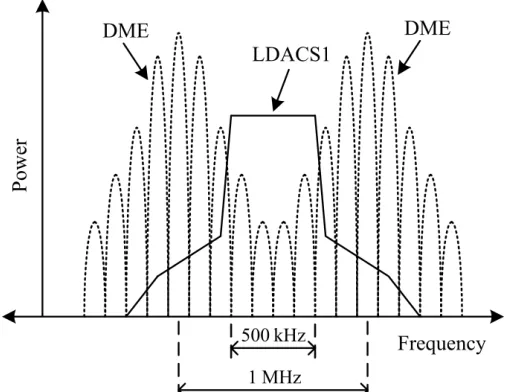
Following recommendations from the International Civil Aviation Organisation (ICAO), one of the options being con-sidered for LDACS1 deployment is an inlay approach be-tween adjacent channels of the Distance Measuring Equipment (DME) which operates in the frequency range 962–1213 MHz. The proposed LDACS1 standard provides two isolated data-links: the LDACS1 ground-to-air (called forward) and air-to-ground (called reverse) data-links, which provide a total of 46 communication channels with a bandwidth of 500 kHz each. Each LDACS1 channel is offset by 500 kHz with respect to the adjacent DME channels to avoid interference, as shown in Fig. 1. Stringent requirements on the transmitted LDACS1 are needed to support such an inlay approach.
To ensure the non-interfering co-existence of LDACS1 and DME channels, spectral mask specifications in terms of rela-tive attenuation at particular frequencies away from the center frequency of a LDACS1 channel are specified in the LDACS1 specification document [2]. Following are the frequencies away from the center frequency of a LDACS1 channel and the corresponding attenuations required {(249.025 kHz, 0 dB), (336.184 kHz, -40 dB), (622.563 kHz, -56 dB), (771.978 kHz, -76 dB), (1245.125 kHz, -76 dB)}. These spectral mask specifications have to be satisfied in order to use LDACS1 channels for communication.
[image:3.612.311.566.51.247.2]Traditionally, communication channels for forward and re-verse links are allocated statically; the aircraft that wishes to communicate with a specific ground station must manually switch to the allocated frequency before initiating a com-munication. However, this static assignment results in highly inefficient use of the limited available spectrum. Dynamic spectrum allocation strategies based on cognitive radio based spectrum sensing have recently been proposed to achieve efficient aviation spectrum management [3], [5]. This would also reduce the load on the ground stations, which would otherwise have to manage and keep track of different channels that are allocated to the communicating parties.
Fig. 1: Frequency domain view of the proposed LDACS1 deployment, interspersed within existing DME channels in L-band spectrum.
We have considered the following dynamic spectrum ac-cess enabled LDACS1 communication scenario in our work – with dynamic spectrum access, an aircraft that needs to communicate with the ground base-station has to first identify vacant frequency bands, determine a suitable channel amongst them and then initiate a LDACS1 transmission. To detect the vacant frequency bands, energy detector based spectrum sensing can be performed using variable cutoff digital filters or filter banks [6], [7]. Once a suitable frequency band is chosen, an LDACS1 transmission may be initiated, which needs to pass through a channel filter to meet the stringent LDACS1 spectral mask specifications. Each of these operations is complex: the filter bank and channel filter when implemented statically, consume large energy and area. However, since these blocks are non-concurrent, it should be possible to implement them in a manner that the blocks can be loaded as and when they are needed. Therefore, a major research challenge involved in the realization of this LDACS1 communication scenario is to achieve an area and energy efficient architecture to implement the LDACS1 radio system.
III. RELATEDWORK
Evolving commercial radio standards rely on flexibility to make efficient use of the limited communication spectrum, requiring radio platforms to support run-time adaptability for baseband as well as RF systems. Cognitive radio platforms like GNU Radio [8] and Iris [9] focussed on software-driven platforms and modularity. Software-based approach enables the baseband and the MAC layers to be easily adapted at run-time. However, the processing overheads due to software-based radios on general purpose platforms limit their usability in low-power and constrained environments like aircraft.
like WARP [10] and Iris [11], where it was shown that the flexibility of FPGA-based platforms can help minimize power consumption in the baseband processing path in response to dynamically varying channel conditions. Other platforms like CRUSH [12] and CRKIT [13] also demonstrated the benefits of offloading complex baseband processing to custom hard-ware on FPGAs. With faster adapting standards, increasing flexibility requirements, and hard constraints on space and power, FPGAs offer the performance benefits of custom hard-ware with some of the flexibility of softhard-ware. They have been exploited in the design of adaptive architectures for spectrum sensing using filter banks [14] and in general architectures for channel filtering to meet emission mask specifications for multiple standards [15], where software implementations would have been unfeasible within embedded constraints.
Numerous works have explored the use of low complexity variable digital filters and filter banks in software defined radio platforms [16], [17], [18] for both spectrum sensing and chan-nelisation. The usage of filter banks for spectrum sensing was proposed in [16]. We have recently proposed a low complexity variable digital filter [18] and a filter bank [17] which can be used for multi-standard channelization in software defined radios. Use of such filters and filter banks offers the ability to realize low power reconfigurable radio architectures which can be efficiently implemented using FPGAs.
Beyond the performance enhancements, partial reconfigura-tion (PR) has also been explored for reprogramming hardware sub-modules to adapt baseband functions at run-time [11], [4]. PR is an advanced technique that allows parts of the hardware to be modified at runtime while other parts continue to run, enabling designers to swap modules at any given time. Iris has explored the use of partial reconfiguration, but the software portions of the radio are deployed on a PowerPC hard processor on the Virtex 5 FPGA, resulting in low performance [11]. In [4], a more efficient approach is described using the hybrid Zynq platform, which offers tight coupling between the software and hardware sections of the radio system and integrates a high-speed reconfiguration management system that abstracts the low-level details asso-ciated with PR. Our experiments in this paper leverage the capabilities of this platform for enabling dynamic spectrum access in the LDACS1 scenario.
IV. PLATFORMARCHITECTURE
A. Filter architecture
[image:4.612.312.562.50.189.2]In the LDACS1 radio platform presented in this paper, we use a digital filter bank and a channel filter in the LDACS1 transmitter chain for spectrum sensing and shaping respec-tively. The digital filter bank is based on the fast filter bank (FFB) design technique as proposed in [6]. The FFB design method proposed in [6] is a low complexity filter bank design technique which provides multiple uniform subbands which satisfy the stringent LDACS1 spectral mask specifications as discussed in Sec. II. When used in the receiver chain of an aircraft, the FFB can be used to perform energy detector based spectrum sensing to detect the vacant frequency bands. We
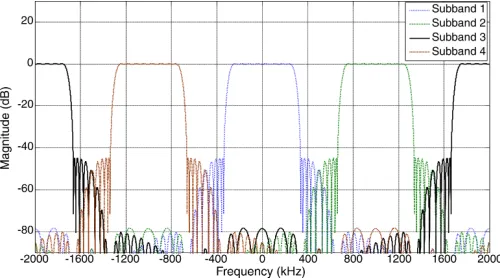
Fig. 2: Filter response of the Fast Filter Bank design used for channelisation.
consider a sampling frequency of 4 MHz and design an 8-channel FFB to be used in our radio platform. Out of the 8 subbands provided by the designed FFB, 4 alternate subbands are used for LDACS1. Fig. 2 shows the frequency responses of these 4 subbands of the FFB. As can be noted from Fig. 2, each of the obtained subbands satisfies the desired LDACS1 spectral mask specifications. The FFB used in our LDACS1 radio platform requires a total of 70 coefficient multipliers which can be efficiently implemented on an FPGA using the available DSP blocks.
The FFB architecture follows a tree structure as shown in Fig. 3. For a k-stage FFB, the interpolation factor (Mi) of
2(k−i) is used on the prototype lowpass filter of ith stage (wherei= 1,2...k) to get a multiband response. For the case
k = 3 shown in Fig 3, we get M1 = 4, M2 = 2, M3 = 1. Frequency shifted versions of the interpolated prototype filter response and their complementary responses are used at every stage as shown in Fig 3. Frequency shifted filters are denoted as Fij in Fig 3, where i refers to the number of stage and j refers to the frequency shift index. A k-stage FFB generates totalN = 2k subbands. Transition bandwidth of each channel
istbw/2(k−1), where tbw is transition bandwidth of prototype filter in first stage.
The digital channel filter is designed using MATLAB Filter Design and Analysis Tool. Similar to the case of the FFB, a sampling frequency of 4 MHz is considered and the edge frequencies are accordingly computed for a low-pass filter. To ensure that all of the different attenuation specifications for an LDACS1 spectral mask are satisfied, we consider the most stringent attenuation specification, i.e., -76 dB and design the channel filter to satisfy the same. Fig. 4 shows the frequency response of the channel filter used in our LDACS1 radio platform. The order of the filter used is 200 and it requires 101 coefficient multipliers for its implementation using the transposed direct-form implementation architecture, which are then mapped to FPGA DSP blocks.
Original response Complementary response Fij(zM)
Filter bank subbands Stage 1 Stage 2 Stage 3
F10(zM1)
F20(zM2)
F21(zM2)
F30(zM3)
F31(zM3)
F32(zM3)
F33(zM3)
From
RF for energy
[image:5.612.317.566.50.296.2]detection
Fig. 3: Architecture of the Fast Filter Bank used for channeli-sation.
Fig. 4: Filter response of the Channel Filter used for shaping the transmission spectrum.
channel bandwidth of LDACS1 is approximately 500 kHz, we have chosen the sampling frequency as 4 MHz for the FFB as well as the channel filter.
B. LDACS1 Radio Platform
Hybrid FPGAs like the Xilinx Zynq present a compact and efficient architecture for building cognitive radio systems that integrate cognitive software to interact and manage high performance processing datapaths built in hardware. The Zynq platform tightly couples a highly capable dual-core ARM processing system with a reconfigurable fabric, providing com-putational capability and flexibility for both the control path in software and the processing blocks in hardware. However, managing hardware adaptation on FPGAs at runtime requires integration of low-level control tasks and knowledge of the underlying hardware.
Our radio platform abstracts such low-level details from the user while also integrating efficient high-speed dynamic
Zynq PL
PRR ZyCAP
Tx Buffer
Rx Buffer DMAs
RF
Interface
Zynq PS
ARM
Obs Act
Switch DDR Memory
Flash Memory
Filter Bank Channel Filter
[image:5.612.49.297.52.269.2]Config Reconfigure
Fig. 5: Architecture of the proposed LDACS1 radio platform on the Xilinx Zynq FPGA.
partial reconfiguration for hardware-level support of baseband adaptation [4]. The simplified diagram in Fig. 5 shows the ar-chitecture of the radio platform and the integration of LDACS1 filter blocks into the baseband section. Data movement from/to software or external interfaces (like DRAM memory or Eth-ernet interfaces) is handled using dedicated direct memory access (DMA) controllers. The baseband functionality and antenna interfaces are implemented in the programmable logic (PL) region of the Zynq, and use dedicated interfaces for interaction with the software tasks running on the arm core.
The antenna interface connects to an off-the-shelf Analog Devices AD-FMCOMMS4-EBZ board (based on the AD9364) using an FPGA Mezzanine Card (FMC) connector. The FMCOMMS4-EBZ offers an operating range of up to 6 GHz with tunable parameters that can be configured by the soft-ware application or directly from the baseband modules. This adaptability, called parametric reconfiguration, offers a method to quickly alter the performance of the system without any changes in the physical design of the processing blocks. Fur-ther, the platform supports high-speed partial reconfiguration through ZyCAP [20], that allows the physical implementation to be modified at runtime with low latency. We make use of PR to reduce the area overhead and power consumption in case of LDACS1 scenario by implementing the non-concurrent functionality in a partially reconfigurable region (PRR), which can then be reconfigured on-the-fly when needed.
[image:5.612.49.300.314.455.2]as well as other LDACS1 channels). During normal receive operation (ground-to-air link), the PRR region is loaded with bypass logic that streams data from the antenna interface to the upstream baseband modules in the LDACS1 chain. The receiver of the RF interface can be tuned to the specific LDACS1 channel (frequency and bandwidth) for receiving the ground-to-air communication. LDACS1 uses Orthogonal Frequency Division Modulation (OFDM) as the baseband modulation technique, for which numerous implementations are available.
When the aircraft is to initiate a transmission to the ground station, the air-to-ground link must be sensed to determine the free channel(s) available. For this, the RF interface is tuned to the air-to-ground band covering the entire bandwidth and the PRR region is loaded with the FFB module to determine spectrum gaps. Double buffers are placed prior to the FFB module to accumulate the received samples, which alternatively feed the FFB module with a burst of received samples. The FFB module analyses 4 LDACS1 frequency bands at a time, with an energy detector at each subband to determine the presence or absence of an LDACS1 signal in the chosen channel. Once all the 23 channels are analysed, the list of available channels for transmission and their energy levels are presented to the software application which can then determine the best channel for transmission. The buffers combined with the high-speed operation of the FFB modules allows the operations to be overlapped, minimising the latency associated with spectrum sensing.
To transmit data, the PRR region is loaded with the CF module. The channel filter shapes the transmission stream to meet the LDACS1 requirements before passing it to the antenna interface. The channel filter also operates at high frequencies allowing the LDACS1 frame to be streamed to the RF interface with minimal latency. FIFOs are integrated at the input and output ports of the channel filter to adapt to the different data/clock rates. The different modules are loaded into the PRR by the cognitive software application using the function call set_basesband(spectrum_sense)from software running on the PS. The PR manager integrated into the platform handles all the low-level steps needed for physical reconfiguration. Hence, it would be possible to modify the adaptive behaviour purely by changing the software.
V. RESULTS
[image:6.612.320.555.75.232.2]To evaluate the efficiency of the approach, we imple-ment the radio architecture targeting the Xilinx ZC702 de-velopment platform, which houses a low-end Zynq device (XC7020CLG484-1). The device features dual ARM A9 cores that can run at 667 MHz as the PS while the PL region offers 53k Look Up Tables (LUTs), 106k Flip Flops (FFs) and 220 DSP blocks for implementing the radio baseband modules. We have used Xilinx Vivado 2014.2 as the tool flow for our implementation process. For comparison, a static implementation is generated on the ZC-706 platform that uses a mid-range Zynq device (XC7045FFG900-2) that offers sufficient DSP blocks for a fully static implementation.
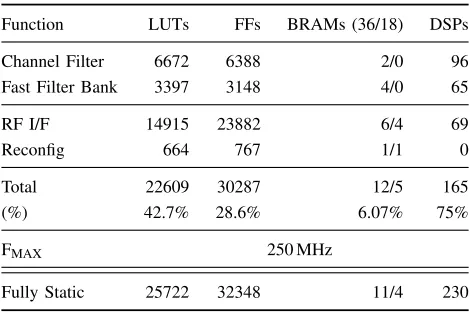
TABLE I: Resource utilisation on XC7020 and comparison with the fully static implementation on the XC7045.
Function LUTs FFs BRAMs (36/18) DSPs
Channel Filter 6672 6388 2/0 96
Fast Filter Bank 3397 3148 4/0 65
RF I/F 14915 23882 6/4 69
Reconfig 664 767 1/1 0
Total 22609 30287 12/5 165
(%) 42.7% 28.6% 6.07% 75%
FMAX 250 MHz
Fully Static 25722 32348 11/4 230
Table I shows the resources consumed by the different mod-ules of the design. It can be seen that the CF and FFB modmod-ules are DSP intensive and cannot be implemented concurrently on the XC7020 device. Our approach of using PR for loading these functional modules as and when needed, reduces the number of DSP blocks needed (highest of the two), resulting in a 28.3% reduction in DSP block requirements compared to a fully static implementation. The lower DSP block requirement also allows us to target a low-power device as the implemen-tation target, cutting down on the static power consumption of the platform. As observed from Table I, the implemented blocks consume only up to 43% of the logic resources (LUTs and FFs), leaving aside resources for implementing OFDM modulator/demodulator chain of the LDACS1 baseband. Also, the efficient implementation of the filter blocks allows us to obtain a maximum operating frequency of 250 MHz.
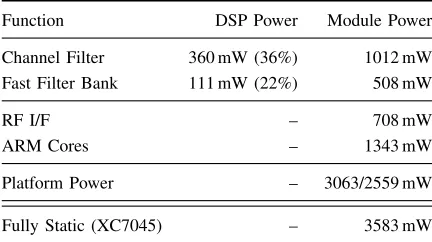
Table II details the power estimates generated using the Power Analyser tool available within the Vivado design suite. To provide accurate estimates, we have used the post place and route simulation activity of the modules at 250 MHz operating frequency as the activity file input to the Power Analyser. This allows the tool to evaluate the activity of the internal signals and predict the power consumption with high accuracy. It can be observed that the DSP intensive channel filter results in a power consumption of 1012 mW, of which 36% is contributed by the DSP blocks. In comparison, the fast filter bank that performs spectrum sensing consumes 508 mW of power. By loading these modules only when needed, we can lower the power consumption of the platform under normal operation by up to 1.02 W, compared to a fully static implementation on a larger XC7045 device.
TABLE II: Power consumption on XC7020.
Function DSP Power Module Power
Channel Filter 360 mW (36%) 1012 mW Fast Filter Bank 111 mW (22%) 508 mW
RF I/F – 708 mW
ARM Cores – 1343 mW
Platform Power – 3063/2559 mW
Fully Static (XC7045) – 3583 mW
channels and detect the spectral energy of each channel using our FFB module consumes 30.08 ms. A further reconfiguration operation is required to enable the channel filter, which con-sumes 1.88 ms using our high-speed reconfiguration interface (98% of theroetical maximum). This allows our platform to achieve a low turnaround time of 31.96 ms starting from the spectrum sensing phase to the activation of transmission chain on a vacant LDACS1 channel.
VI. CONCLUSION
Aeronautical communication is being upgraded to handle the ever increasing volume of information and to offer new pathways for communicating with critical systems on-board aircrafts. LDACS1 is an upcoming L-band aeronautical com-munication standard that aims to enable improved air-traffic management while ensuring non-interfering co-existence with the legacy L-band systems like DME. Techniques like dynamic spectrum access are being considered for this upcoming stan-dard, that would allow efficient use of the spectrum; however, the operations associated with dynamic spectrum access are complex and computationally intensive, requiring an efficient approach to implement them.
In this paper, we presented the case for incorporating dynamic spectrum access in LDACS1 air-to-ground commu-nication leveraging partial reconfiguration on FPGAs. We showed that our proposed approach results in over 28.5% reduction in dynamic power consumption and 28.5% reduction in resource utilisation, while offering high-speed switching between the different modes of operation in real-time. We aim to extend this approach to other aircraft communication systems that operate in different modes along the various phases of the flight, thus providing improved consolidation and energy efficiency. We are also integrating our full OFDM baseband for an end-to-end demonstration.
REFERENCES
[1] W. Sch¨utz and M. Schmidt, “Action Plan 17 - Future Communication Study: Final Conclusions and Recommendations Report,” EUROCON-TROL/FAA Memorandum of Cooperation, Tech. Rep., 2007. [2] M. Sajatovic, B. Haindl, U. Epple, and T. Gr¨aupl, “Updated LDACS1
System Specification,” SESAR Joint Undertaking Report EWA04-1-T2-D1, Tech. Rep., 2011.
[3] C. Zhang, Y. Zhang, J. Xiao, and J. Yu, “Aeronautical Central Cognitive Broadband Air-to-Ground Communications,”IEEE Journal on Selected
Areas in Communications, vol. 33, no. 5, pp. 946–957, 2015.
[4] S. Shreejith, B. Banarjee, K. Vipin, and S. A. Fahmy, “Dynamic Cognitive Radios on the Xilinx Zynq Hybrid FPGA,” inInternational Conference on Cognitive Radio Oriented Wireless Networks (CROWN-COM), 2015, pp. 427–437.
[5] P. Jacob, A. S. Madhukumar, and A. P. Vinod, “Efficient aviation spec-trum management through dynamic frequency allocation,” inIntegrated
Communication, Navigation and Surveillance Conference (ICNS), 2015,
pp. L3:1–L3:9.
[6] A. Ambede, K. G. Smitha, and A. P. Vinod, “Low complexity spectrum sensing using variable digital filters for cognitive radio based air-ground communication,” inInternational Workshop on Cognitive Cellular
Sys-tems (CCS), 2014, pp. 1–5.
[7] S. Dhabu, A. P. Vinod, and A. S. Madhukumar, “Low complexity fast filter bank-based channelization in L-DACS1 for aeronautical commu-nications,” inIEEE New Circuits and Systems Conference (NEWCAS), 2015, pp. 1–4.
[8] GNU Radio. Free Software Foundation, Inc. [Online]. Available: http://www.gnuradio.org/
[9] P. D. Sutton, J. Lotze, H. Lahlou, S. A. Fahmy, K. E. Nolan, B. Ozgul, T. W. Rondeau, J. Noguera, and L. E. Doyle, “Iris: An architecture for cognitive radio networking testbeds,”IEEE Communications Magazine, vol. 48, no. 9, pp. 114–122, 2010.
[10] K. Amiri, Y. Sun, P. Murphy, C. Hunter, J. R. Cavallaro, and A. Sab-harwal, “WARP, a unified wireless network testbed for education and research,” inIEEE International Conference on Microelectronic Systems
Education, 2007, pp. 53–54.
[11] J. Lotze, S. A. Fahmy, J. Noguera, B. Ozgul, L. E. Doyle, and R. Esser, “Development framework for implementing FPGA-based cognitive net-work nodes,” inProceedings of the IEEE Global Telecommunications
Conference (GLOBECOM), 2009, pp. 1–7.
[12] G. Eichinger, K. Chowdhury, and M. Leeser, “Crush: Cognitive radio universal software hardware,” in International Conference on Field
Programmable Logic and Applications (FPL), 2012, pp. 26–32.
[13] K. Le, P. Maddala, C. Gutterman, K. Soska, A. Dutta, D. Saha, P. Wolniansky, D. Grunwald, and I. Seskar, “Cognitive radio kit frame-work: experimental platform for dynamic spectrum research,” ACM
SIGMOBILE Mobile Computing and Communications Review, vol. 17,
no. 1, pp. 30–39, Jan 2013.
[14] S. A. Fahmy and L. E. Doyle, “Reconfigurable polyphase filter bank architecture for spectrum sensing,” inReconfigurable Computing:
Ar-chitectures, Tools and Applications Proceedings of the International
Symposium on Applied Reconfigurable Computing, 2010, pp. 343–350.
[15] T. H. Pham, I. V. McLoughlin, and S. A. Fahmy, “Spectrally efficient emission mask shaping for OFDM cognitive radios,” Digital Signal
Processing, vol. 50, pp. 150–161, Mar 2016.
[16] B. Farhang-Boroujeny, “Filter bank spectrum sensing for cognitive radios,” IEEE Transactions on Signal Processing, vol. 56, no. 5, pp. 1801–1811, May 2008.
[17] A. Ambede, K. G. Smitha, and A. P. Vinod, “Flexible low complexity uniform and non-uniform digital filter banks with high frequency resolu-tion for multi-standard radios,”IEEE Transactions on Very Large Scale
Integration (VLSI) Systems, vol. 23, no. 4, pp. 631–641, April 2015.
[18] A. Ambede, S. Shreejith, A. P. Vinod, and S. A. Fahmy, “Design and realization of variable digital filters for software defined radio channeliz-ers using improved coefficient decimation method,”IEEE Transactions
on Circuits and Systems II: Express Briefs, vol. 63, no. 1, pp. 59–63,
Jan 2016.