Original citation:
LHCb Collaboration (Including: Back, J. J., Blake, T., Craik, Daniel, Dossett, D.,
Gershon, T. J., Kreps, Michal, Latham, Thomas, Pilar, T., Poluektov, Anton, Reid,
Matthew M., Silva Coutinho, R., Wallace, Charlotte, Whitehead, M. (Mark) and Williams,
M. P.). (2014) Measurement of Υ production in pp collisions at √s = 2.76 TeV. Physical
Review D (Particles, Fields, Gravitation and Cosmology), Volume 74 (Number 4). Article
number 2835..
Permanent WRAP url:
http://wrap.warwick.ac.uk/62961
Copyright and reuse:
The Warwick Research Archive Portal (WRAP) makes this work of researchers of the
University of Warwick available open access under the following conditions.
This article is made available under the Creative Commons Attribution 4.0 International
license (CC BY 4.0) and may be reused according to the conditions of the license. For
more details see:
http://creativecommons.org/licenses/by/4.0/
A note on versions:
The version presented in WRAP is the published version, or, version of record, and may
be cited as it appears here.
DOI 10.1140/epjc/s10052-014-2835-1
Regular Article - Experimental Physics
Measurement of
ϒ
production in pp collisions at
√
s
=
2
.
76 TeV
The LHCb Collaboration
CERN, 1211 Geneva 23, Switzerland
Received: 12 February 2014 / Accepted: 25 March 2014 / Published online: 29 April 2014
© CERN for the benefit of the LHCb collaboration 2014. This article is published with open access at Springerlink.com
Abstract The production of ϒ(1S), ϒ(2S) and ϒ(3S) mesons decaying into the dimuon final state is studied with the LHCb detector using a data sample corresponding to an integrated luminosity of 3.3 pb−1collected in proton–proton collisions at a centre-of-mass energy of√s=2.76 TeV. The
differential production cross-sections times dimuon branch-ing fractions are measured as functions of theϒtransverse momentum and rapidity, over the ranges pT < 15 GeV/c and 2.0<y<4.5. The total cross-sections in this kinematic region, assuming unpolarised production, are measured to be
σ(pp→ϒ(1S)X)×Bϒ(1S)→μ+μ− =1.111±0.043±0.044 nb,
σ(pp→ϒ(2S)X)×Bϒ(2S)→μ+μ− =0.264±0.023±0.011 nb,
σ(pp→ϒ(3S)X)×Bϒ(3S)→μ+μ− =0.159±0.020±0.007 nb,
where the first uncertainty is statistical and the second sys-tematic.
1 Introduction
Studies of the production of heavy quark-antiquark bound systems, such as the bb states ϒ(1S), ϒ(2S) andϒ(3S) (indicated generically as ϒ in the following) in hadron-hadron interactions probe the dynamics of the colliding par-tons and provide a unique insight into quantum chromo-dynamics (QCD). The total production cross-sections and spin configurations of these heavy quarkonium states are currently not reproduced by the theoretical models. These include the colour singlet model [1–5], recently improved by adding higher-order contributions [6,7], the colour-evaporation model [8], and the non-perturbative colour octet mechanism [9–11], which is investigated in the framework
e-mail: [email protected]
of non-relativistic QCD. The first complete next-to-leading order calculation ofϒ production properties [12], based on the non-relativistic QCD factorisation scheme, provides a good description of the measured differential cross-sections at large transverse momentum, pT, but overestimates the data at low pT.
The production ofϒmesons in proton–proton (pp) colli-sions occurs either directly in parton scattering or via feed-down from the decay of heavier prompt bottomonium states, likeχb[13–16], or higher-massϒ states. The latter source complicates the theoretical description of bottomonium production [17,18].
The Large Hadron Collider provides a unique possibility to study bottomonium and charmonium hadroproduction in pp interactions at different collision energies and discrim-inate between various theoretical approaches. This study presents the first measurement of the inclusive production cross-sections of the three consideredϒ mesons in pp col-lisions at a centre-of-mass energy of√s = 2.76 TeV. The
measurements are performed as functions of the ϒ trans-verse momentum and rapidity, y, separately in six bins of
pT in the range pT < 15 GeV/c and five bins of y in the range 2.0<y<4.5. The results are reported as products of
the cross-sections and the branching fractions ofϒ mesons into the dimuon final state. This analysis is complementary to those performed by the ATLAS [19], CMS [20] and LHCb [21,22] collaborations and allows studies of theϒ produc-tion cross-secproduc-tion at forward rapidities as a funcproduc-tion of the centre-of-mass energy.
2 Detector and data sample
of a dipole magnet with a bending power of about 4 Tm, and three stations of silicon-strip detectors and straw drift tubes placed downstream. The combined tracking system provides a momentum measurement with relative uncertainty that varies from 0.4 % at 5 GeV/c to 0.6 % at 100 GeV/c, and
impact parameter resolution of 20μm for tracks with large transverse momentum. Different types of charged hadrons are distinguished by information from two ring-imaging Cherenkov detectors [24]. Photon, electron and hadron can-didates are identified by a calorimeter system consisting of scintillating-pad and preshower detectors, an electromag-netic calorimeter and a hadronic calorimeter. Muons are iden-tified by a system composed of alternating layers of iron and multiwire proportional chambers [25].
The analysis is carried out using a sample of data corre-sponding to an integrated luminosity of 3.3 pb−1collected in pp collisions at√s =2.76 TeV. Events of interest are
pre-selected by a trigger consisting of a hardware stage, based on information from the calorimeter and muon systems, fol-lowed by a software stage, which applies a full event recon-struction. The presence of two muon candidates with the product of their pTlarger than 1.68(GeV/c)2is required in the hardware trigger. At the software stage, the events are required to contain two well reconstructed tracks with hits in the muon system, having total and transverse momenta greater than 6 and 0.5 GeV/c, respectively. The selected muon
candidates are further required to originate from a common vertex and have an invariant mass larger than 4.7 GeV/c2.
To determine the acceptance, reconstruction and trigger efficiencies, fully simulated signal samples are reweighted to reproduce the multiplicity distributions for reconstructed primary vertices, tracks and hits in the detector observed in the data. The simulation is performed using the LHCb con-figuration [26] of thePythia 6.4 event generator [27]. Here, decays of hadronic particles are described byEvtGen [28] in which final-state photons are generated usingPhotos [29]. The interaction of the generated particles with the detector and its response are implemented using theGeant4 toolkit [30,31] as described in Ref. [32].
3 Signal selection and cross-section determination
The selection strategy used in the previous LHCb studies on ϒ production [21,22] is applied here. It includes selection criteria that ensure good quality track and vertex reconstruc-tion. In addition, the muon candidates are required to have
p >10 GeV/c and pT >1 GeV/c. To further reduce back-ground contamination, a set of additional requirements is employed in this analysis. It consists of tightened criteria on track quality [33], muon identification [34] and a good qual-ity of a global fit of the dimuon vertex with a primary vertex constraint [35].
9 10 11 12 13
1 10 2 10
[image:3.595.308.543.56.245.2]3 10
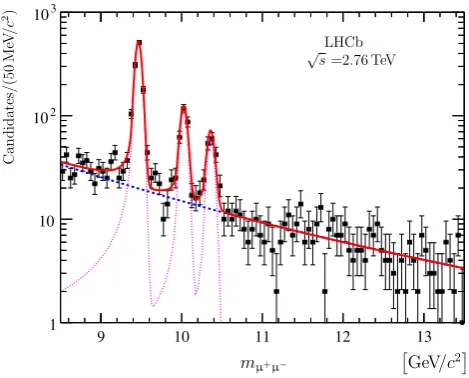
Fig. 1 Invariant mass distribution of selectedϒ→μ+μ−candidates with pT<15 GeV/c and 2.0<y<4.5. The result of the fit described
in the text is illustrated with a red solid line, while the signal and back-ground components are shown with magenta dotted and blue dashed lines, respectively. The three peaks correspond to theϒ(1S),ϒ(2S) andϒ(3S)mesons (from left to right)
The invariant mass distribution of the selectedϒ→μ+μ− candidates is shown in Fig.1for the full kinematic range. The distribution is described by a function similar to the one used in the previous studies onϒ production [21,22]. It models the signal component using the sum of three Crystal Ball functions [36], one for each of theϒ(1S),ϒ(2S)andϒ(3S) signals, and includes an exponential component to account for combinatorial background. The position and width of the Crystal Ball function describing the ϒ(1S)meson are allowed to vary, while the mass differences betweenϒstates are fixed to their known values [37] along with parameters describing the radiative tail, as determined from simulation studies. The widths of theϒ(2S)andϒ(3S)peaks are con-strained to the value of the width of theϒ(1S)signal scaled by the ratio of their masses to theϒ(1S)mass. In total, five parameters are extracted from the fit for the signal compo-nent: the yields ofϒ(1S),ϒ(2S)andϒ(3S)states, theϒ(1S) mass resolution and its peak position. The latter is found to be consistent with the known mass of theϒ(1S)meson [37], while reasonable agreement is observed between the data and simulation for theϒ(1S)mass resolution.
Theϒproduction cross-sections are measured separately in six bins of pTand five bins of y since the limited amount of data does not allow a measurement of double differential cross-sections. For a given pTor y bin, the differential cross-section for the inclusiveϒ production of the three different states decaying into the dimuon final state is determined as
dσ(pp→ϒX) d pT
×Bϒ→μ+μ−= Nϒcorr
L×pT
dσ(pp→ϒX)
dy ×B
ϒ→μ+μ−= Nϒcorr
L×y , (1b)
where Nϒcorris the efficiency-corrected yield ofϒ→μ+μ− decays,Lstands for the integrated luminosity andpT(y) denotes the pT(y)bin size. For the mass fits in individual pT and y bins, theϒ(1S)peak position is fixed to the value obtained from the fit for the full kinematic range, while the ϒ(1S) mass resolution is parameterised with a func-tion of pTand y using simulation. The total observed signal yields and their statistical uncertainties for ϒ(1S),ϒ(2S) andϒ(3S)mesons obtained by summation over pT(y)bins are 1139±37(1145±37), 271±20(270±20)and 158± 16(156±16), respectively. These results are in good agree-ment with the total signal yields obtained from the fit to the reconstructed dimuon invariant mass for the full kinematic range.
Based on the mass fit results in individual bins, the efficiency-corrected yield for each kinematic region is deter-mined as
Nϒcorr =
i
wϒ
i
εtot
i
, (2)
wherewiϒis a signal weight factor,εitotis the total signal event efficiency and the sum runs over all candidates i . Thewiϒ fac-tor accounts for the background subtraction and is obtained from the fit using the sPlot technique [38]. The total signal event efficiency is calculated for eachϒ→μ+μ−candidate as
εtot=εacc×εrec×εtrg×εµID, (3)
whereεaccis the detector acceptance,εrecis the reconstruc-tion and selecreconstruc-tion efficiency, εtrg is the trigger efficiency andεµIDis the efficiency of muon identification. The effi-ciencies εacc, εrec and εtrg are determined using simula-tion and further corrected using data-driven techniques to account for small differences in muon reconstruction effi-ciency between data and simulation [33,34,39]. The effi-ciencyεµIDis measured directly from data using a tag-and-probe method on a large sample of J/ψ→μ+μ−decays. The total efficiency-corrected signal yields obtained by summa-tion over pT(y)bins forϒ(1S),ϒ(2S)andϒ(3S)mesons are 3678±144(3684±143), 875±76(869±75) and 527±65(515±64), respectively.
The integrated luminosity of the data sample is estimated with the beam-gas imaging method [40–44]. It is based on the beam currents and the measurements of the angles, off-sets and transverse profiles of the two colliding bunches, which is achieved by reconstructing beam-gas interaction vertices.
4 Systematic uncertainties
Previous LHCb studies ofϒproduction [21,22] showed that the signal efficiency depends on the initial polarisation of ϒ mesons. This property was measured in pp collisions at √
s =7 TeV by the CMS collaboration at central rapidities and large pT and was found to be small [45]. Polarisation of other vector quarkonium states, such as J/ψandψ(2S) mesons was studied in pp collisions at√s =7 TeV by the LHCb [46,47] and ALICE [48] collaborations and was also found to be small. This analysis is performed assuming zero polarisation ofϒ mesons and no corresponding systematic uncertainty is assigned.
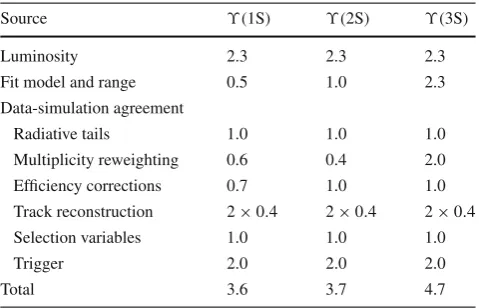
The systematic uncertainties affecting theϒcross-section measurements presented in this paper are summarised in Table1. These uncertainties are strongly correlated between bins. The largest contribution arises from the absolute lumi-nosity scale, which is determined with a 2.3 % uncertainty. It is dominated by the vertex resolution of beam-gas interac-tions and detector alignment [44].
The influence of the signal extraction technique is studied by varying the fit range and the signal and background param-eterisations used in the fit model. The fits are also performed with floating mass and resolution of theϒ(1S)peak and with-out constraints for theϒ(2S)andϒ(3S)masses. The spread of the extracted signal yields between these scenarios is taken as the corresponding systematic uncertainty. It ranges from 0.4 to 33 % for different pT(y)bins and amounts to 0.5, 1.0 and 2.3 % for the ϒ(1S),ϒ(2S)andϒ(3S)cross-section measurements in the full kinematic region, respectively.
[image:4.595.306.546.557.711.2]The possible mismodeling of bremsstrahlung simulation for the radiative tail and its effect on the signal shape was addressed in the previous LHCb analysis [22]. It leads to an additional uncertainty of 1.0 %.
Table 1 Relative systematic uncertainties (in %) affecting theϒ pro-duction cross-section measurements in the full kinematic region. The total uncertainties are obtained by adding the individual effects in quadrature
Source ϒ(1S) ϒ(2S) ϒ(3S)
Luminosity 2.3 2.3 2.3
Fit model and range 0.5 1.0 2.3
Data-simulation agreement
Radiative tails 1.0 1.0 1.0
Multiplicity reweighting 0.6 0.4 2.0
Efficiency corrections 0.7 1.0 1.0
Track reconstruction 2×0.4 2×0.4 2×0.4
Selection variables 1.0 1.0 1.0
Trigger 2.0 2.0 2.0
Several systematic uncertainties are related to the deter-mination of the total efficiency components in Eq. (3). The detector acceptance, reconstruction and selection efficien-cies are determined using simulated samples. These are cor-rected using an iterative procedure to match the multiplicity distributions for reconstructed primary vertices, tracks and hits in the detector with those observed in data. The system-atic uncertainty associated with this reweighting procedure is assessed by varying the number of iterative steps. It ranges from 0.4 to 4.8 % for different pT(y)bins and is found to be 0.6, 0.4 and 2.0 % for the ϒ(1S), ϒ(2S) and ϒ(3S) cross-section measurements in the full kinematic region, respectively.
The εrec efficiency is corrected using data-driven tech-niques for a small difference in the muon reconstruc-tion efficiency between data and simulareconstruc-tion [33,34]. The εµID efficiency is determined from data using alternative methods, based on a tag-and-probe approach on a large sample of J/ψ→μ+μ− decays. The difference between these methods is taken as the corresponding systematic uncertainty. It is combined with the uncertainties associ-ated with the correction factors discussed above and prop-agated to the ϒ cross-section measurements using 400 pseudo-experiments. The resulting uncertainty ranges from 1.0 to 13 % for different pT(y) bins and amounts to 0.7, 1.0 and 1.0 % for the ϒ(1S), ϒ(2S) and ϒ(3S) cross-section measurements in the full kinematic region, respectively.
To account for differences between the actual tracking efficiency and that estimated with simulation using data-driven techniques [33,39], a systematic uncertainty of 0.4 % is assigned per track.
Good agreement between the data and reweighted sim-ulation is observed for all selection variables used in this analysis, in particular for theχ2of the dimuon vertex fit and theχ2of the global fit [35]. The discrepancies do not exceed 1.0 %, which is conservatively taken as a systematic uncer-tainty to account for the disagreement between the data and simulation.
The systematic uncertainty associated with the trigger requirements is assessed by studying the performance of the dimuon trigger, described in Sect.2, for events selected using the single muon high- pTtrigger [49]. The fractions of signal ϒ(1S)events selected using both trigger requirements are compared for the data and simulation in bins of dimuon pT, and a systematic uncertainty of 2.0 % is assigned.
5 Results
The integratedϒ production cross-sections times dimuon branching fractions in the kinematic region pT<15 GeV/c and 2.0<y<4.5 are measured to be
σ(pp→ϒ(1S)X)×Bϒ(1S)→μ+μ− =1.111±0.043±0.044 nb,
σ(pp→ϒ(2S)X)×Bϒ(2S)→μ+μ− =0.264±0.023±0.011 nb,
σ(pp→ϒ(3S)X)×Bϒ(3S)→μ+μ− =0.159±0.020±0.007 nb,
where the first uncertainty is statistical and the second sys-tematic.
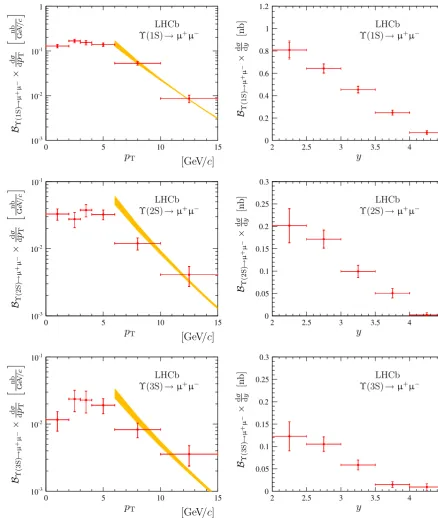
The single differential cross-sections times dimuon branching fractions are shown as functions of pT and y in Fig.2 and summarised in Table2. The total uncertain-ties of the results are dominated by statistical effects in all pT and y bins. In addition to the data, Fig.2 reports theoretical predictions, based on the next-to-leading order non-relativistic QCD calculation [18], for the ϒ differen-tial cross-sections in the kinematic region 6 < pT < 15 GeV/c and 2.0 < y < 4.5. The long-distance matrix
elements used in the calculations are fitted to CDF [50] and D0 [51] results forϒ(1S)production in pp collisions at √s = 1.8 and 1.96 TeV. The predictions include the
feed-down contributions from higher excited S-wave and P-wave bb states. Good agreement between the data and predictions is found for all threeϒ states. The dependence of the ϒ cross-sections on y is found to be more pro-nounced than at higher collision energies [21,22], which is in line with theoretical expectations presented for example in Ref. [52].
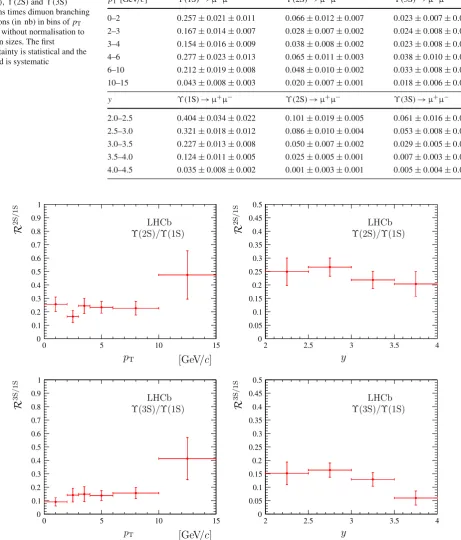
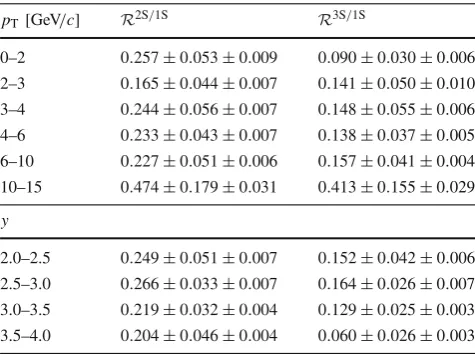
Figure 3 illustrates the ratios of the ϒ(2S) to ϒ(1S), R2S/1S, andϒ(3S)toϒ(1S),R3S/1S, cross-sections times dimuon branching fractions as functions of pTand y. Here, most of the systematic uncertainties on the cross-sections cancel, while the statistical uncertainties remain significant. The ratios are found to be in good agreement with the cor-responding results obtained in the previous analyses onϒ production at √s = 7 and 8 TeV [21,22]. The measured R2S/1SandR3S/1Sare also consistent with theoretical pre-dictions presented in Refs. [52–54], where theϒ(3S)meson is considered as a mixture of normal bb and hybrid bbg states. Table 3 lists R2S/1S and R3S/1S for each pT and
y bin.
To provide a reference for a future LHCb measurement of ϒ production with pPb collisions at√sN N =5 TeV, theϒ
cross-sections are measured in the reduced kinematic region
pT < 15 GeV/c and 2.5 < y < 4.0. The corresponding integrated cross-sections times dimuon branching fractions in this kinematic region are
0 5 10 15
-3
10
-2
10
-1
10 1
2 2.5 3 3.5 4 4.5
0 0.2 0.4 0.6 0.8 1 1.2
0 5 10 15
-3
10
-2
10
-1
10
2 2.5 3 3.5 4 4.5
0 0.05 0.1 0.15 0.2 0.25 0.3
0 5 10 15
-3
10
-2
10
-1
10
2 2.5 3 3.5 4 4.5
[image:6.595.69.508.54.573.2]0 0.05 0.1 0.15 0.2 0.25 0.3
Fig. 2 Differential cross-sections for ϒ(1S), ϒ(2S) and ϒ(3S) mesons times dimuon branching fractions as functions of pT(left) and
y (right). The inner error bars indicate the statistical uncertainty, while
the outer error bars indicate the sum of statistical and systematic uncer-tainties in quadrature. The next-to-leading order non-relativistic QCD predictions [18] are shown by the solid yellow band
σ(pp→ϒ(2S)X)×Bϒ(2S)→μ+μ− =0.159±0.013±0.007 nb,
σ(pp→ϒ(3S)X)×Bϒ(3S)→μ+μ− =0.089±0.010±0.004 nb.
6 Conclusions
Table 2 Cross-sections for ϒ(1S),ϒ(2S)andϒ(3S) mesons times dimuon branching fractions (in nb) in bins of pT
and y without normalisation to the bin sizes. The first uncertainty is statistical and the second is systematic
pT[GeV/c] ϒ(1S)→μ+μ− ϒ(2S)→μ+μ− ϒ(3S)→μ+μ−
0–2 0.257±0.021±0.011 0.066±0.012±0.007 0.023±0.007±0.002 2–3 0.167±0.014±0.007 0.028±0.007±0.002 0.024±0.008±0.002 3–4 0.154±0.016±0.009 0.038±0.008±0.002 0.023±0.008±0.001 4–6 0.277±0.023±0.013 0.065±0.011±0.003 0.038±0.010±0.002 6–10 0.212±0.019±0.008 0.048±0.010±0.002 0.033±0.008±0.001 10–15 0.043±0.008±0.003 0.020±0.007±0.001 0.018±0.006±0.002 y ϒ(1S)→μ+μ− ϒ(2S)→μ+μ− ϒ(3S)→μ+μ−
2.0–2.5 0.404±0.034±0.022 0.101±0.019±0.005 0.061±0.016±0.003 2.5–3.0 0.321±0.018±0.012 0.086±0.010±0.004 0.053±0.008±0.003 3.0–3.5 0.227±0.013±0.008 0.050±0.007±0.002 0.029±0.005±0.001 3.5–4.0 0.124±0.011±0.005 0.025±0.005±0.001 0.007±0.003±0.001 4.0–4.5 0.035±0.008±0.002 0.001±0.003±0.001 0.005±0.004±0.001
0 5 10 15
0 0.1 0.2 0.3 0.4 0.5 0.6 0.7 0.8 0.9 1
2 2.5 3 3.5 4
0 0.05 0.1 0.15 0.2 0.25 0.3 0.35 0.4 0.45 0.5
0 5 10 15
0 0.1 0.2 0.3 0.4 0.5 0.6 0.7 0.8 0.9 1
2 2.5 3 3.5 4
0 0.05 0.1 0.15 0.2 0.25 0.3 0.35 0.4 0.45 0.5
Fig. 3 Ratios of theϒ(2S)toϒ(1S)andϒ(3S)toϒ(1S)cross-sections times dimuon branching fractions as functions of pTand y. The error
bars indicate the total uncertainties of the results obtained by adding statistical and systematic uncertainties in quadrature
a data sample corresponding to an integrated luminosity of 3.3 pb−1. The ϒ differential production cross-sections times dimuon branching fractions are measured separately as functions of theϒtransverse momentum and rapidity for
Table 3 Ratios of theϒ(2S)toϒ(1S)andϒ(3S)toϒ(1S) cross-sections times dimuon branching fractions as functions of pTand y.
The first uncertainty is statistical and the second is systematic pT[GeV/c] R2S/1S R3S/1S
0–2 0.257±0.053±0.009 0.090±0.030±0.006 2–3 0.165±0.044±0.007 0.141±0.050±0.010 3–4 0.244±0.056±0.007 0.148±0.055±0.006 4–6 0.233±0.043±0.007 0.138±0.037±0.005 6–10 0.227±0.051±0.006 0.157±0.041±0.004 10–15 0.474±0.179±0.031 0.413±0.155±0.029 y
2.0–2.5 0.249±0.051±0.007 0.152±0.042±0.006 2.5–3.0 0.266±0.033±0.007 0.164±0.026±0.007 3.0–3.5 0.219±0.032±0.004 0.129±0.025±0.003 3.5–4.0 0.204±0.046±0.004 0.060±0.026±0.003
ϒ(1S)cross-sections times dimuon branching fractions as functions of pTand y are found to be in agreement with the corresponding results obtained at higher collision energies.
Acknowledgments We thank G. Bodwin, L. S. Kisslinger, A. K. Likhoded and A. V. Luchinsky for fruitful discussions about bottomo-nium production. In addition, we are grateful to K.-T. Chao, H. Han and H.-S. Shao for the next-to-leading order non-relativistic QCD predic-tions for promptϒproduction at√s=2.76 TeV. We also express our gratitude to our colleagues in the CERN accelerator departments for the excellent performance of the LHC. We thank the technical and admin-istrative staff at the LHCb institutes. We acknowledge support from CERN and from the national agencies: CAPES, CNPq, FAPERJ and FINEP (Brazil); NSFC (China); CNRS/IN2P3 and Region Auvergne (France); BMBF, DFG, HGF and MPG (Germany); SFI (Ireland); INFN (Italy); FOM and NWO (The Netherlands); SCSR (Poland); MEN/IFA (Romania); MinES, Rosatom, RFBR and NRC “Kurchatov Institute” (Russia); MinECo, XuntaGal and GENCAT (Spain); SNSF and SER (Switzerland); NAS Ukraine (Ukraine); STFC (United Kingdom); NSF (USA). We also acknowledge the support received from the ERC under FP7. The Tier1 computing centres are supported by IN2P3 (France), KIT and BMBF (Germany), INFN (Italy), NWO and SURF (The Netherlands), PIC (Spain), GridPP (United Kingdom). We are indebted to the communities behind the multiple open source software packages we depend on. We are also thankful for the computing resources and the access to software R&D tools provided by Yandex LLC (Russia).
Open Access This article is distributed under the terms of the Creative Commons Attribution License which permits any use, distribution, and reproduction in any medium, provided the original author(s) and the source are credited.
Funded by SCOAP3/ License Version CC BY 4.0.
References
1. V.G. Kartvelishvili, A.K. Likhoded, S.R. Slabospitsky, D meson andψ meson production in hadronic interactions. Sov. J. Nucl. Phys. 28, 678 (1978)
2. C.-H. Chang, Hadronic production of J/ψassociated with a gluon. Nucl. Phys. B 172, 425 (1980)
3. E.L. Berger, D. Jones, Inelastic photoproduction of J/ψandϒby gluons. Phys. Rev. D 23, 1521 (1981)
4. R. Baier, R. Rückl, Hadronic collisions: a quarkonium factory. Z. Phys. C 19, 251 (1983)
5. R. Baier, R. Rückl, Hadronic production of J/ψandϒ: transverse momentum distributions. Phys. Lett. B 102, 364 (1981)
6. J. Campbell, F. Maltoni, F. Tramontano, QCD corrections to J/ψ andϒproduction at hadron colliders. Phys. Rev. Lett. 98, 252002 (2007).arXiv:hep-ph/0703113
7. P. Artoisenet et al.,ϒ production at Fermilab Tevatron and LHC energies. Phys. Rev. Lett. 101, 152001 (2008).arXiv:0806.3282
8. A.D. Frawley, T. Ullrich, R. Vogt, Heavy flavor in heavy-ion collisions at RHIC and RHIC II. Phys. Rep. 462, 125 (2008).
arXiv:0806.1013
9. G.T. Bodwin, E. Braaten, G.P. Lepage, Rigorous QCD analysis of inclusive annihilation and production of heavy quarkonium. Phys. Rev. D 51, 1125 (1995).arXiv:hep-ph/9407339
10. P. Cho, A.K. Leibovich, Color-octet quarkonia production. Phys. Rev. D 53, 150 (1996).arXiv:hep-ph/9505329
11. P. Cho, A.K. Leibovich, Color-octet quarkonia production II. Phys. Rev. D 53, 6203 (1996).arXiv:hep-ph/9511315
12. B. Gong, L.-P. Wan, J.-X. Wang, H.-F. Zhang, Complete next-to-leading-order study on the yield and polarization ofϒ(1S,2S,3S) at the Tevatron and LHC.arXiv:1305.0748
13. ATLAS collaboration, G. Aad et al., Observation of a newχbstate
in radiative transitions toϒ(1S)andϒ(2S)at ATLAS, Phys. Rev. Lett. 108, 152001 (2012).arXiv:1112.5154
14. D0 collaboration, V.M. Abazov et al., Observation of a narrow mass state decaying intoϒ(1S)+γin pp collisions at√s=1.96 TeV. Phys. Rev. D 86, 031103 (2012).arXiv:1203.6034
15. LHCb collaboration, R. Aaij et al., Measurement of the fraction of ϒ(1S)originating fromχb(1P)decays in pp collisions at√s=
7 TeV. JHEP 11, 31 (2012).arXiv:1209.0282
16. LHCb collaboration, Observation ofχb(3P)state at LHCb in pp
collisions at√s=7 TeV, LHCb-CONF-2012-020
17. A. Likhoded, A. Luchinsky, S. Poslavsky, Production ofχb-mesons
at LHC. Phys. Rev. D 86, 074027 (2012).arXiv:1203.4893
18. K. Wang, Y.-Q. Ma, K.-T. Chao,ϒ(1S)prompt production at the Tevatron and LHC in nonrelativistic QCD. Phys. Rev. D 85, 114003 (2012).arXiv:1202.6012
19. ATLAS Collaboration, G. Aad et al., Measurement of Upsilon pro-duction in 7 TeV pp collisions at ATLAS. Phys. Rev. D 87, 052004 (2013).arXiv:1211.7255
20. CMS Collaboration, S. Chatrchyan et al., Measurement of the ϒ(1S),ϒ(2S)andϒ(3S)cross sections in pp collisions at√s = 7 TeV. Phys. Lett. B 727, 101 (2013).arXiv:1303.5900
21. LHCb collaboration, R. Aaij et al., Measurement ofϒproduction in pp collisions at√s=7 TeV. Eur. Phys. J. C 72, 2025 (2012).
arXiv:1202.6579
22. LHCb collaboration, R. Aaij et al., Production of J/ψ and ϒ mesons in pp collisions at √s = 8 TeV. JHEP 06, 64 (2013).
arXiv:1304.6977
23. LHCb collaboration, A.A. Alves Jr et al., The LHCb detector at the LHC. JINST 3, S08005 (2008)
24. M. Adinolfi et al., Performance of the LHCb RICH detector at the LHC. Eur. Phys. J. C 73, 2431 (2013).arXiv:1211.6759
25. A.A. Alves Jr et al., Performance of the LHCb muon system. JINST 8, P02022 (2013).arXiv:1211.1346
26. I. Belyaev et al., Handling of the generation of primary events in Gauss, the LHCb simulation framework, Nuclear Science Sympo-sium Conference Record (NSS/MIC). IEEE 1155 (2010) 27. T. Sjöstrand, S. Mrenna, P. Skands, Pythia 6.4 physics and manual,
JHEP 05, 026 (2006).arXiv:hep-ph/0603175
29. P. Golonka, Z. Was, Photos Monte Carlo: a precision tool for QED corrections in Z and W decays. Eur. Phys. J. C 45, 97 (2006).
arXiv:hep-ph/0506026
30. Geant4 collaboration, J. Allison et al., Geant4 developments and applications. IEEE Trans. Nucl. Sci. 53, 270 (2006)
31. Geant4 collaboration, S. Agostinelli et al., Geant4: a simulation toolkit. Nucl. Instrum. Methods A 506, 250 (2003)
32. M. Clemencic et al., The LHCb simulation application, Gauss: design, evolution and experience. J. Phys. Conf. Ser. 331, 032023 (2011)
33. R. Aaij et al., Measurement of the track reconstruction efficiency at LHCb, LHCb-DP-2013-002 (in preparation)
34. F. Archilli et al., Performance of the muon identification at LHCb. JINST 8, P10020 (2013).arXiv:1306.0249
35. W.D. Hulsbergen, Decay chain fitting with a Kalman filter. Nucl. Instrum. Methods A 552, 566 (2005).arXiv:physics/0503191
36. T. Skwarnicki, A study of the radiative cascade transitions between theϒandϒresonances, PhD thesis, Institute of Nuclear Physics, Krakow, DESY-F31-86-02 (1986)
37. J. Beringer et al., Particle Data Group, Review of particle physics. Phys. Rev. D 86, 010001 (2012) (2013 partial update for the 2014 edition)
38. M. Pivk, F.R. Le Diberder, sPlot: a statistical tool to unfold data distributions. Nucl. Instrum. Meth. A 555, 356 (2005).
arXiv:physics/0402083
39. LHCb collaboration, R. Aaij et al., Prompt K0
s production in
pp collisions at√s = 0.9 TeV. Phys. Lett. B 693, 69 (2010).
arXiv:1008.3105
40. M. Ferro-Luzzi, Proposal for an absolute luminosity determi-nation in colliding beam experiments using vertex detection of beam-gas interactions. Nucl. Instrum. Methods A 553, 388 (2005)
41. R. Aaij et al., LHCb collaboration. Absolute luminosity measure-ments with the LHCb detector at the LHC, JINST 7, P01010 (2012).
arXiv:1110.2866
42. P. Hopchev, LHCb beam-gas imaging results.arXiv:1107.1492
43. P. Hopchev, Absolute luminosity measurement at LHCb, PhD the-sis, Université de Grenoble, Grenoble, CERN-THESIS-2011-210 (2011)
44. C. Barschel, Precision luminosity measurement at LHCb with beam-gas imaging, PhD thesis, Fakultät für Mathematik, Infor-matik and Naturwissenschaften der RWTH Aachen University, Aachen (2013)
45. CMS collaboration, S. Chatrchyan et al., Measurement of the ϒ(1S),ϒ(2S)andϒ(3S)polarizations in pp collisions at√s= 7 TeV. Phys. Rev. Lett. 110, 081802 (2013).arXiv:1209.2922
46. LHCb collaboration, R. Aaij et al., Measurement of J/ψ polar-ization in pp collisions at√s=7 TeV. Eur. Phys. J. C 73, 2631 (2013).arXiv:1307.6379
47. LHCb collaboration, R. Aaij et al., Measurement ofψ(2S) polar-isation in pp collisions at√s=7 TeV, LHCb-PAPER-2013-067 (in preparation)
48. ALICE collaboration, B. Abelev et al., J/ψ polarization in pp collisions at√s =7 TeV. Phys. Rev. Lett. 108, 082001 (2012).
arXiv:1111.1630
49. R. Aaij et al., The LHCb trigger and its performance in 2011. JINST 8, P04022 (2013).arXiv:1211.3055
50. CDF collaboration, D. Acosta et al.,ϒproduction and polarization in pp collisions at√s = 1.8 TeV. Phys. Rev. Lett. 88, 161802 (2002)
51. D0 collaboration, V.M. Abazov et al., Measurement of inclu-sive differential cross sections forϒ(1S)production in pp col-lisions at√s = 1.96 TeV. Phys. Rev. Lett. 94, 232001 (2005).
arXiv:hep-ex/0502030
52. L.S. Kisslinger, D. Das, ϒ production in pp collisions for for-ward rapidities at LHC. Mod. Phys. Lett. A 28, 1350067 (2013).
arXiv:1207.3296
53. L.S. Kisslinger, M.X. Liu, P. McGaughey, Heavy quark qtate production in pp collisions. Phys. Rev. D 84, 114020 (2011).
arXiv:1108.4049
54. L.S. Kisslinger,ϒproduction in pp collisions at LHC. Mod. Phys. Lett. A 27, 1250074 (2012).arXiv:1201.1033
The LHCb Collaboration
R. Aaij41, B. Adeva37, M. Adinolfi46, A. Affolder52, Z. Ajaltouni5, J. Albrecht9, F. Alessio38, M. Alexander51, S. Ali41, G. Alkhazov30, P. Alvarez Cartelle37, A. A. Alves Jr25, S. Amato2, S. Amerio22, Y. Amhis7, L. Anderlini17,g, J. Anderson40, R. Andreassen57, M. Andreotti16,f, J. E. Andrews58, R. B. Appleby54, O. Aquines Gutierrez10, F. Archilli38, A. Artamonov35, M. Artuso59, E. Aslanides6, G. Auriemma25,n, M. Baalouch5, S. Bachmann11, J. J. Back48, A. Badalov36, V. Balagura31, W. Baldini16, R. J. Barlow54, C. Barschel39, S. Barsuk7, W. Barter47, V. Batozskaya28, Th. Bauer41, A. Bay39, J. Beddow51, F. Bedeschi23, I. Bediaga1, S. Belogurov31, K. Belous35, I. Belyaev31, E. Ben-Haim8, G. Bencivenni18, S. Benson50, J. Benton46, A. Berezhnoy32, R. Bernet40, M.-O. Bettler47, M. van Beuzekom41, A. Bien11, S. Bifani45, T. Bird54, A. Bizzeti17,i, P. M. Bjørnstad54, T. Blake48, F. Blanc39, J. Blouw10, S. Blusk59, V. Bocci25, A. Bondar34, N. Bondar30, W. Bonivento15,38, S. Borghi54, A. Borgia59, M. Borsato7, T. J. V. Bowcock52, E. Bowen40, C. Bozzi16, T. Brambach9, J. van den Brand42, J. Bressieux39, D. Brett54, M. Britsch10, T. Britton59, N. H. Brook46, H. Brown52, A. Bursche40, G. Busetto22,r, J. Buytaert38, S. Cadeddu15, R. Calabrese16,f, O. Callot7, M. Calvi20,k, M. Calvo Gomez36,p, A. Camboni36, P. Campana18,38, D. Campora Perez38, A. Carbone14,d, G. Carboni24,l, R. Cardinale19,j, A. Cardini15, H. Carranza-Mejia50, L. Carson50, K. Carvalho Akiba2, G. Casse52, L. Castillo Garcia38, M. Cattaneo38, Ch. Cauet9, R. Cenci58, M. Charles8, Ph. Charpentier38, S.-F. Cheung55, N. Chiapolini40, M. Chrzaszcz26,40, K. Ciba38, X. Cid Vidal38, G. Ciezarek53, P. E. L. Clarke50, M. Clemencic38, H. V. Cliff47, J. Closier38, C. Coca29, V. Coco38, J. Cogan6, E. Cogneras5, P. Collins38, A. Comerma-Montells36, A. Contu15,38, A. Cook46, M. Coombes46, S. Coquereau8, G. Corti38, I. Counts56, B. Couturier38, G. A. Cowan50, D. C. Craik48, M. Cruz Torres60, S. Cunliffe53, R. Currie50, C. D’Ambrosio38, J. Dalseno46, P. David8, P. N. Y. David41, A. Davis57, I. De Bonis4,
M. Deckenhoff9, L. Del Buono8, N. Déléage4, D. Derkach55, O. Deschamps5, F. Dettori42, A. Di Canto11, H. Dijkstra38, S. Donleavy52, F. Dordei11, M. Dorigo39, P. Dorosz26,o, A. Dosil Suárez37, D. Dossett48, A. Dovbnya43, F. Dupertuis39, P. Durante38, R. Dzhelyadin35, A. Dziurda26, A. Dzyuba30, S. Easo49, U. Egede53, V. Egorychev31, S. Eidelman34, S. Eisenhardt50, U. Eitschberger9, R. Ekelhof9, L. Eklund38,51, I. El Rifai5, Ch. Elsasser40, S. Esen11, A. Falabella16,f, C. Färber11, C. Farinelli41, S. Farry52, D. Ferguson50, V. Fernandez Albor37, F. Ferreira Rodrigues1, M. Ferro-Luzzi38, S. Filippov33, M. Fiore16,f, M. Fiorini16,f, C. Fitzpatrick38, M. Fontana10, F. Fontanelli19,j, R. Forty38, O. Francisco2, M. Frank38, C. Frei38, M. Frosini17,38,g, J. Fu21, E. Furfaro24,l, A. Gallas Torreira37, D. Galli14,d, M. Gandelman2,
P. Gandini59, Y. Gao3, J. Garofoli59, J. Garra Tico47, L. Garrido36, C. Gaspar38, R. Gauld55, E. Gersabeck11, M. Gersabeck54, T. Gershon48, Ph. Ghez4, A. Gianelle22, S. Giani’39, V. Gibson47, L. Giubega29, V. V. Gligorov38, C. Göbel60, D. Golubkov31, A. Golutvin31,38,53, A. Gomes1,a, H. Gordon38, M. Grabalosa Gándara5, R. Graciani Diaz36, L. A. Granado Cardoso38, E. Graugés36, G. Graziani17, A. Grecu29, E. Greening55, S. Gregson47, P. Griffith45, L. Grillo11, O. Grünberg61, B. Gui59, E. Gushchin33, Yu. Guz35,38, T. Gys38, C. Hadjivasiliou59, G. Haefeli39, C. Haen38, T. W. Hafkenscheid64, S. C. Haines47, S. Hall53, B. Hamilton58, T. Hampson46, S. Hansmann-Menzemer11, N. Harnew55, S. T. Harnew46, J. Harrison54,
T. Hartmann61, J. He38, T. Head38, V. Heijne41, K. Hennessy52, P. Henrard5, L. Henry8, J. A. Hernando Morata37, E. van Herwijnen38, M. Heß61, A. Hicheur1, D. Hill55, M. Hoballah5, C. Hombach54, W. Hulsbergen41, P. Hunt55, N. Hussain55, D. Hutchcroft52, D. Hynds51, V. Iakovenko44, M. Idzik27, P. Ilten56, R. Jacobsson38, A. Jaeger11, E. Jans41, P. Jaton39, A. Jawahery58, F. Jing3, M. John55, D. Johnson55, C. R. Jones47, C. Joram38, B. Jost38, N. Jurik59, M. Kaballo9, S. Kandybei43, W. Kanso6, M. Karacson38, T. M. Karbach38, M. Kelsey59, I. R. Kenyon45, T. Ketel42, B. Khanji20,
C. Khurewathanakul39, S. Klaver54, O. Kochebina7, I. Komarov39, R. F. Koopman42, P. Koppenburg41, M. Korolev32, A. Kozlinskiy41, L. Kravchuk33, K. Kreplin11, M. Kreps48, G. Krocker11, P. Krokovny34, F. Kruse9, M. Kucharczyk20,26,38,k, V. Kudryavtsev34, K. Kurek28, T. Kvaratskheliya31,38, V. N. La Thi39, D. Lacarrere38, G. Lafferty54, A. Lai15, D. Lambert50, R. W. Lambert42, E. Lanciotti38, G. Lanfranchi18, C. Langenbruch38, T. Latham48, C. Lazzeroni45, R. Le Gac6,
J. van Leerdam41, J.-P. Lees4, R. Lefèvre5, A. Leflat32, J. Lefrançois7, S. Leo23, O. Leroy6, T. Lesiak26, B. Leverington11, Y. Li3, M. Liles52, R. Lindner38, C. Linn11, F. Lionetto40, B. Liu15, G. Liu38, S. Lohn38, I. Longstaff51, J. H. Lopes2, N. Lopez-March39, P. Lowdon40, H. Lu3, D. Lucchesi22,r, J. Luisier39, H. Luo50, E. Luppi16,f, O. Lupton55, F. Machefert7, I. V. Machikhiliyan31, F. Maciuc29, O. Maev30,38, S. Malde55, G. Manca15,e, G. Mancinelli6, M. Manzali16,f, J. Maratas5, U. Marconi14, P. Marino23,t, R. Märki39, J. Marks11, G. Martellotti25, A. Martens8, A. Martín Sánchez7, M. Martinelli41, D. Martinez Santos42, F. Martinez Vidal63, D. Martins Tostes2, A. Massafferri1, R. Matev38, Z. Mathe38, C. Matteuzzi20, A. Mazurov16,38,f, M. McCann53, J. McCarthy45, A. McNab54, R. McNulty12, B. McSkelly52, B. Meadows55,57, F. Meier9, M. Meissner11, M. Merk41, D. A. Milanes8, M.-N. Minard4, J. Molina Rodriguez60, S. Monteil5, D. Moran54, M. Morandin22, P. Morawski26, A. Mordà6, M. J. Morello23,t, R. Mountain59, F. Muheim50, K. Müller40, R. Muresan29, B. Muryn27, B. Muster39, P. Naik46, T. Nakada39, R. Nandakumar49, I. Nasteva1, M. Needham50, N. Neri21, S. Neubert38, N. Neufeld38, A. D. Nguyen39, T. D. Nguyen39, C. Nguyen-Mau39,q, M. Nicol7, V. Niess5, R. Niet9, N. Nikitin32, T. Nikodem11,
A. Novoselov35, A. Oblakowska-Mucha27, V. Obraztsov35, S. Oggero41, S. Ogilvy51, O. Okhrimenko44, R. Oldeman15,e, G. Onderwater64, M. Orlandea29, J. M. Otalora Goicochea2, P. Owen53, A. Oyanguren36, B. K. Pal59, A. Palano13,c, F. Palombo21,u, M. Palutan18, J. Panman38, A. Papanestis38,49, M. Pappagallo51, L. Pappalardo16, C. Parkes54, C. J. Parkinson9, G. Passaleva17, G. D. Patel52, M. Patel53, C. Patrignani19,j, C. Pavel-Nicorescu29, A. Pazos Alvarez37, A. Pearce54,
A. Pellegrino41, G. Penso25,m, M. Pepe Altarelli38, S. Perazzini14,d, E. Perez Trigo37, P. Perret5, M. Perrin-Terrin6, L. Pescatore45, E. Pesen65, G. Pessina20, K. Petridis53, A. Petrolini19,j, E. Picatoste Olloqui36, B. Pietrzyk4, T. Pilaˇr48, D. Pinci25, A. Pistone19, S. Playfer50, M. Plo Casasus37, F. Polci8, G. Polok26, A. Poluektov34,48, E. Polycarpo2, A. Popov35, D. Popov10, B. Popovici29, C. Potterat36, A. Powell55, J. Prisciandaro39, A. Pritchard52, C. Prouve46, V. Pugatch44, A. Puig Navarro39, G. Punzi23,s, W. Qian4, B. Rachwal26, J. H. Rademacker46, B. Rakotomiaramanana39, M. Rama18, M. S. Rangel2, I. Raniuk43, N. Rauschmayr38, G. Raven42, S. Redford55, S. Reichert54, M. M. Reid48, A. C. dos Reis1, S. Ricciardi49, A. Richards53, K. Rinnert52, V. Rives Molina36, D. A. Roa Romero5, P. Robbe7, D. A. Roberts58, A. B. Rodrigues1, E. Rodrigues54, P. Rodriguez Perez37, S. Roiser38, V. Romanovsky35, A. Romero Vidal37, M. Rotondo22, J. Rouvinet39, T. Ruf38, F. Ruffini23, H. Ruiz36, P. Ruiz Valls36, G. Sabatino25,l, J. J. Saborido Silva37, N. Sagidova30, P. Sail51, B. Saitta15,e, V. Salustino Guimaraes2, B. Sanmartin Sedes37, R. Santacesaria25, C. Santamarina Rios37, E. Santovetti24,l, M. Sapunov6, A. Sarti18, C. Satriano25,n, A. Satta24, M. Savrie16,f, D. Savrina31,32, M. Schiller42, H. Schindler38, M. Schlupp9,
M. Schmelling10, B. Schmidt38, O. Schneider39, A. Schopper38, M.-H. Schune7, R. Schwemmer38, B. Sciascia18,
M. Smith54, H. Snoek41, M. D. Sokoloff57, F. J. P. Soler51, F. Soomro39, D. Souza46, B. Souza De Paula2, B. Spaan9, A. Sparkes50, F. Spinella23, P. Spradlin51, F. Stagni38, S. Stahl11, O. Steinkamp40, S. Stevenson55, S. Stoica29, S. Stone59, B. Storaci40, S. Stracka23,38, M. Straticiuc29, U. Straumann40, R. Stroili22, V. K. Subbiah38, L. Sun57, W. Sutcliffe53, S. Swientek9, V. Syropoulos42, M. Szczekowski28, P. Szczypka39,38, D. Szilard2, T. Szumlak27, S. T’Jampens4, M. Teklishyn7, G. Tellarini16,f, E. Teodorescu29, F. Teubert38, C. Thomas55, E. Thomas38, J. van Tilburg11, V. Tisserand4, M. Tobin39, S. Tolk42, L. Tomassetti16,f, D. Tonelli38, S. Topp-Joergensen55, N. Torr55, E. Tournefier4,53, S. Tourneur39, M. T. Tran39, M. Tresch40, A. Tsaregorodtsev6, P. Tsopelas41, N. Tuning41, M. Ubeda Garcia38, A. Ukleja28, A. Ustyuzhanin62, U. Uwer11, V. Vagnoni14, G. Valenti14, A. Vallier7, R. Vazquez Gomez18, P. Vazquez Regueiro37, C. Vázquez Sierra37, S. Vecchi16, J. J. Velthuis46, M. Veltri17,h, G. Veneziano39, M. Vesterinen11, B. Viaud7, D. Vieira2, X. Vilasis-Cardona36,p, A. Vollhardt40, D. Volyanskyy10,*, D. Voong46, A. Vorobyev30, V. Vorobyev34, C. Voß61, H. Voss10, J. A. de Vries41, R. Waldi61, C. Wallace48, R. Wallace12, S. Wandernoth11, J. Wang59, D. R. Ward47, N. K. Watson45, A. D. Webber54, D. Websdale53, M. Whitehead48, J. Wicht38, J. Wiechczynski26, D. Wiedner11, L. Wiggers41, G. Wilkinson55, M. P. Williams48,49, M. Williams56, F. F. Wilson49, J. Wimberley58, J. Wishahi9, W. Wislicki28, M. Witek26, G. Wormser7, S. A. Wotton47, S. Wright47, S. Wu3, K. Wyllie38, Y. Xie38,50, Z. Xing59, Z. Yang3, X. Yuan3, O. Yushchenko35, M. Zangoli14, M. Zavertyaev10,b, F. Zhang3, L. Zhang59, W. C. Zhang12, Y. Zhang3, A. Zhelezov11, A. Zhokhov31, L. Zhong3, A. Zvyagin38
1Centro Brasileiro de Pesquisas Físicas (CBPF), Rio de Janeiro, Brazil 2Universidade Federal do Rio de Janeiro (UFRJ), Rio de Janeiro, Brazil 3Center for High Energy Physics, Tsinghua University, Beijing, China 4LAPP, Université de Savoie, CNRS/IN2P3, Annecy-Le-Vieux, France
5Clermont Université, Université Blaise Pascal, CNRS/IN2P3, LPC, Clermont-Ferrand, France 6CPPM, Aix-Marseille Université, CNRS/IN2P3, Marseille, France
7LAL, Université Paris-Sud, CNRS/IN2P3, Orsay, France
8LPNHE, Université Pierre et Marie Curie, Université Paris Diderot, CNRS/IN2P3, Paris, France 9Fakultät Physik, Technische Universität Dortmund, Dortmund, Germany
10Max-Planck-Institut für Kernphysik (MPIK), Heidelberg, Germany
11Physikalisches Institut, Ruprecht-Karls-Universität Heidelberg, Heidelberg, Germany 12School of Physics, University College Dublin, Dublin, Ireland
13Sezione INFN di Bari, Bari, Italy 14Sezione INFN di Bologna, Bologna, Italy 15Sezione INFN di Cagliari, Cagliari, Italy 16Sezione INFN di Ferrara, Ferrara, Italy 17Sezione INFN di Firenze, Florence, Italy
18Laboratori Nazionali dell’INFN di Frascati, Frascati, Italy 19Sezione INFN di Genova, Genoa, Italy
20Sezione INFN di Milano Bicocca, Milan, Italy 21Sezione INFN di Milano, Milan, Italy
22Sezione INFN di Padova, Padua, Italy 23Sezione INFN di Pisa, Pisa, Italy
24Sezione INFN di Roma Tor Vergata, Rome, Italy 25Sezione INFN di Roma La Sapienza, Rome, Italy
26Henryk Niewodniczanski Institute of Nuclear Physics Polish Academy of Sciences, Kraków, Poland
27Faculty of Physics and Applied Computer Science, AGH, University of Science and Technology, Kraków, Poland 28National Center for Nuclear Research (NCBJ), Warsaw, Poland
29Horia Hulubei National Institute of Physics and Nuclear Engineering, Bucharest-Magurele, Romania 30Petersburg Nuclear Physics Institute (PNPI), Gatchina, Russia
31Institute of Theoretical and Experimental Physics (ITEP), Moscow, Russia
32Institute of Nuclear Physics, Moscow State University (SINP MSU), Moscow, Russia
33Institute for Nuclear Research of the Russian Academy of Sciences (INR RAN), Moscow, Russia 34Budker Institute of Nuclear Physics (SB RAS) and Novosibirsk State University, Novosibirsk, Russia 35Institute for High Energy Physics (IHEP), Protvino, Russia
36Universitat de Barcelona, Barcelona, Spain
38European Organization for Nuclear Research (CERN), Geneva, Switzerland 39Ecole Polytechnique Fédérale de Lausanne (EPFL), Lausanne, Switzerland 40Physik-Institut, Universität Zürich, Zurich, Switzerland
41Nikhef National Institute for Subatomic Physics, Amsterdam, The Netherlands
42Nikhef National Institute for Subatomic Physics and VU University Amsterdam, Amsterdam, The Netherlands 43NSC Kharkiv Institute of Physics and Technology (NSC KIPT), Kharkiv, Ukraine
44Institute for Nuclear Research of the National Academy of Sciences (KINR), Kyiv, Ukraine 45University of Birmingham, Birmingham, UK
46H.H. Wills Physics Laboratory, University of Bristol, Bristol, UK 47Cavendish Laboratory, University of Cambridge, Cambridge, UK 48Department of Physics, University of Warwick, Coventry, UK 49STFC Rutherford Appleton Laboratory, Didcot, UK
50School of Physics and Astronomy, University of Edinburgh, Edinburgh, UK 51School of Physics and Astronomy, University of Glasgow, Glasgow, UK 52Oliver Lodge Laboratory, University of Liverpool, Liverpool, UK 53Imperial College London, London, UK
54School of Physics and Astronomy, University of Manchester, Manchester, UK 55Department of Physics, University of Oxford, Oxford, UK
56Massachusetts Institute of Technology, Cambridge, MA, UK 57University of Cincinnati, Cincinnati, OH, USA
58University of Maryland, College Park, MD, USA 59Syracuse University, Syracuse, NY, USA
60Pontifícia Universidade Católica do Rio de Janeiro (PUC-Rio), Rio de Janeiro, Brazil, associated to2 61Institut für Physik, Universität Rostock, Rostock, Germany, associated to11
62National Research Centre Kurchatov Institute, Moscow, Russia, associated to31
63Instituto de Fisica Corpuscular (IFIC), Universitat de Valencia-CSIC, Valencia, Spain, associated to36 64KVI, University of Groningen, Groningen, The Netherlands, associated to41
65Celal Bayar University, Manisa, Turkey, associated to38
aUniversidade Federal do Triângulo Mineiro (UFTM), Uberaba-MG, Brazil
bP.N. Lebedev Physical Institute, Russian Academy of Science (LPI RAS), Moscow, Russia cUniversità di Bari, Bari, Italy
dUniversità di Bologna, Bologna, Italy eUniversità di Cagliari, Cagliari, Italy fUniversità di Ferrara, Ferrara, Italy gUniversità di Firenze, Florence, Italy hUniversità di Urbino, Urbino, Italy
iUniversità di Modena e Reggio Emilia, Modena, Italy jUniversità di Genova, Genoa, Italy
kUniversità di Milano Bicocca, Milan, Italy lUniversità di Roma Tor Vergata, Rome, Italy mUniversità di Roma La Sapienza, Rome, Italy
nUniversità della Basilicata, Potenza, Italy
oAGH, University of Science and Technology, Faculty of Computer Science, Electronics and Telecommunications,
Kraków, Poland
pLIFAELS, La Salle, Universitat Ramon Llull, Barcelona, Spain qHanoi University of Science, Hanoi, Viet Nam
rUniversità di Padova, Padua, Italy sUniversità di Pisa, Pisa, Italy