
Selective
k
Opioid Antagonists nor-BNI, GNTI and JDTic
Have Low Affinities for Non-Opioid Receptors and
Transporters
Thomas A. Munro1,2,3*, Xi-Ping Huang4, Carmela Inglese5, Maria Grazia Perrone5, Ashlee Van’t Veer1,2, F. Ivy Carroll6, Ce´cile Be´guin1,2, William A. Carlezon Jr.1,2, Nicola A. Colabufo5, Bruce M. Cohen1,2, Bryan L. Roth4
1McLean Hospital, Belmont, Massachusetts, United States of America,2Department of Psychiatry, Harvard Medical School, Boston, Massachusetts, United States of America,3School of Chemistry and Bio21 Institute, University of Melbourne, Parkville, Australia,4National Institute of Mental Health Psychoactive Drug Screening Program and Department of Pharmacology, University of North Carolina School of Medicine, Chapel Hill, North Carolina, United States of America,5Dipartimento di Farmacia-Scienze del Farmaco, Universita` degli Studi di Bari, Bari, Italy,6Center for Organic and Medicinal Chemistry, Research Triangle Institute, Research Triangle Park, North Carolina, United States of America
Abstract
Background:Nor-BNI, GNTI and JDTic induce selectivekopioid antagonism that is delayed and extremely prolonged, but some other effects are of rapid onset and brief duration. The transient effects of these compounds differ, suggesting that some of them may be mediated by other targets.
Results:In binding assays, the three antagonists showed no detectable affinity (Ki$10mM) for most non-opioid receptors and transporters (26 of 43 tested). There was no non-opioid target for which all three compounds shared detectable affinity, or for which any two shared sub-micromolar affinity. All three compounds showed low nanomolar affinity forkopioid receptors, with moderate selectivity over m and d (3 to 44-fold). Nor-BNI bound weakly to the a2C-adrenoceptor (Ki= 630 nM). GNTI enhanced calcium mobilization by noradrenaline at thea1A-adrenoceptor (EC50= 41 nM), but did not activate the receptor, displace radioligands, or enhance PI hydrolysis. This suggests that it is a functionally-selective allosteric enhancer. GNTI was also a weak M1 receptor antagonist (KB= 3.7mM). JDTic bound to the noradrenaline transporter (Ki= 54 nM), but only weakly inhibited transport (IC50= 1.1mM). JDTic also bound to the opioid-like receptor NOP (Ki= 12 nM), but gave little antagonism even at 30mM. All three compounds exhibited rapid permeation and active efflux across Caco-2 cell monolayers.
Conclusions:Across 43 non-opioid CNS targets, only GNTI exhibited a potent functional effect (allosteric enhancement of
a1A-adrenoceptors). This may contribute to GNTI’s severe transient effects. Plasma concentrations of nor-BNI and GNTI may be high enough to affect some peripheral non-opioid targets. Nonetheless,k opioid antagonism persists for weeks or months after these transient effects dissipate. With an adequate pre-administration interval, our results therefore strengthen the evidence that nor-BNI, GNTI and JDTic are highly selectivekopioid antagonists.
Citation:Munro TA, Huang X-P, Inglese C, Perrone MG, Van’t Veer A, et al. (2013) SelectivekOpioid Antagonists nor-BNI, GNTI and JDTic Have Low Affinities for Non-Opioid Receptors and Transporters. PLoS ONE 8(8): e70701. doi:10.1371/journal.pone.0070701
Editor:James Porter, University of North Dakota, United States of America
ReceivedApril 19, 2013;AcceptedJune 21, 2013;PublishedAugust 14, 2013
Copyright:ß2013 Munro et al. This is an open-access article distributed under the terms of the Creative Commons Attribution License, which permits unrestricted use, distribution, and reproduction in any medium, provided the original author and source are credited.
Funding:Funding was provided by: the National Institute of Mental Health (Psychoactive Drug Screening Program, administered by BLR); National Institute of Drug Abuse (DA09045 to FIC and DA030586 to WAC); Department of Defense (National Defense Science and Engineering Graduate Fellowship to AVV); and Ministero dell’Istruzione, dell’Universita` e della Ricerca, Italy (MIUR, PRIN 20097FJHPZ-001 to NAC). The funders had no role in study design, data collection and analysis, decision to publish, or preparation of the manuscript.
Competing Interests:The authors have read the journal’s policy and have the following conflicts: CB, BMC, and WAC hold US patents on the use ofkligands to treat mood disorders (6,528,518 and 7,629,475). RTI holds several US patents on the preparation and therapeutic use of JDTic, on which FIC is an author. This does not alter the authors’ adherence to all the PLOS ONE policies on sharing data and materials.
* E-mail: [email protected]
Introduction
Selective k (kappa) opioid antagonists may have therapeutic potential against conditions such as depression and anxiety disorders [1,2]. The best-established agents in this class, shown in Figure 1, are nor-BNI, GNTI and JDTic. In vitro, these compounds are potent and selective antagonists at the k opioid receptor (k-OR), with much lower potency atm- (mu) andd- (delta) OR [3]. They are therefore generally consideredk-selective, but
little evidence is available on binding and activity at other receptors, ion channels, transporters and enzymes.
Delayed, prolongedkopioid antagonism
antagonists are typically effective for only hours or at most days,k
antagonism can persist for weeks or months after nor-BNI, GNTI or JDTic [4]. To account for this abnormal timecourse, it was long presumed that these compounds were slowly absorbed and eliminated. Recently, studies have suggested instead that nor-BNI, GNTI and JDTic activate the enzyme c-Jun N-terminal kinase 1 (JNK1, MAPK8), causing desensitization of k-OR that persists long after the compounds are eliminated [5]. Thus, these compounds appear to induce functional antagonism via a non-competitive mechanism. Short-acting k antagonists did not activate JNK1 [6].
Transient effects
Surprisingly, despite the extremely protracted timecourse ofk
antagonism, other effects of nor-BNI, GNTI and JDTic are of rapid onset and brief duration [4,7]. After subcutaneous (s.c.) administration to mice, nor-BNI and GNTI induce scratching that is maximal within 20 minutes and lasts less than two hours [8,9]. Nor-BNI and JDTic inhibit self-administration of ethanol by rats at 2 hours, but not 24 hours [10]. Nor-BNI also reduces the maximal responding rate to intracranial self-stimulation in rats over the first two hours, but not after 24 hours [11]. In mice, GNTI strongly inhibits locomotor activity within 20 minutes, but the effect dissipates within three hours [12]. Nor-BNI inhibits locomotor activity in rats on the day of administration, but not the next day [13]. Despite its high k-selectivity in vitro [3], nor-BNI produces transientmanddantagonism in mice, again with rapid onset and lasting only a few hours [14,15]. Thus, all three of these compounds have transient effects.
Potential mechanisms of transient effects
These effects are maximal whenk antagonism is submaximal (,2 hours), and undetectable when antagonism is maximal
(24 hours) [4,16]. This strongly suggests that these effects are not mediated by antagonism of the endogenouskopioid dynorphin A (dynA). We recently found that nor-BNI, GNTI and JDTic are rapidly absorbed and eliminated from plasma after intraperitoneal (i.p.) administration, coinciding closely with the timecourse of their transient effects [7]. We have argued that such effects are likely to result from competitive, reversible mechanisms, while the delayed, prolonged timecourse ofk antagonism is more consistent with a non-competitive, irreversible process such as desensitization [7].
Whilekantagonism cannot plausibly account for these transient effects, the fact that some of them are caused by several of these compounds suggests that they may nonetheless be k -OR-mediated. They might, for instance, result from inverse or biased agonism. However, effects seen after only one of these agents suggest the involvement of targets other thankopioid receptors (k -OR). Dramatically, we found that administration of a high dose of GNTI to mice (30 mg/kg i.p.) caused ataxia, convulsions and death within 18 minutes. By contrast, even at 100 mg/kg, nor-BNI and JDTic caused no convulsions or deaths [7]. Naltrexone is also much less toxic to mice (LD50= 570 mg/kg s.c.) [17]. The
GNTI analogue 59-aminomethylnaltrindole was also recently reported to induce gasping and convulsions after a high dose (20 mg/kg i.p.), suggesting that this series of compounds may act on a common target other thank-OR [18].
Nor-BNI [19], GNTI [20] and JDTic [21] all inhibit deprivation-induced feeding in rats. Surprisingly, however, while nor-BNI also inhibits feeding induced by butorphanol or neuropeptide Y, GNTI does not [20]. These contrasting profiles suggest that nor-BNI or GNTI, or both, interact with another target that modulates feeding. Evidence has recently been presented that GNTI-induced scratching is mediated by targets other than k-OR [9,22–25]. In addition to the discrepancy in timecourse noted above, scratching was not inhibited by naloxone,
and was equally intense ink-OR knockout mice [9]. Screening of 1mM GNTI against a panel of 34 non-opioid receptors and ion channels revealed substantial binding only to M1 muscarinic
receptors (M1-R) [9]. In vivo, M1 agonist McN-A-343 inhibited
GNTI-induced scratching, consistent with thein vitroevidence for the involvement of this receptor [9,25].
Less evidence is available on the affinities of nor-BNI and JDTic for non-opioid targets. Nor-BNI has been reported to show very low affinity (Ki.1mM) for the N-methyl-D-aspartate (NMDA)
receptor [26], and to weakly modulate dynA binding to the same receptor [27]. No binding was detected at 10mM to the glucocorticoid receptor NR3C1 [28]. Nor-BNI’s affinity for the opioid-like nociceptin/orphanin FQ receptor (NOP) is also negligible; one study found low affinity (Ki= 780 nM) [29], while
another detected no binding at 10mM [30].
To summarize, the mechanisms underlying the transient effects of nor-BNI, GNTI and JDTic are unknown, and differences between these compounds suggest that non-opioid targets may be involved. In this study, we sought evidence of such interactions. Using the resources of the National Institute of Mental Health’s Psychoactive Drug Screening Program [31], we measured the binding affinities of nor-BNI, GNTI and JDTic for 46 receptors, ion channels and neurotransmitter transporters, and evaluated hits in functional assays. We also tested for active efflux from Caco-2 cell monolayers, which express multiple efflux transporters.
Results
Nor-BNI, GNTI and JDTic bind selectively to opioid receptors
As expected, nor-BNI, GNTI and JDTic bound selectively tok -overm- andd-OR, albeit with lower selectivity (3 to 44-fold) than in some previous reports [3]. All three compounds had very low affinities for non-opioid targets generally (Table 1): at most targets, (26 of 43), none of the three compounds bound detectably at 10mM. Furthermore, there was no non-opioid target to which all three compounds bound detectably at 10mM, or for which any two shared sub-micromolar affinity. Only three sub-micromolar affinities were detected: nor-BNI for thea2C-adrenoceptor (a2C
-AR, Ki= 630 nM), and JDTic for the opioid-like receptor NOP
(Ki= 12 nM) and the noradrenaline (norepinephrine) transporter
(NET, Ki= 54 nM).
Nor-BNI does not bind to NMDA receptors
Contrary to previous reports, we detected no binding by nor-BNI to NMDA receptors. However, this receptor’s multiple binding sites complicate comparisons. Nor-BNI was reported to weakly displace3H]CGP-39,653 from the glutamate site [26], and to modulate displacement of [3H]-MDL-105,519 from the glycine site by dynA [27]. In our hands, nor-BNI did not displace [3H]MK-801 from the phencyclidine (cation channel) site at 10mM,. This does not exclude the possibility of binding to the glutamate and glycine sites. Note that in previous reports, binding to these sites was only detectable at nor-BNI concentrations above 1mM, consistent with the negligible affinity observed here.
GNTI is an allosteric enhancer ofa1A-AR (EC50= 41 nM) In initial tests, GNTI showed affinity for a1A adrenoceptors
(a1A-AR). We therefore measured functional activity in an
intracellular calcium mobilization assay. Surprisingly, even at 30mM GNTI neither activateda1A-AR nor inhibited activation
by noradrenaline (norepinephrine). To reconcile this apparent discrepancy, we tested for allosteric enhancement of noradrena-line’s effects.
In the calcium mobilization assay, GNTI did not activatea1A
-AR, but increased the maximal response to noradrenaline by up to 20% without affecting potency (Figure 2A). This suggests that GNTI is an allosteric enhancer, or positive allosteric modulator. The EC50 of GNTI for this enhancement was 41 nM (95%
CI = 24 to 72 nM). At the highest concentration of GNTI tested (30mM), the potency of noradrenaline and the increase in maximal response were both reduced, suggesting that weak competitive antagonism occurs at this concentration.
By contrast, GNTI slightly reduced the maximal response to noradrenaline in an assay measuring hydrolysis of phosphatidy-linositol 4,5-bisphosphate (PI); weak competitive antagonism again occurred above 10mM (Figure 2B). This discrepancy was surprising, since PI hydrolysis leads to calcium mobilization. However, other pathways governing a1A-AR-mediated calcium
mobilization reportedly exist [32]. While fluorescent dye-based calcium assays of the kind we used can generate artefacts [33], the lack of response to 30mM GNTI in the absence of noradrenaline argues against this (Figure 2A). These results suggest that GNTI imposes functional selectivity on noradrenaline’s actions at a1A
-AR, selectively enhancing efficacy towards a PI-independent signalling pathway.
Table 1.Binding affinities of nor-BNI, GNTI and JDTic for 46 neurotransmitter receptors and transporters, determined by radioligand displacement.
nor-BNI GNTI JDTic
nor-BNI GNTI JDTic
TargetKi(nM) Target Ki(nM)
k 4 3 1 b3
m 41 54 3 D1
d 20 58 44 D2
NOP 4,400 2,500 12 D3
5-HT1a1,100 D4
5-HT1b D5 3,900 8,200
5-HT1d1,100 DAT 4,400
5-HT1e GABAA
5-HT2a GABAA(BZP)
5-HT2b H1
5-HT2c H2 1,800
5-HT3 H3
5-HT5a H4
5-HT6 M1
5-HT7 M2 5,400
a1D M3
a1A 9,800 M4
a1B 9,500 4,800 M5
a2A 4,900 NET 54
a2B 1,500 NMDA
a2C 630 2,200 SERT
b1 s1 1,900
b2 s2
Submicromolar affinities are shown in bold; blank cells indicateKi$10mM. For details (uncertainty, radioligand, membrane type, species), see Table S1. For binding curves, see File S1.
doi:10.1371/journal.pone.0070701.t001
Upon retesting, we were unable to replicate our initial finding of high binding affinity: GNTI displaced [125I]HEAT froma1A-AR
only at concentrations approaching 10mM (Table 1). In addition, 10mM GNTI did not detectably modulate the displacement of [125I]HEAT by noradrenaline. This is not inconsistent with the functional results, since allosteric modulators can affect efficacy independently of affinity [34]. However, it is fortuitous that the apparently incorrect initial result led us to investigate further.
To summarize, the above data indicate that GNTI acts as a functionally-selective allosteric enhancer ofa1A-ARs. Under these
conditions, GNTI increases maximal calcium mobilization by noradrenaline, but does not enhance PI hydrolysis.
GNTI is a weak M1antagonist (KB= 3.7mM)
GNTI showed negligible affinity for all non-opioid targets (Ki.2mM). In a previous report [9], GNTI gave 52%
displace-ment from M1-R at 1mM, while we observed only 49%
displacement at 10mM. One potential reason for this small difference is our use of a different radioligand, [3H]3-quinuclidinyl benzilate (QNB); the previous report used [3H]N -methylscopola-mine. Given the convergent evidence reported previously for the involvement of M1-R [9], we nonetheless tested for functional
activity using an intracellular calcium mobilization assay (Figure 3A). GNTI did not activate M1-R, and inhibited the
effect of acetylcholine with very low potency:KB= 3.7mM (95%
CI = 3.2 to 4.3mM). Given the consistently sub-nanomolar potency of GNTI atk-OR in functional assays [3], these results confirm.3,000-fold selectivity.
JDTic weakly inhibits noradrenaline transport (IC50= 1.1mM)
JDTic bound to the noradrenaline transporter with moderately high affinity (Ki= 54 nM versus [3H]nisoxetine). However, in a
functional assay (Figure 3B), inhibition of transport only occurred at much higher concentrations (IC50= 1.1mM, 95% CI = 0.5 to
2.6mM). This was not due to assay insensitivity, since the positive control nisoxetine exhibited high potency (IC50= 9 nM, 95%
CI = 5 to 15 nM). The surprisingly low potency of JDTic suggests that it may bind with high affinity to an allosteric site, modulating the affinity of [3H]nisoxetine without affecting noradrenaline
transport. Evidence for at least one affinity-modulating allosteric site in NET has been reported previously [35]. The inhibition seen at high concentrations may be due to JDTic binding with lower affinity to a transport-modulating site.
JDTic weakly inhibits NOP (pA2,7.1)
JDTic bound with high affinity to NOP (Ki= 12 nM, 95%
CI = 7 to 20; Table 1), displacing the endogenous agonist nociceptin/orphanin FQ ([3H]N/OFQ). Nor-BNI showed negli-gible affinity, consistent with prior reports [29,30], as did GNTI. Surprisingly, despite its high affinity and lack of efficacy, JDTic only weakly inhibited the response to N/OFQ in a functional assay (inhibition of cyclic AMP production: pA2= 7.1, 95%
CI = 5.9 to 8.3, Figure 4A). This would be equivalent to aKBof
73 nM for a competitive antagonist (95% CI = 4.6 to 1,200 nM). Maximally-effective concentrations of N/OFQ (.100 nM) were not affected even by extremely high concentrations of JDTic (30mM); this saturable effect suggests negative allosteric modula-tion rather than competitive antagonism (Figure 4A). The full displacement of [3H]N/OFQ we observed in the binding assay is therefore surprising. Note, however, the low concentration of [3H]N/OFQ used: 0.74 nM, equal to theKd. At this
concentra-tion of N/OFQ, JDTic almost abolished response in the funcconcentra-tional assay (Figure 4A). The positive control SB-612,111 caused potent surmountable antagonism, abolishing the response to maximally-effective concentrations of N/OFQ (pA2= 9.8, 95% CI = 9.4 to
10.2, Figure 4B). This is concordant with a prior report [36]. The extreme potency of JDTic ink-OR functional assays (Ke,20 pM)
[3] thus confers at least .1,000-fold selectivity over NOP and NET, and the incomplete NOP antagonism we observed suggests that effective selectivity is greater still.
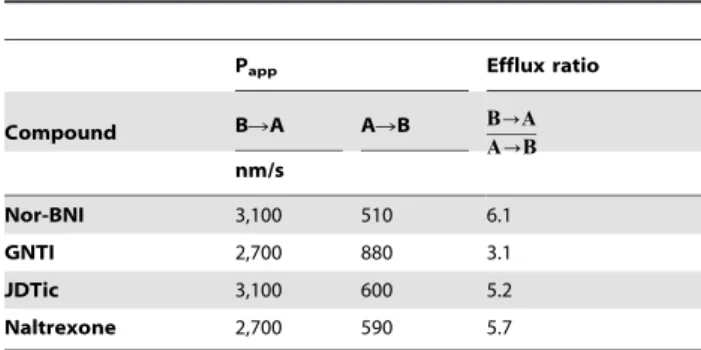
Nor-BNI, GNTI and JDTic undergo active efflux from Caco-2 cells
We next evaluated membrane permeation and active efflux, measuring permeation through Caco-2 cell monolayers by UV spectroscopy. Nor-BNI, GNTI, JDTic and naltrexone all ap-peared to undergo active efflux, as indicated by an efflux ratio greater than 1 (Table 2). Note, however, that compounds with efflux ratios in this moderate range (,18) may be modulators
Figure 2. GNTI enhances maximal Ca2+ mobilization by noradrenaline at a1A-AR without affecting potency (A); maximal PI
hydrolysis is not increased (B).Some intermediate curves have been omitted for clarity. Error bars represent mean6S.E.M. For raw data, see Datasets S1 and S2.
rather than substrates [37]. Contrary to these results, in previous tests using Caco-2 and other cell lines, naltrexone was not found to undergo active efflux [7,38,39]. The permeabilities we observed for all four compounds were also orders of magnitude higher than we previously observed in LLC-PK1 cell layers [7]. We are unaware of the reason(s) for these discrepancies; Caco-2 cell populations exhibit substantial heterogeneity, with differences in the expression of particular transporters and high inter-laboratory variation in permeation rates [40,41]. Nonetheless, the finding that nor-BNI, GNTI and JDTic are subject to active efflux is consistent with the low brain uptake we observed previously [7]. We found there that nor-BNI and GNTI were not substrates of human permeability glycoprotein (P-gp); taken together our results suggest that these antagonists may be substrates of another efflux transporter.
Discussion
Potential consequences ofa1A-AR modulation by GNTI Our results indicate that GNTI is a moderately potent allosteric enhancer of a1A-AR. It is interesting to note that GNTI is
structurally similar to othera1-AR ligands (Figure 5). Aperidine
and analogues act as a1A-AR antagonists, and a guanidine
substituent is required for activity [42]. The peptider-TIA (not shown) is a negative allosteric modulator ofa1-AR, also featuring a
guanidine substituent that is essential for activity [43].
Clonidine is an allosteric modulator ofa1A-AR [44] featuring a
phenylimidazoline moiety similar to the phenylguanidine group of GNTI (Figure 5). Clonidine and many related ligands appear to bind in an allosteric pocket of thea-AR, unlike the orthosteric phenethylamines [45]. The structurally-related sodium channel blocker amiloride and analogues (Figure 5) are negative allosteric
Figure 3. GNTI is a weak antagonist of acetylcholine at M1-R (A); JDTic weakly inhibits the noradrenaline transporter (B).Error bars
represent mean6S.E.M. For raw data, see Datasets S3 and S4. doi:10.1371/journal.pone.0070701.g003
Figure 4. Antagonism of N/OFQ at NOP by JDTic (A) and SB-612,111 (B): inhibition of cAMP production.Error bars represent mean6
S.E.M. For raw data, see Dataset S5. doi:10.1371/journal.pone.0070701.g004
modulators ofa1A-AR [46]. These prior results indicate thata1A
-AR possesses an allosteric site that binds structurally diverse guanidine-substituted ligands and related compounds. Interesting-ly, it has recently been reported that unlike the orthosteric agonist noradrenaline, the imidazolines are functionally selective ata1A
-AR, with a bias towards calcium mobilization [47].
Allosteric enhancement of noradrenaline’s actions ata1A-AR
may plausibly contribute to some of GNTI’s transient effects. For instance, a1agonists have been reported to inhibit feeding [48]
and serotonin-induced itch [49]. The ataxia and death we observed after high-dose GNTI [7] may also be related, since
a1-AR agonists have been found to promote catalepsy [50] and to
raise blood pressure [51]. Furthermore, GNTI’s potency as ana1A
enhancer (41 nM) is comparable to our estimate of the unbound brain concentration after a high dose of GNTI (5 nM after 39 mg/kg) [7]. Thus, it is plausible that synergy between this target andk-OR might contribute to centrally-mediated effects of GNTI such as inhibition of feeding and locomotion. Such an
interaction is less plausible for M1-R, towards which the potency of
GNTI is orders of magnitude lower.
Do M1receptors contribute to GNTI-induced scratching?
Remaining questions
Our finding that GNTI acts as a weak M1 antagonist is
consistent with a previous report of weak binding to that receptor [9]. Nonetheless, it is unclear whether the extremely low potency we observed would be relevantin vivo. In the prior report, an M1
agonist (McN-A-343) inhibited GNTI-induced scratching in mice, providing apparentin vivoconfirmation that GNTI acts upon this receptor [9,25]. An M1antagonist had no effect. However, those
results are difficult to interpret, for several reasons. Firstly, in earlier reports M1agonists induced scratching, while antagonists
inhibited it [52]. Thus, the reported inhibition of GNTI-induced scratching by an M1agonist is paradoxical. Secondly, McN-A-343
was administered intrathecally (i.t.), while GNTI was injected s.c. [9]. Due to GNTI’s low potency and extremely low central uptake [7], this would be unlikely to result in a detectable effect on spinal M1-R. Indeed, GNTI induces scratching after s.c. but not i.t.
administration [9], while M1 agonists show the opposite profile
[53], suggesting that any interaction would be indirect. Finally, McN-A-343 is poorly selective for M1 receptors [54], so the
involvement of other targets cannot be ruled out. Collectively, this evidence is more consistent with an indirect, downstream interaction than a competitive one between GNTI and McN-A-343 at spinal M1receptors. Further exploration of this issue would
benefit from the use of more selective M1ligands, administered by
the same route as GNTI.
Potential roles of peripheral non-opioid targets in the transient effects of nor-BNI and GNTI
It remains plausible that peripheral M1 receptors may be
involved in some transient effects of GNTI. We previously observed peak unbound GNTI concentrations in plasma of 2mM at a dose of 10 mg/kg, and 8mM at 39 mg/kg [7]. These concentrations would be expected to result in some peripheral M1
Table 2.Mean permeation rates and efflux ratios in Caco-2 cell monolayers.
Papp Efflux ratio
Compound BRA ARB B?A
A?B
nm/s
Nor-BNI 3,100 510 6.1
GNTI 2,700 880 3.1
JDTic 3,100 600 5.2
Naltrexone 2,700 590 5.7
Data are the mean of three independent determinations (samples in triplicate) each with SEM,10%. A: apical; B: basolateral.
doi:10.1371/journal.pone.0070701.t002
antagonism, given KB= 3.7mM. At these concentrations,
detect-able receptor occupancy would also be expected at five other peripheral targets, including M2-R (Table 1). Similarly, the peak
unbound concentration of nor-BNI in plasma was 3mM at 10 mg/kg [7], comparable to the affinities determined here for six non-opioid targets. Thus, due to the very low uptake of nor-BNI and GNTI, effective levels in brain require very high plasma concentrations after peripheral administration. These concentra-tions will result in transient occupancy of peripheral targets for which these compounds have low affinity, reducing their effective selectivity. The relevance of thisin vivois unclear. While it seems plausible that peripheral receptors might influence responses such as scratching, this seems less likely for behaviours such as locomotion and feeding. The peak unbound concentration of JDTic in plasma was 100 nM after a 10 mg/kg dose [7]. Based on our results, this concentration would be expected to yield substantial binding to NOP and NET, but little or no functional effect. Moreover, this concentration would not be expected to produce substantial occupancy of any of the other non-opioid targets studied here.
Plasma concentrations of nor-BNI, GNTI and JDTic decline by over 80% within 4 hours, and over 98% within 24 hours [7]. By contrast,kopioid antagonism is maximal at 24 hours in each case [4]. To achieve optimal selectivity, these compounds should therefore be administered at least 4 and preferably 24 hours before testing [4,14,15]. With an adequate pre-administration interval, none of the non-opioid activities we report here are likely to be detectablein vivo.
Is JDTic a negative allosteric modulator of NOP?
Surmountable but noncompetitive antagonism of the kind exhibited by JDTic at NOP suggests allosteric modulation. However, it seems unlikely that JDTic binds to an allosteric site. JDTic protrudes deeply into the orthosteric site of k-OR in the recently reported crystal structure [55]. C-24, a peptide mimetic derived from nociceptin, adopts the same pose in the orthosteric site of NOP, superimposable upon JDTic [56]. The binding pockets of k-OR and NOP are extremely similar: dynA shows nanomolar affinity for NOP, and subnanomolar affinity for point mutants [29]. Therefore, the most plausible binding site for JDTic in NOP is the common orthosteric site exhibited in the crystal structures. This is puzzling given the apparent allosteric modula-tion we observed. Note, however, that allosteric modulamodula-tion can occur between two orthosteric ligands bound to a receptor dimer [57].
Conclusions
Our results confirm that nor-BNI, GNTI and JDTic bind with high selectivity to thek-OR, extending previous results for opioid receptors to a broad panel of 43 non-opioid receptors and transporters. There was no non-opioid target for which all three compounds shared detectable affinity, or for which any two shared sub-micromolar affinity, while affinity for k-OR was low nanomolar. Of the other interactions detected, the only one likely to occur in the CNS at typical concentrations is allosteric enhancement of a1A-AR by GNTI. This may partially account
for that compound’s severe transient effects. However, due to the low brain uptake of these compounds, achievement of effective central concentrations requires high plasma levels, which may briefly influence low-affinity peripheral receptors. For instance, GNTI acted as a weak M1antagonist. Nonetheless, thek opioid
antagonism these compounds induce persists for weeks or months after these transient effects dissipate. With an adequate
pre-administration interval, our results confirm that nor-BNI, GNTI and JDTic are exquisitely selective tools for the study ofk-ORin vivo.
Materials and Methods
Compounds
GNTIN2HClN1.5H2O: Tocris Bioscience, Ellisville MI (batches
4B/91591 and 4B/94133). JDTicN2HClNH2O: F. Ivy Carroll,
Research Triangle Institute, NC.NaltrexoneNHClN2H2O: Tocris
Bioscience (batch 5B/93329).Nor-BNIN2HClNH2O: Tocris
Bio-science (batches 8A/90732 and 9A/93084). Other compounds were purchased from Sigma-Aldrich (Milan, Italy).
Binding and functional assays
Inhibition of the noradrenaline transporter (NET) was determined using fluorescent dye uptake (Neurotransmitter Transporter Uptake Assay Kit R8174, Molecular Devices, Sunnyvale CA) [58]. NOP binding assays were performed against [3H]N/OFQ in membranes prepared from HEK293T cells transiently transfected with human NOP as described previously [56]. Cyclic AMP inhibition by N/OFQ was determined in the same cells using a GloSensorTMassay (Promega Corp., Madison WI) as described elsewhere [59]. Briefly, cells were preincubated with antagonist for 15 min, then agonist for 15 min, before addition of luciferin and isoproterenol. Luminescence was measured after a further 20 minutes. Other functional and radioligand displacement assays were performed using standard PDSP protocols as described previously [60]. For all binding and functional assays, a minimum of three experiments were conducted in triplicate. For details of specific binding assays, see Table S1. Results were analyzed using nonlinear regression with Graphpad Prism 6.
Caco-2 cell monolayer permeation
Caco-2 cells were grown in Dulbecco’s Modified Eagle Medium (DMEM) with 10% heat-inactivated fetal calf serum, 100 U/mL penicillin, 100mg/mL streptomycin, and 2 mM L-glutamine. The cells were trypsinized twice a week with trypsin/ethylenediamine-tetraacetic acid (EDTA) (0.02% each) and the medium was changed twice a week. Cells were harvested with trypsin-EDTA and seeded onto a MultiScreen Caco-2 assay system (Millipore, Billerica, MA) at a density of 10,000 cells per well. The culture medium was replaced every 48 h for the first 6 days and every 24 h thereafter, and after 21 days in culture, the Caco-2 monolayer was utilized for the permeability experiments. Trans-epithelial electrical resistance (TEER) of the monolayers was measured daily before and after the experiment using an epithelial volt-ohm meter (Millicell-ERS; Millipore, Billerica, MA). TEER values were greater than 1800Vfor 21-day cultures.
Apical to basolateral (Papp, ARB) and basolateral to apical
(Papp, BRA) permeability of compounds were measured at
120 min and at various compound concentrations (1–100mM). Compounds were dissolved in Hanks’ balanced salt solution (HBSS, pH 7.4) and sterile filtered. After 21 days of cell growth, the medium was removed from filter wells and from the receiver plate. The filter wells were filled with 75mL of fresh HBSS buffer and the receiver plate with 250mL per well of the same buffer. This procedure was repeated twice, and the plates were incubated at 37uC for 30 min. After incubation time, the HBSS buffer was removed and compound solutions added to the filter well (75mL). HBSS without the compound was added to the receiver plate (250mL). The plates were incubated at 37uC for 120 min. After incubation time, samples were removed from the apical (filter well)
and basolateral (receiver plate) side of the monolayer and then were stored in a freezer (220uC) pending analysis. Concentrations were calculated from UV absorbance at the following wavelengths (nm): 278 (nor-BNI); 285 (GNTI); 276 (JDTic); 228 (naltrexone). The apparent permeability (Papp), in nm sec
21
, was calculated using the following equation:
Papp~
VA Area|time
| ½drugacceptor
drug ½ initial
where VAis the volume (in mL) in the acceptor well; Area is the
surface area of the membrane (0.11 cm2of the well); time is the total transport time in seconds (7200 s); [compound]acceptoris the
concentration of the compound measured by UV spectroscopy; [compound]initial is the initial compound concentration in the
apical or basolateral wells.
Supporting Information
Dataset S1 Raw data for Figure 2A.
(XML)
Dataset S2 Raw data for Figure 2B.
(XML)
Dataset S3 Raw data for Figure 3A.
(XML)
Dataset S4 Raw data for Figure 3B.
(XML)
Dataset S5 Raw data for Figure 4.
(XML)
File S1 Radioligand displacement curves.
(PDF)
Table S1 Binding affinities with standard error, radio-ligand, membrane type, and species.
(XLS)
Author Contributions
Conceived and designed the experiments: CB FIC WAC BMC NAC XPH CI MGP BLR AVV. Performed the experiments: XPH CI MGP NAC. Analyzed the data: XPH CI MGP NAC BLR. Contributed reagents/ materials/analysis tools: FIC. Wrote the paper: TAM.
References
1. Knoll AT, Carlezon WA Jr (2010) Dynorphin, stress, and depression. Brain Res 1314:56–73. doi:10.1016/j.brainres.2009.09.074
2. Carlezon WA Jr, Beguin C, Knoll AT, Cohen BM (2009) Kappa-opioid ligands in the study and treatment of mood disorders. Pharmacol Ther 123:334–343. doi:10.1016/j.pharmthera.2009.05.008
3. Be´guin C, Cohen BM (2009) Medicinal Chemistry of Kappa Opioid Receptor Antagonists. In: Dean RL, Bilsky EJ, Negus SS, editors. Opiate Receptors and Antagonists: from Bench to Clinic. New York: Humana Press. pp. 99–118. doi:10.1007/978-1-59745-197-0_6
4. Metcalf M, Coop A (2005) Kappa opioid antagonists: Past successes and future prospects. AAPS J 7:E704–E722. doi:10.1208/aapsj070371
5. Bruchas MR, Yang T, Schreiber S, DeFino M, Kwan SC, et al. (2007) Long-Acting k Opioid Antagonists Disrupt Receptor Signaling And Produce Noncompetitive Effects By Activating c-Jun N-Terminal Kinase. J Biol Chem 282:29803–29811. doi:10.1074/jbc.M705540200
6. Melief EJ, Miyatake M, Carroll FI, Beguin C, Carlezon WA, et al. (2011) Duration of Action of a Broad Range of Selective Kappa Opioid Receptor Antagonists is Positively Correlated with c-Jun N-Terminal Kinase-1 Activation. Mol Pharmacol 80:920–929. doi:10.1124/mol.111.074195
7. Munro TA, Berry LM, Van’t Veer A, Be´guin C, Carroll FI, et al. (2012) Long-actingkopioid antagonists nor-BNI, GNTI and JDTic: pharmacokinetics in mice and lipophilicity. BMC Pharmacol 12:5. doi:10.1186/1471-2210-12-5 8. Kamei J, Nagase H (2001) Norbinaltorphimine, a selective kappa-opioid
receptor antagonist, induces an itch-associated response in mice. Eur J Pharmacol 418:141–145. doi:10.1016/S0014-2999(01)00941-4
9. Inan S (2010) Pharmacological and neuroanatomical analysis of GNTI-induced repetitive behavior in mice [Ph.D. thesis Thesis]. Philadelphia, PA: Temple University. Available: http://digital.library.temple.edu/cdm/ref/collection/ p245801coll10/id/75332 archived at: http://www.webcitation.org/ 66yCyVaZH. Accessed 2013 July 2.
10. Schank JR, Goldstein AL, Rowe KE, King CE, Marusich JA, et al. (2012) The kappa opioid receptor antagonist JDTic attenuates alcohol seeking and withdrawal anxiety. Addict Biol 17:634–647. doi:10.1111/j.1369-1600.2012.00455.x 11. Potter DN, Damez-Werno D, Carlezon WA Jr, Cohen BM, Chartoff EH (2011)
Repeated Exposure to thek-Opioid Receptor Agonist Salvinorin A Modulates Extracellular Signal-Regulated Kinase and Reward Sensitivity. Biol Psychiatry 70:744–753. doi:10.1016/j.biopsych.2011.05.021
12. Qi CT, Zou H, Zhang CH, Xie QL, Jin ML, et al. (2006) Effect of GNTI, a kappa opioid receptor antagonist, on MK-801-induced hyperlocomotion and stereotypy in mice. Acta Pharmacol Sin 27:1401–1408. doi:10.1111/j.1745-7254.2006.00448.x
13. Leventhal L, Cole JL, Bodnar RJ (1996) Reductions in locomotor activity following central opioid receptor subtype antagonists in rats. Physiol Behav 60:833–836. doi:10.1016/0031-9384(96)00103-5
14. Horan P, Taylor J, Yamamura HI, Porreca F (1992) Extremely long-lasting antagonistic actions of nor-binaltorphimine (nor-BNI) in the mouse tail-flick test. J Pharmacol Exp Ther 260:1237–1243.
15. Endoh T, Matsuura H, Tanaka C, Nagase H (1992) Nor-binaltorphimine: a potent and selectivek-opioid receptor antagonist with long-lasting activity in vivo. Arch Int Pharmacodyn Ther 316:30–42.
16. Negus S, Mello N, Linsenmayer D, Jones RM, Portoghese P (2002) Kappa opioid antagonist effects of the novel kappa antagonist 59-guanidinonaltrindole (GNTI) in an assay of schedule-controlled behavior in rhesus monkeys. Psychopharmacology 163:412–419. doi:10.1007/s00213-002-1038-x 17. Braude MC, Morrison JM (1976) Preclinical toxicity studies of naltrexone.
NIDA Res Monogr 9:16–26. Available: http://archives.drugabuse.gov/pdf/ monographs/09.pdf#page = 27. Accessed 2013 July 2.
18. Casal-Dominguez JJ, Clark M, Traynor JR, Husbands SM, Bailey SJ (2013) In vivo and in vitro characterization of naltrindole-derived ligands at the kappa-opioid receptor. J Psychopharmacol 27:192–202 doi:10.1177/0269881112464828 19. Levine AS, Grace M, Billington CJ, Portoghese PS (1990) Nor-binaltorphimine
decreases deprivation and opioid-induced feeding. Brain Res 534:60–64. doi:10.1016/0006-8993(90)90112-O
20. Jewett DC, Grace MK, Jones RM, Billington CJ, Portoghese PS, et al. (2001) The kappa-opioid antagonist GNTI reduces U50,488-, DAMGO-, and deprivation-induced feeding, but not butorphanol- and neuropeptide Y-induced feeding in rats. Brain Res 909:75–80. doi:10.1016/S0006-8993(01)02624-5 21. Need A (2008) Development and characterization of a methodology for the
simultaneous and individual determination of in vivo receptor occupancy at mu, delta, and kappa opioid receptors, and examination of the effects of opioid antagonist occupancy on feeding behavior in the rat [Ph.D. Thesis]. Indianapolis, IN: Indiana University. Available: http://gradworks.umi.com/ 33/04/3304655.html. Accessed 2013 July 2.
22. Cowan A, Inan S (2009) Kappa-Opioid Antagonists as Pruritogenic Agents. In: Dean RL, Bilsky EJ, Negus SS, editors. Opiate Receptors and Antagonists: from Bench to Clinic. New York: Humana Press. pp. 541–549. doi:10.1007/978-1-59745-197-0_28
23. Inan S, Dun NJ, Cowan A (2009) Inhibitory effect of lidocaine on pain and itch using formalin-induced nociception and 59-guanidinonaltrindole-induced scratching models in mice: behavioral and neuroanatomical evidence. Eur J Pharmacol 616:141–146. doi:10.1016/j.ejphar.2009.06.026
24. Inan S, Dun NJ, Cowan A (2009) Nalfurafine prevents 59 -guanidinonaltrindole-and compound 48/80-induced spinal c-fos expression -guanidinonaltrindole-and attenuates 59 -guanidinonaltrindole-elicited scratching behavior in mice. Neuroscience 163:23– 33. doi:10.1016/j.neuroscience.2009.06.016
25. Inan S, Dun NJ, Cowan A (2011) Investigation of gastrin-releasing peptide as a mediator for 59-guanidinonaltrindole-induced compulsive scratching in mice. Peptides 32:286–292. doi:10.1016/j.peptides.2010.11.022
26. Shukla VK, Lemaire S (1993) Norbinaltorphimine protection against
N-methyl-D-aspartic acid-induced convulsions and mortality. Eur J Pharmacol 231:293– 296. doi:10.1016/0014-2999(93)90463-R
27. Voorn P, van de Witte SV, Li KW, Jonker AJ (2007) Dynorphin displaces binding at the glycine site of the NMDA receptor in the rat striatum. Neurosci Lett 415:55–58. doi:10.1016/j.neulet.2006.12.041
28. Evans SJ, Searcy BT, Moore FL (2000) A subset of kappa opioid ligands bind to the membrane glucocorticoid receptor in an amphibian brain. Endocrinology 141:2294–2300. doi:10.1210/en.141.7.2294
30. Kusaka T, Yamada S, Kimura R (2001) Characterization of Specific [3
H]Nociceptin Binding in Rat Brain and Spinal Cord. Biol Pharm Bull 24:902–905. doi:10.1248/bpb.24.902
31. Besnard J, Ruda GF, Setola V, Abecassis K, Rodriguiz RM, et al. (2012) Automated design of ligands to polypharmacological profiles. Nature 492:215– 220. doi:10.1038/nature11691
32. Copik AJ, Ma C, Kosaka A, Sahdeo S, Trane A, et al. (2009) Facilitatory Interplay ina1Aandb2Adrenoceptor Function Reveals a Non-GqSignaling Mode: Implications for Diversification of Intracellular Signal Transduction Mol Pharmacol 75:713–728. doi:10.1124/mol.108.050765
33. Heusinkveld HJ, Westerink RHS (2011) Caveats and limitations of plate reader-based high-throughput kinetic measurements of intracellular calcium levels. Toxicol Appl Pharmacol 255:1–8. doi:10.1016/j.taap.2011.05.020
34. May LT, Leach K, Sexton PM, Christopoulos A (2007) Allosteric Modulation of G Protein–Coupled Receptors. Annu Rev Pharmacol Toxicol 47:1–51. doi:10.1146/annurev.pharmtox.47.120505.105159
35. Plenge P, Mellerup ET (1997) An affinity-modulating site on neuronal monoamine transport proteins. Pharmacol Toxicol 80:197–201. doi:10.1111/ j.1600-0773.1997.tb00396.x
36. Spagnolo B, Carra G, Fantin M, Fischetti C, Hebbes C, et al. (2007) Pharmacological characterization of the nociceptin/orphanin FQ receptor antagonist SB-612111 [(-)-cis-1-methyl-7-[[4-(2,6-dichlorophenyl)piperidin-1-yl]-methyl]-6,7,8,9-tetrah ydro-5H-benzocyclohepten-5-ol]: in vitro studies. J Pharmacol Exp Ther 321:961–967. doi:10.1124/jpet.106.116764
37. Colabufo NA, Berardi F, Cantore M, Contino M, Inglese C, et al. (2010) Perspectives of p-glycoprotein modulating agents in oncology and neurodegen-erative diseases: pharmaceutical, biological, and diagnostic potentials. J Med Chem 53:1883–1897. doi:10.1021/jm900743c
38. Kanaan M, Daali Y, Dayer P, Desmeules J (2009) P-glycoprotein is not involved in the differential oral potency of naloxone and naltrexone. Fundam Clin Pharmacol 23:543–548. doi:10.1111/j.1472-8206.2009.00724.x
39. Mahar Doan KM, Humphreys JE, Webster LO, Wring SA, Shampine LJ, et al. (2002) Passive permeability and P-glycoprotein-mediated efflux differentiate central nervous system (CNS) and non-CNS marketed drugs. J Pharmacol Exp Ther 303:1029–1037. doi:10.1124/jpet.102.039255
40. Artursson P, Palm K, Luthman K (2001) Caco-2 monolayers in experimental and theoretical predictions of drug transport. Adv Drug Deliv Rev 46:27–43. doi:10.1016/S0169-409X(00)00128-9
41. Hidalgo IJ (2001) Assessing the absorption of new pharmaceuticals. Curr Top Med Chem 1:385–401. doi:10.2174/1568026013395010
42. Wakimoto T, Nitta M, Kasahara K, Chiba T, Ye Y, et al. (2009) Structure-activity relationship study ona1 adrenergic receptor antagonists from beer. Bioorg Med Chem Lett 19:5905–5908. doi:10.1016/j.bmcl.2009.08.068 43. Ragnarsson L, Wang CIA, Andersson A, Fajarningsih D, Monks T, et al. (2013)
Conopeptider-TIA defines a new allosteric site on the extracellular surface of the a1B-adrenoceptor. J Biol Chem 288:1814–1827. doi:10.1074/ jbc.M112.430785
44. Waugh DJ, Gaivin RJ, Damron DS, Murray PA, Perez DM (1999) Binding, partial agonism, and potentiation of a1-adrenergic receptor function by benzodiazepines: a potential site of allosteric modulation. J Pharmacol Exp Ther 291:1164–1171.
45. Perez DM (2007) Structure-function of a1-adrenergic receptors. Biochem Pharmacol 73:1051–1062. doi:10.1016/j.bcp.2006.09.010
46. Leppik RA, Mynett A, Lazareno S, Birdsall NJ (2000) Allosteric interactions between the antagonist prazosin and amiloride analogs at the human a1A -adrenergic receptor. Mol Pharmacol 57:436–445.
47. Evans BA, Broxton N, Merlin J, Sato M, Hutchinson DS, et al. (2011) Quantification of functional selectivity at the humana1A-adrenoceptor. Mol Pharmacol 79:298–307. doi:10.1124/mol.110.067454
48. Wellman PJ (2000) Norepinephrine and the control of food intake. Nutrition 16:837–842. doi:10.1016/S0899-9007(00)00415-9
49. Gotoh Y, Andoh T, Kuraishi Y (2011) Noradrenergic regulation of itch transmission in the spinal cord mediated bya-adrenoceptors. Neuropharma-cology 61:825–831. doi:10.1016/j.neuropharm.2011.05.030
50. Sukul NC, Cherian L, Klemm WR (1988) Alpha noradrenergic agonists promote catalepsy in the mouse. Pharmacol Biochem Behav 31:87–91. doi:10.1016/0091-3057(88)90316-4
51. Docherty JR (2010) Subtypes of functionala1-adrenoceptor. Cell Mol Life Sci 67:405–417. doi:10.1007/s00018-009-0174-4
52. Raffa RB, Mathiasen JR, Goode TL, Vaught JL (1987) Evidence that reciprocal hindlimb scratching elicited in mice by intrathecal administration of muscarinic agonists is mediated through M1 type receptors. Life Sci 41:1831–1836. doi:10.1016/0024-3205(87)90702-8
53. Scott RW, Goode TL, Raffa RB (1987) Pilocarpine-induced reciprocal hindlimb scratching in mice. Pharmacol, Biochem Behav 26:327–331. doi:10.1016/0091-3057(87)90126-2
54. Figueroa KW, Griffin MT, Ehlert FJ (2009) Selectivity of agonists for the active state of M1 to M4 muscarinic receptor subtypes. J Pharmacol Exp Ther 328:331–342. doi:10.1124/jpet.108.145219
55. Wu H, Wacker D, Mileni M, Katritch V, Han GW, et al. (2012) Structure of the human k-opioid receptor in complex with JDTic. Nature 485:327–332. doi:10.1038/nature10939
56. Thompson AA, Liu W, Chun E, Katritch V, Wu H, et al. (2012) Structure of the nociceptin/orphanin FQ receptor in complex with a peptide mimetic. Nature 485:395–399. doi:10.1038/nature11085
57. Smith NJ, Milligan G (2010) Allostery at G protein-coupled receptor homo- and heteromers: uncharted pharmacological landscapes. Pharmacol Rev 62:701– 725. doi:10.1124/pr.110.002667
58. Jorgensen S, Nielsen EO, Peters D, Dyhring T (2008) Validation of a fluorescence-based high-throughput assay for the measurement of neurotrans-mitter transporter uptake activity. J Neurosci Methods 169:168–176. doi:10.1016/j.jneumeth.2007.12.004
59. Kimple AJ, Soundararajan M, Hutsell SQ, Roos AK, Urban DJ, et al. (2009) Structural determinants of G-proteinasubunit selectivity by regulator of G-protein signaling 2 (RGS2). J Biol Chem 284:19402–19411. doi:10.1074/ jbc.M109.024711
60. National Institute of Mental Health (2008) NIMH Psychoactive Drug Screening Program Assay Protocol Book. Available: http://pdsp.med.unc.edu/UNC-CH%20Protocol%20Book.pdf. Archived at http://www.webcitation.org/ 6AfPc6HyI. Accessed 2013 July 2.


![11 (4 Chlorophenyl) 10 methyl 8 phenyl 6,8 dihydro 5H benzo[f]pyrazolo[3,4 b]quinoline](data:image/gif;base64,R0lGODlhAQABAIAAAP///wAAACH5BAEAAAAALAAAAAABAAEAAAICRAEAOw==)