Copyright © 2015 Vilnius Gediminas Technical University (VGTU) Press Technika http://www.bjrbe.vgtu.lt
doi:10.3846/bjrbe.2015.11 OF ROAD AND BRIDGE ENGINEERING ISSN 1822-427X / eISSN 1822-4288
2015 Volume 10(1): 89–96
1. Introduction
Bridges play an important role in transportation. Eve-ry year many bridges fail, not for structural reasons, but due to the scouring of bed materials around their piers and abutments (Akib et al. 2011; Zarrati et al. 2006). This happens particularly during floods. Bridge failure during flood leads to disruption in transportation systems and cause loss of life and damage to property. More than 1000 bridges have collapsed over the past 30 years in the United States of America with 60% of those failures due to scour (Shirole, Holt 1991). Scouring is an important factor that must be considered in bridge design.
As a result of scour, holes appear around the piers of a bridge and undermine its stability. These bridges then are easily destroyed in a flood. The impact of the water flow on bridge piers and their subsequent decomposition are the cause of local scour around bridge piers. Down-flows are produced when water flows around the piers of a bridge, the pressure from free surface flows towards the stream-bed are reduced. After striking the streamstream-bed, these down-flows bump against the main stream of the water flow and eventually cause a horseshoe vortex. Horseshoe vortexes are mostly found at the front of a pier. The flow of the water leaving creates a vortex directly behind the pier. These wa-kes cause sheer stress behind the piers. Surveys reveal that horseshoe, as well as wake vortexes, play a role in the gene-ration of scour holes around bridge piers (Link et al. 2008).
Chiew and Melville (1987) investigated local scours around cylindrical bridge piers in uniform, cohesion-less sediment. Three empirical functions, related to equili-brium scour depth with approach velocities, sediment size and depth were obtained. The variations of equilibrium scour depth with approach velocity show that the depth of scour decreased at velocities just above the threshold until it reached a min of twice the threshold velocity. The-reafter, it increased until a max was reached at the transi-tion flatbed conditransi-tion. At still higher velocities, the equi-librium scour depth decreased owing to the formation of anti-dunes. Both effects of sediment size and flow depth were found to be independent of the stage of bed particle motion and the 47 approach velocity.
Adjustment factors for the effects of sediment size and flow depth have been defined and evaluated. Ba-ker (1980) proposed a formula relating the equilibrium scour depth upstream of cylindrical bridge piers caused by horseshoe vortex systems to various flow parameters. Assumptions were made concerning the vortex size and shape during the scouring process. Although there have been extensive studies on bridge pier scours, no single so-lution for the precise calculation of the depth of the holes or a method to reduce them, has been discovered.
Failures due to scouring have been studied by several researchers who have proposed several methods to minimi-ze bridge pier scour. Out of all the methods suggested, some
EXPERIMENTAL STUDY FOR DETERMINATION OF COLLAR DIMENSIONS
AROUND BRIDGE PIER
Afshin Jahangirzadeh1, Shatirah Akib2
Dept of Civil Engineering, University of Malaya, Jalan Universiti str., 50603 Kuala Lumpur, Federal Territory of Kuala Lumpur, Malaysia
E-mails: 1[email protected]; 2[email protected]
Abstract. The shape and size of a collar is important to maximize its effect as a scour countermeasure. Current re-search shows that the depth of the scour hole is decreased by using rectangular collars around circular piers. This study determined the approximate optimum dimensions for rectangular collars to minimize the temporal trend of scour-ing around a pier model. Effects of different sizes of rectangular collars on a model pier were investigated both at the upstream and downstream of the flume. It was observed that irrespective of the rectangular collar dimensions the up-stream and the downup-stream were estimated to be 0.86 and 1.42, respectively. The optimum collar width was estimated to be 2.8 times the diameter of the pier. By using this optimized collar dimension, the non-dimensional depth of scour reached a min value of 0.034 at 72 h. The reduction percentage of the scour depth reached 98% at 72 h.
of the most influential are as follows: riprap, sacrificial piles, slots, and collars (Akib et al. 2014; Deng, Cai 2010; Chiew 1992; Khosronejad et al. 2012; Tafarojnoruz et al. 2010).
Installing collars around piers prevents the down-flo-ws as well as weakening of the horseshoe vortex. Scour ve-locity is also reduced in piers fitted with collars. The scour starts on the side of the bridge pier. For piers fitted with a collar, the wake vortices appear first and then the hor-seshoe vortices follow. The scour starts from the collar bor-der and spreads to the bridge pier.
Many researchers have examined the effects of collars on reducing scour depth (Jahangirzadeh et al. 2014; Neill 1973; Thomas 1967; Zarrati et al. 2004, 2006). Laursen and Toch (1956) are considered pioneers in the field. They em-ployed a collar-like instrument in order to prevent bridge pier scour and eventually they concluded that this technique weakened the scour around the piers. Thomas (1967) also studied on the methods for reducing scour. Thomas (1967) observed that the depth and volume of the scour hole were reduced using collars. His experiments were done on cy-lindrical pier protected by collars with 50 mm diameter, 100 mm and 150 mm width. His results showed that using a collar with 50 mm diameter results in reduction in the vi-cinity of the streambed. Thomas (1967) pointed out the im-portance of collar diameter as well as its position.
Ettema (1980) conducted experiments in a 46 cm – employing cylindrical piers 45 mm – wide and under clear water conditions where = 0.9. Ettema (1980) used a collar twice as wide as the pier diameter and with a thick-ness of 0.4 mm. The collars where positioned in relation to the riverbed using the following Eq (1):
, (1)
where yc– the collar distance from the bed (the nega-tive sign indicates the installation of the collar under the streambed). In the case of , Ettema (1980) did not observe any reduction in the depth of the hole and duly re-futed the functionality of the collars placed above the stre-ambed. Ettema (1980) used the collars near the riverbed as the piers fitted with collars placed in this location showed a reduction in scour velocity. Dargahi (1990) studied the scour mechanism around bridge piers and the effects of using collars on down-flows. Dargahi (1990) observed that the reduction of scour velocity in case of piers fitted with
collars and reported that neither the collar shape nor its position altered the scour mechanism.
Still other researchers have concluded that out of all different collar shapes examined the optimal shapes were rectangular and circular (Zarrati et al. 2006). Zarrati et al. (2004) tested the effectiveness of collars on rectangular piers. Experiments were carried out on the threshold of se-diment motion with piers aligned with and skewed by 5° and 10° to the flow of the water, and with collars of different widths and at various elevations. They found that wider col-lars at lower levels were more effective and that the effecti-veness of collars was reduced by increasing the skewedness of the pier. The max reduction of scouring was 74%, 56%, and 35% for a collar with a width equal to the pier width at streambed elevation when the pier was aligned, skewed by 5° and skewed by 10° to the flow, respectively.
Collars have also been employed in combination with other methods (Gaudio et al. 2012; Kumar et al. 1999; Mashahir et al. 2010; Tafarojnoruz et al. 2012; Zarrati et al. 2006). Moncada-M et al. (2009) demonstrated the effects produced by a collar with a rectangular slot around a cir-cular pier controlled the scour depth. Uniform sand and a circular pier with a diameter of 7.3 cm were used. When the collar was placed at the same level as the streambed, the min depth of scour was reached. The scour depth was reduced when the collar diameter was increased. To decre-ase local scour, the most effective slot placement location was the location where the slot was near the streambed.
Zarrati et al. (2010) employed a combination of ri-prap and collars in order to reduce scour. They conducted experiments using collars with diameters two or three ti-mes larger than the model pier and eight different sizes of pebbles. Their results showed that scour was minimized using collars and riprap simultaneously. The effects of a larger collar were described positively.
Despite the efforts of previous researchers, the opti-mum size of a collar has not been determined. The objecti-ve of the current study is to determine the optimum size and orientation of a collar.
2. Materials and techniques
The experiments used in this study were conducted in the hydraulic laboratory of the hydraulic engineering division at the University of Malaya. The experimental canal within this laboratory was 12 m long, 30 cm wide, 45 cm high and had a slope of 0.002. At the end of the canal there was a ba-sin in which a triangular weir was placed in order to meas-ure the flow discharge with an accuracy of 0.1 lit/s (Fig. 1). Two pumps were used to circulate the water. An adjustable tail gate was arranged downstream to measure the water depth. The flow velocity and depth of scouring was measured and recorded using a 3 Axis Electronic Cur-rent Velocity Meter and Sand Surface Meter.
the experiment, the bridge pier model was set up in the middle of the 2 m area (the movable bed). The rectangu-lar colrectangu-lars were constructed from rigid plastic with the thickness of 0.8 mm. The rectangular collars were located on the bed with two sides parallel to the walls of the flume.
The experimental design considered the following points:
a) the effect of flume width (W) was considered when choosing the diameter or width of the bridge pier model. Previous studies showed that if then the scour depth, which was measured using a scour sensor, was not affected by the width of the flume (Raudkivi, Ettema 1983) and a max scour depth would be the result. According-ly, a bridge pier model with a diameter of 14 mm was used;
b) the average diameter of the sediment grains were chosen in a way that the min scour depth was achie-ved. In this study, this factor was accounted for using the formula (Melville 1997), where d50 equaled 0.34 mm (Fig. 2) and the bridge pier diameter of 14 mm for the model, D = 14 mm, d50 = 0.34 mm → .
c) the standard deviation of grain sizes was σg= 1.37 < 1.3–1.4, to eliminate the effect of non-unifor-mity of the bed material on scour depth (Raudkivi 1998);
d) the water flow depth in the flume had to ensure that the depth of the scour hole would not be affected by the flow depth (Chiew, Melville 1987);
e) the model was designed for clear water scour. The max scour depth in this case was achieved when .
Critical velocity of the flow was calculated for several levels by establishing constant discharge and gradually redu-cing the flow depth. The results were compared with the em-pirical Eq (2) suggested by Neill (1973):
, (2)
where vc – the critical velocity, m/s; y – the water depth, m; d50 – the average size of the sediment grains; ku – a constant coefficient that is equal to 1.81; θc – the critical Shields parameter. The following equation was developed to calculate the critical Shields parameter (Meyer-Peter, Muller 1948) (Eq (3)).
. (3)
The Shields stress parameter is estimated from sedi-ment entrainsedi-ment and critical shear stress studies in gra-vel river beds (Motamedi et al. 2010).
The conditions of and and
were used for all experiments.
The experiments were first conducted without col-lars. Then the experiments were repeated using various widths, upstream and downstream collar lengths to deter-mine the optimum dimensions.
3. Results and discussion
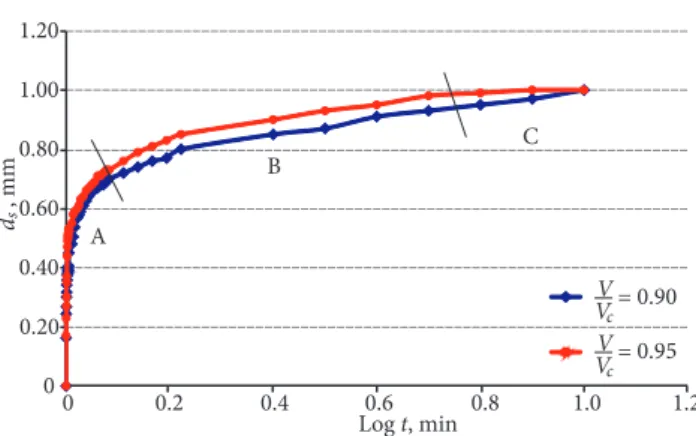
3.1. Bridge piers scour in the unprotected condition In this study, the experiments were initially done without collars. In these tests, the scour started from the front of the pier and then it was dragged all the way to the sides of the pier. After a while, it reached downstream. The scouring rate in the unprotected experiments was initially considerable, but it gradually decreased. Scour depth was measured in upstream at specific times, 2 mm from the pier. The time development of the scour depth formed on the front of the pier is demonstrated in Fig. 3.
In the first two hours, the scouring rate was high eno-ugh that 80% of the scour depth developed at this time (part A of the distributions). In part B of the distributions, the increase of scour depth was relatively small. In part C, scour was negligible. Scour depth equilibrium time was calculated based on part C. The results are shown in Ta-ble 1 where te represents scour depth equilibrium time and dse represents the equilibrium depth of scour.
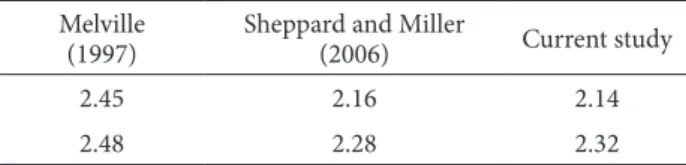
The non-dimensional depth of scour was compared with the equations proposed by Melville (1997) and Sheppard and Miller (2006). As shown in Table 1 the results from our experiments were in agreement.
3.2. Bridge pier model scour in one-sided collar condition
In this part of the experiment, one-sided collars were em-ployed in order to estimate the most effective upstream collar length Luc (Fig. 4). The decision to use one-sided
Fig. 2. Grain size distribution in the experiments
collars was made because it allowed for the unhampered downstream activity of the wake vortexes while weaken-ing horseshoe vortexes and decreasweaken-ing the energy of the down-flows at the front of the pier. In these experiments, downstream collar length Ldc was small and it gradually increased in the upstream. The scour depth was measured in the front of the pier and the reduction percentage of the scour depth was calculated by comparing it with the results of the experiments conducted using unprotected piers. Increasing the collar length in the upstream section of the canal was continued until there were no further changes in the scour depth. In these experiments the col-lar and flow characteristics were as follows: Ldc = 2 mm, Luc = 2, 4, 6, 8, 10, 12, 14, 16, 18, 20 mm, Lwc = 30 mm, ec = 0.8 mm, = 0.9, 0.95. Lwc represents the collar width, and ec stands for its thickness.
The scour mechanism in the case of one-sided collars was not the same as the scour mechanism when no collar was used. One-sided collar as presented in Fig. 4 protec-ted only the pier front. Scour starprotec-ted from the pier rear, owing to the action of wake vortices. It is different from the unprotected pier scour, in which the scour initiated from the pier front. During this set of experiments, it took 35 min for the collar to get rid of the sediments. Following the removal of sediments, the experiment lasted for the Table 1. Time and depth of equilibrium scour
dse,
mm the,
0.90 30.04 2.14 17.2
0.95 32.48 2.32 17.9
Table 2. Comparison of non-dimensional depth of scour between researchers
Melville
(1997) Sheppard and Miller (2006) Current study
2.45 2.16 2.14
2.48 2.28 2.32
Fig. 4. One-sided collar
Table 3. Characteristics of experiments regarding bridge pier model scour in one-sided collar
Q,
lits-1 cmY, msV, -1 msVc-1, mmec, mmLwc, mmLdc, mmLuc, mm, r%e,
7.68 13.41 0.191 0.21 0.91 0.8 30 2 2 0.14 29.69 2.11 1.16
7.74 13.66 0.189 0.21 0.90 0.8 30 2 4 0.28 29.52 2.10 1.73
7.80 13.91 0.187 0.21 0.89 0.8 30 2 6 0.42 29.46 2.10 1.93
7.84 13.54 0.193 0.21 0.92 0.8 30 2 8 0.57 29.05 2.07 3.29
7.75 13.82 0.187 0.21 0.89 0.8 30 2 10 0.71 28.00 2.00 6.79
7.90 13.94 0.189 0.21 0.90 0.8 30 2 12 0.86 26.35 1.88 12.28
7.81 14.08 0.185 0.21 0.88 0.8 30 2 14 1.00 26.35 1.88 12.28
7.70 13.45 0.191 0.21 0.91 0.8 30 2 16 1.14 26.30 1.87 12.45
7.85 13.92 0.189 0.21 0.90 0.8 30 2 18 1.28 26.30 1.87 12.45
7.75 13.83 0.186 0.21 0.86 0.8 30 2 20 1.42 26.25 1.87 12.61
7.67 12.66 0.202 0.21 0.96 0.8 30 2 2 0.14 32.35 2.31 0.40
7.68 12.87 0.199 0.21 0.95 0.8 30 2 4 0.28 32.13 2.29 1.07
7.80 13.07 0.199 0.21 0.95 0.8 30 2 6 0.42 31.91 2.27 1.75
7.82 13.24 0.197 0.21 0.94 0.8 30 2 8 0.57 31.50 2.25 3.01
7.73 13.23 0.195 0.21 0.93 0.8 30 2 10 0.71 30.40 2.17 6.40
7.80 13.20 0.197 0.21 0.94 0.8 30 2 12 0.86 28.95 2.06 10.86
7.77 13.02 0.199 0.21 0.95 0.8 30 2 14 1.00 28.90 2.06 11.02
7.69 12.89 0.199 0.21 0.95 0.8 30 2 16 1.14 28.85 2.06 11.17
7.75 13.81 0.187 0.21 0.89 0.8 30 2 18 1.28 28.75 2.05 11.48
duration of the scour depth equilibrium time. The experi-ments are discussed in Table 3.
In Eq (3) below, restands for the reduction percentage of the scour depth and shows the scour depth in the piers fitted with collar condition: it is calculated using Eq (4):
. (4)
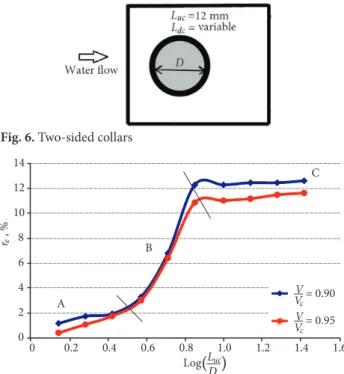
Fig. 5 demonstrates the changes in reduction percen-tage of scour depth with non-dimensional length in the pier upstream .
The distributions in Fig. 5 were divided into three parts. In part A, the collar length did not properly reduce the scour depth. In part B, the length of the collar was able to reduce scour depth and the reduction was seen as an in-creasing trend. In part C, collar length decreased the scour depth but the increase in did not bring about any considerable changes to scour depth reduction because of its horizontal distributions. When the information in Table 3 and part C were considered, the most effective length for collar on an upstream pier was determined to be 12 mm. The proper collar length for an upstream pier and its non-dimensional value are calculated as follows: Luc = 12 mm, = 0.86.
3.3. Bridge pier model scour in two-sided collar condition
In all the experiments, the collar length for upstream piers was considered equal to the optimum value (Luc = 12 mm) (Fig. 6). In order to estimate the proper collar length for downstream of the pier (Ldc), this process was continued as long as the increase of the collar length did not signifi-cantly affect the reduction of scour depth. All experiments were conducted under clear water conditions with two values of . The experiments lasted until the scour depth equilibrium time was reached. Collar and flow charac-teristics were calculated as follows: Lu c= 12 mm, Ldc = 4, 6, 8, 10, 12, 14, 16, 18, 20, 22, 24 mm, Lwc = 30 mm, ec = 0.8 mm, = 0.9, 0.9.5.
The scour mechanisms for two-sided collars were diffe-rent from those of one-sided collars or unprotected piers. In case of two-sided collars, the scour began behind the pier and around the collar borders. The scour slowly moved to-wards the front of the pier after passing beneath the collar. The duration of sediment removal beneath the collar was de-pendent on the flow conditions and the collar dimensions and ranged from 30 min to 10 h. This indicated that scouring rate decreased when two-sided collars were used. The results of this part of the study are explained in Table 4.
Fig. 7 demonstrates the reduction percentage of the scour depth with non-dimensional collar length in the downstream . The distributions were divided into
three parts in Fig. 7. Part A shows that the collar length for the downstream of the pier was not able to adequate-ly reduce scour because of the conditions imposed by one-sided collar. In part B, the increase in downstream collar length resulted in an adequate reduction of scour depth with an increasing trend. Part C shows that an increase in collar length for the downstream of the pier no longer reduced scour depth and the scour depth be-came constant.
Examining the results of Table 4 and the characteris-tics of part C (Fig. 7) the proper length of the collar for the downstream of the pier was calculated as 20 mm. The proper collar length for the downstream of the pier and its non-dimensional value were calculated as follows:
Ldc = 20 mm, = 1.42.
The function of the asymmetric rectangular col-lars in decreasing scour depth was revealed through the
Fig. 5. Reduction percentage of scour depth with non-dimensional length in the upstream
Fig. 6. Two-sided collars
Table 4. Characteristics of experiments regarding bridge pier model scour in two-sided collar
Q,
lits-1 cmY, msV, -1 msVc-1, mmec, mmLwc, mmLuc, mmLdc, mm, r%e,
7.83 13.74 0.190 0.21 0.90 0.8 30 12 4 0.28 26.39 1.88 12.15
7.74 13.52 0.191 0.21 0.91 0.8 30 12 6 0.42 25.45 1.81 15.28
7.83 13.90 0.188 0.21 0.89 0.8 30 12 8 0.57 23.90 1.70 20.44
7.79 13.39 0.194 0.21 0.92 0.8 30 12 10 0.71 22.75 1.62 24.26
7.79 13.90 0.187 0.21 0.89 0.8 30 12 12 0.85 21.35 1.52 28.92
7.80 13.76 0.189 0.21 0.90 0.8 30 12 14 1.00 19.60 1.40 34.75
7.81 13.71 0.190 0.21 0.90 0.8 30 12 16 1.14 19.15 1.36 36.25
7.72 13.70 0.188 0.21 0.89 0.8 30 12 18 1.28 18.62 1.33 38.01
7.87 13.68 0.192 0.21 0.91 0.8 30 12 20 1.42 18.55 1.32 38.24
7.81 13.71 0.190 0.21 0.90 0.8 30 12 22 1.57 18.55 1.32 38.24
7.76 13.76 0.188 0.21 0.89 0.8 30 12 24 1.71 18.50 1.32 38.41
7.90 13.44 0.196 0.21 0.93 0.8 30 12 4 0.28 28.56 2.04 12.06
7.86 13.31 0.197 0.21 0.94 0.8 30 12 6 0.42 27.62 1.97 14.96
7.72 12.75 0.202 0.21 0.96 0.8 30 12 8 0.57 26.25 1.87 19.18
7.81 12.83 0.203 0.21 0.96 0.8 30 12 10 0.71 25.30 1.80 22.10
7.92 13.48 0.196 0.21 0.93 0.8 30 12 12 0.85 23.85 1.70 26.57
7.80 13.07 0.199 0.21 0.94 0.8 30 12 14 1.00 22.25 1.58 31.49
7.78 13.10 0.198 0.21 0.94 0.8 30 12 16 1.14 21.80 1.55 32.88
7.77 13.16 0.197 0.21 0.94 0.8 30 12 18 1.28 21.25 1.51 34.57
7.69 12.69 0.202 0.21 0.96 0.8 30 12 20 1.42 21.20 1.51 34.72
7.96 13.48 0.197 0.21 0.94 0.8 30 12 22 1.57 21.15 1.51 34.88
7.80 13.07 0.199 0.21 0.94 0.8 30 12 24 1.71 21.15 1.51 34.88
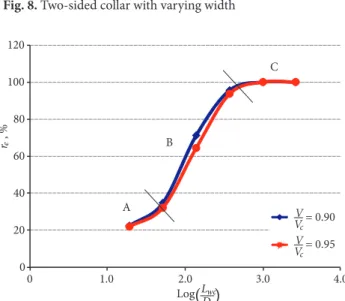
Table 5. Characteristics of bridge pier model scour experiments under two-sided collar with varying width condition
Q,
lits-1 cmY, msV, -1 msVc-1, mmec, mmLuc, mmLdc, mmLwc, mm, r%e,
7.80 13.55 0.192 0.21 0.91 0.8 12 20 18 1.28 23.30 1.66 22.43
7.72 13.70 0.188 0.21 0.89 0.8 12 20 24 1.71 19.60 1.40 34.75
7.89 13.63 0.193 0.21 0.92 0.8 12 20 30 2.14 8.65 0.61 71.20
7.92 13.90 0.190 0.21 0.90 0.8 12 20 36 2.57 1.32 0.09 95.60
7.83 13.61 0.192 0.21 0.91 0.8 12 20 42 3.00 0.00 0.00 100.00
7.73 13.71 0.188 0.21 0.89 0.8 12 20 48 3.42 0.00 0.00 100.00
7.74 12.78 0.202 0.21 0.96 0.8 12 20 18 1.28 25.35 1.81 21.95
7.77 13.09 0.198 0.21 0.94 0.8 12 20 24 1.71 22.05 1.57 32.11
7.67 12.73 0.201 0.21 0.95 0.8 12 20 30 2.14 11.56 0.82 64.40
7.89 13.42 0.196 0.21 0.93 0.8 12 20 36 2.57 2.06 0.14 93.65
7.82 13.45 0.194 0.21 0.92 0.8 12 20 42 3.00 0.00 0.00 100.00
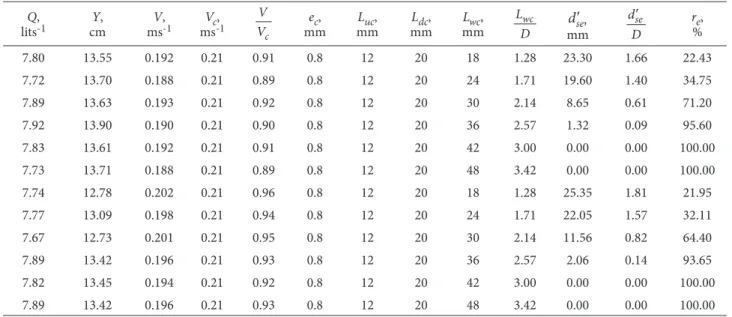
experiments and the results showed that the asymmetric collars performed better than the symmetric collars. 3.4. Effect of bridge width in bridge pier model scour In this section, the upstream and downstream collar lengths were chosen according to the experimental values mentioned above (Fig. 8). The experiments revealed that with an increase in collar width the scour velocity was re-duced. For example, in the case of a collar with a width 2.8 times the pier diameter, no scour was formed around the bridge pier model after 72 h. The collar and flow characteristics in this instance are expressed as follows: Luc = 12 mm, Ldc = 20 mm, Lwc = 18, 24, 30, 36, 42, 48 mm, ec = 0.8 mm, = 0.9, 0.95.
The scour mechanism in this set of experiments was the same as that of two-sided collars scour mechanisms. The duration of experiment depended on the time it took to remove sediments beneath the collar as well as the scour depth equilibrium time. The experiments are briefly described in Table 5.
Fig. 9 demonstrates the reduction percentage of scour depth with a non-dimensional width collar . In part A, the collar width did not properly reduce the scour depth. In part B, the increase in collar width resulted in an adequate reduction of scour depth with an increasing trend. In part C, collar width decreased the scour depth but the increase in did not bring about any considerable changes to scour depth reduction. It is clear from the experiments that when collar width increased, scour depth decreased as in the case of Lwc= 2.8D where af-ter 72 h the scour around the pier was significantly reduced. By taking Fig. 9 into account as well as the infor-mation found in Table 5, the proper collar width was 2.8 times the pier diameter. That is: Lwc= 40 mm, = 2.8.
In instances where the piers were fitted with a col-lar, the scour mechanism and flow pattern were different than they were for piers that were unprotected. As found before, the horseshoe vortexes were produced first and then wake vortexes were formed. Scour started in the front of the bridge pier. In cases where the pier was fitted with a collar, the wake vortexes developed first and then the horseshoe vortexes were formed. The scour started to develop from the collar border and expanded to the pier. These experiments demonstrated that increasing the col-lar dimensions leads to the reduction of scour depth con-firming the results put forth by Thomas (1967). Tables 4 and 5, and Figs 7 and 9 demonstrate that asymmetric col-lars perform better than symmetric colcol-lars in reducing scour depth.
4. Conclusions
In this paper, experimental method was used to investi-gate the application of rectangular collars with different dimensions. This investigation was carried out in order to
assess the reduction of local scour around a single and cy-lindrical bridge pier. Furthermore, the most effective col-lar dimensions were calculated through multiple experi-ments under different hydraulic conditions. The following conclusions are drawn from the results of this study.
1. Around 80% of the scouring depth was observed during the first 12% of the equilibrium time. Also, the maximum rate of the scouring occurred during the first hours of the experiments and the rate of scouring decrea-sed with time.
2. Results from the unprotected experiments in con-junction with the time development of the scour holes showed that the maximum equilibrium scour depth was 32.48 mm and occurred after 17.9 h.
3. Experiments on piers fitted with collars confirmed that the use of rectangular collars reduced the scouring rate.
4. The optimum value of the proportion of upstream and downstream length of a rectangular collar to pier dia-meter was found to be 0.86 and 1.42, respectively.
5. The optimum collar width was found to be 2.8 ti-mes of the bridge pier diameter.
6. Using the optimized collar dimensions, the non-dimensional depth of scour reached a minimum value of 0.034 after 72 h. In addition, the reduction percentage of the scour depth reached 98% in 72 h.
5. Acknowledgements
Financial support by the high impact research grants from the University of Malaya (UM.C/625/1/HIR/61,
Fig. 8. Two-sided collar with varying width
account number: H-16001-00-D000061) is gratefully ac-knowledged.
References
Akib, S.; Fayyadh, M. M.; Othman, I. 2011. Structural Behaviour of a Skewed Integral Bridge Affected by Different Parameters, TheBaltic Journal of Road and Bridge Engineering 6(2): 107– 114. http://dx.doi.org/10.3846/bjrbe.2011.15
Akib, S.; Jahangirzadeh, A.; Basser, H. 2014. Local Scour around Complex Pier Groups And Combined Piles at Semi-Integral Bridge, Journal of Hydrology Hydromechanics 62(2): 108–116.
http://dx.doi.org/10.2478/johh-2014-0015
Baker, C. J. 1980. Theoretical Approach to Prediction of Local Scour around Bridge Piers, Journal of Hydraulic Research 18(1): 1–12. http://dx.doi.org/10.1080/00221688009499564
Chiew, Y. M. 1992. Scour Protection at Bridge Piers, Journal of Hydraulic Engineering 118(9): 1260–1269.
http://dx.doi.org/10.1061/(ASCE)0733-9429(1992)118:9(1260)
Chiew, Y. M.; Melville, B. W. 1987. Local Scour around Bridge Piers, Journal of Hydraulic Research 25(1): 15–26.
http://dx.doi.org/10.1080/00221688709499285
Dargahi, B. 1990. Controlling Mechanism of Local Scouring, Journal of Hydraulic Engineering 116(10): 1197–1214.
http://dx.doi.org/10.1061/(ASCE)0733-9429(1990)116:10(1197)
Deng, L.; Cai, C. 2010. Bridge Scour: Prediction, Modeling, Mon-itoring, and Countermeasures-Review, Practice Periodical on Structural Design and Construction 15(2): 125–134.
http://dx.doi.org/10.1061/(ASCE)SC.1943-5576.0000041
Ettema, R. 1980. Scour at Bridge Piers. Research Report No. 216. Dept of Civil Engineering, University of Auckland, New Zea-land.
Gaudio, R.; Tafarojnoruz, A.; Calomino, F. 2012. Combined Flow-Altering Countermeasures against Bridge Pier Scour, Journal of Hydraulic Research 50(1): 35–43.
http://dx.doi.org/10.1080/00221686.2011.649548
Jahangirzadeh, A.; Basser, H.; Akib, S.; Karami, H.; Naji, S.; Sham-shirband, S. 2014. Experimental and Numerical Investigation of the Effect of Different Shapes of Collars on the Reduction of Scour Around a Single Bridge Pier, PloS ONE 9(6): 1–11.
http://dx.doi.org/10.1371/journal.pone.0098592
Khosronejad, A.; Kang, S.; Sotiropoulos, F. 2012. Experimen-tal and Computational Investigation of Local Scour Around Bridge Piers, Advances in Water Resources 37: 73–85.
http://dx.doi.org/10.1016/j.advwatres.2011.09.013
Kumar, V.; Ranga Raju, K. G.; Vittal, N. 1999. Reduction of Local Scour Around Bridge Piers Using Slots and Collars, Journal of Hydraulic Engineering 125(12) 1302–1305.
http://dx.doi.org/10.1061/(ASCE)0733-9429(1999)125:12(1302)
Laursen, E. M.; Toch, A. 1956. Scour around Bridge Piers and Abutments. Bulletin No 4, Iowa Highways Research Board, Ames, Iowa.
Link, O.; Pfleger, F.; Zanke, U. 2008. Characteristics of Develop-ing Scour-Holes at a Sand-Embedded Cylinder, International Journal of Sediment Research 23(3): 258–266.
http://dx.doi.org/10.1016/S1001-6279(08)60023-2
Mashahir, M. B.; Zarrati, A. R.; Mokallaf, E. 2010. Application of Riprap and Collar to Prevent Scouring Around Rectangular
Bridge Piers, Journal of Hydraulic Engineering 136(3): 183–141.
http://dx.doi.org/10.1061/(ASCE)HY.1943-7900.0000145
Melville, B. W. 1997. Pier and Abutment Scour – an Integrated Approach, Journal of Hydraulic Engineering 123(2): 125–136.
http://dx.doi.org/10.1061/(ASCE)0733-9429(1997)123:2(125)
Meyer-Peter, E.; Muller, R. 1984. Formulas for Bed-Load Trans-port, in Proc. of the 2nd Meeting of the International Associa-tion Hydraulic Structure Research, 1984, Stockholm, Sweden. Moncada-M, A. T.; Aguirre-Pe, J.; Bolivar, J. C.; Flores, E. J. 2009. Scour Protection of Circular Bridge Piers with Collars and Slots, Journal of Hydraulic Research 47(1): 119–126.
http://dx.doi.org/10.3826/jhr.2009.3244
Motamedi, A.; Afzalimehr, H.; Singh, V. P. 2010. Evaluation of a Novel Approach to Determine the Critical Shields Stress, Journal of Hydrologic Engineering 15(11): 892–900.
http://dx.doi.org/10.1061/(ASCE)HE.1943-5584.0000266
Neill, C. R. 1973. Guide to Bridge Hydraulics. Toronto: University of Toronto press. 191 p. ISBN 0802019617.
Raudkivi, A. J. 1998. Loose Boundary Hydraulics. A. A. Balkema, Rotterdam, The Netherlands. 512 p. ISBN 9789054104483. Raudkivi, A.; Ettema, R. 1983. Clear-Water Scour at Cylindrical
Piers, Journal of Hydraulic Engineering 109(3): 338‒350.
http://dx.doi.org/10.1061/(ASCE)0733-9429(1983)109:3(338)
Sheppard, D. M.; Miller, Jr. W. 2006. Live-Bed Local Pier Scour Ex-periments, Journal of Hydraulic Engineering 132(7): 635–642.
http://dx.doi.org/10.1061/(ASCE)0733-9429(2006)132:7(635)
Shirole, A. M.; Holt, R. C. 1991. Planning for a Comprehensive Bridge Safety Assurance Program, in Proc. of the 3rd Bridge Engi-neering Conference. 10–13 March 1991, Denver, Colorado, USA. Tafarojnoruz, A.; Gaudio, R.; Calomino, F. 2012. Bridge Pier
Scour Mitigation under Steady and Unsteady Flow Condi-tions, Acta Geophysica 60(4): 1076–1097.
http://dx.doi.org/10.2478/s11600-012-0040-x
Tafarojnoruz, A.; Gaudio, R.; Dey, S. 2010. Flow-Altering Coun-termeasures against Scour at Bridge Piers: a Review, Journal of Hydraulic Research 48(4): 441–452.
http://dx.doi.org/10.1080/00221686.2010.491645
Thomas, Z. 1967. An Interesting Hydraulic Effect Occurring at Local Scour, in Proc. of the 12th International Association for Hydraulic Research Congress. 11–14 September 1967, Fort Collins, Colorado, USA.
Zarrati, A. R.; Nazariha, M.; Mashahir, M. B. 2006. Reduction of Local Scour in the Vicinity of Bridge Pier Group Using Collars and Riprap, Journal of Hydraulic Engineering 132(2): 154–162.
http://dx.doi.org/10.1061/(ASCE)0733-9429(2006)132:2(154)
Zarrati, A. R.; Gholami, H.; Mashahir, M. B. 2004. Application of Collar to Control Scouring Around Rectangular Bridge Piers, Journal of Hydraulic Research 42(1): 97–103.
http://dx.doi.org/10.1080/00221686.2004.9641188
Zarrati, A. R.; Chamani, M. R.; Shafaei, A.; Latifi, M. 2010. Scour Countermeasure for Cylindrical Piers Using Riprap and Combination of Collar and Riprap, International Journal of Sediment Research 25(3): 313–321.
http://dx.doi.org/10.1016/S1001-6279(10)60048-0