Vol. 2, No. 2, pp 207-222
Estimation in ARMA models based on signed
ranks
J. Allal1, A. Kaaouachi2
1D´epartement de Math´ematiques, Facult´e des Sciences, Universit´e Mohamed
Ier, Oujda 60 000 Morocco. ([email protected])
2D´epartement d’Informatique, EST-ENSA, Universit´e Mohamed Ier, Oujda
60 000 Morocco. ([email protected])
Abstract. In this paper we develop an asymptotic theory for
estima-tion based on signed ranks in the ARMA model when the innovaestima-tion density is symmetrical. We provide two classes of estimators and we establish their asymptotic normality with the help of the asymptotic properties for serial signed rank statistics. Finally, we compare our procedure to the one of least-squares, and we illustrate the perfor-mance of the proposed estimators via a Monte Carlo study.
1
Introduction
Consider the ARMA(p, q) model
Xt−A1Xt−1−. . . .−ApXt−p=εt+B1εt−1+. . .+Bqεt−q, t∈Z, (1)
Received: November 2002, Revised: September 2003
Key words and phrases: ARMA models, asymptotic relative efficiency, asymp-totic uniform linearity, local asympasymp-totic normality, rank and signed-rank proce-dures,R-estimation, serial signed rank statistics.
with (εt;t ∈ Z) is a white noise with unspecified symmetric (with respect to some known median, which can be set equal to zero without any loss of generality) densitygand cumulative distribution function G, andθ0= (A1, . . . , Ap, B1, . . . , Bq)∈Rp+qis the vector of unknown parameters which ensures both the stationarity and the invertibility conditions.
The commonly used methods of estimatingθ0 include the method of moments, the least-squares and the maximum likelihood methods. These estimators are not very efficient in some situations, that is why many researchers are focused to other procedures which are either more robust, or more efficient. The important special classes are : M-estimation, L-estimation and R-estimation.
The R-estimation class represents the estimation methods based on ranks or signed ranks. These methods inherit all the desirable fea-tures resulting from theirinvarianceproperties. They are robust, and even may outperform the more classical methods based on Gaussian quasi-likelihoods. Historically, the R-estimation class was the sub-ject of a vast literature in linear regression models. Major contribu-tions include Hodges and Lehmann (1963), Adichie (1967), Jureˇckov´a (1971), Koul (1971), Jaeckel (1972), and Heiler and Willers (1988). The monographs by Puri and Sen (1985) and Jureˇckov´a and Sen (1996) give details and extensive bibliography. However, there are a few attempts extending the above works to time series context. Koul and Saleh (1993) developed the theory for R-estimation in AR models by minimizing dispersions based on non-decreasing right continuous score functions of ranks, using the “weak convergence technique”. Such a technique involves both residual ranks and the observations themselves, and works only for bounded score functions. More re-cently, Allal, Kaaouachi and Paindaveine (2001) proposed a new class of R-estimators for an ARMA model, based on an appropriate func-tion which is entirely measurable with respect to the residual ranks. In this paper, we develop the theory of R-estimation in ARMA models when the innovation density is symmetric. In this situation, it is well known that the vector(rank, sign)is maximal invariant with respect to the group of continuous, even order-preserving transforma-tions. An important tool in our approach is the LAN property, with the signed-rank based version established by Hallin and Puri (1994), and the proposed estimators are measurable with respect to the max-imal invariant. The treatments put forward in Allal, Kaaouachi and Paindaveine (2001) are still valid, with some adaptations. They
resent a general methodology allowing for the construction of efficient estimates in time series context under LAN property. Relevant pa-pers in this direction are Kreiss (1987), Jeganathan (1995), Drost et al. (1997), and Koul and Schich (1997), to quote only a few.
The paper is organized as follows. Definitions and main technical assumptions are stated in Section 2. Section 3 presents the LAN result with a signed rank version and asymptotic properties of serial signed rank statistics. Section 4 gives the first class of estimators based on signed ranks. Section 5 gives the second class of estimators based on signed ranks. Section 6 provides the asymptotic relative efficiencies of estimators with respect to the least-squares estimate. In Section 7, we illustrate the performance of the proposed estimators via a Monte Carlo study.
2
Definitions and main technical assumptions
The ARMA(p, q) model (1) can be written as A(L)Xt=B(L)εt, t∈Z,
where L is the lag operator, A(L) = 1−
p X
i=1
AiLi, and B(L) = 1 + q
X
i=1 BiLi.
LetX(n)= (X1(n), . . . , Xn(n)) be an observed series of lengthn, and
denote byHg(n)(θ0) the hypothesis under whichX(n) is generated by
model (1). Denote by R+(n,t)(θ0) the rank of the residual |Zt(n)(θ0)| among the absolute values|Z1(n)(θ0)|, . . . ,|Zn(n)(θ0)|, where
Zt(n)(θ0) := A(L) B(L)X
(n)
t , t= 1, . . . , n,
and lets(tn)(θ0) be the sign ofZt(n)(θ0).
We suppose that the vector (ε−q+1, . . . , ε0, X−p+1, . . . , X0) is ob-served, or thatXt= 0,t≤0. Such assumptions have no influence on
asymptotic results. Then, under Hg(n)(θ0),
n
Z1(n)(θ0), . . . , Zn(n)(θ0)
o
is a n-tuple of i.i.d. random variables with probability density func-tion g.
Consider the serial signed rank statistic of orderk(k= 1, . . . , n−
1), known as a signed rank autocorrelation of orderkand is fruitfully used to provide efficient tests (see Hallin and Puri (1991, 1994)),
r(kn)+(θ0) :=
h
(n−k)σ(+n)
i−1 Xn
t=k+1
s(tn)(θ0)s(t−n)k(θ0)
J1 1 2+
R(+n,t)(θ0) 2(n+ 1)
!
J2
1 2 +
R(+n,t)−k(θ0) 2(n+ 1)
, (2)
whereJ1 and J2 are two score functions defined on (0,1), andσ+(n) is a normalizing constant such that (n−k)1/2rk(n)+(θ0) is exactly stan-dardized (mean zero and variance one) underHg(n)(θ0). The explicit
form ofσ+(n) is given by (3.15) of Hallin and Puri (1994), with minor modifications.
Particularizing the score functions, we obtain the van der Waer-den, Wilcoxon and Laplace signed rank autocorrelations (see Hallin and Puri (1991)).
Define now the vector of signed rank statistics
√
nT(Jn)+
1;J2(θ0) :=
n−1
X
k=1
(n−k)1/2ψk(1)(θ0)r(kn)+(θ0), . . . ,
n−1
X
k=1
(n−k)1/2ψk(p+q)(θ0)r(kn)+(θ0)
!0
, (3)
where
n
ψ(1)t (θ0), . . . , ψ(tp+q)(θ0);t∈Z
o
is an arbitrary fundamental system of solutions of the homogeneous equation
A(L)B(L)ψt= 0, t∈Z.
(Convenient choices of this system are given in Section 4 of Hallin and Puri (1994)).
Associated with this fundamental system, denote by Cψ(θ0) and
W2ψ(θ0)the matrices whose elements areψ (j)
i (θ0) and
∞ X
t=1
ψ(ti)(θ0)ψ (j)
t (θ0)
(i, j = 1, . . . , p+q), respectively. Finally, let
M(θ0) :=
1 0 . . . 0 1 0 . . . 0 g1 1 . . . h1 1 . . .
..
. ... ... ...
gp−1 . . . 1 hq−1 . . . 1 gp . . . g1 hq . . . h1
..
. ... ... ...
gp+q−1 . . . gq hp+q−1 . . . hp ,
wheregi and hi are the Green’s functions associated with the
opera-tors A(L) andB(L), respectively. They are characterized by A−1(L) =
∞ X
i=0
giLi and B−1(L) = ∞ X
i=0 hiLi.
Next putting
∆(Jn)+
1;J2(θ0) :=n
1/2M0(θ
0)C0−ψ1(θ0)TJ(n1)+;J2(θ0).
The latter function will play a fundamental role in our treatment. Throughout the paper we assume that the following assumptions hold for the innovation densityg and the score functions J1 and J2.
Assumptions A.1. (borrowed from Hallin and Puri (1994))
(i) g(x)>0 ∀x∈R,
Z
xg(x)dx= 0 and 0< σ2:=
Z
x2g(x)dx <∞;
(ii) g is symmetric, absolutely continuous and strongly unimodal; (iii) letting ϕg := −g0/g, where g0 stands for the first derivative of
g, the Fisher information I(g) :=R[ϕg(x)]2g(x)dx is finite;
(iv) the vector (ε−q+1;. . .;ε0;X−p+1;. . .;X0) possesses a nowhere
vanishing joint densityg0(., θ) that satisfiesg0(., θ(n))−g0(., θ0) =oP(1), underHg(n)(θ0), as θ(n)→θ0.
Assumptions A.2. (borrowed from Allal, Kaaouachi and
Pain-daveine (2001))
(i) J1 and J2 are nondecreasing and square-integrable functions such that
1
Z
0
Ji(u)du= 0, i= 1,2;
(ii) J1◦Gand J2◦G are Lipschitz.
Remark 2.1
Assumptions A.1 are used in proving the LAN result. Assumption A.2(ii) is verified, for example, ifJi = Φ−1(.) andG is normal (Φ(.)
stands for the standard normal distribution function),Ji(u) = 2u−1
andGis normal or logistic orJi(u) = ln(u/1−u) andGis logistic. It
easily can be weakened into a piecewise Lipschitz assumption, which also accomodates such distributions as the double exponential.
3
LAN result and asymptotic properties of
serial signed rank statistics
This section of the paper is devoted to the LAN result with the signed-rank based version for the ARMA model, and to the asymptotic properties of serial signed rank statistics. For this purpose, consider the sequence of local alternatives Hg(n) θ0+n−1/2τ
, where τ := (γ,δ)∈Rp×Rq . Let Λ = Λ(θn)
0+n−1/2τ/θ0 be the log-likelihood ratio forHg(n)(θ0+n−1/2τ) with respect toHg(n)(θ0), then we have
Proposition 3.1. (Local asymptotic normality) Assume that Assumptions A.1 hold. Then, under Hg(n)(θ0),
Λ =τ0σ[I(g)]1/2∆(ϕn)+
g◦G−1;G−1(θ0)− 1 2σ
2I(g)τ0Γ(θ
0)τ+oP(1),
as n→ ∞, where
Γ(θ0) :=M0(θ0)C0−ψ1(θ0)W2ψ(θ0)C−ψ1(θ0)M(θ0).
Moreover, the limiting distribution of∆(ϕn)+
g◦G−1;G−1(θ0)underH (n)
g (θ0) is N(0,Γ(θ0)).
Proof. See Proposition 4.1 (iii) of Hallin and Puri (1994). 2
By applying LeCam’s third Lemma (we adopt here H´ajek and ˇ
Sid´ak (1967)’s terminology), we obtain the following corollary.
Corollary 3.1. Assume that AssumptionsA.1hold. Then, the
lim-iting distribution of∆(ϕn)+
g◦G−1;G−1(θ0)−σ[I(g)] 1/2Γ(θ
0)τ underHg(n)(θ0 +n−1/2τ) is N(0,Γ(θ0)).
The following proposition gives some asymptotic properties of se-rial signed rank statistics.
Proposition 3.2. (Asymptotic properties of serial signed rank statistics)
Assume that A.1 and A.2 hold. Then, (i)n1/2rk(n)+(θ0) =I−1n−1/2
n X
t=k+1
J1◦G(Zt(n)(θ0))J2◦G(Zt(−n)k(θ0)) +
oP(1), under H
(n)
g (θ0), as n→ ∞, where
I2:= 1
Z
0
[J1(u)]2 du 1
Z
0
[J2(u)]2 du;
(ii) the signed rank statistic n1/2r(kn)+(θ0) is asymptotically normal under Hg(n)(θ0), with mean zero and variance one ;
(iii) the signed rank statistic n1/2r(kn)+(θ0) is asymptotically normal underHg(n)(θ0+n−1/2τ), with meanc(J1, J2, g)(ak+bk)and variance
one, where
c(J1, J2, g) :=I−1 1
Z
0
J1(u)ϕg◦G−1(u)du
1
Z
0
J2(u)G−1(u)du,
and
ak:= p X
j=1
γjgk−j and bk:= q X
j=1
δjhk−j;
(iv) for all k= 1, . . . , n−1 and all c >0, sup
kτk≤c n
1/2hr(n)+
k (θ0+n
−1/2τ)−r(n)+
k (θ0) i
+c(J1, J2, g)(ak+bk)
=oP(1), (4)
under Hg(n)(θ0), as n→ ∞.
Here, k.k stands for the Euclidean norm in Rp+q .
Proof. (i) direct application of Proposition 3.1 (i) of Hallin and
Puri (1991) ; called the asymptotic representation result for serial signed rank statistics ;
(ii) use (i) and the central limit theorem for U-statistic under k-dependent random variables (See Yoshihara (1976)’s Theorem 1) ; (iii) use LeCam’s third Lemma ;
(iv) use (i) and Proposition 3.3 of Allal, Kaaouachi and Paindaveine (2001). 2
4
A first class of estimators based on signed
ranks
In this section we introduce a first class of estimators based on signed ranks for the parameter θ0 of the ARMA model.
From Proposition 3.2 (ii), we can show that the vector∆(Jn)+ 1;J2(θ0) is asymptotically normal underHg(n)(θ0), with mean zero and
covari-ance matrix Γ(θ0). This suggests estimating the unknown parameter θ0 by the value ofθfor which∆(Jn1)+;J2(θ) is as near to zero as possible, i.e. to estimate θ0 by
¯
θ(n):= arg min
θ k∆
(n)+
J1;J2(θ)k. (5)
The following proposition gives the asymptotic uniform linearity of ∆(Jn)+
1;J2(θ0+n
−1/2τ) in kτk ≤c, forc >0.
Proposition 4.1. Assume that A.1 and A.2 hold. Then, for all
c >0,
sup
kτk≤c ∆
(n)+
J1;J2(θ0+n
−1/2τ)−∆(n)+
J1;J2(θ0)
+c(J1, J2, g)Γ(θ0)τ
=oP(1), (6)
under Hg(n)(θ0), as n→ ∞.
Proof. The claim readily follows from Proposition 3.2 (iv), using
standard arguments. 2
Now we are ready to give the limit law of signed rank estimators.
Proposition 4.2. Assume that A.1 and A.2 hold. Let (¯θ(n)) be a
√
n-consistent solution of (5), i.e. satisfying
√
nθ¯(n)−θ0
=OP(1), under Hg(n)(θ0), as n→ ∞.
Then, the asymptotic distribution of √n θ¯(n)−θ0
under Hg(n)(θ0) is N 0, c−2(J
1, J2, g)Γ−1(θ0)
.
Proof. The result follows from the asymptotic normality of∆(Jn)+
1;J2(θ0) under Hg(n)(θ0) together with the Cram´er-Wold device and
Proposi-tion 4.1. 2
Proposition 4.3. Assume that A.1 and A.2 hold, and suppose that λ0∆(Jn1);J2(θ0 +b n−1/2λ) is monotone in b for every kλk = 1. Then, for any solution (¯θ(n)) of (5), the asymptotic distribution of
√
n θ¯(n)−θ0 under Hg(n)(θ0) isN 0, c−2(J1, J2, g)Γ−1(θ0)
.
Proof. The proof proceeds along the same lines as in Jureˇckov´a
(1971). 2
Note that the above two propositions give the asymptotic nor-mality of any solution of (5) with some additional assumptions, and the proposed estimators have an implicit form via the minimization problem. To resolve these difficulties, we propose in the following section a new class of signed rank estimators possessing an explicit form and asymptotic normality without any assumption.
5
A second class of estimators based on signed
ranks
In this section we adopt the H´ajek-LeCam approach to construct a second class of estimators ˆθ(n)based on signed ranks and satisfying
∆(Jn)+
1;J2(ˆθ
(n)) =o
P(1), under Hg(n)(θ0), as n→ ∞.
For this purpose, let (˜θ(n)) denote a discretized √n-consistent pre-liminary estimate ofθ0, i.e. a sequence of estimates such that
(i) √n-consistency: √nθ˜(n)−θ
0
= OP(1), under Hg(n)(θ0), as n→ ∞;
(ii) Local discreteness: the number of possible values of ˜θ(n) in
balls of the form
θ∈Rp+q :
√
nkθ−θ0k ≤c , c >0 fixed,
remains bounded, as n→ ∞.
The √n-consistency condition is satisfied by all estimates usually considered in the context of ARMA models (see for example Fuller (1976)), and the local discreteness condition goes back to LeCam (1960) and has become an important technical tool in the construc-tion of efficient estimators in semiparametric models ; see Bickel, Klaassen, Ritov and Wellner (1993) and references therein.
Proposition 5.1. Assume thatA.1 and A.2 hold. Define ˆ
θ(n)= ˜θ(n)+√1
nc
−1(J1, J2, g)Γ−1(˜θ(n))∆(n)+
J1;J2(˜θ
(n)). (7)
Then, under Hg(n)(θ0), as n→ ∞,
√
n(ˆθ(n)−θ0) =c−1(J1, J2, g)Γ−1(θ0)∆(Jn)+
1;J2(θ0) +oP(1), (8) and the asymptotic distribution of √n
ˆ
θ(n)−θ0
under Hg(n)(θ0) is
N 0, c−2(J1, J2, g)Γ−1(θ0). In addition
∆(Jn)+
1;J2(ˆθ
(n)) =o
P(1).
Proof. Note that by the consistency of Γ(˜θ(n)) for Γ(θ0), we have
√
n
ˆ
θ(n)−θ0
−c−1(J1, J2, g)Γ−1(θ0)∆(Jn)+ 1;J2(θ0) =
√
nθ˜(n)−θ0
+c−1(J1, J2, g)Γ−1(θ0)
∆(Jn)+
1;J2(˜θ
(n))−∆(n)+
J1;J2(θ0)
+oP(1),
which, in view of Proposition 4.1, is an oP(1), under H
(n)
g (θ0), as n→ ∞. The rest is obvious. 2
Remark 5.1
It follows from the H´ajek-LeCam theory for LAN experiments that an estimator ˆθ(n)from (7) is asymptotically optimal in the LAM sense (local asymptotic minimaxity, concept introduced by H´ajek (1972)) if the two score functions J1 and J2 are respectively ϕg◦G−1 and
G−1. In this case, a LAM estimator ˆθ(n)
LAM takes the form
ˆ
θLAM(n) = ˜θ(n)+ √1
nσ
−1I−1/2(g)Γ−1(˜θ(n))∆(n)+
ϕg◦G−1;G−1(˜θ (n)).
Consequently, the limit law of √nθˆ(LAMn) −θ0
under Hg(n)(θ0) is N 0, σ−2I−1(g)Γ−1(θ
0)
.
The following proposition shows that ˆθ(n) and ¯θ(n) are asymptot-ically equivalent.
Proposition 5.2. Assume that A.1 and A.2 hold. Let (¯θ(n)) be a
√
n-consistent solution of (5). Then
√
nθˆ(n)−θ¯(n)=oP(1),
under Hg(n)(θ0), as n→ ∞.
Proof. The desired result readily follows from the fact that both ˆθ(n) and ¯θ(n) satisfy (8). 2
The advantage of ˆθ(n)is that, contrary to ¯θ(n), it can be computed easily and its asymptotic properties are evident.
6
Asymptotic relative efficiencies
Pitman asymptotic relative efficiencies of the proposed estimators with respect to least-squares estimate are obtained as ratios of the asymptotic variance matrices. The asymptotic variance matrix of the proposed signed rank estimator ˆθ(n) is given in Proposition 5.1, and it is well-known that the asymptotic variance matrix of the least-squares estimate ˆθ(LSn) isΓ−1(θ0) (see Whittle (1962)). Therefore, the ARE of ˆθ(n) with respect to ˆθ(LSn) is given by
ARE(ˆθ(n)/θˆ(LSn)) =c2(J1, J2, g).
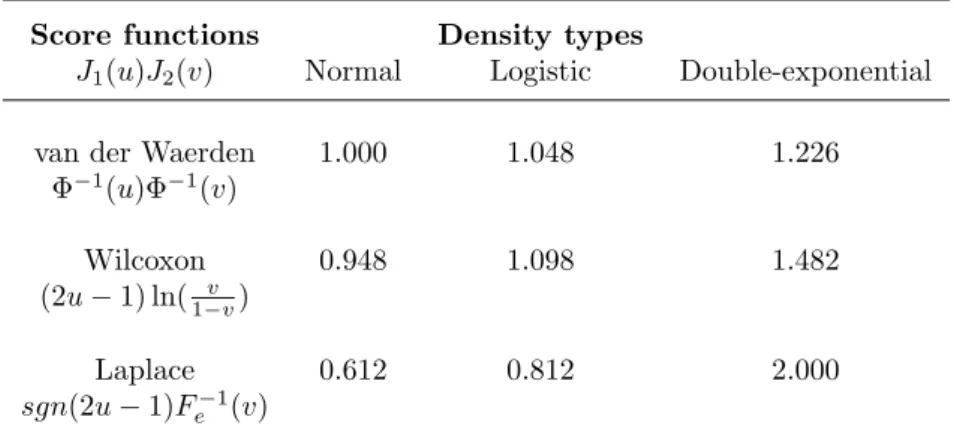
The following table summarizes the numerical values of ARE of the proposed signed rank estimators with respect to the least-squares estimate for various score functions (van der Waerden, Wilcoxon and Laplace) under some usual densities (normal, logistic and double-exponential).
Score functions Density types
J1(u)J2(v) Normal Logistic Double-exponential
van der Waerden 1.000 1.048 1.226
Φ−1(u)Φ−1(v)
Wilcoxon 0.948 1.098 1.482
(2u−1) ln( v
1−v)
Laplace 0.612 0.812 2.000
sgn(2u−1)F−1
e (v)
Table 1: ARE of ˆθ(n) with respect to ˆθ(LSn).
An inspection of Table 1 reveals the excellent asymptotic perfor-mances of the proposed signed rank estimator: the van der Waerden estimator performs uniformly and strictly better that the correspond-ing least-squares except of course under normal density, when they perform equally well.
7
Simulation results
In this section we report the result of a small simulation study per-formed using S-plus. We considered the following AR(1) model
Xt−θ0Xt−1=εt, t∈Z,
where |θ0| < 1 and εt has an unspecified density g symmetric with
respect to zero.
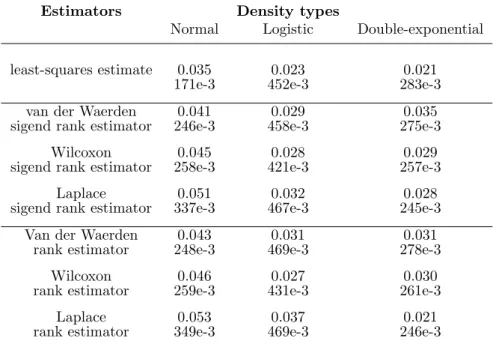
The parameter θ0 was taken to be 0.4 and the three innovation density (normal, logistic and double-exponential) have been investi-gated. In each case, we generated independently M = 1000 repli-cations for sample sizes n = 40 (small) and n = 200 (large), and constructed seven estimators forθ0 : the least-squares estimate, rank estimator described in Allal, Kaaouachi and Paindaveine (2001) (for van der Waerden, Wilcoxon and Laplace scores) and our signed rank estimator (for van der Waerden, Wilcoxon and Laplace scores). For each estimate, we report the sample mean M1 PM
i=1θˆ (n)
i −θ0 and the mean square error M1 PM
i=1(ˆθ (n)
i −θ0)2. Results are presented in Ta-bles 2 and 3. The simulations show that the signed rank estimators perform slightly better than the least-squares estimate, even when the latter is used as the initial estimate, except the case when the innovation density is normal.
On the other hand, observe in Table 3 that both the rank estima-tor and the signed rank estimaestima-tor give approximately the same results without detecting the advantage of one of the two types. But, Ta-ble 2 indicates the performance of signed rank estimators relatively to rank estimators. This latter numerical result is also established in Hallin et al. (1990) who showed that the signed-rank procedures perform better than the unsigned ones, for short series lengths.
Estimators Density types
Normal Logistic Double-exponential
least-squares estimate 0.035 0.023 0.021
171e-3 452e-3 283e-3
van der Waerden 0.041 0.029 0.035
sigend rank estimator 246e-3 458e-3 275e-3
Wilcoxon 0.045 0.028 0.029
sigend rank estimator 258e-3 421e-3 257e-3
Laplace 0.051 0.032 0.028
sigend rank estimator 337e-3 467e-3 245e-3
Van der Waerden 0.043 0.031 0.031
rank estimator 248e-3 469e-3 278e-3
Wilcoxon 0.046 0.027 0.030
rank estimator 259e-3 431e-3 261e-3
Laplace 0.053 0.037 0.021
rank estimator 349e-3 469e-3 246e-3
Table 2: Simulation results with series lengthn= 40.
Estimators Density types
Normal Logistic Double-exponential
least-squares estimate 0.017 0.008 0.015
542e-5 745e-6 681e-5
van der Waerden 0.019 0.011 0.016
sigend rank estimator 561e-5 586e-5 503e-5
Wilcoxon 0.018 0.009 0.012
sigend rank estimator 613e-5 508e-5 571e-5
Laplace 0.024 0.010 0.011
sigend rank estimator 715e-5 604e-5 413e-5
Van der Waerden 0.020 0.010 0.014
rank estimator 560e-5 582e-5 500e-5
Wilcoxon 0.017 0.008 0.013
rank estimator 617e-5 507e-5 569e-5
Laplace 0.024 0.012 0.009
rank estimator 712e-5 605e-5 416e-5
Table 3: Simulation results with series lengthn= 200.
Acknowledgments
The authors express their deep gratitude to the Editor Ahmad Par-sian and the referees. Their suggestions led to a considerable im-provement of the presentation of the initial version of this paper. This research was partially supported by the “Programme d’Appui `a la Recherche Scientifique (PARS)”.
References
Adichie, J. N. (1967), Estimation of regression parameters based on rank tests. Ann. Math. Statist.,38, 894-904.
Allal, J., Kaaouachi, A. and Paindaveine, D. (2001), R-estimation for ARMA models. Journal of Nonparametric Statistics, 13, 815-831.
Bickel, P. J., Klaassen, C. A. J., Ritov, Y. and Wellner, J. A. (1993), Efficient and Adaptive Estimation for Semiparametric Mod-els.Baltimore: Johns Hopkins University Press.
Drost, F. G., Klaassen, C. A. J. and Werker, B. J. M. (1997), Adap-tive estimation in time-series models. Ann. Statist., 25, 786-817.
Fuller, W. A. (1976), Introduction to Statistical Time Series.New York: John Wiley.
H´ajek, J. (1972), Local asymptotic minimax and admissibility in estimation. Proc. Sixth. Berkeley Sympo. Math. Statist. Prob.,1, 175-194. Univ. of California Press.
H´ajek, J. and ˇSid´ak, Z. (1967), Theory of Rank Tests. New York: Academic Press.
Hallin, M., Laforet, A. and M´elard, G. (1990), Distribution-free tests against serial dependence: signed or unsigned ranks? Jour. Statist. Plan. Inf.,24, 151-165.
Hallin, M. and Puri, M. L. (1991), Time series analysis via rank-order theory: signed-rank tests for ARMA models. J. Multi-variate Anal., 39, 1-29.
Hallin, M. and Puri, M. L. (1994), Aligned rank tests for linear models with autocorrelated error terms. J. Multivariate Anal., 50, 175-237.
Heiler, S. and Willers, R. (1988), Asymptotic normality of R-estimat-es in the linear model. Statistics, 19, 173-184.
Hodges, J. L. and Lehmann, E. L. (1963), Estimates of location based on rank tests. Ann. Math. Statist.,34, 589-611.
Jaeckel, L. A. (1972), Estimating regression cœfficients by minimiz-ing the dispersion of the residuals. Ann. Math. Statist., 43, 1449-1458.
Jeganathan, P. (1995), Some aspects of asymptotic theory with ap-plications to time series models. Econometric Theory,11, 818-887.
Jureˇckov´a, J. (1971), Nonparametric estimate of regression cœffi-cients. Ann. Math. Statist.,42, 1328-1338.
Jureˇckov´a, J. and Sen, P. K. (1996), Robust Statistical Procedures : Asymptotics and Interrelations. New York: John Wiley. Koul, H. L. (1971), Asymptotic behavior of a class of confidence
regions based on ranks in regression. Ann. Math. Statist., 42, 466-476.
Koul, H. L. and Saleh, A. K. Md. E. (1993), R-estimation of the parameters of autoregressive [AR(p)] models. Ann. Statist., 21, 534-551.
Koul, H. L. and Schick, A. (1997), Efficient estimation in nonlinear autoregressive time series models. Bernoulli, 3, 247-277. Kreiss, J. P. (1987), On adaptive estimation in stationary ARMA
processes. Ann. Statist.,15, 112-133.
LeCam, L. (1960), Locally asymptotically normal families of distri-butions. University of California. Publications in Statistics,3, 37-98.
Puri, M. L. and Sen, P. R. (1985), Nonparametric Methods in Gen-eral Linear Models. New York: John Wiley.
Whittle, P. (1962), Gaussian estimation in stationary time series. Bull. Int. Statist.,39, 105-129.
Yoshihara, K. I. (1976), Limiting behavior of U-statistics for sta-tionary absolutely regular process. Z. Wahrsch. Vew. Gebiete, 35, 237-252.