Sharif University of Technology
Scientia IranicaTransactions E: Industrial Engineering http://scientiairanica.sharif.edu
Resilient network design in a location-allocation
problem with multi-level facility hardening
Z. Esfandiyari
a, M. Bashiri
b;, and R. Tavakkoli-Moghaddam
c;da. Department of Industrial Engineering, Science and Research Branch, Islamic Azad University, Tehran, Iran. b. Department of Industrial Engineering, Shahed University, Tehran, Iran.
c. School of Industrial Engineering, College of Engineering, University of Tehran, Tehran, Iran. d. Arts et Metiers ParisTech, LCFC, Metz, France.
Received 19 April 2017; received in revised form 28 October 2017; accepted 30 June 2018
KEYWORDS Static resilience; Location-allocation; Random disruption; Multi-level hardening; Lagrangian
decomposition algorithm.
Abstract. Many sources of risk aect network elements, which may lead to network failure; thus, planners need to consider them in the network design. One of the most important strategies for disruption risk management is the static resilience. In this strategy, the network functionality is maintained after the disruption event by the prevention and hardening actions. In this paper, a resilient capacitated xed-charge location-allocation model is proposed. Both facility hardening and equipping of the network with backup facilities for disrupted elements are considered together to avoid supply network failure due to random disruption. Facilities are decided to be hardened in multiple levels before disruption events. The problem is formulated as a non-linear integer programming model; then, its equivalent linear form is presented. A Lagrangian Decomposition Algorithm (LDA) is developed to solve large-scale instances. Computational results conrm the high ecacy of the proposed solution approach, compared to classical solution approaches, in dealing with large-scale problems. Moreover, the superiority of the proposed model is conrmed in comparison to the classical models.
© 2019 Sharif University of Technology. All rights reserved.
1. Introduction 1.1. Motivation
Supply networks (e.g., supply chains and electrical power networks) are widespread throughout the world. Such networks consist of a set of facilities (e.g., power substations, ports, and distribution centers) and a set of customers to be served by the facilities. These facilities form the backbone of networks, and their
*. Corresponding author.
E-mail addresses: zahra [email protected] (Z. Esfandiyari); [email protected] (M. Bashiri); [email protected] (R.Tavakkoli-Moghaddam) doi: 10.24200/sci.2018.20167
failure may result in interruptions in the ow of goods or services. One common assumption about traditional supply network design decisions is that facilities are always operational and never fail while operating; hence, the possibility of failure is not incorporated into the problem modeling. Because the operation of networks can be disrupted randomly or intentionally, there is a need to perceive how network systems and their performance can be aected by the failure of their facilities in the real-world cases of disruption events. For example, the failure or decline of power supply facilities eventuates in dramatic consequences for a national society and its economy; thus, these facilities are vital entities. The relevance of a continuous power supply to our daily life, industrial production, and electronics stimulates today's society to be highly
vulnerable and susceptible to power supply stoppage. In all countries, even a short power outage is not ac-ceptable due to having signicant impact on the entire economy. For example, power outages in the North East of the United States in 2003 brought adverse eects on business in this area. Due to a labor strike in 2002, 29 ports on the eastern coast of the United States were disabled, leading to the closure of the New United Motor Manufacturing Plant. Natural disasters can also have signicant impact on these network performances and their functionalities. In 2010, 450 natural disasters were recorded across the world; in 2011, only the U.S. rescued economic damage worth over 55 billion dollars from natural disasters [1]. After Hurricane Katrina, due to the loss of electric power at the pumping stations, the supply of petroleum products was interrupted. The incidence of these disruptions and their consequences have increased recently. A research center for communicable disasters has stated that disruptions have increased exponentially around the world during the past few decades.
Additionally, facility disruption is sometimes even more important; for instance, failures of emergency rooms in hospitals and Automated Teller Machines (ATMs) may lead to irreparable consequences. These instances and their severe consequences demonstrate that the classic supply network design is not able to cope with disruption by unpredictable events. It has forced decision-makers to consider the possibility of facility disruptions and to protect such facilities from failure during the network design.
1.2. Related studies
In the literature, supply network disruption risks are divided into two categories based on their sources: random and intentional disruption risks. The former may occur at any point of the supply network, such as natural hazards (e.g., earthquakes, system component breakdown and plant re). However, in the latter category, components whose failure may bring maxi-mum damage to a supply network are highly probable to be targeted (e.g., terrorist attacks and labor union strikes) [2].
The reliability of supply networks can be im-proved by implementing some risk management strate-gies to mitigate disruption eects. Static resilience is one of the most important strategies of disruption risk management in the supply chain network design. The main objective of this strategy is to maintain the network functionality after disruption and often focuses on reduction options in terms of prevention and protec-tion in order to design reliable systems and prevent (or absorb) adverse events. Facility hardening with additional investment in location-allocation decisions about hedging network from failures is an instance of this strategy that leads to the creation of a reliable and
ecient network. Hardened facilities are immune to a failure and do not lose the capacity after disruptive events; thus, they are completely reliable. Facility hardening includes acquiring and installing protective measures, procuring and maintaining backup inven-tory, and hiring extra workers [3]. Telecommunication networks, water supply, power supply, power distribu-tion, energy networks, etc. are some instances for these strategy applications.
In this paper, we study a facility location-allocation problem with the possibility of facility dis-ruption, considering facility hardening and facility backup for network reliability improvement. The two main categories of studies can be identied in facility hardening for network reliability improvement. In the rst one, network facilities are commonly subject to interdiction (i.e., intentional and planned attacks), and decisions are made using bi-level or tri-level game theory models. In such studies, decisions about al-location of protection resources are made to protect networks with facilities that are more eective. The previous studies in [4-8] are examples of the rst category. In the second one, facilities face random disruption; there are commonly two types of facilities: unreliable facilities with specic failure probabilities and hardened or reliable ones that must be located. The model makes decisions about facility location and allocation to customers to minimize the total expected cost. The previously published works in [9-12] are some studies in the second category.
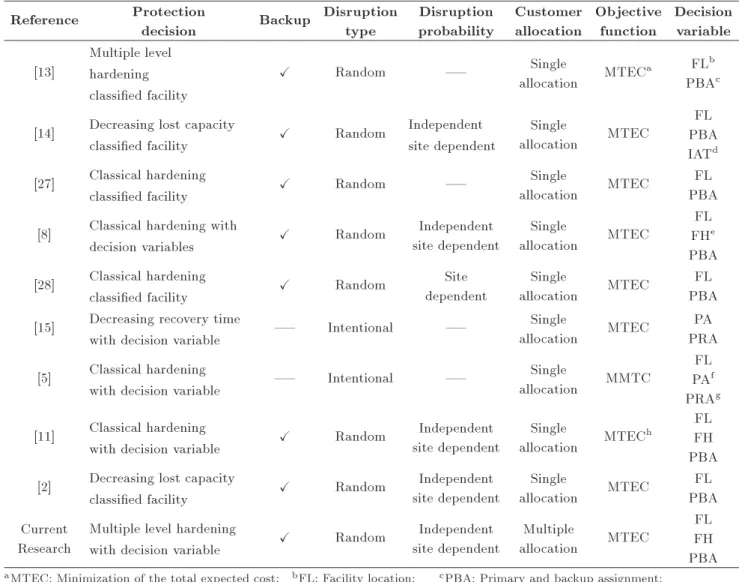
To the best of the authors' knowledge, there are only four studies of facility hardening at dierent levels. Azad et al. [2] and Fattahi et al. [13] classied facilities into dierent hardening levels and costs; the model makes decisions about locations and the primary and backup assignments [2,13]. However, Jabbarzade et al. [14] considered a model to make a decision about these classied facility locations, customer allocations, inventory, and a number of transshipments from re-liable facilities to unrere-liable ones. Losada et al. [15] found a relationship between network recovery time and dierent initial amounts of protection investment for dierent hardening levels. In order to minimize the total expected costs, the model makes decisions on only facility protection investments. In addition, all previ-ous studies have considered a single allocation situation for customers assigned to located facilities via binary decision variables, while the present paper proposes a non-linear integer programming model that considers multiple allocation situations for customers assigned to facilities and facility hardening at dierent levels. Fa-cilities can be partially hardened under dierent initial rates of protection investment; therefore, facilities may lose some of their capacity after disruption events based on their hardening levels. Hardened facilities at level one will not lose their capacity after disruption events,
Table 1. Brief review of studies in facility location for the network reliability improvement. Reference Protection
decision Backup Disruptiontype
Disruption probability
Customer allocation
Objective function
Decision variable [13]
Multiple level hardening classied facility
X Random |{ Single
allocation MTECa
FLb
PBAc
[14] Decreasing lost capacity
classied facility X Random
Independent site dependent
Single
allocation MTEC
FL PBA IATd
[27] Classical hardening
classied facility X Random |{
Single
allocation MTEC
FL PBA [8] Classical hardening with
decision variables X Random
Independent site dependent
Single
allocation MTEC
FL FHe
PBA [28] Classical hardening
classied facility X Random
Site dependent
Single
allocation MTEC
FL PBA [15] Decreasing recovery time
with decision variable |{ Intentional |{
Single
allocation MTEC
PA PRA [5] Classical hardening
with decision variable |{ Intentional |{
Single
allocation MMTC
FL PAf
PRAg
[11] Classical hardening
with decision variable X Random
Independent site dependent
Single
allocation MTEC
h FHFL
PBA [2] Decreasing lost capacity
classied facility X Random
Independent site dependent
Single
allocation MTEC
FL PBA Current
Research
Multiple level hardening
with decision variable X Random
Independent site dependent
Multiple
allocation MTEC
FL FH PBA
aMTEC: Minimization of the total expected cost; bFL: Facility location; cPBA: Primary and backup assignment; dIAT: Inventory and transportation; eFH: Facility hardening; fPA: Primary allocation;
gPRA: Protection resource allocation; hMMTC: Minimization of the maximum total cost.
while hardened facilities at level two will lose half of their capacity after such events. Table 1 presents a brief review of the second category-related studies.
One of the real applications of the proposed model is the decisions concerning the protection of hospitals and clinical services against accidental elec-tric power outage during their operation. Dierent types of medical equipment (e.g., oxygen compressors, dialysis machines, mechanical ventilation, and cardiac monitors) require sucient power to carry out vital support tasks for patients in these centers. Due to the sensitivity of this equipment to power, the power outages can aect the quality of patient care. There-fore, planners should invest in electricity supply and outage prevention when they construct hospitals and other health care centers, such as clinics, laboratories, and nursing homes [16]. For this purpose, dierent types of power generators can be used to supply part of the electricity consumed by specic departments in
hospitals, such as the emergency rooms in an accidental power outage. In other words, using generators of uninterruptible power of low to moderate power, these units will be only responsive to the electricity consumed by specic departments, such as emergency rooms. Moreover, in order to supply all parts of the hospital in a major electricity disruption, parallel high-capacity power lines can be used. The hardening of the distri-bution centers against re in the supply chain design is another application of the proposed model. Fire in these centers can be prevented through maintenance of electrical wiring and accessories, education on the basis of electrical safety principles, and investment in low-risk reghting equipment. Furthermore, the installation of re detection systems and rainwater systems will reduce the impact of re [14]. In this condition, by storing some stocks in these centers, part of customer's demands can be satised, and the remaining demands will be supplied by other centers.
The proposed model can be used in various real case applications, such as two mentioned ones, to have a resilient network.
The main contributions of this study that dier-entiate it from the past studies in the related literature can be summarized as follows:
A non-linear integer programming model is devel-oped for the facility location-allocation problem in the supply chain network design, considering a multi-allocation situation for customers assigned to facilities, capacity limitation, and multi-level hardening to optimize the total expected cost in disruption events;
A comparison of the model priority is made with classical hardening decisions in facility location problems in dierent facility failure probabilities; The proposed model is linearized by suitable
tech-niques;
A Lagrangian Decomposition Algorithm (LDA) is
developed to obtain a solution to large-scale prob-lems in a reasonable amount of time.
The structure of this paper is organized as follows. The proposed model and its proper LDA are presented in Section 2. Section 3 presents the computational results. Finally, results and suggestions for the future research are given in the last section.
2. Problem description
The proposed model considers the xed-charge facility location problem with site-specic facility failure prob-abilities and facility hardening. The model seeks to minimize the total expected cost by optimally opening facilities, deciding on the hardening level of opened facilities, and allocating customers to them as primary and backup assignments. We describe the assumptions, notations, and parameters to formulate the problem in the following sections.
2.1. Assumptions
The main assumptions of the proposed model are as follows:
Customer demands are deterministic and can be met by multiple facilities;
Facility disruption is independent and site-specic; The establishment cost is site-specic;
A facility can be hardened at additional cost up to the highest level during its establishment;
Only facilities hardened at level one are reliable and immune to failure;
After a disruption event, based on a facility hard-ening level, the disrupted facility keeps serving part
of its assigned demands, and unserved demands are reassigned to another reliable facility with a penalty cost per unit of demand;
The transportation cost is related to the distance between a customer and its assigned facility per unit of demand.
2.2. Mathematical model of reliable facility location-allocation with multi-level hardening
The following parameters and variables are described and followed by the mathematical model.
Notations and sets
I Set of potential locations;
J Set of customers;
L Set of hardening levels;
V Penalty budget;
B Hardening budget;
M A large positive constant.
Parameters
dj Demand of customer j;
pi Failure probability of facility i;
ai Establishment cost of facility i;
si Penalty cost of facility i;
ci Capacity of facility i;
hij Cost of per unit of demand to ship
from facility i to customer j;
fil The lth level hardening cost of
facility i. Decision variables
xi 1 if plant i is opened; 0, otherwise;
zil 1 if plant i is hardened at level l; 0,
otherwise;
ttij 1 if facility i is allocated to customer
j; 0, otherwise;
x1ij Fraction of customer j's demands
is satised by facility i as primary facility;
x2irj Fraction of customer j's demands is
not satised by facility r as a primary facility, but is satised by a backup facility i.
2.3. Mathematical model
The mathematical model of the Reliable Facility Location-Allocation problem with Multi-level
Harden-ing (RFLAMH) can be presented by: min :
W =X
i
ai xi+
X
i
X
j
x1ij zi1 hij
dj+
X i X j X l2
x1ij zil hij
dj (1 pi) +
X i X j x1ij 1 X l zil !
hij dj (1 pi)
+X i X j X l2
x1ij zil pi hij
dj l +X i X j X r6=i X l2
x2irj x1rj
zrl pr hij dj
l 1 l +X i X j X r6=i
x2irj x1rj
1 X
l
zrl
!
pr hij dj
+X i X j X l2
x1ij pi zil si dj
l 1 l +X i X j
x1ij pi
1 X
l
zil
!
si dj
+X
i
X
l
fil zil; (1)
s.t.:
x1ij xi 8 i; j; (2)
x2irj xi 8 i; r 6= i; j; (3)
X
i
x1ij = 1 8 j; (4)
x2irj zi1 8 i; r 6= i; j; (5)
zil xi 8 i; l; (6)
X
l
zil 1 8 i; (7)
X
i6=r
x2irj = ttrj (1 zr1) 8 r; j; (8)
ttij x1ij 8 i; j; (9)
ttij M x1ij 8 i; j; (10)
X i X j X l2
x1ij zil si dj
l 1 l +X i X j
x1ij 1
X
l
zil
!
si dj V; (11)
X
i
X
l
fil zil B; (12)
X
j
x1ij dj+
X j X r6=i X l2
x2irj x1rj zrl
dj l 1 l +X j X r6=i
x2irj x1rj
1 X
l
zrl
!
dj ci 8 i; (13)
xi; zil; ttij 2 f0; 1g 8 i; j; l; (14)
x1ij; x2irj2 [0; 1] 8 i; r 6= i; j; l: (15)
Eq. (1) is the objective function that minimizes the total expected cost. Constraints (2) and (3) guarantee that only open facilities can serve as suppliers. Con-straint (4) ensures that customer demand should be served completely. Constraint (5) ensures that only reliable facilities can serve customers as backup suppli-ers. Constraint (6) guarantees that only open facilities can be hardened at dierent levels. Constraint (7) limits facilities to being hardened at most to one level only. Constraints (8)-(10) guarantee that customers of failed facilities can be reassigned to backup facilities. Constraint (11) limits penalty budgets. Constraint (12) limits hardening budgets. Constraint (13) considers the capacity limitation of each facility to serve customers. Constraints (14) and (15) dene decision variable types.
2.4. Linearization of the proposed mathematical model
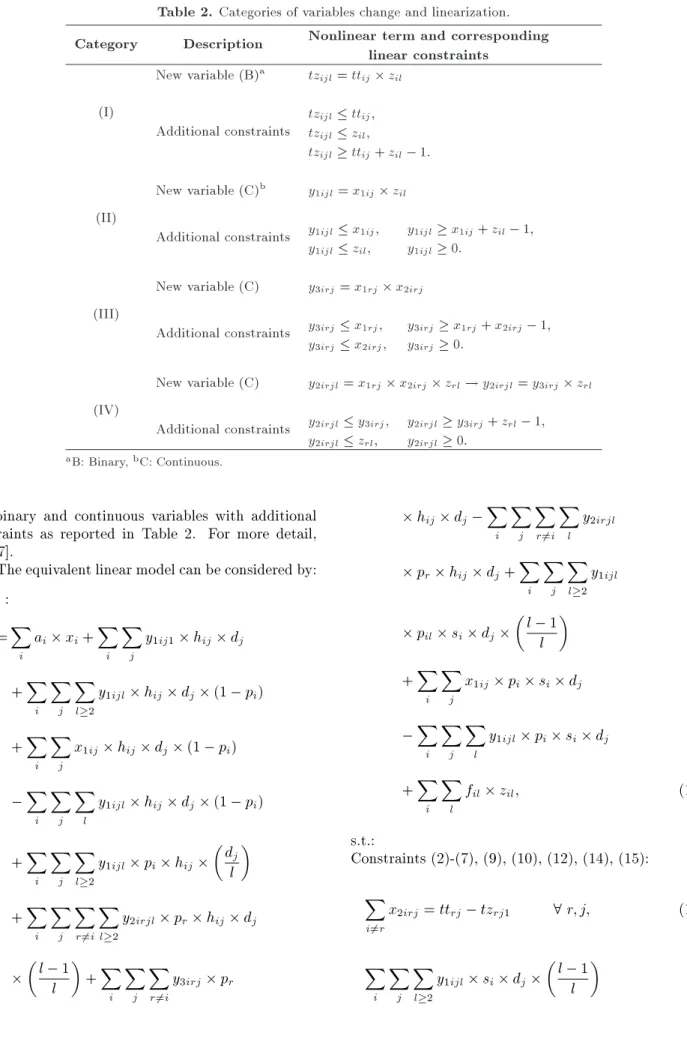
It can be seen that the proposed model is nonlinear. Therefore, in order to linearize it, we introduce some
Table 2. Categories of variables change and linearization. Category Description Nonlinear term and corresponding
linear constraints
(I)
New variable (B)a tz
ijl= ttij zil
Additional constraints tztzijlijl tt zilij;;
tzijl ttij+ zil 1:
(II)
New variable (C)b y
1ijl= x1ij zil
Additional constraints y1ijl x1ij, y1ijl x1ij+ zil 1,
y1ijl zil, y1ijl 0.
(III)
New variable (C) y3irj= x1rj x2irj
Additional constraints y3irj x1rj, y3irj x1rj+ x2irj 1,
y3irj x2irj, y3irj 0.
(IV)
New variable (C) y2irjl= x1rj x2irj zrl! y2irjl= y3irj zrl
Additional constraints y2irjl y3irj, y2irjl y3irj+ zrl 1,
y2irjl zrl, y2irjl 0. aB: Binary,bC: Continuous.
new binary and continuous variables with additional constraints as reported in Table 2. For more detail, see [17].
The equivalent linear model can be considered by: min :
W =X
i
ai xi+
X
i
X
j
y1ij1 hij dj
+X
i
X
j
X
l2
y1ijl hij dj (1 pi)
+X
i
X
j
x1ij hij dj (1 pi)
X
i
X
j
X
l
y1ijl hij dj (1 pi)
+X
i
X
j
X
l2
y1ijl pi hij
dj
l
+X
i
X
j
X
r6=i
X
l2
y2irjl pr hij dj
l 1 l
+X
i
X
j
X
r6=i
y3irj pr
hij dj
X
i
X
j
X
r6=i
X
l
y2irjl
pr hij dj+
X
i
X
j
X
l2
y1ijl
pil si dj
l 1
l
+X
i
X
j
x1ij pi si dj
X
i
X
j
X
l
y1ijl pi si dj
+X
i
X
l
fil zil; (16)
s.t.:
Constraints (2)-(7), (9), (10), (12), (14), (15): X
i6=r
x2irj= ttrj tzrj1 8 r; j; (17)
X
i
X
j
X
l2
y1ijl si dj
l 1
l
+X
i
X
j
x1ij si dj
X
i
X
j
X
l
y1ijl
si dj V; (18)
X
j
x1ij dj+
X
j
X
r6=i
X
l2
y2irjl dj
l 1
l
+X
j
X
r6=i
y3irj dj
X
j
X
r6=i
X
l
y2irjl dj
ci; 8 i; (19)
tzijl ttij 8 i; j; l; (20)
tzijl zil 8 i; j; l; (21)
tzijl ttij+ zil 1 8 i; j; l; (22)
y1ijl x1ij 8 i; j; l; (23)
y1ijl zil 8 i; j; l; (24)
y1ijl x1ij+ zil 1 8 i; j; l; (25)
y2irjl x2irj 8 i; r 6= i; j; (26)
y2irjl y1rjl 8 i; r 6= i; j; l; (27)
y2irjl x2irj+ y1rjl 1 8 i; r 6= i; j; l; (28)
y3irj x1rj 8 i; r 6= i; j; (29)
y3irj x2irj 8 i; r 6= i; j; (30)
y3irj x1rj+ x2irj 1 8 i; r 6= i; j; (31)
tzijl2 f0; 1g 8 i; j; l; (32)
y1ijl; y2irjl; y3irj 2 [0; 1] 8 i; r 6= i; j; l: (33)
2.5. Solution method
Since the classic solution algorithms for the capacitated location-allocation problem need a huge computational time, especially in large cases, it appears to be essential to propose an ecient solution approach to solving the model in large instances. On the other hand, the studies on location-allocation problems that utilize the Lagrangian relaxation-based solution method to solve the problem have presented the eectiveness of this method in solving such problems [3,9,10,18-31]. Herein, the Lagrangian Decomposition Algorithm (LDA) is proposed to solve the problem eciently.
Solving the RFLAMH model is time consuming by the GAMS software, especially for large-scale prob-lems. Because the proposed model contains binary
and continuous variables, in this type of problems, a decomposition approach can intensively reduce compu-tational times. In order to prepare the proposed model for decomposition in the rst step by an implemen-tation of linearization techniques, the proposed model is changed into a linear form, in which all terms in the objective function contain only one type of decision variables. In the next step, by relaxing constraints that connect binary and continuous variables, all terms in unrelaxed constraints contain only one type of decision variables. Then, the new linear relaxed problem can be decomposed easily into two sub-problems. The rst one contains only binary variables that can be solved by the branch-and-bound algorithm. The second one contains only the continuous variables that can be solved by the simplex method in a short time. Numerical calculations and comparison in the next section show the eciency of the proposed solution approach. The main structure of the LDA is described below:
1. Lagrangian relaxation: The Lagrangian
relax-ation problem is obtained by relaxing constraints that connect binary variables to continuous vari-ables. The relaxed constraints appear in the new objective function by Lagrangian multipliers;
2. Decomposition: The relaxed problem is then
decomposed into two independent sub-problems that can easily be solved. Both sub-problems can be solved optimally to generate lower and upper bounds concurrently;
3. Sub-gradient optimization: The Lagrangian
multipliers are adjusted based on the violation of relaxed constraints, and the process is repeated until achieving a deterministic stopping criterion. 2.5.1. Lagrangian relaxation for the RFLAMH model In the RFLAMH model, by relaxing Constraints (2), (3), (5), (9), (10), (17), (24), and (25), the relaxed problem can be expressed by:
min :
W =X
i
ai xi+
X
i
X
j
y1ij1 hij dj
+X
i
X
j
X
l2
y1ijlhijdj(1 pi)
+X
i
X
j
x1ij hij dj (1 pi)
X
i
X
j
X
l
y1ijl hij dj (1 pi)
+X
i
X
j
X
l2
y1ijl pi hij
dj
l
+X i X j X r6=i X l2
y2irjl pr hij dj
l 1 l +X i X j X r6=i
y3irj pr
hij dj
X i X j X r6=i X l
y2irjl pr
hij dj+
X i X j X l2
y1ijl pi
si dj
l 1 l +X i X j x1ij
pi si dj
X i X j X l y1ijl
pi si dj+
X
i
X
l
fil zil
+X
i
X
j
u1ij (x1ij xi)
+X i X r6=i X j
u2irj (x2irj xi)
+X i X r6=i X j
u3irj (x2irj zi1)
+X r X j u4rj 0 @X i6=r
x2irj (ttrj tzrj1)
1 A +X i X j
u5ij (x1ij ttij)
+X
i
X
j
u6ij (ttij M x1ij)
+X i X j X l
u7ijl (y1ijl zil)
+X i X j X l
u8ijl(x1ij+ zil 1 y1ijl); (34)
s.t.:
Constraints (4), (6), (7), (12), (14), (15), (18), (19), (23), (26)-(33).
2.5.2. Decomposition of the relaxed RFLAMH model The relaxed problem is decomposed into two indepen-dent sub-problems: location-hardening and allocation sub-problems, called sub1 and sub2, respectively. In sub-problems, uij, uijl, and uirj are Lagrangian
multi-pliers.
Sub-problem 1 (sub1):
The rst sub-problem (sub1) that includes binary variables is given only by:
min :
W =X
i
ai xi+
X
i
X
l
fil zil
X
i
X
j
u1ij xi
X i X r6=i X j
u2irj xi
X i X r6=i X j
u3irj zi1
X
r
X
j
u4rj (ttrj tzrj1)
X
i
X
j
u5ij ttij+
X i X j u6ij ttij X i X j X l
u7ijl zil
+X i X j X l
u8ijl zil; (35)
s.t.:
Constraints (6), (7), (12), (14), (20)-(22), and (32). Sub-problem 2 (sub2):
The second sub-problem (sub2) that includes continu-ous variables only is given by:
min : Wsub2=
X
i
X
j
y1ij1 hij dj
+X i X j X l2
y1ijl hij dj (1 pi)
+X
i
X
j
x1ij hij dj (1 pi)
X i X j X l
y1ijl hij dj (1 pi)
+X i X j X l2
y1ijl pi hij
dj
l
+X i X j X r6=i X l2
y2irjl pr hij dj
l 1 l +X i X j X r6=i
y3irj pr
hij dj
X i X j X r6=i X l
y2irjl pr
hij dj+
X i X j X l2
y1ijl pi si
dj l 1 l +X i X j
x1ij pi si
dj X i X j X l
y1ijl pi si dj
+X
i
X
j
u1ij x1ij+
X i X r6=i X j u2irj
x2irj+
X i X r6=i X j
u3irj x2irj
+X r X j u4rj X i6=r
x2irj+
X i X j u5ij x1ij X i X j
u6ij M x1ij
+X i X j X l
u7ijl y1ijl
+X i X j X l
u8ijl (x1ij y1ijl 1); (36)
s.t.:
Constraints (4), (15), (18), (19), (22), (26)-(31), and (33).
2.5.3. Sub-gradient optimization
In order to solve the decomposed problems, a sub-gradient algorithm is used to calculate the Lagrangian multipliers. For more detail, see [29,30]. The following notations and steps are used for the procedure. Notations
WLB Best lower bound
WUB Best upper bound
$M Maximum of the relative gap
L Step size
Step size coecient
t Number of iterations
tmax Max iteration
"t
q Violation of constraint q for a solution
in iteration t
IM0 Max iteration without improvement
In order to generate lower and upper bounds concur-rently with the suitable quality, sub-gradient optimiza-tion is applied by using the following steps:
Step 0: Initialize the parameters (uq, , tmax, IM0,
$M)
1. Set WLB ! 1 and WUB ! +1.
Step 1: 1. Solve sub1, 2. Solve sub2,
3. Set W
LR = Wsub1 + Wsub2 ,
4. If W
LR WLB, set WLB= WLR ,
otherwise, IM = IM + 1,
5. Fix sub1 solution in the main problem and get (W),
6. If (W< W
UB) ! Set WUB= W,
7. Set $ = (WUB WLB)
WLB .
Step 2: 1. If (t tmax OR $ $M), stop,
otherwise, go to the next step. Step 3: 1. If IM IM0, then = =2,
2. Set L = (WUBP WLB) q("
t q)2 ,
3. Set ut+1
q = max(0; utq+ (L "tq)),
4. Set t t + 1 and return to Step 1. 3. Computational results
Some numerical analyses from dierent aspects are described in two parts. In the rst one, the necessity of the proposed mathematical model (RFLAMH) is evaluated by comparing it to the classical hardening facility location-allocation model (RFLACH). Then, in the next part, the eciency of the proposed solution algorithm (LDA) is considered in both solution quality and computational time.
3.1. The proposed model's eect in the
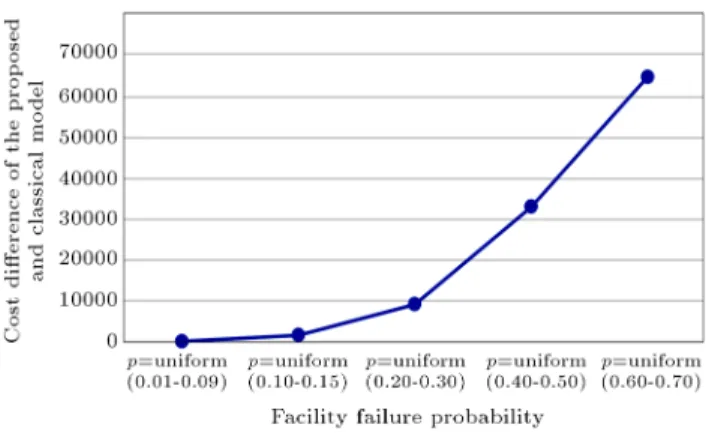
network design compared to classic models To consider the eectiveness of the proposed mathe-matical model in a network design, the behavior of the proposed model is compared with the classical hard-ening facility location-allocation model (RFLACH) in an instance. The selected instance consists of 15 facilities, 20 customers, and 3 hardening levels in dierent values of failure probability. The Objective Function Values (OFVs) of the two models are obtained for selected instance, considering various degrees of failure probabilities. Figure 1 illustrates the dierence of two OFVs by increasing the failure probability.
Figure 1. Dierence of OFVs of RFLAMH and RFLACH in dierent failure probabilities.
The comparison of results shows that the total cost of the RFLAMH model is lower than that of the RFLACH model. This comparison conrms the necessity of using the proposed model in the network
design. The numerical analysis conrms that the
proposed model should be used in cases with a large value of failure probabilities of facilities.
3.2. Evaluating the eciency of LDA
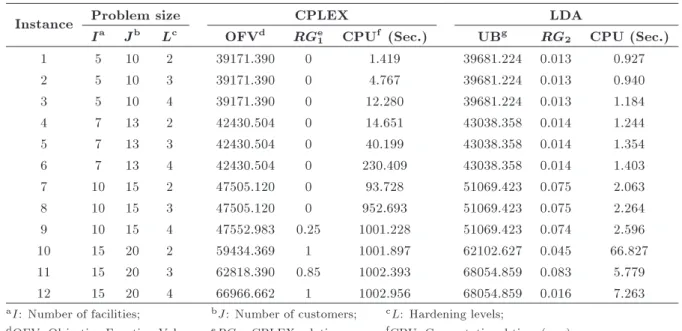
In this section, the performance of the proposed solu-tion approach is evaluated using some test problems with several sizes. For mentioned problems, dierent parameters (e.g., capacity, facility establishment cost, facilities failure probability, facility hardening cost, and penalty cost) are randomly generated by the uniform distribution function, as presented in Table 3. The results of the LDA in each instance are compared with the obtained results of solving the linear proposed model by the CPLEX solver in GAMS 24.7.4. The best values of the LDA upper bounds and the gaps of the LDA compared to the CPLEX are given for each problem in Table 4. For each problem, the LDA gap in comparison to the CPLEX is obtained by:
RG2= (Upper BoundOFVLDA OFVCPLEX)
CPLEX : (37)
Table 3. Parameters for the generated test problems and initial multipliers for the LDA.
Parameters Multipliers
ai= uniform[0:01; 0:1] u1ij= uniform(0:01; 0:1)
ci= uniform[10000; 13000] u2irj= uniform(0:01; 0:1)
dj= uniform[200; 500] u3irj= uniform(0:01; 0:1)
hij= uniform[10; 15] u4rj= uniform(0:01; 0:1)
pi= uniform[0:01; 0:1] u5rj= uniform(0:01; 0:1)
si= uniform[20; 30] u6rj= 0
fi1 = 0:01 uniform[30; 50] u7ijl= uniform(0:01; 0:1)
fi2 = 0:01 uniform[15; 20] u8ijl= 0
fi3 = 0:1 uniform[12; 15]
Figure 2. Comparison of the LDA and CPLEX computational times.
Figure 3. Comparison of the upper bound and OFV.
It is expected that the proposed solution algorithm be more ecient in solving the RFLAMH compared to the classic solution approaches. Results of a comparison are depicted in Figures 2 and 3.
4. Conclusion and recommendations
In the real world, facilities can be disrupted in some cases. Facility disruption may lead to the increase of network costs and customers dissatisfaction. This concept can be more important for cases with higher penalty costs of unserved demands. For example, telecommunication networks, relief distribution cen-ters, and emergency rooms in healthcare services are some examples of such applications. The facilities should be hardened enough to prevent a failure. In this paper, a mathematical model was proposed, and a static resilient network was considered. The numerical studies conrmed that the network designed by the proposed model led to a signicantly less cost compared to the network designed by classic models. The dier-ence between the proposed model and previous classic models had a considerable dierence in cases with high facility failure probabilities. The human-based moni-toring cases are some examples of such cases. Since solving location-allocation models is time consuming by the classical solution algorithms, especially for large-scale problems, Lagrangian Decomposition Algorithm (LDA) was one of the solution approaches to this problems. In order to decompose the problem, the proposed non-linear model was linearized. The numer-ical results conrmed that the LDA had the ability
Table 4. Computational results of the LDA and CPLEX.
Instance Problem size CPLEX LDA
Ia Jb Lc OFVd RGe
1 CPUf (Sec.) UBg RG2 CPU (Sec.)
1 5 10 2 39171.390 0 1.419 39681.224 0.013 0.927
2 5 10 3 39171.390 0 4.767 39681.224 0.013 0.940
3 5 10 4 39171.390 0 12.280 39681.224 0.013 1.184
4 7 13 2 42430.504 0 14.651 43038.358 0.014 1.244
5 7 13 3 42430.504 0 40.199 43038.358 0.014 1.354
6 7 13 4 42430.504 0 230.409 43038.358 0.014 1.403
7 10 15 2 47505.120 0 93.728 51069.423 0.075 2.063
8 10 15 3 47505.120 0 952.693 51069.423 0.075 2.264
9 10 15 4 47552.983 0.25 1001.228 51069.423 0.074 2.596
10 15 20 2 59434.369 1 1001.897 62102.627 0.045 66.827
11 15 20 3 62818.390 0.85 1002.393 68054.859 0.083 5.779
12 15 20 4 66966.662 1 1002.956 68054.859 0.016 7.263
aI: Number of facilities; bJ: Number of customers; cL: Hardening levels;
dOFV: Objective Function Value; eRG1: CPLEX relative gap; fCPU: Computational time (sec.); gUB: Upper Bound of LDA.
to generate very near-optimal solutions to the exact ones in less computation time. There are some cases with uncertain customer demands; therefore, demand uncertainty can be one of the directions for future researches. A decision about dierent transportation modes with dierent environmental pollutions in the problem modeling can be made in order to reduce the total expected cost of location, hardening, transporta-tion, and decreasing of environmental pollutions. Using other decomposition algorithms can be considered as another future work.
References
1. Amoaning, Y. \A resiliency framework for planning in state transportation agencies", Gor. Ins. Technol., pp. 1-2 (2013).
2. Azad, N., Davoudpour, H., Saharidis, G.K.D., and Shiripour, M. \A new model to mitigating random disruption risks of facility and transportation in supply chain network design", International Journal of Ad-vanced Manufacturing Technology, 69, pp. 1757-1774 (2013).
3. Qingwei, L. and Savachkin, A. \A heuristic approach to the design of fortied distribution networks", Trans-portation Research Part E, 50, pp. 138-148 (2013).
4. Church, R.L., Middleton, R.S., and Scaparra, M.P. \Identifying critical infrastructure: The median and covering facility interdiction problems", Annals of the Association of American Geographers, 94, pp. 491-502 (2004).
5. Scaparra, M.P. and Church, R.L. \A bilevel mixed-integer program for critical infrastructure protection planning", Computer and Operations Research, 35, pp. 1905-1923 (2008).
6. Aksen, D., Necati, A., and Piyade, N. \The budget constrained r-interdiction median problem with capac-ity expansion", Central European Journal of Opera-tions Research, 18, pp. 269-291 (2010).
7. Daskin, M., Liberatore, F., and Scaparra, M.P. \Hedg-ing against disruptions with ripple eects in location analysis", OMEGA, 40, pp. 21-30 (2012).
8. Medal, H.R., Pohl, E.A., and Rossetti, M.D. \A multi-objective integrated facility location-hardening model: Analyzing the pre and post-disruption tradeo", Eu-ropean Journal of Operational Research, 237, pp. 257-270 (2014).
9. Snyder, L. and Daskin, M.S. \Reliability models for facility location: the expected failure cost case", Transportation Science, 39, pp. 400-416 (2005).
10. Lim, M., Daskin, M.S., Bassamboo, A., and Chopra, S. \Facility reliability problem: formulation, properties, and algorithm", Naval Research Logistics, 57, pp. 58-70 (2009).
11. Shishebori, D., Snyder, L.V., and Jabalameli, M.S. \A reliable budget-constrained facility location/network design problem with unreliable facilities", Networks and Spatial Economics, 14, pp. 549-580 (2014).
12. Mohammadi, M., Tavakkoli-Moghaddam, R., Siadat, A., and Dantan, J.-Y. \Design of a reliable logistics network with hub disruptions under uncertainty", Applied Mathematical Modelling, 40, pp. 5621-5642 (2016).
13. Fattahi, M., Govindan, K., and Keyvanshokooh, E. \Responsive and resilient supply chain network design under operational and disruption risks with delivery lead-time sensitive customers", Transportation Re-search Part E: Logistics and Transportation Review, 101, pp. 176-200 (2017).
14. Jabbarzadeh, A., Fahimnia, B., Sheu, J.B., and Shahmoradi-Moghadam, H. \Designing a supply chain resilient to major disruptions and supply/demand interruptions", Transportation Research Part B, 94, pp. 121-149 (2016).
15. Losada, C., Scaparra, M.P., and O'Hanley, J.R. \Op-timizing system resilience: a facility protection model with recovery time", European Journal of Operational Research, 217, pp. 519-530 (2012).
16. Rastgoufard, P., Leevongwat, I., and Rastgoufard, R. \Electric grid hardening and resiliency: part I, resiliency and safety", Engineering & Technology Ref-erence, 14 pages (2016).
17. Niakan, F. and Rahimi, M. \A multi-objective health-care inventory routing problem: A fuzzy possibilistic approach", Transportation Research Part E: Logistics and Transportation Review, 80, pp. 74-94 (2015).
18. Holmberg, K., Ronnqvist, M., and Yuan, D. \An exact algorithm for the capacitated facility location problems with single sourcing", European Journal of Operational Research, 113, pp. 544-559 (1999).
19. Barcelo, J. and Casanovas, J. \A heuristic Lagrangean algorithm for the capacitated plant location problem", European Journal of Operational Research, 15, pp. 212{226 (1984).
20. Beasley, J.E. \Lagrangean heuristics for location prob-lems", European Journal of Operational Research, 65, pp. 383{399 (1993).
21. Agar, M.C. and Salhi, S. \Lagrangean heuristics ap-plied to a variety of large capacitated plant location problems", Journal of the Operational Research Soci-ety, 49(1), pp. 1072{1084 (1998).
22. Cortinhal, M.J. and Captivo, M.E. \Upper and lower bounds for the single source capacitated location prob-lem", European Journal of Operational Research, 151, pp. 333{351 (2003).
23. Chen, C.H. and Ting, C.J. \Combining Lagrangian heuristic and ant colony system to solve the single source capacitated facility location problem", Trans-portation Research Part E: Logistics and Transporta-tion Review, 44(6), pp. 1099-1122 (2008).
24. Jena, S.D., Cordeau, J.F., and Gendron, B. \Solving a dynamic facility location problem with partial closing and reopening", Computers and Operations Research, 67, pp. 143-154 (2016).
25. Ronnqvist, M., Tragantalerngsak, S., and Holt, J. \A repeated matching heuristic for the single-source ca-pacitated facility location problem", European Journal of Operational Research, 116, pp. 51-68 (1999).
26. Wu, T., Chu, F., Yang, Z., and Zhou, Z. \A La-grangean relaxation approach for a two-stage capac-itated facility location problem with choice of facility size", In Proceedings of the IEEE International Con-ference on Systems, Man, and Cybernetics, pp. 713-718 (2015).
27. Li, Q., Savachkin, A., and Zeng, B.O. \Reliable facility location design under disruptions", Computers and Operations Research, 40, pp. 901-909 (2013).
28. Li, Q. and Savachkin, A. \Reliable distribution net-works design with nonlinear fortication function", International Journal of Systems Science, 47, pp. 805-813 (2014).
29. Held, M., Crowder, D., and Wolf, H. \Validation of subgradient optimization", Mathematical Program-ming, 6, pp. 62-88 (1974).
30. Eskandarzadeh, S., Tavakkoli-Moghaddam, R., and Azaron, A. \An extension of the relaxation algorithm for solving a special case of capacitated arc routing problems", Journal of Combinatorial Optimization, 17(2), pp. 214-234 (2009).
31. Shishebori, D., Youse Babadi, A., and Noormoham-madzadeh, Z.A. \Lagrangian relaxation approach to fuzzy robust multi-objective facility location network design problem", Scientia Iranica, 25, pp. 1750-1767 (2018).
Biographies
Zahra Esfandiyari is currently a PhD student under the supervision of Professor Bashiri at Islamic Azad University-Science & Research Branch in Tehran. She obtained her BSc in Pure Mathematics from Iran University of Alzahra in Tehran. She obtained her MSc in Industrial Engineering from the Islamic Azad University Science & Research Branch in Tehran. Her research interests include supply chain, disruption and mathematical modeling.
Mahdi Bashiri is a Professor of Industrial Engineer-ing at Shahed University. He holds a BSc degree in Industrial Engineering from Iran University of Science and Technology as well as MSc and PhD degrees from Tarbiat Modarres University. He is a recipient of the 2013 young national top scientist award from the Academy of Sciences of the Islamic Republic of Iran. He serves as the Editor-in-Chief of Journal of Quality Engineering and Production Optimization published in Iran and the Editorial Board member of some reputable academic journals. His research interests are facility planning, stochastic optimization, meta-heuristics, and multi-response optimization. He published about 10 books and more than 190 papers in reputable academic journals and conferences.
Reza Tavakkoli-Moghaddam is a Professor of In-dustrial Engineering at the College of Engineering, Uni-versity of Tehran in Iran. He obtained his PhD, MSc, and BSc degrees in Industrial Engineering from Swin-burne University of Technology in Melbourne (1998), University of Melbourne in Melbourne (1994), and Iran University of Science and Technology in Tehran
(1989), respectively. He serves as the Editor-in-Chief of Journal of Industrial Engineering published in Iran. He is a recipient of the 2009 and 2011 Distinguished Re-searcher Awards and the 2010 and 2014 Distinguished Applied Research Awards at University of Tehran, Iran. He has been selected as the National Iranian
Distinguished Researcher in 2008 and 2010 by the Ministry of Science, Research, and Technology in Iran. He has obtained the outstanding rank as the top 1% scientist and researcher in the world elite group since 2015. He has published 4 books, 22 book chapters, and more than 1000 journal and conference papers.