COMPOSITION CHANGES DURING RE-REFINEMENT OF
USED LUBRICATING OILS USING FABRICATED
PACKED-BED REACTOR
F. M. Adebiyi
[a]*, A. F. Adeyemi
[a,b], O. A. Koya
[c], S. Mastrolitti,
[d]V. Valerio
[e]and A. Santoro
[e]Keywords: GC-MS, IR, lubricating oil, PBR, PAHs, re-refined.
This study aimed at developing a laboratory scale packed bed reactor (PBR) and evaluating its performance in re-refining of used lubricating oils. Used and unused motor oil samples of two brands (Mobil Super SAE 20W-50 and Total Quartz 5000 SAE 20W-50) were used in this study. The sorbent materials were a blend of diatomaceous materials in the same mass ratio. The compound types of the oils eluted from the PBR and those of used and virgin oil samples were studied for comparison. FTIR spectroscopy was employed to observe the variations in the types and nature of functional groups present in the various oils as well as to estimate the oxidation products of the oils using peak area increase (PAI). The constituent organic compounds were also identified and quantified using GC-MS. The results revealed that some of the compounds exist in different isomeric forms in the oil samples. The similarity in the classes of compounds is affirmed by their very similar FTIR spectra. GC-MS results indicated that the used oils contained the highest number of compounds, followed by the treated oils and also indicated similar treatment effects on the brands of lubricating oil. The study concluded that the developed reactor is a viable and sustainable technique for re-refining of used lubricating oils.
* Corresponding Authors Phone: +2348034237426
E-Mail: [email protected], [email protected] [a] Department of Chemistry, Obafemi Awolowo University,
Ile-Ife, Nigeria
[b] Department of Chemistry, University of Medical Sciences, Ondo, Nigeria
[c] Department of Mechanical Engineering, Obafemi Awolowo University, Ile-Ife, Nigeria
[d] Italian National Agency for New Technologies, Energy and Sustainable Economic Development (ENEA), Territorial Office of Bari, Italy
[e] Italian National Agency for New Technologies, Energy and Sustainable Economic Development (ENEA), C.R. Trisaia [e] Joint Research Centre (JRC) - Brussels, Belgium
Introduction
Motor oil used in automobile engines picks up a number of debris from engine wear. These include metals, sulphur, water, dirt, combustion products, such as ash, and carbon residue. Due to the presence of degraded additives and the aforementioned contaminants, used motor oil disposal can be more environmentally degrading than crude oil pollution. The amount of lubricating oils annually generated worldwide is enormous and is increasing due to increase in automobiles. The large amount of waste engine oils has significant socio-economic and environmental impacts on the society. If discharged onto the land, water or even burnt as a low grade fuel, it may cause serious environmental pollution because harmful metals and other persistent organic and inorganic pollutants are released into the environment. 1 These additives and contaminants may cause
both short and long-term adverse effects. Since motor oil does not degrade, used motor oil as the potential to be recycled safely and productively, saving energy and circumventing environmental pollution. 2,3,4
The conventional approaches of recycling used motor oil either entail a high-cost technology such as vacuum distillation or the use of toxic materials such as sulphuric acid, contaminating by-products with high sulphur
concentrations may be made. Blend of vacuum distillation and hydrogenation systems had been used for recycling used engine oil.5 This approach gives high quality product
including high yield. It also removes most of the contaminants from the used oil viz., sulphur, nitrogen and oxygenated compounds as well as enhanced the colour and odour of the oil but it involves high investment cost.6,7
Acid-clay technique which had also been severally adopted has disadvantages viz., production of large amount of pollutants, incapability to treat modern multi-grade oils and the difficulty in removing asphaltic impurities.1,8,9
Solvent extraction method has substituted acid treatment for
improving the oxidative constancy and
viscosity/temperature characteristics of base oils. The solvent selectively dissolves the unwanted aromatic components, leaving the required saturated components, particularly alkanes, as a distinct phase.10 Although the oil
resulting from this process was akin to that produced by the acid-clay method, it is not cost effective as expensive solvents and vacuum distillation set-ups are essential to carry out the technique.11,12 In the report of Rincon et al,13
propane was used as a solvent. Propane can dissolve paraffinic or waxy material and partially dissolve oxygenated material. Asphaltenes which contain heavy condensed aromatic compounds and particulate matter are insoluble in the liquid propane. These properties make propane ideal for recycling the used engine oil, although there are many other concerns that have to be well-thought-out. Propane is expensive and inflammable, so that this procedure is viewed as both cost-ineffective and unsafe. Also, the extraction involves solvent losses, and highly skilled operating maintenance. In addition, extraction occurs at pressures higher than 10 atm and requires high pressure sealing systems which make solvent extraction plants expensive to build and operate. The process also generates significant amounts of hazardous by-products.9,14
polyethersulphone (PES), polyvinylidene fluoride (PVDF), and polyacrylonitrile (PAN), were used for recycling the used engine oils. The process is carried out at 40 °C and 0.1 MPa pressure.15 It is an uninterrupted operation procedure, it
eliminates metal particles and dusts from used engine oil and also improves the recovered oils liquidity and its flash point. Its shortcomings are that the expensive membranes used in the method may get spoiled or fouled by large particulate matters.9,15
The application of the packed-bed reactor using the locally available diatomaceous material is a safe and economical small-scale purification of used lubricating oil since the contaminants have good affinity for diatomaceous materials. This approach is similar to the principle of chromatography separation, hence this study.
Experimental
Materials and their preparation
Unused (virgin) oil samples of two brands (Mobil Super SAE 20W-50 and Total Quartz 5000 SAE 20W-50) were purchased from standard lubricant stations in Ile-Ife, Nigeria, and they were introduced, at the time of routine services, into five selected cars for each brand. The oils were drained after 11 – 12 weeks, and retained as the Used lubricating oil (ULO) samples. The sorbent materials employed consisted of a blend of diatomaceous materials in equal ratio by mass. The sorbent materials were obtained from and prepared at the Federal Institute for Industrial Research, Oshodi (FIIRO), Lagos, Nigeria. Slurry of the sorbent mixture was made and fired at 900°C to produce a cake, which was then ground and screened to produce uniform material of narrow particle-size distribution (1.00-1.50 mm). The particle-size distribution of the ground material was estimated using two sieves of 1.00 and 1.50 mm pore sizes. The ground sorbent was activated by soaking in 6 M H2SO4 at 60 °C for 6 h.
This was followed by filtration and then drying in a Muffle furnace at about 250 °C for 4 h.
The Packed Bed Reactor consisted of a reservoir which housed the pre-heated used oil, a tap, a reciprocating pump (powered by 1 horse power geared motor), a crank connected to the motor, piston enclosed in a sleeve, pressure gauge, the packed-bed and a collecting vessel. The column was formulated to contain about 10 L quantity of the sorbent while the wall thickness was defined to withstand the required pressure. The packed bed reactor was constructed at the Central Technological Laboratory and Workshop (CTLW), Obafemi Awolowo University, Ile-Ife, Nigeria. The fabricated packed bed reactor is shown in Supplementary material.
The used oil samples were allowed to stand still for two weeks to give way for sedimentation. The top part of each was decanted into stainless pan and heated in open air at about 115 °C for two hours to drive out trapped moisture and some volatile constituents and to reduce its viscosity so that flowing through the packed bed can be enhanced. The hot oil was filtered into the reservoir after which the tap was opened. Five sets of used oil samples from each of the two brands were run through the packed bed reactor (PBR). The
constituent organic compounds in the eluted oils from the PBR (treated oils), used and virgin oils were identified and quantified using FTIR spectroscopy and GC-MS. The FT-IR analysis was done at Redeemer University, Ede, Nigeria, while the GC-MS analysis was carried out at University of Ilorin, Ilorin, Nigeria.
Results and discussion virgin
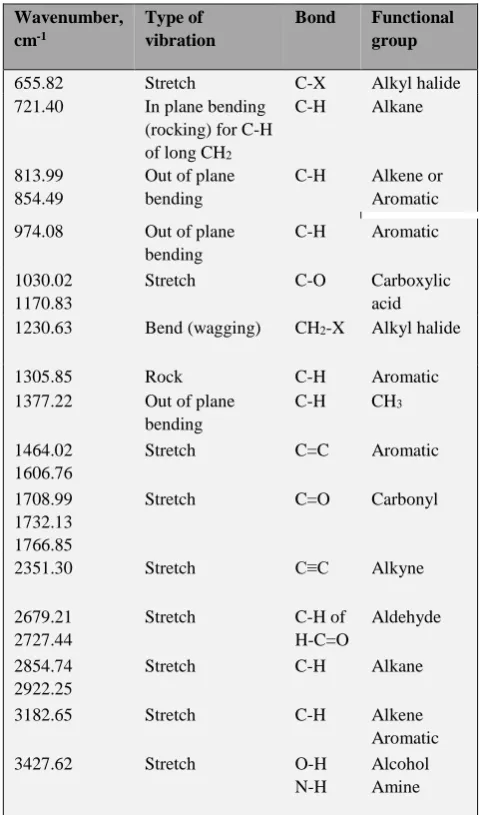
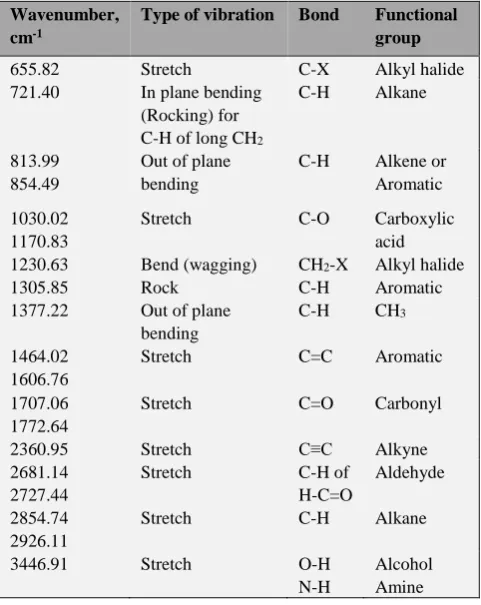
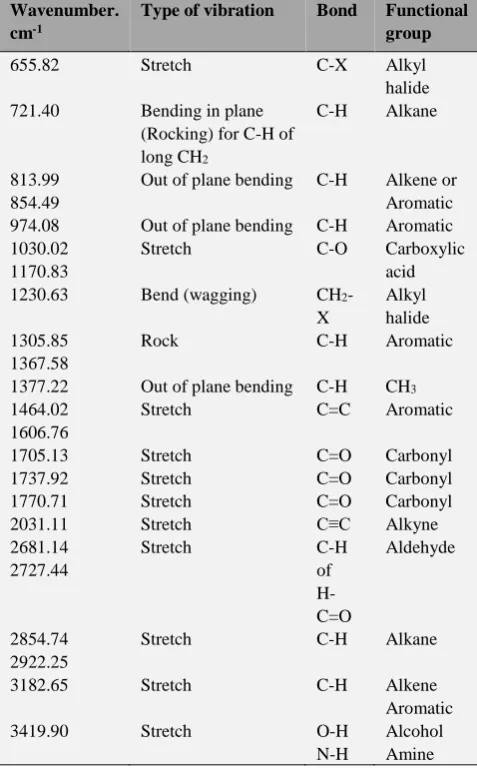
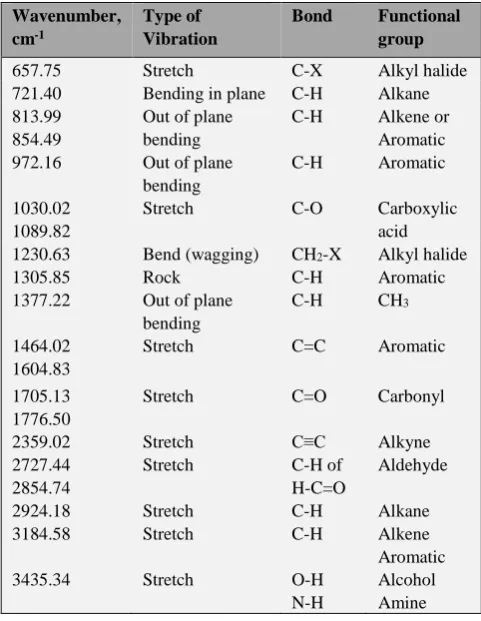
The identification of compounds found in the virgin, treated and used oils were performed by IR and GC-MS methods. Tables 1-9 show the wave numbers as revealed by the FTIR spectroscopy, the corresponding type of vibration, associated bond(s) and functional groups of the oil samples; while their spectra samples are presented in Supplementary materials.
The spectra as well as the peak areas of the various oil samples were very similar. Thus the peak area increase (PAI) values between the used and the treated oils might be very small or the same and consequently, could not be meaningfully determined.16 Thus, the PAI could not be
meaningfully used to estimate the oxidation products.
Table 1. Results of the FTIR analysis of the Virgin Mobil oil sample.
Wavenumber, cm-1
Type of vibration
Bond Functional group
655.82 Stretch C-X Alkyl halide 721.40 In plane bending
(rocking) for C-H of long CH2
C-H Alkane
813.99 854.49
Out of plane bending
C-H Alkene or Aromatic
974.08 Out of plane bending
C-H Aromatic
1030.02 1170.83
Stretch C-O Carboxylic acid 1230.63 Bend (wagging) CH2-X Alkyl halide
1305.85 Rock C-H Aromatic 1377.22 Out of plane
bending
C-H CH3
1464.02 1606.76
Stretch C=C Aromatic
1708.99 1732.13 1766.85
Stretch C=O Carbonyl
2351.30 Stretch C≡C Alkyne
2679.21 2727.44
Stretch C-H of H-C=O
Aldehyde
2854.74 2922.25
Stretch C-H Alkane
3182.65 Stretch C-H Alkene Aromatic 3427.62 Stretch O-H
N-H
Table 2. FT-IR analysis of the Virgin Total oil sample.
Wavenumber, cm-1
Type of vibration
Bond Functional group
653.89 Stretch C-X Alkyl halide 721.40 Bending in plane
(Rocking) for C-H of long CC-H2
C-H Alkane
813.99 Out of plane bending
C-H Alkene or Aromatic 972.16 Out of plane
bending
C-H Aromatic
1032.02 1089.82 1168.90
Stretch C-O Carboxylic acid
1230.63 1305.85
Bend (wagging) CH2-X Alkyl halide
1377.22 Out of plane bending
C-H CH3
1464.02 1606.76
Stretch C=C Aromatic
1705.13 Stretch C=O Carbonyl 2359.02 Stretch C≡C Alkyne 2673.43
2727.44
Stretch C-H of H-C=O
Aldehyde
2854.74 2924.18
Stretch C-H Alkane
3176.87 Stretch C-H Alkene Aromatic
3419.90 Stretch O-H N-H
Alcohol Amine
Table 3. FT-IR analysis of the Treated Mobil oil sample 1.
Wavenumber, cm-1
Type of vibration Bond Functional group
655.82 Stretch C-X Alkyl halide 721.40 In plane bending
(Rocking) for C-H of long CH2
C-H Alkane
813.99 854.49
Out of plane bending
C-H Alkene or Aromatic
1030.02 1170.83
Stretch C-O Carboxylic acid 1230.63 Bend (wagging) CH2-X Alkyl halide
1305.85 Rock C-H Aromatic 1377.22 Out of plane
bending
C-H CH3
1464.02 1606.76
Stretch C=C Aromatic
1707.06 1772.64
Stretch C=O Carbonyl
2360.95 Stretch C≡C Alkyne 2681.14
2727.44
Stretch C-H of H-C=O
Aldehyde
2854.74 2926.11
Stretch C-H Alkane
3446.91 Stretch O-H N-H
Alcohol Amine
Table 4. FT-IR analysis of the Treated Mobil oil sample 2.
Wavenumber, cm-1
Type of vibration Bond Functional group
655.82 Stretch C-X Alkyl halide 721.40 In plane bending
(Rocking) for C-H of long CH2
C-H Alkane
813.99 854.49
Out of plane bending
C-H Alkene or Aromatic 974.08 Out of plane
bending
C-H Aromatic
1030.02 1170.83
Stretch C-O Carboxylic acid 1230.63 Bend (wagging) CH2-X Alkyl
halide 1305.85 Rock C-H Aromatic 1377.22 Out of plane
bending
C-H CH3
1464.02 1606.76
Stretch C=C Aromatic
1707.06 1734.06 1772.64
Stretch Stretch
C=O Carbonyl
2360.95 Stretch C≡C Alkyne 2681.14
2727.44
Stretch C-H of H-C=O
Aldehyde
2854.74 2926.11
Stretch C-H Alkane
3184.58 Stretch C-H Alkene
3446.91 Stretch O-H N-H
Alcohol Amine
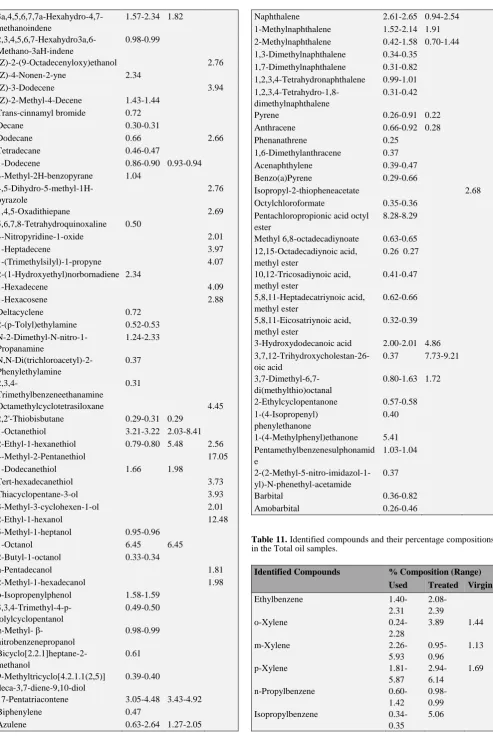
The organic compounds present in the oil samples with their percentage compositions as elucidated by the GC-MS analysis are presented in Tables 10 and 11, while their chromatograms are displayed in supplementary materials.
The results showed that the used oil samples were more complex in compounds compositions than those of the treated or virgin oil samples. In the used oil samples number of identified compounds ranges from 56 to 98. In the treated samples the number of identified compounds is between 34 and 56 while in the two virgin oil samples the number of identified compounds are 23 and 26. The results, however, do not show clear-cut trend in the compositions as the samples contained similar classes and types of compounds.
degradation or isomerisation during use. On the other hand, the numerous compounds in the used oil may be due to contamination by foreign materials, engine parts wearing and degradation as well as isomerisation of the engine oil components during use.
Table 5. FT-IR analysis of the treated total oil sample 1.
Wavenumber. cm-1
Type of vibration Bond Functional group
655.82 Stretch C-X Alkyl halide 721.40 Bending in plane
(Rocking) for C-H of long CH2
C-H Alkane
813.99 854.49
Out of plane bending C-H Alkene or Aromatic 974.08 Out of plane bending C-H Aromatic 1030.02
1170.83
Stretch C-O Carboxylic acid 1230.63 Bend (wagging) CH2
-X
Alkyl halide 1305.85 Rock C-H Aromatic 1367.58
1377.22 Out of plane bending C-H CH3
1464.02 1606.76
Stretch C=C Aromatic
1705.13 Stretch C=O Carbonyl 1737.92 Stretch C=O Carbonyl 1770.71 Stretch C=O Carbonyl 2031.11 Stretch C≡C Alkyne 2681.14
2727.44
Stretch C-H
of H-C=O
Aldehyde
2854.74 2922.25
Stretch C-H Alkane
3182.65 Stretch C-H Alkene Aromatic
3419.90 Stretch O-H
N-H
Alcohol Amine
With respect to the specificity of the compounds, the most notable is the actual and proportions of polycyclic aromatic hydrocarbons (PAHs). The used oil samples contained appreciably higher number of PAHs, with varying proportions, than the treated oil samples. No PAH was detected in the virgin oil samples. This agreed with the findings of Dominguez-Rosado and Pichtel17 who reported
that the PAHs contents of used motor oils were often between 34 and 90 times higher than new oil.
The identified PAHs and the range of their percentage compositions in the used and treated oil samples respectively are: azulene (Mobil: 0.63-2.64, 1.27-2.05; Total: 0.45-1.19, 1.11-2.62), naphthalene (Mobil: 2.61- 2.65,
0.94-2.54; Total: 3.20-3.28; 2.34-2.36),
1-methylnaphthalene (Mobil: 1.52-2.14, 1.91-1.92; Total: 0.35- 0.41, 0.89-1.65), 2-methylnaphthalene (Mobil: 0.42-1.58, 0.70-1.44; Total: 0.36-1.48, 1.12-1.59), 1,3-dimethylnaphthalene (Mobil: 0.34-0.35, ND; Total: ND, ND), 1,5-dimethylnaphthalene (Mobil: ND, ND;
Total:0.34-0.38, ND), 1,6-dimethylnaphthalene (Mobil: ND, ND; Total: 0.37-1.46,ND), 1,7-dimethylnaphthalene (Mobil: 0.31-0.82,
ND; Total: 1.33-1.34; Total: ND, ND),
2,7-dimethylnaphthalene (Mobil: ND,ND; Total: 0.33-1.18, ND), 2-ethylnaphthalene (Mobil: ND, ND; Total: 0.61-0.63, ND), 1,4,6-Trimethylnaphthalene (Mobil: ND, ND; Total: 0.68-0.69, ND), 2,3,6-Trimethylnaphthalene (Mobil: ND, ND; Total: 0.34-0.39, ND), 1,2,3,4-Tetrahydronaphthalene (Mobil: 0.99-1.01, ND; Total: 0.97-0.99, ND), 6-Ethyl-1,2,3,4-Tetrahydronaphthalene (Mobil: ND, ND; Total: 0.20-1.97, ND), 1,2,3,4-
Table 6. FT-IR analysis of the Treated Total oil sample 2.
Wavenumber, cm-1
Type of vibration
Bond Functional
group
655.82 Stretch C-X Alkyl halide 721.40 In plane
bending
C-H Alkane
813.99 854.49
Out of plane bending
C-H Alkene or Aromatic 974.08 Out of plane
bending
C-H Aromatic
1030.02 1170.83
Stretch C-O Carboxylic acid 1230.63 Bend
(wagging)
CH2-X Alkyl halide
1305.85 Rock C-H Aromatic 1377.22 Out of plane
bending
C-H CH3
1464.02 1604.83
Stretch C=C Aromatic
1707.06 1732.13 1772.64
Stretch C=O Carbonyl
2360.95 Stretch C≡C Alkyne 2681.14
2727.44
Stretch C-H of H-C=O
Aldehyde
2854.74 2924.18
Stretch C-H Alkane
3182.65 Stretch C-H =C-H 3443.05 Stretch O-H
N-H
Alcohol Amine
Table 7. FT-IR analysis of the Used Mobil oil sample 1.
Wavenumber, cm-1
Type of vibration
Bond Functional
group
655.82 Stretch C-X Alkyl halide 721.40 In plane bending C-H Alkane 813.99
854.49
Out of plane bending
C-H Alkene or Aromatic 974.08 Out of plane
bending
C-H Aromatic
1030.02 1155.40
Stretch C-O CO2H,
CO2
R,--C-OH 1230.63 Bend (wagging) CH2-X Alkyl halide
1305.85 Rock C-H Aromatic 1377.22 Out of plane
bending
1464.02 1606.76
Stretch C=C Aromatic
1705.13 1732.13 1770.71
Stretch C=O Carbonyl
2038.83 2173.85 2359.02
Stretch C≡C Alkyne
2679.21 2727.44
Stretch C-H of H-C=O
Aldehyde
2854.74 2924.18
Stretch C-H Alkane
3173.01 Stretch C-H =C-H 3431.48 Stretch O-H
N-H
Alcohol Amine
Table 8. FT-IR analysis of the Used Mobil oil sample 2
Wavenumber, cm-1
Type of Vibration
Bond Functional
group
657.75 Stretch C-X Alkyl halide 721.40 Bending in plane C-H Alkane 813.99
854.49
Out of plane bending
C-H Alkene or Aromatic 972.16 Out of plane
bending
C-H Aromatic
1030.02 1089.82
Stretch C-O Carboxylic acid 1230.63 Bend (wagging) CH2-X Alkyl halide
1305.85 Rock C-H Aromatic 1377.22 Out of plane
bending
C-H CH3
1464.02 1604.83
Stretch C=C Aromatic
1705.13 1776.50
Stretch C=O Carbonyl
2359.02 Stretch C≡C Alkyne 2727.44
2854.74
Stretch C-H of H-C=O
Aldehyde
2924.18 Stretch C-H Alkane 3184.58 Stretch C-H Alkene Aromatic 3435.34 Stretch O-H
N-H
Alcohol Amine
Tetrahydro-1,8-dimethylnaphthalene (Mobil: 0.31-0.42, ND; Total: 0.21- 0.41, 0.20-0.48), Pyrene (Mobil: 0.26-0.91, 0.22-0.23; Total: 0.25-0.35, ND ), Anthracene (Mobil: 0.66- 0.92, 0.28-0.30; Total: 0.93-1.02), Phenanathrene (Mobil: 0.25-0.27, ND; Total: 0.32-2.61, ND), 3-Methylanthracene
(Mobil: ND,ND; Total: 0.33-0.34, ND),
1,6-Dimethylanthracene (Mobil: 0.37-0.42, ND; Total: ND, ND), 1,6-Dimethylphenanthrene (Mobil: ND, ND; Total: 0.35-0.36, ND), Acenaphthylene (Mobil: 0.39-0.47, ND; Total: 0.17-0.46, ND), Benzo(a)Pyrene (Mobil: 0.29-0.66, ND; Total: 0.30-0.31, ND), 1,2,3,5,8,8a-Hexahydronaphthalene (Mobil: ND, 1.92-1.94; Total: ND, 0.21-1.81), 3,4-Dihydro-3-methyl-1(2H)-naphthalenone (Mobil: ND, ND; Total: 0.09-0.16), 1,5-Dimethoxy-9,10-anthracenedione (Mobil: ND, 1.37-7.96; Total: ND, ND). The presence of PAHs in high concentrations in the used lubricating oils could be as a
result of the action of internal combustion engine which subjects the oil to a lot of thermal activities. The high reduction in number and/proportions of the PAHs in the used oil samples as observed in the treated samples is an indication that the sorbent materials have good uptake for these carcinogenic compounds.
Moreover, the lower numbers of various compounds in the treated oil samples than their corresponding used oil samples is an indication that a fraction of the constituent compounds in the used oil sample were removed by the PBR. The higher number of low molecular weight compounds in the used oil samples than the treated or the virgin oil samples showed that the used oil samples contained more volatile compounds or more fragile compounds that can thermally break down more readily.
Table 9. FT-IR Analysis of the Used Total oil sample 1
Wavenumber, cm-1
Type of vibration
Bond Functional group
659.68 Stretch C-X Alkyl halide 721.40 Bending in
plane
C-H Alkane
812.06 Out of plane bending
C-H Alkene or Aromatic 974.08 Out of plane
bending
C-H Aromatic
1031.95 1155.40
Stretch C-O Carboxylic acid
1230.63 Bend (wagging) CH2
-X
Alkyl halide 1309.71 Rock C-H Aromatic 1377.22 Out of plane
bending
C-H CH3
1464.02, 1604.83
Stretch C=C Aromatic
1705.13, 1774.57
Stretch C=O Carbonyl
2036.90, 2360.95
Stretch Stretch
C≡ C Alkyne
2679.21 2727.44
Stretch C-H of H-C=O
Aldehyde
2854.74, 2924.18, 2955.04
Stretch C-H Alkane
3192.30 Stretch C-H Alkene Aromatic 3446.91 Stretch O-H
N-H
Alcohol Amine
The difference in organic compounds compositions of the two virgin oil samples may linked to the types of the base oil as well as types of additives used by the respective manufacturer in their production.
The virgin oil samples contain more of branched chains than straight chains alkanes; the longest straight alkane chain being tridecane. The longer chains are alkenes [1-Hexadecene, 1-Heptadecene and 1-Hexacocene], alcohols [(Z)-2-(9-octadecenyloxy)ethanol, n-Pentadecanol, 2-Methyl-1-hexadecanol], thiol [Tert-hexadecanethiol] and ester [6,9-Octadecadiynoic acid, methyl ester]. Even the alkenes and other identified unsaturated compounds are more common, both in number and proportion, than the alkanes. These observations suggest breaking in chain lengths and/or rearrangements of the components during the gas chromatography analysis. Moreover, the inconsistency in the retention times of a particular component in the various samples is an indication of high variation in the constitutions of the samples and that interactions among the various components in the samples play a role in their relative movement through the capillary.
Table 10. Identified compounds and their percentage compositions in the Mobil oil samples.
Identified Compounds % Composition (range)
Used Treated Virgin
Ethylbenzene 2.06-6.32 2.59
o-Xylene 2.5 3.04-4.48 6.01 m-Xylene 5.01-6.32 1.02-2.29 p-Xylene 3.13-4.43 2.24-7.14 2.46 n-Propylbenzene 0.98-1.41 0.92
Isopropylbenzene 0.34-0.41 1.27
1,4-Oxathiane 6.05
1,2,3-Trimethylbenzene 1.71-2.30 2.31-2.43 1,2,4-Trimethylbenzene 1.83-5.41 1.32-4.34 Mesitylene 2.29-8.11 0.96-9.10 1-Methyl-2-propylbenzene 2.35
1-Methyl-3-propylbenzene 0.80 1,2-Diethylbenzene 1.15
2-Ethenyl-1,4-dimethylbenzene 2.91 0.95-1.01 2-Ethenyl-1,3,5-trimethylbenzene 0.40
1-Ethyl-2-methylbenzene 2.11-5.41 2.72-4.52 1-Ethyl-3-methylbenzene 1.56-7.71 1.86 1-Ethyl-4-methylbenzene 4.10 1.04-1.42 1-Ethyl-3,5-dimethylbenzene 1.56-1.10
2-Ethyl-1,4-dimethybenzene 0.97-0.97 1.04-1.99 4-Ethyl-1,2-dimethylbenzene 0.97-5.41
1-Ethyl-2,4,5-trimethylbenzene 0.98-0.97 1-Methyl-3-propylbenzene 2.34-2.35 0.92 1-Methyl-4-propylbenzene 0.85-0.86 1-Methyl-3-isopropylbenzene 0.80 1-Ethyl-3-isopropylbenzene 0.44 1-Ethyl-4-isopropylbenzene 0.36-0.53 1,3-Diethyl-5-methylbenzene 0.30-0.31 1,3-Dimethyl-5-isopropylbenzene 0.97
1,2,3,4-Tetramethylbenzene 1.63 1.21 1,2,3,5-Tetramethylbenzene 0.67-0.94 1.59 1,2,4,5-Tetramethylbenzene 0.67-1.63 Pentamethylbenzene 0.44 2,4-Diethyl-1-methylbenzene 0.29-0.56 1-Methyl-4-sec-butylbenzene 0.66-1.19 p-Allyltoluene 0.53 3-(m-Tolyl)-1-butene 0.53-1.07
3-(p-Tolyl)-1-butene 0.53 2-Methyl-3-phenyl-2-butene 1.08
o-Allyltoluene 3.52 0.96 p-Ethylcumene 0.53
3,4-Dimethylcumene 0.56-0.57 1.12 2-Butenylbenzene 0.28-3.52 2.23
1-(2-Butenyl)-2,3-dimethylbenzene
0.30
(E)-4-(2-Butenyl)-1,2-dimethylbenzene
0.36
2-Methylstyrene 2.29-3.73 4-Methylstyrene 3.73-4.10 2,4-Dimethylstyrene 3.34-4.16 2.21 2,5-Dimethylstyrene 2.91-4.16 1.84 2,6-Dimethylstyrene 3.87
2,4,6-Trimethylstyrene 0.40-2.09 2-tert-butyltoluene 1.22-1.23 1,4-Diisopropenylbenzene 0.52 2.14 5-Ethyl-2-methyldecane 0.36-0.37 o-Cymene 0.92-1.15 1.06
m-Cymene 0.80
p-Cymene 0.29-5.41 1.99-3.89 2-Phenyl-2-pentene 1.08
2-Methyl-1-phenyl-2-butene 0.63-0.88 (2-Bromocyclopropyl)benzene 0.72
1-Chlorooctadecane 2.44
1,2-Dichlorocyclohexane 0.76
1,2-Dipentylcyclopropene 2.56 1-Methyl-1-silabenzocyclobutene 2.33
3,5,5-Trimethylcyclohexene 0.38
Benzocycloheptatriene 0.46-0.47 0.97-2.11
Bicyclo[4.4.1]undeca-1,3,5,7,9-pentaene
2.65 2.13-2.52
1-Methyl-tricyclo[5.2.1.0(2,6)]dec-4-ene
0.75-0.76
7-Methylbicyclo[4.2.0]octa-1,3,5-triene
0.49-3.03 0.87-3.14
7-Ethylbicyclo[4.2.1]nona-2,4,7-triene
0.91-1.51 0.93
3-Tert-butyl-7,7-dimethyloct-3-ene-1,5-diyne
0.52 1.93
2-Thiopheneacetyl chloride 0.78-0.96 0.93 6,6-Dimethylfulvene 0.32-6.67 1.03-8.66 1,2,3,4-Tetramethylfulvene 1.15-2.33
1,3,8-p-Menthatriene 4.38-4.39 0.92-2.11 1,2,3-Trimethylindene 0.52
1-Chloro-2,3-dihydro-1H-indene 3.49-3.50 2,3-Dihydro-2,2-dimethylindene 1.53-1.54
2,3-Dihydro-1,6-dimethyl-1H-Indene
0.55-0.56 1.01-1.30
2,3-Dihydro-4,7-dimethyl-1H-Indene
0.80-1.24
2,3-Dihydro-5,6-dimethyl-1H-indene
0.53
2,3-Dihydro-1,1,5-trimethyl-1h-indene
0.36
Octahydro-2-methylene-4,7-Methano-1H-indene
0.50-0.51
2,3,6,7-Tetrahydro-3a,6-methano-3aH-indene
3a,4,5,6,7,7a-Hexahydro-4,7-methanoindene
1.57-2.34 1.82
2,3,4,5,6,7-Hexahydro3a,6-Methano-3aH-indene
0.98-0.99
(Z)-2-(9-Octadecenyloxy)ethanol 2.76 (Z)-4-Nonen-2-yne 2.34
(Z)-3-Dodecene 3.94
(Z)-2-Methyl-4-Decene 1.43-1.44 Trans-cinnamyl bromide 0.72
Decane 0.30-0.31
Dodecane 0.66 2.66
Tetradecane 0.46-0.47
1-Dodecene 0.86-0.90 0.93-0.94 4-Methyl-2H-benzopyrane 1.04
4,5-Dihydro-5-methyl-1H-pyrazole
2.76
1,4,5-Oxadithiepane 2.69
5,6,7,8-Tetrahydroquinoxaline 0.50
4-Nitropyridine-1-oxide 2.01
1-Heptadecene 3.97
1-(Trimethylsilyl)-1-propyne 4.07 2-(1-Hydroxyethyl)norbornadiene 2.34
1-Hexadecene 4.09
1-Hexacosene 2.88
Deltacyclene 0.72 2-(p-Tolyl)ethylamine 0.52-0.53
N-2-Dimethyl-N-nitro-1-Propanamine
1.24-2.33
N,N-Di(trichloroacetyl)-2-Phenylethylamine
0.37
2,3,4-Trimethylbenzeneethanamine
0.31
Octamethylcyclotetrasiloxane 4.45 2,2'-Thiobisbutane 0.29-0.31 0.29
1-Octanethiol 3.21-3.22 2.03-8.41 2-Ethyl-1-hexanethiol 0.79-0.80 5.48 2.56 4-Methyl-2-Pentanethiol 17.05 1-Dodecanethiol 1.66 1.98
Tert-hexadecanethiol 3.73
Thiacyclopentane-3-ol 3.93
3-Methyl-3-cyclohexen-1-ol 2.01
2-Ethyl-1-hexanol 12.48
5-Methyl-1-heptanol 0.95-0.96
1-Octanol 6.45 6.45
2-Butyl-1-octanol 0.33-0.34
n-Pentadecanol 1.81
2-Methyl-1-hexadecanol 1.98
p-Isopropenylphenol 1.58-1.59
3,3,4-Trimethyl-4-p-tolylcyclopentanol
0.49-0.50
α-Methyl-
β-nitrobenzenepropanol
0.98-0.99
Bicyclo[2.2.1]heptane-2-methanol
0.61
9-Methyltricyclo[4.2.1.1(2,5)] deca-3,7-diene-9,10-diol
0.39-0.40
17-Pentatriacontene 3.05-4.48 3.43-4.92
Biphenylene 0.47
Azulene 0.63-2.64 1.27-2.05
Naphthalene 2.61-2.65 0.94-2.54 1-Methylnaphthalene 1.52-2.14 1.91 2-Methylnaphthalene 0.42-1.58 0.70-1.44 1,3-Dimethylnaphthalene 0.34-0.35
1,7-Dimethylnaphthalene 0.31-0.82 1,2,3,4-Tetrahydronaphthalene 0.99-1.01
1,2,3,4-Tetrahydro-1,8-dimethylnaphthalene
0.31-0.42
Pyrene 0.26-0.91 0.22
Anthracene 0.66-0.92 0.28 Phenanathrene 0.25
1,6-Dimethylanthracene 0.37 Acenaphthylene 0.39-0.47 Benzo(a)Pyrene 0.29-0.66
Isopropyl-2-thiopheneacetate 2.68 Octylchloroformate 0.35-0.36
Pentachloropropionic acid octyl ester
8.28-8.29
Methyl 6,8-octadecadiynoate 0.63-0.65 12,15-Octadecadiynoic acid,
methyl ester
0.26 0.27
10,12-Tricosadiynoic acid, methyl ester
0.41-0.47
5,8,11-Heptadecatriynoic acid, methyl ester
0.62-0.66
5,8,11-Eicosatriynoic acid, methyl ester
0.32-0.39
3-Hydroxydodecanoic acid 2.00-2.01 4.86
3,7,12-Trihydroxycholestan-26-oic acid
0.37 7.73-9.21
3,7-Dimethyl-6,7-di(methylthio)octanal
0.80-1.63 1.72
2-Ethylcyclopentanone 0.57-0.58 1-(4-Isopropenyl)
phenylethanone
0.40
1-(4-Methylphenyl)ethanone 5.41 Pentamethylbenzenesulphonamid e
1.03-1.04
2-(2-Methyl-5-nitro-imidazol-1-yl)-N-phenethyl-acetamide
0.37
Barbital 0.36-0.82
Amobarbital 0.26-0.46
Table 11. Identified compounds and their percentage compositions in the Total oil samples.
Identified Compounds % Composition (Range)
Used Treated Virgin
Ethylbenzene
1.40-2.31
2.08-2.39
o-Xylene 0.24-
2.28
3.89 1.44
m-Xylene
2.26-5.93
0.95-0.96
1.13
p-Xylene
1.81-5.87
2.94-6.14
1.69
n-Propylbenzene 0.60-1.42
0.98-0.99 Isopropylbenzene
0.34-0.35
1,2,3-Trimethylbenzene 1.36-2.26
1.72-2.33 1,2,4-Trimethylbenzene
2.06-4.53
3.44-8.53
Mesitylene
1.17-2.22
1.82-7.91 1-Ethyl-2-methylbenzene
0.81-2.09
1.32, 1.57 1-Ethyl-3-methylbenzene
3.00-6.74
1.41-4.48 1-Ethyl-4-methylbenzene 0.23 4.52 1-Ethyl-2,4-dimethylbenzene
1.03-1.04
0.67
1-Ethyl-3,5-dimethylbenzene 1.18 2-Ethyl-1,3-dimethylbenzene 1.41 2-Ethyl-1,4-dimethybenzene 0.97-3.50
1.11-3.38 4-Ethyl-1,2-dimethylbenzene 5.18 0.93-0.95 1-Methyl-2-propylbenzene 2.37 0.92 1-Methyl-3-propylbenzene
0.82-2.33
0.89-0.92 1-Methyl-3-isopropylbenzene
0.85-0.99
4-Butyl-1-methylbenzene 0.21 1.14-1.20 1-Ethyl-4-isopropylbenzene 0.79
1-Ethyl-2,4,5-trimethylbenzene 1.39 0.54 1,2,3,5-Tetramethylbenzene 1.20
1,2,4,5-Tetramethylbenzene 0.67-1.64
1.31─ 1.34 Pentamethylbenzene
0.43-0.83 1,3-Diethyl-5-methylbenzene 0.31-0.32 1,4-Diethyl-2-methylbenzene 0.44-0.80
0.46-1.83 1,3-Dimethyl-5-isopropylbenzene
0.30-0.96 2,4-Diethyl-1-methylbenzene 0.96-0.97 1-Methyl-4-sec-butylbenzene 1.16-1.17
3-(m-Tolyl)-1-butene 0.63 1.02-1.08 1,4-Dimethyl-2-t-butylbenzene 1.15
3-(p-Tolyl)-1-butene 0.61-0.62 2-Methyl-2-phenyl-2-buteene 2.04-2.05 o-Allyltoluene 3.35-3.36 1,4-Diethyl-2,5-dimethylbenzene 0.65
2-Propenylbenzene 0.52 3.66-3.67 2-Butenylbenzene
0.45-1.39 1-(2-Butenyl)-2,3-dimethylbenzene 0.22 (E)-
4-(2-Butenyl)-1,2-dimethylbenzene
0.35-0.43
2-Methylstyrene 3.67-3.68
4.30
2,4-Dimethylstyrene 2.15-4.15
0.97-2.93 2,5-Dimethylstyrene 4.46
2,4,6-Trimethylstyrene 1.78-2.81
0.40
o-Isopropenyltoluene 1.58 2-Methyl-2-phenylbenzene 0.43 1,2-Diisopropylbenzene 1.21 4-Heptynylbenzene 0.31-0.32
o-Cymene
1.15-2.59
1.06
p-Cymene 3.16
1.99-4.46 3-Methylphenylacetylene
3.42-3.43 2-Phenyl-2-pentene 1.03-1.04 2-Methyl-1-phenyl-2-butene 2.07-4.06
2.44-4.80
2-Isopropenylcumene
0.42-0.42
3-Isopropenylcumene
0.49-0.50
0.42-0.81
Chloromethyl n-propyl sulphide 6.04 2,4-Dimethylbenzyl chloride 0.17
1,2-Dichlorocyclohexane 0.75-0.78
1.04-1.06 1-Methyl-1-silabenzocyclobutene
2.28-2.29 1-Ethynyl-1-Cyclohexene 4.20-4.21
Benzocycloheptatriene 4.42 1.03-1.85
Bicyclo[4.4.1]undeca-1,3,5,7,9-pentaene
2.61-3.20
1.71-2.24
1-Methyl-tricyclo[5.2.1.0(2,6)]dec-4-ene
0.6-0.64
3-Methyl-4-methylenebicyclo[3.2.1]oct-2-ene 0.80
7-Ethylbicyclo[4.2.1]nona-2,4,7-triene
1.49-2.07
0.36-0.93
7-Isopropylbicyclo[4.2.0]octa-1,3,5-triene
0.52
1,7,7-Trimethyl-2-vinylbicyclo[2.2.1]hept-2-ene
0.19
3-Tert-butyl-7,7-dimethyloct-3-ene-1,5-diyne
0.47-0.48
1.88
2,4-Dimethylheptane 0.16 2,3-Dimethyl-cyclohexa-1,3-diene 0.23 1,2,3,4-Tetramethyl-5-methylene-1,3-Cyclopentadiene
2.34
1,3,8-p-Menthatriene 1.66 1.01-1.02
Indane 2.60 6.56
Indene
1.65-3.46
2,3-Dihydro-1,3-dimethyl-1H-indene
1.20
2,3-Dihydro-1,6-dimethyl-1H-Indene
0.51 0.94-1.30
2,3-Dihydro-3,3-dimethyl-1H-Inden-1-one
0.17
2,3-Dihydro-4,7-dimethyl-1H-Indene
1.21-1.22
0.81
2,3-Dihydro-1,1,3-trimethyl-1H-indene
0.16
2,3-Dihydro-1,1,5-trimethyl-1H-indene
0.39-1.07
Octahydro-4,7-methano-1H-indene 0.50 1.32-1.33
Octahydro-2-methylene-4,7-Methano-1H-indene
0.44 0.52
2,3,6,7-Tetrahydro-3a,6-methano-3aH-indene
3.85 1.63-2.47
3a,4,5,6,7,7a-Hexahydro-4,7-methanoindene
2.20 1.59-1.62 (Z)-4-Nonen-2-yne
2.29-2.36
(E)-3-Octene 15.21
(E)-3-Methyl-4-Decene 0.23
(Z)-2-Methyl-5-undecene 1.11 1.02 2.51 Trans-cinnamyl bromide
0.71-0.73
3-Methyl-2-Heptene 6.81
Decane
0.31-0.45
Dodecane
0.34-0.39
1.53
3-Methyldecane 0.24 2,6-Dimethylundecane 0.40 2-Bromododecane 0.18 7-Methyltridecane 0.27
Tridecane 1.56
1-Dodecene
0.47-0.48
0.98-1.02
1-Pentadecene 1.23
1-Heptadecene 1.23
2-Tolyloxirane 0.43 3-Methyl-1H-pyrrole 0.56 2-(Isopropyl)-1H-benzimidazole 0.33
2-Isopropyl-1H-pyrrolo[2,3-b]pyridine
0.93
4-Methyl-2H-benzopyrane 1.00-1.01 5,6,7,8-Tetrahydroquinoxaline 2.59-3.12 1,5-Dimethyl-2-pyrrolecarbonitrile 0.62 Trichlorovinylsilane 0.62 1,3,6-Trioxocane 0.21-0.79
0.19-1.22
Hexacosane 0.45
17-Pentatriacontane 0.66 1.10
Deltacyclene 0.71
4-Propylbenzenamine 0.90
p-Pentylaniline 0.35 2,3,4-Trimethylbenzeneethanamine 6.58
N-2-Dimethyl-N-nitro-1-Propanamine
0.46-0.47
N,N'-Dibenzylideneethylenediamine
1.36
N,N-Di(trichloroacetyl)-2-Phenylethylamine
0.36-0.37 2,3,4-Trimethylbenzeneethanamine 6.58-6.58 2,2'-Thiobisbutane 0.15-0.26
0.29 1.24
1-Octanethiol 1.45-8.34
1.96-8.81
19.12
3-Methyl-1-Pentanethiol 7.42
4-(9-Borabicyclo[3.3.1]non-9-yloxy)-2-thiapentane
1.43
5-Methyl-1-heptanol 0.97 5.51
6-Methyl-1-heptanol 4.93
1-Phenyl-1-cyclopentanol 0.56
3,3,4-Trimethyl-4-p-tolylcyclopentanol
0.26-0.26
(Z)-2-(9-Octadecenyloxy)ethanol 1.44
3,9- Dimethyltricyclo[4.2.1.1(2,5)]dec-3-en-9-ol
0.28
9-Methyltricyclo[4.2.1.1(2,5)]deca-3,7-diene-9,10-diol
0.41
Biphenyl 0.32
3-Methyl-1,1'-biphenyl 0.74 4-Methyl-1,1'-biphenyl 0.22
Biphenylene
0.20-0.63
Azulene
0.45-1.19
1.11-2.62
Naphthalene 3.20 2.34
1-Methylnaphthalene 0.35 0.89-1.65 2-Methylnaphthalene
0.36-1.48
1.12-1.59 1,5-Dimethylnaphthalene 0.34
1,6-Dimethylnaphthalene 0.37-1.46 1,7-Dimethylnaphthalene 1.33-1.35 2,7-Dimethylnaphthalene 0.33-1.18 2-Ethylnaphthalene 0.61─
0.69 1,4,6-Trimethylnaphthalene 0.68 1,6,7-Trimethylnaphthalene 0.43 2,3,6-Trimethylnaphthalene 0.34-0.39
6-Ethyl-1,2,3,4-tetrahydronaphthalene
0.20-1.97 1,2,3,4-Tetrahydronaphthalene 0.98
1,2,3,4-Tetrahydro-1,8-dimethylnaphthalene
0.21- 0.41
Pyrene 0.25-0.35
Anthracene
1.02-1.32 Phenanathrene 0.32-2.61 2-Methylphenanthrene 0.33-0.42 3-Methylanthracene 0.33-0.34 1,6-Dimethylphenanthrene 0.35-0.36 Acenaphthylene 0.17-0.46 Benzo(a)Pyrene 0.30-0.31
3,4-Dihydro-3-methyl-1(2H)-naphthalenone
0.16
Thiophene-2-acetic acid, cyclobutyl ester
0.59
Methyl 6,8-octadecadiynoate 0.60-0.61 6,9-Octadecadiynoic acid, methyl ester
1.12
4-[(Tetrahydro-2H-pyran-2-yl)oxy]butanal
0.64
3,7-Dimethyl-6,7-di(methylthio)octanal
0.78-0.79
1.62
3-(4-Methylphenyl)-2-Propenal 0.98 1-(4-Methylphenyl)ethanone 5.06-5.06 5-Methylene-4,5,6,6a-tetrahydro-3ah-pentalen-1-one
0.46 ─0.48
Thiopropionamide 1.65
Butethal
0.32-0.34
Barbital
0.35-0.36 Pentobarbital 0.32-0.81
Conclusion
The three sets of the oil samples (used, treated and virgin) from each of the two brands contained similar classes of compounds but varying degree in number, specificity and proportion of compounds with the treated oil samples saddled between the other two sets. The study showed that the sorbent materials have good uptake for polycyclic aromatic hydrocarbon, soot and other impurities in used lubricating oil.
The application of the packed bed reactor using the locally produced materials used in this study is recommended for small-scale pre-treatment of used lubricating oil before its subsequent uses. Further improvement on the packed bed reactor system is needed to be pursued with the objective of conducting theoretical studies of this work on the basis of the experimental data. This will enable the designing of the packed bed reactor and development of a dynamic model in order to estimate values of the parameters characterizing the
interaction of transport phenomena with diatomaceous sorption in packed bed used lubricating oil re-refining.
The information from the study will help in the development of highly efficient packed bed reactor for the recycling of used lubricating oil by working on the method optimization. Consequently, the packed bed reactor may be enlarged using principles of geometry and dynamic similarity, and possibly modified for low-cost and environmental friendly large-scale used lubricating oil recycling.Studies should also be conducted on the recycling possibility of the sorbent materials.
Acknowledgement
The authors express appreciation to
TWAS/COSMOTECH for awarding Dr. F.M. Adebiyi a financial research grant for Individual Scientist (RGA NO: 11-081RG/CHE/AF/AC_1-UNESCO FR: 3240262666) for the accomplishment of this study.
References
1Reis, M. A. R., Jeronimo, M. S., Ind. Eng. Chem. Res., 1988, 27,
1222 – 1228. https://doi.org/10.1021/ie00079a023
2Boughton, B., Horvath, A., Environ. Sci. Tech.,2004, 38(2),
353-358. https://doi.org/10.1021/es034236p
3Kajdas, C., Tribotest, 2000, 7(1), 61─74.
https://doi.org/10.1002/tt.3020070107
4IARC Monographs on the Evaluation of Carcinogenic Risks to
Humans, International Agency for Research on Cancer, Lyon, France, 1984.
5Beuther, H., Peno, T., County, A., Henke, A. M., Petreson, R. E.,
U.S. Patent 622,312, 15, 1956.
6Puerto-Ferre, E., Kajdas, C., in Proceedings of 9th International
Colloquium, Ecological and Economic Aspects of Tribology, Esslingen, Germany, 14–16 January, 1994.
7Havemann, R., in Proceedings of the 3rd International
Conference of Used Oil Recovery & Reuse, Houston, TX, USA, 16–18, October, 1978.
8Fox, M.F., Handbook of Lubrication and Tribology, Taylor and
Francis, New York, USA. 2007.
9Ihsan, H., Talal, Y., Sardasht, R., Energies, 2013, 6, 1023-1049.
https://doi.org/10.3390/en6021023
10Rincon, J., Canizares, P., Garcia, M. T., Ind. Eng. Chem. Res., 2005, 44, 43–73.
11Shakirullah, M., Ahmed, I., Saeed, M., Khan, M. A., Rehman, H.,
Ishaq, M., Shah, A. A., J. Chin. Chem. Soc., 2006, 53, 335 – 342. https://doi.org/10.1002/jccs.200600042
12Martins, J. P., Ind. Eng. Chem. Res., 1997, 36, 3854 – 3858.
https://doi.org/10.1021/ie960593f
13Rincon, J., Canizares, P., Garcia, M. T., Gracia, I., Ind. Eng.
Chem. Res., 2003, 42, 4867-4873.
https://doi.org/10.1021/ie030013w
14Quang, D. V., Carriero, G., Schieppati, R., Comte, A., Andrews,
J. W., Hydrocarbon Process., 1974, 53, 129 – 131.
15Dang, C. S., Tribotest, 1997, 3, 445–457.
https://doi.org/10.1002/tt.3020030407
16ASTM International, American Society for Testing and Materials,
17Dominguez-Rusado, E., Pitchel, J., Proc. Indian Acad. Sci.,2003,
112, 109-116.