UTILIZATION OF ENVIRONMENTAL WASTE MATERIALS
(COAL FLY ASH AND PROSOPIS JULIFLORA CARBON) IN THE
REMOVAL OF CHROMIUM, LEAD, ZINC AND COPPER FROM
INDUSTRIAL EFFLUENTS
K.K. Sivakumar
[a]and M.S. Dheenadayalan
[b]Keywords: Adsorption, heavy metal, fly ash, effluent treatment
Waste materials such as coal fly ash generated from power plant in India and environmental threat causing plant such as Prosopis juliflora has been converted into a cheap potential adsorbent. This has been characterized and utilized for the removal of chromium, lead, zinc and copper from synthetic and actual wastewater. The sorption efficiency decreases with increase in pH. Adsorption of chromium, lead, copper and zinc on Coal Fly ash (CFA) and Prosopis Juliflora Carbon (PJC) individually and 50:50 mixture of CFA and PJC follows the Freundlich adsorption isotherm and these have been used to obtain the thermodynamic parameters of the process. The sorption capacity of these adsorbents for the heavy metal removal is found to be better alternative comparable to other low cost adsorbents.
* Corresponding Authors
E-Mail: [email protected]
[a] Department of Chemistry, Chettinad College of Engineering & Technology, Karur-639 114. Tamil Nadu, INDIA [b] PG and Research Department of Chemistry, GTN Arts
College, Dindigul. Tamil Nadu, INDIA
Introduction
Toxic metal is defined as that metal, which is neither essential nor has beneficial effect, on the contrary, it displays severe toxicological symptoms at low levels. With increasing industrialization, more and more metals are entering into the environment.1 These metals stay permanently because they cannot be degraded from the environment. They pass into the food and they ultimately make their passage into the tissue.
Cr(III) is a very stable oxidation state for chromium. In this state, the chromium is labile and kinetically very slow to react or form complexes. It is not a strong oxidizer and the human's natural body acidity is enough for the chromium to keep as Cr(III) state. Chromium enters the air, water and soil mostly in the form of chromium(III) and chromium(VI). Chromium(III) is an essential nutrient that helps the body use sugar, protein, and fat.
Cr(VI) is not a very stable state when compared to Cr (III). The Cr(VI) is a very strong oxidizing agent and likely to form complexes. Breathing high level can cause irritation to the nose, such as runny nose, nosebleeds, ulcers and holes in the nasal septum. Ingesting large amounts can cause stomach upsets and ulcers, convulsions, kidney and liver damage and even death.
The main reason for which Cr(VI) is so toxic is that one of the reduction products of Cr(VI) is Cr(V). Chromium(V) is a known carcinogen and will lodge in any tissue to form cancerous growths. There are reports that chromium(V) is also a factor leading to premature senility in parts of Russia. In the body, the acidity and action of enzymes on Cr(VI) will promote the formation in small quantities of Cr(V).
However, as the size of this is normally too large to be adopted by a tissue, the Cr (V) will pass out. The only place where the Cr (V) is likely to lodge is in some of the fine capillaries in the kidneys, intestines or lungs.
Lead is a poisonous metal that can damage nervous connections (especially in young children) and cause blood and brain disorders. Lead poisoning typically results from ingestion of food or water contaminated with lead; but may also occur after accidental ingestion of contaminated soil, dust, or lead based paint and textiles. Long-term exposure can cause nephropathy and colic-like abdominal pains. The main target for lead toxicity is the nervous system, both in adults and children. It may also cause weakness in fingers, wrists, or ankles. Lead exposure also causes small increases in blood pressure, particularly in middle-aged and older people and can cause anaemia. Exposure to high lead levels can severely damage the brain and kidneys in adults or children and ultimately cause death. In pregnant women, high levels of exposure to lead may cause miscarriage.
Copper exposure in high level builds up first in the liver and disrupts the liver's ability to detoxify the blood in general. It can give rise to many psychological imbalances such as mood swings, depression, mental agitation, feeling over-stimulated, restlessness, anxiety, insomnia and a racing mind with too many thoughts are all hallmarks of elevated copper toxicity.
Acute toxicity of zinc may result in sweet taste, throat dryness, cough, weakness, generalized aching, chills, fever, nausea and vomiting. Eating large amounts of zinc, even for a short time, can cause stomach cramps, nausea, and vomiting. The proposed limit of zinc in drinking water is 5 ppm as proposed by FDA.
chromium tanning, textile dyeing and wood preserving industries and certain glue. The effluent from textile dyeing and bleaching industries contain hexavalent chromium concentrations ranging from 0.2 to 0.3, divalent lead concentrations ranging from 0.2 to 1.9 mg L-1, divalent copper concentrations ranging from 2.2 to 4.5 mg L-1 and divalent zinc concentration ranging from 6.1 to 11.2 mg L-1. Both Chromium and lead is considered by IARC as a powerful carcinogenic agent that modifies the DNA transcription process causing important chromosomic aberrations. The USEPA recommends that the levels of Cr(VI) in drinking is allowed up to 0.05 mg L-1, Pb(II) in drinking water should be 0.05 mg L-1, copper in drinking water is allowed up to 0.05 mg L-1 and zinc in drinking water is allowed up to 0.5 mg L-1. Consequently, the removal of these ions from industrial wastewater has become a research topic of great interest.2
Scope of the study
Several methods such as chemical precipitation, ion exchange, electrochemical precipitation, solvent extraction, reverse osmosis, etc. These methods are cost intensive and are unaffordable for large scale treatment of wastewater that is rich in Cr (VI), Pb (II), Cu (II) and Zn (II) especially to developing countries like India.3 Adsorption using the activated carbon is an effective method for the treatment of industrial effluents contaminated with Cr (VI), Pb (II), Cu (II) and Zn (II), moreover is quite popular as compared to other methods. The cost associated with the commercial activated carbon is very high which make the adsorption process expensive. This indicates that the cost effective alternate adsorbents for the treatment of Cr (VI), Pb (II), Cu (II) and Zn (II) contaminated waste streams are needed at present.4
Aim and objectives
Power plant waste product such as coal fly ash and indigenous carbon prepared from eco-hate prosopis juliflora is used as an adsorbent for the removal of Cr(VI), Pb(II), Cu(II) and Zn(II) from wastewater. Batch experiments are carried out for kinetic studies on the removal of Cr(VI), Pb(II), Cu(II) and Zn(II) from aqueous solution. Heavy metal contamination exists in aqueous wastes of many industries, such as metal plating, mining operations, tanneries, chloralkali, radiator manufacturing, smelting, alloy industries and storage batteries industries, etc. The effects of various influencing parameters such as initial pH, contact time, dose of adsorbent and initial concentration of adsorbate are studied. The equilibrium isotherm data and kinetic data are tested with various isotherm models and kinetic models.5-7
Experimental materials
Preparation of adsorbent (Fly ash)
The fly ash used in this study is collected from National Thermal Power Corporation (NTPC), Ramagundum, AP. The fly ash is washed with distilled water and then activation is carried out by treating it with concentrated sulphuric acid
(98 % w/w) in 1:1 weight ratio and is kept in an oven maintained at a temperature range of 150 ºC for 12 hours. Again it is washed with distilled water to remove the free acid and finally dried at 110 ºC for 5 hours.
Preparation of adsorbent (Prosopis Juliflora Carbon)
The Prosopis Juliflora wood used in this study is collected from in and around of Virdhunagar District, Tamil Nadu. The process of activation is carried out in two stages. Firstly the Prosopis Juliflora wood is converted into wooden charcoal by carbonization process which is usually carried out in mud-pits, brick kilns and metallic portable kilns. Secondly wood charcoal is activated by treating it with concentrated sulphuric acid at a temperature of 150 ºC for about 12 hours in an oven. The chemical activation takes place at the internal surface area, creating more sites for adsorption.
Characterization of adsorbents
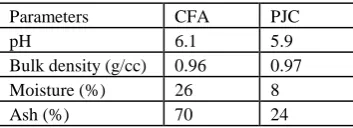
The physicochemical characteristics like moisture content, particle density, ash content and water soluble components of adsorbents such as activated coal fly ash and activated prosopis juliflora carbon were determined and given in Table 1.
Table 1. Parameters for CFA and PJC
Parameters CFA PJC
pH 6.1 5.9
Bulk density (g/cc) 0.96 0.97
Moisture (%) 26 8
Ash (%) 70 24
The bulk density and particle density affect the adsorption of metal ions. The decrease in the bulk density enhances the adsorption of metals ions. The adsorption process will be higher if the size of the adsorbent is fine. The bulk density value less than 1.2 indicates the adsorbent materials are fine nature. When this value falls within the range of 1.2-2 the materials are medium and the value more than 2 indicates that the materials are coarse in nature. The particle density value is less than 2.2, which indicates the materials are finer, the value between 2.2-4 are medium and more than 4 indicates materials are coarse in nature. In the present study, the bulk density and particle density values obtained are closer to fine in nature.
Other Chemicals
All other chemicals used are of analytical reagent grade and were obtained from Loba and Glaxo/BDH, Buffer solutions of pH equal to 4, 7 and 9 for calibration of the pH meter, concentrated nitric acid, individual standard solution for Cr(VI) ion, individual standard solution for Pb(II) ion, individual standard solution for Cu(II) ion, individual standard solution for Zn(II) ion, sodium hydroxide pellets, sodium nitrate and 0.5 N hydrochloric acid.
Chemical analysis
The test methods cover the determination of dissolved and total recoverable chromium, lead, copper and zinc in water and waste water by atomic-absorption spectrophotometry. The reason to choose the AAS is the results produced are reproducible and accurate and moreover applicable to industrial discharges which may contain less than 10 mg L-1 of any heavy metal.
In atomic absorption a sample is aspired into a flame and atomized. A light beam is directed through the flame into a monochromator, and onto a detector that measures the amount of light absorbed by the atomized element in the flame. For some metals, atomic absorption exhibits superior sensitivity over flame emission. Because each element has its own characteristic absorption wavelength, a source lamp composed of that element is used, which is called the Hollow Cathode Lamp. This makes the method relatively free from spectral or radiation interference. The amount of energy at the characteristic wavelength absorbed in the flame is proportional to the concentration of the element in the sample over a limited concentration range. The instrument used in determination of heavy metals is the Atomic Absorption Spectrophotometer Perkin-Elmer Model 403 equipped with a Honeywell Electronik 193 strip chart recorder. The method used for the determination of heavy metals was (Direct Air- Acetylene Flame Method).
In case of the hexavalent chromium, the absorption of the color complex measured at a wavelength of 540 nm, the divalent lead, the absorption of the color complex measured at a wavelength of 283.3 nm, the divalent copper, the absorption of the color complex measured at a wavelength of 324.7 nm and the divalent zinc, the absorption of the color complex measured at a wavelength of 213.8 nm.
Batch experiments
The batch experiments are carried out in 250 mL borosil shaker bottles by shaking a pre weighed amount of the CFA, PJC and 50:50 mixture of CFA and PJC with 100 mL of the aqueous solutions for a pre determined period (found out from the kinetic studies) at 30ºC with an initial adsorbate concentration of 100 mg L-1 and an adsorbent of 10 g L-1. The effect of adsorbent amount is studied by varying it in the range of 10 to 50 g L-1 with the adsorbate concentration range of 5 to 25 mg L-1 at 30ºC. The effect of pH of adsorbate on adsorption is studied by varying it in the range of acidic 2 to alkaline 12. Moreover the effect of contact time between adsorbate and adsorbent is studied by varying it in the range of 15 to 180 minutes.
The various experimental parameters which influence the process are as follows:
(i) Effect of varying the concentration of dyes
(ii) Effect of varying the pH of the solution
(iii) Effect of varying the amount of photocatalyst
(iv) Effect of varying the contact time
Effect of varying the concentration
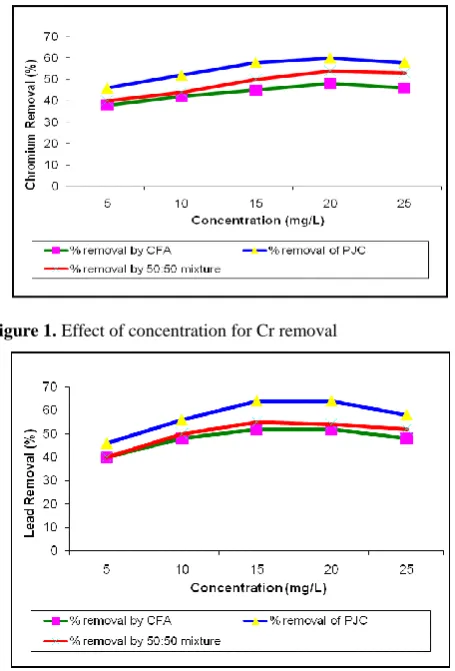
The effect of initial concentration of Cr(VI), Pb(II), Cu(II) and Zn(II) on the amount of CFA, PJC and 50:50 mixture was studied with a fixed dose of adsorbent (10 g L-1) and constant contact time (60 min) by varying the initial concentration of above adsorbate. From the experimental results, it is found that the amount of adsorbate adsorbed exponentially increases while the percentage removal decreases with the increase in initial concentration of adsorbate. This indicates that there exists a reduction in immediate solute adsorption due to the lack of available active sites on the adsorbent surface compared to the relatively large number of active sites required for the high initial concentration of adsorbate. Similar results have been reported in literature on the extent of removal of heavy metals by various adsorbent materials. The effect of concentration on the percentage removal of adsorbate is shown in this chapter Fig. 1 to 4.
Figure 1. Effect of concentration for Cr removal
Figure 3. Effect of concentration for Cu removal
Figure 4. Effect of concentration for Zn removal
The relative adsorption capacity of CFA, PJC and 50:50 mixture also reveals that under identical experimental conditions, compared to CAC, the adsorptive capacities of CFA, PJC and 50:50 mixture are less (Table 2). This may be due to the porous textural nature of the surface of AC. These low cost adsorbents possess nearly 50% adsorptive capacities compared to that of AC. The percentage removal of adsorbate by above mentioned adsorbent is found to exponentially decrease with increase in initial concentration of heavy metal, which may be due to the lack of available active sites on the surface of the adsorbent. The amount of adsorbate adsorbed on an adsorbent increases with increase in initial concentration of heavy metal. The optimum concentration of heavy metals found to be 15-20 ppm.
Table 2. Identical and Optimum removal
Adsorbent Experimental Condition
Identical Optimum
CFA 48 60
PJC 58 70
50:50 (CFA:PJC) mixture
52 64
Effect of dose of adsorbent
To study the influence of the adsorbent dosage on the removal of heavy metal ions, different values have been taken by varying the adsorbent concentration ranging from
10-50 g L-1 by keeping the volume of the effluent solution constant under optimum temperature and contact time.
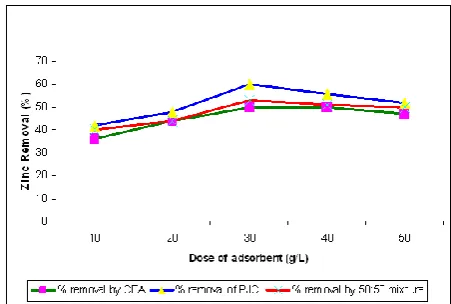
Figure 5 to 8 shown in this chapter shows the effect of adsorbent dosage on the removal of chromium, lead, copper and zinc by CFA, PJC and 50:50 ratio of CFA: PJC at optimum temperature of 296 K and time 60 min. In case of PJC, chromium removal of 46 % to 60 % achieved with respect to dose of 10 to 50 g L-1, lead removal 46 % to 64 % achieved with respect to dose of 10-50 g L-1, copper removal of 42-56 % achieved with respect to dose of 10-50 g L-1 and zinc removal of 42-60 % is achieved with respect to dose of 10-50 g L-1.
Figure 5. Effect of dose of adsorbent for Cr removal
Figure 6. Effect of dose of adsorbent for Pb removal
Figure 8. Effect of dose of adsorbent for Zn removal
In case of CFA, chromium removal of 38 % to 48 % achieved with respect to dose of 10 to 50 g L-1, lead removal 40 % to 52 % achieved with respect to dose of 10-50 g L-1, copper removal of 36-52 % achieved with respect to dose of 10-50 g L-1 and zinc removal of 36-50 % is achieved with respect to dose of 10-50 g L-1.
But in case of 50:50 mixture, chromium removal of 40 % to 54 % achieved with respect to dose of 10 to 50 g L-1, lead removal 40 % to 55 % achieved with respect to dose of 10-50 g L-1, copper removal of 40-53 % achieved with respect to dose of 10-50 g L-1 and zinc removal of 40-53 % is achieved with respect to dose of 10-50 g L-1.
The observation made in this study promotes the extend of removal of heavy metal ions from the textile dye effluent increases with increase in adsorbent dosage. This can be explained by the availability of the exchangeable sites or surface area on the adsorbents.8 In the minimum adsorbent dosage level (10 g L-1) there will be a low availability of exchangeable sites, ultimately the removal of metal ions at low adsorbent dosage is also minimum. But at the maximum adsorbent dosage level (50 g L-1) there will be a greater availability of exchangeable sites or surface area, hence the removal of metal ions at maximum adsorbent dosage is also maximum.
Success of removal of heavy metal ions with the effect of adsorbent dosage has been evaluated through the study of the percentage of ratio, before and after individual adsorbent dose.
Effect of pH
The effect of pH on the removal of heavy metal ions was studied by varying the pH ranging from 2 to 12 and keeping the concentration of the individual solution and dose of adsorbent are constant under optimum condition of temperature 296 K and time 60 min.
The removal of heavy metals is found to be highly pH dependent. The figure 9 to 12 in this chapter shows that the percentage removal of chromium varies from 20% to 63% for the pH range of 2-10, the percentage removal of lead varies from 18% to 66% for the pH range of 2-10, the percentage removal of copper varies from 16% to 68% for the pH range of 2-10 and the percentage removal of zinc
varies from 12% to 58% for the pH range of 2-10 respectively. It was observed that the adsorption capacity of adsorbents increased when pH of heavy metal solution increased. As pH value increases, the extent of removal increases, reaches a maximum value and then decreases further increased up to optimum pH.
Figure 9. Effect of pH for Cr removal
Figure 10. Effect of pH for Pb removal
Figure 11. Effect of pH for Cu removal
Figure 12. Effect of pH for Zn removal
These adsorption data suggest that the studied alternatives could be used as low cost adsorbent alternative to any other adsorbent which is currently used for the cost effective treatment of effluents, especially for the removal of metal ions.
Effect of contact time
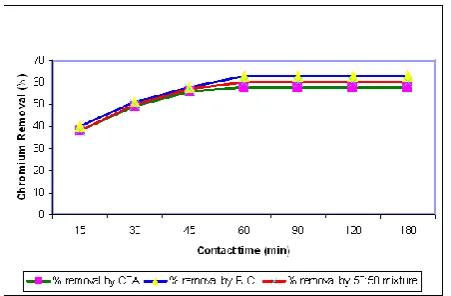
The influence of the contact time on the removal of heavy metal ions at different time intervals ranging from 15 min to 180 min while keeping the concentration of the individual solution constant under optimum temperature 296 K and adsorbent dosage of 50 g L-1 was studied. The figure 13 to 16 in this chapter explains the removal of Cr, Pb, Zn and Cu is optimum at the contact time of 60 minutes.
Figure 13. Effect of contact time for Cr removal
Adsorption mechanism
In the present study, the initial pH of solution is maintained at pH value 3. At the lower value of pH, in case of Cr(VI) is HCrO4- while the surface of adsorbent is charged positively. The increase in Cr(VI) adsorption is due to the electrostatic attraction between positively charged groups of adsorbent surface and the HCrO4- which is dominant at lower value of 3. Similarly, other heavy metal ion shows increased adsorption due to certain interaction.
Figure 14. Effect of contact time for Pb removal
Figure 15. Effect of contact time for Cu removal
Figure 16. Effect of contact time for Zn removal
Adsorption Isotherm
In the present study, as the new adsorbent is developed, hence it is needed to test the equilibrium data obtained for heavy metal ions removal using activated tamarind seeds with different isotherm models available in the literature. In the present work, Freundlich isotherm model is tested with the experimentally obtained equilibrium data.
Freundlich Isotherm model
log (x/m) = log k + (1/n) log Ce (1)
Where, (x/m) is the amount of adsorbate adsorbed per unit mass of the adsorbent, Ce is the equilibrium concentration and k and 1/n are the Freundlich constants, which are the measure of the adsorptive capacity and adsorption intensity, respectively. The log(x/m) values are found to be linearly correlated to the log Ce values in the case of all the adsorbents. The computed r values which are very close to unity conclude that the Freundlich model is applicable to the experimental data.
The observed high values (2 to 4) of 1/n in the case of all the adsorbents indicate an adsorption mechanism with an intraparticle diffusion or mass transfer as the rate limiting step. The increasing order of the adsorptive capacities of these adsorbents as indicated by the k values (log k values) for CFA, PJC and 50:50 mixture.
Adsorption kinetics
In order to understand the kinetics of removal of hexavalent chromium, divalent lead, divalent copper and divalent zinc using CFA, PJC alone and 50:50 mixture as an adsorbent, pseudo first order and second order kinetics are tested with the experimental data. As per the application of second order kinetics, it obeys better than any other.
Pollution index
The pollution index was used in this study to evaluate the degree of heavy metal contamination. The tolerable level of the element concentration in the water considered safe for human consumption. The BIS drinking water standards (2009) were used as tolerable level for water and the pollution index can be calculated by the formula below.
/
Me T
C C
PI N
(2)
where CMe is the heavy metal concentration in water, CT is the tolerable level, and N is the number of heavy metals. The PI among all sites varied from 0.01 to 1.5 and 0.106 to 5.0 for highly polluted and less polluted sites respectively. Concentrations of lead and chromium in most of the water samples were comparatively high than the given tolerable levels while in few water samples showed lower concentration. PI was below 0.1 at 4 and 6 sample representing (27.2 and 37.5%) of the total samples, between 0.1 to 0.3 at 6 and 8 samples (37.5 and 50%) and greater than 0.3 at 5 and 2 samples (33.3 and 12.5%) for least treating industries, respectively.
Conclusion
The following conclusions could be drawn from the present study:
The maximum adsorption of Cr(VI), Pb(II), Cu(II) and Zn(II) was observed at the pH value of 8.5, 9.0, 8.2 and 8.3 respectively.
The equilibrium time for the adsorption of Cr(VI), Pb(II), Cu(II) and Zn(II) on the CFA, PJC and 50:50 mixture ranges from is 45 to 90 minutes.
The percentage removal of Cr(VI), Pb(II), Cu(II) and Zn(II) increases with increase in the adsorbent amount. Optimum dose found in this study for various adsorbents ranges from 30 to 50 g L-1.
The equilibrium data obtained for the adsorption of Cr(VI), Pb(II), Cu(II) and Zn(II) can be well described by Freundlich adsorption isotherm model.
Adsorption follows and obeys second order rate equation.
Among the various adsorbents, PJC (Prosopis Juliflora
Carbon) proves that as a waste material has negligible cost and has also been proved to be an efficient alternative to commercial activated carbon.
Acknowledgement
The authors are highly thankful to their respective Management and Principal for providing necessary facilties.
References
1
Khan, N. A., Ibrahim, S. and Subramaniam, P., Malaysian J. Sci., 2004, 23, 43.
2
Chandra, B. S.. Saswati, G. and Chand, G. U., J. Environ. Sci. Eng., 2005, 47(4), 316.
3
Rao, M., Parwate A.V. and Bhole, A.G., J. Environ Std. Policy, 2001, 4(1), 11.
4
Gopalakrishnan, K. and Jeyadoss, T. Indian J Chem Tech., 2011, 18, 61.
5
Lark, B. S., Mahajan R.K. and Walia, T.P.S. Indian J. Environ. Health., 2002, 44(2), 164.
6
Robinson, T., Chandran, B. and Nigam, P., Bioresource Technol., 2002, 84(3), 299.
7
Saravanane, R., Sundarajan, T. and Reddy, S. S., Indian J. Environ. Health, 2002, 44(2), 78.
8
Kadirvelu, K., Senthil Kumar, P., Tamaraiselvi, K. and Subburam, V., Bioresouce Technol., 2002, 81(1), 87-90.
Received: 06.09.2012.