LEAD AND ZINC IN THE SUSPENDED PARTICULATE
MATTER AND SETTLED DUST IN BUDAPEST, HUNGARY
Péter Sipos
[a]*, Viktória Kovács Kis
[b], Emő Márton
[c], Tibor Németh
[a], Zoltán
May
[d]and Zoltán Szalai
[e]The paper was presented at the 4th International Symposium on Trace Elements in the Food Chain, Friends or Foes, 15-17 November, 2012, Visegrád, Hungary
Keywords: air pollution, heavy metals, magnetite, clay minerals, urban geochemistry
Urban airborne particulate matters and dusts can be both ingested and inhaled, causing health damage due to their size, shape and nature of toxic components. Our aim was to characterize the concentration, enrichment and host phases of lead and zinc in total suspended particulate matter (TSP) and settled dust (SD) samples from Budapest, Hungary. TSP samples were collected from the air filters placed in the respiration channels of thermal power stations, while SD samples were collected in glass pots next to a busy street. Detailed mineralogical, chemical and magnetic susceptibility analyses were carried out on these samples. The concentrations of both elements were generally higher in the TSP (330-3597 mg kg-1 for Pb and 1342-19 046 mg kg-1 for Zn) than in the SD samples (58-474 mg kg-1 for Pb and 399-1140 mg kg-1 for Zn). Additionally, they showed moderate contamination in the SD samples, while moderate to heavy contamination in TSP samples with enrichment factors up to 4.9 for Pb and 5.3 for Zn. Transmission electron microscopy (TEM) analyses showed that magnetite may contain significant amount of Zn (up to 2.60 wt%) and Pb (2.50 wt%). However, Zn could be also associated with layer silicates (up to 5.06% by wt) and Ca-carbonates. Moreover, Zn also appeared as major phase constituent in carbonates and oxides. Magnetite particles are resistant to weathering releasing its toxic components slowly to the environment, while layer silicates (and carbonates, Zn-oxides) may be the potential source of mobile toxic metals in the studied materials.
Corresponding Author Fax: +36-1-319-3137 E-Mail: [email protected]
[a] Institute for Geological and Geochemical Research, Research Centre for Astronomy and Earth Sciences, Hungarian Academy of Sciences, H-1112 Budapest, Budaörsi út 45., Hungary
[b] Institute of Technical Physics and Materials Science, Research Centre of Natural Sciences, Hungarian Academy of Sciences, H-1121 Budapest, Konkoly-Thege Miklós út 29-33, Hungary
[c] Paleomagnetic Laboratory, Geological and Geophysical Institute of Hungary, H-1145 Budapest, Columbus utca 17-23, Hungary
[d] Institute of Materials and Environmental Chemistry, Research Centre of Natural Sciences, Hungarian Academy of Sciences, H-1025 Budapest, Pusztaszeri út 59-67, Hungary [e] Geographical Institute, Research Centre for Astronomy and Earth Sciences, Hungarian Academy of Sciences, H-1112 Budapest, Budaörsi út 45., Hungary
Introduction
Airborne particulate matter has been widely associated with health disorders as presented by various studies. The settled dust (SD) sediment is created by particles with great sedimentation power and their retention time in the atmosphere is very short, while the total suspended particles (TSP) may travel great distances due to their small particle size causing contamination far away from their sources1.
Recent attention has focused on the characterization of their size fractions below 10 m as they may cause the most intense health damage due to their easy penetration to the innermost regions of the lung2. However, particles with a
diameter of up to 100 m can be inhaled by nose or mouth, and those below 32 m may reach the bronchial tubes too3.
These particles, after their sedimentation, can also contaminate soils, groundwater (and even the food chain) by their mobile toxic components4.
Lead and zinc are among the most frequent heavy metal pollutants in the urban environment5. Soils, road dusts and
airborne particulate matter generally show significant enrichment in their Pb and Zn contents there. The most important source of these metals is the traffic but they may also originate from domestic and industrial combustion for heating purposes and are the common component of construction materials of the built environment, too6.
Studies on sources, compositions, and distribution of dust and particulate matter components are necessary for their risk assessment to atmospheric quality, ecology and human health. This is especially true for the urban environment, where population and traffic density are relatively high, and human exposure to hazardous substances has expected to be significantly high7. In this study detailed mineralogical, as
well as geochemical and magnetic analyses were carried out on total suspended particles and settled dust samples from Budapest Hungary.
Our aim was (1) to study the concentrations of and the degree of enrichment for lead and zinc, and (2) to identify and characterize the mineral phases associated with these chemical elements in such materials.
Materials and Methods
Settled dust (SD) samples were collected according to the Hungarian standard (MSZ 21454/1-83 1983)8. Two parallel
Total suspended particle (TSP) samples were collected from the air filters placed in the respiration channels used for the air supply of the methane-heated turbines in four thermal power stations (Csepel – CS, Kelenföld – KF, Kőbánya – KB, Újpest – UP). The filters are in use until their transmission is high enough (up to even a year). During this time such a filter may filter more than one million m3 of
air monthly. They are generally placed at 5-15 m height so the contribution of soil to TSP material is minimal. However, contribution of soot and carbonaceous particles may be overrepresented with this sampling method due to the result of methane combustion in the thermal power stations. Samples were removed from the filters mechanically. Large plant and animal debris were removed by passing them through a 2 mm sieve.
A Fritsch Analysette Microtech A22 laser diffraction analyser determined particle size distribution of the samples. Magnetic susceptibility (MS) measurements were carried out using a KLY-2 Kappabridge instrument operating with one frequency. The bulk samples were characterized for their mineralogical composition by a Philips PW 1710 X-ray diffractometer (XRD).
Concentrations of Pb and Zn in the bulk samples were analysed by a Thermo Niton XL3 type X-ray fluorescent spectrometer (XRF). Enrichment factors were calculated after Ji et al.9 and using the geochemical background values
from the geochemical map of Hungary10.
High resolution transmission electron microscopy (HR-TEM) and selected area electron diffraction (SAED) analyses were carried out to characterize the mineralogical and chemical composition of individual mineral particles in the samples with special emphasis on those containing Pb and Zn. The dust samples were suspended in ethanol, and then they were dropped onto a holey carbon coated Cu grid for the analyses. The measurements were performed on a Philips CM 20 TEM with a LaB6 filament, equipped with a Noran energy dispersive spectrometer (EDS). For the chemical analyses a 20 nm spot size and counting times of 100 s were used. The relative standard deviations of the EDS analyses are below 2.5%, 10% and 50% for element concentrations >10%, 1-10%, and <1%, respectively. We pretended to analyze only one discrete particle in each case, which could be confirmed from the corresponding diffraction pattern.
Results and Discussion
Samples characterization
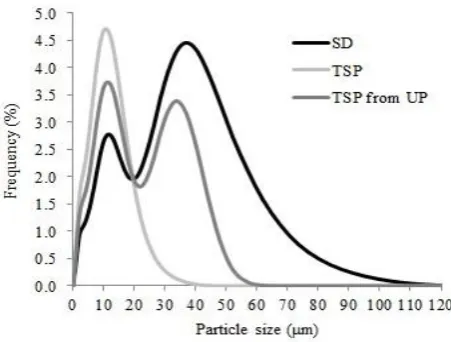
The settling dust (SD) samples consist of particles with a size generally below 100 m with two maxima (Figure 1): a higher one at around 35 m and a lower one at around 11
m. Between 10 and 30% of the particles are below 10 m. In contrast, total suspended particulate (TSP) samples consist of much smaller particles as it is expected. Their particles are generally lower than 50 m, and can be characterized mostly with one maximum at around 11 m. Between 45 and 80% of their particles are below 10 m. TSP samples from the UP thermal station, however, show a
Figure 1. Characteristic particle size distribution types of the studied samples
The bulk mineralogical composition of the samples reflects primarily the geological characteristics of the sampling areas. The main components of the SD samples are in the order of their frequency: quartz (60-90%), dolomite (2-20%), calcite (1-15%), feldspar (3-6%), mica (1-5%), chlorite (1-5%). Such phases also appear in the TSP samples with different ratios: quartz (20-30%), carbonates (dolomite and calcite 10-20%), clay minerals (5-15%) and feldspars (around 5%). These phases are characteristic natural components of urban dusts11. However, Zhao et al.12
found that some portion of these phases (quartz, feldspar, carbonates) could appear also in amorphous forms in the urban settled dust that suggest their anthropogenic origin. Significant amount of amorphous (organic?) material was found in the summer SD samples, probably due to increased contribution of plant materials (debris, pollen etc.) and the unfortunate presence of algae in the sampling pots. The presence of amorphous materials may be as high as 40% in the TSP samples, which is composed both of soot and debris of plant and animal remains. Trace amounts of gypsum also appear in the autumn SD samples. It also appears in the TSP samples (up to 5%) together with halite (up to 10%). Gypsum is general component of the construction materials, but it may form also due to the reaction between sulfuric acid and calcic material in several anthropogenic processes, while halite is common deicing agent13. Additionally, both
XRD and MS analyses showed the presence of large amounts of magnetite (up to 15%) in the TSP samples. This mineral was detectable in the SD samples only by magnetic analyses. Such particles have long been recognized to be associated with atmospheric particulates in the urban environment14. They are mainly derived from combustion
processes, such as industrial, domestic and vehicle emissions or from abrasion products from asphalt and from vehicles brake systems15.
Magnetic properties of the studied samples show large variation. Apparent susceptibility values for SD samples were found to be between 6 and 253 10-6 SI, while their
mass susceptibility values varied between 0.7 and 9.4 10-6
m3 kg-1. These values were found to be much higher for the
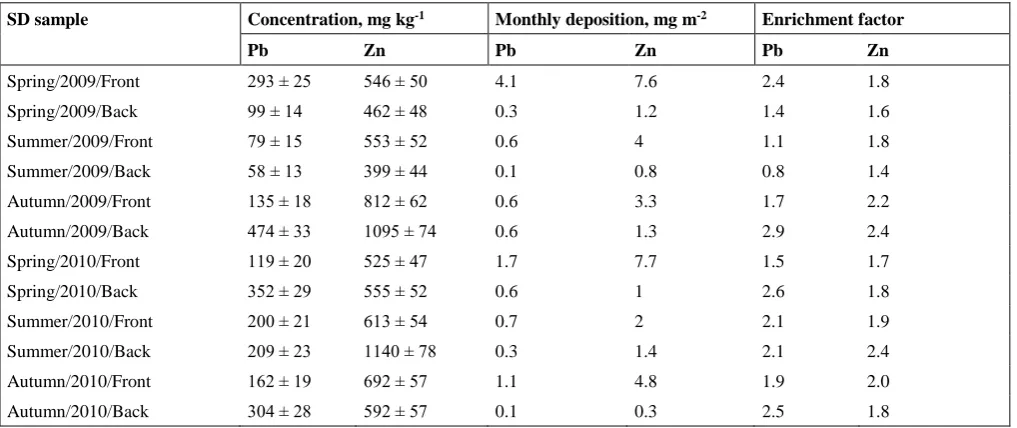
Table 1. Concentrations, monthly deposition rates and enrichment factors of Pb and Zn in the settled dust (SD) samples.
SD sample Concentration, mg kg-1 Monthly deposition, mg m-2 Enrichment factor
Pb Zn Pb Zn Pb Zn
Spring/2009/Front 293 ± 25 546 ± 50 4.1 7.6 2.4 1.8
Spring/2009/Back 99 ± 14 462 ± 48 0.3 1.2 1.4 1.6
Summer/2009/Front 79 ± 15 553 ± 52 0.6 4 1.1 1.8
Summer/2009/Back 58 ± 13 399 ± 44 0.1 0.8 0.8 1.4
Autumn/2009/Front 135 ± 18 812 ± 62 0.6 3.3 1.7 2.2
Autumn/2009/Back 474 ± 33 1095 ± 74 0.6 1.3 2.9 2.4
Spring/2010/Front 119 ± 20 525 ± 47 1.7 7.7 1.5 1.7
Spring/2010/Back 352 ± 29 555 ± 52 0.6 1 2.6 1.8
Summer/2010/Front 200 ± 21 613 ± 54 0.7 2 2.1 1.9
Summer/2010/Back 209 ± 23 1140 ± 78 0.3 1.4 2.1 2.4
Autumn/2010/Front 162 ± 19 692 ± 57 1.1 4.8 1.9 2.0
Autumn/2010/Back 304 ± 28 592 ± 57 0.1 0.3 2.5 1.8
Metals concentrations and enrichment
The average Pb (207 mg kg-1) and Zn (665 mg kg-1)
concentrations and their ranges (Table 1) in the SD samples are in the similar range as found in 12 Polish towns16. There
is no significant linear relationship between Pb and Zn concentrations in these samples (r = 0.49; p = 0.05). Both metals show moderate contamination in these samples with similar ranges and averages (EF=1.9) of their enrichment factors. The TSP samples show much higher metal concentrations (Table 2) with averages of 846 mg kg-1 for
Pb and 4837 mg kg-1 for Zn. Consequently, they can also be
characterized by much higher enrichment factors suggesting generally heavy contamination for both metals (EF=3.5 for Pb and 3.9 for Zn). During a study concerning to 15 Chinese cities, it was found that the total fraction of the urban dusts (<100 m) is practically uncontaminated, while the fine fractions (<10 m) were mostly heavily contaminated with Pb, Zn and other metals (Cr, Co, Cu)17. So the higher
concentration and enrichment of the studied metals in TSP than in SD samples is not unexpected as the former samples can be characterized by much greater ratio of PM10 particles.
Interestingly, metal concentrations are often higher in the backside SD samples than in the front-side ones in spite that the intense traffic should affect primarily the front-side of the building. As the mass of SD samples could be also affected by the contribution of algae or remnants of algaecide, monthly deposition values are much more useful for comparison. These values are much higher at the front-side for both metals than at the backfront-side as it is expected (Table 1). These values were found to be in the characteristic range for urban areas18.
The deposition rates of the studied metals show significant linear relationship to each other (r = 0.83; p = 0.05) suggesting the similar deposition characteristics of their host phases. Our unpublished data on the deposition characteristics of the dust around the study building suggest the dominance of re-suspension of roadside dust and soil in dust deposition. Threshold limit value is only given for Pb in Hungary that is 1.2 mg m-219. This value is exceeded only in
two times in the spring samples at the front-side of the building.
Table 2. Concentrations and enrichment factors of Pb and Zn in the total suspended particle (TSP) samples.
Concentration, mg kg-1 Monthly deposition, mg m-2
TSP sample Pb Zn Pb Zn
KF 06-08/2010_1 2785 ± 88 5297 ± 152 4.7 4.0
KF 06-08/2010_2 1782 ± 59 2679 ± 91 4.2 3.3
KF 06-11/2010_1 3533 ± 87 4902 ± 128 4.9 3.9
KF 06-11/2010_2 3597 ± 89 4837 ± 128 4.9 3.9
KB 07/2009-07/2010 496 ± 32 1463 ± 69 3.0 2.7
KB 04-09/2010 559 ± 35 1342 ± 67 3.1 2.7
UP 01-12/2010 846 ± 41 19046 ± 237 3.5 5.3
UP 03-08/2010 434 ± 29 12880 ± 189 2.8 4.9
Either apparent or mass susceptibility values do not show any linear relationship with Pb and Zn concentrations both in the SD and TSP samples. Although these metals are often associated with magnetic particles in urban environment20,
several studies showed that significant proportion (up to 60%) of total metal concentration in dust could be dissolved by weak acids, which did not mobilize them from magnetite21. In contrast, apparent susceptibility and metal
deposition values show strong linear correlation both for Pb (r = 0.89; p = 0.05) and Zn (r = 0.92; p = 0.05). Both apparent susceptibility and metal deposition values are not influenced by the possible errors in weight measurements of SD samples. This suggests that these metals travel together at least party with magnetic particles primarily in case of re-suspension of road dust and roadside soils.
Host phases for Pb and Zn
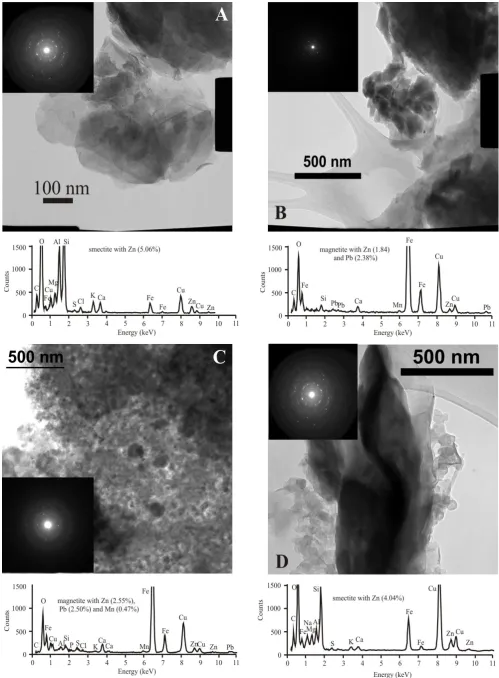
TEM analyses showed that the most significant components of the SD samples are different mineral phases. The most frequent particles are gypsum, quartz, feldspar, layer silicates, calcite, dolomite as well as Fe and Ti oxides as XRD analyses also showed partly. The most characteristic size range is between 10 and 20 m for most of the particles, but its dominance may be affected by the samples preparation technique. The most important Pb and Zn bearing phases are magnetite and clay minerals in these samples (Figure 2a. and b.). Additionally, Zn was found to be associated with a calcite particle in one case. This metal could be associated both with clay and Fe-oxide particles, while lead primarily to the latter ones. The silicate and oxide particles are often form aggregates with each other. The Zn content of clay minerals can be as high as 5 wt%, while Fe-oxides are characterized by a slightly lower Zn content (up to 2.5 wt%). The Pb content of the latter one phases is generally between 2 and 3 wt% and they also contain other trace metals (~0.5 wt% Mn). Among Fe-oxide particles both magnetite and hematite were identified. Additionally, ilmenite and titanite were also found in the samples but they do not contain detectable amount of Pb and Zn.
The soot aggregates consisting of nano-sized (few tens of nm) soot particles are the dominant phases in the TSP samples. This is in good agreement with the presence of high amounts of X-ray-amorphous (organic) material found in the samples by XRD analyses. The most important Pb and Zn bearing mineral phases were found to be spherular or xenomorphic magnetite particles (Figure 2c). They sometimes contain 2-3 wt% Pb and Zn. These magnetite particles often form aggregates and are closely associated with soot and/or clay minerals. In samples with high magnetite content metal-free magnetite spherules up to a few m sizes also appeared. Samples also contain ferrihydrite and probably hematite, but their amount is much lower than that of magnetite. Clay minerals and mica particles were found to contain significant amount of Zn (up to 5 wt%) and also Pb in much smaller amount (up to 0.41 wt%) (Figure 2d). Additionally, single ZnO and ZnCO3
(smithsonite) particles were also found in the sample with highest Zn content (collected at the UP thermal station). Again a single aggregate consisting of iron oxide and calcium carbonate was also found to contain significant amount of Pb (4.88 wt%) suggesting the presence of Pb also in carbonates. However, more direct data is needed to support this latter supposition.
Anthropogenic magnetite particles often contain Pb and Zn as showed by the close relation between their concentrations in the urban particulate matter and magnetic properties20. Additionally, Zn mostly associated to layer
silicates both in natural and contaminated soils22. Magnetite,
metal-carbonate and Zn-oxide particles in the dust may be primarily originated from anthropogenic emissions, while clay particles derived rather from the re-suspension of roadside dust and urban soils. Magnetite particles are resistant to weathering releasing its toxic components slowly to the environment23. However, layer silicates, carbonates
and oxides are much less resistant than magnetite24 so they
may be the potential source of mobile Pb and Zn metals in the studied samples.
Conclusions
TSP characterized by smaller particle sizes contain much higher ratio of potentially anthropogenic phases (amorphous phases, salts, magnetite), while they can be hidden by the large amount of coarse particles of soil origin in the SD samples. Accordingly, the concentrations and enrichment of the studied metals is also higher in the TSP samples as compared to SDs. Lead and zinc concentrations do not show any linear relationship with magnetic susceptibilities in both types of the samples. Only the close correlation between the metal deposition and apparent susceptibility values suggests the partial association of Pb and Zn with magnetic particles in the SD samples where the particles from soil re-suspension dominate.
Although trace-metal-free magnetite particles also appear in the studied samples, this phase is the most important host-phase for Pb and it often contains also Zn supporting the relation between metal deposition and apparent susceptibility of settling dust samples. On the other hand, highest amounts of Zn were found to be hosted with clay minerals. This latter metal also associated with carbonates and Zn-oxide phases in much smaller rate. Magnetite particles are resistant to weathering releasing its toxic components slowly to the environment, while layer silicates (and carbonates, oxides) may be the potential source of mobile toxic metals in the studied materials.
Acknowledgements
The project was financially supported by the OTKA (K76317, K75395 and PD 75740). B. Major (Budapesti Erőmű Zrt.) is thanked for the TSP samples. P. Sipos also thanks for the support of the János Bolyai Research Scholarship of the Hungarian Academy of Sciences.
References
1 Remeteiova, D., Smincakova, E., Florian, K., Microchim. Acta,
2007, 156, 109.
2 Samet, J. M., Dominici, F., Curriero, F. C., Zeger, S .L., Coursac, I., New Engl. J. Med., 2000, 343, 1742.
3 UNEP & WHO, Urban Pollution in Megacities of the World.
Earth Watch: Global Environment System. Blackwell, Oxford,
4 Seiler, H., Sigel, H., Sigel, A., Handbook on Toxicity of Inorganic
Compounds. Marcel Dekker INC, New York,1988.
5 Li, X. D., Poon, C. S., Pui, S.L. Appl. Geochem., 2001, 16, 1361. 6 Sutherland, R.A., Environ. Geol., 2000, 39, 611.
7 Vardoulakis, S., Fisher, B. E. A., Pericleous, K., Gonzalez-Fresca, N., Atmos. Environ., 2003, 37, 155.
8 MSZ 21454/1-83, Test of solid impurities in ambient atmosphere.
Determination of settling dust mass. Hungarian Standards Institution,1983, G 23.
9 Ji, Y., Feng, Y., Wu, J., Zhu, T., Bai, Z., Duan, C., J. Environ.
Sci., 2008, 20, 571.
10 Ódor, L., Horváth, I., Fügedi, U., J. Geochem. Explor.,1997, 60, 55.
11 Farkas, I., Weiszburg, T., Földtani Közlöny, 2006, 136, 547.
12Zhao, J., Peng, P., Song, J., Ma, S., Sheng, G., Fu, J., Air Qual.
Atmos. Health, 2010, 3, 139.
13Panigrahy, P.K., Goswami, G., Panda, J.D., Panda, R.K., Cem.
Concr. Res., 2003, 33, 945.
14 Hunt, A., Jones, J., Oldfield, F., Sci. Total. Environ.,1984, 33, 129.
14 Gautam, P., Blaha, U., Appel, E., Atmos. Environ., 2005, 39, 2201.
15 Gautam, P., Blaha, U., Appel, E., Atmos. Environ., 2005, 39, 2201.
16 Krolak, E., Pol. J. Environ. Stud., 2000, 9, 517.
17 Ji, Y., Feng, Y., Wu, J., Zhu, T., Bai, Z., Duan, C., J. Environ.
Sci., 2008, 20, 571.
18 Shahin, U., Yi, S. M., Paode, R. D., Holsen, T. M., Environ. Sci.
Technol., 2000, 34, 1887.
19 Bartófi, I., Environmental technology (in Hungarian),
Mezőgazda Kiadó, Budapest, 2000.
20 Filipelli, G. M., Laidlaw, M. A. S., Latimer, J. C., Raftis, R.
GSA Today, 2005, 15, 4.
21 Duong, T. T. T., Lee, B.K. Atmos. Environ., 2009, 43, 3502. 22 Manceau, A., Lanson, B., Schlegel, M.L., Harge, J. C., Musso,
M., Eybert-Berard, L., Hazemann, J. L., Chateigner, D., Lamble, G. M., Am. J. Sci.,2000, 300, 289.
23 Graham, R. C., Weed, S. B., Bowen, L. H., Buol, S. W., Clay.
Clay. Miner.,1989, 37, 19.
24 Vogelein, A., Pfister, S., Scheinost, A. C., Marcus, M. A., Kretzschmar, R., Environ. Sci. Technol.,2005, 39, 6616.