JEEECCS, Volume 3, Issue 9, pages 11-16, 2017
The Design and Implementation
of an Interactive Game-based Application
using Augmented Reality Technology
Ștefan Pavel, Gabriel Rădulescu
Automatic Control, Computers and Electronics Department Petroleum-Gas University of Ploiești
Romania [email protected]
Abstract – The rise of devices such as smart phones or tablets has led to the development of feasible applications that allow everyone to access various resources, anytime, anywhere. The flexibility of these devices makes possible the emergence of applications that rely on exploiting the user environment. These include applications from a relatively new field, augmented reality. The augmented reality mobile systems provide services without restricting the user to be in a specially equipped area. Ideally, augmented reality applications work virtually anywhere, adding a palpable layer of information to any medium whenever they want. By doing so, this type of application has the potential to revolutionize how information is presented to people, and the environment is transformed into the user interface. The first part of the present paper provides an overview of augmented reality theory and of the elements that are based on these concepts having the purpose of developing various products. The second part is focusing on the stages that present the implementation and realization of a product based on the theoretical and practical concepts previously developed in the field of study, but the result is an original one. The essence of the work is to improve the interaction between real and virtual objects that can be manipulated, so that this resulting experience is natural and the user is not disturbed by an unnatural interaction with the system, the relationship between real world objects and virtual objects a smooth one. The application must adapt to virtual elements according to the real scene, and all of this must be done in real time so that the user has quality results.
Keywords – augmented reality, virtual content, interactivity, mobile systems.
I. INTRODUCTION
A. Augumented Reality. Concepts and Foundations
The augmented reality is the field of computer science research that uses image processing, various computer graphics techniques, and artificial vision algorithms to integrate digital content into the real world. This allows in real time [3] the interaction between the user, the virtual and the real objects in the environment. The augmented reality includes the following features:
Combines real world with computer graphics;
Provides interaction with various objects in real time;
Provides real-time tracking services;
Provides imaging or object recognition methods;
Provide environmental information in a timely manner.
Paul Milgram presents the continuum of reality-virtuality [2], also called mixed reality continuum, illustrated in fig. 1. One of the ends of the continuum is represented by the real environment, the reality, and the other end is virtual environment, virtuality. A mixed reality system combines the real world and the virtual world to produce a new environment in which physical and digital objects coexist and interact. Reality here means the physical environment represented by the visible environment, as seen directly or on a video screen [5].
Fig. 1 Milgram's Reality-Virtuality Continuity [10].
B. The architecture of an augmented reality system
Ștefan Pavel, Gabriel Rădulescu 12
Fig. 2 Logic scheme for augmented reality system [11].
In the above scheme 1 represents camera, 2- the image, 3- Capturing module, 4- Tracking module, 5-Virtual components, 6- Rendering module, 7- Augmented Image and 8 the display.
The tracking module allows the system to add virtual components as part of the real scene. The fundamental difference compared to other image processing tools is that in augmented reality, virtual objects are moved and rotated in 3D coordinates instead of the 2D coordinates of the image. The rendering module positions the virtual image according to the camera images. In classical computer graphics, the virtual scene is projected onto an image plan using a virtual camera and this projection is then played back. Innovation in augmented reality is to use a virtual camera identical to the real system. Thus, virtual objects in the scene are designed in the same way as real objects, and the results are convincing. To be able to imitate real cameras, the system needs to know the optical characteristics of the camera. The process of identifying these features is called camera calibration, and this calibration may be part of the augmented reality system or may be a separate process [5].
C. The current state of using this technology
Augmented reality technology is beneficial and suited to many application areas. It is suitable for the development of applications for augmented viewing of various environments, represented either inside the premises or outside of buildings. It is also suitable for applications that aim to visualize and assist in assembling, maintaining or preparing in certain areas of development. The augmented reality allows the development of interactive games, capitalizing on the benefits of this technology, or the use of this technology to generate new forms of advertising. Certain location-based support has led to the development of a so-called augmented reality browser, and in print media, augmented reality allows 3D graphics and a video format to be printed with printed publications. In addition, augmented reality has been tested in medical applications and traffic orientation applications [6].
II. RESOURCES USED FOR THE DEVELOPMENT OF THE APPLICATION Unity 3D (logo fig. 3) is a software package that offers many of the features that are used and underpinning the construction of a video game. It allows the rendering and rendering of various forms both 2D and 3D forms that are imported after they
have been generated and processed in other software, such as Blender or 3D Studio Max.
This game development environment is one of the most used software for this purpose by both professional and amateur developers. Unity 3D has many advantages including the fact that it is not necessary to develop a certain type of game, that is, the development of 2D games with different themes and configurations but also of some 3D using the mechanical and logical facilities offered by this environment.
Fig. 3 Unity logo [12].
Unity 3D games allow for very good graphics rendering, realistic lighting, physical elements such as gravity or collision detection, particle systems, and many other elements that give these applications true [7].
Vuforia is a mobile-based software development kit (SDK) that lets you create applications using augmented reality [8]. To achieve these applications, Computer Vision technology is used to recognize and track images (image targets) and simple 3D objects, such as boxes, in real time. This image capture capability allows developers to position and direct virtual objects such as 3D models and other media in real-world images when viewed through a camera's mobile device. The augmented virtual object then follows the position and orientation of the image on which it was augmented, in real time, so that the viewer is given a fair view of it so that the virtual object appears as part of the real-world scene [9].
Fig. 4 shows the general structure on which it operates augmenting the environment using Vuforia. The camera object ensures that each video frame is captured and transmitted to the Tracker. The frame is automatically transmitted in a format and size dependent on the device. The image converter is required to convert from the camera format to an acceptable format for OpenGL playback and tracking. This conversion also includes sub-sampling for images provided by the camera to be available in various resolutions in the stack of converted frames.
The tracker contains algorithms that allow the detection and tracking of real objects in video frames. The recognition results are stored in a state object used by the image generating module. This module displays the image that should appear on the terminal screen. For each processed frame, the status object is updated and the graphical content generation method is called
[4]
. The whole process is summarized in the following steps:
a) Checking the status object for the
appearance of detected images or image updates (position change);
b) Updating the logic with new input data;
c) Enhanced graphics rendering;
III. DESIGN, IMPLEMENTATION AND TESTING OF THE APPLICATION
A. Application Design. The basics of development The application design process presented in this paper is a thorough one and requires a high level of research focusing on multiple fields, including image processing, graphic content generation, and object-oriented programming. The first steps behind the development of the application were the awareness of the potential of the augmented reality field and of the tools that allow the development of such an application. After exploring these issues, it has been chosen as the main development environment for the Unity 3D software package presented above for the tools it provides to develop an interactive game-type application that can also be developed using the benefits of augmented reality technology. In 2016, Unity 3D and Vuforia have made a partnership (fig. 5) uniting their forces to make the development of augmented reality applications easier. Unity and Vuforia share a common mission to promote the development of augmented reality, so far it is working to fully integrate the Vuforia platform, which is the main platform for the development of augmented reality, into the working mechanism of Unity 3D.
Fig. 5 Oficial Vuforia & Unity partenership [14].
B. Implementing a Primary Application
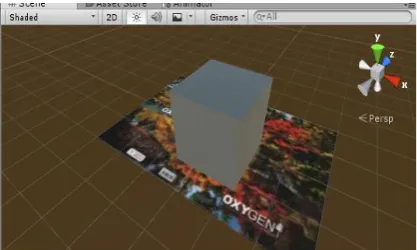
Once downloaded and installed all necessary resources for application development, the implementation process can be started. To get started, you need to create an account on the Vuforia Development Portal. After authentication, two actions are taken: creating an application license key and creating a database and target image. A license key is a unique ID that is required to create an application that uses Vuforia in the Unity development environment. One important thing to mention at this stage is the "rating" of the image used as a target. A good rating means that it can be used for tracking, while a low rating means that the image does not have enough points with special features (interesting points in the image such as edges, corners, etc. that are used for image tracking). Unity is a very powerful game development environment and is spread on a large scale thanks to its portability and great advantages. The first step for implementation is to create a new project, which will encompass all the defining elements for the implementation of the application. This is how the Vuforia packages generated in the previous step are being imported into the new project. Unity 3D works with scenes, so all elements that appear at one time or another in the application are in scenes in different forms: 3D objects, cameras, lights, scripts, or special items such as target image or virtual buttons. Fig. 6 shows a first scene where the augmented Reality Camera, the target image (ImageTarget), and a virtual object represented by a cube are used. The target image properties are in line with those set when Vuforia is set up so that only a picture that is in the database previously developed, downloaded and imported into the project.
Fig. 6 Implementation of fundamental components for augmented reality and virtual content.
The easiest implementation and testing of an augmented reality application using these resources is to augment a simple 3D form, such as a cube. This was the first test and application base much developed in later stages. Fig. 7 shows how to run this basic application.
Ștefan Pavel, Gabriel Rădulescu 14
C. Deploying "Augmented History"
The application developed and presented in this paper is about linking two main scenes, each representing a type of game that allows user interaction in a more attractive way. The first part of this application involves the development of a game of general culture on the historical theme chosen as a leitmotiv, namely the defining events of the Second World War. It aims to introduce the user into the atmosphere of that period and to more fully understand the events illustrated in the second part of the application, the augmented reality part of the application. Within the scene developed based on augmented reality technology, the user is allowed to interact and influence the events and actions that take place in the fights illustrated.
D. Main menu and game of general culture
The application consists of two main scenes so as to initially run an intermediate scene (Fig. 8), representing the main menu of the application.
Fig. 8 Application menu.
This allows the continuation of the application in two ways, the first one, the START GAME, involves running general culture questions with final effect in the battle scene, if enough scoring is achieved or return to the main menu in case of insufficient score. While the second option, WITHOUT QUESTIONS, allows the user to get into the actual scene for augmented reality without going through the set of questions. Fig. 9 shows one of the set questions. At the same time, the timer and score can be observed at the time of the question. The number of variants is variable so that the size of the buttons is proportional to their number.
Fig. 9 Scenario example.
The end of the round, illustrated in fig. 10, and implicitly the set of questions involves performing several operations among them by stopping the stopwatch, displaying the final results, and based on a point threshold it is determined whether the user can move to the next level or whether it is necessary to return to the menu.
Fig. 10 Final winning scene.
E. Scene using augmented reality technology
The realization of this central part of the application presented in this paper is based on the compatibility between Unity 3D and Vuforia. Various elements and concepts have been implemented and used within this scene to generate the resulting finished product.
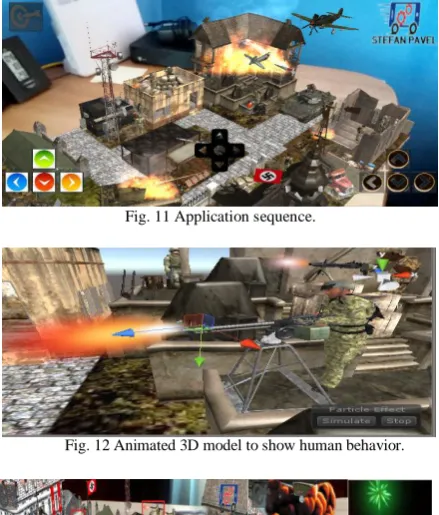
Fig. 11 illustrates a sequence in the run of this scene, a sequence in which the relationship between the environment and the generated virtual content can be observed.
Fig. 11 Application sequence.
Fig. 12 Animated 3D model to show human behavior.
Fig. 13 Examples of use of the particle system
direction. To make 3D models that have human characteristics and can be animated to perform people-specific action in a natural way. Blender software has been used that provides many of the tools needed for such development. Fig. 12 shows a 3D model that is animated to have a human behavior.
Unity 3D allows the introduction and use of many elements that allow the development of realistic and attractive scenes. Particle System (Particle System) is a very important tool used to simulate the effects whether they are represented by gunfire, explosions, flowing water or fires, so fig. 13 shows some of the objects and events that use the particle system.
Fig. 14 Using the virtual button.
Augmented Reality offers many tools to develop interactive and innovative applications. Among these elements made available by the Vuforia SDK are the virtual buttons that provide a useful mechanism for object and action interaction, based on images. The occurrence of an event is represented either when the button is actuated or when it is released. Fig. 14 shows how to deploy the virtual button, whose position was selected in the area of the logo on the target image. When running the application any time the virtual button area is operated on the device screen, a button will be displayed to allow you to return to the main menu. Once this area is released, the button will disappear.
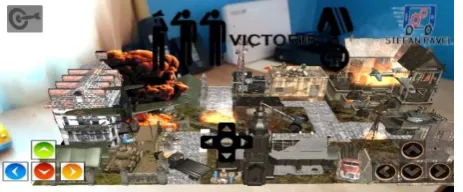
The objectives to be met in order for the user to win the battle have as a central element the main character illustrated in fig. 12 as being animated, which will move to different areas of the city and trigger certain actions. Thus, by changing the position of this model in relation to the coordinated scene in the main script of the scene, certain codings are made, which means that once the soldier has arrived in a certain area, various options are available. The final configuration of this stage in the game as soon as the user meets all the objectives is shown in fig. 15, noting the confirmation of the user's victory.
Fig. 15 Illustration of the end of the scene.
IV. CONCLUSIONS
The elaboration of the application presented in this paper involves a complex process in which the stages regarding the expansion of reality are detailed. This development process can be divided into three stages:
Configuring a software environment favorable to such development;
Implementing the defining elements of augmented reality;
Modeling of virtual content and description of its interactivity functionality.
In the developing of a product based on augmented reality one can encounter various problems. In the expansion of the application presented in the following article there were some problems related to the software and hardware fields. Regarding to the software problems, the most common ones were about programming the environment and animate all elements in a natural way in order that the created scene to be as closer to reality as it can be. The other field in which there were encountered problems is the hardware domain. Such problems as the operating system of the smart devices on which there was uploaded the application and the technical properties : the device’s camera or Graphics Processing Unit, of such devices had influenced the efficiency of the application.
Considering the very generous training potential revealed by the augmented reality application presented in the paper and the innovative way in which information exchange takes place, this digital technology deserves all the attention of the actors involved in the processes aimed at developing such applications. At the same time, the interactivity and contextualization, facilitated by the sensory immersion opportunity in the environment, are the features that make the "Augmented History" application the ideal tool for personalizing education in a different and modern way.
There are a lot of extraordinary ideas that await someone who can make them real and take shape, so Jules Verne, the French author and father of science fiction, said, "Everything can imagine a man, another can make it real, "so augmented reality provides the perfect framework for implementing applications and systems that will revolutionize the everyday life.
REFERENCES
[1] JANI, B.Y, Pratiksha Dahale, Ankita Nagane, Bhavika Sathe, Nilam Wadghule, “Interior Design in Augmented Reality Environment”, International Journal of Advanced Research in Computer and Communication Engineering Vol. 4, 2015. [2] MILGRAM, P., Takemura, H., Utsumi, A. & Kishino, F.,
“Augmented Reality: A Class of Displays on the Reality-Virtuality Continuum”, SPIE, Vol. 2351,1994.
[3] PARASCHIV, Nicolae, Achiziția și prelucrarea datelor, Editura Universității Petrol-Gaze Ploiești, 2013.
[4] PLOTEAN, Mihail, Realitatea augmentată pe dispozitive Android, Universitatea “Ştefan cel Mare” Suceava, 2012. [5] SILTANEN, Sanni, Theory and applications of marker-based
augmented reality, Ed. Kopijyvä Oy, Kuopio 2012.
Ștefan Pavel, Gabriel Rădulescu 16
International Symposium on Mixed and Augmented Reality, 2008.
[7] WINN, Brian, Intro to Unity3D, Michigan State University, 2015.
[8] Augmented Reality (Vuforia) ,
https://developer.qualcomm.com/software/vuforia-augmented-reality-sdk
[9] Developing with Vuforia 6. Vuforia Developer.
https://vuforia.com/blog/vuforia-6
[10] MILGRAM, P., Takemura, H., Utsumi, A. & Kishino, F., “Augmented Reality: A Class of Displays on the Reality-Virtuality Continuum”, SPIE, Vol. 2351,1994.
[11] SILTANEN, Sanni, Theory and applications of marker-based augmented reality, Ed. Kopijyvä Oy, Kuopio 2012.
[12] Unity Logo, https://unity3d.com/
[13] PLOTEAN, Mihail, Realitatea augmentată pe dispozitive Android, Universitatea “Ştefan cel Mare” Suceava, 2012. [14] Unity - Partners – Vuforia,
![Fig. 1 Milgram's Reality-Virtuality Continuity [10].](https://thumb-us.123doks.com/thumbv2/123dok_us/7806405.2085170/1.595.328.539.497.553/fig-milgram-s-reality-virtuality-continuity.webp)
![Fig. 2 Logic scheme for augmented reality system [11].](https://thumb-us.123doks.com/thumbv2/123dok_us/7806405.2085170/2.595.311.497.503.760/fig-logic-scheme-augmented-reality.webp)