379
© 2018 by the Serbian Biological Society How to cite this article: Li J, Han X, Tang L, Wang C, Zhang W, Ma J. 20-hydroxyecdysone protects wheat seedlings from salt stress. Arch Biol Sci. 2018;70(2):379-86.
20-Hydroxyecdysone protects wheat seedlings from salt stress
Jin-ting Li*, Xue-ping Han, Li Tang, Can Wang, Wei-yu Zhang and Jian-hui Ma
Henan Normal University, College of Life Science, Xinxiang, Henan Province, China
*Corresponding author: [email protected]
Received: July 22, 2017; Revised: November 14, 2017; Accepted: December 11, 2017; Published online: December 22, 2017
Abstract: 20-Hydroxyecdysone (20E), a molting hormone of insects, is the most abundant phytoecdysteroid (PE) produced by plants, where it represents a protective molecule against insect herbivores. The objective of the investigation is to deter-mine the effect of 20E on the growth, physiological and biochemical characteristics and the transcript levels of antioxidant enzymes of wheat seedlings under salt stress. Our results showed that exogenous 20E was able to significantly alleviate salt-induced oxidative damage in wheat seedlings. It most likely acts by decreasing the concentration of malondialdehyde
(MDA) and the rate of superoxide radical (O2•−) generation, and by increasing the activities of superoxide dismutase (SOD),
peroxidase (POD), catalase (CAT), concentrations of ascorbic acid (AsA) and glutathione (GSH), and the gene expression
levels of SOD, POD, CAT. It was suggested that foliar spraying with 20E could efficiently protect wheat seedlings against
salt-induced oxidative stress. The results also show that 20E had a positive physiological effect on the growth of salt-stressed seedlings. This is the first report dealing with the effect of 20E pretreatment in the enhancing of wheat seedling tolerance under salt stress.
Key words: Triticum aestivum; 20-hydroxyecdysone; salt stress; oxidative stress; antioxidative system
INTRODUCTION
20-Hydroxyecdysone (20E) is one of the phytoecdys-teroids (i.e. analogs of insect steroid hormones) found in the rhizomes, root and stems of many plants. 20E is also the ecdysteroid hormone of arthropods and many other invertebrates, where it regulates several physio-logical processes [1]. In plants, phytoecdysteroids, be-ing physiologically active compounds, may affect mor-phological and physiological processes and protect plants against phytophagous insects and nematodes [2-5]. 20E has attracted much attention for its plant growth regulatory, cytotoxic and antioxidant proper-ties [2,6]. Hu et al. [7] found that 20E could protect against oxidative stress-induced neuronal injury by scavenging free radicals and modulating NF-κB and JNK pathways. Lamhamdi et al. [8] have also shown that 20E treatment had a positive effect on the growth and metabolism of wheat seedlings against lead stress. However, little is known about the antioxidative effect of 20E on the seedlings of wheat (Triticum aestivum L.), one of the most commercial crops in the world, under both normal and salt-stressed conditions.
Fur-thermore, it remains unclear whether 20E plays a sig-nificant protective role in ameliorating the influence of salt stress on wheat seedlings by increasing its salt tolerance.
system [9,10,14]. Therefore, enhancing the activities of antioxidant enzymes and contents of nonenzymatic antioxidants in plants is necessary to counteract many environmental stressors, and can confer enhanced tol-erance to unfavorable growth conditions.
The aim of this study was to investigate the role of 20E on wheat seedlings under salt stress by examining the transcript levels and enzymatic activities of SOD, POD, CAT and APX, the concentration of photosyn-thetic pigments, of AsA and GSH, and membrane injury. Results from this study are fundamental for understanding the antioxidative effect of 20E on wheat seedlings under salt stress.
MATERIALS AND METHODS
Plant materials and salinity treatments
Wheat seed samples of Triticum aestivum L. cv Zhou-mai No.9023 were harvested from the Henan Acad-emy of Agricultural Sciences. Growth was controlled by fluorescent illumination (800 μmol m-2·s-1) set to provide a 12 h photoperiod, at 60% humidity and 25°C/18°C (day/night temperatures, respectively). Hoagland solution served as a growth medium in Petri dishes (18 cm in diameter). The seeds were sterilized with 0.01% HgCl2 for 2 min, followed by running wa-ter for another 10 min. One-week-old homogenous seedlings (with fully expanded leaves) served as ex-perimental material for treatment with 20E and NaCl. Treatments were as follows: (i) distilled water (con-trol); (ii) 150 mM NaCl; (iii) pretreatment with 3 µM 20E alone; (iv) pretreatment with 3 µM 20E, followed by 150 mM NaCl. 20E was purchased from Sigma-Aldrich (St. Louis, MO, USA). For 20E treatment, 3 µM of 20E was sprayed over the leaves two times at two-day intervals, while control plants received the same amount of distilled water. Three days after com-mencing the 20E treatments, 150 mM of NaCl was added to the Hoagland solution for seedlings with or without 20E treatment. The concentrations of 20E were selected based on a preliminary experiment, performed using different concentrations of 20E (0.1, 0.25, 0.5, 1.0, 2.0, 3.0 and 4.0 µM), to examine where significant growth stimulation would be observed. The concentration of 3 µM of 20E was subsequently
selected (data not shown). Five Petri dishes containing 80 seedlings each were regarded as a treatment group, and all experiments were independently repeated at least three times. On the 4th day of exposure to salt stress, wheat seedlings were collected and frozen in-stantly in liquid nitrogen and stored at -80°C until further use.
Analysis of growth and biomass
Root and shoot dry weights were estimated after oven-drying at 65°C to a constant weight. Plant height and root length were also gauged with a ruler.
Determination of malondialdehyde and hydrogen peroxide
Malondialdehyde (MDA) concentration was assayed using the thiobarbituric acid method described by Predieri et al. [15]. Wheat seedlings (0.2 g fresh weight − FW) were homogenized in phosphate buffer (50 mM, pH 7.8) and centrifuged for 10 minutes at 8000 × g. One mL of the supernatant was mixed with 2.5 mL of thiobarbituric acid for 20 min in a boiling water bath and cooled immediately on ice. Absorbance of the supernatant was measured at 532 nm and 600 nm after 5 min centrifugation at 10000 × g. After sub-tracting the nonspecific absorbance (600 nm), MDA concentration was measured by its molar extinction coefficient (155 mM-1 cm-1) and the results were ex-pressed in µmol MDA g-1 FW.
Hydrogen peroxide was estimated according to Sergiev et al. [16]. Wheat seedlings (0.3 g FW) were homogenized in an ice bath with 3 mL 3% (w/v) tri-chloroacetic acid and centrifuged at 12000 × g for 15 min. One mL of the supernatant was added to 1 mL of 100 mM of potassium phosphate buffer (pH 7.0) and 2 mL of 1 M KI. The absorbance was measured at 390 nm and the content of H2O2 was calculated based on a standard curve of a known concentration of H2O2.
Determination of the rate of production of the superoxide radical (O2•−)
phos-phate buffer (1 mL, 50 mM, pH 7.8) and centrifuged at 10000 × g for 10 min. Next, 0.5 mL of phosphate buffer (50 mM, pH 7.8) and 0.1 mL of hydroxylamine hydrochloride (10 mM) were applied to 0.5 mL of supernatant for 1 h at 25oC. Finally, 1 mL of sulfanil-amide (17 mM) and 1 mL α-naphthylamine (7 mM) were added to the reaction for another 20 min. The rate of O2•− generation was determined by the absor-bance at 530 nm. Sodium nitrite was used as a stan-dard solution to calculate the production rate of O2•−.
Determination of antioxidative enzyme activities
For determination of antioxidant enzyme activities, 0.5 g homogenized seeds and 3 mL of ice-cold phos-phate buffer (pH 7.8, containing 1 mM EDTA) were mixed and centrifuged at 15000 × g for 20 min (4°C). After centrifugation, the supernatant was used as a crude extract in which the activities of SOD, POD, CAT and APX were estimated.
SOD (EC1.15.1.1) activity was determined by the inhibition of photochemical reduction of nitro-blue tetrazolium (NBT) [18]. The reaction solution was composed of phosphate buffer (50 mM, pH 7.8), EDTA (0.1 mM), methionine (130 mM), NBT (0.75 mM), riboflavin (0.02 mM) and enzyme extract (0.1 mL). The reaction was initiated by exposure with riboflavin to two 40 W fluorescent lamps, and then terminated by removing after 10 min away from the light source. Calibration standards were made using the same procedure but without the addition of the supernatant. Absorbance was measured at 560 nm and was expressed as U mg-1 (FW).
CAT (EC1.11.1.6) activity was measured as the absorbance at 240 nm for H2O2 decomposition [19]. The reaction solution was composed of phosphate buffer (50 mM, pH 7.8), EDTA (0.1 μM), H2O2 (0.1%), and enzyme extract (0.1 mL). The decomposition of H2O2 was detected by measuring the decrease in ab-sorbance at 240 nm for 3 min, and quantified by its molar extinction coefficient (36 mM-1 cm-1). One unit of catalase activity was defined as a change of 0.01 absorbance min-1 by the enzyme extract.
POD (EC 1.11.1.7) activity was determined by the rate of formation of tetraguaiacol at 470 nm [20]. Absorbance was measured at 470 nm for 5 min by
adding the enzyme extract (0.02 mL) to the reaction mixture, which contained guaiacol solution (0.02 mL) and hydrogen peroxide solution (0.01 mL) in 3 mL of phosphate buffer solution (pH 7.0). Enzyme ac-tivity was quantified by the amount of tetraguaiacol formed using its molar extinction coefficient (26.6 mM-1 cm-1).
APX (EC 1.11.1.1) activity was measured accord-ing to the method of Nakano and Asada [21]. The 3-mL reaction mixture was composed of phosphate buffer (50 mM, pH 7.8), EDTA (0.1 mM), ascorbate (0.5 mM), H2O2 (0.1 mM) and enzyme extract (0.1 mL). Activity was recorded as the decrease in absor-bance at 290 nm for 3 min and the concentration of oxidized ascorbate was calculated using the molar extinction coefficient of 2.8 mM-1·cm-1.
Determination of ascorbate, glutathione and soluble protein concentrations
Wheat seedlings (0.2 g) were centrifuged at 15000 × g for 15 min after grinding in ice-cold 5% (w/v) tri-chloroacetic acid. Then, 0.2 mL of supernatant was added to 2.6 mL NaH2PO4 (pH 7.7) and 0.2 mL 5, 5-dithiobis (2-nitrobenzoic) (DTNB). After 5 min at 30oC, the absorbance was measured at 412 nm and the reduced glutathione (GSH) content was calculated based on the standard curve [22].
Homogenized seeds (0.2 g) in ice-cold metaphos-phoric acid (2 mL 10%) were centrifuged at 15000 × g for 10 min. After centrifugation, to 0.5 mL of super-natant was added 1 mL of citric acid-phosphoric acid buffer (pH 2.3) and 1 mL of 2, 6-dichlorophenol indo-phenol (30 mg·L-1). Absorbance was measured at 524 nm after 30 s. AsA concentration was determined as described [23]. The soluble protein content in wheat seedlings was measured according to the procedure of Bradford [24] using bovine serum albumin as a standard.
Total RNA extraction, cDNA synthesis and real-time quantitative PCR
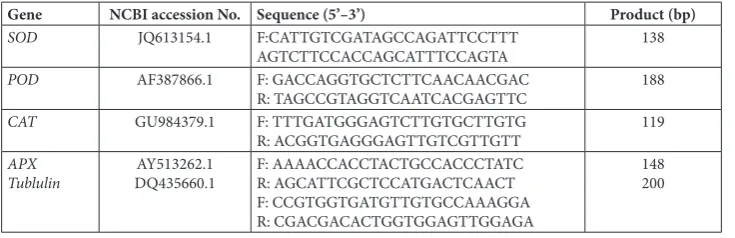
manufac-turer’s instructions. Total RNA quantitation, cDNA synthesis and qRT-PCR were performed according to a previously described method [25]. Ten µg of to-tal RNA were treated with RNase-free DNase I (Pro-mega), and 2 µg were reverse-transcribed into cDNA using random hexamers and M-MLV Reverse Tran-scriptase (Promega, USA). After reverse transcription, the products of each reaction were diluted 5 times to avoid potential primer interference in the qRT-PCR reaction. Quantitative RT-PCR was performed using SYBR® qPCR Mix (Toyobo, Japan) in a 20-μL reaction volume, containing 2 µL of diluted cDNA as template and 300 nM of each primer. Triplicate reactions were carried out using a Rotor-Gene 3000 real-time PCR detection system (Qiagen). Gene-specific primers for catalase (CAT), peroxidase (POD), superoxide dis-mutase (SOD), ascorbate peroxidase (APX), and the reference gene tubulin were used to amplify amplicons specific for wheat. The used primers are given in Table S1, and they were designed according to wheat EST sequences of candidate proteins available in the NCBI.
Statistical analysis
The experiments were repeated three times and each data point was the mean of six replicates. All obtained data were statistically analyzed by two-way analysis of variance (ANOVA), and statistical significance of the means were compared by Duncan’s multiple range tests at 5% probability level using SPSS software. In all figures, the error bars represent standard errors of the means. The effects of NaCl, 20E and their interac-tion (20E×NaCl) in terms of activity of antioxidant enzymes, content of MDA, O2•−, GSH, AsA, protein and growth parameters are presented in Table 1 ac-cording to two-way ANOVA.
RESULTS
Effect of 20E on growth parameters of wheat seedlings under NaCl stress
Fig. 1 presents plant height, root length, shoot dry weight (DW) and root DW in wheat seedlings ex-posed to 150 mM NaClstress for 4 days with or with-out 3 µM of 20E. It can be observed that there was a significant decrease in plant height, root length, shoot
DW and root DW in wheat seedlings exposed to NaCl stress as compared with the control. When the 20E pretreatment was combined with 150 mM of NaCl, root length and root DW were significantly enhanced in wheat seedlings, but plant height and shoot DW were not. 20E treatment alone did not significantly change plant height, shoot DW and root DW in wheat seedlings, with the exception of root length.
Table 1. Two-way analysis of variance (ANOVA) for NaCl, 20E,
and their interaction (ES×NaCl) for morphological and physi-ological parameters in wheat seedlings under NaCl stress.
Dependent
variable NaCl Independent variable 20E 20E×NaCl
MDA 7.30* 5.98* 2.11 ns
O•— 2 28.50** 46.64*** 44.67***
H2O2 43.20** 18.56* 20.36*
SOD 35.58** 83.29*** 69.50***
POD 91.21*** 9.97* 24.10**
CAT 0.91 ns 7.79* 10.04*
APX 41.25*** 2.95 ns 13.09*
GSH 0.29 ns 49.96*** 2.16 ns
ASA 0.18 ns 9.85* 6.63*
Protein 13.44* 0.98 ns 2.24 ns
Plant height 11.73* 1.97 ns 4.97*
Root length 30.23** 10.79* 17.55*
Shoot dry weight 6.03* 5.19* 20.86*
Root dry weight 5.35* 12.13* 5.82*
Numbers represent F values at 5% level. Ns – not significant. *P<0.05; **P<0.01; ***P<0.001
Effect of 20E application on the MDA and H2O2
contents and the production rate of O2•− in wheat
seedlings under NaCl stress
The contents of MDA and H2O2 and the production rate of O•— 2 in wheat seedlings were affected by the salt stress and 20E application (Table 1, Fig. 2). Compared to the control, NaCl stress alone resulted in significant increases in MDA, H2O2 content and the production rate of O•— 2 in wheat seedlings by 22%, 54% and 35%, respectively. However, the exogenous 3-µM 20E treatment significantly alleviated the salt-induced accumulation of MDA and H2O2, and de-creased the production rate of O•— 2 in wheat seed-lings (P<0.05). When the 20E-treated seedlings were compared to the control, the content of MDA, H2O2 and the production rate of O•— 2 were not affected.
Effect of 20E on antioxidant enzyme activities in wheat seedlings under NaCl stress
To investigate the antioxidant role of 20E against NaCl stress, the activities of antioxidant enzymes were de-termined. As shown in Fig. 3, when compared to the control, NaCl stress alone significantly decreased the activities of SOD and CAT (P<0.05) in wheat seed-lings, although it induced increases in POD and APX activities by 15% and 13%, respectively. In contrast, a more remarkable increase (P<0.05) in the activities of
SOD, POD and CAT were observed in the seedlings treated with exogenous 20E combined with 150 mM NaCl (Fig. 3). Fig. 3 also shows that the treatment with 20E alone had little effect on the activities of SOD, CAT and APX, with the exception of POD.
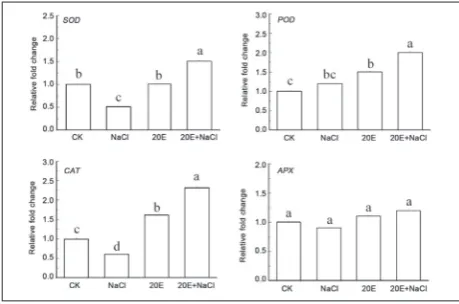
Effect of 20E on gene expression in wheat seedlings under NaCl stress
Real-time PCR analysis was performed to determine the expression levels of four antioxidant enzyme genes, SOD, POD, CAT and APX, in wheat seedlings under 150-mM-NaCl stress for 4 days with or with-out 20E treatment. Consistent with the enzyme activi-ties, SOD and CAT expression levels were significantly downregulated by 150-mM NaCl stress when com-pared with the control (Fig. 4). In contrast, significant
Fig. 2. Effects of exogenous 20E on the content of MDA (a), H2O2
(b) and the production rate of O2•− (c) in wheat seedlings under NaCl stress for 4 days. Different treatment were: distilled water (control, CK), 3 µM 20E, 150 mM NaCl, 3 µM 20E + 150 mM NaCl (20E + NaCl). Bars are means ± standard error of 6 repli-cates. Means with different letters above the bars were significantly different at 0.05 level according to Duncan’s multiple range test.
Fig. 3. Effect of exogenous 20E on the activities of SOD (a), POD
(b), CAT (c) and APX (d) in wheat seedlings under NaCl stress for 4 days. See notes to Fig. 2.
Fig. 4. Effect of 20E treatment on SOD, POD, CAT and APX
upregulation of SOD, POD and CAT gene expression was observed in seedlings treated with 20E and 150 mM of NaCl. However, APX transcript levels did not vary significantly, irrespective of the presence or ab-sence of 20E treatment or NaCl stress. In addition, the 20E treatment alone had a significantly effect on POD and CAT transcript levels, but not SOD gene expres-sion, when compared to the control.
Effect of 20E on GSH, AsA and protein contents in wheat seedlings under NaCl stress
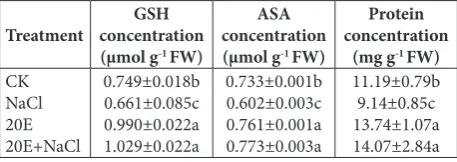
Salt stress caused significant decreases (P<0.05) in the concentrations of GSH, AsA and protein in wheat seedlings (Table 2), while the same concentrations in 20E-treated seedlings were significantly enhanced as compared to 150-mM-NaCl stress alone. Table 1 also shows that 20E alone had a significant influence on GSH, AsA and protein compared to the control.
DISCUSSION
Salt stress is known to cause significant reduction in plant growth, manifesting as decreased leaf area, leaf length and root and shoot DW [9]. In the pres-ent study, a significant reduction in the growth of plant height, root length, shoot DWand root DW of wheat seedlings was observed under salt stress. This result is in agreement with Li et al. [9], who showed that salinity caused a marked reduction in the growth parameters of wheat. However, it was observed that exogenous 20E treatment significantly increased the root length and root DW of wheat seedlings under
salt stress when compared to corresponding untreated plants. A similar result was reported by Bakrim et al. [5], who foundthat 20E exogenously applied to the seeds of tomato induced morphological and biochem-ical modifications, including effects on root and shoot length in the seedlings. A significant increase (P<0.05) in wheat seedling growth under salt stress (root DW and root length) was observed under exogenous 20E treatment, which was concomitant with the decreased production rate of O2•− and MDA concentration. The high MDA decrease points to changes in membrane fluidity and damage to membrane proteins, such as inactivation of receptors, enzymes and ion channels. MDA has been considered a marker for membrane lipid peroxidation in various crops [9,10,25]. Hu et al. [1] showed that 20E protected against oxidative stress-induced neuronal injury by scavenging free radicals and decreasing MDA concentration. Lamhamdi et al. [8] also reported that 20E treatment notably de-creased MDA concentration in wheat seedlings under lead stress. Here, we also found that exogenous 20E treatment significantly reduced the increase in MDA, H2O2 concentration and the production rate of O2•− in wheat seedlings under salt stress, suggesting that the application of exogenous 20E could ameliorate the effect of lipid peroxidation and facilitate maintenance of membrane functions.
The reactive nature of ROS makes them poten-tially harmful to cellular components. However, ROS in plants are eliminated by an efficient ROS-scaveng-ing system. There is evidence that the alleviation of oxidative damage and increased resistance to salinity and other environmental stresses are usually asso-ciated with an efficient antioxidative system [9,26]. Yasmeen et al. [27] suggested that an efficient an-tioxidant defense system provided by moringa leaf extract might play an important role in the tolerance of wheat seedlings to salt stress. Lamhamdi et al. [8] also showed that exogenous application of 20E sig-nificantly increased the activities of SOD, POD and APX in wheat seedlings exposed to lead stress. A simi-lar result was found here, where the activities of the ROS-scavenging enzymes, SOD, POD and CAT, were significantly increased in 20E-treated wheat seedlings under salt stress, suggesting that the spraying 20E on leaves enhanced the activities of antioxidant defense enzymes and conferred salt tolerance to wheat seed-lings. Moreover, exogenous 20E induced the synthesis
Table 2. Effect of 20E treatment on GSH, AsA and protein
con-centrations in wheat seedlings exposed to NaCl stress for 4 days (mg g-1 FW).
Treatment concentrationGSH
(μmol g-1 FW)
ASA concentration
(μmol g-1 FW)
Protein concentration
(mg g-1 FW)
CK NaCl 20E 20E+NaCl
0.749±0.018b 0.661±0.085c 0.990±0.022a 1.029±0.022a
0.733±0.001b 0.602±0.003c 0.761±0.001a 0.773±0.003a
11.19±0.79b 9.14±0.85c 13.74±1.07a 14.07±2.84a
of antioxidant metabolites that provided an additional neutralization of the toxic effects of salt-stress-gener-ated ROS. The decreased contents of chlorophyll, AsA and protein in C. Vulgaris cells treated with lead were restored by the co-application of 20E [28]. We also observed that 20E significantly increased the contents of GSH and AsA in salt-stressed wheat seedlings. The activities of enzymes and antioxidant metabolites in salt-stressed wheat seedlings were enhanced by 20E application, which was consistent with 20E reducing the rate of O2•− generation and MDA content in wheat seedlings. These results indicated that 20E alleviated salt-induced membrane injury by increasing the ROS-scavenging ability, suggesting that 20E could strongly protect wheat seedlings from salt-stress damage.
There is relatively little information on the effect of 20E on the regulation of antioxidant enzyme ac-tivities and antioxidant concentrations during plant adaptation to salt stress. We showed that one of the effects of a pretreatment with 20E on oxidative stress is increased activities of antioxidant enzymes. Analysis of changes in the expression of antioxidant enzymes at the transcriptional levels has not been reported. To determine whether salt-induced stress was capable of regulating the expression of antioxidant genes, we performed a quantitative RT-PCR-based assay. We showed that Cu/Zn-SOD, POD and CAT were upregu-lated in plants exposed to 20E pretreatment combined with 150 mM NaCl, when compared to salt stress alone. This was consistent with the increased activi-ties of SOD, POD, CAT in wheat seedlings. Upregula-tion of antioxidant enzymes by brassinosteroids is the consequence of enhanced expression of the gene det2, which enhanced the resistance to oxidative stress in Arabidopsis [29]. In agreement with these results, Qiu et al. [25] reported that the expression pattern for the catalase gene (CAT1) correlated with its enzyme activ-ity. These results suggest that enhanced antioxidant enzymatic gene expression contributed to the increase in the activities of SOD, POD and APX, resulting in enhanced protection against oxidative damage in-duced by salt stress.
CONCLUSION
Application of 20E significantly ameliorated the adverse effects of salt stress by upregulating the expression of
SOD, POD and CAT genes and raising the enzymatic activities of SOD, POD and CAT. 20E also increased AsA and GSH concentrations and decreased the con-centration of MDA and the rate of O2•− generation. These results support the hypothesis that foliar spraying with 20E can enhance the tolerance of wheat seedlings to salt stress. Further investigations into the roles of 20E will help us to better understand the antioxidative effect of 20E on wheat seedlings under salt stress.
Funding: This research was funded by the National Nature
Sci-ence Foundation of China [81274076] and the Key Projects of Henan Province Colleges and Universities [17A180026].
Author contributions: Jinting Li and Xueping Han designed the
study and revised the manuscript. Xueping Han, Li Tang, Can Wang, Weiyu Zhang and Jianhui Ma performed the sample col-lection, analyzed the data and wrote the manuscript. All authors have read and approved the final manuscript.
Conflict of interest disclosure: The authors declare that they
have no competing interests.
REFERENCES
1. Hu J, Zhao TZ, Chu WH, Luo CX, Tang H, Yi L, Feng H. Protective effects of 20-hydroxyecdysone on CoCl2-induced cell injury in PC12 cells. J Cell Biochem. 2010;111:1512-21. 2. Holá D, Kočová M, Rothová O, Tůmová L, Kamlar M, Macek
T. Exogenously applied 20-hydroxyecdysone increases the net photosynthetic rate but does not affect the photosyn-thetic electron transport or the content of photosynphotosyn-thetic pigments in Tetragonia tetragonioides L. Acta Physiol Plant. 2013;35:3489-95.
3. Rothová O, Holá D, Kočová M, Tůmováa M, Hniličkab F, Hniličkováb H, Kamlarc M, Macekc T. 4-Epibrassinolide and 2-hydroxyecdysone affect photosynthesis differently in maize and spinach[J]. Steroids. 2014;85:44-57.
4. Golovatskaya IF. Effect of ecdysterone on morphological and physiological processes in plants. Russ J Plant Physiol. 2004;51:407-13.
5. Bakrim A, Lamhamdi M, Sayah F, Chibi F. Effects of plant hormones and 20-hydroxyecdysone on tomato ( Lycopersi-cum esculentum) seed germination and seedlings growth. Afr J Biotech. 2009;6:2792-802.
6. Haitov B, Mamadalieva N, Egamberdieva D. Plant derived 20-hydroxyecdysone alleviates salt stress in cotton ( Gossy-pium hirsutum L.) seedlings. Asian Australasian J Plant Sci Biotechnol. 2013;7:39-42.
8. Lamhamdi M, Lafont R, Rharrabe K, Sayah F, Aarab A, Bakrim A. 20-Hydroxyecdysone protects wheat seedlings (Triticum aestivum L.) against lead stress. Plant Physiol Bioch. 2016;98:64-71.
9. Li JT, Qiu ZB, Zhang XW, Wang LS. Exogenous hydrogen peroxide can enhance tolerance of wheat seedlings to salt stress. Acta Physiol Plant. 2011;33:835-42.
10. Wu HF, Liu XL, You LP, Zhang LB, Zhou D, Feng JH. Effects of salinity on metabolic profiles, gene expressions, and anti-oxidant enzymes in Halophyte Suaeda salsa. J Plant Growth Regul. 2012;31:332-41.
11. Talaat NB. Effective microorganisms improve growth per-formance and modulate the ROS-scavenging system in com-mon bean (Phaseolus vulgaris L.) plants exposed to salinity stress. J Plant Growth Regul. 2015;34:35-46.
12. Triantaphylides C, Havaux M. Singlet oxygen in plants: production, detoxification and signaling. Trends Plant Sci. 2009;14:219-28.
13. Gao LM, Li YF, Han R. He-Ne laser preillumination improves the resistance of tall fescue (Festuca arundinacea
Schreb.) seedlings to high saline conditions. Protoplasma. 2015;252:1135-48Zhang ZP, Miao MM, Wang CL. Effects of ALA on photosynthesis, antioxidant enzyme activity, and gene expression, and regulation of proline accumulation in tomato seedlings under NaCl stress. J Plant Growth Regul. 2015;34:637-50.
14. Predieri S, Norman HA, Krizek DT, Pillai P, Mirecki RM, Zimmerman RH. Influence of UV-B radiation on membrane lipid composition and ethylene of evolution in ‘Doyenne d’Hiver’ pear shoots grown in vitro under different photo-synthetic photo fluxes. Environ Exp Bot. 1995;35:151-60. 15. Sergiev I, Alexieva V, Karanov E. Effect of spermine, atrazine
and combination between them on some endogenous pro-tective systems and stress markers in plants. CR Acad Bulg Sci. 1997;51:121-4.
16. Elstner EF, Heupel A. Inhibition of nitrite formation from hydro-xylaminonium-chloride: a simple assay for superox-ide dismutase. Anal Biochem. 1976;70:616-20.
17. Giannopolitis CN, Ries SK. Superoxide dismutase occur-rence in higher plants. Plant Physiol. 1977;59:309-14. 18. Cakmak I, Marschner H. Magnesium deficiency and high
light intensity on enhance activities of superoxide dismutase, peroxidase and glutatione reductase in bean leaves. Plant Physiol. 1992;98:1222-7.
19. Zhang JX, Kirham MB. Drought stress-induced changes in activities of superoxide dismutase, catalase and peroxidase in wheat species. Plant Cell Physiol. 1994;35:785-91. 20. Nakano Y, Asada K. Hydrogen peroxide is scavenged by
ascorbate-specific peroxidase in spinach chloroplasts. Plant Cell Physiol. 1981;22:867-80.
21. Ellman GL. Tissue sulfhydryl groups. Arch Biochem Bio-phys. 1959;82:70-7.
22. Tonamura B, Nakatani H, Ohnishi M, Yamaguchiito J, Hiromi K. Test reactions for a stopped flow apparatus regu-lation of 2, 6-D and potassium ferricynide by L-ascorbic acid. Anal Biochem. 1978;84:370-83.
23. Bradford M. A rapid and sensitive method for the quantifi-cation of microgram quantities of protein utilizing the prin-ciple of protein-dye binding. Anal Biochem. 1976;72:248-54. 24. Qiu ZB, Li JT, Zhang MM, Bi ZZ, Li ZL. He-Ne laser pre-treatment protects wheat seedlings against cadmium-induced oxidative stress.Ecotox Environ Safe. 2013;88:135-41. 25. Tijen D, Ismail T. Comparative lipid peroxidation,
antioxi-dant defense systems and proline content in roots of two rice cultivars differing in salt tolerance. Environ Exp Bot. 2005;53:247-57Yasmeen A, Basra SMA, Farooq M, Rehman H, Hussain NY, Athar HUR. Exogenous application of mor-inga leaf extract modulates the antioxidant enzyme system to improve wheat performance under saline conditions. Plant Growth Regul. 2013;69:225-33.
26. Bajguz A, Godlewska-Zylkiewicz B. Protective role of 20-hydroxyecdysone against lead stress in Chlorella vulgaris
cultures. Phytochemistry. 2004;65:711-20.
27. Cao S, Xu Q, Cao Y, Qian K, An K, Zhu Y. Loss of func-tion mutafunc-tions in DET2 gene lead to an enhanced resis-tance to oxidative stress in Arabidopsis. Physiol Plantarum. 2005;123:57-66.
Supplementary Data
Table S1. Primer sets used for real-time PCR in the study
Gene NCBI accession No. Sequence (5’–3’) Product (bp)
SOD JQ613154.1 F:CATTGTCGATAGCCAGATTCCTTT
AGTCTTCCACCAGCATTTCCAGTA 138
POD AF387866.1 F: GACCAGGTGCTCTTCAACAACGAC
R: TAGCCGTAGGTCAATCACGAGTTC 188
CAT GU984379.1 F: TTTGATGGGAGTCTTGTGCTTGTG
R: ACGGTGAGGGAGTTGTCGTTGTT 119
APX
Tublulin DQ435660.1AY513262.1 F: AAAACCACCTACTGCCACCCTATC R: AGCATTCGCTCCATGACTCAACT F: CCGTGGTGATGTTGTGCCAAAGGA R: CGACGACACTGGTGGAGTTGGAGA