GENDER DIFFERENCES AND SOCIAL CAPITAL AMONG TEMPORARY AND PERMANENT MIGRANTS IN CHINA
Douglas Hopping
A master’s thesis submitted to the faculty at the University of North Carolina at Chapel Hill in partial fulfillment of the requirements for the degree of Master of Arts in the Department of
Geography
Chapel Hill 2016
Approved by: Clark Gray Yong Cai
ABSTRACT
Douglas Hopping: Gender Differences and Social Capital Among Temporary and Permanent Migrants in China
(Under the direction of Clark Gray)
ACKNOWLEDGMENTS
I’d like to acknowledge the support and guidance I received on this project from my
committee, Yong Cai, Xiaodong Chen, and Clark Gray (chair). The analysis described here was supported by NIH (R03-HD083528).
This research uses data from China Health and Nutrition Survey (CHNS). We thank the National Institute of Nutrition and Food Safety, China Center for Disease Control and
Prevention, Carolina Population Center, the University of North Carolina at Chapel Hill, the NIH (R01-HD30880, DK056350, and R01-HD38700) and the Fogarty International Center, NIH for financial support for the CHNS data collection and analysis files from 1989 to 2006 and both parties plus the China-Japan Friendship Hospital, Ministry of Health for support for CHNS 2009 and future surveys.
TABLE OF CONTENTS
List of Tables ………. v
List of Figures ………...……… vi
Chapter 1: Introduction ………...1
Chapter 2: Data ………...8
Chapter 3: Descriptive Statistics ………...15
Chapter 4: Models and Results ……….18
Chapter 5: Discussion and Conclusion ……….27
LIST OF TABLES
Table 1: Descriptive statistics for predictors……… 16
Table 2: Migration Outcomes 1991-2009………. 17
Table 3: Multinomial logistic model of migration outcomes………... 18
Table 4: Gender-stratified multinomial logistic model of migration outcomes………... 22
LIST OF FIGURES
Figure 1: Permanent and temporary migration rate by age ………... 11
CHAPTER 1: INTRODUCTION AND BACKGROUND
China’s household registration system, i.e. the hukou system, plays a unique role in
regulating Chinese internal migration. While some migrants are able to change their household registration and undertake permanent moves to their destination, many more migrants are either unable or unwilling to overcome these institutional barriers and instead make temporary moves without changing their hukou status. Moving temporarily, away from one’s place of hukou
registration, cuts migrants off from essential state resources including access to state sector jobs, health care services, public schools, and housing (Solinger 1999, Chan and Buckingham 2008). Despite the disadvantages of moving without having obtained hukou in the destination, as of 2011, China had an estimated floating population of 200 million migrants who had left the counties where their hukou was located to seek economic opportunities in large urban centers (Chan 2013). The lack of access to resources and the full rights of citizenship faced by these temporary migrants in their destination make hukou an important mediator in determining migrants’ economic success and opportunities after migrating (Fan 2002).
In recent years, studies have sought to compare the differences between temporary and permanent migrants in China by looking at differences in destination choices (Xiu and Lu 2015, Liang and Ma 2004), predictors of migrating (Hu et al. 2010, Sun and Fan 2011, Chan et al. 1999) and reasons for migrating (Liang and Ma 2004). This paper builds on this literature in four key ways. First, I introduce the use of longitudinal panel data for assessing individuals’
between the predictors of male and female migration. This approach treats gender as a central organizing principal for migration, rather than one of several independent variables (Pedraza, 1991). Third, I account for migrant social capital in the form of previous household migration experience, a variable I am able to construct from the panel design of the data. Finally, I am able to update previous work on the determinants of migration with more recent data that extends up until 2011, five years past the results of most previous studies.
This paper uses a cumulative causation framework (Massey 1990, Massey et al. 1993) to examine the relationship between temporary and permanent migration streams. Cumulative causation suggests that migration patterns develop into stable flows which are sustained by the accumulation of reciprocal ties between origins and destinations. In China temporary and permanent migrants often come from different communities, demonstrate different destination preferences, and have distinct demographic and socio-economic profiles (Liu and Xu 2015, Liang and Ma 2004, Chan et al. 1999). These two migration regimes represent separate sets of flow sustained by distinct socio-economic, institutional, and cultural forces. Labor market opportunities, institutional constraints, and social capital in the form of migrant networks, all may exercise different forms of selectivity on potential temporary and permanent migrants. These differences in selectivity could be particularly salient in the Chinese context, where social inequality has a notably geographic character (Xie and Zhou 2014, Fan and Sun 2008).
Hukou – The Chinese Household Registration System
parts, a hukou type, hukou leibie, which could either be agricultural, nongye, or non-agricultural, fei nongye, and the place (city, town, rural area…) where the hukou is registered, hukou suozaidi (Chan and Buckingham 2008). It is important to point out that while these two aspects of hukou are often related, both large cities and small villages have residents with agricultural and non-agricultural hukou. While a person’s hukou type was originally associated with his or her
occupation, this has become increasingly obscured over time. As the Chinese economy and occupational structure have changed and more people with agricultural hukou are employed in either local or migrant off-farm work, the meanings of agricultural and non-agricultural hukou have changed to become more reflective of rural and urban divisions (Cheng and Selden 1994, Chan and Zhang 1999, Solinger 1999).
What has remained unchanged is the role that hukou type plays in defining different sets of rights for rural and urban citizens. While urban citizens with non-agricultural hukou are guaranteed access to resources and benefits including state-subsidized housing, employment in state sector jobs, and commodity grain (a long-time benefit which was eliminated in 1992), rural citizens are given little more than property rights to farmland and an expectation of
self-sufficiency. These fundamentally different contracts with the state create a system where rural residents become second-class citizens, and form the basis for a rural-urban inequality that is at the heart of China’s low-cost manufacturing industry (Chan 2010).
Hukou and Migration
Before the 1980’s, without the employment opportunities offered by local
work, food, and housing in cities (Fan 2008). With the opening up of the Chinese economy in the 1970’s and 1980’s this began to change. Private sector employers started hiring non-local
workers willing to work at lower wages than the local population. Employment in non-state enterprises provided opportunities to work and live in cities without obtaining local hukou (Liang 2001). Between the 1982 and 2000 census, this floating population of migrants without local hukou grew from 7 to 79 million migrants (Liang and Ma 2004). Recent estimates as of 2011 count more than 200 million migrants living outside the county where their hukou is located (Sun and Fan 2011). Most of these migrants are settling in cities, and from 1978 to 2011 the percent of China’s population living in urban areas increased from 17.9% to 51.3% (Liu and Xu, 2015).
Still, without local hukou, temporary migrants remain cut off from vital state resources including access to state sector employment, public schools, and subsidized housing
opportunities (Solinger, 1999). Temporary migrants have reduced access to health care services in cities with respect to their local counterparts (Zeng et al. 2016, Hu et al. 2008); they face lower school enrollment for their children (Liang and Chen 2007); and they face reduced employment and housing opportunities (Fan 2002, Shen 2002). The litany of structural
disadvantages faced by temporary migrants has led to what K.W. Chan would call a two-class urban society (Chan 1996).
Beginning in the 1990’s the hukou process began undergoing a series of reforms which
the bottom, local residents in the middle, and those privileged enough to migrant permanently after obtaining local hukou at the top.
The 1990’s hukou reforms broadly had two components. First, the management of the
hukou system was delegated to local governments and the processes for obtaining local hukou were placed in the hands of local authorities. Second, certain cities and provinces began relaxing the process of changing hukou type from agricultural to non-agricultural, a process known as nongzhuangfei (Chan and Buckingham 2008, Fan 2008). This localization of hukou management has led to a heterogeneous landscape of hukou policies and complicated sets of reforms that vary from municipality to municipality.
While these reforms have made it easier for some migrants to obtain local hukou, they are generally in the best interest of the city or province devising them (Chan 2013). As a result many of these policies are selective, designed to allow desirable migrants in, while keeping the
undesirable out. The availability of local hukou is often tied to the ability to invest in a local business, buy property, and pay taxes, or offered to those migrants who already possess a high level of human capital either in the form of desired skills or a college degree (Chan and
Reasons for Migrating – Education, Labor, and Family
The literature’s focus on labor migration has neglected many of the different reasons
people move. Men and women migrate for a number of reasons aside from work. People move to attend school, to get married or join family members, or when they have been displaced from their homes. Because the heterogeneous set of policies for obtaining local hukou often treat these moves differently, they provide an important framework for understanding the hukou system’s
control over population mobility. In the 2000 Chinese census both temporary and permanent migrants were asked to provide a reason for migrating. The list of possible responses includes: manual labor or business, job transfer, job assignment, education or training, demolition of old residence or change of residence, marriage, joining dependents, joining relatives or friends, and other (PCO 2001). Liang and Ma (2004) observed that the most common reasons for migrating were related to work, education, and family. However, when they divided up respondents by gender, age, and local hukou status, they observed distinct profiles of responses from each of these different groups. Temporary intercounty migrants most often responded that they had moved for manual labor, while permanent intercounty migrants tended to move for education. While this was true for both men and women, women were also much more likely to move for social/family reasons such as marriage and joining family members who could provide support. This tendency for women to move for marriage or support from family members was even more stark amongst intracounty migrants (Liang and Ma 2004).
contribute their labor to the resources of the house in exchange for a bridesprice (Croll 1984). Marriage has traditionally been arranged by matchmakers who have matched men and women from the same village, or villages not too far away, keeping the distance that women moved for marriage short. Recently though some women have begun moving much farther distances for marriage. Many of these women, moving from poor rural areas to more developed regions may be marrying over longer distances as a means of socio-economic mobility in the face of
CHAPTER 2: DATA
The China Health and Nutrition Survey (CHNS) has collected panel data from
approximately 4,400 households and 19,000 individuals from 9 provinces and 3 direct-controlled municipalities in nine separate waves in the 22 year period from 1989-2011. The CHNS was designed to look at health behaviors and public health outcomes in the face of socio-economic change in post-reform China. This the longest running longitudinal survey of its type in China, with information about demographic characteristics, sources of household income, assets and other topics including the date and destination of out migrants, and whether previously
households and interviewing all household members. While there are no sampling
weights and the sample is not nationally representative, the provinces in CHNS are economically and geographically diverse and individual and household characteristics are similar to those in nationally representative datasets (Chen 2005, Chen et al. 2015).
Both individual and household attrition have been moderately low, with an 88% individual follow-up rate and 90% household follow-up rate from wave to wave. Over the course of the study, the size of the sample has been maintained by replacing households lost to a lack of follow up with the addition of households formed by individuals who had been in the initial set of households as well as new households from the same community which had not been previously surveyed. Occasionally entire communities were lost and replaced with a
community randomly selected from the same multistage random cluster process used to construct the initial sample. In 1997 the entire Liaoning prince was unable to participate because of
flooding and Heilongjiang province was added to the sample. Liaoning province was added back to the sample in the next wave, while Heilongjiang continued to remain in the sample. As of 2009, 216 communities were included in the sample with 36 urban neighborhoods, 36 suburban neighborhoods, 36 towns, and 108 villages (Popkin et al 2010).
not used in this paper, they represent a high cost to participating in the survey which may have impacted attrition. A community level questionnaire administered to a knowledgeable
respondent in the community collected community level data in each wave providing information on infrastructure, public services and amenities, and population.
Previous migration publications using data from the CHNS have looked at migration selectivity and the impacts of migration on families and communities, mostly relating to health. Notable results from CHNS include contributions to migration decision-making in light of family health and risks (Giles and Mu 2007, Ward and Shively 2011), migration and health selectivity (Tong and Piotrowski 2012), and the impacts of migration on left-behind family members’ health outcomes and time-use (Chen et al. 2015, Chang et al. 2011). This study is the first study using CHNS data to explicitly account for both temporary and permanent migrants. By comparing the determinants of whole-household attrition to the determinants of migration, I also help contribute to the understanding of the relationship between migration and attrition in CHNS.
Constructing a Person-period Dataset
migration outcomes (a four-part categorical variable with values - non-migrant, permanent migrant, temporary migrant, and lack of follow up) collected at wave t+1, the end of the period.
The first wave, 1989, was excluded from the analysis due to concerns about the consistency of data collection compared with future waves. We restricted our sample to individuals who were age 15-39 at the start of the period, the ages at which most migration occurs, and migration rates were highest (see Figure 1). Since this is a survival analysis,
individuals also needed to be living in the household at the start of the period. Individuals who died over the period were excluded from the sample. Individuals who left the household, but did not leave the village or township were counted as non-migrants and excluded in subsequent panels. Individuals whose communities were not revisited in the following wave were excluded
0
.1
.2
.3
.4
.5
0 20 40 60
age
Female Permanent Male Permanent
Female Temporary Male Temporary
for that wave. This was relevant for many communities throughout the survey, most notably in 1997 when the entire province of Liaoning was left out of the sample, only to be re-included in the year 2000. In total 25,193 individual person-periods were included over the study period.
Migration outcomes were constructed from questions asked on the household
questionnaire. In each wave the head of the household was asked questions about each household member on the previous household roster as well as any new household members. Two questions were used to capture permanent and temporary migration. Permanent migrants were defined as those individuals who were in the household in the previous wave but were no longer registered in the household during the following wave and had neither died nor stayed within their
township or village. Temporary migrants were defined as those individuals who were in the household in the previous wave and were still registered in the household, but were not currently living in the house and had been gone for a period of one month or more. Individuals were designated as providing a “lack of follow up” if they were found to be missing at the end of the period and an effort had been made to re-interview their household.
consistent year to year than income and could be divided into consumer and commercial assets, which have been shown to interact with migration differently (De Brauw and Rozelle 2006, Mendola 2012, Garip 2014). Asset indices were constructed using principal component analysis (Filmer and Pritchett 2001). The first two components, which were found to correspond
respectively to consumer and commercial assets, were used in the analysis. Efforts were made to impute the values of missing covariates including, age, educational attainment, relation to the head of household, whether the individual was in school, household assets, and household size. Missing values for age, educational attainment, relation the head of household, household assets, and household size were all imputed to be the median value for these variables. Whether or not an individual was in school was imputed to be true if the individual was younger than 17 and false if the individual was 17 or older. Dummy variables to indicate imputed variables were also included into models and tested for significance. The rates of missing values were at or below 3% for all covariates except education and whether the individual was enrolled in school, which were 10% and 14% respectively.
A Note on Attrition
CHAPTER 3: DESCRIPTIVE STATISTICS
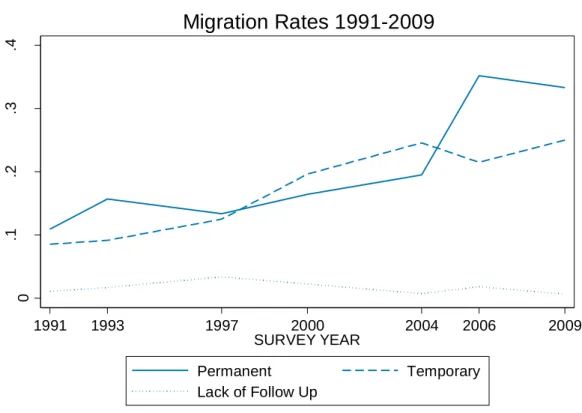
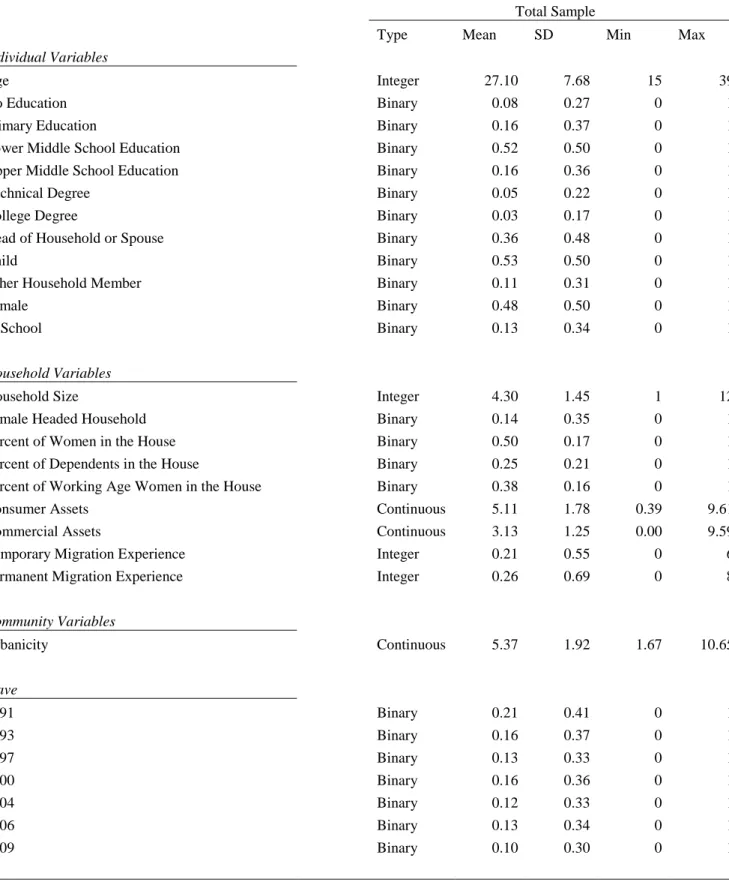
Descriptive statistics for all predictors across the entire population used in the analysis are included in Table 1. Figure 2 shows the rates for permanent migration, temporary migration and lack of follow up throughout the study period. Both permanent and temporary migration increased throughout the study period, while lack of follow up stayed low and relatively
Figure 2
0
.1
.2
.3
.4
1991 1993 1997 2000 2004 2006 2009
SURVEY YEAR
Permanent Temporary
Lack of Follow Up
Table 1 - Descriptive Statistics for Predictors
Total Sample
Type Mean SD Min Max
Individual Variables
Age Integer 27.10 7.68 15 39
No Education Binary 0.08 0.27 0 1
Primary Education Binary 0.16 0.37 0 1
Lower Middle School Education Binary 0.52 0.50 0 1 Upper Middle School Education Binary 0.16 0.36 0 1
Technical Degree Binary 0.05 0.22 0 1
College Degree Binary 0.03 0.17 0 1
Head of Household or Spouse Binary 0.36 0.48 0 1
Child Binary 0.53 0.50 0 1
Other Household Member Binary 0.11 0.31 0 1
Female Binary 0.48 0.50 0 1
In School Binary 0.13 0.34 0 1
Household Variables
Household Size Integer 4.30 1.45 1 12
Female Headed Household Binary 0.14 0.35 0 1
Percent of Women in the House Binary 0.50 0.17 0 1 Percent of Dependents in the House Binary 0.25 0.21 0 1
Percent of Working Age Women in the House Binary 0.38 0.16 0 1 Consumer Assets Continuous 5.11 1.78 0.39 9.61
Commercial Assets Continuous 3.13 1.25 0.00 9.59 Temporary Migration Experience Integer 0.21 0.55 0 6
Permanent Migration Experience Integer 0.26 0.69 0 8
Community Variables
Urbanicity Continuous 5.37 1.92 1.67 10.65
Wave
1991 Binary 0.21 0.41 0 1
1993 Binary 0.16 0.37 0 1
1997 Binary 0.13 0.33 0 1
2000 Binary 0.16 0.36 0 1
2004 Binary 0.12 0.33 0 1
2006 Binary 0.13 0.34 0 1
2009 Binary 0.10 0.30 0 1
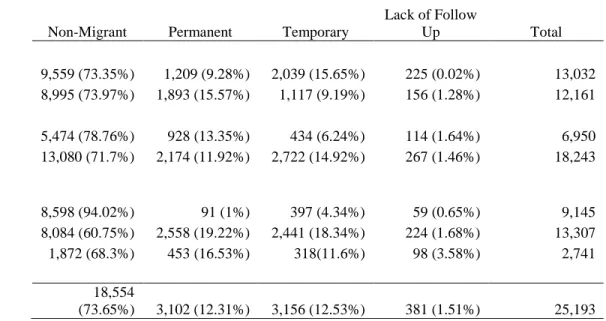
constant. Table 2 shows the migration outcomes for both the total population and broken down by gender, whether the community was rural or urban, and the relationship of the individual to the head of the household. Our study population is largely rural (72.41% rural) and has slightly more men than women (51.73% male, 48.27% female). Rates of permanent migration are similar for rural and urban dwellers, while the rural population is much more likely to engage in
temporary migration. Women have much higher rates of permanent migration than men, while temporary migration is the opposite. This matches results from previous studies which have looked at rate of temporary and permanent migration without focusing specifically on labor migration (Liang and Ma 2004). Looking back at Figure 1 we see that temporary migration tends to peak at younger ages than permanent migration for both genders, with temporary migration spiking reaching a peak in the late teens. Temporary migration has a longer tail for men than women though, as female permanent migration takes off in the early twenties as women enter ages of marriage. These results suggest a different set of circumstances and behaviors
surrounding male and female migrants, which will be investigated further in a gender-stratified model.
Table 2 - Migration Outcomes 1991-2009
Non-Migrant Permanent Temporary
Lack of Follow
Up Total
Gender
Male 9,559 (73.35%) 1,209 (9.28%) 2,039 (15.65%) 225 (0.02%) 13,032 Female 8,995 (73.97%) 1,893 (15.57%) 1,117 (9.19%) 156 (1.28%) 12,161
Rural/Urban
Urban 5,474 (78.76%) 928 (13.35%) 434 (6.24%) 114 (1.64%) 6,950 Rural 13,080 (71.7%) 2,174 (11.92%) 2,722 (14.92%) 267 (1.46%) 18,243
Relation to Head of Household
Head/Spouse 8,598 (94.02%) 91 (1%) 397 (4.34%) 59 (0.65%) 9,145 Child 8,084 (60.75%) 2,558 (19.22%) 2,441 (18.34%) 224 (1.68%) 13,307 Other Relation 1,872 (68.3%) 453 (16.53%) 318(11.6%) 98 (3.58%) 2,741
CHAPTER 4: MODELS AND RESULTS
To examine the predictors of migrating between waves I estimate two sets of multinomial logistic regression models to perform discrete-time event history analyses (Allison, 1984). The dependent variable is the four category migration outcomes variable described above with one equation for each categorical outcome beyond the reference outcome of not migrating. These three equations take the following form, where the log odds of observing a given migration outcome relative to not migrating are:
where is the odds of migration outcome r for individual i at time t, is the odds of the reference outcome, is a vector of predictors, and is a vector of parameters for the effects of the predictors on migration outcome r. Errors were clustered at the community level to account for the use of community level variables and the non-independence of households within the community (Angeles et al. 2005).
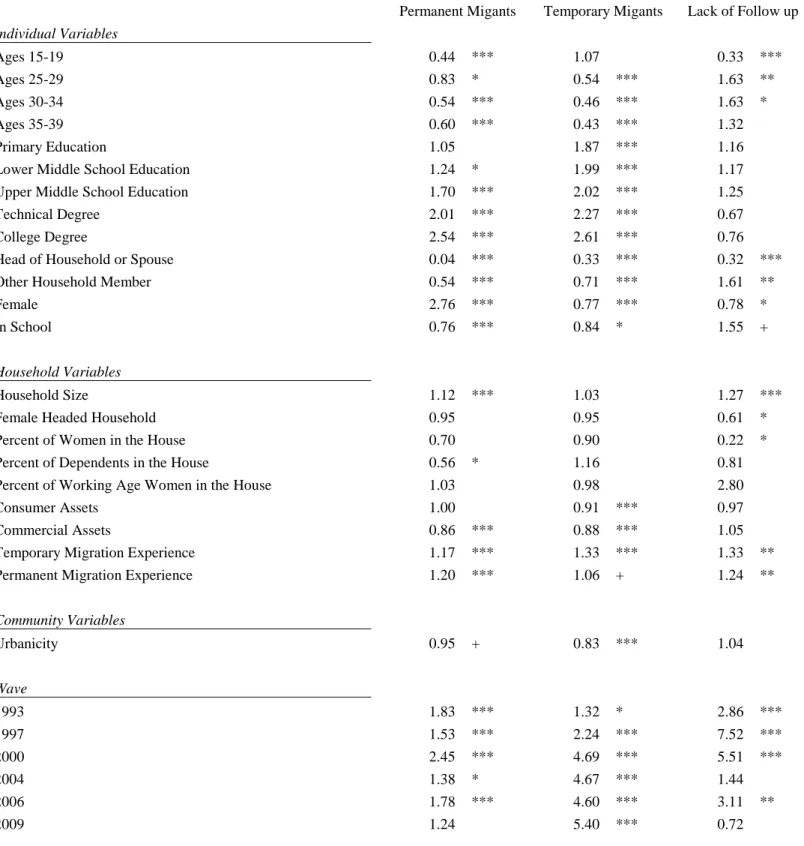
Table 3 - Multinomial Logistic Model of Migration Outcomes Permanent Migants Temporary Migants Lack of Follow up
Individual Variables
Ages 15-19 0.44 *** 1.07 0.33 ***
Ages 25-29 0.83 * 0.54 *** 1.63 **
Ages 30-34 0.54 *** 0.46 *** 1.63 *
Ages 35-39 0.60 *** 0.43 *** 1.32
Primary Education 1.05 1.87 *** 1.16
Lower Middle School Education 1.24 * 1.99 *** 1.17 Upper Middle School Education 1.70 *** 2.02 *** 1.25
Technical Degree 2.01 *** 2.27 *** 0.67
College Degree 2.54 *** 2.61 *** 0.76
Head of Household or Spouse 0.04 *** 0.33 *** 0.32 *** Other Household Member 0.54 *** 0.71 *** 1.61 **
Female 2.76 *** 0.77 *** 0.78 *
In School 0.76 *** 0.84 * 1.55 +
Household Variables
Household Size 1.12 *** 1.03 1.27 ***
Female Headed Household 0.95 0.95 0.61 *
Percent of Women in the House 0.70 0.90 0.22 *
Percent of Dependents in the House 0.56 * 1.16 0.81 Percent of Working Age Women in the House 1.03 0.98 2.80
Consumer Assets 1.00 0.91 *** 0.97
Commercial Assets 0.86 *** 0.88 *** 1.05
Temporary Migration Experience 1.17 *** 1.33 *** 1.33 ** Permanent Migration Experience 1.20 *** 1.06 + 1.24 **
Community Variables
Urbanicity 0.95 + 0.83 *** 1.04
Wave
1993 1.83 *** 1.32 * 2.86 ***
1997 1.53 *** 2.24 *** 7.52 ***
2000 2.45 *** 4.69 *** 5.51 ***
2004 1.38 * 4.67 *** 1.44
2006 1.78 *** 4.60 *** 3.11 **
2009 1.24 5.40 *** 0.72
migrate in periods beginning when they are between the ages of 20 and 24. The likelihood of migration spikes in this period and then declines rapidly for future age groups. Teenagers are less likely to become permanent migrants than their 20-24 year-old counterparts. For the purpose of interpretation, it is important to note that periods are defined as the time-span between waves and that values collected at the beginning of the period are predicting migration outcomes two to four years later. This means that a person who is age 17 at the beginning of the period may be 19-21 when migration outcomes are measured.
Educational attainment increases the odds of both temporary and permanent migration, although the degree to which it does so varies for each type of migration. Any education greatly increases the likelihood of temporary migration with slightly larger effects as the level of educational attainment increases, while the likelihood of permanent migration only begins to increase at higher levels of educational attainment beginning in upper middle school. This suggests that in many cases the barrier to entry for permanent migration opportunities may be higher than for temporary migration opportunities. Being in school at the beginning of the period reduces the likelihood of both permanent and temporary migration, but the effect is smaller and less significant effect for temporary migration. Children were the most likely members of a household to migrate and while heads of household and their spouses were less likely to migrate both permanently and temporarily, and permanent migration for heads and spouses was much less likely.
may increase the demand for household labor and act as a deterrent to migration. Consumer assets also reduce the odds of temporary migration, but show no significant effect on permanent migration. Temporary and permanent migration display major differences with regards to gender and network effects. Women are nearly 3 times more likely to become permanent migrants than men, and men are about 30% more likely to become temporary migrants than women. Household temporary migration experience increases the odds of both permanent and temporary migration, but has a stronger effect on temporary migration. Household permanent migration experience only increases the odds of future permanent migration.
While the predictors of lack of follow up were mostly dominated by wave effects and the presence of missing predictors (not shown), there were some similarities to the predictors of migration. Household migration experience slightly increased the odds of lack of follow up suggesting that one of the stronger household level predictors of migration increased the odds that a household would be lost in future waves.
I then estimated a pair of multinomial models stratified by gender to look at the impact of predictors on migration outcomes for women and men separately. These are presented in Table 4. While there are still similarities between the predictors for each gender, there are also clear differences in the selection of male and female migrants.
and start at lower levels of education. Heads and their spouses continue to be at a reduced risk of migrating, but female heads/spouses are much less likely to migrate temporarily than male heads/spouses who migrate somewhat regularly. Household size continues to have a weak
positive influence on migration for both genders. Commercial assets still reduce the likelihood of both types of migration equally, and the effect of consumer assets on temporary migration is similar for bother men and women.
In the gender stratified model, it becomes clear that household migration experience has very different effects for men and women. For men, household migration experience is
segregated; access to temporary household migration experience increases the odds of temporary migration, and permanent household migration experience increases the odds of permanent migration, but neither affects the other. For women access to permanent household migration experience is similar to men, and increases the likelihood of permanent migration with no effect on temporary migration. However, temporary household migration experience increases the likelihood that women will migrate both temporarily and permanently in the future. This
suggests that there is either a difference in the type of social capital available to men and women from temporary migration experience or there is a difference in their ability to apply this
information to permanent migration.
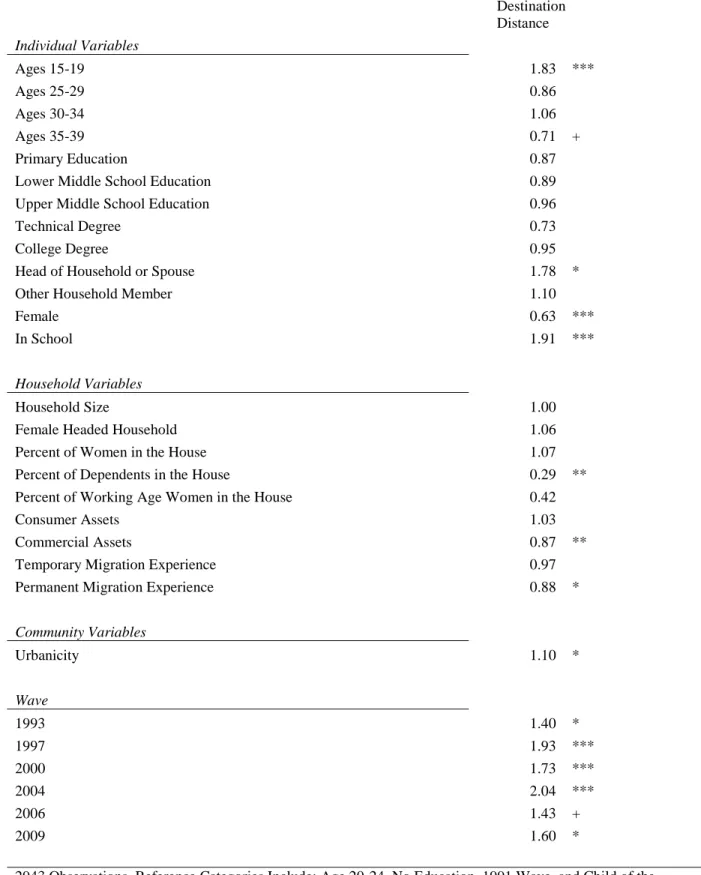
Table 5 - Ordinal Logit Model of Migration Distance for Permanent Migrants Destination
Distance
Individual Variables
Ages 15-19 1.83 ***
Ages 25-29 0.86
Ages 30-34 1.06
Ages 35-39 0.71 +
Primary Education 0.87
Lower Middle School Education 0.89
Upper Middle School Education 0.96
Technical Degree 0.73
College Degree 0.95
Head of Household or Spouse 1.78 *
Other Household Member 1.10
Female 0.63 ***
In School 1.91 ***
Household Variables
Household Size 1.00
Female Headed Household 1.06
Percent of Women in the House 1.07
Percent of Dependents in the House 0.29 **
Percent of Working Age Women in the House 0.42
Consumer Assets 1.03
Commercial Assets 0.87 **
Temporary Migration Experience 0.97
Permanent Migration Experience 0.88 *
Community Variables
Urbanicity 1.10 *
Wave
1993 1.40 *
1997 1.93 ***
2000 1.73 ***
2004 2.04 ***
2006 1.43 +
2009 1.60 *
2943 Observations. Reference Categories Include: Age 20-24, No Education, 1991 Wave, and Child of the Household Head
migrating (Liang and Ma 2004). Migrants who moved shorter distances, staying within their own county, were found to be much more likely to list social reasons such as marriage or joining family members as their reason for migrating in the 2000 census, while over 50% of intercounty migrants listed work related reasons for moving (Liang and Ma 2004).
Distance was derived from a question about where permanent migrants were at the time of the survey which had categorical outcomes for staying in the same county, same prefecture, same province, or leaving the province. Predictors were the same as before. The model was run for both the whole sample and stratified by gender. Results were similar for the gender stratified model and the full sample model. The full sample model is shown in Table 5.
There are two major findings from this model. The first is that women are less likely to move far away than men. This bears itself out with descriptive statistics as well. 43.48% of women stay within their county, compared to only 30.96% of men. The rate of male permanent migrants leaving their home province (22.28%) is nearly twice the rate for women leaving their province (11.26%). If shorter moves are associated with family and socially-driven migration, it’s possible that this is a sign that female permanent migrants are making more mover for
family/social reasons than their male counterparts. This is also consistent with Liang and Ma 2004’s tabulations of reasons for female permanent migration. Liang and Ma found nearly half
the female permanent moves were related to family reasons including marriage, joining dependents, or joining relatives.
CHAPTER 5: DISCUSSION AND CONCLUSION
The main objective of this paper has been to determine the differences between the predictors of Chinese temporary and permanent migration. I find that temporary and permanent migrants are part of two distinct migratory flows, with different sets of structural forces
motivating participation in each. I also argue that gender plays a central role in understanding the effects of the hukou system on migration. Much of the previous research on migration and hukou has either lumped female movers together with men as labor migrants, or ignored them entirely. This approach neglects the different reasons why women move and the different socio-cultural context in which they do so.
The findings indicate that temporary and permanent migration by men and women are distinct processes. The differential effects that age, education, and social capital have for male and female migrants are representative of the distinct reasons that men and women move and the different social, economic, and institutional constraints they face when they do so. The
segregation of temporary and permanent migrant social capital for men in particular supports the hypothesis that temporary and permanent migration consist of separate flows. That migrant social capital is not transferable to different types of migration for men suggests that temporary and permanent migration experiences are distinct enough from each other that social capital and information relating to either one is not helpful for the other.
REFERENCES
Allison, Paul D. 1984. Event History Analysis: Regression for Longitudinal Event Data. SAGE.
Angeles, Gustavo, David K. Guilkey, and Thomas A. Mroz. 2005. “The Impact of Community-Level Variables on Individual-Community-Level Outcomes Theoretical Results and Applications.” Sociological
Methods & Research 34 (1): 76–121. doi:10.1177/0049124104273069.
Chan, Kam Wing. 1996. “Post-Mao China: A Two-Class Urban Society in the Making.”
International Journal of Urban and Regional Research 20 (1): 134–50. doi:10.1111/j.1468- 2427.1996.tb00305.x.
———. 2010. “The Household Registration System and Migrant Labor in China: Notes on a Debate.” Population and Development Review 36 (2): 357–64.
———. 2013. “China: Internal Migration - The Encyclopedia of Global Human Migration - Chan - Wiley Online Library.” 2016. Accessed June 21.
http://onlinelibrary.wiley.com/doi/10.1002/9781444351071.wbeghm124/abstract;jsessionid =D30E7D27A7D55814F6EC1CED9987EE3E.f01t04?userIsAuthenticated=false&deniedA ccessCustomisedMessage=.
Chan, Kam Wing, Ta Liu, and Yunyan Yang. 1999. “Hukou and Non-Hukou Migrations in China: Comparisons and Contrasts.” International Journal of Population Geography 5 (6): 425–48. doi:10.1002/(SICI)1099-1220(199911/12)5:6<425::AID-IJPG158>3.0.CO;2-8.
Chan, Kam Wing, and Li Zhang. 1999. “The Hukou System and Rural-Urban Migration in China: Processes and Changes.” The China Quarterly, no. 160(December): 818–55.
Chang, Hongqin, Xiao-yuan Dong, and Fiona MacPhail. 2011. “Labor Migration and Time Use Patterns of the Left-behind Children and Elderly in Rural China.” World Development 39 (12): 2199–2210. doi:10.1016/j.worlddev.2011.05.021.
Chen, Feinian. 2005. “Residential Patterns of Parents and Their Married Children in
Chen, Feinian, Hui Liu, Kriti Vikram, and Yu Guo. 2015. “For Better or Worse: The Health Implications of Marriage Separation Due to Migration in Rural China.” Demography 52 (4): 1321–43. doi:10.1007/s13524-015-0399-9.
Cheng, Tiejun, and Mark Selden. 1994. “The Origins and Social Consequences of China’s Hukou System.” The China Quarterly, no. 139: 644–68.
Croll, Elisabeth. "The exchange of women and property: Marriage in post-revolutionary China."
Women and Property–Women As Property. London: Croom Helm (1984): 44-61.
Curran, Sara R., and Estela Rivero-Fuentes. 2003. “Engendering Migrant Networks: The Case of Mexican Migration.” Demography 40 (2): 289–307. doi:10.1353/dem.2003.0011.
Curran, S.R., F. Garip, C. Chung, and K. Tangchonlatip. 2005. “Gendered Migrant Social Capital: Evidence from Thailand.” Social Forces 84 (1): 225–55.
DE BRAUW, Alan, and Scott ROZELLE. 2008. “Migration and Household Investment in Rural China.” China Economic Review 19 (2): 320–35. doi:10.1016/j.chieco.2006.10.004.
DiMaggio, Paul, and Filiz Garip. 2011. “How Network Externalities Can Exacerbate Intergroup Inequality.” American Journal of Sociology 116 (6): 1887–1933. doi:10.1086/659653.
Fan, C. Cindy. 2000. “Migration and Gender in China.” China Review, 423–54.
———. 2002. “The Elite, the Natives, and the Outsiders: Migration and Labor Market
Segmentation in Urban China.” Annals of the Association of American Geographers 92 (1): 103–24. doi:10.1111/1467-8306.00282.
———. 2005. “Interprovincial Migration, Population Redistribution, and Regional Development in China: 1990 and 2000 Census Comparisons.” The Professional Geographer 57 (2): 295– 311. doi:10.1111/j.0033-0124.2005.00479.x.
Fan, C. Cindy, and Youqin Huang. 1998. “Waves of Rural Brides: Female Marriage Migration in China.” Annals of the Association of American Geographers 88 (2): 227–51.
Fan, C. Cindy, and Ling Li. 2002. “Marriage and Migration in Transitional China: A Field Study of Gaozhou, Western Guangdong.” Environment and Planning A 34 (4): 619–38.
doi:10.1068/a34116.
Fan, C. Cindy, and Mingjie Sun. 2008. “Regional Inequality in China, 1978-2006.” Eurasian Geography and Economics 49 (1): 1–18. doi:10.2747/1539-7216.49.1.1.
Filmer, Deon, and Lant H. Pritchett. 2001. “Estimating Wealth Effects Without Expenditure Data—Or Tears: An Application To Educational Enrollments In States Of India*.” Demography 38 (1): 115–32. doi:10.1353/dem.2001.0003.
Garip, Filiz. 2014. “The Impact of Migration and Remittances on Wealth Accumulation and Distribution in Rural Thailand.” Demography 51 (2): 673–98. doi:10.1007/s13524-013-0260-y.
Giles, John, and Ren Mu. 2007. “Elderly Parent Health and the Migration Decisions of Adult Children: Evidence from Rural China.” Demography 44 (2): 265–88.
doi:10.1353/dem.2007.0010.
Hu, Feng, Zhaoyuan Xu, and Yuyu Chen. 2011. “Circular Migration, or Permanent Stay? Evidence from China’s Rural–urban Migration.” China Economic Review 22 (1): 64–74. doi:10.1016/j.chieco.2010.09.007.
Hu, Xiaojiang, Sarah Cook, and Miguel A Salazar. 2008. “Internal Migration and Health in China.” The Lancet 372 (9651): 1717–19. doi:10.1016/S0140-6736(08)61360-4.
Liang, Zai. 2001. “The Age of Migration in China.” Population and Development Review 27 (3): 499–524. doi:10.1111/j.1728-4457.2001.00499.x.
Liang, Zai, and Yiu Por Chen. 2007. “The Educational Consequences of Migration for Children in China.” Social Science Research 36 (1): 28–47. doi:10.1016/j.ssresearch.2005.09.003.
Liang, Zai, and Zhongdong Ma. 2004. “China’s Floating Population: New Evidence from the 2000 Census.” Population and Development Review 30 (3): 467–88. doi:10.1111/j.1728-4457.2004.00024.x.
Liu, Ye, and Wei Xu. 2015. “Destination Choices of Permanent and Temporary Migrants in China, 1985–2005.” Population, Space and Place, July, n/a-n/a. doi:10.1002/psp.1963.
Massey, Douglas S. 1990. “Social Structure, Household Strategies, and the Cumulative Causation of Migration.” Population Index 56 (1): 3–26. doi:10.2307/3644186.
Massey, Douglas S., Joaquin Arango, Graeme Hugo, Ali Kouaouci, Adela Pellegrino, and J. Edward Taylor. 1993. “Theories of International Migration: A Review and Appraisal.” Population and Development Review 19 (3): 431–66. doi:10.2307/2938462.
Mendola, Mariapia. 2012. “Rural out-Migration and Economic Development at Origin: A Review of the Evidence.” Journal of International Development 24 (1): 102–22. doi:10.1002/jid.1684.
Pedraza, Silvia. 1991. “Women and Migration: The Social Consequences of Gender.” Annual Review of Sociology 17: 303–25.
Popkin, Barry M., Shufa Du, Fengying Zhai, and Bing Zhang. 2010. “Cohort Profile: The China Health and Nutrition Survey—monitoring and Understanding Socio-Economic and Health Change in China, 1989–2011.” International Journal of Epidemiology 39 (6): 1435–40. doi:10.1093/ije/dyp322.
Roberts, Kenneth. 2002. “Female Labor Migrants to Shanghai: Temporary ‘Floaters’ or Potential Settlers?1.” International Migration Review 36 (2): 492–519.
doi:10.1111/j.1747-7379.2002.tb00090.x.
Shen, Jianfa. 2002. “A Study of the Temporary Population in Chinese Cities.” Habitat International 26 (3): 363–77. doi:10.1016/S0197-3975(02)00013-9.
Sun, Mingjie, and C. Cindy Fan. 2011. “China’s Permanent and Temporary Migrants: Differentials and Changes, 1990–2000.” The Professional Geographer 63 (1): 92–112. doi:10.1080/00330124.2010.533562.
Tong, Yuying, and Martin Piotrowski. 2012. “Migration and Health Selectivity in the Context of Internal Migration in China, 1997–2009.” Population Research and Policy Review 31 (4): 497–543. doi:10.1007/s11113-012-9240-y.
Wing Chan, Kam, and Will Buckingham. 2008. “Is China Abolishing the Hukou System?” The China Quarterly 195 (September): 582–606. doi:10.1017/S0305741008000787.
Xie, Yu, and Xiang Zhou. 2014. “Income Inequality in Today’s China.” Proceedings of the National Academy of Sciences 111 (19): 6928–33. doi:10.1073/pnas.1403158111.
Zeng, Jiazhi, Leiyu Shi, Xia Zou, Wen Chen, and Li Ling. 2015. “Rural-to-Urban Migrants’ Experiences with Primary Care under Different Types of Medical Institutions in