Regions in the nonstandard plane that
contain no standard points
STEVENC. LETH
Abstract: Nonstandard methods are applied to continuum theory in the plane. The main result concerns internal regions V that contain no standard points and have the property that st(V) does not disconnect the plane and are bounded by simple closed curves that have small intersection with∗st(V). We show that such sets cannot contain a “Y-set” consisting of three arcs intersecting only at a single common point with the property that the non-intersecting endpoints of each arc are a noninfinitesimal distance from the arc joining the other two ends.
2010 Mathematics Subject Classification54J05, 54F15 (primary); 03H05 (sec-ondary)
Keywords: nonstandard topology, continuum theory
1
Preliminaries
A continuum is a compact, connected metric space. Here we are concerned solely with continua in the plane and the nonstandard plane. A good general reference for Continuum Theory is [15]. A short historical perspective is given in [8].
We work in a nonstandard universe, as described in detail for example in [3],[5],[10], or [11]. We assume that our universe isi+1 saturated, as this is needed in some of the
results.
Definition 1.1 Ifp1 andp2 are points in the nonstandard plane we will writep1≈p2
if they are an infinitesimal distance apart and we will say thatp1 isnearp2.
IfAis a standard set we will write∗Afor its nonstandard counterpart.
Ifpis a point in the nonstandard plane that is within some standard distance of the origin we writest(p) for the unique standard point that is within an infinitesimal distance of p.
The elements of∗P(R2) are theinternal sets(here we useP(A) to denote the power set
ofA). Intuitively these are the subsets of∗R2 that the nonstandard model recognizes
The results in the proposition below are elementary and well-known, but are funda-mental to this work, so the proofs are included here for convenience.
Proposition 1.2 i) IfAis any internal set in the plane thenst(A)(the set of all standard points infinitesimally close to points inA) is closed.
ii) If A is internal, connected and bounded (i.e. contained in some ∗B(0,r) for a standard realr>0) in the nonstandard plane thenst(A) is connected.
Proof i) If p is a limit point of st(A) then for any standard ε > 0 there must exist points of Awithin εofp. Internally we may letr =infa∈Aka−pk, and r must be infinitesimal. But thenpis a standard point near points inA, sop∈st(A).
ii). Suppose thatst(A) is not connected, and letU andV be a separation, i.e. suppose thatst(A) ⊂U∪V, both are open, and both have nonempty intersection with st(A). Letu∈U∩st(A) andv∈V∩st(A). Then there existsau,avinAsuch thatst(au)=u andst(av)=v. Since U andV are open, there exists a standard d >0 such that all points withind ofuare in U and all points withindofvare inV. Thus, by transfer, au∈ ∗U, andav ∈ ∗V, and these two sets are open and disjoint. SinceAis connected and both ∗U and ∗V intersect A, there must exist a point x ∈A that is not contained in∗U∪ ∗V. Since Ais boundedst(x) exists and sincest(x) is an element ofst(A), it is contained in eitherUorV. As above, however, this means thatxis in either∗U or ∗V, and this contradiction completes the proof.
Most of the definitions needed here are all collected below. The two “Y-set” definitions do not seem to correspond exactly to other definitions in the literature. They are simple triods with appropriate “width” properties. The notion of “IL-chainable” is a natural extension of usual chainability definitions into this nonstandard setting.
Definition 1.3 IfAis an arc (either standard or internal) anda1 anda2are two points
onAthen we will writeA[a1,a2] for the subarc froma1toa2. IfSis a simple closed
curve in the plane or the nonstandard plane we will writeVS for the bounded region whose boundary is S (VS exists and is well-defined by the Jordan Curve Theorem). We will say that a setA ⊂ ∗R2 contains aY-setif there exist four points a,b,c, and
x in A, arcs Cax,Cbx, and Ccx in A intersecting only at x, from a to x, b to x, and c tox, respectively, such that none of the pointsa,b, or c are within an infinitesimal of any point on the arcs joining the others to x (thus, for example, no point of Cax
is infinitesimally close to b or to c). If δ > 0 we will say that a set A in the plane contains asize δ Y-setif there exist four pointsa,b,c,andx inA, and arcsCax,Cbx, andCcxin Aintersecting only atx fromato x, btox, andc tox, respectively, such that none of the pointsa,b, orcare withinδof any point on the arcs joining the others tox (thus, for example, no point of Cax is within distance δ of b orc). We will call an internal subset of the nonstandard planeIL-chainable(for “infinitesimally linearly chainable”) if it can be covered by a hyperfinite collection of open setsG0, ...,Gn of infinitesimal diameter with the “linear chain” condition that Gi∩Gj is nonempty iff |i−j| ≤1.
A standard set that can be covered by a finite chain of setsGi as in the above definition is calledδ-chainable if each of the chaining sets are of diameter less thanδ. A set is called chainable if it isδ-chainable for all δ >0. So, IL-chainable sets are just those that satisfy the usual definition of beingδ-chainable inside the nonstandard model for some infinitesimalδ >0.
2
Regions Containing No Standard Points
In this section we exploit the interplay between a set and the internal set obtained by first taking the standard part and then looking at the nonstandard version of that set. Of particular importance are regionsV that have little intersection with∗st(V) and that contain no standard points. It is easy to find simple examples of regionsV such that ∗st(V) ∩V is empty. For example if η > 0 is infinitesimal and V is the interior of the rectangle with corners at (η,1),(2η,1),(2η,0) and (η,0) then st(V) is simply the closed line segment on theyaxis from (0,0) to (0,1). The set∗st(V) is the nonstandard counterpart of st(V), so includes nonstandard points on this line segment, including points within an infinitesimal of the origin, but since the standard universe satisfies the statement that all the points inst(V) havex coordinate of 0 the nonstandard version of this set has the same property by the transfer principle. This shows that∗st(V) ∩V is empty. The boundary ofV does not intersect∗st(V) at all in this example. However in the most interesting cases, such as regions obtained by blocking off long portions of a simple dense canal, there will always be some intersection with∗st(V), although only on the small segments used to close off a region. There will always be many points of ∗st(V) in the interior ofV, but the crucial additional condition in the theorem below is that none of them will be actual standard points.
Theorem 2.1 Let V ⊂ ∗R2 be a bounded (internal) region (i.e. contained in some
∗B(0,r) for a standard real r > 0) bounded by a simple closed curve S and suppose
thatV contains no standard points,st(V) does not disconnect the plane, and that there exists an arcAof infinitesimal length onSsuch that∗st(V)∩S⊂A. ThenV contains no Y-set.
Proof We first note thatst(V) has no interior. Since V contains no standard points, every point of∗st(V) is near a point of its boundaryS. If∗st(V) were to contain any ball of noninfinitesimal diameter, then it would intersect S at points that are not all near each other, which violates the condition that∗st(V)∩S⊂A. Thus,st(V) has no interior by transfer.
Suppose thatV contains a Y-set. We leta,b,c andx be points as in the definition of a Y-set, but we note that there are many possible choices fora,b, andc, and since the arcAis of infinitesimal length, we may choose these points in such a way that none of them are nearA. We letY =Cax∪Cbx∪Ccx.
We next show that there must exist standard disjoint ballsBa,Bb,andBc satisfying the following:
i)a∈ ∗Ba,b∈ ∗Bb, andc∈ ∗Bc.
ii) Each of these three balls have non-zero radius (and thus non-infinitesimal radius since they are standard sets).
iii) The arcAdoes not intersectBa,Bb, orBc.
iv) every point onBa is not near any point onCbx orCcx, every point onBb is not near any point onCax orCcx, and every point onBc is not near any point onCax orCbx. v) The interior of each ball contains points not disconnected from infinity by st(V) together with the closure of the other two balls. For example, the interior of Ba contains points not disconnected from infinity byst(V)∪Bb∪Bc.
It is clear from the conditions given that standard balls of sufficiently small radius can be found that will satisfy the first four properties, and we assume that we begin with a B0a,B0b, andB0c satisfying just those. It is possible that, for example,st(V)∪B0b∪B0
c disconnects the plane. However, since st(V) does not disconnect the plane, and no point of B0b is near B0
c or any point on Cax or Ccx, a bounded component of the complement of st(V)∪B0b∪B0
c could occur only if a portion of Cbx encloses some standard open set and then passes back into or within an infinitesimal of B0b or if a portion of Ccx encloses some standard open set and then passes back into or within
an infinitesimal of B0
c. If B0a is in such a bounded component (all points in this set must be in the same component since no point of the boundary intersects B0a) we let pa be a standard point in B0a−st(V), andTa be a standard path frompa to infinity in
R2− (st(V)). Such a path exists since R2− (st(V)) is open and connected, and thus
path-connected. This standard path cannot pass near b orc since it stays a standard nonzero distance away fromst(V). Similarly ifB0b is in a bounded component of the complement ofst(V)∪B0
a∪B0c we letpbbe a standard point inB0b−st(V), andTbbe a standard path frompato infinity inR2−(st(V)), and ifB0c is in a bounded component of the complement of st(V)∪B0
a∪B0b we let pc be a standard point in B0c −st(V), and Tc be a standard path from pc to infinity in R2− (st(V)). We can now choose
smaller ballsBa,Bb, and Bc inside B0a,B0b, and B0c such that conditions i) through iv) are satisfied and none of these intersect Ta, Tb or Tc. This ensures that condition v) will hold, for points in (R2− (st(V)))∩Ba are in the same connected component of the complement of st(V)∪Bb∪Bc aspa, points in (R2− (st(V)))∩Bb are in the same connected component of the complement of st(V)∪Ba∪Bc as pb and points in (R2− (st(V)))∩Bc are in the same connected component of the complement of st(V)∪Ba∪Bb aspc.
Having established the existence of the standard balls satisfying conditions i) through v), we now leta0 be the last point of Cax∩Ba on the arc fromatox, and defineCa0x to be the subarc ofCax froma0 tox. We defineb0,Cb0x,c0,Cc0x analogously. We let Y0 =Ca0x∪Cb0x∪Cc0x, and we note thatY0 is path-connected and therefore connected. By proposition 1st(Y0) is connected, and thus ∗st(Y0) is connected by transfer.
We let qa be a standard point in Ba−st(V) and Ta0 be a standard infinite path (ray) in R2− (st(V)∪Bb ∪Bc) starting at qa and going off to infinity. Similarly we let qb be a standard point in Bb−st(V) and Tb0 be a standard infinite path in R2−
(st(V)∪Bb∪Bc∪Ta0) starting atqband going off to infinity, andqc be a standard point inBc−st(V) andTc0 be a standard infinite path (ray) inR2− (st(V)∪Bb∪Bc∪Ta0∪Tb0) starting atqc and going off to infinity. Figure 1 illustrates these definitions.
Sincest(V) and any bounded portion of Ta0,Tb0,andTc0 are disjoint compact sets, they are some non-zero distance apart, so by transfer there are no points of∗st(V) that are within an infinitesimal distance of any points of ∗Ta0, ∗Tb0, or ∗Tc0. We note that the single point st(A) is in st(V), so the arc A is also not within an infinitesimal distance of any points of∗Ta,∗Tb, or∗Tc.
We now define internal infinite arcs as follows: We letΓa consist of the line segment from a0 to a nearest point of ∗Ta0 ∩Ba, followed by ∗Ta0 from that point to infinity. There may be more than one “nearest point” and we can choose any of them. This
Figure 1: Illustration of definitions
condition ensures that the initial segment does not intersect ∗Ta0 except at this point. The internal paths Γb and Γc are defined analogously. Since there are no points of ∗st(Y0) in the interior of B
a,Bb, and Bc there are no points of ∗st(Y0) other than a0 that intersect Γa, and similarly the other two arcs only intersect∗st(Y0) at their initial points. Since the arcAdoes not intersectBa, Bb, orBc we also know that Adoes not intersectΓa,Γb,orΓc.
The setΓa ∪ Γb∪Γc∪Y0 consists of three non-intersecting infinite arcs originating from the point x, and so divides the nonstandard plane into three regions. One of these regions, which we will callR1, is bounded byΓa ∪Ca0x ∪Cb0x∪Γb. No point in this region can be within an infinitesimal distance of c0, since c0 is not contained in R1 and is not near any of the points on the boundary. Similarly we let R2 be the region bounded by Γb ∪Cb0x ∪Cc0x∪Γc andR3 be the region bounded byΓc∪Cc0x ∪Ca0x∪Γa, noting that no point ofR2 is neara0 and no point ofR3 is nearb0. We consider connected components of∗R2−(S∪ Γa∪ Γb∪Γc)) that contain standard points (and so are external to V). These cannot intersect more than one of our three regions. This is because these connected components are bounded by portions of the the outside ofS together with portions of theΓcurves, and since S does not intersect Y, a point traveling alongS may only move from one of the three regions into another one by passing throughΓa,Γb, orΓc. The arcAof infinitesimal length can be a part
of the boundary of only one of these components, since it does not intersectBa,Bb, or Bc. Thus, the boundary of all of these components except one is completely contained in∗R2− ∗st(Y0).
No standard points of∗st(Y0) can be on any of the boundary points ofR1, R2, orR3,
so all of the standard points of this set are in one of the three regionsR1,R2, orR3. We
will assume, wlog, that there is a standard pointp1 inR1. Sincep1 is a standard point it cannot be inV, so from above C(p1,∗R2−(S∪ Γa∪ Γb)) must be contained inR1.
Butst(c0) cannot be inR1 since no point inR1 is within an infinitesimal distance ofc0,
and so wlog we suppose that it is in R2. By a similar argument,C(st(c0),∗R2−(S∪
Γb∪ Γc)) is contained in R2. But from above, at least one of these sets is contained
in a connected component of ∗R2−(S∪ Γa∪ Γb∪ Γc)) whose boundary lies in the complement of ∗st(Y0). This contradicts the connectedness of ∗st(Y0), finishing the proof.
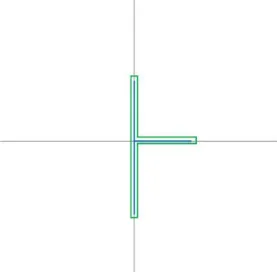
It is easy to see that the condition thatV contains no standard points is necessary, for without it we could let Y be the set in the nonstandard plane consisting of the closed line segments from (0,1) to (0,−1) and (0,0) to (1,0), and let V be the interior of a simple closed curve that traces around Y, and stays infinitesimally close to it at all points. Such aV satisfies the other conditions of the proposition (the boundary of V does not intersect∗st(V) at all), but certainly contains the Y -set that we surrounded, as shown in figure 2.
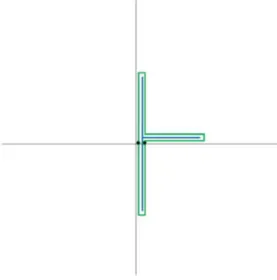
Similarly we can see that we cannot allow the curve to intersect the standard part on more than one small arc. If we move the example above up and over by an infinitesimal distance we can surround it with a simple closed curve containing no standard points if we allow the curve to have two disjoint arcs of infinitesimal length intersect the standard part, rather than only one, as in the theorem. In this case the two disjoint arcs can even be infinitesimally close to each other (though not close as one follows along the curve). This is illustrated in figure 3.
Figure 3: The region must intersect its standard part only in a small arc
It seems unlikely that the condition thatst(V) does not disconnect the plane is necessary in the main result above, but no easy way to remove this condition in the proof is apparent. As is discussed more in section 4, the study of planar continua that do not separate the plane is the fundamental motivation for this work, and in that context this condition will always hold. Still, it would be nice to know if it can be removed from the hypotheses in the result above. It would be easy to see that we could remove this condition if every Y-set whose standard part disconnects the plane contains a Y-set whose standard part does not disconnect the plane, but there are counterexamples to this. One such example takes the union of the following three sets: the closed interval from (−1,0) to (0,0), the graph of the function y =xsin(1/x) on (0,1] and the line segment from (0,0) to (1,1+ζ) where ζ is infinitesimal.
Theorem 2.2 LetEbe a non-separating compact set in the plane, andRnbe a sequence
of regions bounded by simple closed curves Sn with the property that for any k and
any finite collection of points in the plane {p1,p2,p3...pk} there exists an nsuch that {p1,p2,p3, ...,pk} ∩Rn =∅andE∩Sn ⊂An, where An is an arc of length less than 1/k and all points of Sn are within 1/k of some point in E. Then for all δ >0 there
exists annsuch thatRn contains no sizeδ Y set.
Proof We suppose that there exists some δ > 0 for which no such n exists. We consider the collection of mathematical statements “{R is a region with simple closed curve boundaryS,{p1,p2,p3, ...,pk} ∩R=∅,∗E∩S⊂A, whereAis an arc of length
less than 1/k,all points of Sn are within 1/k of some point in ∗E,R contains a size δ Y set}, where {p1,p2,p3, ...,pk} includes every finite subset of points in the plane. By the hypothesis (and transfer), for any finite subset of this collection there exists an Sn and Rn that makes all the statements in the finite subcollection true. Thus by i+1
saturation there exists a single internal regionRbounded by an internal simple closed curveS satisfying all the statements at once, and thus satisfying the conditions of the theorem. All of the conditions needed to apply theorem 1 now hold except that it is possible thatst(V) (which must be contained inE) disconnects the plane. However, sinceE does not, any point disconnected from infinity byst(V) must be in E, and any point disconnected from infinity and not within an infinitesimal distance ofst(V) is in the interior of E. In the proof of theorem 2.1 we use the fact that points inside the original balls satisfying the first four conditions are not disconnected from infinity by st(V), and that must still be the case. Thus, the conclusion of the theorem holds, and this contradicts the fact that thisV contains a size δ Y-set.
This theorem appears to be significantly stronger than what we obtain by replacing the condition that “E∩Sn ⊂ An, where An is an arc of length less than 1/k” with simply “E∩Sn =∅”. Still this weaker result yields the following standard corollary,
which is similar to the classic result of Moore’s about triods in the plane [13], although here it is well known from Moore’s work and “folklore” results that the condition “non-separating” in the corollary below is extraneous.
Corollary 2.3 For everyδ >0no non-separating compact set in the plane can contain infinitely many disjoint connected components each of which contains a sizeδ Y-set.
Proof If such a setEexisted then given anymdistinct components ofEeach of which contains a size δ Y set, we may surround these components with non-intersecting simple closed curves all of whose interiors are everywhere within 1/m of E but are
such that the boundary curves do not intersectE. If we focus on a fixed countable set of components ofEthe collection of all finite subsets is countable, and for each finite subset we obtain finitely many simple closed curves. The countable collection of all of these simple closed curves now forms a collection{Rn} that satisfies the conditions of the theorem above (with each An the empty set). This is because given any finite collection ofk points, any subcollection that covers k+1 distinct components in the manner described must include one whose closure contains none of the given points, and by construction the other conditions are satisfied. But the conclusion of the theorem contradicts that each of these contains a sizeδ Y set.
A note on the strength of these standard results: in a comment on an earlier version of this paper it was pointed out that the corollary above can be derived easily from results in Moore’s classic book [14]. It is reasonably likely that the theorem above can be derived from results in that book as well, although probably not as easily, partly due to the fact that, although the result is natural in a nonstandard setting, it is somewhat cumbersome when translated into a standard result. The real strength of the nonstandard result lies not in its standard translation, but in the fact that it allows us to use saturation arguments to seek situations in which internal regions contain no standard points, and thus contain no Y-set. This provides a new nonstandard tool that can be used to approach standard problems in continuum theory.
3
Examples and Extensions
The position of the standard points inside an internal region is subtle. For example we consider the usual sin(1/x) continuum partially enclosed by an internal simple closed curve as shown in figure 4. We letp be a point on the curve that is an infinitesimal distance from the y axis and assume that the simple closed curve is “closed off” by a line segment in such a way thatp is inside the region. The pointqis a standard point on the curve. In this example the standard part ofp is outside the curve, whereas the standard parts of all the points that are more than an infinitesimal distance from the axis are all inside the curve. This is true regardless of the width of the region - i.e. even if the distance from the curve to the continuum is a fixed infinitesimal distance. The next result shows why this must be true, and provides important simple conditions under which a region will contain no standard points.
Proposition 3.1 Suppose thatAis a standard (closed) arc, Bis a standard infinite arc,
Figure 4: Standard parts move from inside to outside as we move along the curve
∗A = {a,b}. Let S be a simple closed curve formed by ∗A[b,a] together with ∗B[a,b], and suppose thatst(a)∈/ VS.ThenV
S contains no standard points (we note
thatst(a)=st(b)).
Proof Suppose thatxis a standard point in the plane contained inVS. Sincest(a)∈/VS it is not on ∗A[b,a] . If δ > 0 is any noninfinitesimal real number the hypotheses show that in the nonstandard universe there are portions of B that intersect portions of A to form these “loops” in arcs not containing st(a) but such that both endpoints are within δ of st(a). By transfer this is also true in the standard universe, which means that for every such loop formed in this way there must be similar ones that are nearer to st(a). Using the transfer principle again we see that this must be true in the nonstandard universe as well. However no loop formed in this way can be nearer tost(a) and contain x without intersecting the boundary of VS. Since no two points on B intersect, and since the loops only intersect ∗A at the two endpoints this is not possible.
The example illustrated in figure 4 shows the importance of the condition that∗B[b,a]∩ ∗A = {a,b}. The boundary of the region in that example could be a portion of a standard infinite arc - one that travels back and forth approaching the sine portion of the curve more closely each time. IfAis any standard arc that begins on the y axis and ends at some point with intersection on the continuum we see that all the conditions of the proposition could be satisfied except that the portion of the standard infinite arc in question will always intersect the standard arc in infinitely many places. There are standard arcs that intersect this portion of the curve at exactly two points, as required in the conditions of the proposition, and those portions do, in fact, contain standard
points, but in those cases the standard part of the endpoint will be contained inVS. The proposition shows that regardless of the width of the region, the standard parts must stay inside until the curve is within an infinitesimal of the y axis - otherwise we could find a standard arc that intersects the curve at exactly two points and does not contain the standard point of the intersection. But then, by the proposition above, no standard points could be contained in the region.
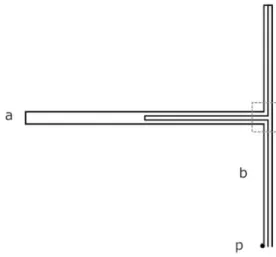
The conclusion of theorem 2.1 cannot be improved from “V contains no Y-set” to “V is IL-chainable”, at least not without additional assumptions. If a set is δ-chainable then it is easy to see that it can contain no size δ Y-set, so IL-chainability certainly implies that the set contains no Y set. Figure 5 provides an example that shows that the converse is false. Ifa(the width shown) is infinitesimal andb(the length shown) is not, we see that this figure contains no Y-set, and it is easy to see that it is not IL chainable. This example does not yet show that the conditions given in theorem 2.1 are not strong enough to allow us to conclude IL-chainability, however, as the set shown does not satisfy those conditions. Any simple closed curve containing a set of this shape would either contain standard points or would intersect its standard part on more than a single infinitesimal arc.
Figure 5: Contains no Y set
In order to see that theorem 2.1 cannot be improved to allow us to conclude IL-chainability we consider Ingram’s construction of a continuumAthat has uncountably many connected components all of positive “span” [7]. Lelek introduced the notion
of the span of a metric space in 1964 [9] and proved that chainable continua have span zero. See, for example, [16] for related definitions and results.
Definition 3.2 Let E be a continuum with metric d, and let C be the set of all subcontinua C of E×E with the property that π1(C) =π2(C). The spanof E is
supC∈Cinf{d(a,b) : (a,b)∈C}.
In Ingram’s construction there must exist aδ >0 such that infinitely many connected components ofAhave span greater thanδ, and thus cannot be chained with a collection of mesh less than δ. Using a saturation argument similar to that used in the proof of theorem 2.2 we can obtain an example of an internal region V surrounded by an internal simple closed curveSthat does not intersect∗Aat all and contains no standard points but does contain an internal connected component of ∗Athat has internal span greater than δ (and thus cannot be covered by an internal chain of mesh less than δ). All the hypotheses of the theorem are satisfied, butV is not IL-chainable.
Additional conditions that would allow us to conclude that the region is IL-chainable would be highly desirable, and could lead to applications to standard questions in-volving chainability. One simple condition that is sufficient is that st(V) itself be chainable. Any chain of standard open sets for st(V) would also form a chaining set for V, so that V could be covered by an internal chaining set of arbitrarily small non-infinitesimal mesh and thus one of infinitesimal mesh. This condition is not very useful, and is far from necessary. An internal “canal” could be IL-chainable and have a standard part that includes a disk simply by winding back and forth and staying within an infinitesimal distance of the previous pass. Finding other conditions that allow us to conclude the chainability ofV would be highly desirable. Hoehn has recently shown that there exist non-chainable plane continua that do not have span zero [4], so it would also be interesting to find additional conditions that guarantee that the region must have infinitesimal span.
4
Fixed Points
Does every non-separating plane continuum have the fixed point property? This ques-tion is usually referred to as the plane fixed point problem. An extensive and compre-hensive overview of results and questions related to the plane fixed point problem can be found in [2]. One of the motivations for the results in this paper was to try to find more situations where the classic “dog-chases rabbit” argument (Bing’s terminology)
works to prove results related to the plane fixed point problem. The idea of this type of argument is to move from points toward their images in such a way that the images are “trapped” and chased down by the points until a fixed point is found. The proposition below provides an example of such an argument in this setting.
Proposition 4.1 Let E be a non-separating plane continuum and f be a continuous function from E to E. Let D be a connected subset of ∗E andR a connected, open region containingD, and suppose that the following conditions are satisfied:
i) R is IL-chainable, i.e. R ⊂ ∪n
k=0Gk, with each Gk of infinitesimal diameter and Gi∩Gj nonempty iff|i−j| ≤1.
ii) The boundary of R, except perhaps onR∩G0, is contained in the complement of
E, i.e. ∂R−G0⊂ ∗R2−E.
iii) There exists an indexjand a pointpin D∩Gj such thatf(p)∈D− ∪jk=0Gk.
Thenf has a fixed point.
Proof We first note that conditions i) and ii) imply that for each i, if p ∈ (∗E∩ ∪n
k=i+1Gk)−Gi thenC(p,
∗E−G
i)⊂ ∗E∩ ∪nk=i+1Gk. Since pandf(p) are both in the connected setD contained inR they are in the same connected component of ∗E inR. Thus, we may assume thatDis this connected component of∗E inR, for if not we replaceDby its connected component and the remainder of the conditions are still satisfied.
We first show that all points in D∩Gj must be mapped into R− ∪ j
k=0Gk. If not, let q ∈ D∩Gj such that f(q) ∈/ R− ∪jk=0Gk. Let ε > 0 be an infinitesimal less than the distance between ∗E∩(R− ∪i
k=0Gk) and any point in ∗E−(R∩(∪nk=iGk)) (for i=1, ...,n) (here we use condition ii) to see that such anεexists). Now we letδ >0 be the corresponding infinitesimal that exists by the uniform continuity off. SinceD is compact it can be covered by a (hyper)finite collection of balls of radius δ/2, and sinceD is connected there is a sequence of theseδ/2 balls such that the first ball in the sequence containsp, each ball in the sequence intersects the next, and the final ball containsq. We now note that if any point in any Gi∩Dis mapped toR− ∪ik=0Gk, then so is every point in Gi∩Dthat is in the same δ/2 ball, since no point can move far enough to move out of the region, unless it were to move to Gi itself. But no point inGi can map intoGi since the diameter is infinitesimal and there are no fixed points. But for the same reason, any point in an intersectingδ/2 ball must also stay inside R and move to a higher numbered set (again, using the fact that it cannot map
into a region of the same index). Now by following the chain to the point qwe get a contradiction.
Thus, every point inD∩Gj must be mapped intoR− ∪jk=0Gk. But D∩Gj∩Gj+1is
not empty, or else we could disconnectDby using∪jk=0Gk and∪nk=j+1Gk, so there is a point in D∩Gj+1 that maps into R− ∪jk=0Gk, and since no point in Gj+1 can map
into a point inGj+1 there is a point that maps intoR− ∪jk+1=0Gk. Then, reasoning as above we see that all points inD∩Gj+1 map intoR− ∪
j+1
k=0Gk, and continuing in this way we see that for allm>j, all points in D∩Gm map into R− ∪mk=0Gk. Thus all points in Dmap into R, but since f(D) is connected, D is a connected component of ∗EinR, andf(p)∈D, we must have thatf(D)⊂D. But from above this means that for each m, all points in D∩Gm map into D− ∪mk=0Gk. This contradicts that n is (hyper)finite, completing the proof.
This particular argument does not use infinitesimals in a fundamental way. If E, D andR are standard in the proposition above andR isδ-chainable then the conditions allow us to conclude thatf has a point that moves a distance less thanδ. The condition thatD is connected and thatE can only intersect at one end of the chain are critical. For example in the diagram below the images can “escape” as we move towardf(p) on the set. Similarly, if the connected component ofpdoes not reach the end of the chain and is not the same as the connected component of f(p) then we have not necessarily created a fixed point trap.
Figure 6: This chainable set has not created a fixed point trap
Returning to the example given in figure 5 we consider the property of containing no Y-sets from the point of view of searching for fixed points. If we imagine this to be a portion of the nonstandard version of a standard continua that connects only at the point p to the rest of the set and f is a standard continuous function fromE to E that sends the pointpto some other point on the portion shown, then the “dog chases rabbit” argument works here andf must have a fixed point, but the argument is subtle. There are internal (but not standard) continuous functions that could “chase” the image around and let it “escape” without ever getting within an infinitesimal of it, but only if points that are within an infinitesimal of each other are mapped to points that are far apart. This set has noninfinitesimal internal span for a similar reason.
Under what conditions will a region that contains no Y-set form fixed point traps? Under what additional conditions do sets that satisfy the conditions of theorem 2.1 form fixed point traps? Answers to these questions could provide additional ways to attack unsolved cases of the plane fixed point problem. One of many possible specific conjectures along these lines is given below.
Conjecture 4.2 With E and f as in the fixed point problem let D be a connected subset of∗E and R a connected open region whose closure contains D and suppose that the following conditions are satisfied
i)V contains no Y-set.
ii) The boundary of V, except on an arc of infinitesimal length A, is contained in the complement of∗E.
iii) There existsp∈D∩A and ballsBof arbitrarily small non-infinitesimal diameter aboutp such that
a)C(f(p), ∗E−B)⊂V
b)V∩Bis connected.
c)V∩∂Bis an arc of infinitesimal length Thenf has a fixed point.
AcknowledgementThe author would like to thank the referees for their helpful input and suggestions.
References
[1] H. Bell,On fixed point properties of plane continua, Trans. Amer. Math. Soc., 128, (1967), 539-548; doi:10.2307/1994475.
[2] C. L. Hagopian,An update on the elusive fixed-point property, in: Open Prob-lems in Topology II, E. Pearl (ed.), Elsevier, (2007), 263-278; doi:10.1016/B978-044452208-5/50031-4.
[3] C.W. Henson, Foundations of nonstandard analysis-A gentle introduction to nonstandard extensions, in: Nonstandard Analysis: Theory and Applications, N.J. Cutland, C.W. Henson, and L. Arkeryd (eds.), Kluwer Academic, (1997), 1-50.
[4] L. C. Hoehn, A non-chainable plane continuum with span zero, Fund. Math. 211 (2011), no. 2, 149-174; doi: 10.4064/fm211-2-3.
[5] A.E. Hurd and P.A. Loeb,An Introduction to Nonstandard Analysis, Academic Press, 1985.
[6] W.T. Ingram,An atriodic tree-like continuum with positive span, Fund. Math. 77 (1972), 99-107..
[7] W.T. Ingram,An uncountable collection of mutually exclusive planar, atriodic tree-like continua with positive span, Fund. Math. 85 (1974), 73-78.
[8] W.T. Ingram, A brief historical view of continuum theory, Topology and Its Applications 153 (2006), 1530-1539; doi: 10.1016/j.topol.2004.08.024
[9] A. Lelek, Disjoint mappings and the span of spaces, Fund. Math. 55 (1964), 199-214.
[10] T. Lindstrom,An invitation to nonstandard analysis, in: Nonstandard Analysis And Its Application, N.J. Cutland (ed.), Cambridge University Press, (1988), 1-105; doi:10.1017/CBO9781139172110.002
[11] P.A. Loeb and M. Wolff,Nonstandard Analysis For the Working Mathematician, Kluwer Academic, 2000; doi:10.1007/978-94-011-4168-0
[12] J. C. Mayer,Embeddings and prime end structure of chainable continua, Hous-ton J Math. 8 (1982),no. 2, 221-253.
[13] R. L. Moore,Concerning triods in the plane and the junction points of plane continua, Proc. Nat. Acad. Sci., 14 (1928), 85-88; doi:10.1073/pnas.14.1.85 [14] R.L. MooreFoundations of Point Set Theory, rev. ed., American Mathematical
Society Colloquium Publications, v. XIII, 1962.
[15] S.B. Nadler, Jr.,Continuum Theory, An Introduction, Marcel Dekker, Inc., 1992. [16] L.G. Oversteegen and E.D. Tymchatyn, On span and chainable continua, Fund.
Math. 123 (1984), no. 2, 137-149.
[17] K. Sieklucki,On a class of plane acyclic continua with the fixed point property, Fund. Math. 63 (1968), 257-278.
University of Northern Colorado [email protected] http://www.unco.edu