Dynamic Programming for
H
-minor-free Graphs
(Extended Abstract)
Juanjo Ru´e1, Ignasi Sau2, and Dimitrios M. Thilikos3 1 Instituto de Ciencias Matem´aticas, Madrid, Spain.
2 AlGCo project-team, CNRS, LIRMM, Montpellier, France. [email protected]
3 Department of Mathematics, National and Kapodistrian University of Athens, Greece. [email protected]
Abstract. We provide a framework for the design and analysis of dynamic pro-gramming algorithms forH-minor-free graphs with branchwidth at mostk. Our technique applies to a wide family of problems where standard (deterministic) dynamic programming runs in 2O(k·logk)
·nO(1) steps, withnbeing the number of vertices of the input graph. Extending the approach developed by the same authors for graphs embedded in surfaces, we introduce a new type of branch de-composition forH-minor-free graphs, called anH-minor-free cut decomposition, and we show that they can be constructed in Oh(n3) steps, where the hidden constant depends exclusively onH. We show that the separators of such decom-positions have connected packings whose behavior can be described in terms of a combinatorial object called`-triangulation. Our main result is that when applied onH-minor-free cut decompositions, dynamic programming runs in 2Oh(k)
·nO(1) steps. This broadens substantially the class of problems that can be solved deter-ministically insingle-exponentialtime forH-minor-free graphs.
Keywords: analysis of algorithms; parameterized algorithms; graphs minors; branch-width; dynamic programming; non-crossing partitions.
1
Introduction
The celebrated theorem of Courcelle [7] states that graph problems expressible in MSOL can be solved inf(bw)·nsteps, where bw is the branchwidth andnis the number of vertices of the input graph. Using terminology from parameterized complexity, this im-plies that a large number of graph problems admit fixed-parameter tractable algorithms when parameterized by the branchwidth of their input graph. As the bounds forf(bw) provided by Courcelle’s theorem are huge, the design of specific dynamic programming algorithms for graph problems so thatf(bw) is a simple function, became an essential ingredient for many results on graph algorithms (see [2, 4, 12, 13, 33]). In this paper, we provide a general framework for the design and analysis of dynamic programming algo-rithms for families of graphs excluding a graph H as a minor, wheref(bw) = 2O(bw). Our framework applies to a family of problems where no deterministic dynamic program-ming algorithm with single-exponential parameterized dependence onbw is known. Motivation and previous work.Dynamic programming is usually applied in a bottom-up fashion on a rooted branch decomposition of the input graphG. Roughly, a branch decomposition of a graph is a way to decompose it into a tree structure of edge bipar-titions (the formal definition is in Section 2). Each bipartition defines a separator S
of the graph called the middle set, of cardinality bounded by the branchwidth of the input graph. The decomposition is routed, in the sense that one of the parts of each
bipartition is the “lower part of the middle set”, i.e., the so-far processed one. For each graph problem, dynamic programming requires a suitable definition of tables encoding how potential (global) solutions of the problem are restricted to a middle set and the corresponding lower part. The size of these tables reflects the dependence onk=|S|in the running time of the dynamic programming.
Designing the tables for each middle set S may vary considerably among different problems. For simple problems where the tables of dynamic programming encode vertex subsets of the middle set, such asVertex CoverorDominating Set, we may easily have a single-exponential dependence onk, as the number of subsets of a set of sizekis 2k. However, there are problems where the tables of the dynamic programming encode vertex pairings, such asLongest Path,Cycle Packing, orHamiltonian Cycle, or (more generally) vertex packings, such asConnected Vertex Cover, Connected Dominating Set,Feedback Vertex Set, orSteiner Tree. For the latter category of problems, single-exponential bounds on their table size are not known to exist. This complication arises from the fact that, for such problems, the tables should encode at least 2Θ(klogk)many pairings/packings. Nevertheless, for such problems one can do bet-ter for several classes of sparse graphs. This line of research was initiated in [14] and occu-pied several researchers in parameterized algorithms design (see also [5, 8, 11, 13, 24, 33]). The current technology of dynamic programming in graphs of bounded decomposability implies single-exponential parametric dependence for problems encodable by pairings in
H-minor free graphs [13] and for problems encodable by packings in graphs embedded in surfaces [33]. In this paper we extend both approaches of [13] and [33] to problems encodable by packings inH-minor free graphs.
Our results and techniques. We present a general framework that provides single-exponential dynamic programming algorithms for connected packing-encodable prob-lems (the formal definition of this class of problems is in Section 3) when the input graph excludes a graphH as a minor. The main idea in [33] was to introduce a new type of branch decomposition for graphs on surfaces, called asurface cut decomposition(which in turn, extended the concept of sphere cut decompositions for planar graphs introduced in [14, 34]). Namely, in [33], it was proved that the number of partial solutions that can be arranged on a surface cut decomposition can be upper-bounded by the number of non-crossing partitions on surfaces with boundary, which have been recently enumer-ated in [32]. It follows that partial solutions can be represented by a single-exponential number of configurations. This proves that, when applied on surface cut decompositions, dynamic programming for connected packing-encodable problems runs in 2O(k)·nO(1) steps.
We follow the same approach to extend this technique to H-minor-free graphs: we define a new type of branch decomposition for graphs excluding an h-vertex graph H
as a minor; we call it an H-minor-free cut decomposition. In Section 5 we show how to compute anH-minor-free cut decomposition of width Oh(k) inOh(n3) steps1. This algorithm uses the recent result of Kawarabayashi and Wollan [21] to find in timeO(n3) the tree-like decomposition of anH-minor-free graphG, given by the seminal structure theorem of of Robertson and Seymour [30]. Roughly, this result says that eachH-minor free graph admits a bounded-adhesion tree decomposition whose bags are nearly embed-ded in some surface of small genus. We also make use of the algorithm of [33] to find a surface cut decomposition of the surface-embedded part of each bag, then enhance them with the apices and vortices, and finally we glue them appropriately along the clique-sums. But for being able to use the algorithm of [33], we need to prove that there exists a tree-like decomposition ofGchose bags have good topological properties. This is done in
1 Given a computable functionf and an integer h, we use the notation O
h(f(k)) to denote
Dynamic Programming forH-minor-free Graphs (Extended Abstract) 3
Section 4, and requires a suitable extension of the notion of a polyhedral decomposition introduced in [33].
In order to prove the upper bound on the size of the tables when using anH -minor-free cut decomposition, the main difficulty is to deal with the vortices. From a combi-natorial point of view, our main contribution is to capture the behavior of the vortices of an H-minor-free graph in terms of an object called `-triangulation (cf. Section 2). Roughly speaking, in order to take into account the number ofsimultaneouscrossings of a set connected subgraphs inside a vortex,`-triangulations seem to be the appropriate combinatorial object to look at (see Section 6 for more details). Finally, we prove our main result in Section 7. That is, by combining all the ingredients mentioned above, we prove that by usingH-minor-free cut decompositions, the size of the tables for solv-ing connected packsolv-ing-encodable problems is ssolv-ingle-exponential in the branchwidth. We would like to note that we did not make any effort to optimize the constants depending onH, as they are already huge since we use the Structure Theorem of the Graph Minors series [21, 30]. Due to space limitations, all proofs are omitted in this extended abstract, while sketches of them can be found in the Appendix.
Our results can also be used to derive subexponential parameterized algorithms for connected packing-encodablebidimensional problems. That way, we broaden the class of problems where the general framework introduced in [9] can be applied.
Recent results and further research. Recently, Cygan et al. [8] have presented a new framework for obtainingrandomizedsingle-exponential algorithms parameterized by treewidth in general graphs. This framework is based on a dynamic programming tech-nique named Cut&Count, which seems applicable to most connected packing-encodable problems, like Connected Vertex Cover, Connected Dominating Set, Feed-back Vertex Set, or Steiner Tree. The randomization in the algorithms of [8] comes from the usage a probabilistic result called the Isolation Lemma [26], whose de-randomization is a challenging open problem [3]. Therefore, the existence of determin-istic single-exponential algorithms parameterized by treewidth for connected packing-encodable problems in general graphs remains wide open.
Our results for minor-free graphs can be seen as an intermediate step towards an eventual positive answer to this question. It may also be the case that this class of graphs establishes a frontier of the existence ofdeterministicsingle-exponential parameterized algorithms for connected packing-encodable problems (one way to prove this would be to use the recent approach given by Lokshtanovet al. [24] in order to provide lower bounds of running times of problems parameterized by treewidth), although we do not think that this is the case. It would be also interesting to reduce the big polynomial overheads in the algorithms of [8], given by the usage of the Isolation Lemma.
If one wants to further extend our approach to more general classes of graphs, the natural candidate are graphs excluding a graphH as a topological minor, possibly using the recent structural results of Grohe and Marx [18]. Nevertheless, our framework seems hard to extend to graphs of bounded degree, which are topological-minor-free.
Finally, it is worth mentioning that another type of branch decomposition for graphs on surfaces, called surface split decomposition, has been recently introduced by Bon-sma [5] to prove thatSubgraph Isomorphismcan be solved in single-exponential time in graphs on surfaces. It remains open to find single-exponential algorithms for Sub-graph IsomorphisminH-minor-free graphs.
2
Preliminaries
All graphs we consider are finite, simple, and undirected. Given a graphGand an edge
and parallel edges. IfH can be obtained from a subgraph of Gby a (possibly empty) sequence of edge contractions, we say thatH is aminor ofG. In this paper, we consider graphs embedded in surfaces that are compact and their boundary is homeomorphic to a (possibly empty) finite set of disjoint circles. We denote by ν(Σ) the number of connected components of the boundary of a surfaceΣ. For a graphG, theEuler genus
ofG, denoted γ(G), is the smallest Euler genus among all surfaces in whichG can be embedded (see [25] for the precise definitions). A subset Π of a surface Σ is surface-separating ifΣ\Π has at least two connected components.
Tree-like decompositions of graphs. Let G be a graph on n vertices. A branch decomposition(T, µ) of a graphGconsists of an unrooted ternary treeT(i.e., all internal vertices are of degree three) and a bijectionµ :L →E(G) from the set L of leaves of
T to the edge set ofG. We define for every edgeeof T themiddle setmid(e)⊆V(G) as follows: LetT1 andT2 be the two connected components ofT\ {e}. Then let Gi be the graph induced by the edge set {µ(f) : f ∈ L∩V(Ti)} for i ∈ {1,2}. The middle
set is the intersection of the vertex sets of G1 and G2, i.e.,mid(e) :=V(G1)∩V(G2). Thewidthof (T, µ) is defined asw(T, µ) := max{|mid(e)| |e∈T}. An optimal branch decomposition of G is defined by a treeT and a bijection µ which give the minimum width, thebranchwidth, denoted bybw(G). By definition (see [29]), the branchwidth of a graphGwith|E(G)| ≤1 is taken to be zero.
A tree decomposition of a graph G is a pair D = (X, T) where T is a tree and
X ={Xt |t∈V(T)} is a collection of subgraphs of V(G) such that: S
t∈V(T)Xt=G and for each x ∈ V(G), the set {t | x ∈ V(Xt)
} induces a connected subtree of T. We call the vertices of T nodes of D and we call the graphs in X bags of D. The
width of a tree decomposition D is max{|V(Xt)
| −1 | t ∈ V(T)} and its adhesionis max{|V(Xt)
∩V(Xt0
)| | t, t0 ∈ V(T)}. The treewidth of a graph G is the minimum width over all tree decompositions ofG. For everyXt, t
∈V(T) we denote byC(Xt) =
{V(Xt)
∩V(Xt0
)|t0 ∈N
T(t)} and we define theD-closure of Xt, as the graph X t
=
Xt∪S
C∈C(Xt)K[C]
, where K[C] is the clique obtained it we connect all pairs of distinct vertices ofC. We finally define G=S
t∈V(T)X t
.
`-triangulations and related constructions. Let Dk be a disc with k vertices on its border. We assume that these vertices are labeled anticounterclockwise with labels 1,2, . . . , k. By an `-triangulation of Dk we mean a maximal set of diagonals with no pairwise crossing set of size `+ 1. In other words, the graph whose vertices are the diagonals of the`-triangulation and there is an edge between two diagonals if and only if they cross in an internal vertex, does not containK`+1 as a subgraph. This concept generalizes the classical notion oftriangulation of a disc, as 1-triangulations correspond to triangulations. Denote by T`(k) the number of different `-triangulations of Dk. In particular,T0(k+ 2) is equal to thek-th Catalan numberCk = k+11 2kk, result which is well-known since Euler’s time. The study of`-triangulations for` >1 is more involved than the study of triangulations. In [16,27] the authors show that the number of diagonals in an`-triangulation of Dk is always `(k−2`−1). More recently, in [20] the following closed expression forT`(k) has been obtained:
T`(k) =
Ck−2 Ck−3 · · ·Ck−`−1
Ck−3 Ck−4 · · ·Ck−`−2 ..
. ... . .. ...
Ck−`−1Ck−`−2· · · Ck−2` . (1)
This expression generalizes the enumeration of the number of triangulations of a polygon withkvertices. For the asymptotic ofT`(k), observe that the recurrenceCk =4kk+1−2Ck−1
Dynamic Programming forH-minor-free Graphs (Extended Abstract) 5 6 J. Ru´e, I. Sau, and D. M. Thilikos
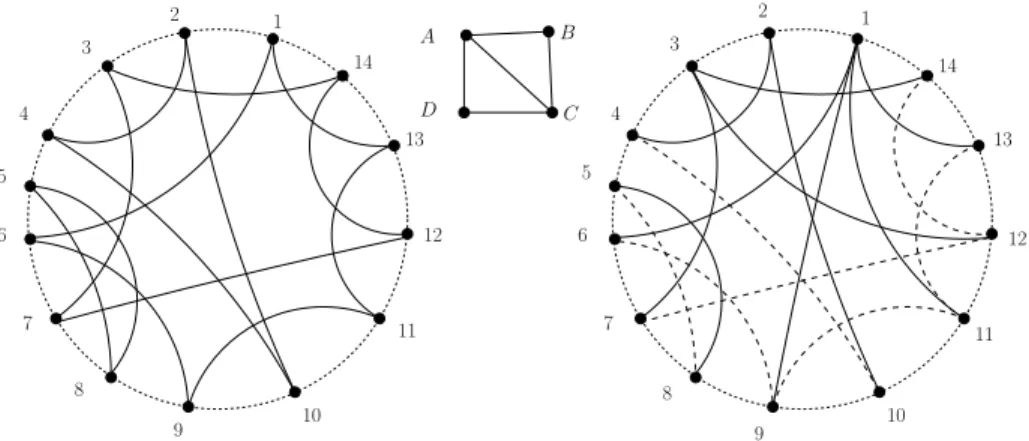
same way ash-triangulations generalize triangulations of a disc. In the leftmost side of Fig. 1 a 3-partition is drawn. We denote byPh(k) the number ofh-packings of a disc withkvertices.
In the following proposition we find asymptotic estimates for the number of h-packings ofDk.
Lemma 1. The number ofh-packings ofDksatisfies Ph(k) ≤ 2h(k−2h−1)·Th(k) ≤k→∞ h!
22h2+h·πh/2 ·k− 3h/2
·8hk = 2O(hk+hlogh). Proof: We construct an injective application from h-packings of Dk into partial h-triangulations ofDk. For each block, we consider the first vertex we meet when we move aroundDkstarting at vertex 1. From each one of these vertices we draw diagonals to the rest of the vertices of the block. Then it is obvious that the resulting set of diagonals is a partialh-triangulation: a pair of diagonals coming from the same block do not cross, and for each pair of crossing blocks there exists at least a pair of crossing diagonals. See the rightmost side of Fig. 1 for an explicit construction. As each partialh-triangulation is obtained from a (maximal) h-triangulation by deleting a subset of edges, and each (maximal)h-triangulation hash(k−2h−1) edges, the result follows. !
3 8 9 13 10 11 12 14 1 2 B 4 C 10 11 12 13 14 1 2 3 D A 4 5 6 7 8 9 5 6 7
Fig. 1. A 3-partition of the disc D14 with blocks A = {1,6,9,11,13}, B = {2,4,10}, C = {3,7,12,14}and D ={5,8}, the incidence graph of the partition and the associated partial 3-triangulation.
4.2 Non-crossing partitions of a surface with boundary
Extended considerations of this subsection can be found in [?]. LetΣ be a connected surface with boundary. Such a surface can be constructed by a compact and connected surface by deleting a finite set of disjoint open discs (see [?]). Denote by ν(Σ), χ(Σ) the number of connected components of the boundary and the Euler characteristic of Σ, respectively. We assumek vertices on the boundary of the surface. Vertices on each boundary are labeled in anticounterclockwise order. In particular, boundary components
Fig. 1. A 3-packing of the disc D14 with blocks A = {1,6,9,11,13}, B = {2,4,10}, C =
{3,7,12,14}andD={5,8}. On the left, the incidence graph of the partition, and on the right, the associated partial 3-triangulation (used in the proof of Lemma 1 in the Appendix).
makes each entry of the determinant equal toCk times a rational function of degree at most 2`in `. Using also thatCk= √1πk−3/24k(1 +o(1)) forklarge enough, it is easy to get bounds forT`(k). More concretely,T`(k)≤k→∞ π`/`!2k−3`/24`k.
We say that a set of diagonals in Dk is a partial `-triangulation if it a subset of an`-triangulation. LetΠ ={π1, π2, . . . , πr} be a partition of the set {1,2, . . . , k} (i.e., Sr
i=1πi ={1,2, . . . , r}, and πi∩πj =∅ if and only ifi6= j). We say that each of the subsetsπi, i ∈ {1,2, . . . , r} is a block of the partition Π. We represent a partition in the following way: we draw each block ofΠ as a polygon connecting the corresponding vertices. This defines a graphG(Π) whose vertices are the blocks ofΠ, and the edges are defined by the incidences of the blocks (i.e., an edge is drawn between a blockπi and a blockπj if and only if the associated polygons intersect in the graphical representation). We say that a packing (that is, a collection of pairwise disjoint non-empty blocks) of the discDk is an`-packing if and only ifG(Π) does not containK`+1 as a subgraph. In particular, if` < `0, then an`-packing is also an`0-packing. The notion of`-packing of a disc is a natural generalization of the notion of non-crossing partition, which corresponds to the case`= 1, in the same way as`-triangulations generalize triangulations of a disc. In the leftmost side of Fig. 1 a 3-packing is drawn. In the following lemma we find asymptotic estimates for the number of`-packings ofDk, which we denote byP`(k). Lemma 1. The number of `-packings ofDk satisfiesP`(k) = 2O`(k).
Partitions of an integer.Letq be a non-negative integer. Apartition ofq is a non-increasing sequence of positive integersp1, p2, . . . , prwhose sum isq. We denote byp(q) the number of partitions of q. The Hardy-Ramanujan-Rademacher estimate for p(q) (see [1] for details) states thatp(q) = 4√1
3qe
π√2q/3(1 +o(1)) = 2O(√q).
3
Connected packing-encodable problems
The standard dynamic programming approach on branch decompositions requires a so calledrootedbranch decomposition, defined as a triple (T, µ, er), where (T, µ) is a branch decomposition ofG such that T is a tree rooted at a leaf vl of T incident with some
edgeer. We slightly abuse notation by insisting that no edge ofGis assigned tovland thus mid(er) = ∅ (for this, we arbitrarily pick some edge of a branch decomposition, subdivide it and then connect by er the subdivision vertex with a new leaf vl). The edges ofT are oriented towards the rooter, and for each edgee∈E(T) we denote by
Eethe edges ofGthat are mapped to leaves ofT that are descendants ofe. We also set
Ge =G[Ee] and we denote by L(T) the edges ofT that are incident with leaves ofT. Given an edge ewhose tail is a non-leaf vertex v, we denote bye1, e2 ∈E(T) the two edges heading atv (we call themchildren ofe). When the tail of an edge ofT is also a leaf ofT then we call it leaf-edge.
Typically, dynamic programming on a rooted branch decomposition (T, µ, er) of a graphGassociates some suitable combinatorial structurestruct(e) with each edgeeofT, such that the knowledge ofstruct(er) makes it possible to determine the solution to the problem. Roughly speaking,struct(e) encodes all the ways that the possible certificates of a partial solution on graph Ge may be restricted to mid(e). The computation of struct(e) is done bottom-up, by first providing struct(e) when e is a leaf-edge ofT and then giving a recursive way to constructstruct(e) from struct(e1) andstruct(e2), where
e1ande2 are the children ofe.
The encoding of struct is commonly referred as the “tables” of the dynamic pro-gramming algorithm. It is desirable that the size of the tables, as well as the time to process them, is bounded by f(|mid(e)|)·nO(1), where f is a function not depending onn. This would give a polynomial-time algorithm for graphs of fixed branchwidth. In technical terms, this means that the problem isFixed Parameter Tractable(FPT), when parameterized by the branchwidth of the input graph (for more on Fixed Parameter Tractability, see [15, 17, 28]). A challenge in the design of such algorithms is to reduce the contribution of branchwidth to the size of their tables, and therefore to simplifyf
as much as possible. As indicated by the lower bounds in [6, 19, 23], for many problems like Independent Set, Dominating Set, or q-Coloring for fixed q ≥ 3, f is not expected to be better than single-exponential in general graphs.
Before we proceed with the description of the family of problems that we examine in this paper, we need some definitions. LetGbe a graph and letS be a set of vertices of
G. We denote byG the collection of all subgraphs ofG. EachH ∈ G defines a packing
PS(H) of S such that two vertices x, y ∈ S belong to the same set of PS(H) if x, y belong to the same connected component ofH. We say thatH1, H2∈ GareS-equivalent if PS(H1) = PS(H2), and we denote it by H1 ≡S H2. Let GS the collection of all subgraphs ofGmodulo the equivalence relation ≡S. We define the set of all connected
packings ofS with respect to G as the collection ΨG(S) ={PS(H) | H ∈ GS}. Notice that each member ofΨG(S) can indeed be seen as a packing ofS, as its sets may not necessarily meet all vertices ofS.
In this paper we consider graph problems that can be solved by dynamic programming algorithms on branch decompositions for which the size ofstruct(e) is upper-bounded2by 2O(|mid(e)|)
· |ΨGe(mid(e))| ·nO(1). We call these problemsconnected packing-encodable. We stress that our definition of connected packing-encodable problem assumes the exis-tence ofanalgorithm with this property, but there may exist other algorithms whose ta-bles are much bigger. For these problems, dynamic programming has a single-exponential dependence on branchwidth if and only if ΨGe(mid(e)) contains a single-exponential number of packings, i.e.,|ΨGe(mid(e))|= 2O(|mid(e)|). See [33] for more details.
In general, the number of different connected packings that could be created dur-ing the dynamic programmdur-ing is not necessarily smaller than the number of the non-2 In most cases this bound is independent fromn. We choose to present it in a more general form that might include graph problems that are not covered by the linear time algorithms derived from Courcelles’s theorem.
Dynamic Programming forH-minor-free Graphs (Extended Abstract) 7
connected ones. In fact, it typically depends on the k-th Bell number, where k is the branchwidth of the input graph. This implies that, in general,|ΨGe(mid(e))|= 2O(klogk) is the best upper bound that can be so far achieved for connected packing-encodable problems, at least for deterministic algorithms. The purpose of this paper is to show that, for such problems, this bound can be reduced to a single-exponential one when their input graphs exclude a graph as a minor. In Section 5, we define the concept of an
H-minor-free cut decomposition, which is a key tool for the main result of this paper, summarized as follows.
Theorem 1. Every connected packing-encodable problem whose input is an n-vertex graphGthat excludes anh-vertex graphH as a minor, and has branchwidth at mostk, can be solved by a dynamic programming algorithm on anH-minor-free cut decomposition ofGwith tables of size 2Oh(k)·nO(1).
In Section 3, we prove (Theorem 3) that, given an H-minor-free graph G, an H -minor-free cut decomposition ofG of width Oh(bw(G)) can be constructed in Oh(n3) steps. Therefore, we conclude the following result.
Theorem 2. Every connected packing-encodable problem whose input is an n-vertex graphG that excludes anh-vertex graph H as a minor and has branchwidth at mostk, can be solved in2Oh(k)·nO(1) steps.
4
Polyhedral decomposition of
H
-minor-free graphs
LetΣ be a surface with boundary. AnO-arc is a subset ofΣ homeomorphic to S1. A subset ofΣmeeting the drawing only at vertices ofGis calledG-normal. If anO-arc is
G-normal, then we call it anoose. We denote by VN the set of vertices met by a noose
N, i.e.,V(N) =V(G)∩N. ThelengthN of a noose is the number of the vertices that it meets and is denoted by|N|, i.e., |N|=|V(N)|. Thefacewidthof aΣ-embedded graph embedding (G, τ) is the smallest length of a non-contractible (i.e., non null-homotopic) noose inΣand is denoted byfw(G). We call aΣ-embedded graph Gpolyhedral [25] if
Gis 3-connected and fw(G)≥3, or ifGis a clique and 1≤ |V(G)| ≤3.
Definition 1. Let α, β, γ, δ be non-negative integers. A graph G is (α, β, γ, δ)-nearly embeddable, if there is a surface Σ of Euler genus γ and a set of vertices A ⊆V(G)
(called apices) of size at most α such that graph G\A is the union of subgraphsG =
{G0, . . . , Gδ} (some of them may be the empty graph) with the following properties:
1. There is a setR={∆1, . . . , ∆δ} of pairwise disjoint open discs in Σ such that G0
is a graph embedded inΣ in a way thatG0∩Si=1,...,δ∆i=∅ for some (G0 is called underlying graphof G),
2. the graphs G1, . . . , Gδ (called vortices) are pairwise disjoint and for 1 ≤ i ≤ δ,
V(G0)∩V(Gi)⊆bor(∆i)(we call the vertices in V(G0)∩V(Gi)⊆bor(∆i) base verticesof the vortex Gi),
3. for1≤i≤δ, letUi={ui1, . . . , uimi} be the base vertices ofGi appearing in an order
obtained by counterclockwise traversing ofbor(∆i). We call the vertices ofUi bases
ofGi. ThenGi has a path decompositionBi= (Bji)1≤j≤mi, of width equal toβ such
that for 1 ≤ j ≤ mi, we have uij ∈ Bji. We also denoteB = {B1, . . . ,Bδ} and for
each vi
j, we call Bji the cloudofvij.
IfGis an (α, β, γ, δ)-nearly embeddable graph for someE= (A, Σ,G,R,B) as above, we say thatEis its embedding pattern. If in Definition 1 we demand the embedding of
the graph G0 to be polyhedral, then we say that G is polyhedrally (α, β, γ, δ)-nearly
embeddable, and we say that the corresponding pattern is polyhedral. We also say that
G is (polyhedrally) c-nearly embeddable graph if it is (polyhedrally) (α, β, γ, δ)-nearly embeddable for someα, β, γ, δ≤c. The main result of this section is the following: Proposition 1. There exists an algorithm that, given an h-vertex graph H and an n -vertex graphGthat excludesH as a minor, outputs, inOh(n3)steps, a tree decomposition
D= (X ={Xt
|t∈V(T)}, T)ofGof adhesionOh(1)and such that everyt∈V(T),X t
is a polyhedrallyOh(1)-nearly embeddable graph. Moreover, the same algorithm outputs
the corresponding embedding patternEtof Xtfor each t∈V(T).
Given an h-vertex graph H and an H-minor free graph G, we call a tree decom-positionDas the one in Proposition 1, a ch-nearly polyhedral decomposition (wherech is a constant depending only on h). If in Proposition 1 G is a graph embedded in a surface, then a ch-nearly polyhedral decomposition is what has been defined in [33] as a polyhedral decomposition, where the adhesion is at most 2 (now in each embedding patternEt = (At, Σt,Gt,Rt,Bt), we have that Gt
0 contains only the underlying graph, whileRt=∅ andBt=∅).
5
H
-minor-free cut decompositions
In this section we define and show how to construct a special type of branch decomposi-tions for families of graphs excluding a graphH as a minor; we call them H-minor-free cut decompositions. Their construction relies on surface cut decompositions, recently introduced in [33].
Let Σ be a surface without boundary, and let N be a finite set of O-arcs in Σ
pairwise intersecting at zero-dimensional subsets ofΣ(i.e., points). Then the closure of each connected component ofΣ\∪∪∪∪∪∪∪∪∪N is called apseudo-surface, where∪∪∪∪∪∪∪∪∪N =S
N∈NN. For a point p ∈ Σ, let N(p) be the number of O-arcs in N containing p, and let
P(N) ={p∈Σ:N(p)≥2}; note that by assumption P(N) is a finite set of points of
Σ. Then we defineθ(N) =P
p∈P(N)(N(p)−1).
Note that if theO-arcs are pairwise disjoint, then each pseudo-surface is a surface with boundary. Notice that in Definition 1 we can permit Σ to be a pseudo-surface with boundary instead of a surface without boundary. This extension of the definition is necessary for defining the concept of anH-minor-free cut decomposition below. Definition 2. Given an h-vertex graph H, ann-vertex H-minor-free graph G, an H -minor-free cut decompositionofGis a branch decomposition(T, µ)ofGsuch that there exists anOh(1)-nearly polyhedral decomposition D= (X ={Xt| t ∈V(T0)}, T0)of G
such that for each edgee∈E(T), either |mid(e)|=Oh(1) or there exists a bagXt∈ X
such that
• mid(e)⊆V(Xt);
• given thatEt= (At, Σt,
Gt,
Rt,
Bt)is the embedding pattern ofXtand
Gt=
{Gt 0, Gt1,
. . . , Gt
δ}, there exists a set N of nooses of Gt0 in Σt such the vertices ofmid(e)∩
V(Gt
0)are all met by the nooses in N in a way that the following hold
1. |N |=Oh(1),
2. the nooses inN pairwise intersect only at subsets ofmid(e), 3. θ(N) =Oh(1),
4. Σt\∪∪∪∪∪∪∪∪∪N contains exactly two connected components, such that the graphG[V(G e)∩
V(Xt)]isO
Dynamic Programming forH-minor-free Graphs (Extended Abstract) 9
If in the above definition we consider thatGis embedded in some surface of genusγ
and we restrict eachGtto contain only the underlying graph (i.e., there are no vortices,
Rt =∅, and Bt =∅), we have the definition of surface cut decompositions introduced in [33]. Finally, if we further restrictΣto be a sphere and setAt=∅, we have the notion of sphere cut decompositions introduced in [14, 34].
Theorem 3. There exists an algorithm that, given anh-vertex graphH and ann-vertex graphGthat excludesH as a minor and has branchwidth at most k, outputs inOh(n3)
steps anH-minor-free cut decomposition ofGof widthOh(k).
It is worth noting here that the algorithm that computes a surface cut decomposition for a surface-embedded graph in [33] has running time 2O(k)
·n3, because we wanted to optimize the dependence on the genus of the width of the obtained branch decomposition, while keeping the overall running time single-exponential ink.
6
Combinatorial behavior of the vortices
In this section we focus on the combinatorial behavior of the vortices in a graph excluding a graph H as a minor. The main objective is to prove that, in an H-minor-free cut decomposition, the number of ways that connected subgraphs can behave inside a vortex can be upper-bounded by the number ofOh(1)-packings (defined in Section 2) of size linear in the branchwidth of the input graph. By Theorem 3, from now on we assume that we have anH-minor-free cut decomposition (T, µ) ofG, as well as a tree decomposition
D= (X ={Xt|t∈V(T)}, T) ofGof adhesionO
h(1), such that eachD-closureX t
is a polyhedrally (α, β, γ, δ)-nearly embedded graph, withα, β, γ, δ=Oh(1).
In order to have a clearer picture of the behavior of the vortices, we define according to [13] the graphRd,s, where
V(Rd,s) =V1∪ · · · ∪Vs with|Vi|=dfor 1≤i≤s, and
E(Rd,s) ={{xj, xk} |xj, xk∈Vi,1≤j6=k≤d,1≤i≤s} ∪
{{xj, yj} |xj∈Vi−1andyj∈Vi,1≤j≤d,1≤i≤s}.
We call such a graphRd,s anormalized vortex. In the graphRd,swe distinguish a subset
U ⊆ V(Rd,s) containing exactly one vertex from eachVi. The pair (Rd,s, U) is called an (d, s)-vortex pattern. See Fig. 2 for an example of a normalized vortexR5,12 and the corresponding (5,12)-vortex pattern, where the set U is defined by the white vertices. These white vertices are thebase vertices of the vortex, and each one of thedconcentric paths is called a track of the vortex. We say that an (d, s)-vortex pattern has depth
d. Note that each base vertex belongs to a clique of size d. The d edges between two consecutive cliques are called a section of the vortex. Normalized vortices and vortex patterns are useful because any vortex is a minor of a vortex pattern, as stated in the following lemma.
Lemma 2 (Dorn, Fomin, and Thilikos [13]). Any vortex of ad-nearly embeddable graph with base set J is a minor of a (d, s)-vortex pattern (Rd,s, U), where the minor
operations map bijectively the vertices ofU to the vertices inJ in a way that the order of the vortex and the cyclic ordering ofU induced by the indices of its elements is respected.
By Lemma 2, from now on we will only deal with vortex patterns. We say that connected subgraphBofGmeets a vortexF, ifB contains some of the base vertices of
F. If U is the set of base vertices ofF, the number of times thatB meets F is exactly
|V(B)∩U|. For the analysis, we need to consider the possibility that a subgraph in a connected packingP ∈ΨG(S) meets more than one vortex. This possibility is ruled out in the following lemma.
R5,12
V1
V2
V3
V4 V 5
V6
V7
V8
V9
V10
V11
V12
Fig. 2.A (5,12)-vortex pattern. The setU is defined by the white vertices.
Lemma 3. We can assume that each subgraph in a connected packingP ∈ΨG(S)meets
at most one vortex.
Loosely speaking, the proof of Lemma 3 is based on the fact that if a subgraphBin a connected packingP ∈ΨG(S) meets two vortices of depth at mostβ, these two vortices can be virtually merged along a path ofB into a new vortex of depth at most 2β. As a subgraph may a priori meet an arbitrary number of the vortices, for our analysis we need to consider all possibilities of merging any subset of theδ vortices, which are at mostp(δ) many (see Section 2). Therefore, potentially some of this merged vortices may have depth up toδ·β =Oh(1). Also, in order to find an upper bound for the number of connected packings, we will need to incur an additional factor p(δ). The following lemma, whose proof uses Lemma 3 above, will allow us to simulate the behavior of the vortices with simpler objects of appropriate size, independent of the integers.
Lemma 4. For each vortex F, we can assume that the total number of times that the subgraphs in a connected packingP ∈ΨG(S)meet F isOh(k).
LetF be a given (d, s)-vortex pattern with set of base verticesU ={u1, . . . , us}, or-dered cyclically. AconfigurationinFis a set of vertex-disjoint subgraphsF={F1, . . . , F`} of F. We say that two subgraphs Fi, Fj ∈ F cross if there exist ui1, ui2 ∈ V(Fi)∩U
anduj1, uj2 ∈V(Fj)∩U such thati1< j1< i2 < j2. The crossing graph Fc of a
con-figurationF has one vertex for each subgraph inF, and an edge between two vertices if and only if their corresponding subgraphs cross. A configurationF is said to be an
`-configuration if the maximum size of a clique inFc is `. In the following lemma we prove that in a vortex of given depth, the existing configurations can cross only in a
boundedway. This fact will enable us to upper-bound the number of configurations in a vortex of depthdin terms of the number of d-packings in the circle.
Lemma 5. A vortex pattern of depth at most β does not contain any β0-configuration
withβ0 > β.
7
Upper-bounding the size of the tables
In this section we show that by usingH-minor-free cut decompositions in order to solve connected packing-encodable problems inH-minor-free graphs, one can guarantee single-exponential upper bounds on the size of the tables of dynamic programming algorithms. Theorem 1 follows directly by the definition of a connected packing-encodable problem and the following lemma, which we will prove in this section.
Lemma 6. Let Gbe a graph excluding anh-vertex graphH as a minor, and let (T, µ)
be anH-minor-free cut decomposition ofGof width at mostk. Then for everye∈E(T),
|ΨGe(mid(e))|= 2 Oh(k).
Dynamic Programming forH-minor-free Graphs (Extended Abstract) 11
Let (T, µ) be an H-minor-free cut decomposition of a graphG. For edges e∈E(T) such that mid(e) = Oh(1), we trivially have that |ΨGe(mid(e))| = 2Oh(1), and there-fore the statement of Lemma 6 is satisfied. Therethere-fore, we only need to deal with edges
e∈E(T) such thatmid(e) is contained in a graph which is polyhedrally Oh(1)-nearly embedded in a surfaceΣ.
In order to prove Lemma 6, we will need the lemmata of Section 6 about the com-binatorial behavior of the vortices. We will also need the following key result from [33], which bounds the size of the tables for graphs embedded in surfaces with boundary. Lemma 7. LetGbe a graph containing a setAof vertices such thatG\Ais embedded in a surfaceΣwith boundary. Let alsoS be the set of vertices ofGthat lie on the boundary of Σ and A0 ⊆ A. Then, if |S| ≤ k and |A|, γ(Σ), ν(Σ) ≤ γ, then |Ψ
G(S∪A0)| =
γO(γ)·kO(γ)·γO(k).
Note that, in the statement of Lemma 7, if|A|, γ(Σ), ν(Σ) =Oh(1), then it holds that
|ΨG(S∪A0)|= 2Oh(k). The following lemma gives an upper bound on the number of non-crossing packings on a surface with apices and vortices. Intuitively, our approach consists in considering each vortex as a new virtual noose of lengthOh(k) in anH-minor-free cut decomposition, where each vertex of such noose corresponds to an eventual meeting of a subgraph of the connected packing with the corresponding vortex. We then consider all non-crossing packings taking into account the original and the virtual nooses, and finally we merge the subgraphs incident to a virtual noose according to the possible
Oh(1)-packings corresponding to that vortex. This approach is made more precise in Lemma 8 below, which implies Lemma 6, and therefore also Theorem 1 and Theorem 2. The proof of Lemma 8 makes use of Lemmata 2, 4, 5, and 7.
Lemma 8. Let G be a graph polyhedrally (α, β, γ, δ)-nearly embedded in a surface Σ
with boundary, with a set of apices A. Let alsoS be the set of vertices ofGthat lie on the boundary ofΣ. If|S| ≤kandα, β, γ, δ, ν(Σ)≤η, then|ΨG(S∪A)|= 2Oη(k).
References
1. G. Andrews. The Theory of Partitions. Cambridge University Press, 1984.
2. S. Arnborg. Efficient algorithms for combinatorial problems on graphs with bounded de-composability – a survey.BIT, 25(1):2–23, 1985.
3. V. Arvind and P. Mukhopadhyay. Derandomizing the Isolation Lemma and Lower Bounds for Circuit Size. InProc. of APPROX-RANDOM, volume 5171 ofLNCS, pages 276–289, 2008.
4. H. L. Bodlaender. Dynamic programming on graphs with bounded treewidth. InProc. of the 15th International Colloquium on Automata, Languages and Programming (ICALP), volume 317 ofLNCS, pages 105–118, 1988.
5. P. Bonsma. Surface split decompositions and subgraph isomorphism in graphs on surfaces. CoRR, abs/1109.4554, 2011, to appear in theProc. of STACS 2012.
6. L. Cai and D. W. Juedes. On the existence of subexponential parameterized algorithms. Journal of Computer and System Sciences, 67(4):789–807, 2003.
7. B. Courcelle. The monadic second-order logic of graphs: definable sets of finite graphs. In Proc. of the 14th International Workshop on Graph-theoretic Concepts in Computer Science (WG), volume 344 ofLNCS, pages 30–53, 1988.
8. M. Cygan, J. Nederlof, M. Pilipczuk, M. Pilipczuk, J. M. M. van Rooij, and J. O. Woj-taszczyk. Solving connectivity problems parameterized by treewidth in single exponential time. InProc. of the 52nd Annual IEEE Symposium on Foundations of Computer Science (FOCS), pages 150–159, 2011.
9. E. D. Demaine, F. V. Fomin, M. T. Hajiaghayi, and D. M. Thilikos. Subexponential Pa-rameterized Algorithms on Graphs of Bounded Genus andH-Minor-Free Graphs.Journal of the ACM, 52(6):866–893, 2005.
10. E. D. Demaine, M. T. Hajiaghayi, and K.-i. Kawarabayashi. Algorithmic graph minor theory: Decomposition, approximation, and coloring. In Proc. of the 46th Annual IEEE Symposium on Foundations of Computer Science (FOCS), pages 637–646, 2005.
11. F. Dorn, F. V. Fomin, and D. M. Thilikos. Fast Subexponential Algorithm for Non-local Problems on Graphs of Bounded Genus. InProc. of the 10th Scandinavian Workshop on Algorithm Theory (SWAT), volume 4059 of LNCS, pages 172–183, 2006.
12. F. Dorn, F. V. Fomin, and D. M. Thilikos. Subexponential parameterized algorithms. InProc. of the 34th International Colloquium on Automata, Languages and Programming (ICALP), volume 4596 of LNCS, pages 15–27, 2007.
13. F. Dorn, F. V. Fomin, and D. M. Thilikos. Catalan Structures and Dynamic Programming inH-minor-free Graphs. InProc. of the 19th annual ACM-SIAM Symposium on Discrete algorithms (SODA), pages 631–640, 2008.
14. F. Dorn, E. Penninkx, H. L. Bodlaender, and F. V. Fomin. Efficient exact algorithms on planar graphs: Exploiting sphere cut decompositions.Algorithmica, 58(3):790–810, 2010. 15. R. G. Downey and M. R. Fellows. Parameterized Complexity. Springer-Verlag, 1999. 16. A. Dress, J. H. Koolen, and V. Moulton. On line arrangements in the hyperbolic plane.
European Journal of Combinatorics, 23(5):549–557, 2002.
17. J. Flum and M. Grohe. Parameterized Complexity Theory. Springer Verlag, 2006. 18. M. Grohe and D. Marx. Structure theorem and isomorphism test for graphs with excluded
topological subgraphs. CoRR, abs/1111.1109, 2011.
19. R. Impagliazzo, R. Paturi, and F. Zane. Which Problems Have Strongly Exponential Com-plexity?Journal of Computer and System Sciences, 63(4):512–530, 2001.
20. J. Jonsson. Generalized triangulations and diagonal-free subsets of stack polyominoes. Journal of Combinatorial Theory, Series A, 112(1):117–142, 2005.
21. K.-i. Kawarabayashi and P. Wollan. A simpler algorithm and shorter proof for the graph minor decomposition. In Proc. of the 43rd ACM Symposium on Theory of Computing (STOC), pages 451–458, 2011.
22. K.-i. Kawarabayashi and P. Wollan. A simpler algorithm and shorter proof for the graph minor decomposition. In Proc. of the 43rd ACM Symposium on Theory of Computing (STOC), pages 451–458, 2011.
23. D. Lokshtanov, D. Marx, and S. Saurabh. Known Algorithms on Graphs of Bounded Treewidth are Probably Optimal. InProc. of the 22nd annual ACM-SIAM Symposium on Discrete algorithms (SODA), pages 777–789, 2011.
24. D. Lokshtanov, D. Marx, and S. Saurabh. Slightly Superexponential Parameterized Prob-lems. InProc. of the 22nd annual ACM-SIAM Symposium on Discrete algorithms (SODA), pages 760–776, 2011.
25. B. Mohar and C. Thomassen. Graphs on surfaces. John Hopkins University Press, 2001. 26. K. Mulmuley, U. V. Vazirani, and V. V. Vazirani. Matching is as easy as matrix inversion.
Combinatorica, 7(1):105–113, 1987.
27. T. Nakamigawa. A generalization of diagonal flips in a convex polygon. Theoretical Com-puter Science, 235(2):271–282, 2000.
28. R. Niedermeier.Invitation to Fixed-Parameter Algorithms. Oxford University Press, 2006. 29. N. Robertson and P. D. Seymour. Graph minors. X. Obstructions to Tree-decomposition.
Journal of Combinatorial Theory, Series B, 52(2):153–190, 1991.
30. N. Robertson and P. D. Seymour. Graph minors. XVI. Excluding a Non-planar Graph. Journal of Combinatorial Theory, Series B, 77:1–27, 1999.
31. N. Robertson and P. D. Seymour. Graph minors. XVI. Excluding a non-planar graph. Journal of Combinatorial Theory, Series B, 89(1):43–76, 2003.
32. J. Ru´e, I. Sau, and D. M. Thilikos. Asymptotic enumeration of non-crossing partitions on surfaces. CoRR, abs/1104.2477, 2011 (a preliminary version appeared in theProc. of ICALP 2011). Last version available atwww.lirmm.fr/∼sau/Pubs/RST11NCP.pdf. 33. J. Ru´e, I. Sau, and D. M. Thilikos. Dynamic programming for graphs on surfaces.CoRR,
abs/1104.2486, 2011, to appear inACM Transactions on Algorithms (TALG). Last version available atwww.lirmm.fr/∼sau/Pubs/RST12TALG.pdf.
34. P. D. Seymour and R. Thomas. Call routing and the ratcatcher.Combinatorica, 14(2):217– 241, 1994.
Dynamic Programming forH-minor-free Graphs (Extended Abstract) 13
Appendix
Sketch of the proof of Lemma 1.Our aim is to prove that the number of`-packings ofDk satisfies
P`(k) ≤ 2`(k−2`−1)·T`(k) ≤k→∞ 22`2+``!
·π`/2·k− 3`/2
·8h`k = 2O`(k).
We construct an injective application from`-packings ofDk into partial`-triangulations ofDk. For each block, we consider the first vertex we meet when we move aroundDk starting at vertex 1. From each one of these vertices we draw diagonals to the rest of the vertices of the block. Then it is obvious that the resulting set of diagonals is a partial
`-triangulation: a pair of diagonals coming from the same block do not cross, and for each pair of crossing blocks there exists at least a pair of crossing diagonals. See the rightmost side of Fig. 1 for an explicit construction. As each partial`-triangulation is obtained from a (maximal)`-triangulation by deleting a subset of edges, and each (max-imal)`-triangulation has`(k−2`−1) edges, the result follows.
Sketch of the proof of Proposition 1.The result has been recently been proven in [22] without the demand thatXtis a polyhedrallyOh(1)-nearly embeddable graph. In fact, the non-polyhedral version of Theorem 1 is known as the Structure Theorem of the Graph Minors series [31]. In [22], a simpler proof of this theorem was found together with an al-gorithm with the claimed running time (see also [10]). In order to impose the polyhedral condition, we further build a tree decomposition of eachXtwhere all of its bags are poly-hedrallyOh(1)-nearly embeddable. For this, assume thatEt= (At, Σt,Gt,Rt,Bt) is the embedding pattern of a bagXtthat is non-polyhedrally (α, β, γ, δ)-nearly embeddable whereα, β, γ, δ≤ch.
We fist updateBt so that for each i
∈ {1, . . . , δ} andj ∈ {1, . . . , mi}, the following hold: (a) ui
j, uij+1 ∈Bji (here we interpret uimi+1 as u i
1), (b)uij ∈Bij∩Bj−i 1 (here we interpret Bi
0 as Bmii ), and (c) |Bji ∩Bji+1| ≤ k+12 (here we interpret Bmii +1 as Bi1). This can be done if for every i ∈ {1, . . . , δ}, we set Bi ← ( ˆBji)1≤j≤mi so that ˆBij =
Bi
j ∪Bji+1, j ∈ {1, . . . , mi} (here Bmii +1 = B1i). We call the conditions (a), (b), (c)
flexibility conditions for Bt and we show that they can be assumed with the cost of updatingβ to be 2β+ 1. This enhancement of Bt is necessary in order to build a tree decomposition ofXt. For this, we essentially imitate the steps of Algorithm 1 in [33] by including in the common intersections of the bags of this tree decomposition not only the vertices met by the separating nooses, but also their cloud vertices along with the (common) apex setA. In what follows, we outline this enhancement process.
The fact thatEtis not polyhedral implies that the underlying graphGt
0, embedded inΣ has a nooseN where |V(N)| ≤2 and such that one of the following holds: (1) V(N) is a separator of Gt
0. (2) V(N) is not a separator of Gt
0 andN is non-contracible and not surface separating. In case (1), Xt has a separation (X, Y) where X ∩Y contains the vertices of V(N) along with their clouds and the apices inA. Making use of the flexibility conditions, it is possible to split the bag Xt into two bags A andB that are both (α, β, γ, δ)-nearly embeddable and the flexibility conditions are still satisfied for both of them. While step (1) is applied, the apices in At are included in the common intersection of any two neighboring bags of this tree decomposition ofXt. This makes the adhesion of the resulting tree decomposition to be at most 2β+α.
In case (2), we reviseEt= (At, Σt,
Gt,
Rt,
Bt) to a new oneE0= (At0, Σt0,Gt0,Rt0,Bt0) as follows: we defineAt0 so that it contains all vertices inAt along with the vertices in
V(N) and their clouds. We defineΣt0 to be the surface whereGt
0\V(N) is embedded, and take into account thatγ0 =γ(Σt0)< γ. Our next step is to see thatN may split, in the new embedding, at most one of the vortices inGtto two vortices, and this induces a revision of (Gt,
Rt,
B)to a new triple (
Gt0,Rt0,Bt0) such that Xt is (α0, β0, γ0, δ0)-nearly embeddable with pattern (At0, Σt0,Gt0,Rt0,Bt0) whereα0 ≤α+ 2·β,β0 =β,γ0≤γ−1, and δ0 ≤ δ+ 1. Also, this update can be done in a way flexibility conditions again hold for Bt0. Our progress is that we reduced γ0 in the cost of increasing α0 and δ0. This means that case (2) will not be applied more than Oh(1) times, and therefore after the application of the transformation of cases (1) and (2) until this is not possible anymore, we end up with a tree decomposition of adhesion 2β+α=Oh(1) consisting of polyhedrally (α0, β0, γ0, δ0)-nearly embeddable bags, whereα0, β, γ0, δ0=Oh(1). Given that we have the decompositionDand the embedding patternEtofXtfor eacht∈V(T) and following the arguments of the proof of Proposition 4.2 in [33], it is easy to verify that, givenD and the embedding pattern Et of Xt for each t ∈ V(T), the procedure described in the above sketch requires at mostO(n3) steps. ut Sketch of the proof of Theorem 3. The algorithm applies first the algorithm of Proposition 1 in order to find a tree decompositionD= (X ={Xt|t ∈V(T0)}, T0) of adhesionOh(1) and such that for every t ∈V(T0), X
t
is a polyhedrally Oh(1)-nearly embeddable graph. Then, for every t ∈ V(T0) we consider the underlying graph Gt
0, and find a branch decomposition of it of widthOh(k). This can be done inO(n3) steps by using a standard planarization procedure that cuts the graph along minimum length non-contractible nooses (see [11,13]) and then using the approximation algorithm in [34]. Our next aim is to transform this branch decomposition into a new branch decomposition (Tt, τt) ofGt
0 with the property that for everye∈E(T), there exists a setN of nooses ofGt
0 in Σt such that the vertices of mid(e)∩V(Gt0) are all met by the nooses in N, in a way that conditions 1–3 of Definition 2 hold and, moreover, Σt
\ ∪∪∪∪∪∪∪∪∪N contains exactly two connected components, such that the graph Ge \A is embedded in the closure of one of them. This construction is using Algorithm 2 of [33] and the proof of its correctness uses the same arguments as the proof of Theorem 7.2 in [33]. Our next step is to enhance (Tt, τt) so that it becomes a branch decomposition ofG[V(G
e)∩V(Xt)] satisfying property4. For this, we use Observation 5.1 of [33] to enhance (Tt, τt) so to contain also all edges incident with the vertices inAt, and then we use the construction of Lemma 10 of [13] in order to further enhance it to a branch decomposition ( ˆTt,τˆt) of
G[V(Ge)∩V(Xt)] so that property4 holds. Our last step is to glue together all branch decompositions (Tt, τt), t∈T0 by following the way the bags ofX are glued together in
D. The outcome of this procedure gives the requiredH-minor-free cut decomposition of
G. ut
Sketch of the proof of Lemma 3. Let B be a subgraph in a connected packing
P ∈ΨG(S), and assume thatB intersects two vorticesF1 and F2 of depth at most β. Let∆1and∆2be the open discs ofΣsuch thatFiis contained in∆ifori∈ {1,2}. Since
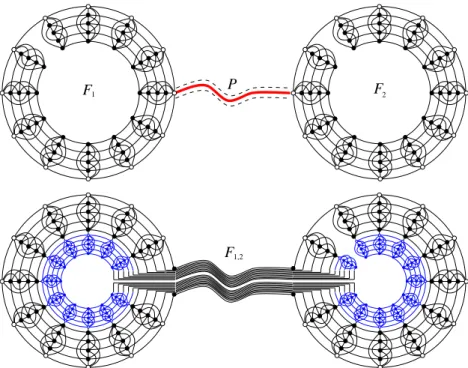
B intersects bothF1andF2, we can assume that B contains a pathP inΣ connecting the discs∆1and∆2, disjoint from all the other vortices. SinceG0is embedded inΣ, no other subgraph in the connected packingP intersects the pathP. Therefore, the same packingP would also exist if the two discs∆1and∆2 are merged along the pathP. In terms of the vortices, this merging operation can be translated into considering a new vortexF1,2of depth at most 2βmade of the union ofF1andF2alongP, as illustrated in Fig. 3. We omit the details here (see [13] for a similar trick). As a subgraph may a priori intersect an arbitrary number of vortices, we need to consider all possibilities of merging any subset of the δ vortices, which are at most p(δ) many (see Section 2). Therefore, potentially some of this merged vortices may have depth up toδ·β=Oh(1).
Dynamic Programming forH-minor-free Graphs (Extended Abstract) 15
F1,2
F1 P F2
Fig. 3. Example in the proof of Lemma 3. If a subgraph intersects two vortices F1 and F2 (illustrated above with the red pathP), we can consider a bigger vortexF1,2 (depicted below) obtained from merging vorticesF1 andF2 along the pathP.
Sketch of the proof of Lemma 4. Again, it will be useful to assume that the vortices are all isomorphic to (β, s)-vortex patterns (see Fig. 2). LetF be a fixed vortex, and let us order its base vertices counterclockwise asU ={u1, u2, . . . , us} (cf. the white set of vertices in Fig. 2).
We can also assume that each subgraph in a connected packing is a tree ofG, which is enough for connectivity purposes. Each leaf of such a tree is a vertex in the corresponding middle set of the branch decomposition. As the total number of vertices in each middle set is at mostk, in order to prove that a given vortex is met by some subgraphOh(k) times, it is enough to prove that every path of a subgraph with both endvertices being in the separatorS meets a given vortex Oh(1) times. Therefore, we assume henceforth that the subgraphs in a connected packing are paths. Throughout the proof, see Fig. 4. In the figure, vertices of the form vi belong to the separator S of the minor-free cut decomposition, while vertices of the formuj are base vertices of the vortex.
LetBa fixed path intersectingF(cf. the thick black path in Fig. 4, containing vertices
v1 and v4), and letuf (resp.ul) be the first (resp. last) vertex ofV(B)∩U according to the counterclockwise ordering ofU (in Fig. 4, we have uf =u2 and ul = u12). By Lemma 3, we may assume thatB does not intersect any other vortex other thanF. Let
ui and uj be two consecutive vertices in V(B)∩U, withf < i < j < l. If no other subgraph intersects a vertexu` ∈U, withi < k < j (cf. verticesu4 and u6 in Fig. 4), we can just shortcut the pathB from the clique containingui to the clique containing
uj along a free track of the vortex, so that Bdoes not intersect ui oruj anymore (such a shortcut is depicted with a thick green path in Fig. 4). This transformation preserves the connectivity ofBand does not modify any other subgraph in the connected packing. Therefore, we may assume that some other subgraphB0intersects a vertexu
`∈U, with
i < k < j. But since B is connected, B contains a path P from ui or uj outside the vortexH (cf. vertices u8 andu11 in Fig. 4). The idea is that ifB0 intersects u` and is
F
N
B
F´
u2
u4 u6
u8 u11
u12
v1
v2 v3
v4
P
Fig. 4.Example in the proof of Lemma 4.
disjoint fromP (by definition of a connected packing), then necessarilyB0uses a handle or a noose (for instance, in Fig. 4, the red path containing vertexv2 uses a handle, and the blue path containing vertexv3uses a noose). There may be other vorticesF0 inside the region delimited byP (cf. vortexF0in Fig. 4), but by Lemma 3 we can assume that no subgraph intersecting F0 intersects also F. That is, the number of times that the pathB intersects the vortexF can be linearly upper-bounded by the total number of handles and nooses in the surface. Since the genus ofΣisOh(1), as well as the number of nooses in anH-minor-free cut decomposition, we conclude thatB meets F at most
Oh(1) times. The lemma follows. ut
Sketch of the proof of Lemma 5. LetF be a vortex pattern of depthd, and assume thatF is a configuration inF. The key observation is that isF1andF2are two crossing subgraphs in F, then by the structure of a vortex pattern necessarily F1 and F2 use two edges in a same section of F. Inductively, one can easily check that if F1, . . . , F` are pairwise crossing subgraphs inF, then necessarily F1, . . . , F` use`edges in a same section ofF. Therefore, as the number of edges in a section ofF is exactlyd, it follows thatFc does not contain any clique of size at leastd+ 1. ut Sketch of the proof of Lemma 8.LetG={G0, G1, . . . , Gδ}be the subgraphs ofG\A defining its polyhedral (α, β, γ, δ)-nearly embedding. By Lemma 2, we can assume that each vortex is isomorphic to an (β, s)-vortex pattern for some s≥1. Recall that each vortex is contained in an open disc∆i ofΣ, such thatUi=V(G0)∩V(Gi)⊆bor(∆i). Also, by Lemma 4, we can assume that the subgraphs of a connected packing meet each vortex Oh(k) times. Let S = {v1, . . . , vk} be the set of vertices of G that lie on the boundary of Σ, which we can assume to be contained in a set of disjoint nooses
N1, . . . , Nγ with γ =Oh(1) (see [33] for more details). Letch be a constant such that
chk satisfies the statement of Lemma 4. For each vortex Gi, 1 ≤ i ≤ δ, we consider a set of chk auxiliary vertices Si = {u1i, . . . , uchki } placed cyclically inside around ∆i, corresponding to the potential meetings of the subgraphs in a connected packing with the vortex. We see each set of auxiliary verticesSias a new noose ¯Niof sizechk, placed in
Σinside the border of∆i, such that both nooses are concentric. Potentially, the vertices in Ui (which are in bor(∆i)) can be joined to the vertices in Si (which are in ¯Ni) in anyplanarway insideΣ. In order to formalize this fact, we define the class of graphs ¯G0 as follows: ¯G0 contains all the graphs that can be obtained from G0 by replacing each
Dynamic Programming forH-minor-free Graphs (Extended Abstract) 17
N3 N4 N1
N2
v
F
B2 B1
B4
T1
B3
B5 B6 T2
1
v
13v
2v
3v
5v
4v
6v
7v
8v
9v
10v
11v
12u
1u
2u
7u
3u
4u
5u
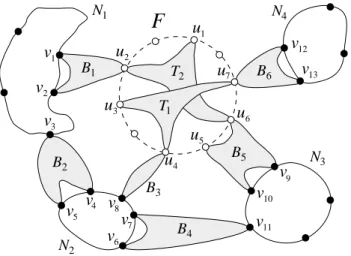
6Fig. 5.Example in the plane of our approach to simulate the behavior of the vortices. There are four noosesN1, N2, N3, N4 drawn with full lines, and a vortexF of depth 2 drawn with a dashed circle. Black vertices correspond to vertices in the separatorS(thus, in the nooses), while white vertices belong to the base set of the vortex. The non-crossing packingP0 inΣhas the following six subgraphs (depicted with dark regions), abstracted as blocks containing only black and white vertices:B1={v1, v2, u2}, B2 ={v3, v4, v5}, B3 ={v8, u4}, B4={v6, v7, v11}, B5 =
{v9, v10, u5, u6}, andB6 ={v12, v13, u7}. With the two subgraphs T1 ={u3, u4, u7}andT2 =
{u1, u2, u6} corresponding to a 2-packing of the vortex, subgraphsB1 and B5 (resp. B6 and
B6) get merged into the new subgraph{v1, v2, v9, v10}(resp.{v8, v12, v13}).
vortexGi with a planar bipartite subgraph ¯Giwith bipartitionUi andSi, such that the vertices ofUi are placed aroundbor(∆i), and the vertices of Si are placed around ¯Ni. (We would like to stress that do not need to compute this class of graphs algorithmically, it is only used in the analysis to provide an upper bound on the number of connected packings.) Note that each graph ¯G0∈G¯0is embedded inΣ, and therefore Lemma 7 can be applied to ¯G0. Let ¯S =S∪Sδi=1Si
, and note that |S¯| ≤k+Oh(k) =Oh(k), and that the vertices in ¯S are contained in a set of at mostγ+δ=Oh(1) disjoint nooses of
Σ. The key observation is that every connected packingP ∈ΨG(S∪A) can be obtained by combining a non-crossing packing P0 ∈ΨG¯0( ¯S∪A), for some graph ¯G0 ∈ G¯0, with appropriateOh(1)-packings of the (possibly merged) vortices. Indeed, by Lemma 5 we know that a vortex pattern of depth at most β does not contain any β0-configuration withβ0> β, so the number ofβ-packings on c
hkelements gives an upper bound to the number of configurations in each vortex. See Fig. 5 for an example of such construction.
Hence, from the above discussion we conclude that
|ΨG(S∪A)| ≤ max ¯ G0∈G¯0
{|ΨG¯0( ¯S∪A)|} ·p(δ)·(Pδβ(chk))δ
= 2Oh(k)·2Oh(1)·
2Oh(k) Oh(1)
= 2Oh(k) ,
where in the last equality we have used Lemma 7, the estimate forp(q) given in Section 2, and Lemma 1, in this order. The result follows.