Abstract. Curcumin has been shown to exert potential antitumor activity in vitro and in vivo involved in multiple signaling pathways. However, the application of curcumin is still limited because of its poor hydrophilicity and low bio-availability. In the present study, we investigated the thera-peutic effects of a novel and water soluble bis(hydroxymethyl) alkanoate curcuminoid derivative, MTH-3, on human breast adenocarcinoma MDA-MB-231 cells. This study investigated the effect of MTH-3 on cell viability, cell cycle and induction of autophagy and apoptosis in MDA-MB-231 cells. After 24-h treatment with MTH-3, a concentration-dependent decrease in MDA-MB-231 cell viability was observed, and the IC50 value
was 5.37±1.22 µM. MTH-3 significantly triggered G2/M phase
arrest and apoptosis in MDA-MB-231 cells. Within a 24-h treatment, MTH-3 decreased the CDK1 activity by decreasing CDK1 and cyclin B1 protein levels. MTH-3-induced apoptosis was further confirmed by morphological assessment and Annexin V/PI staining assay. Induction of apoptosis caused by MTH-3 was accompanied by an apparent increase of DR3, DR5 and FADD and, as well as a marked decrease of Bcl-2 and Bcl-xL protein expression. MTH-3 also decreased the protein
levels of Ero1, PDI, PERK and calnexin, as well as increased the expression of IRE1α, CHOP and Bip that consequently led to ER stress and MDA-MB-231 cell apoptosis. In addition, MTH-3-treated cells were involved in the autophagic process and cleavage of LC3B was observed. MTH-3 enhanced the protein levels of LC3B, Atg5, Atg7, Atg12, p62 and Beclin-1 in MDA-MB-231 cells. Finally, DNA microarray was carried out to investigate the level changes of gene expression modulated by MTH-3 in MDA-MB-231 cells. Taken together, our results suggest that MTH-3 might be a novel therapeutic agent for the treatment of triple-negative breast cancer in the near future. Introduction
Breast cancer is the second leading cause of death in women and has approximately 1 million new cases per year world-wide (1,2). Breast cancer patients develop metastasis eventually leading to poor prognosis (3). Triple-negative breast cancer (TNBC) accounts for 12-20% of all breast cancer (4). It has more aggressive disease progress and worse prognosis (5). TNBC characteristics are the lack of expression of estrogen receptor (ER), progesterone receptor (PR) and the lack of over-expression of HER-2 (4,6). TNBC is resistance to anti-hormone therapies and HER-2-aiming target therapies (7,8). Treatment of TNBC remains a great clinical challenge because of the lack of targeting agents and limited therapeutic options (8,9).
Curcumin has been used in traditional Chinese medicine for a long time in Taiwan, China and India (10). The phar-macological effects of curcumin include anti-amyloid (11), anti-bacterial (12), anti-depressant (13), anti-inflamma-tory (14), anti-oxidant (15), anti-diabetes (16) and anticancer properties (17,18). In addition, curcumin has been found to affect several anticancer signaling pathways such as inhibi-tion of cancer cell proliferainhibi-tion (19,20) and inducinhibi-tion of cell cycle arrest (21), apoptosis (22) or autophagy (23). Specifically,
Effect of bis(hydroxymethyl) alkanoate curcuminoid derivative
MTH-3 on cell cycle arrest, apoptotic and autophagic
pathway in triple-negative breast adenocarcinoma
MDA-MB-231 cells: An in vitro study
LING-CHU CHANG1, MIN-TSANG HSIEH1,2, JAI-SING YANG3, CHI-CHENG LU6,
FUU-JEN TSAI4,5, JE-WEI TSAO2, YU-JEN CHIU7, SHENG-CHU KUO1,2 and KUO-HSIUNG LEE1,8 1Chinese Medicinal Research and Development Center, China Medical University Hospital; 2School of Pharmacy, China Medical University; 3Department of Medical Research, China Medical University Hospital, China Medical University;
4Human Genetic Center, China Medical University Hospital; 5School of Chinese Medicine, China Medical University, Taichung 404; 6Department of Pharmacy, Buddhist Tzu Chi General Hospital, Hualien 970; 7Division of Reconstructive and
Plastic Surgery, Department of Surgery, Taipei Veterans General Hospital, Taipei 112, Taiwan, R.O.C.; 8Natural Products Research Laboratories, UNC Eshelman School of Pharmacy, University of North Carolina, Chapel Hill, NC 27599, USA
Received June 20, 2017; Accepted September 29, 2017
DOI: 10.3892/ijo.2017.4204
Correspondence to: Dr Kuo-Hsiung Lee, Natural Products Research Laboratories, UNC Eshelman School of Pharmacy, University of North Carolina, Chapel Hill, NC 27599, USA
E-mail: [email protected]
Dr Sheng-Chu Kuo, School of Pharmacy, China Medical University, 91 Hsueh-Shih Road, Taichung City 40402, Taiwan, R.O.C.
E-mail: [email protected]
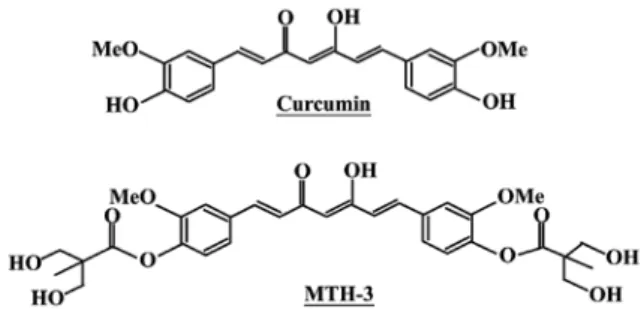
the phase II and III clinical trial of curcumin was advocated for use in patients with colon and pancreatic cancers (24,25), but its low water solubility exerts poor bioavailability and primary limiting factors (low efficacy and safety) (26,27). To improve these issues, we designed and developed a novel bis(hydroxymethyl) alkanoate curcuminoid derivative, MTH-3 (Fig. 1). In our previous studies, novel bis(hydroxymethyl) alkanoate curcuminoid derivatives were shown to exhibit antitumor effects on triple-negative breast cancer cells and in a xenograft animal experiment (28). The aim of the present study was to characterize the property of MTH-3 and to clarify the molecular mechanism of MTH-3 in human breast adenocarcinoma MDA-MB-231 cells in vitro.
Materials and methods
Chemicals and reagents. MTH-3 was synthesized as previously
described (28) (patent pending). The purity of MTH-3 is 98.7, and its molecular weight is 600.61. Leibovitz's L-15 medium, fetal bovine serum (FBS), penicillin-streptomycin, trypsin-EDTA, Premo Autophagy Sensor LC3B-GFP (BacMam 2.0) and 4',6-diamidino-2-phenylindole (DAPI) were purchased from Thermo Fisher Scientific (Waltham, MA, USA). The antibodies were purchased from Cell Signaling Technology (Danvers, MA, USA). All chemicals were obtained from Sigma-Aldrich (St. Louis, MO, USA) unless otherwise stated.
Cell culture. The human breast adenocarcinoma cell line
MDA-MB-231 was purchased from the Bioresource Collection and Research Center (BCRC; Hsinchu, Taiwan). Cells were cultured in Leibovitz's L-15 medium with 10% FBS and 1% penicillin-streptomycin (100 Units/ml penicillin and 100 µg/ml streptomycin) in an incubator under 95% air and 5% CO2 at 37˚C.
Cell viability assay and morphologic changes. Cell viability
was evaluated by the reduction in MTT to yield blue formazan. MDA-MB-231 cells (1x10⁴ cells/well) in 96-well plates were
allowed to attach overnight and then treated with different concentrations (1, 3, 5 and 10 µM) of MTH-3 for 24 h. After treatments, MTT solution was added to each well (a final concentration of 0.5 µg/ml), and then the plates were incubated for another 4 h. The medium was removed, blue formazan was dissolved in dimethyl sulfoxide (DMSO), and the absorbance was read at 570 nm as previously described (29). For trypan blue exclusion assay, cells were collected after 1, 3, 5 and 10 µM of MTH-3 exposure, stained with 0.4% trypan blue and then counted on a hemocytometer under a microscope.
For morphological observation, cells were visualized and photographed using a phase-contrast microscope equipped with a digital camera (Leica Microsystems GmbH, Wetzlar, Germany) as in previous reports (26,30).
Distribution of cell cycle analysis. MDA-MB-231 cells (2x10⁵
cells/well) in 12-well plates were exposed to 10 µM MTH-3. After a 24-h treatment, cells were harvested and fixed gently by putting 70% ethanol at 4˚C overnight before being stained with PI solution (40 µg/ml PI and 0.1 mg/ml RNase and 0.1% Triton X-100) in the dark for 30 min as previously described (31). The cells were analyzed for the cell cycle distribution with a flow cytometer (FACSCalibur; BD Biosciences, San Jose, CA, USA).
CDK1 kinase assay. CDK1 kinase activity was analyzed
according to the manufacturer's protocol (CycLex Cdc2-Cyclin B Kinase Assay kit; MBL International Corp., Woburn, MA, USA). The ability of CDK1 kinase from MDA-MB-231 cell extracts prepared from each treatment of 10 µM MTH-3 for 4, 8, 16 and 24 h was measured as previously described (32,33).
Apoptosis analysis. MDA-MB-231 cells (2x10⁵ cells/well)
into 12-well plates were incubated in the presence and absence of 10 µM MTH-3 for 24 and 48 h. Subsequently, cells were harvested and stained with Annexin V and propidium iodide (PI) using the Annexin V-FITC apoptosis detection kit (BD Biosciences, San Diego, CA, USA) and subjected to flow cytometry (BD FACSCalibur; BD Biosciences). The percentage of apoptotic cells were quantified with BD CellQuest Pro software (BD Biosciences) (34,35).
Cells lysate preparation and western blot analysis. After
10 µM MTH-3 treatments at indicated intervals of time, MDA-MB-231 cells were harvested, washed and suspended in the PRO-PREP Protein Extraction Solution (iNtRON Biotechnology, Gyeonggi-do, Korea). Protein concentra-tions were estimated using the Protein Assay kit (Bio-Rad Laboratories, Hercules, CA, USA). The samples were resolved with SDS-PAGE and transferred to a polyvinylidene difluo-ride membrane (PVDF) (EMD Millipore, Billerica, MA, USA). Each membrane was blocked in 5% non-fat milk in Tris-buffered saline with 0.1% Tween-20 for 1 h followed by individual incubation with specific primary antibodies [cyclin B1 (cat. no. 4138, 1:1,000), CDK1/Cdc2 (cat. no. 9116, 1:1,000), DR3 (cat. no. 4758, 1:1,000), DR5 (cat. no. 8074, 1:1,000), FADD (cat. no. 2782, 1:1,000), Bcl-2 (cat. no. 4223, 1:1,000), Bcl-xL (cat. no. 2764, 1:1,000), Ero1 (cat. no. 3264, 1:1,000), PDI (cat. no. 3501, 1:1,000), PERK (cat. no. 5683, 1:1,000), calnexin (cat. no. 2679, 1:1,000), IRE1α (cat. no. 3294, 1:1,000), CHOP (cat. no. 2895, 1:1,000), Bip (cat. no. 3177, 1:1,000), Atg5 (cat. no. 12994, 1:1,000), Atg7 (cat. no. 8558, 1:1,000), Atg12 (cat. no. 4180, 1:1,000), Beclin-1 (cat. no. 3495, 1:1,000), p62 (cat. no. 88588, 1:1,000), LC3A/B (cat. no. 12741, 1:1,000) and β-actin (cat. no. 3700, 1:5,000) (Cell Signaling Technology, Danvers, MA, USA)] at 4˚C overnight. Each membrane was then incubated with anti-rabbit IgG (cat. no. 7074, 1:10,000) or anti-mouse IgG (cat. no. 7076, 1:10,000) horseradish peroxidase (HRP)-linked antibodies (Cell Signaling Technology) at room temperature for 1 h. The signal was detected with the Immobilon Western Chemiluminescent
HRP substrate (EMD Millipore) and visualized using the LAS 4000 imaging system (Fuji, Tokyo, Japan) as previously described (36-38). The quantitative densitometric analysis of immunoreactive band was employed by ImageJ bundled with 64-bit Java 1.6.0_24 program for Windows from the National Institutes of Health (NIH; Bethesda, MD, USA).
Immunofluorescence staining. MDA-MB-231 cells (2x10⁶
cells/dish) were grown on sterile coverslips placed in a 10-cm dish. After 10 µM MTH-3 treatment, cells were fixed with 4% paraformaldehyde and permeabilized with 0.2% Triton X-100 in phosphate-buffered saline (PBS). After blocking with 2% bovine serum albumin (BSA) in PBS, LC3B and p62 were detected using anti-LC3B and anti-p62 antibody followed by reaction with FITC- or PE-conjugated secondary antibody (BD Biosciences). Coverslips were mounted on glass slides with ProLong Gold Antifade reagents (Thermo Fisher Scientific) containing DAPI, and fluorescent image was taken on a Leica Microsystems TCS SP2 Confocal Spectral micro-scope as detailed by Lu et al (39).
cDNA microarray analysis. MDA-MB-231 cells were
incu-bated with or without 10 µM MTH-3 for 24 h. After exposure, cell pellets were collected, and the total RNA from each treatment was purified using the Qiagen RNeasy Mini kit (Qiagen, Valencia, CA, USA). RNA purity was determined to check the quality at 260/280 nm using a NanoDrop 1000 spectrophotometer (Thermo Fisher Scientific). mRNA was amplified and labeled using the GeneChip WT Sense Target Labeling and Control Reagents kit (Affymetrix, Santa Clara, CA, USA) for expression analysis. The synthesized cDNA was labeled with fluorescence and then hybridized for 17 h using GeneChip Human Gene 1.0 ST array (Affymetrix) to determine microarray hybridization following the manu-facturer's protocols. The arrays were subsequently washed using GeneChip Fluidics Station 450 (Affymetrix), stained with streptavidin-phycoerythrin (GeneChip Hybridization, Wash and Stain kit; Affymetrix) and scanned on a GeneChip Scanner 3000 (Affymetrix). The localized concentrations of fluorescent molecules were quantitated and analyzed using Expression Console Software (Affymetrix) with default RMA parameters as previously described (40). The gene expression level of a 2.5-fold change (log2 ratio) was considered a differ-ence in MTH-3-treated cells in vitro (41,42).
Statistical analysis. Data are presented as the mean ± SD for
three separate experiment. Differences among the groups were considered to be significant at P<0.05 using ANOVA followed by the Duncan's test.
Results
MTH-3 inhibits cell proliferation of human breast adenocar-cinoma MDA-MB-231 cells. At first, the effect of MTH-3 on
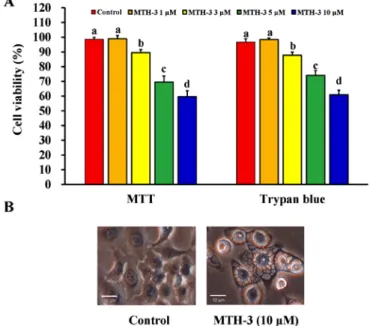
the viability of MDA-MB-231 cells was investigated using the MTT and trypan blue exclusion assays. MTH-3 at 1, 3, 5 and 10 µM significantly reduced the viability of MDA-MB-231 cells by 98.94±2.26, 89.57±2.07, 69.57±4.13 and 59.6±4.04%, respectively (Fig. 2A). Importantly, the cell viability reduction after 30 µM MTH-3 challenge is 34.23±3.31%. This effect is in
a concentration-dependent manner. Data from morphological observation revealed that MTH-3 treatment at 10 µM caused obvious MDA-MB-231 cell apoptosis and autophagy with characteristics, including cytoplasmic membrane blebbing, cell shrinkage and autophagic vacuoles (Fig. 2B). Based on these findings and gaining effective evidence of cell death, we selected MTH-3 at 10 µM for the majority of the experiments in MDA-MB-231 cells.
MTH-3 triggers G2/M phase arrest and reduces CDK1 activity
in MDA-MB-231 cells. To investigate the cell cycle
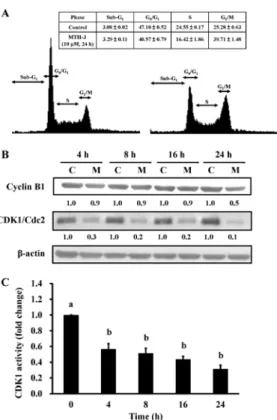
distribu-tion of treated and untreated MDA-MB-231 cells, cells were monitored after 10 µM MTH-3 challenge. Results from flow cytometric analysis showed that MTH-3 treatment of MDA-MB-231 cells significantly increased G2/M phase cell population at
24 h (Fig. 3A). The effects of MTH-3 on G2/M phase-related
proteins in MDA-MB-231 cells were investigated. Our results showed that MTH-3 effectively down-regulated the levels of cyclin B1 and CDK1 (Fig. 3B). We also tested the CDK1 kinase activity in MDA-MB-231 cells prior to MTH-3 treatment. MTH-3 markedly reduced CDK1 kinase activity at 4, 8, 12 and 24 h of treatment, respectively (Fig. 3C). Therefore, the finding showed that downregulation of CDK1 activity contributed to G2/M phase arrest caused by MTH-3 in MDA-MB-231 cells.
MTH-3 elicits cell apoptosis of MDA-MB-231 cells. To further
explore whether the inhibition of cell viability results from the induction of apoptosis in MDA-MB-231 cells, MTH-3-treated cells were detected with Annexin V/PI double staining (Fig. 4). Treatment with 10 µM MTH-3 for 48 h significantly increased the population of Annexin V-positive cells (Fig. 4),
indicating that MTH-3 induced apoptosis in MDA-MB-231 cells. However, the necrotic cells (Annexin V+/PI+) increased
rapidly after 48 h of 10 µM MTH-3 exposure.
MTH-3 activates death receptor, mitochondrial and ER stress-mediated apoptotic pathways in MDA-MB-231 cells.
The effects of MTH-3 on apoptosis-related proteins in MDA-MB-231 cells were investigated. Our results demon-strated that MTH-3 upregulated the levels of DR5 and FADD, and it downregulated the levels of Bcl-2 and Bcl-xL (Fig. 5A). Furthermore, our findings also revealed that MTH-3 markedly increased the levels of CHOP and Bip, as well as decreased the levels of Ero1, PDI, PERK, calnexin and IRE1α (Fig. 5B). These results suggest that MTH-3 induced apoptosis through death receptor (extrinsic pathway) and mitochondria (intrinsic pathway)-dependent pathways and possibly by modulating ER stress mechanism in MDA-MB-231 cells.
MTH-3 stimulates autophagy in MDA-MB-231 cells.
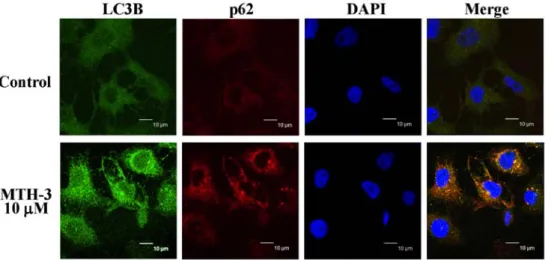
To confirm if autophagy is involved in the inhibition of MDA-MB-231 cell viability, cells with or without MTH-3 exposure were detected with LC3B and p62 double immuno-staining. MTH-3 at 10 µM increased the LC3B (FITC; green
Figure 3. MTH-3 induces G2/M phase arrest of MDA-MB-231 cells. (A) Cells
were exposed to 10 µM MTH-3 for 24 h. The cell cycle distribution was detected using flow cytometric analysis and cell cycle distribution was quanti-fied. (B) Cells were exposed to 10 µM MTH-3 and then incubated for 0, 4, 8, 16 and 24 h. The protein levels of cyclin B1, CDK1 and β-actin were determined by western blotting. C, control; M, MTH-3 exposure. (C) CDK1 activity was examined as described in Materials and methods. Data are presented as the mean ± SD of three independent experiments. The different letters (a-b) show statistically significant differences (P<0.05) in each group by the Duncan's test.
Figure 4. MTH-3 induces apoptosis of MDA-MB-231 cells. Cells were incu-bated with 10 µM MTH-3 for 24 and 48 h. Cells were collected and stained with Annexin V/propidium iodide (PI) before analysis with flow cytometry. The Annexin V-positive cells were counted, and data are presented as the mean ± SD of three independent experiments. *P<0.05 indicates statistically
significant differences by the Duncan's test.
color) and p62 (PE; red color) protein expression (Fig. 6), indicating that MTH-3 induced autophagy through increasing LC3B/p62 signaling in MDA-MB-231 cells.
MTH-3 alters the levels of autophagy-associated proteins in MDA-MB-231 cells. Based on the results of autophagy, its
related signals were further employed by immunoblotting anal-ysis. MTH-3 treatment induced the levels of Atg5, Atg7, Atg12, Beclin-1, p62 and LC3B in a time-dependent manner (Fig. 7). These data demonstrated that MTH-3 induced autophagy by activating Atg family proteins in MDA-MB-231 cells.
MTH-3 modulates cell death-related gene expression in MDA-MB-231 cells by cDNA microarray analysis. After
treatment with 10 µM MTH-3 for 24 h, cells were collected,
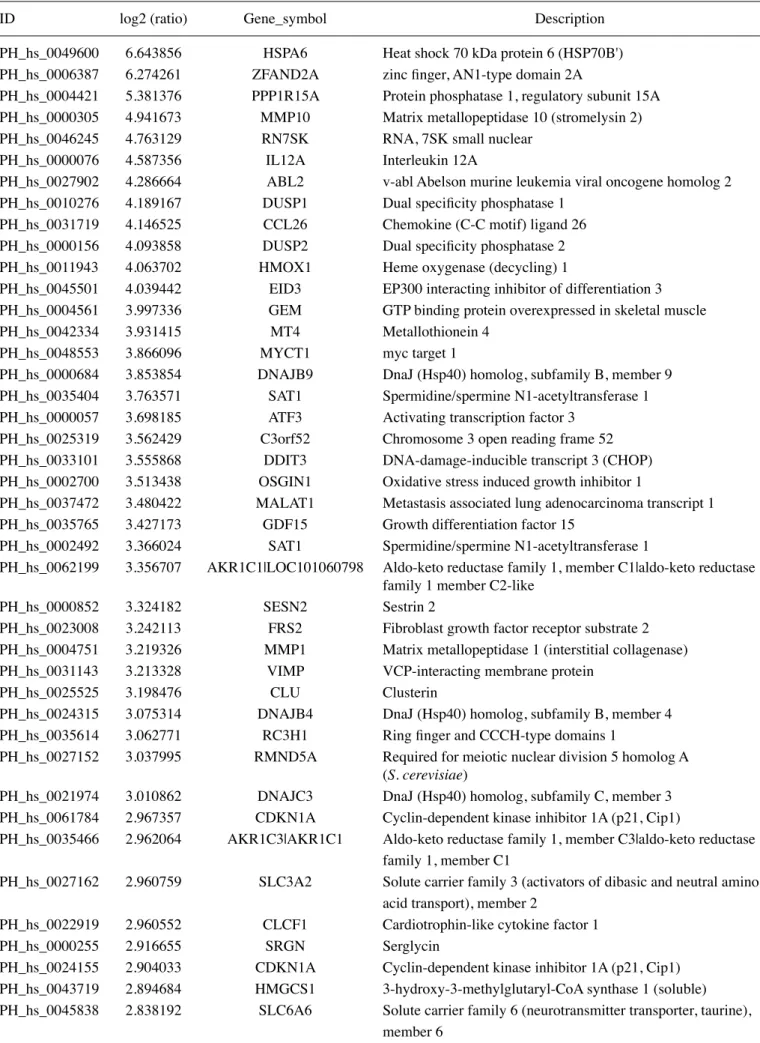
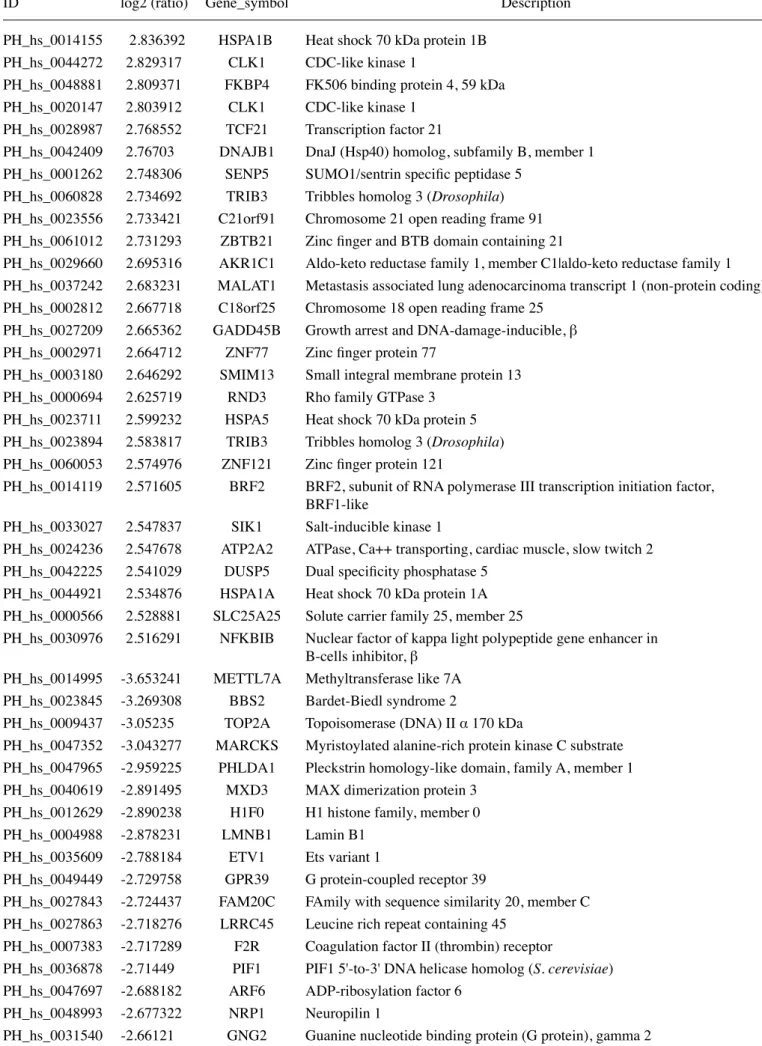
and cDNA microarray analysis was performed. The analysis showed that 97 genes (69 genes, upregulated; 28 genes, down-regulated) were expressed at least by 2.5-fold compared with the untreated control (Table I). The top alteration in gene expression scored by the number of pathway networks from GeneGo analysis program (Fig. 8). These genes may also be involved in cell death and cytotoxic responses in MTH-3-treated MDA-MB-231 cells.
Discussion
Previous studies have demonstrated the anticancer potential of curcumin in regulating cell cycle, autophagy, apoptosis and survival, proliferation, angiogenesis, invasion and metas-tasis (19-23). Guan et al (43) demonstrated that curcumin reduced Akt kinase in MDA-MB-231 cells accompanied by a decrease in cell proliferation and migration as well as an increase in autophagic activity; moreover, AMPK-mediated activation
Figure 6. MTH-3 induces LC3B and p62 expression of MDA-MB-231 cells. Cells were treated with 10 µM MTH-3 for 24 h. Cells were collected and stained with LC3B-FITC antibody (green color) and p62-PE antibody (red color) and analyzed with confocal microscope. DAPI dye (blue color) is for nuclear acid (nuclear) staining. Scale bar, 10 µm.
Figure 7. MTH-3 alters the protein levels of autophagy-related proteins in MDA-MB-231 cells. Cells were incubated with 10 µM MTH-3 for 4, 8, 16 and 24 h, and cell lysates were collected for western blot analysis to probe autophagic signals (Atg5, Atg7, Atg12, Beclin-1, p62, LC3A and LC3B).
β-actin was an internal control. C, control; M, MTH-3 exposure.
Table I. The >2.5-fold changes in mRNA levels in MDA-MB-231 cells following a 24-h treatment with 10 µM MTH-3 as identified using DNA microarray.
ID log2 (ratio) Gene_symbol Description
PH_hs_0049600 6.643856 HSPA6 Heat shock 70 kDa protein 6 (HSP70B')
PH_hs_0006387 6.274261 ZFAND2A zinc finger, AN1-type domain 2A
PH_hs_0004421 5.381376 PPP1R15A Protein phosphatase 1, regulatory subunit 15A
PH_hs_0000305 4.941673 MMP10 Matrix metallopeptidase 10 (stromelysin 2)
PH_hs_0046245 4.763129 RN7SK RNA, 7SK small nuclear
PH_hs_0000076 4.587356 IL12A Interleukin 12A
PH_hs_0027902 4.286664 ABL2 v-abl Abelson murine leukemia viral oncogene homolog 2
PH_hs_0010276 4.189167 DUSP1 Dual specificity phosphatase 1
PH_hs_0031719 4.146525 CCL26 Chemokine (C-C motif) ligand 26
PH_hs_0000156 4.093858 DUSP2 Dual specificity phosphatase 2
PH_hs_0011943 4.063702 HMOX1 Heme oxygenase (decycling) 1
PH_hs_0045501 4.039442 EID3 EP300 interacting inhibitor of differentiation 3
PH_hs_0004561 3.997336 GEM GTP binding protein overexpressed in skeletal muscle
PH_hs_0042334 3.931415 MT4 Metallothionein 4
PH_hs_0048553 3.866096 MYCT1 myc target 1
PH_hs_0000684 3.853854 DNAJB9 DnaJ (Hsp40) homolog, subfamily B, member 9
PH_hs_0035404 3.763571 SAT1 Spermidine/spermine N1-acetyltransferase 1
PH_hs_0000057 3.698185 ATF3 Activating transcription factor 3
PH_hs_0025319 3.562429 C3orf52 Chromosome 3 open reading frame 52
PH_hs_0033101 3.555868 DDIT3 DNA-damage-inducible transcript 3 (CHOP)
PH_hs_0002700 3.513438 OSGIN1 Oxidative stress induced growth inhibitor 1
PH_hs_0037472 3.480422 MALAT1 Metastasis associated lung adenocarcinoma transcript 1
PH_hs_0035765 3.427173 GDF15 Growth differentiation factor 15
PH_hs_0002492 3.366024 SAT1 Spermidine/spermine N1-acetyltransferase 1
PH_hs_0062199 3.356707 AKR1C1|LOC101060798 Aldo-keto reductase family 1, member C1|aldo-keto reductase family 1 member C2-like
PH_hs_0000852 3.324182 SESN2 Sestrin 2
PH_hs_0023008 3.242113 FRS2 Fibroblast growth factor receptor substrate 2
PH_hs_0004751 3.219326 MMP1 Matrix metallopeptidase 1 (interstitial collagenase)
PH_hs_0031143 3.213328 VIMP VCP-interacting membrane protein
PH_hs_0025525 3.198476 CLU Clusterin
PH_hs_0024315 3.075314 DNAJB4 DnaJ (Hsp40) homolog, subfamily B, member 4
PH_hs_0035614 3.062771 RC3H1 Ring finger and CCCH-type domains 1
PH_hs_0027152 3.037995 RMND5A Required for meiotic nuclear division 5 homolog A
(S. cerevisiae)
PH_hs_0021974 3.010862 DNAJC3 DnaJ (Hsp40) homolog, subfamily C, member 3
PH_hs_0061784 2.967357 CDKN1A Cyclin-dependent kinase inhibitor 1A (p21, Cip1)
PH_hs_0035466 2.962064 AKR1C3|AKR1C1 Aldo-keto reductase family 1, member C3|aldo-keto reductase family 1, member C1
PH_hs_0027162 2.960759 SLC3A2 Solute carrier family 3 (activators of dibasic and neutral amino acid transport), member 2
PH_hs_0022919 2.960552 CLCF1 Cardiotrophin-like cytokine factor 1
PH_hs_0000255 2.916655 SRGN Serglycin
PH_hs_0024155 2.904033 CDKN1A Cyclin-dependent kinase inhibitor 1A (p21, Cip1)
PH_hs_0043719 2.894684 HMGCS1 3-hydroxy-3-methylglutaryl-CoA synthase 1 (soluble)
Table I. Continued.
ID log2 (ratio) Gene_symbol Description
PH_hs_0014155 2.836392 HSPA1B Heat shock 70 kDa protein 1B
PH_hs_0044272 2.829317 CLK1 CDC-like kinase 1
PH_hs_0048881 2.809371 FKBP4 FK506 binding protein 4, 59 kDa
PH_hs_0020147 2.803912 CLK1 CDC-like kinase 1
PH_hs_0028987 2.768552 TCF21 Transcription factor 21
PH_hs_0042409 2.76703 DNAJB1 DnaJ (Hsp40) homolog, subfamily B, member 1 PH_hs_0001262 2.748306 SENP5 SUMO1/sentrin specific peptidase 5
PH_hs_0060828 2.734692 TRIB3 Tribbles homolog 3 (Drosophila) PH_hs_0023556 2.733421 C21orf91 Chromosome 21 open reading frame 91 PH_hs_0061012 2.731293 ZBTB21 Zinc finger and BTB domain containing 21
PH_hs_0029660 2.695316 AKR1C1 Aldo-keto reductase family 1, member C1|aldo-keto reductase family 1 PH_hs_0037242 2.683231 MALAT1 Metastasis associated lung adenocarcinoma transcript 1 (non-protein coding) PH_hs_0002812 2.667718 C18orf25 Chromosome 18 open reading frame 25
PH_hs_0027209 2.665362 GADD45B Growth arrest and DNA-damage-inducible, β PH_hs_0002971 2.664712 ZNF77 Zinc finger protein 77
PH_hs_0003180 2.646292 SMIM13 Small integral membrane protein 13
PH_hs_0000694 2.625719 RND3 Rho family GTPase 3
PH_hs_0023711 2.599232 HSPA5 Heat shock 70 kDa protein 5 PH_hs_0023894 2.583817 TRIB3 Tribbles homolog 3 (Drosophila) PH_hs_0060053 2.574976 ZNF121 Zinc finger protein 121
PH_hs_0014119 2.571605 BRF2 BRF2, subunit of RNA polymerase III transcription initiation factor, BRF1-like
PH_hs_0033027 2.547837 SIK1 Salt-inducible kinase 1
PH_hs_0024236 2.547678 ATP2A2 ATPase, Ca++ transporting, cardiac muscle, slow twitch 2 PH_hs_0042225 2.541029 DUSP5 Dual specificity phosphatase 5
PH_hs_0044921 2.534876 HSPA1A Heat shock 70 kDa protein 1A PH_hs_0000566 2.528881 SLC25A25 Solute carrier family 25, member 25
PH_hs_0030976 2.516291 NFKBIB Nuclear factor of kappa light polypeptide gene enhancer in B-cells inhibitor, β
PH_hs_0014995 -3.653241 METTL7A Methyltransferase like 7A
PH_hs_0023845 -3.269308 BBS2 Bardet-Biedl syndrome 2
PH_hs_0009437 -3.05235 TOP2A Topoisomerase (DNA) II α 170 kDa
PH_hs_0047352 -3.043277 MARCKS Myristoylated alanine-rich protein kinase C substrate PH_hs_0047965 -2.959225 PHLDA1 Pleckstrin homology-like domain, family A, member 1 PH_hs_0040619 -2.891495 MXD3 MAX dimerization protein 3
PH_hs_0012629 -2.890238 H1F0 H1 histone family, member 0
PH_hs_0004988 -2.878231 LMNB1 Lamin B1
PH_hs_0035609 -2.788184 ETV1 Ets variant 1
PH_hs_0049449 -2.729758 GPR39 G protein-coupled receptor 39
PH_hs_0027843 -2.724437 FAM20C FAmily with sequence similarity 20, member C PH_hs_0027863 -2.718276 LRRC45 Leucine rich repeat containing 45
PH_hs_0007383 -2.717289 F2R Coagulation factor II (thrombin) receptor
PH_hs_0036878 -2.71449 PIF1 PIF1 5'-to-3' DNA helicase homolog (S. cerevisiae) PH_hs_0047697 -2.688182 ARF6 ADP-ribosylation factor 6
PH_hs_0048993 -2.677322 NRP1 Neuropilin 1
of autophagy contributes to anticancer effects through Akt degradation. In the present study, we also checked the growth inhibition effect of curcumin on MDA-MB-231 cells. Our data indicated that the half maximal inhibitory concentration (IC50)
value of curcumin on MDA-MB-231 cells is 38.77±3.35 µM. Strikingly, the IC50 value of MTH-3 on MDA-MB-231 cells
is 5.37±1.22 µM (data not shown). Our results demonstrated that the MTH-3 had highly cytotoxic effects on MDA-MB-231 cells. Moreover, we also found that MTH-3 was non-cytotoxic on non-tumorigenic epithelial mammary MCF10A cells and human skin fibroblast Detroit 551 cells, respectively (data not shown). These are only preliminary data and further study is needed to validate the findings.
There are no reports regarding that the effects of MTH-3 on cell cycle arrest, autophagy and apoptosis and associ-ated gene expression in human breast cancer cells. This study is first to demonstrate that MTH-3 induced cytotoxic effect on induction of G2/M phase arrest, autophagy and
apoptosis in human breast adenocarcinoma MDA-MB-231 cells. The data demonstrated that MTH-3 induced growth inhibitory effects through G2/M phase arrest, apoptosis
and autophagy in MDA-MB-231 cells. Our results showed that MTH-3 induced G2/M phase arrest through regulating
cyclin B1 and CDK1 signaling. G2/M phase progression has
been reported to regulate CDK1 and CDK2 kinases that are activated primarily in association with cyclins A and B (44). Furthermore, MTH-3 inhibited the CDK1 activity and the protein expression of CDK1 in MDA-MB-231 cells. However, neither effect is positively correlated because CDK1 activity might be involved in kinase activation rather than CDK1/ cdc2 protein level (32,33). Previous studies also demon-strated that curcumin inhibited cell proliferation through induction of G0/G1 phase arrest of cancer cells (45,46), but
our finding indicated that MTH-3 induced G2/M phase arrest
upon different types of cancer cell lines. However, the results are in agreement with previous studies to show that curcumin inhibited cell proliferation by inducing G2/M phase arrest
in human glioblastoma U87 cells (47) and in Bcl-2 overex-pressed MCF-7 cells (48). Further research is required to verify the mechanism of MTH-3 action in different breast cancer cell lines (such as MCF-7 and MDA-MB-453 cells).
It is well documented that apoptosis plays an important role in the maintenance of tissue homeostasis for the elimination of excessive cells (49,50). Induction of apoptosis of cancer cells by anticancer drugs such as etoposide, cisplatin and paclitaxel have been used for treatment of cancer in target cells (51). Apoptosis-associated signaling pathways include extrinsic (death receptor), intrinsic (mitochondria-dependent) and ER stress (unfolded protein response) signals (52,53). Our results demonstrated that MTH-3 promoted the protein levels of DR5, and FADD and downregulated the levels of Bcl-2 and Bcl-xL in MDA-MB-231 cells. MTH-3 also promoted the protein levels of CHOP and Bip, and it reduced the levels of Ero1, PDI, PERK, calnexin and IRE1α in MDA-MB-231 cells. Our novel findings suggest that both extrinsic and intrinsic pathways, and ER stress signals were involved in MTH-3-treated cells
in vitro. This agrees with a previous study reporting that the
major targets of apoptotic initiation are mediated by dysfunc-tion of cellular organelles (mitochondria, ER, lysosomes and golgi apparatus) (54).
Table I. Continued.
ID log2 (ratio) Gene_symbol Description
PH_hs_0010634 -2.659899 TXNIP|LOC101060503 Thioredoxin interacting protein|thioredoxin-interacting protein-like
PH_hs_0028935 -2.621805 CCDC85B Coiled-coil domain containing 85B
PH_hs_0000866 -2.612763 OMA1 OMA1 zinc metallopeptidase homolog (S. cerevisiae)
PH_hs_0030800 -2.552826 FANCF Fanconi anemia, complementation group F
PH_hs_0025966 -2.55207 CTDSP1 CTD small phosphatase 1
PH_hs_0023862 -2.551096 CBY1 Chibby homolog 1 (Drosophila)
PH_hs_0047571 -2.546813 PDP1 Pyruvate dehyrogenase phosphatase catalytic subunit 1
PH_hs_0028200 -2.537288 CENPI Centromere protein I
PH_hs_0003147 -2.533627 PDGFC Platelet derived growth factor C
PH_hs_0035337 -2.514458 OMA1 OMA1 zinc metallopeptidase homolog (S. cerevisiae)
PH_hs_0038982 -2.502536 LOC100134259 Uncharacterized LOC100134259
Figure 9. The proposed model shows that MTH-3 induces G2/M phase arrest,
Autophagy is another major clearance route for intracel-lular protein (55). Recently, curcumin can induce autophagy in cancer cells (56,57). Our results showed that MTH-3 signifi-cantly increased protein expression of autophagy markers LC3B, Atg complex (Atg5, Atg7 and Atg12) and Beclin-1, as well as GFP-LC3 puncta formation, suggesting that LC3B was recruited to the autophagosomal membrane during autopha-gosome formation. Our data strongly suggest that MTH-3 activated autophagy in MDA-MB-231 cells.
From gene expression profiles by DNA microarray, we found that cellular and molecular responses to MTH-3 treat-ment are multi-faceted and mediated by various regulatory pathways in MDA-MB-231 cells. MTH-3 regulated the expres-sion of important genes in cell cycle, pathways in cancer, MAPK signaling, base excision repair, DNA replication, p53 signaling, homologous recombination, TGF-β signaling, G2/M
checkpoint, pyrimidine metabolism, Jak-STAT signaling, focal adhesion, endocytosis and mismatch repair pathways. The gene regulation may be responsible for inhibiting the proliferation of MDA-MB-23 cells. Cyclins associate with cyclin-dependent protein kinases (CDKs) and CDK inhibitor (CKI) can control the procedure of cell cycle to arrest the cell cycle and inhibit the cell growth of cancer cells (44,58). Our results from gene expression profiles indicated that MTH-3 changed the expression of cyclin and cyclin-dependent kinase inhibitor gene CDKN1A, suggesting a change in cyclin, cyclin-dependent kinase inhibitors which could finally lead to cell cycle G2/M phase arrest.
Heme oxygenase-1 (HO-1) has been implicated in cellular defense against oxidative stress and has anti-inflammation function (59,60). A recent study has demonstrated that curcumin inhibits appoptosin-induced apoptosis by upregulating HO-1 expression in SH-SY5Y cells (61). Curcumin-induced HO-1 expression also prevents H2O2-induced cell death in
wild-type and HO-2 knockout adipose-derived mesenchymal stem cells (62). In this study of the gene expression profiles, MTH-3 upregulated the expression of heme oxygenase 1 (HMOX1) gene, suggesting that MTH-3 might have anti-inflammation and cell protection function.
In conclusion, the molecular signaling pathways are summarized in Fig. 9. This study is the first report to provide an approach regarding the bis(hydroxymethyl) alkanoate curcuminoid derivative, MTH-3 tends to inhibit human breast adenocarcinoma MDA-MB-231 cells. Based on the presented novel findings, the efficacy of MTH-3 might be sufficient to further investigate the potential of breast cancer treatment.
Acknowledgements
The present study was supported by research grants from the National Science Council of the Republic of China awarded to S.-C.K. and by China Medical University under the Aim for Top University Plan of the Ministry of Education, Taiwan (CHM106-2).
References
1. Aseyev O, Ribeiro JM and Cardoso F: Review on the clinical use of eribulin mesylate for the treatment of breast cancer. Expert Opin Pharmacother 17: 589-600, 2016.
2. Cornejo-Moreno BA, Uribe-Escamilla D and Salamanca-Gómez F: Breast cancer genes: Looking for BRACA's lost brother. Isr Med Assoc J 16: 787-792, 2014.
3. Koo T and Kim IA: Brain metastasis in human epidermal growth factor receptor 2-positive breast cancer: From biology to treatment. Radiat Oncol J 34: 1-9, 2016.
4. Mouh FZ, Mzibri ME, Slaoui M and Amrani M: Recent progress in triple negative breast cancer research. Asian Pac J Cancer Prev 17: 1595-1608, 2016.
5. Hurvitz S and Mead M: Triple-negative breast cancer: Advancements in characterization and treatment approach. Curr Opin Obstet Gynecol 28: 59-69, 2016.
6. Zeichner SB, Terawaki H and Gogineni K: A review of systemic treatment in metastatic triple-negative breast cancer. Breast Cancer (Auckl) 10: 25-36, 2016.
7. Wang Y, Cao S and Chen Y: Molecular treatment of different breast cancers. Anticancer Agents Med Chem 15: 701-720, 2015. 8. Tomao F, Papa A, Zaccarelli E, Rossi L, Caruso D, Minozzi M,
Vici P, Frati L and Tomao S: Triple-negative breast cancer: New perspectives for targeted therapies. Onco Targets Ther 8: 177-193, 2015.
9. Gilani RA, Phadke S, Bao LW, Lachacz EJ, Dziubinski ML, Brandvold KR, Steffey ME, Kwarcinski FE, Graveel CR, Kidwell KM, et al: UM-164: A potent c-Src/p38 kinase inhibitor with in vivo activity against triple-negative breast cancer. Clin Cancer Res 22: 5087-5096, 2016.
10. Zheng B, Yang L, Wen C, Huang X, Xu C, Lee KH and Xu J: Curcumin analog L3 alleviates diabetic atherosclerosis by multiple effects. Eur J Pharmacol 775: 22-34, 2016.
11. Ferreira N, Saraiva MJ and Almeida MR: Natural polyphenols as modulators of TTR amyloidogenesis: in vitro and in vivo evidences towards therapy. Amyloid 19 (Suppl 1): 39-42, 2012. 12. Vilekar P, King C, Lagisetty P, Awasthi V and Awasthi S:
Antibacterial activity of synthetic curcumin derivatives: 3,5-bis(benzylidene)-4-piperidone (EF24) and EF24-dimer linked via diethylenetriaminepentacetic acid (EF2DTPA). Appl Biochem Biotechnol 172: 3363-3373, 2014.
13. Bhutani MK, Bishnoi M and Kulkarni SK: Anti-depressant like effect of curcumin and its combination with piperine in unpre-dictable chronic stress-induced behavioral, biochemical and neurochemical changes. Pharmacol Biochem Behav 92: 39-43, 2009.
14. Cianciulli A, Calvello R, Porro C, Trotta T, Salvatore R and Panaro MA: PI3k/Akt signalling pathway plays a crucial role in the anti-inflammatory effects of curcumin in LPS-activated microglia. Int Immunopharmacol 36: 282-290, 2016.
15. Choudhury AK, Raja S, Mahapatra S, Nagabhushanam K and Majeed M: Synthesis and evaluation of the anti-oxidant capacity of curcumin glucuronides, the major curcumin metabolites. Antioxidants 4: 750-767, 2015.
16. Yang H, Xu W, Zhou Z, Liu J, Li X, Chen L, Weng J and Yu Z: Curcumin attenuates urinary excretion of albumin in type II diabetic patients with enhancing nuclear factor erythroid-derived 2-like 2 (Nrf2) system and repressing inflammatory signaling efficacies. Exp Clin Endocrinol Diabetes 123: 360-367, 2015. 17. Lee D, Kim IY, Saha S and Choi KS: Paraptosis in the anti-cancer
arsenal of natural products. Pharmacol Ther 162: 120-133, 2016. 18. Borges GA, Rêgo DF, Assad DX, Coletta RD, De Luca Canto G
and Guerra EN: In vivo and in vitro effects of curcumin on head and neck carcinoma: A systematic review. J Oral Pathol Med 46: 3-20, 2017.
19. Sordillo PP and Helson L: Curcumin and cancer stem cells: Curcumin has asymmetrical effects on cancer and normal stem cells. Anticancer Res 35: 599-614, 2015.
20. Iqbal B, Ghildiyal A, Sahabjada, Singh S, Arshad M, Mahdi AA and Tiwari S: Antiproliferative and apoptotic effect of curcumin and TRAIL (TNF related apoptosis inducing ligand) in chronic myeloid leukaemic cells. J Clin Diagn Res 10: XC01-XC05, 2016.
21. Zhang L, Cheng X, Gao Y, Bao J, Guan H, Lu R, Yu H, Xu Q and Sun Y: Induction of ROS-independent DNA damage by curcumin leads to G2/M cell cycle arrest and apoptosis in
human papillary thyroid carcinoma BCPAP cells. Food Funct 7: 315-325, 2016.
22. Huang YT, Lin YW, Chiu HM and Chiang BH: Curcumin induces apoptosis of colorectal cancer stem cells by coupling with CD44 marker. J Agric Food Chem 64: 2247-2253, 2016. 23. Kantara C, O'Connell M, Sarkar S, Moya S, Ullrich R and
24. Ji JL, Huang XF and Zhu HL: Curcumin and its formulations: Potential anti-cancer agents. Anticancer Agents Med Chem 12: 210-218, 2012.
25. Shehzad A, Wahid F and Lee YS: Curcumin in cancer chemo-prevention: Molecular targets, pharmacokinetics, bioavailability, and clinical trials. Arch Pharm (Weinheim) 343: 489-499, 2010.
26. Chang PY, Peng SF, Lee CY, Lu CC, Tsai SC, Shieh TM, Wu TS, Tu MG, Chen MY and Yang JS: Curcumin-loaded nanoparticles induce apoptotic cell death through regulation of the function of MDR1 and reactive oxygen species in cisplatin-resistant CAR human oral cancer cells. Int J Oncol 43: 1141-1150, 2013. 27. Douglass BJ and Clouatre DL: Beyond yellow curry: Assessing
commercial curcumin absorption technologies. J Am Coll Nutr 34: 347-358, 2015.
28. Hsieh MT, Chang LC, Hung HY, Lin HY, Shih MH, Tsai CH, Kuo SC and Lee KH: New bis(hydroxymethyl) alkanoate curcuminoid derivatives exhibit activity against triple-negative breast cancer in vitro and in vivo. Eur J Med Chem 131: 141-151, 2017.
29. Peng SF, Lee CY, Hour MJ, Tsai SC, Kuo DH, Chen FA, Shieh PC and Yang JS: Curcumin-loaded nanoparticles enhance apoptotic cell death of U2OS human osteosarcoma cells through the Akt-Bad signaling pathway. Int J Oncol 44: 238-246, 2014. 30. Liao CL, Lai KC, Huang AC, Yang JS, Lin JJ, Wu SH,
Gibson Wood W, Lin JG and Chung JG: Gallic acid inhibits migration and invasion in human osteosarcoma U-2 OS cells through suppressing the matrix metalloproteinase-2/-9, protein kinase B (PKB) and PKC signaling pathways. Food Chem Toxicol 50: 1734-1740, 2012.
31. Tsai SC, Lu CC, Lee CY, Lin YC, Chung JG, Kuo SC, Amagaya S, Chen FN, Chen MY, Chan SF, et al: AKT serine/threonine protein kinase modulates bufalin-triggered intrinsic pathway of apoptosis in CAL 27 human oral cancer cells. Int J Oncol 41: 1683-1692, 2012.
32. Liu CY, Yang JS, Huang SM, Chiang JH, Chen MH, Huang LJ, Ha HY, Fushiya S and Kuo SC: Smh-3 induces G2/M arrest and
apoptosis through calcium-mediated endoplasmic reticulum stress and mitochondrial signaling in human hepatocellular carcinoma Hep3B cells. Oncol Rep 29: 751-762, 2013.
33. Yang JS, Hour MJ, Huang WW, Lin KL, Kuo SC and Chung JG: MJ-29 inhibits tubulin polymerization, induces mitotic arrest, and triggers apoptosis via cyclin-dependent kinase 1-mediated Bcl-2 phosphorylation in human leukemia U937 cells. J Pharmacol Exp Ther 334: 477-488, 2010.
34. Yang JS, Lin CA, Lu CC, Wen YF, Tsai FJ and Tsai SC: Carboxamide analog ITR-284 evokes apoptosis and inhibits migration ability in human lung adenocarcinoma A549 cells. Oncol Rep 37: 1786-1792, 2017.
35. Ho CC, Huang AC, Yu CS, Lien JC, Wu SH, Huang YP, Huang HY, Kuo JH, Liao WY, Yang JS, et al: Ellagic acid induces apoptosis in TSGH8301 human bladder cancer cells through the endoplasmic reticulum stress- and mitochondria-dependent signaling pathways. Environ Toxicol 29: 1262-1274, 2014. 36. Yuan CH, Horng CT, Lee CF, Chiang NN, Tsai FJ, Lu CC,
Chiang JH, Hsu YM, Yang JS and Chen FA: Epigallocatechin gallate sensitizes cisplatin-resistant oral cancer CAR cell apoptosis and autophagy through stimulating AKT/STAT3 pathway and suppressing multidrug resistance 1 signaling. Environ Toxicol 32: 845-855, 2017.
37. Chiang JH, Yang JS, Lu CC, Hour MJ, Chang SJ, Lee TH and Chung JG: Newly synthesized quinazolinone HMJ-38 suppresses angiogenetic responses and triggers human umbilical vein endo-thelial cell apoptosis through p53-modulated Fas/death receptor signaling. Toxicol Appl Pharmacol 269: 150-162, 2013.
38. Huang WW, Chiu YJ, Fan MJ, Lu HF, Yeh HF, Li KH, Chen PY, Chung JG and Yang JS: Kaempferol induced apoptosis via endo-plasmic reticulum stress and mitochondria-dependent pathway in human osteosarcoma U-2 OS cells. Mol Nutr Food Res 54: 1585-1595, 2010.
39. Lu CC, Yang JS, Chiang JH, Hour MJ, Lin KL, Lee TH and Chung JG: Cell death caused by quinazolinone HMJ-38 challenge in oral carcinoma CAL 27 cells: Dissections of endo-plasmic reticulum stress, mitochondrial dysfunction and tumor xenografts. Biochim Biophys Acta 1840: 2310-2320, 2014. 40. King YA, Chiu YJ, Chen HP, Kuo DH, Lu CC and Yang JS:
Endoplasmic reticulum stress contributes to arsenic trioxide-induced intrinsic apoptosis in human umbilical and bone marrow mesenchymal stem cells. Environ Toxicol 31: 314-328, 2016.
41. Kuo YJ, Yang JS, Lu CC, Chiang SY, Lin JG and Chung JG: Ethanol extract of Hedyotis diffusa willd upregulates G0/G1 phase arrest and induces apoptosis in human leukemia cells by modulating caspase cascade signaling and altering associated genes expression was assayed by cDNA microarray. Environ Toxicol 30: 1162-1177, 2015.
42. Wu RS, Liu KC, Tang NY, Chung HK, Ip SW, Yang JS and Chung JG: cDNA microarray analysis of the gene expression of murine leukemia RAW 264.7 cells after exposure to propofol. Environ Toxicol 28: 471-478, 2013.
43. Guan F, Ding Y, Zhang Y, Zhou Y, Li M and Wang C: Curcumin suppresses proliferation and migration of MDA-MB-231 breast cancer cells through autophagy-dependent Akt degradation. PLoS One 11: e0146553, 2016.
44. Dorée M and Hunt T: From Cdc2 to Cdk1: When did the cell cycle kinase join its cyclin partner? J Cell Sci 115: 2461-2464, 2002.
45. Chen ZQ, Jie X and Mo ZN: Curcumin inhibits growth, induces G1 arrest and apoptosis on human prostatic stromal cells by regu-lating Bcl-2/Bax. Zhongguo Zhong Yao Za Zhi 33: 2022-2025, 2008 (In Chinese).
46. Srivastava RK, Chen Q, Siddiqui I, Sarva K and Shankar S: Linkage of curcumin-induced cell cycle arrest and apoptosis by cyclin-dependent kinase inhibitor p21(/WAF1/CIP1). Cell Cycle 6: 2953-2961, 2007.
47. Cheng C, Jiao JT, Qian Y, Guo XY, Huang J, Dai MC, Zhang L, Ding XP, Zong D and Shao JF: Curcumin induces G2/M arrest and triggers apoptosis via FoxO1 signaling in U87 human glioma cells. Mol Med Rep 13: 3763-3770, 2016.
48. Berrak O, Akkoc Y, Arisan ED, Coker-Gurkan A, Obakan-Yerlikaya P and Palavan-Unsal N: The inhibition of PI3K and NFkappaB promoted curcumin-induced cell cycle arrest at G2/M via altering polyamine metabolism in Bcl-2 overexpressing MCF-7 breast cancer cells. Biomed Pharmacother 77: 150-160, 2016. 49. Negroni A, Cucchiara S and Stronati L: Apoptosis, necrosis,
and necroptosis in the gut and intestinal homeostasis. Mediators Inflamm 2015: 250762, 2015.
50. Yang Y, Jiang G, Zhang P and Fan J: Programmed cell death and its role in inflammation. Mil Med Res 2: 12, 2015.
51. Friesen C, Fulda S and Debatin KM: Cytotoxic drugs and the CD95 pathway. Leukemia 13: 1854-1858, 1999.
52. Zhang YS, Shen Q and Li J: Traditional Chinese medicine targeting apoptotic mechanisms for esophageal cancer therapy. Acta Pharmacol Sin 37: 295-302, 2016.
53. Tameire F, Verginadis II and Koumenis C: Cell intrinsic and extrinsic activators of the unfolded protein response in cancer: Mechanisms and targets for therapy. Semin Cancer Biol 33: 3-15, 2015.
54. Ferri KF and Kroemer G: Organelle-specific initiation of cell death pathways. Nat Cell Biol 3: E255-E263, 2001.
55. Dong Z, Liang S, Hu J, Jin W, Zhan Q and Zhao K: Autophagy as a target for hematological malignancy therapy. Blood Rev 30: 369-380, 2016.
56. Gupta SC, Kismali G and Aggarwal BB: Curcumin, a component of turmeric: From farm to pharmacy. Biofactors 39: 2-13, 2013. 57. Ye MX, Li Y, Yin H and Zhang J: Curcumin: Updated molecular
mechanisms and intervention targets in human lung cancer. Int J Mol Sci 13: 3959-3978, 2012.
58. Sánchez-Martínez C, Gelbert LM, Lallena MJ and de Dios A: Cyclin dependent kinase (CDK) inhibitors as anticancer drugs. Bioorg Med Chem Lett 25: 3420-3435, 2015.
59. Kozakowska M, Szade K, Dulak J and Józkowicz A: Role of heme oxygenase-1 in postnatal differentiation of stem cells: a possible cross-talk with microRNAs. Antioxid Redox Signal 20: 1827-1850, 2014.
60. Murakami A: Dose-dependent functionality and toxicity of green tea polyphenols in experimental rodents. Arch Biochem Biophys 557: 3-10, 2014.
61. Zheng KM, Zhang J, Zhang CL, Zhang YW and Chen XC: Curcumin inhibits appoptosin-induced apoptosis via upregu-lating heme oxygenase-1 expression in SH-SY5Y cells. Acta Pharmacol Sin 36: 544-552, 2015.
62. Cremers NA, Lundvig DM, van Dalen SC, Schelbergen RF, van Lent PL, Szarek WA, Regan RF, Carels CE and Wagener FA: Curcumin-induced heme oxygenase-1 expression prevents H2O2
-induced cell death in wild type and heme oxygenase-2 knockout adipose-derived mesenchymal stem cells. Int J Mol Sci 15: 17974-17999, 2014.