A COMPARISON OF THE FAT TALK EXPERIENCE IN YOUNG AND MIDDLE-AGED WOMEN
Alexandra J. Miller
A thesis submitted to the faculty at the University of North Carolina at Chapel Hill in partial fulfillment of the requirements for the degree of Master of Arts in the Department of Psychology
& Neuroscience.
Chapel Hill 2019
Approved by: Sara Algoe Mitch Prinstein
iii
ABSTRACT
Alexandra J. Miller: A Comparison of the Fat Talk Experience in Young and Middle-Aged Women
(Under the direction of Anna M. Bardone-Cone)
Fat talk occurs in both young and middle-aged women. However, little is known about correlates of fat talk or about factors that may strengthen or interrupt the fat talk/body
dissatisfaction link. The current study builds on the existing fat talk literature by examining levels of fat talk between young adult women and middle-aged women, strengths of correlates of fat talk across age cohorts, and potential moderators of the relationship between fat talk and body dissatisfaction. Participants were 358 young adult women, age 17-25, and 358 middle-aged women, age 35-63; these were daughter-mother dyads and thus multilevel modeling was used to account for the lack of independence between daughter and mother observations. Participation involved an online survey about core study constructs. Future research should use both
iv
TABLE OF CONTENTS
LIST OF TABLES... vi
LIST OF FIGURES ... vii
INTRODUCTION... 1
Fat Talk: Conceptualization, Prevalence, and Function... 2
Age Differences in Fat Talk... 4
Correlates of Fat Talk... 5
Moderator Models of the Relationship Between Fat Talk and Body Dissatisfaction... 8
Body checking... 8
Body comparison... 9
Self-compassion... 10
The Current Study... 11
METHOD... 12
Participants... 12
Procedure... 13
Measures... 14
Fat talk... 14
Body dissatisfaction... 15
Depressive symptoms... 15
Disordered eating attitudes and behaviors... 16
v
Body checking... 17
Peer body comparison... 18
Self-compassion... 18
Data Analytic Strategy... 19
Aim 1... 20
Aim 2... 20
Aim 3... 20
RESULTS... 21
Intraclass Correlations... 21
Descriptive Statistics and Aim 1 (Comparing Levels of Fat Talk Across Age Cohorts). 21 Aim 2 (Comparing Strengths of Correlates of Fat Talk Across Age Cohorts)... 22
Body dissatisfaction... 22
Depressive symptoms... 22
Disordered eating behaviors and attitudes... 23
Thin-ideal internalization... 23
Aim 3 (Examining Moderator Models of the Relationship Between Fat Talk and Body Dissatisfaction) ... 24
Body checking... 24
Peer body comparison... 24
Self-compassion... 25
DISCUSSION... 26
vi
LIST OF TABLES
Table
1. Means (Standard Deviations) and Age Cohort Comparisons for Core Study Constructs.. 33 2. Multilevel Regression Analyses Examining the Strength of the
Relationship Between Fat Talk and Various Dependent Variables
Considering the Moderating Effect of Age (N = 716) ... 34 3. Multilevel Regression Analyses Examining Moderator Models
of the Relationship Between Fat Talk (IV) and Body Dissatisfaction (DV) with Potential Moderators of Body Checking, Peer Body
vii
LIST OF FIGURES
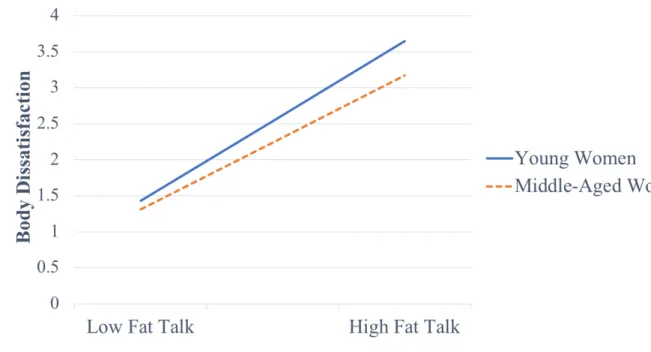
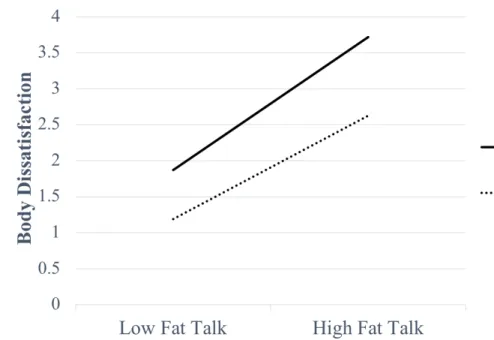
Figure 1 - Significant two-way interaction involving age (young adult women and middle-aged women) as a moderator of the relationship between fat talk
and body dissatisfaction... 38 Figure 2 - Significant two-way interaction involving age (young adult women
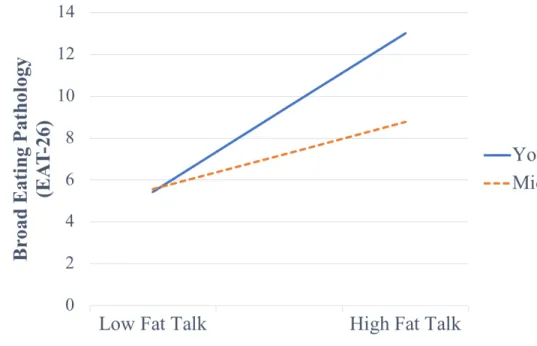
and middle-aged women) as a moderator of the relationship between fat talk
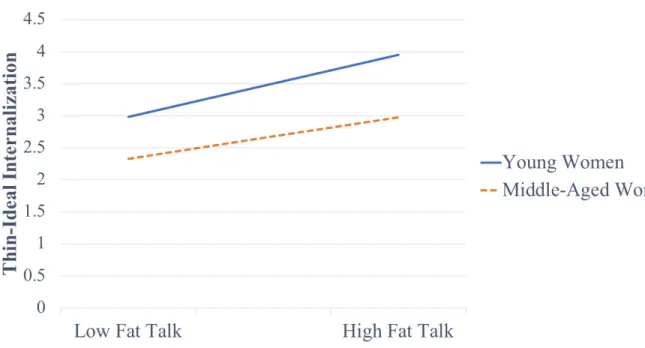
and broad eating pathology... 39 Figure 3 - Significant two-way interaction involving age (young adult women
and middle-aged women) as a moderator of the relationship between fat talk
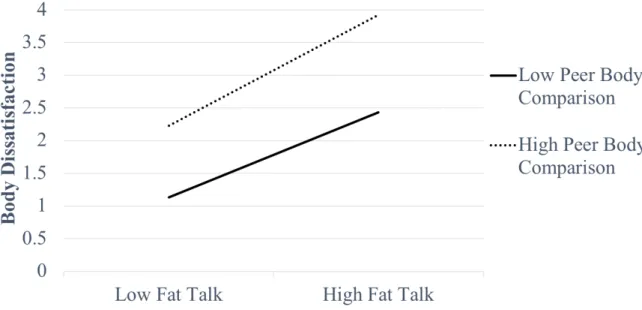
and thin-ideal internalization... 40 Figure 4 - Significant two-way interaction involving peer body comparison
moderating the relationship between fat talk and body dissatisfaction... 41 Figure 5 - Significant two-way interaction involving self-compassion
1
INTRODUCTION
Messages about how one’s body should look get communicated in multiple ways in Western societies: through an array of media (television, movies, magazines, social media, Internet), through family interactions, and through peer interactions. These messages can lead to the internalization of an unrealistic thin body ideal, driving individuals towards body
dissatisfaction through negative appraisals of their own weight and shape (Fredrickson & Roberts, 1997; Thompson, Heinberg, Altabe, & Tantleff-Dunn, 1999). Indeed, research has indicated that the majority of women experience negative body image, to the degree that body dissatisfaction has been referred to as “normative discontent” among women (Rodin, Silberstein, & Striegel-Moore, 1984). Additionally, data suggest that body dissatisfaction remains stable over time (Tiggemann & McCourt, 2013). This is especially alarming given that body dissatisfaction is a robust predictor of disordered eating behaviors (Stice, 2002).
One way that body dissatisfaction is transmitted is through a phenomenon of growing interest known as “fat talk” (Sharpe, Naumann, Treasure, & Shmidt, 2013). To date, research has mainly focused on adolescents and young women, with minimal information about the
2
investigating who may be most at risk for the harmful effects of fat talk on body image. Specifically, we had three aims: (1) to compare levels of fat talk between a young adult group and a middle-aged group; (2) to examine correlates of fat talk; and (3) to test potential
moderators of the relationship between fat talk and body dissatisfaction.
Fat Talk: Conceptualization, Prevalence, and Function
Fat talk is a style of dialogue centered around self-disparaging comments about one’s weight or shape in the presence of others (Nichter, 2000). The dialogue is often cyclical in nature, with “fat talk” from one person precipitating the same from another person in the group (e.g., “My thighs are way too big” may be responded to with “Well, look at my stomach – it totally sticks out”) (Britton, Martz, Bazzini, Curtin, LeaShomb, 2006; Tucker, Martz, Curtin, & Bazzini, 2007). Reassurance is also a common part of these conversations (e.g., a response of “Your thighs aren’t big at all – you are so skinny”) (Salk & Engeln-Maddox, 2011). Fat talk has been observed in women of all body sizes (Martz et al., 2009; Stice, Maxfield, & Wells, 2003), however, there are some demographic differences in terms of prevalence. Research indicates that fat talk is more prevalent in females than males (Martz, et al., 2009; Payne, Martz, Tompkins, Petroff, & Farrow, 2011), in younger women than older women (Engeln & Salk, 2016; Tzoneva, Forney, & Keel, 2015), in undergraduates who have been diagnosed with an eating disorder than those without an eating disorder diagnosis (Ousley, Cordero, & White, 2008), and in white non-Hispanic, non-Hispanic, and Asian women than black women (Fiery, Martz, Webb, & Curtin, 2016).
In general, fat talk appears to be remarkably common and recognized as socially
3
communication is also commonly experienced among middle-aged women (Martz et al., 2009). A study investigating fat talk in women ages 18 to 87 from the U.S., U.K., and Australia
revealed that 81% of the sample reported engaging in fat talk (Becker, Diedrichs, Jankowski, & Werchan, 2013). These authors also identified that fat talk was typical in women up to the age of 60 (Becker et al., 2013).
Distinct theories have emerged regarding the function of fat talk (Britton et al., 2006; Engeln-Maddox, Salk, & Miller, 2012; Gapinski, Brownell, & LaFrance, 2003; Nichter & Vuckovic, 1994; Tucker et al., 2007). Some researchers propose that fat talk represents a means of expressing one’s body concerns and saying negative things about oneself before others can (Britton et al., 2006; Stice et al., 2003). Additionally, researchers have reasoned that fat talk is used as a way to elicit validation or positive feedback from others (Smith & Ogle, 2006). Fat talk has further been described as a way to communicate mutual values regarding appearance within a peer group, theoretically as a means of bonding (Nichter, 2000; Nichter & Vuckovic, 1994). Indeed, Salk and Engeln-Maddox (2011) found that found that most in their sample of college women found pleasure in engaging in fat talk, and used it as a tool to gain social acceptance and support, as well as a way to feel less guilty for consuming high calorie foods. Similarly,
qualitative research has revealed that engaging in fat talk can be a means to gaining social
approval; women disclosed that remaining silent in response to a fat talk comment is an improper option for fear of being regarded as arrogant, thus further compelling women to engage in fat talk (Britton et al., 2006; Engeln-Maddox et al., 2012; Tucker et al., 2007).
In some ways, fat talk appears like a form of co-rumination, a process of over-speculating about problems and dwelling on negative feelings with close friends (Rose, 2002).
4
perceived closeness, is central to the activity. Yet, it is also perceived as maladaptive, since the excessive dialogue of problems has been linked to higher internalizing symptoms (Rose, Carlson, & Waller, 2007). Thus, fat talk can be construed as a type of co-rumination focused on the body; although there may arguably be some positive aspects of fat talk (e.g., as a facilitator of
bonding), it is also related to a host of negative outcomes (Mills & Fuller-Tyszkiewicz, 2016).
Age Differences in Fat Talk
The first aim of the study is to examine age differences in levels of fat talk in women, comparing young women to middle-aged women. The majority of literature focuses on young adult women; previous work indicates age is negatively related to fat talk (Engeln & Salk, 2016; Tzoneva et al., 2015) and younger women are at higher risk for developing eating pathology (Hoek & van Hoeken, 2003), to which fat talk may contribute. Nevertheless, it is important to investigate fat talk in other age groups, and specifically middle-aged women given that this age cohort faces unique experiences in comparison to young adult women. Distinctive features of this stage of life include physical aging, menopause, and weight gain (Slevec & Tiggemann, 2011), and middle-aged women may be more susceptible to engaging in fat talk as a result, perhaps primarily as a way to elicit validation or socially bond. On the other hand, middle-aged women may be buffered from fat talk. Researchers have shown that young women favor more slender bodies than older women (Lamb, Jackson, Cassiday, and Priest, 1993), so that middle-aged women may hold their bodies to different body standards as well as partake in more
5
To our knowledge, three studies have compared levels of fat talk by age cohort, demonstrating that young adult women report higher levels of fat talk on average than older women (Arroyo & Andersen, 2016; Becker et al., 2013; Tzoneva et al., 2015). In particular, the findings of Becker et al. (2013), which separated their female sample into four main age groups (18-29 years; 30-45 years; 46-60 years; and 61 and older) revealed a significant difference in frequency of fat talk engagement based on age, demonstrating that fat talk engagement decreased as participant age increased. Notably, the authors found that the rates of “at least occasional” fat talk remained stable across age groups (82-86%) and there was no marked change in fat talk until women reached the oldest age group of 61 and older.
Correlates of Fat Talk
Although fat talk may be viewed positively by some individuals and may be a means of social bonding, there are problematic factors also associated with fat talk. Thus, the second aim of this study seeks to elucidate the correlates of fat talk among young adult and middle-aged women. The self-degrading, weight-related complaints inherent in fat talk can adversely impact a woman’s wellbeing (Shannon & Mills, 2015; Sharpe et al., 2013). Hearing and engaging in this widespread style of conversation has reliably demonstrated a relationship to body dissatisfaction (Corning, Bucchianeri, & Pick, 2014; Mills & Fuller-Tyszkiewicz, 2016; Salk &
Engeln-Maddox, 2011; Sharpe et al., 2013). A systematic review by Sharpe et al. (2013) revealed that fat talk is consistently associated with body dissatisfaction and is prospectively linked to changes in body dissatisfaction in adolescent and adult women; the reviewed study’s samples did not
6
body satisfaction ratings at weeks two and three, suggesting that recent fat talk exposure predicted higher subsequent levels of body dissatisfaction.
Experimental work also illustrates support for the relationship with body dissatisfaction in young adult women (Cruwys, Leverington, & Sheldon, 2016; Salk & Engeln-Maddox, 2011; Stice et al., 2003; Tucker et al., 2007). Salk and Engeln-Maddox (2011) found that listening to fat talk was causally related to body dissatisfaction; female undergraduate participants randomly assigned to a condition to overhear fat talk were more likely to engage in fat talk themselves in comparison to participants assigned to a condition without fat talk or to a condition where fat talk was challenged by a confederate.Moreover, in a study where undergraduate females were
assigned to listen to a confederate research assistant engage in derogating, accepting, or
aggrandizing talk about her own body, outcomes revealed that the self-derogating group reported the highest ratings of body dissatisfaction (Tucker et al., 2007).
A recent meta-analysis by Mills and Fuller-Tyszkiewicz (2016) found that fat talk was not only positively associated with current and future feelings of body dissatisfaction, but body image disturbance more broadly, including body checking and body surveillance behaviors, body shame experiences, perceived pressures to be thin, internalization of the thin-ideal, and
7
in addition to disordered eating attitudes, fat talk seems linked to disordered eating behaviors as well. Jones, Crowther, and Ciesla (2014) determined that college women recently exposed to fat talk experienced more weight control and disordered eating behaviors, including exercising, dieting, purging, and binging. Additional work connects fat talk to constructs that are not strictly tied to eating pathology. For example, evidence suggests a link between fat talk and negative affect (Cruwys et al. 2016; Jones et al. 2014). A two-week study by Arroyo and Harwood (2012) further revealed that frequency of fat talk in college female students was positively related to levels of depression.
In contrast to research with young adults, there is a paucity of research studying correlates of fat talk in middle-aged women (Engeln and Salk, 2016; Tzoneva et al., 2015). Engeln and Salk (2016) found a positive relationship between fat talk and body dissatisfaction in a sample of women ages 16 to 70. Similarly, Becker et al. (2013) established a negative
8
In the present study, we looked at a subset of these correlates separately in young women and middle-aged women to gain a better understanding of the fat talk experience at different points in time. Specifically, we tested the fat talk connection with body dissatisfaction,
depressive symptoms, disordered eating behaviors and attitudes, and thin-ideal internalization. Based on research by Arroyo and Andersen (2016) and Tzoneva et al. (2015), it was
hypothesized that there would be positive relationships for both cohorts, with the young adult cohort exhibiting stronger associations between fat talk and these correlates.
Moderator Models of the Relationship Between Fat Talk and Body Dissatisfaction
For our third aim, we probed the relationship between fat talk and body dissatisfaction by examining what could intensify or interrupt this relationship. We chose to focus on the correlate of body dissatisfaction as opposed to other correlates given that this correlate is most well-established in connection with fat talk (Sharpe et al., 2013). We assessed body checking, body comparison, and self-compassion as moderators of this connection in the young and middle-aged groups of women and considered whether these relationships may be stronger in one cohort over the other.
Body checking. Research has demonstrated a positive association between body checking and body dissatisfaction (Kraus, Lindenberg, Zeeck, Kosfelder, & Vocks, 2015; Shafran, Lee, Payne, & Fairburn, 2007). Body checking is conceptualized as a repertoire of behaviors which allow for an individual to evaluate his/her own weight and shape, such as repetitively looking in the mirror, weighing oneself, and trying on different clothing sizes
9
checking and body dissatisfaction link has yet to be tested in a middle age population, one study demonstrated that in a sample of women ages 17 to 74, body checking was associated with body- and weight-related shame and guilt (Solomon-Krakus & Sabiston, 2017).
Furthermore, past research has demonstrated support for a positive linkage between body checking and appearance-related communication such as fat talk (Mills & Fuller-Tyskiewicz, 2016). For example, Jones et al. (2014) revealed that fat talk exposure in undergraduate women was associated with both elevated levels of body dissatisfaction and higher frequencies of body checking behaviors. The verbal nature of fat talk, known to be problematic, might be particularly deleterious if these conversations elicit or are paired with potentially harmful actions like body checking. We therefore proposed that body checking would moderate the relationship between fat talk and body dissatisfaction. Given research indicating body checking behaviors as common in both young adults (Stefano et al., 2016) and in middle-aged women (Gagne et al., 2012), we expected body checking to strengthen the relationship between fat talk and body dissatisfaction to a similar extent in both age groups.
Body comparison. Research has also demonstrated that appearance-based social comparison and, more specifically, peer body comparison is positively related to body
10
yet to be examined in a middle-aged cohort, a meta-analysis by Myers and Crowther (2009) found that the relationship between social comparison and body dissatisfaction was stronger for younger individuals than older individuals.
General appearance comparison also has connections to fat talk: past research indicates that individuals who compare their own appearances to the appearances of others tend to engage in more fat talk (Arroyo, 2014; Arroyo & Brunner, 2016). Additionally, a systematic review by Mills and Fuller-Tyszkiewicz (2016), with ages ranging from 5 to 60 years old, demonstrated that fat talk was positively associated with appearance-based comparisons. Thus, we posited that body comparison with peers would moderate the relationship between fat talk and body
dissatisfaction. Meta-analytic work demonstrates age as a moderator of the relationship between social comparison and body dissatisfaction, such that the linkage is stronger for younger
individuals (Myers & Crowther, 2009); therefore, we expected that body comparison would intensify the relationship between fat talk and body dissatisfaction in the young adults, but not in the middle-aged women.
Self-compassion. Self-compassion is conceptualized as an attitude of caring, kindness, and nonjudgmental understanding aimed at oneself (Neff, 2003). Existing evidence supports that self-compassion is inversely associated to body image concerns (Kelly, Vimalakanthan, & Miller, 2014; Wasylkiw, MacKinnon, & MacLellan, 2012), however, the majority of this literature has focused on young adult women to date.
To our knowledge, only one study has looked at the relationship between fat talk and self-compassion. Webb, Fiery, and Jafari (2016) demonstrated that self-compassion was
11
found that self-compassion did not have distinct effects on psychopathology based on age (Macbeth & Gumley, 2012). Therefore, we expected that self-compassion would serve as a moderator such that it would weaken the relationship between fat talk and body dissatisfaction to a similar extent for both the age groups.
The Current Study
In sum, the present study comprised three aims. The first was to compare levels of fat talk in young adult women and middle-aged women. We hypothesized that young adult women would report more fat talk engagement than middle-aged women.
The second aim was to examine correlates of fat talk, with a focus on body
dissatisfaction, depressive symptoms, disordered eating behaviors and attitudes, and thin-ideal internalization, examined in the young adult and middle-aged groups. We expected to find positive relationships in both the young and middle-aged groups, with stronger relationships found for the younger cohort.
The third aim was to test three moderation models of the relationship between fat talk and body dissatisfaction in young adult women and middle-aged women. We hypothesized that body checking and self-compassion would serve as moderators of the connection between fat talk and body dissatisfaction in both age groups. In particular, we hypothesized that higher levels of body checking would strengthen the relation between fat talk and body dissatisfaction, thus
12
relationship between fat talk and body dissatisfaction, but solely for the young adult cohort, and thus expected a significant three-way interaction of fat talk x peer body comparison x age cohort on body dissatisfaction. Namely, among the young adults, greater levels of peer body
comparison would strengthen the relation between fat talk and body dissatisfaction.
METHOD
Participants
Two distinct age groups of women comprised the study’s participants. We recruited 369 undergraduate women who were enrolled in introductory psychology courses at the University of North Carolina at Chapel Hill, representing the young adult cohort. Utilizing contact information provided by the undergraduate women, mothers of the undergraduate women were also recruited. Based on the cutoff utilized by institutions such as the Centers for Disease Control and
Prevention whereby individuals ages 65 and older are generally considered “elderly” rather than middle-aged, mothers under the age of 65 were classified as the “middle-aged” cohort (N = 362). One mother’s age was over 65, and thus this mother-daughter pair was excluded from analyses. Six young adult women whose mothers did not participate were excluded from analyses. Notably, two mothers did not report age data and thus, these mother-daughter pairs were not included in the analyses. Additionally, one young adult and one middle-aged woman did not complete the survey and their respective pairs were excluded from analyses. Our final sample included 358 young adult women and 358 middle-aged women.
The average age for the young adult women was 18.71 years (SD = 0.95; range: 17 to 25 years). In regards to the ethnic composition of the young adult sample, 7.3% (n = 26) identified as Latina or Hispanic. In regards to the racial composition of the young adult sample,
13
American, 7.3% (n = 26) identified as Asian, 0.3% (n = 1) identified as American Indian or Alaska Native, and 5.9% (n = 21) identified as multiracial or other races; three individuals did not disclose their race. The majority of the young adult sample identified as heterosexual (92.5%; n = 331), 0.6% (n = 2) identified as lesbian or gay, 6.1% (n = 22) identified as bisexual, and 0.9% (n = 3) identified as other sexual orientations. The average body mass index (BMI) based on self-reported height and weight was 23.11 kg/m2 (SD = 4.03; range: 15.69 to 45.02 kg/m2).
The average age for the middle-aged women was 49.64 years (SD = 5.08; range: 35 to 63 years old). In regards to the ethnic composition of the middle-aged sample, 5.6% (n = 20)
reported as Latina or Hispanic. In regards to the racial composition of the middle-aged women, 80.2% (n = 284) identified as white, 7.9% (n = 28) identified as black or African American, 8.8% (n = 31) identified as Asian, 0.3% (n = 1) identified as American Indian or Alaska Native, and 2.8% (n = 10) identified as multiracial or other races; four women did not disclose their race. The majority of the middle-aged sample identified as heterosexual (99.2%; n = 355), 0.3% (n = 1) identified as lesbian or gay, 0.3% (n = 1) identified as bisexual, and 0.3% (n = 1) identified as other sexual orientations; one middle-aged woman did not specify a sexual orientation. The average BMI calculated by self-reported height and weight was 25.96 kg/m2 (SD = 5.95; range: 17.72 to 51.76 kg/m2); three middle-aged women did not report information on their weight or height for a BMI calculation.
Procedure
14
The young women’s mothers were contacted by e-mail and a phone call follow-up by utilizing contact information provided by their daughters (the young adult women). The middle-aged participants completed the survey online by clicking on a link that was sent via e-mail; they completed the survey on the device and in the location of their choosing.
The duration for completing the survey was approximately 45-60 minutes. The young adult women received course credit for completing the survey, with additional credit received if their mothers also finished the survey. Middle-aged women who participated in the study were invited to participate in a drawing for $15 gift cards. Data collection started in March 2016 and ended in April 2017, occurring over three semesters. The university’s Institutional Review Board approved this study.
Measures
15
Body dissatisfaction. Body dissatisfaction was evaluated with the combined Weight Concern and Shape Concern subscales of the Eating Disorder Examination-Questionnaire (EDE-Q; Fairburn & Beglin, 2008), which address dissatisfaction and concerns with weight or shape in the past four weeks. Research supports a combined score for these two subscales for a total index of body dissatisfaction (Peterson et al., 2007). The scale of 12 items is coded from 0 to 6, with average scores calculated and elevated ratings signifying higher levels of body dissatisfaction and weight/shape concerns. The Weight and Shape Concern subscales of the EDE-Q are reliable and valid in college women as demonstrated by previous literature (Luce & Crowther, 1999; Quick & Byrd-Bredbenner, 2013). These two subscales of the EDE-Q have additionally demonstrated adequate reliability and validity in middle-aged samples (McLean, Paxton, & Wertheim, 2010). In the present study, the coefficient alpha for the pooled Weight Concern and Shape Concern subscales was .95 for the young adult women and .92 for the middle-aged women.
Depressive symptoms. Depressive symptoms were measured with a modified version of the depression module of the Patient Health Questionnaire (PHQ-9; Kroenke, Spitzer, &
16
summed to generate a severity index which has been recognized as reliable and valid in primary care patients across multiple sites (ages 18-99) (Kroenke et al., 2001; Spitzer et al., 1999). In the present study, the coefficient alpha for the modified depression module of the PHQ-9 was .88 for the young adult women, and .90 for the middle-aged women.
Disordered eating attitudes and behaviors. Two measures of disordered eating were included in this study. Broad eating pathology (attitudes and behaviors) was assessed with the Eating Attitudes Test-26 (EAT-26; Garner, Olmsted, Bohr, & Garfinkel, 1982). Even though the original application of this measure was intended to measure symptoms of anorexia nervosa, modifications in eating disorder criteria have resulted in this measure assessing general
disordered eating (Mintz & O’Halloran, 2000). This measure includes 26 items scored from 1= never to 6 = always. Based on a recommendation by Garner et al. (1982), items scored 1-3 are coded as “0,” whereas items scored 4, 5, or 6 are respectively coded as “1,” “2,” or “3.” These recoded scores are then summed so that higher scores reflect greater eating pathology. Prior work has established this measure as reliable and valid in young adult female samples (Prouty, Protinsky, &, Canady, 2002) and middle-aged female samples (Midlarsky & Nitzburg, 2008) Data has shown that a cutoff score of 20 signifies a possible eating disorder (King, 1991). In the present study, the coefficient alpha for the EAT-26 was .86 for the young adult group, and .80 for the middle-aged group.
17
bulimic symptoms. Past literature has demonstrated this measure as reliable and valid in female college samples (Anestis, Selby, Fink, & Joiner, 2007) and in female middle-aged samples (Keel, Baxter, Heatherton, & Joiner, 2007). In the current study, coefficient alpha for the EDI-Bulimia subscale was .87 for the young adult women, and .86 for the middle-aged women.
Thin-ideal internalization. Thin-ideal internalization was assessed using the Internalization: Thin/Low Body Fat subscale from the Sociocultural Attitudes Towards Appearance Questionnaire (SATAQ-4; Schaefer et al., 2015). The Internalization: Thin/Low Body Fat subscale measures the adoption of messages that promote idealistic standards of thinness for female attractiveness and a desire to achieve such ideals (e.g., “I think a lot about looking thin”). The subscale consists of five items, each rated on a 1 (definitely disagree) to 5 (definitely agree) scale; items are summed and averaged to create a total score where higher scores reflect greater thin-ideal internalization. Evidence of validity and reliability has been demonstrated in a large sample of college women (Schaefer et al., 2015). An earlier version of this measure, the SATAQ-3, has also been demonstrated as valid and reliable in middle-aged women (Slevec & Tiggemann, 2011). In the current study, the coefficient alpha was .86 for young adult women and .85 for middle-aged women.
18
and women with a mean age of 45 with a reported coefficient alpha of .91, demonstrating that the Specific Body Parts subscale is reliable in samples beyond young adults (Reas, White, & Grilo, 2006). In the present study, the coefficient alpha for the Specific Body Parts subscale from the Body Checking Questionnaire was .91 for the young adult women and .89 for the middle-aged women.
Peer body comparison. Peer body comparison was evaluated using the Body
Comparison Orientation subscale (six items) from the Body, Eating, and Exercise Comparison Orientation Measure (BEECOM), which captures the tendency to engage in appearance-related comparisons relative to one’s peers (Fitzsimmons-Craft, Bardone-Cone, & Harney, 2012). An example item is “I pay attention to whether or not I am as thin as, or thinner, than my peers.” Response options range from 1 = never to 7 = always and are summed for a total score, with higher ratings suggesting a greater propensity to engage in peer body comparison. As shown by previous research, this subscale has demonstrated reliability and validity in college women (Fitzsimmons-Craft, Bardone-Cone, & Harney, 2012). To date, the BEECOM has not been administered to a middle-aged sample. In the present study, the coefficient alpha for the body comparison subscale from the BEECOM was .96 for the young adult women and .96 for the middle-aged women.
Self-compassion. compassion was measured with the short form of the
SCS-19
SF as reliable and valid in young adult populations and highly correlated with the long form of this measure (Raes et al., 2011). The SCS-SF has also been validated among middle-aged women (Costa, Maroco, Pinto-Gouveia, Ferreira, & Castilho, 2016). In the present study, the coefficient alpha for the SCS-SF was .86 for the young adult women and .89 for the middle-aged women.
Data Analytic Strategy
Since our sample was comprised of mothers (middle-aged) and daughters (young adult), multilevel modeling (MLM) was used to analyze the nested nature resulting from the lack of independence between the mother and daughter observations (Kenny, Kashy, & Cook, 2006). This allowed for within-dyad and between-dyad variations to be modeled. As these data were comprised of dyads, as suggested by previous literature, there was insufficient information to estimate random slopes, and thus we only estimated random intercepts (Kenny, Kashy, & Cook, 2006). Furthermore, our aims focused on combined within- and between-dyad effects and our analyses estimated dyad-level fixed effects. Our variables were measured at Level 1, where Level 1 is the individual-level and Level 2 is the dyad-level. Also, study variables were tested for normality; tests for normal distributions suggested transformation of the fat talk variable.
20
Hierarchical Linear Modeling (HLM) computational tool (Preacher, Curran, & Bauer, 2006). For significant interactions, we defined low and high conditional values of a continuous
moderator as low being 1 standard deviation below the mean and high being 1 standard deviation above the mean. Statistical analyses were conducted using IBM SPSS Statistics version 25.
Aim 1. In order to compare levels of fat talk in young adult women and middle-aged women, we used an MLM regression model using the age dummy variable as the independent variable and fat talk as the dependent variable.
Aim 2. As in Aim 1, we used MLM regression models for the second aim. As one example of the application of MLM for testing correlates of fat talk, we considered the
hypothesis that fat talk is associated with body dissatisfaction. We hypothesized that elevations in fat talk would be associated with higher levels of body dissatisfaction. To evaluate whether the magnitude and direction of the fat talk effect on body dissatisfaction differed for young adult and middle-aged women, an interaction variable, calculated as the product of the age dummy
variable and fat talk, was added to the MLM regression with body dissatisfaction being the dependent variable and fat talk and age being the independent variables. Thus, in the first step of the MLM regression model, we included fat talk and age cohort and, in the second step, we included the two-way interaction of fat talk x age. In addition to body dissatisfaction, we tested whether fat talk was significantly correlated with depressive symptoms, disordered eating behaviors and attitudes, and thin-ideal internalization.
21
constructing a graphical representation to display the interaction. If the three-way interaction was not significant, then we focused on the two-way interaction of most interest: fat talk x moderator, and interpreted that as applicable. For example, in examining body comparison as a moderator, the first step in the MLM regression model included fat talk, body comparison, and age cohort, the second step included the three two-way interactions among the variables in step one, and the third step was the fat talk x body comparison x age cohort interaction.
RESULTS
Intraclass Correlations
The intraclass correlations (ICC) for each of the core study constructs were calculated to measure the degree of dependence in the data. ICC analyses revealed dependency between-dyads for the following variables: fat talk (11.26%), body dissatisfaction (10.00%), depressive
symptoms (2.63%), broad eating pathology (3.23%), and bulimic symptoms (23.64%); these indicate that the reported percentage of the total variability in these variables were attributable to between-dyad differences. Notably, thin-ideal internalization, self-compassion, peer body
comparison, and body checking revealed negligible correlations in mother-daughter dyads. Still, Hayes (2006) recommends the use of multilevel analysis when an ICC exceeds 5%, justifying our use of multilevel regression.
Descriptive Statistics and Aim 1 (Comparing Levels of Fat Talk Across Age Cohorts)
Descriptive statistics for the core study constructs for both age cohorts as well as statistical comparisons based on multilevel regression models are presented in Table 1.
22
regression revealed that young adult women reported higher levels of fat talk than the middle-aged women.
Across the other core study constructs, the young adult women exhibited greater levels of body dissatisfaction, depressive symptoms, broad eating pathology, bulimic symptoms, thin-ideal internalization, body checking, and peer body comparison than the middle-aged group. Middle-aged women reported higher levels of self-compassion than the young adult women.
Aim 2 (Comparing Strengths of Correlates of Fat Talk Across Age Cohorts)
Body dissatisfaction. Results revealed that fat talk and age significantly interacted to identify levels of body dissatisfaction (B= 0.34, 𝛽 = 0.09, p = .041, see Table 2), indicating that the simple slopes were significantly different from each other(Preacher, Curran, & Bauer, 2006). Simple slope analyses revealed that there was a significant and positive relationship between fat talk and body dissatisfaction for the middle-aged group (B= 1.76, 𝛽 = 0.59, p <.001), as well as for the young adult group (B= 2.11, 𝛽 = 0.67, p <.001). Inspection of the betas indicated that fat talk was more strongly correlated with body dissatisfaction for young adult women compared to middle-aged women (see Figure 1), as hypothesized.
23
Disordered eating behaviors and attitudes. Results revealed that fat talk and age significantly interacted to identify levels of broad eating pathology (B= 4.15, 𝛽 = 0.21, p <.001, see Table 2), indicating that the simple slopes were significantly different from each other (Preacher, Curran, & Bauer, 2006). Simple slope analyses revealed that there was a significant and positive relationship between fat talk and broad eating pathology for the middle-aged group (B= 3.06, 𝛽 = 0.20, p <.001) as well as for the young adult group (B= 7.20, 𝛽 = 0.41, p <.001). Inspection of the betas indicates that fat talk was more strongly correlated with broad eating pathology for young adult women compared to middle-aged women (see Figure 2), as expected.
Results also revealed a non-significant two-way interaction between fat talk and age on bulimic symptoms (B = 0.26, 𝛽 = 0.02, p = .685), indicating that the link between fat talk and bulimic symptoms does not differ by age cohort. Accordingly, our hypothesis that the
relationship between fat talk and bulimic symptoms would be stronger for young adults was not supported. Our final model then is taken from the Step 1 regression model between fat talk and bulimic symptoms without the interaction effect included (see Table 2), we found that there was a significant and positive relationship between fat talk and bulimic symptoms, as expected (B = 3.48, β = 0.35, p <.001).
Thin-ideal internalization. Results revealed that fat talk and age significantly interacted to identify levels of thin-ideal internalization (B= 0.30, 𝛽 = 0.11, p = .014, see Table 2),
indicating that the simple slopes were significantly different from each other (Preacher, Curran, & Bauer, 2006). Simple slope analyses revealed that there was a significant and positive
24
the betas indicated that fat talk was more strongly correlated with thin-ideal internalization for young adult women compared to middle-aged women (see Figure 3), as expected.
Aim 3 (Examining Moderator Models of the Relationship Between Fat Talk and Body Dissatisfaction)
Body checking. As shown in Table 3, the 3-way interaction model of fat talk x age x body checking on body dissatisfaction was not significant (B = -0.02, 𝛽 = -0.04, p = 0.975), indicating that body checking did not moderate the relationship between fat talk and
dissatisfaction differently by age group. Further, results revealed a non-significant two-way interaction between fat talk and body checking on body dissatisfaction (B = 0.00, 𝛽 = 0.00, p = 0.513), such that body checking did not moderate the relationship between fat talk and body dissatisfaction. Accordingly, both our hypothesis that body checking would moderate the relationship between fat talk and body dissatisfaction, and our hypothesis that this relationship would be stronger for young adults, were not supported.
Peer body comparison. As shown in Table 3, the 3-way interaction model of fat talk age x peer body comparison on body dissatisfaction was not significant (B = 0.02, 𝛽 = 0.04, p = 0.329), indicating that peer body comparison did not moderate the relationship between fat talk and dissatisfaction differently by age group. However, there was a significant two-way
interaction between fat talk and peer body comparison on body dissatisfaction such that peer body comparison moderated the relationship between fat talk and body dissatisfaction (B = 0.02, 𝛽 = 0.07, p = 0.009). This interaction is exhibited in Figure 4. In order to probe the nature of this interaction, we conducted simple slope analyses (Preacher, Curran, & Bauer, 2006). Analyses showed that for the fat talk-body dissatisfaction link, the slopes of those low in peer body
25
<.001) were significantly different than zero and significantly different from each other (Preacher, Curran, & Bauer, 2006). In sum, peer body comparison moderated the relationship between fat talk and body dissatisfaction such that among individuals who reported greater peer body comparison, those reporting greater fat talk engagement demonstrated greater concurrent body dissatisfaction than individuals reporting lower peer body comparison. Thus, our
hypothesis that peer body comparison would strengthen the fat talk and body dissatisfaction relationship was supported.
Self-compassion. As shown in Table 3, the 3-way interaction model of fat talk
age x self-compassion on body dissatisfaction was not significant (B = 0.26, 𝛽 = 0.05, p = 0.513), indicating that self-compassion did not moderate the relationship between fat talk and
26
reporting higher self-compassion. Thus, our hypothesis that self-compassion would temper the fat talk and body dissatisfaction relationship was supported.
DISCUSSION
The current study had three main aims, which broadly investigated and compared the fat talk experience among young and middle aged women. First, we tested whether fat talk
engagement with peers differed between young and middle-aged women. In line with our hypothesis and prior research (Arroyo & Andersen, 2016; Becker et al., 2013; Tzoneva et al., 2015), on average, levels of fat talk were higher for young adults than for middle-aged women; this may be explained by extant data suggesting that body acceptance in women increases over time (Tiggemann & McCourt, 2013), which may aid in reducing fat talk engagement over time as well. Furthermore, young adults typically spend the majority of their time in environments where they habitually engage with a large number of peers (i.e. college, social media), whereas middle-aged women may have less opportunity to interact with the same volume of peers, and accordingly witness and engage in less fat talk with peers by nature of largely being in the workplace with a wider range of ages or at home (versus at a school). However, it is also noteworthy that middle-aged women still reported fat talk engagement, providing additional evidence that fat talk is not limited to younger women.
27
demonstrating stronger linkages for young adults were body-specific: namely, body dissatisfaction and thin-ideal internalization. This may be due to the degree to which older women focus on their bodies (or lack thereof); previous work has found that as women age, they tend to place less of an emphasis on their appearance (Pliner, Chaiken, & Flett, 1990; Tiggemann & Lynch, 2001). It is important to recognize, however, that even though there were some
differential findings, for both young adult and middle-aged women, fat talk was significantly and positively associated with an array of negative factors.
Third, the study explored moderators of the well-established fat talk-body dissatisfaction link – factors posited as strengthening this relationship (body checking and peer body
comparison) as well as one factor hypothesized to weaken this relationship (self-compassion). There were no significant three-way interactions involving fat talk, a moderator, and age cohort in relation to body dissatisfaction, meaning that the relationship between fat talk and each
moderator did not differ by age group. However, two significant interactions between fat talk and a moderator emerged: peer body comparison and self-compassion, which were applicable to both young and middle-aged women. First, the relationship between fat talk and body dissatisfaction was stronger among those who reported high levels of peer body comparison compared to those endorsing low levels of peer body comparison. Even though we originally posited this would apply only to the young adult group, peer body comparison served as a moderator for the middle-aged group as well. While middle-middle-aged women may engage in less comparison (as demonstrated in Table 1), it appears that the effect of comparison to peers may function similarly in
conjunction with fat talk as it does for young adults.
28
dissatisfaction was weaker among those who reported high levels of self-compassion compared to those endorsing low levels of compassion. Self-compassion involves not being self-deprecating (the very nature of fat talk) when confronted with flaws and/or failures (such as not fitting into an old pair of jeans or not meeting societal standards of thinness); consequently, it is logical that self-compassion acts as a protective factor against body dissatisfaction symptoms in the context of self-degrading appearance-related conversations. Indeed, even in the context of self-critical body talk, being self-compassionate may protect against negative mental health concerns. It may also be that fat talk could function differently for those who are high in self-compassion – for example, engaging in fat talk for the purpose of social convention rather than expressing personal concerns.
Unexpectedly, body checking behaviors did not emerge as a moderator. This could be explained by there not being an interaction effect, or it may be that the variance accounted for by fat talk in body dissatisfaction leaves insufficient additional variance to be explained by body checking. Also, examination of the items in the body checking measure revealed that most items referred to checking behaviors related to one’s thighs (e.g., measuring, checking if thighs rub together); perhaps other types of body checking behaviors (e.g, frequent weighing, examining oneself in the mirror) would be more powerful moderators. Future research should further examine the relationship fat talk has with behavioral-type variables like body checking, more broadly assessed.
The current findings have important clinical implications for intervention and prevention efforts. The findings point to fat talk as a potential risk factor for negative mental health
29
a robust risk factor for disordered eating. Given that the majority of fat talk interventions are aimed at young adult women, tailoring these interventions to middle-aged women may be warranted considering the study’s findings. Although additional research is needed, our findings suggest that fat talk interventions should be particularly mindful of the impact of fat talk on body-specific constructs for young adult women, whereas mood concerns and bulimic tendencies (perhaps signaling emotion regulation difficulties) may be relevant to both younger and middle-aged women. Additionally, should longitudinal research bear out the additional risk conferred by peer body comparison and the protective effects of self-compassion in the association between fat talk and body dissatisfaction, aiming to decrease peer body comparison and increase self-compassion may be particularly effective in preventing fat talk leading to body dissatisfaction.
The study’s strengths include the large sample size as well as a comparison of the fat talk experience between young and middle-aged women, further extending fat talk literature into diverse age samples. Another strength of this study is its investigation of theoretically-derived moderators of a known link between fat talk and body dissatisfaction. In reflecting on the results of this study, it is important to also address its limitations. One limitation is the potential lack of power to detect a three-way interaction, which could be addressed by recruiting a larger sample size. Moreover, this study solely focused on negative body talk. Past research has found that disclosing positive body talk has been associated with higher body esteem and higher
30
measurement of the fat talk construct such that fat talk engagement was only assessed relative to one’s peers. Future studies should assess fat talk engagement with family members, partners, or others more broadly; one recent study found that family fat talk was negatively related to
mindful eating and positive body image (Webb et al., 2018), whereas another study demonstrated that mother-daughter fat talk was related to greater eating pathology in daughters yet associated with lower depressive symptoms in daughters (Chow & Tan, 2018). Thus, who one chooses to engage in fat talk with should be additionally investigated. Other limitations include: the reliance on self-report rather than objective measures of fat talk engagement; a fairly homogenous sample in terms of race, thus limiting generalizability; and the cross-sectional study design, which precludes the investigation of directionality among constructs.
Future research should explore age differences in the content of fat talk, and perhaps conduct a factor analysis of the fat talk measure separately in young adult and middle-aged women. The Negative Body Talk Body Concerns Subscale (Engeln-Maddox et al., 2012) used in this study includes items that are diet-related (“I need to start watching what I eat”) and body and fat-specific (“I wish I was thinner”). It is currently unclear if either of these groups of items are linked more strongly to negative outcomes, or if content of fat talk may change over time. Similarly, differential motivations for engaging in fat talk is an important extension of extant research. Preliminary work has begun to investigate fat talk in the context of positive intentions, or engagement of fat talk in order to make another person feel better (Mills &
31
better understand and address negative outcomes associated with fat talk, exploration of other possible moderators of the relationship between fat talk and body dissatisfaction by age group may be important such as aging anxiety or age identity (e.g., feeling younger than one’s age). Lastly, some research has begun to examine the effects of appearance-related comments made on social media (Tiggemann & Barbato, 2018), but to date there has yet to be research conducted on fat talk in social media. Given the extensive and increasing use of social media in both young and middle-aged women (“Demographics of Social Media Users and Adoption in the United States,” 2018), this would be an important area of further investigation.
Future research should also explore the role of fat talk as the dependent variable in moderator models, to better understand what factors interact to identify elevated levels of this construct. For example, Arroyo and Brunner (2016) found that undergraduate women who witnessed more fitness-related social media posts by their friends, and who reported greater levels of social appearance comparison, engaged in the greatest amount of negative body talk. Additionally, preliminary findings of moderation work suggest that self-compassion may serve as a protective factor between body shame and fat talk in undergraduate women (Webb et al. 2016). Consequently, there may be other ways moderation may be occurring relative to fat talk.
32
33 Table 1
Means (Standard Deviations) and Age Cohort Comparisons for Core Study Constructs Young adult
women (N = 358)
Middle-aged women (N = 358)
Multi-level regression (F, p-value)
Fat talk 3.20
(1.64)
2.73 (1.29)
F(1, 357) = 12.38, p < .001
Body dissatisfaction 2.67 (1.66) 2.13 (1.45)
F(1, 357) = 25.35, p < .001
Depressive symptoms 6.92 (5.11) 3.99 (4.38)
F(1, 357) = 78.65, p < .001
Broad eating pathology 9.69 (8.93) 6.97 (6.34)
F(1, 357) = 23.74, p < .001
Bulimic symptoms 13.48 (5.52) 11.44 (4.55)
F(1, 357) = 40.34, p < .001
Thin-ideal internalization 3.53 (.96) 2.61 (.92)
F(1, 357) = 199.38, p < .001
Body checking 19.94 (8.03) 14.24 (5.86)
F(1, 357) = 136.18, p < .001
Peer body
comparison (8.71) 29.10 (8.21) 21.69 Fp < .001(1, 357) = 161.105,
34 Table 2
Multilevel Regression Analyses Examining the Strength of the Relationship Between Fat Talk and Various Dependent Variables Considering the Moderating Effect of Age (N = 716) DV = Body dissatisfaction
B SE B 95% CI β SE β 95% CI Step 1
Intercept 2.25*** 0.06 [2.13, 2.38] -0.09* 0.04 [-0.17, -0.02] Age 0.29** 0.08 [0.13, 0.46] 0.19** 0.05 [0.08, 0.29] Fat talk 1.96*** 0.08 [1.79, 2.12] 0.65*** 0.03 [0.60, 0.71] Step 2
Age x fat talk 0.34* 0.17 [0.15, 0.67] 0.09* 0.04 [0.00, 0.17] DV = Depressive symptoms
B SE B 95% CI β SE β 95% CI Step 1
Intercept 4.17*** 0.24 [3.70, 4.46] -0.26*** 0.05 [-0.25, -0.16] Age 2.57*** 0.32 [1.93, 3.21] 0.52*** 0.07 [0.39, 0.65] Fat talk 2.81*** 0.32 [2.17, 3.45] 0.30*** 0.03 [0.23, 0.36] Step 2
Age x fat talk -0.55 0.65 [-1.82, 0.72] -0.04 0.05 [-0.14, 0.06] DV = Broad eating pathology
B SE B 95% CI β SE β 95% CI Step 1
Intercept 7.31*** 0.39 [6.56, 8.07] -0.13** 0.05 [-0.22, -0.03] Age 2.03*** 0.54 [0.97, 3.09] 0.26*** 0.07 [0.12, 0.39] Fat talk 5.39*** 0.52 [4.38, 6.41] 0.36*** 0.03 [0.29, 0.43] Step 2
Age x fat talk 4.15*** 1.03 [2.12, 6.17] 0.21*** 0.05 [0.11, 0.31] DV = Bulimic tendencies
B SE B 95% CI β SE β 95% CI Step 1
Intercept 11.67*** 0.25 [11.18, 12.16] -0.15** 0.05 [-0.25, -0.06] Age 1.59*** 3.03 [0.99, 2.19] 0.31*** 0.06 [0.19, 0.42] Fat talk 3.48*** 0.33 [2.83, 4.13] 0.35*** 0.03 [0.29, 0.42] Step 2
Age x fat talk 0.26 0.64 [-1.00, 1.53] 0.02 0.05 [-0.08, 0.12] DV = Thin-ideal internalization
B SE B 95% CI β SE β 95% CI Step 1
35
Age 0.81*** 0.06 [0.69, 0.93] 0.78*** 0.06 [0.66, 0.89] Fat talk 0.79*** 0.06 [0.67, 0.91] 0.40*** 0.03 [0.34, 0.46] Step 2
Age x fat talk 0.30* 0.12 [0.06, 0.53] 0.11* 0.05 [0.02, 0.20]
Note. For these analyses: the fat talk variable was logged and for the age variable, the middle-aged group was coded as 0 (the reference category) and the young adult group coded as 1. Fat talk was measured by the Body Concerns subscale from the Negative Body Talk Scale (possible range: 1-7). Body dissatisfaction was measured by the combined Weight and Shape Concern subscales of the Eating Disorder Examination-Questionnaire (possible range: 0-6). Depressive symptoms were measured with a modified version of the depression module of the Patient Health Questionnaire (possible range: 0-24). Broad eating pathology (attitudes and behaviors) was assessed with the Eating Attitudes Test-26 (possible range: 0-78). Bulimic symptoms were measured using the Bulimia subscale of the Eating Disorder Inventory (possible range: 7-42). Thin-ideal internalization was assessed using the Internalization: Thin/Low Body Fat subscale from the Sociocultural Attitudes Towards Appearance Questionnaire (SATAQ-4) (possible range: 1-5). For all constructs, higher scores reflect greater levels of the constructs.
36 Table 3
Multilevel Regression Analyses Examining Moderator Models of the Relationship Between Fat Talk (IV) and Body Dissatisfaction (DV) with Potential Moderators of Body Checking, Peer Body Comparison, and Self-Compassion (N = 716)
Moderator = Body checking
B SE B 95% CI β SE β 95% CI Step 1
Intercept 2.45*** 0.06 [2.33, 2.56] 0.03 0.04 [-0.04, 0.10] Body checking 0.08*** 0.01 [0.07, 0.10] 0.40*** 0.03 [0.33, 0.46] Fat talk 1.34*** 0.09 [1.16, 1.53] 0.45*** 0.03 [0.39, 0.51]
Age -0.10 0.08 [-0.26, 0.07] -0.06 0.05 [-0.16, 0.04]
Step 2
Fat talk x body
checking 0.00 0.01 [-0.02, 0.02] 0.00 0.03 [-0.06, 0.06] Fat talk x age -0.29 0.19 [-0.67, 0.09] -0.07 0.05 [-0.17, 0.02] Age x body
checking 0.04** 0.02 [0.02, 0.07] 0.16** 0.04 [0.06, 0.26]
Step 3
Fat talk x body
checking x age -0.02 0.02 [-0.06, 0.03] -0.04 0.06 [-0.15, 0.08] Moderator = Peer body comparison
B SE B 95% CI β SE β 95% CI Step 1
Intercept 2.51*** 0.06 [2.40, 2.62] 0.07* 0.04 [0.00, 0.14] Peer body
comparison 0.08*** 0.00 [0.07, 0.09] 0.47*** 0.03 [0.41, 0.53] Fat talk 1.31*** 0.08 [1.14, 1.47] 0.44*** 0.03 [-0.24, -0.04] Age -0.22** 0.08 [-0.38, -0.07] -0.14** 0.05 [0.07, 0.09]
Step 2 Fat talk x peer body comparison
0.02** 0.01 [0.01, 0.04] 0.07** 0.03 [0.02, 0.12]
Fat talk x age -0.26 0.18 [-0.62, 0.10] -0.06 0.05 [-0.15, 0.03] Age x
peer body comparison
37 Step 3
Fat talk x peer body comparison x age
0.02 0.02 [-0.02, 0.05] 0.05 0.04 [-0.04, 0.13]
Moderator = Self-compassion
B SE B 95% CI β SE β 95% CI Step 1
Intercept 2.42*** 0.06 [2.31, 2.55] 0.02 0.04 [-0.57, 0.09]
Self-compassion -0.66*** 0.06 [-0.79, -0.54] 0.54*** 0.03 [-0.38, -0.26]
Fat talk 1.64*** 0.08 [1.47, 1.80]
-0.32*** 0.03 [0.49, 0.60]
Age -0.06 0.09 [-0.23, 0.11] -0.04 0.06 [-0.14, 0.07]
Step 2
Fat talk x
self-compassion -0.25* 0.11 [-0.47, 0.53] -0.07* 0.03 [-0.05, 0.13] Fat talk x age 0.17 0.18 [-0.19, -0.03] 0.04 0.05 [-0.12, 0.01] Age x
self-compassion -0.24 0.12 [-0.49, 0.00] -0.08 0.04 [-0.15, 0.00]
Step 3
Fat talk x self-compassion x age
0.26 0.22 [-0.17, 0.70] 0.05 0.04 [-0.03, 0.13]
Note. For these analyses: the fat talk variable was logged and for the age variable, the middle-aged group was coded as 0 (the reference category) and the young adult group coded as 1. Fat talk was measured by the Body Concerns subscale from the Negative Body Talk Scale (possible range: 1-7). Body checking behaviors were assessed using the Specific Body Parts subscale from the Body Checking Questionnaire (possible range: 8-40). Peer body comparison was evaluated using the Body Comparison Orientation subscale from the Body, Eating, and Exercise Comparison Orientation Measure (BEECOM) (possible range: 6-42). Self-compassion was measured by the Self-Compassion Scale-Short Form (possible range: 1-5). For all constructs, higher scores reflect greater levels of the constructs.
38
39
40
41
42
43
REFERENCES
Anestis, M. D., Selby, E. A., Fink, E. L., & Joiner, T. E. (2007). The multifaceted role of distress tolerance in dysregulated eating behaviors. International Journal of Eating Disorders, 40, 718-726. doi:10.1002/eat.20471
Arroyo, A. (2014). Connecting theory to fat talk: Body dissatisfaction mediates the relationships between weight discrepancy, upward comparison, body surveillance, and fat talk. Body Image, 11, 303-306. doi:10.1016/j.bodyim.2014.04.006
Arroyo, A., & Andersen, K. K. (2016). Appearance-related communication and body image outcomes: Fat talk and old talk among mothers and daughters. Journal of Family Communication, 16, 95-110. doi:10.1080/15267431.2016.1144604
Arroyo, A., & Brunner, S. R. (2016). Negative body talk as an outcome of friends’ fitness posts on social networking sites: Body surveillance and social comparison as potential
moderators. Journal of Applied Communication Research, 44, 216-235. doi:10.1080/00909882.2016.1192293
Arroyo, A., & Harwood, J. (2012). Exploring the causes and consequences of engaging in fat talk. Journal of Applied Communication Research, 40, 167-187.
doi:10.1080/00909882.2012.654500
Bandura, A., & Walters, R. H. (1977). Social learning theory (Vol. 1). Englewood Cliffs, NJ: Prentice-hall.
Becker, C.B., Diedrichs, P.C., Jankowski, G., & Werchan, C. (2013). I'm not just fat, I'm old: has the study of body image overlooked "old talk"? Journal of Eating Disorders, 1, 1-12. doi: 10.1186/2050-2974-1-6. eCollection 2013.
Brechwald, W. A., & Prinstein, M. J. (2011). Beyond homophily: A decade of advances in understanding peer influence processes. Journal of Research on Adolescence, 21, 166-179. doi: https://doi.org/10.1111/j.1532-7795.2010.00721.x
Britton, L. E., Martz, D. M., Bazzini, D. G., Curtin, L. A., & LeaShomb, A. (2006). Fat talk and self-presentation of body image: Is there a social norm for women to self-degrade? Body Image, 3, 247-254. doi:10.1016/j.bodyim.2006.05.006
Chow, C. M., & Tan, C. C. (2018). The role of fat talk in eating pathology and depressive symptoms among mother-daughter dyads. Body Image, 24, 36-43. doi:
https://doi.org/10.1016/j.bodyim.2017.11.003
Clarke, P. M., Murnen, S. K., & Smolak, L. (2010). Development and psychometric evaluation of a quantitative measure of 'fat talk'. Body Image, 7, 1-7.
44
Cohen, J., Cohen, P., West, S. G., & Aiken, L. S. (2003). Applied multiple regression/correlation analysis for the behavioral sciences (3rd ed.). Hillsdale: Erlbaum.
Corning, A. F., Bucchianeri, M. M., & Pick, C. M. (2014). Thin or overweight women's fat talk: Which is worse for other women's body satisfaction? Eating Disorders: The Journal of Treatment & Prevention, 22, 121-135. doi:10.1080/10640266.2013.860850
Corning, A., & Gondoli, D. (2012). Who is most likely to fat talk? A social comparison perspective. Body Image, 9, 528-31. doi: 10.1016/j.bodyim.2012.05.004
Costa, J., Marôco, J., Pinto-Gouveia, J., Ferreira, C., & Castilho, P. (2016). Validation of the psychometric properties of the Self-Compassion Scale. Testing the factorial validity and factorial invariance of the measure among borderline personality disorder, anxiety disorder, eating disorder and general populations. Clinical Psychology &
Psychotherapy, 23, 460-468. doi:10.1002/cpp.1974
Cruwys, T., Leverington, C. T., & Sheldon, A. M. (2016). An experimental investigation of the consequences and social functions of fat talk in friendship groups. International Journal of Eating Disorders, 49, 84-91. doi:10.1002/eat.22446
Demographics of Social Media Users and Adoption in the United States. (2018, February 05). Retrieved from https://www.pewinternet.org/fact-sheet/social-media/
Dishion, T. J., Spracklen, K. M., Andrews, D. W., & Patterson, G. R. (1996). Deviancy training in male adolescent friendships. Behavior Therapy, 27, 373-390.
doi: https://doi.org/10.1016/S0005-7894(96)80023-2
Engeln, R., & Salk, R. H. (2016). The demographics of fat talk in adult women: Age, body size, and ethnicity. Journal of Health Psychology, 21, 1655-1664.
doi:10.1177/1359105314560918
Engeln-Maddox, R., Salk, R. H., & Miller, S. A. (2012). Assessing women’s negative commentary on their own bodies: A psychometric investigation of the Negative Body Talk Scale. Psychology of Women Quarterly, 36, 162-178.
doi:10.1177/0361684312441593
Fairburn, C. G., & Beglin, S. J. (2008). Eating Disorder Examination-Questionnaire (EDE-Q 6.0). In C. G. Fairburn (Ed.), Cognitive Behavior Therapy and Eating Disorders (pp. 309-313). New York, NY: Guilford Press.
Fiery, M. F., Martz, D. M., Webb, R. M., & Curtin, L. (2016). A preliminary investigation of racial differences in body talk in age-diverse U. S. adults. Eating Behaviors, 21, 232-235. doi: 10.1016/j.eatbeh.2016.03.004
45
& Bulik, C. M. (2015). The relationships among social comparisons, body surveillance, and body dissatisfaction in the natural environment. Behavior Therapy, 46, 257-271. doi:10.1016/j.beth.2014.09.006
Fitzsimmons-Craft, E. E., Bardone-Cone, A. M., & Harney, M. B. (2012). Development and validation of the Body, Eating, and Exercise Comparison Orientation Measure
(BEECOM) among college women. Body Image, 9, 476-487. doi:10.1016/j.bodyim.2012.07.007
Fredrickson, B. L., & Roberts, T. (1997). Objectification theory: Toward understanding women's lived experiences and mental health risks. Psychology of Women Quarterly, 21, 173-206. doi:10.1111/j.1471-6402.1997.tb00108.x
Gagne, D. A., Von Holle, A., Brownley, K. A., Runfola, C. D., Hofmeier, S., Branch, K. E., & Bulik, C. M. (2012). Eating disorder symptoms and weight and shape concerns in a large web-based convenience sample of women ages 50 and above: Results of the Gender and Body Image (GABI) Study. International Journal of Eating Disorders, 45, 832-844. doi:10.1002/eat.22030
Gapinski, K.D., Brownell, K.D. & LaFrance, M. (2003). Body Objectification and “Fat Talk”: Effects on Emotion, Motivation, and Cognitive Performance. Sex Roles, 48, 377-388. doi: https://doi.org/10.1023/A:1023516209973
Garner, D. M., Olmsted, M. P., Bohr, Y., & Garfinkel, P. E. (1982). The Eating Attitudes Test: Psychometric features and clinical correlates. Psychological Medicine, 12, 871-878. doi:10.1017/S0033291700049163
Garner, D. M., Olmstead, M. P., & Polivy, J. (1983). Development and validation of a multidimensional eating disorder inventory for anorexia nervosa and
bulimia. International Journal of Eating Disorders, 2, 15-34. doi:10.1002/1098-108X(198321)2:2<15::AID-EAT2260020203>3.0.CO;2-6
Granic, I., & Dishion, T. J. (2003). Deviant talk in adolescent friendships: A step toward measuring a pathogenic attractor process. Social Development, 12, 314-334. doi: https://doi.org/10.1111/1467-9507.00236
Greer, K. B., Campione-Barr, N., & Lindell, A. K. (2015). Body talk: Siblings’ use of positive and negative body self-disclosure and associations with sibling relationship quality and body-esteem. Journal of Youth and Adolescence, 44, 1567-1579. doi: 10.1007/s10964-014-0180-1
Hayes, A. F. (2006). A primer on multilevel modeling. Human Communication Research, 32, 385-410. doi:10.1111/j.1468-2958.2006.00281.x
46
Homan, K. J. (2016). Self-compassion and psychological well-being in older adults. Journal of Adult Development, 2, 111-119. doi: https://doi.org/10.1007/s10804-016-9227-8 Hwang, S., Kim, G., Yang, J-W., & Yang, E. (2016). The moderating effects of age on the
relationships of self-compassion, self-esteem, and mental health. Japanese Psychological Research, 58, 194-205. doi:10.1111/jpr.12109
Jones, M. D., Crowther, J. H., & Ciesla, J. A. (2014). A naturalistic study of fat talk and its behavioral and affective consequences. Body Image, 11, 337-345.
doi:10.1016/j.bodyim.2014.05.007
Katrevich, A. V., Register, J. D., & Aruguete, M. S. (2014). The effects of negative body talk in an ethnically diverse sample of college students. North American Journal of
Psychology, 16, 43-52.
Keel, P. K., Baxter, M. G., Heatherton, T. F., & Joiner, T. J. (2007). A 20-year longitudinal study of body weight, dieting, and eating disorder symptoms. Journal of Abnormal
Psychology, 116, 422-432. doi:10.1037/0021-843X.116.2.422
Kenny, D. A., Kashy, D. A., & Cook, W. L. (2006). Methodology in the social sciences (David A. Kenny, Series Editor). Dyadic data analysis. New York, NY, US: Guilford Press. Kelly, A. C., Vimalakanthan, K., & Miller, K. E. (2014). Self-compassion moderates the
relationship between body mass index and both eating disorder pathology and body image flexibility. Body Image, 11, 446-453. doi: 10.1016/j.bodyim.2014.07.005
King, M. B. (1991). The natural history of eating pathology in attenders to primary medical care. International Journal of Eating Disorders, 10, 379-387.doi:
https://doi.org/10.1002/1098-108X(199107)10:4<379::AID-EAT2260100402>3.0.CO;2-I
Kraus, N., Lindenberg, J., Zeeck, A., Kosfelder, J., & Vocks, S. (2015). Immediate effects of body checking behaviour on negative and positive emotions in women with eating disorders: An ecological momentary assessment approach. European Eating Disorders Review, 23, 399-407. doi:10.1002/erv.2380
Kroenke, K., Spitzer, R. L., & Williams, J. W. (2001). The PHQ-9: Validity of a brief depression severity measure. Journal of General Internal Medicine, 16, 606-613.
doi:10.1046/j.1525-1497.2001.016009606.x
Lamb, C. S., Jackson, L. A., Cassiday, P. B., & Priest, D. J. (1993). Body figure preferences of men and women: A comparison of two generations. Sex Roles, 28, 345-358. doi: https://doi.org/10.1007/BF00289890