Brownian shape dynamics in fission
Jørgen Randrup1,aand Peter Möller2
1LBNL, Berkeley, California 94720, USA 2LANL, Los Alamos, New Mexico, 87545, USA
Abstract.It was recently shown that remarkably accurate fission-fragment mass distributions are obtained by treating the nuclear shape evolution as a Brownian walk on previously calculated five-dimensional potential-energy surfaces; the current status of this novel method is described here.
1 Introduction
As discussed already in the pioneering works by Meitner and Frisch [1] and Bohr and Wheeler [2, 3] in 1939, nu-clear fission can be viewed qualitatively as an evolution of the nuclear shape from that of a single compound nucleus to two receding fragments. The character of the shape dy-namics is still not well established but, as a step forward from a purely statistical approach toward a full dynamical treatment, it is interesting to explore scenarios in which the evolution is strongly dissipative [4, 5].
We therefore picture the nuclear fission process as an evolution of the nuclear shape from a relatively compact mononucleus to a dinuclear configuration. Generally, the shape is described by a set of parameters,χ={χi}, whose time development is the result of a complicated interplay between a variety of effects. At the present stage, the shape is composed of three smoothly joined quadratic surfaces [6, 7], as illustrated in Fig. 1, and is thus described by five shape parameters.
Most basic is the potential energy associated with a given shape, U(χ), for which a number of rela-tively mature models have been developed. We employ potential-energy surfaces that have been calculated with the macroscopic-microscopic method in which the poten-tial energy is the sum of shape-dependent macroscopic (liquid-drop type) terms and a microscopic correction that reflects the structure of the single-particle levels in the effective potential associated with the specified nuclear shape [8, 9],
U(χ)=Umacro(χ)+Umicro(χ). (1)
Such potential energies have been calculated for 5,254 nuclei with 171 ≤ A ≤ 330 and tabulated on a five-dimensional lattice containing over five million different shapes. The potential energy provides the driving force,
Fpot(χ), which has the componentsFipot=−∂U/∂χi.
ae-mail: [email protected]
Figure 1. Illustration of the 3QS shape family employed: two spheroids are joined smoothly by a hyperboloid.
The driving force seeks to change the nuclear shape to-wards lower energies and the associated matter rearrange-ment gives rise to a collective kinetic energy, 1
2χ˙ ·M·χ˙.
Furthermore, the shape degrees of freedom are coupled dissipatively to the internal degrees of freedom in the nu-clear many-body system. We are assuming that the damp-ing is strong. The resultdamp-ing motion is then slow and, con-sequently, we neglect the acceleration terms, {P
jMi jχ¨j},
as well as terms of second order in the velocities{χ˙i}. The
inertial mass tensor{M(χ)}then plays no role in the shape evolution and it shall henceforth be neglected.
The dissipative coupling renders the shape evolution both damped and diffusive and it must therefore be treated by transport methods that allow for the stochastic elements of the dynamics. The dynamics is then akin to Brownian motion: The Brownian particle is the (five-dimensional) nuclear shape, while the fluid into which it is immersed is represented by the internal (nucleonic) degrees of freedom to which it is coupled.
2 Brownian shape motion
The average dissipative force provides a friction of the standard form, hFdissi = Ffric = −γ·F, and we assume that the random remainder,Fran(t), is Markovian,
hFiran(t)Franj (t0)i=2Tγi jδ(t−t0), (2)
whereT is the temperature of the nucleus when it has at-tained the shape χ. The dissipation tensorγis positive definite and so is its inverse, the mobility tensorµ≡γ−1,
which can be conveniently expressed in terms of its eigen-vectors ˜χ(n),i.e.µ
i j = Pn χ˜ (n) i χ˜
(n) j and
µ·χ˜(n)=µ(n)χ˜(n), X
i
˜
χ(n)
i ·χ˜ (n0) i =µ
(n)δ
nn0. (3)
The shape evolution χ(t) is governed by the Smolu-chowski equation of motion which balances the driving force from the potential against the full dissipative force:
Fpot+Ffric+Fran0. This condition immediately yields
the instantaneous velocity at a given shapeχ,
˙
χ(t)µ·[Fpot(χ)+Fran(χ,t)]. (4)
This equation of motion can be simulated numerically by evaluating the shape change accumulated during a small time interval∆t,
δχ=X
n
˜
χ(n)h
∆tχ˜(n)·Fpot+√
2T∆tξn
i
, (5)
where the five random numbers{ξn}are sampled from a
distribution that has zero mean and unit variance (e.g. a normal distribution). The shape changeδχconsists of an average displacement proportional to (but generally not
aligned with) the driving force Fpot(χ) and a stochastic term arising from the random forceFran(χ). On the basis of this expression, it is straightforward to solve the Smolu-chowski equation by direct numerical simulation.
This type of evolution is exactly characteristic of Brownian motion. But it differs from the familiar text book example in several respects: 1) The motion occurs in five dimensions rather than three (the shape paramterχ is five-dimensional); 2) the medium is both non-uniform and anisotropic (the dissipation tensorγdepends onχand is generally not isotropic); and 3) there is an external driv-ing force,Fpot, that depends on the “position”,i.e.on the
shape parameterχ.
In order to use the above dynamical framework for cal-culating the fission fragment mass distribution, one may proceed as follows. Starting from well inside the fission barrier (e.g.from the ground state or the last isomeric min-imum), the shape evolution is followed until well beyond the last barrier, at which point the neck tends to be steadily shrinking. When the neck radiuschas become so small that any further change in the asymmetry is effectively pre-cluded, the propagation is terminated and the mass split achieved is binned. By generating a sufficiently large sam-ple of such shape trajectories (typically∼ 104) one may
then obtain a histogram of the calculated fission fragment mass distribution.
Of course, no such calculation could be done until the dissipation tensorγ(χ) is known. Fortunately, because of the strong dissipation, one would expect that a large de-gree of equilibration occurs in the course of the evolu-tion and, consequently, that the resulting mass distribuevolu-tion might be less sensitive to the detailed structure of the dis-sipation tensor. If indeed so, one might, to a first (very
rough) approximation, assume that the dissipation tensor
γ(χ) is isotropic, because in this idealized case the Smolu-chowski shape evolution may be simulated [4, 5] by a sim-ple Metropolis walk [10] on the five-dimensional lattice where the potential energy is available [8, 9].
The result of applying the Metropolis procedure to a number of actinide cases is illustrated in Fig. 2. The charge distribution is obtained from the mass distribution by scaling, P(Zf) = P(Af)A0/Z0, because the
charge-to-mass ratio is assumed to be constant throughout the fis-sioning system. Astonishingly good reproduction of the experimental data is achieved. The agreement is particu-larly good for uranium and plutonium which display well-developed asymmetric yields. The thorium sequence is more challenging because the yield changes from symmet-ric to asymmetsymmet-ric as neutrons are added. While this transi-tion is well reproduced, there are significant discrepancies right where the transition occurs,A=224−226. But, re-markably, the differences between the calculated distribu-tions and the corresponding experimental data are less than the differences between two neighboring distributions. So one might say that the calculation is reliable to within a single (doubly occupied) neutron orbital.
b a
d c
Exp.233U(n,f)
Calc. (6.54 MeV) 234U
30 40 50 60
0 5 10 15 20 25
Exp.239Pu(n,f)
Calc. (6.84 MeV) 240Pu
0 5 10 15 20 25 Yield Y( Zf ) (% )
Exp.235U(n,f)
Calc. (6.54 MeV) 236U
Exp.234U(γ,f)
Calc. (11.0 MeV) 234U
30 40 50 60
Fragment Charge Number Zf
b a
d c
Exp.226Th(γ,f)
Calc.(11 MeV) 226Th
30 40 50 60
0 5 10 15 20 25 Yield Y( Zf )(% )
Exp.222Th(γ,f)
Calc.(11 MeV) 222Th
0 5 10 15 20 25
Exp.224Th(γ,f)
Calc.(11 MeV) 224Th
Exp.228Th(γ,f)
Calc.(11 MeV) 228Th
30 40 50 60
Fragment Charge Number Zf
2.1 Sensitivity to the critical neck radius
The only parameter in the calculation of the mass distri-bution is the size of the neck radius at which the splits are extracted,c0. We argued above that whencis sufficiently small there is essentially no further evolution of the asym-metry. We demonstrate here that this is indeed the case.
Figure 3 shows charge distributions obtained with the simple Metropolis walk [4] using various values of c0
(namely 2.5, 2.0, 1.5 fm). It is evident that the resulting distributions that are very robust against the changes in the critical neck radius c0. Consequently, c0 should not
be considered as an adjustable parameter of the model and the method can thus be regarded as being parameter free.
The fact that there is essentially no sensitivity to pre-cisely where the mass asymmetry is extracted suggest that it is not determined primarily by the energetics in the scission region but, presumably, rather by the broader potential-energy landscape encountered by the shape dur-ing its pre-scission evolution (see Sect. 3.2).
0 10
20 239Pu(n,f)
0 10
20 222c Th(γ,f)
0 = 2.5
c0 = 2.0
c0 = 1.5
0 10 20
Yield
Y(Z
f
) (%)
224
Th(γ,f)
30 40 50 60
Fragment charge number Zf
0 10
20 228Th(γ,f)
240Pu
222Th
224Th
228Th
Figure 3. Charge yields for240Pu and222,224,228Th obtained with
the Metropolis walk method with the mass asymmetry being ex-tracted at various neck radii: c0 = 2.5,2.0,1.5 fm; the
experi-mental data are from [11, 12]. (From Ref. [5].)
3 Comparison with other treatments
We discuss here briefly various investigations of the Metropolis walk method relative to other treatments.
3.1 Shape family
The three-quadratic-surface (3QS) shape family [6, 7] is described by five parameters (and the shapes for which the potential energy has been tabulated are labeled by
I JKLM): the overall elongation (corresponding to the lat-tice index I); the degree of constriction (lattice indexJ); the reflection asymmetry determining the fragment masses (lattice index M); and the individual deformations of the two spheroidal partsf1andf2(indicesKandL) [8].
In order to illustrate the importance of employing a shape family that has a sufficient degree of flexibility, we have constructed three-dimensional potential-energy faces by minimizing the full five-dimensional 3QS sur-faces with respect to f1 and f2 (corresponding to the
lattice indices K and L). Thus the shapes in the lower-dimensional space are characterized by only their overall elongation (represented by the lattice index I), their con-striction (represented by the index J), and the degree of reflection asymmetry (represented by the indexM).
Figure 4 shows the resulting charge distributions, to-gether with the experimental data and our standard results based on the full 5D 3QS shape family. Although the 3D calculations occasionally reproduce the qualitative appear-ance ofP(Zf) reasonably well, the reproduction of the ex-perimental data is generally far inferior to the results ob-tained with the 5D shape family. This suggests that it is of utmost importance to employ a shape family that has sufficient flexibility.
0 10 20 239Pu(n,f)
3D 5D
0 10 20 235U(n,f)
0 10 20
Yield
Y(Z
f
) (%)
233U(n,f)
30 40 50 60
Fragment charge number Zf 0
10
234U(γ,f) 240Pu
236U
234U
234U
0 10 20 30
(γ,f) 3D 5D
0 10 20 30
0 10 20
Yield
Y(Z
f
) (%)
30 40 50 60
Fragment charge number Zf 0
10
222Th
224Th
226Th
228Th
Figure 4.Charge yields resulting from Metropolis walks on the 5D potential-energy surfaces, together with the corresponding re-sults obtained with 3D surfaces generated by minimizing the 5D surfaces with respect to the individual fragment deformations, f1 and f2; together with the corresponding experimental data
3.2 Scission model
As already recognized in the very earliest discussions of fission [2, 3], the process involves a compound nucleus in which the excitation energy is distributed among the vari-ous degrees of freedom in a statistical manner. One might then imagine that statistical equilibrium is maintained all the way to scission.
However, the compound equilibrium is established only among those relatively compact shapes that are sit-uated inside of the fission barrier, and the ensemble ex-periences a continual leakage as some nuclei accidentally acquire a shape far enough beyond the saddle point that they then undergo an irreversible evolution towards scis-sion. (Elementary phase-space estimates of the leakage rate form the basis for the familiar transition-state theory of fission.) Thus the resulting fission-fragment mass dis-tribution bears no particular relationship to the disdis-tribution of the asymmetric modes of the compound-nuclear shapes. Furthermore, because of the non-equilibrium nature of the post-barrier evolution there is no reason to expect that the resulting mass distribution should have a statistical form.
0 10
20 239Pu(n,f)
0 10
20 222c Th(γ,f)
sc = 2.5 csc = 2.0 csc = 1.5
0 10 20
Yield
Y(Z
f
) (%)
224Th(γ,f)
30 40 50 60
Fragment charge number Zf
0 10
20 228Th(γ,f)
240Pu
222Th
224Th
228Th
Figure 5. Results of our scission model (see text) for240Pu
and222,224,228Th for scission neck radiic
sc =2.5,2.0,1.5 fm; the
experimental data are from [11, 12]. (From Ref. [5].)
Nevertheless, a variety of statisical scission models have been studied. Indeed, models based on such consid-erations were among the earliest developed [13, 14] and, for each specific case, the details can often be adjusted to yield reasonable agreement with observed mass distribu-tions. But such approaches tend to be very sensitive to the precise definition of the scission configurations adopted.
In order to illustrate this feature, we define a four-dimensional scission hypersurface as consisting of those shapes {χ˜} for which the neck radius equals a specified value,c( ˜χ) =csc, and we then assume that these scission configurations are populated in proportion to their statis-tical weight,W( ˜χ)∼ exp(−U( ˜χ)/T( ˜χ)). As in the trans-port calculations, we use the shape-dependent temperature which ensures that the statistical weight drops rapidly to zero at the boundary of the energetically accessible region of shapes, namely those for whichU(χ)≤Ugs+E∗.
Results of such scission-model calculations are shown in Fig. 5 for the four representative cases also shown in Fig. 3. The character of the fragment mass distribu-tion changes qualitatively ascscis decreased, whereas the Metropolis yields are robust against the changes in c0. These results suggest that the mass split is not determined primarily by the energetics in the scission region.
3.3 Wall dissipation
In order to explore the dependence of the calculated mass distribution P(Af) on the specific friction employed, we adopt the wall formula [15] which provides the one-body dissipation rate caused by the nuclear shape change,
˙
Qwall=mρv¯
Z
˙
n2dσ=X i j
˙
χiγi j(χ) ˙χj. (6)
Because of the simple form of the wall dissipation, it is el-ementary to obtain the associated dissipation tensorγ(χ). It is generally highly anisotropic.
Because we are not interested in thetimeevolution but merely in thepathof the shape, the overall strength ofγ is immaterial, so we renormalize it at each lattice site so its eigenvalues {γn} are unity on average,P
nγn(χ) = 5.
Subsequently we generate an entire family of dissipation tensors, ˜γ(f)(χ), by modifying the eigenvalues,
˜
γ(f)
n (χ)≡[γn(χ)+f]/[1+f]. (7)
Then the friction tensor becomes ever more isotropic as the parameter fis increased from 0 to∞and by varying f
through this range we may then assess the sensitivity of the mass distribution to the structure of the dissipation. (The pure wall dissipation is not fully realistic but serves well for checking the sensitivity to the dissipation tensor.)
0 10
20 239Pu(n,f)
μ(f=0.2) μ(f=1.0)
f >> 1
0 10
20 235U(n,f)
0 10 20
Yield
Y(Z
f
) (%)
233U(n,f)
30 40 50 60
Fragment charge number Zf
0 10
20 234U(γ,f)
240Pu
236U
234U
234U
E*=6.84
E*=6.54
E*=6.54
E*=11
Figure 6. The fragment charge distributions for plutonium and uranium isotopes obtained by solving the Smoluchowski equa-tion (4) for dissipaequa-tion tensors having various anisotropies as specified by the parameter f(see Eq. (7)), together with the ex-perimental data [11, 12]. (From Ref. [5].)
In addition to the experimental data, each plot shows the result of three different mobility scenarios: the ideal-ized scenario (labeled f 1) where the mobility tensor is isotropic, an intermediate scenario (f=1) in which the dissipation tensor is the average of the one associated with the wall formula (6) and the corresponding directional av-erage, and a more structured dissipation (f =0.2) that has an isotropic admixture of only 20%.
For the plutonium and uranium cases (Fig. 6), for which the asymmetric yield is well established, there is very little sensitivity to the structure of the dissipation, but for the sequence of thorium isotopes, where the yield changes from symmetric to asymmetric as neutrons are added, the situaiton is more complicated. Generally speak-ing the dependence on the anisotropy parameter f is re-markably small. But the central yield does exhibit a signif-icant dependence: it grows systematically more prominent and f is decreased,i.e.as the dissipation tensor acquires more structure.
Because the actual mobility tensor is not well known, it would seem prudent to employ a range of mobility
sce-0 10 20 30 40
μ(f=0.2)
μ(f=1.0) μ(f>>1)
0 10 20 30
0 10 20
Yield
Y(Z
f
) (%)
30 40 50 60
Fragment charge number Zf
0 10
222Th
224Th
226Th
228Th
E*=11
E*=11
E*=11
E*=11
Figure 7.The fragment charge distribution for thorium isotopes obtained by solving the Smoluchowski equation (4) for dissi-pation tensors having various anisotropies as specified by the parameter f (see Eq. (7)), together with the experimental data [11, 12]. (From Ref. [5].)
narios. The spread among the results might then be taken as a rough indication of the uncertainty in the calculation.
4 Energy dependence
The remarkable success of the Metropolis treatment for low-energy fission makes it natural to extend the appli-cations towards higher excitations. For that the gradual weakening of the microscopic effects must be considered. We sketch below how it is this important feature may be incorporated by means of energy-dependent potential-energy surfaces (for a detailed discussion, see Ref. [16]).
The potential energies employed were calculated with the macroscopic-microscopic method and thus have the form (1), U = Umacro +Umicro, where both terms are available on a five-dimensional lattice of shapes. The macroscopic energy was calculated by means of the finite-range liquid-drop model [8, 9] and it has a smooth depen-dence on deformation. The corresponding macroscopic potential-energy landscape displays a single fission barrier and the associated saddle shape is reflection symmetric. By contrast, the microscopic part energy exhibits an oscil-latory behavior as the shape is changed. Therefore the total potential-energy landscape has a rather bumpy appearance which for the actinides causes the ground-state shape to be deformed, generates a secondary (isomeric) minimum, and may render the outer saddle shapes asymmetric.
The tabulated potential energies U(χ) in (1) pertain to a cold nucleus, T = 0. As the temperature is raised, both terms in (1) generally change. But the macroscopic term depends only weakly on temperature and may be as-sumed to remain constant. On the other hand, the micro-scopic term exhibits a significant temperature dependence and generally subsides as the temperature is increased; this feature may be taken into account in a simple manner by simply suppressing the term at higher excitations.
Qualitatively speaking, one expects that the micro-scopic term will decrease as the excitation is raised. So one may simply introduce an energy-dependent suppres-sion of that term and define an energy-dependenteffective
potential[16],
UE(χ) ≡Umacro(χ)+S(E∗(χ))Umicro(χ), (8)
whereEis the total energy of the fissioning system (which remains constant during the shape evolution) andE∗(χ)≡ E−U(χ) is the excitation energy of the nucleus when it has the shapeχ. The suppression factorS(E∗) decreases from one towards zero asE∗increases, so the usual potentialU
is recovered forE∗ =0, while only the macroscopic part remains at high excitation.
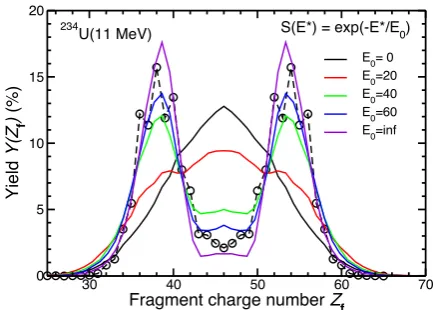
The effect of such a suppression is illustrated in Fig. 8 for a purely exponential suppression function,
S(E∗)=exp(−E∗/E
0), for various values of the damping
energy E0. The standard result is obtained for E0 → ∞
and the yield at symmetry is not fully accounted for. But this shortfall is rectified already for a value as high as
E0=60 MeV. AsE0is lowered further, the symmetric yield increases steadily and atE0=20 MeV the asymmetric com-ponent is hardly visible. ForE0=0 the potential is exclu-sively macroscopic and the charge distribution is peaked at symmetry. Because an exponential suppression with
E0=60 MeV damps the microscopic effects far too slowly, a more general suppression function is called for [16].
30 40 50 60 70
Fragment charge number Zf
0 5 10 15 20
Yield
Y(Z
f
) (%)
E0= 0
E0=20
E0=40
E0=60
E0=inf
234U(11 MeV) S(E*) = exp(-E*/E
0)
Figure 8. The relative charge yield for fission of234U at an
ex-citation ofE∗=
11 MeV, as calculated with a purely exponential suppression function,S(E∗
) =exp(−E∗/
E0), for various values
of E0, as indicated. The corresponding experimental data for 234U(γ,f) (open circles joined by dashed lines) are from Ref. [12],
5 Concluding remarks
We have illustrated the utility of the simple Metropolis walk [4] on the previously calculated potential-energy lat-tice [8, 9] for obtaining the approximate form of fission-fragment mass or charge distributions for a large range of nuclei (altogether, potential-energy surfaces were calcu-lated for more than 5,000 nuclei).
For more accurate results it is necessary to invoke also the dissipative features of the shape evolution as repre-sented by the shape-dependent dissipation tensor. The shape evolution then resembles Brownian motion in an anisotropic (and non-uniform) medium. Because the dis-sipation mechanism is not yet as well understood as the potential energy, it is advisable to make a series of cal-culations with various forms of the dissipation tensor and then use the ensuing spread in the results as an indication of the uncertainty of the calculated mass yield. The cal-culation of the kinetic energies of the fission fragments is beyond the scope of the Smoluchowski treatment (and the Metropolis walk) as it would require the reintroduction of the (still poorly known) inertial-mass tensor.
The results obtained in this manner are often remark-ably robust. Consequently, the method may be of practical use for calculating fission-fragment mass distributions for any of the thousands of nuclei for which the required 5D potential-energy surface is already available.
References
[1] L. Meitner and O.R. Frisch, Nature143, 239 (1939). [2] N. Bohr, Nature143, 330 (1939).
[3] N. Bohr and J.A. Wheeler, Phys. Rev.56, 426 (1939). [4] J. Randrup and P. Möller, Phys. Rev. Lett.106, 132503
(2011).
[5] J. Randrup, P. Möller, and J. Sierk, Phys. Rev. C84, 034613 (2011).
[6] J.R. Nix, Report UCRL-17958, preprint of Ref. [7]. [7] J.R. Nix, Nucl. Phys. A130, 241 (1969).
[8] P. Möller, D.G. Madland, A.J. Sierk, and A. Iwamoto, Nature409, 785 (2000).
[9] P. Mölleret al., Phys. Rev. C79, 064304 (2009).
[10] N. Metropolis, A.W. Rosenbluth, M.N. Rosenbluth, A.H. Teller, and E. Teller, J. Chem. Phys. 26, 1087 (1953).
[11] M.B. Chadwicket al., Nucl. Data Sheets107, 2931 (2006).
[12] K.-H. Schmidtet al., Nucl. Phys. A665, 221 (2000). [13] P. Fong, Phys. Rev.102, 434 (1956).
[14] B.D. Wilkins, E.P. Steinberg, and R.R. Chasman, Phys. Rev. C14, 1832 (1976).
[15] J. Blocki, Y. Boneh, J.R. Nix, J. Randrup, M. Robel, A.J. Sierk, and W.J. Swiatecki, Ann. Phys. 113, 330 (1978).

![Figure 2.Fragment charge distributions extracted fromMetropolis walks on the respective 5D potential-energy sur-faces [8, 9], together with the corresponding experimental data[11, 12]](https://thumb-us.123doks.com/thumbv2/123dok_us/8641666.1431374/2.595.312.531.404.726/fragment-distributions-extracted-frommetropolis-respective-potential-corresponding-experimental.webp)
![Figure 3. Charge yields for 240Pu and 222,224,228Th obtained withthe Metropolis walk method with the mass asymmetry being ex-tracted at various neck radii: c0 = 2.5, 2.0, 1.5 fm; the experi-mental data are from [11, 12]](https://thumb-us.123doks.com/thumbv2/123dok_us/8641666.1431374/3.595.65.276.374.725/figure-charge-obtained-withthe-metropolis-asymmetry-tracted-various.webp)
![Figure 5.Results of our scission model (see text) for 240Puand 222,224,228Th for scission neck radii csc = 2.5, 2.0, 1.5 fm; theexperimental data are from [11, 12]](https://thumb-us.123doks.com/thumbv2/123dok_us/8641666.1431374/4.595.62.280.374.739/figure-results-scission-model-puand-scission-radii-theexperimental.webp)