Licensed under Creative Common Page 414
http://ijecm.co.uk/
IMPACT OF CAPITAL STRUCTURE ON
FIRM PERFORMANCE IN NIGERIA
L. B. Ajayi
Department of Finance, Faculty of Management Sciences, Ekiti State University, Ado-Ekiti, Nigeria
O. G. Obisesan
Department of Finance, Faculty of Management Sciences, Ekiti State University, Ado-Ekiti, Nigeria
Abstract
This study seeks to investigate the impact of capital structure on firm performance in Nigeria for
period of 2013 and 2017. The study considered the impact of some key macroeconomic
variables (gross domestic product and inflation) on firm performance. The traditional theory of
capital structure was employed to determine the significance of leverage and macroeconomic
variables on firm’s performance. A static panel analysis was used to achieve the objectives of
the study. Using fixed effect regression estimation model, a relationship was established
between performance (proxied by return on investment) and leverage of the firms over a period
of five years. The results provide strong evidence in support of the traditional theory of capital
structure which asserts that leverage is a significant determinant of firms’ performance. A
significant negative relationship is established between leverage and performance. From the
findings, the study strongly recommended that firms should use more of equity than debt in
financing their business activities; this is because in spite of the fact that the value of a business
can be enhanced with debt capital, it gets to a point that it becomes detrimental. Each firm
should establish with the aid of professional financial managers, that particular debt-equity mix
that maximizes its value and minimizes its weighted average cost of capital.
Licensed under Creative Common Page 415
INTRODUCTION
Financing and investment are two major decision areas in a firm. In the financing decision the manager is concerned with determining the best financing mix or capital structure for his firm. Capital structure decision is the mix of debt and equity that a company uses to finance its business (Damodaran, 2001). Capital structure is the way a company finances its assets through the mixture of equity, debt or hybrid securities. According to Chechet and Olayiwola (2014) whether a business is newly born or it is ongoing, it requires fund to carry out its activities. This fund is referred to as capital. Capital therefore refers to the means of funding a business.
According to Kochhar (1997), poor capital structure decisions may lead to a possible reduction/loss in the value derived from strategic assets. Hence, the capability of a firm in managing its financial policies is important if the firm is to realize gains from its specialized resources. The raising of appropriate funds in an organization will aid the firm in its operation; hence, it is important for firms in Nigeria to know the debt‐equity mix that gives effective and efficient performance after a good analysis of business operations and obligations.
Capital structure has been a major issue in financial economics ever since Modigliani and Miller showed in 1958 that given frictionless markets, homogeneous expectations; capital structure decision of the firm is irrelevant. By relaxing the assumptions and analyzing their effects, theories seek to determine whether an optimal capital structure exists or not, and if so what could possibly be its determinants. The relationship between capital structure decisions and firm value has been extensively investigated in the past few decades. Capital structure could have two effects; according to Desai (2007) firms of the same risk class could possibly have higher cost of capital with higher leverage. Second, capital structure may affect the valuation of the firm, with more leveraged firms, being riskier and consequently valued lower than the less leveraged firms. If the manager of a firm has the shareholders' wealth maximization as his objective, then capital structure is an important decision, for it could lead to an optimal financing mix which maximizes the market price per share of the firm.
Licensed under Creative Common Page 416 acceptable result, this study intends to make a comparison between two set of companies; lowly geared and highly geared companies in the private sector of the Nigeria Economy.
In Nigeria, most corporate decisions are dictated by managers. Equity issues are often favored over debt in spite of debt being a cheaper source of fund; even where debts are employed, it is usually on the short term basis. This could be as a result of the manager’s tendency to protect his undiversified human capital and avoid the performance pressure associated with debt commitment. More often, when debts are issued voluntarily, particularly long term debt, it is used as an anti-takeover device against the challenge of potential corporate rider. The corporate sector in the country is characterized by a large number of firms operating in a largely deregulated and increasingly competitive environment. Since 1987, financial liberalization resulting from the Structural Adjustment Program changed the operating environment of firms. The macroeconomic environment has not been conducive for business while both monetary and fiscal policies of government have not been stable. Following the Structural Adjustment Program, lending rate rose to a high side from 1.5 percent in 1980 to a peak of 29.8 percent in 1992; but it declined to 16.9 percent in 2006. The high interest rate implies that costs of borrowing went up in organized financial market, thus increased the cost of operations. The Structural Adjustment Program (SAP) came with its conditions, policies that liberalized and opened up the Nigerian economy to the outside world in equal comparison to international commodities, causing unfavorable balance of payment as domestic demand for foreign goods increased also led to the high volatility of the exchange rate system thereby rendering business in Nigeria uncompetitive, especially given high cost of borrowing and massive depreciation of Naira, which culminated to increasing rate of Inflation in Nigeria.
A firm’s capital structure refers to the mix of its financial liabilities. It has long been an important issue from the strategic management standpoint since it is linked with a firm’s ability to meet the demands of various stakeholders (Roy & Minfang, 2000). Debt and equity are the two major classes of liabilities, with debt holders and equity holders representing the two types of investors in the firm. Each of these is associated with different levels of risk, benefits, and control. While debt holders exert lower control, they earn a fixed rate of return and are protected by contractual obligations with respect to their investment. Equity holders are the residual claimants, bearing most of the risk and have greater control over decisions.
Licensed under Creative Common Page 417 terms of profits. From the foregoing, it is therefore important to understand how firm’s financing choice affects their performance. It is evidently clear that both internal (firm specific) factors and external (macroeconomic) factors could be very important in explaining the performance of firms in an economy. Thus, the central point of this study is to assess the impact of capital structure on firm’s performance in Nigeria. A theoretical and empirical analysis of the lowly and highly geared companies in Nigeria will be critically assessed. Furthermore, macroeconomic factors alongside firm’s specific factors that could drive the performance of Nigeria firms will be closely considered. The main objective of this study is to examine the impact of leverage on the value of the selected firms. It intends making a comparison between the firms whether an optimal capital structure exists. This study will also take a look at the effect of macroeconomic variables like gross domestic product, interest rate and inflation on the financing decisions of firms and consequently their values.
LITERATURE REVIEW
The term capital structure according to Kennon (2010) refers to the percentage of capital (money) at work in a business by type. There are two forms of capital: equity capital and debt capital. Alfred (2007) stated that a firm’s capital structure implies the proportion of debt and equity in the total capital structure of the firm. Pandey (1999) differentiated between capital structure and financial structure of a firm by affirming that the various means used to raise funds represent the firm’s financial structure, while the capital structure represents the proportionate relationship between long-term debt and equity. The capital structure of a firm as discussed by Inanga and Ajayi (1999) does not include short term credit, but means the composite of a firm’s long-term funds obtained from various sources. Therefore, a firm’s capital structure is described as the capital mix of both equity and debt capital in financing its assets. However, whether or not an optimal capital structure exists is one of the most important and complex issues in corporate finance.
Capital structure, preferred stock and common equity are mostly used by firms to raise needed funds, capital structure policy seeks a trade-off between risk and expected return. The firm must consider its business risk, tax positions, financial flexibility and managerial conservatism or aggressiveness, while these factors are crucial in determining the target capital structure, operating conditions may cause the actual capital structure to differ from the optimal capital structure.
Licensed under Creative Common Page 418 managers do not have an incentive to maximize firm’s performance because their compensation is not generally linked to it. Moreover, since managers do not share firm’s profits with shareholders, they are very likely to increase company’s expenditures by purchasing everything they like and surrounding themselves of luxury and amenities.
Hence, the main concern of shareholders is ensuring that managers do not waste firm’s resources and run the firm in order to maximize its value, which entails finding a way to solve the principal-agent problem. Capital structure is the combination of the debt and equity structure of a company. It can also be referred to as the way a corporation finances its assets through some combination of equity, debt or hybrid securities; that is the combination of both equity and debt. A firm’s capital structure is then the composition of its liabilities. The various components of a firm’s capital structure according to Inanga and Ajayi (1999) may be classified into equity capital, preference capital and long-term loan (debt) capital. Equity capital refers to the contributed capital; money originally invested in the business in exchange for shares of stock; and retained profits; profits from past years that have been kept by the company to strengthen the balance sheet, growth, acquisition and expansion of the business. Preference capital refers to a hybrid that combines the features of debentures and equity shares except the benefits while debt capital refers to the long term bonds used by the firm in financing its investment decisions while coming up with its principal and also paying back interest.
Review of Empirical Studies
Chandrasekharan (2012) conducted a study using 87 firms out of the population of 216 firms listed on the Nigeria stock exchange for a period of five years (2007-2011) from static trade-off, agency and pecking order theory point of view. He employed the panel multiple regression analysis and the study reveals that for the Nigerian listed firms; firms’ size, growth and age are significant with the debt ratio of the firm, whereas, profitability and tangibility are not.
Licensed under Creative Common Page 419 Akinyomi (2013), using three manufacturing companies selected randomly from the food and beverage categories and a period of five years (2007-2011) using the static trade-off and the pecking order theory point of view. He adopted the use of correlation analysis method and revealed that each of debt to capital, debt to common equity, short term debt to total debt and the age of the firms’ is significantly and positively related to return on asset and return on equity but long term debt to capital is significantly and relatively related to return on asset and return on return on equity. His hypothesis also tested that there is significant relationship between capital structure and financial performance using both return on asset and return on equity.
Taiwo (2012), using ten firms listed on the Nigerian Stock Exchange for a period of five years (2006-2010) from the static trade-off, pecking order and agency theory point of view. In his findings, He employed the Im, Pesaran and shine unit root test and Panel Least Square test and revealed that the sampled firms were not able to utilize the fixed asset composition of their total assets judiciously to impact positively on their firms’ performance.
Bassey, Aniekan, Ikpe and Udo (2013), using a sample of 60 unquoted agro-based firms in Nigeria within a period of six years (2005-2010) from the agency cost theory point of view. They employed the Ordinary Least Sqaure regression and descriptive statistics and revealed that only growth and educational level of firms owners were significant determinants of both long and short term debt ratios, assets structure, age of the firms, gender of owners and export status impacted significantly on long term debt ratios, while business risk, size and profitability of firms were major determinants of short term debt ratio for the firms under investigation.
Simon-Oke and Afolabi (2011), using a study of five quoted firms within a period of nine years (1999-2007) from the static trade-off and agency cost theory point of view. They employed the panel data regression model and revealed in their study a positive relationship between firms’ performance and equity financing as well as between firms’ performance and debt-equity ratio. There is also a negative relationship that exists between firms performance and debt financing due to high cost of borrowing in the country.
Semiu and Collins (2011), using a sample size of 150 respondents and 90 firms were selected for both primary data and secondary data respectively for a period of five years (2005-2009) from the relevance, pecking order, the free cash flow, the agency cost and the trade-off theory point of view. They employed the descriptive statistics and Chi square analysis and suggested that a positively significant relationship exists between a firm’s choice of capital structure and its market value in Nigeria.
Licensed under Creative Common Page 420 based measures of financial performance (return on Equity, return on Assets and gross profit margin) were used. The result revealed that capital structure choice decision in general, has a weak-to-no impact on firm’s performance.
Chowdhury and Chowdhury (2010), empirically support the argument of Modigliani and Miller (MM). Their work test the influence of debt-equity structure on the value of shares given different sizes, industries and growth opportunities with the companies incorporated in the Dhaka Stock exchange (DSE) and Chittagong Stock Exchange (CSE) of Bangladesh.
Ong and Teh (2011) investigated on the capital structure and firms performance of construction companies for a period of four years (2005-2008) in Malaysia. Long term debt to capital, debt to asset, debt to equity market value, debt to common equity, long term debt to common equity were used as proxies as the independent variables (capital structure) while returns on capital, return on equity, earnings per share, operating margin, net margin were used to proxy the corporate performance. The result shows that there is relationship between capital structure and corporate performance.
In Jordan, Zeitun and Tian (2007) conducted a study on capital structure and corporate performance on 167 Jordanian firms between 1989-2003. They found a significantly negative relationship between capital structure and corporate performance. Many variables such as return on assets, return on equity, profitability, Tobin’s Q were used to measure performance while leverage, growth, size and tangibility were proxies for capital structure.
In Sri Lanka, Puwanenthiren (2011) carried out an investigation on capital structure and financial performance of some selected companies in Colombo Stock Exchange between 2005-2009. Capital structure was surrogated by debt while performance was proxy by gross profit, net profit, return on investment / capital employed and returns on assets. The results shown the relationship between the capital structure and financial performance is negative.
Licensed under Creative Common Page 421 In Pakistan, Abdul (2010) using 36 engineering sector firms in Pakistani market listed on the Karachi Stock Exchange (KSE) during the period 2003-2009 applied Pooled Ordinary Least Square regression and revealed the results show that financial leverage measured by short term debt to total assets (STDTA) and total debt to total assets (TDTA) has a significantly negative relationship with the firm performance measured by Return on Assets (ROA), Gross Profit Margin (GM) and Tobin’s Q. The relationship between financial leverage and firm performance measured by the return on equity (ROE) is negative but insignificant. Asset size has an insignificant relationship with the firm performance measured by ROA and GM but negative and significant relationship exists with Tobin’s Q. Firms in the engineering sector of Pakistan are largely dependent on short term debt but debts are attached with strong covenants which affect the performance of the firm.
However, what the researcher discovered with the majority of this studies is that they are sectorial focusing; like the studies of Babalola (2014), Akinyomi (2013) and Khalaf (2013) focused on manufacturing industries of Nigeria and Amman, Shehu (2011) concentrated on insurance companies in Nigeria, Basseu, Aniekan, Ikpe and Udo (2013) focused on Agro based companies in Nigeria, Ong and Teh (2011) concentrated on construction companies in Malaysia, Berger and Wharton (2002) focused on the U. S. banking industry and Abdul (2010) focusing on the engineering sector in Pakistan. Nonetheless, most of the studies fall under the same range of period of 2000-2011 as their year of assessment, the exception of Zeitun and Tian (2007) reviewed between 1989-2003 with a period of fifteen (15) years. Most of the studies did not study on the leverage position of the firms except Ogebe, Ogebe and Alewi, 2011). In conclusion, the findings of the foreign studies are very vital only that the differences in their political and economic situation among the nations may hinder their finding from being applicable to Nigeria.
METHODOLOGY
Model Specification
In order to capture the impact of capital structure on firm’s performance, the study adopts capital structure model which states that firm’s performance depends on capital structure and some control variables. The study modifies the capital structure model by augmenting it with macroeconomic variables to adequately capture firm performance. This is seen below;
Performance = f (leverage, inflation, gdp)
ROIit = β0 + β1 LEVit + β2 INFit + β3 GDPit + β4 ROIit+ Ɛt
Licensed under Creative Common Page 422 performance) “LEVERAGE” captures the gearing level of firms. “INFLATION” is proxied by consumer price index, “GDP” is the income level proxied by gross domestic product. The study expects a negative relationship between capital structure and returns on investment. This is evident from the fact that interest is paid on the debt and this tends to reduce firm performance. Also, lagged returns on investment are expected to be positively related to current returns on investment. GDP is expected to be positively related to firm performance and inflation is expected to negatively affect firm performance. Following the theoretical framework above, the a priori expectations for the parameters are; β1 < 0; β2 < 0; β3 > 0; β4 > 0.
Data Sources
In other to achieve the stated objectives of the study, an annual panel data was employed. The data (secondary data) were obtained from various sources which include; annual reviews from various companies and Central Bank of Nigeria Statistical Bulletin (various issues). The period covered spans from 2013 to 2017 due to data availability and in the literature most articles make used of 5 years data time series (Khalaf, 2013; Semiu & Collins, 2011, among others).
Method of Data Analysis
To determine the relationship between the various variables correlation was employed and to determine the degree of significance and impact of leverage on firm performance, the study consider the both pooled and fixed effect model estimation technique. Since the number of cross sectional unit is smaller than the parameters in the above equation, random effect estimate is not appropriate.
ANALYSIS AND FINDINGS
The correlation result from the four variables employed is seen below.
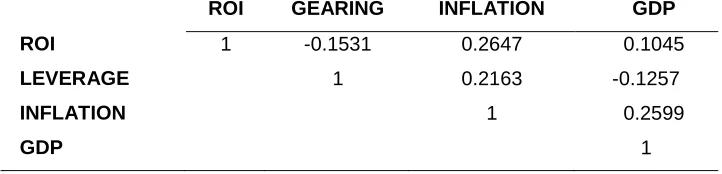
Table 1 Correlation Coefficient Matrix for the highly geared Companies
ROI GEARING INFLATION GDP
ROI 1 -0.1531 0.2647 0.1045
LEVERAGE 1 0.2163 -0.1257
INFLATION 1 0.2599
Licensed under Creative Common Page 423 Table shows the correlation matrix for highly geared firms. The correlation matrix computed above was calculated to gain insight into the nature of the relationship among the variables in the model. The relationship falls between zero and one, thereby measuring the linear association between the observed values. Leverage has a negative relationship with firm performance (returns on investment). This shows that there exists an optimal debt financing on companies performance. Inflation and GDP has a positive relationship. This finding conforms to the results from Kinsman and Newman (1998). Conversely, macroeconomic variables (GDP and Inflation) are positively correlated with firm performance. It should be further noted that impact analysis is not provided for in correlation analysis.
Table 2 Correlation Coefficient Matrix for the lowly geared Companies
ROI GEARING INFLATION GDP
ROI 1 -0.265 0.4081 0.04
LEVERAGE 1 0.2647 0.0867
INFLATION 1 0.404
GDP 1
The above table shows the correlation matrix for the lowly geared firms. In line with table 3 leverage is negatively correlated to firms performance (ROI). This indicates higher levels of debt are correlated with lower firm performance. It also shows that there is an optimal amount of debt financing that tends to exert a negative effect on firms performance. In addition, the macroeconomic variables are positively correlated to firm performance.
Table 3 Panel Regression Result For Highly Geared Firms
Variables Pooled Fixed Effect
Coefficient p-value Coefficient p-value
C 3.1835*** 0.0000*** 4.7519*** 0.0000
LEV -1.8351** 0.0031** -3.0692*** 0.0000
INF 3.5927*** 0.0000*** 0.1590** 0.0326
GDP 0.2894*** 0.0000*** 0.2619*** 0.0023
ROI(-1) -0.2138*** 0.0000*** 3.6819** 0.0412
R-squared 0.7593 0.8417
Adjusted R2 0.7501 0.7842
P-value(F) 0.0283 0.0001
Durbin- Watson 1.9224 2.0161
Licensed under Creative Common Page 424 The above table presents the estimated result for the highly geared firms (Total Nigeria plc and Mobile oil). The pooled and fixed effect regression were run and compared. Due to small cross sectional unit (cross sectional units is less than regressors), the study fail to run the random effect because the cross sectional units are smaller than number of regressors. For the two set of firms, the fixed effect model performs better compared to the pooled regression; hence the study adopt the fixed effect in the analysis. Fitting the values into the model, the study has the following:
ROI = 4.7519 -3.0692LEV + 0.1590INF + 0.2619GDP + 3.6819 ROI(-1) ……… 4.1
The R2 shows that the regressors jointly account for 84.2 % of variations in firm performance in the highly geared firms. Also, the explanatory variables are jointly significant in the model and the Durbin Watson statistics shows the absence of autocorrelation.
However, from the fixed effect regression, all the explanatory variables are statistically significant in explaining changes in firm performance level. Leverage has a negative impact on firm performance. 1 percent increase (decrease) in leverage will reduce (increase) firms performance by 30.7 percent. The result conforms to a priori expectation on a negative relationship between leverage and capital structure. This shows that overleveraging negatively affects firm performance. Also, debt financing reduces firm performance because of the compounding nature of interest rates on debt. This finding corroborates with other studies on capital structure (Gleason, Mathur & Mathur, 2000; Agarwal and Elston, 2001; Abor 2007; Chen, Firth, & Zhang, 2008; & Ogebe, Ogebe & Alewi, 2013) and firms performance level. Also, the findings are in tandem with the traditional theory of capital structure, because leverage has a significant impact on firm performance in Nigeria, hence the study accept the traditional theory of capital structure and reject the MM theory of capital structure.
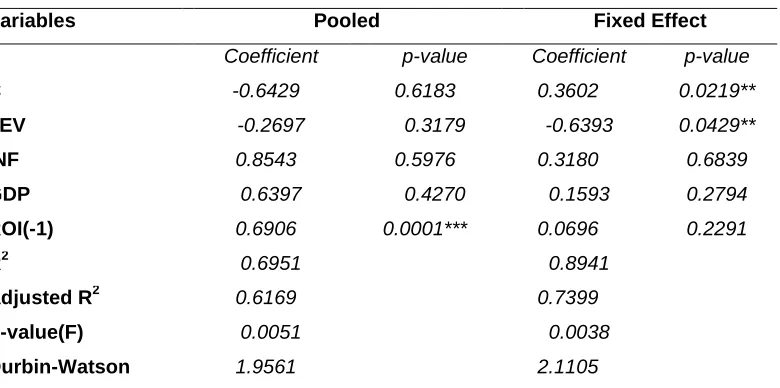
Licensed under Creative Common Page 425 Table 4 Panel Regression Result For Lowly Geared Firms
Variables Pooled Fixed Effect
Coefficient p-value Coefficient p-value
C -0.6429 0.6183 0.3602 0.0219**
LEV -0.2697 0.3179 -0.6393 0.0429**
INF 0.8543 0.5976 0.3180 0.6839
GDP 0.6397 0.4270 0.1593 0.2794
ROI(-1) 0.6906 0.0001*** 0.0696 0.2291
R2 0.6951 0.8941
Adjusted R2 0.6169 0.7399
P-value(F) 0.0051 0.0038
Durbin-Watson 1.9561 2.1105
Note: *, **, and *** signifies 10%, 5% and 1% respectively
Fitting the values into the model, the study has the following: The table presents the estimated result for the lowly geared firms. The table shows both the poled regression and fixed effect regression analysis. From both, the study accepts the fixed effect model because it gives more robust estimates from the result. In the fixed effect model, the explanatory variables account for 89.4 percent variation in firm’s performance. The f-statistics shows that the explanatory variables are jointly statistical significant in the model and the Durbin-Watson statistics shows that there is no autocorrelation in the model.
ROI = 0.3602 -0.6393LEV + 0.3180INF + 0.1593GDP + 0.0696ROI (-1) ……… 4.2
Leverage has a negative and statistically significant relationship with firm performance. The relationship between leverage and firms performance is statistically significant at 5 percent level of significance for the lowly geared firms. This result is in tandem with Gleason et al
(2000); Agarwal et al (2001); Abor (2007) and Chen et al (2008). This shows that leveraging negatively impacts on firm performance. A percentage increase (decrease) in leverage will reduce (increase) firm performance by 63.9 percent. Since the relationship is statistically significant, it conforms to the expectation on traditional theory of capital structure. On the contrary, macroeconomic variables in our study exhibit a positive impact on firm performance. Though not statistically significant a percentage increase or decrease in inflation and gross domestic product will increase or decrease firm performance.
Licensed under Creative Common Page 426 performance in terms of value than the lowly geared firms, probably because of the size of their investments, it is however important to know that since a significant negative relationship exists between gearing and returns, an optimal capital structure exists and this further supports the belief of the proponents of the traditional theory of capital structure.
CONCLUSION AND RECOMMENDATIONS
Traditional capital structure theory provides models that can assess the effects of leverage (gearing) on firms’ performance. This study has examines the effectiveness of leverage on firms performance in some selected firms in Nigeria. The study considered six firms which were selected into two classes; highly geared (Total Nigeria PLC and Mobil Oil) and lowly geared firms (May and Baker, and GSK). The study employed panel data and the scope spanned from 2013 to 2017.
The study confirms that the traditional capital structure theory is valid. It reaffirms that leverage in both the highly and lowly geared firms is statistically significant and is an important determinants of firm’s performance. Also, in line with various empirical studies on capital structure and firm’s performance, this study confirms the negative relationship between leverage (gearing) and firm’s performance in selected companies in Nigeria.
As it is well known leverage negatively impacts on firm’s performance, but the extent of its impact on firm’s performance varies in relation to highly and lowly geared firms. The findings report that high gearing has a larger impact on firm’s performance compared to low gearing. In the highly geared firms a 100 percent increase in leverage reduces firm’s performance by 17%, but for the lowly geared firms it reduces firm’s performance by 15 percent.
Furthermore, macroeconomic variables have a significant effect on the performance of highly geared firms while it’s not significant for lowly geared firms. Gross domestic product and inflation have a higher impact on firm’s performance in the highly geared firms compared to lowly geared firms. In addition, lagged returns on investment affects firm’s performance in the highly geared firms.
Licensed under Creative Common Page 427 In addition, the government should create an enabling business friendly environment so that businesses can thrive and thus increase firm’s performance level. This is evident in the fact that macroeconomic variables positively affect the performances of most firms in Nigeria. Further studies can be carried out on other sectors.
REFERENCES
Abdul G. K. (2010). The Relationship of Capital Structure Decisions with Firm Performance: A Study of the Engineering Sector of Pakistan. COMSATS Institute of Information Technology, Vehari.
Abor, J. (2007). The effect of Capital Structure on Profitability: An Empirical Analysis of Listed firms in Ghana. Journal of Risk Finance, 6, 438-47.
Agarwal, R., & Elston, J. A. (2001). Bank-firm relationships, Financing and Firm Performance in Germany. Economics Letters, 72, 225–232.
Akinyomi, O. J. (2013), Effect of Capital Structure on Firms Performance: Evidence from Nigerian Manufacturing Company. International Journal of Innovative Research and Studies, 2(9), 205-225.
Alfred, D. D. (2007). Corporate Finance: Issues, Investigations, Innovations and Applications (2nd ed.). Lagos: High Rise Publication.
Babalola Y. A. (2014). Triangulation Analysis of Capital Structure and Firms’ Performance in Nigeria. East Ukrainian National University [Vol. Dahl] 91034 Lugansk, Ukraine.
Bassey, N. E., Aniekan J. A., Ikpe, I. K., & Udo, U. J. (2013). Analysis of the Determinants of Agricultural Science. Science and Education Centre of North America, 1(4), 36-47.
Berger, A.N., & Wharton, F. (2002). Capital Structure and Firm Performance: A New Approach to Testing Agency Theory and an Application to the Banking Industry.
Berle, N., & Means, H. (1932). The Modern Corporation and Private Property. Newton Publishing.
Chandrasekharan, C. V.(2012). Determinant of Capital Structure in the Nigerian Listed Firms. International Journal of Advanced Research in Management and Social Sciences, 1(2), 638-649.
Chechet, I. L., & Olayiwola, A. B. (2014). Capital Structure and Profitability of Nigerian Quoted Firms: The Agency Cost Theory Perspective. Retrieved from http://www.aijssnet.com/journals/Vol_3_No_1_January_2014/13.pdf. Chen, G., Firth, M., & Zhang, W. W. (2008). The Efficiency and Profitability effects of China’s Modern Enterprise Restructuring Programme. Asian Review of Accounting, 16(1), 74-91.
Chowdhury, A., & Chowdhury, S. P. (2010). Impact of Capital Structure on Firm’s Value: Evidence from Bangladesh. Business and Economic Horizon (BEH), 3(3), 111-122.
Damodaran, D. (2001). Corporate Finance. Theory and Practice (2nd edition). New York: Wiely. Desai, A. (2007). Corporate Tax Avoidance and Firm Value. Harvard University and NBER.
Dimitris, M., & Psillaki, M. (2008). Capital Structure, Equity Ownership and Firm Performance. Department of Finance, University of Nice-Sophia Antipolis, Einstein 06560 France.
Donaldson, G. (1961). Corporate Debt Capacity: A study of Corporate Debt Policy and the Determination of Corporate Debt Capacity. Boston: Division of Research, Harvard School of Business Administration.
Gleason, K.C., Mathur, L.K., & Mathur, I. (2000). The Interrelationship between Cultures, Capital Structure, and Performance: Evidence from European Retailers. Journals of Business Research, 50, 185-91.
Inanga, E. L., & Ajayi, C. A. (1999). Accountancy. Lagos: The CIBN Press Limited.
Jensen M. and Meckling W. (1976). Theory of the Firm: Managerial Behavior, Agency Costs and Ownership Structure. Journal of Financial Economics, 3, 305-360.
Kennon, J. (2010). An introduction to Capital Structure: Why Capital Structure matters to your Investments. [Online] Available: www.about.com (July 20, 2010).
Licensed under Creative Common Page 428 Kochhar, R. (1997). Strategic Assets, Capital Structure, and Firm Performance. Journal of Financial and Strategic Decisions, 10(3), 23-36.
Miller M. (1977). Debt and Taxes. Journal of Finance 32, 261-275.
Modigliani, F., & Miller, M. H. (1958). The Cost of Capital, Corporate Finance and the Theory of Investment. American Economic Review, 48, 261-97
Myers, S. C., & Majluf, N. S. (1984), Corporate Financing and Investment Decisions. When Firms Have Information That Investors Do Not Have. Journal of Financial Economics, 13, 187-222.
Ogbe, P., Ogede, J. & Alewi, K. (2013). The Impact of Capital Structure on Firms’Performance in Nigeria. Munich Personal RePEc Archive.Paper No. 46173.
Ong, T. S., & Teh, B. H. (2011). Capital Structure and Corporate Performance of Malaysian Construction Sector. International Journal of Humanities and Social Science, 1(2), 28-36.
Pandey, I. M. (1999). Financial Management (8th ed.). New Delhi: Vikas Publishing House PVT Ltd.
Puwanenthiren, P. (2011). Capital Structure and Financial Performance: Evidence from Listed business companies in Colombo Stock Exchange Sri Lanka. Journal of Arts, Science & Commerce, 5(7), 79-93.
Roy, L., & Minfang, L. (2000). Environmental Dynamism, Capital Structure and Performance: A theoretical Integration and an Empirical Test.”Strategic Management Journal, 4(2), 23-39.
Semiu, B. A., & Collins, S. O. (2011). Perceived Relationship between Corporate Capital Structure and Firm Value in Nigeria. International Journal of Business and Social Science 2 (19), 21-38.
Taiwo A. M. (2012) An Empirical Analysis of Capital Structure on Firms’ Performance in Nigeria. International Journal of Advances in Management and Economics, 1(5),116- 124.