© 2018 IJSRST | Volume 4 | Issue 2 | Print ISSN: 2395-6011 | Online ISSN: 2395-602X Themed Section: Science and Technology
Log Likelihood Ratio Based Quantizer Design for Target Tracking in Wireless
Sensor Networks
K. S. Balamurugan, Sri Sahithi
Associate Professor, Department of ECE, Bharat Institute of Engineering and Technology, Hyderabad, Telangana, India
ABSTRACT
In Wireless sensor network (WSN), the estimated target location is measured by sensors at each time of tracking and sends to the fusion centre. Optimizing Sensors is a challenging issue with respects to size, battery powered devices and the resources. Transmission of whole sensor measurements to the fusion center probably carry too much of energy and bandwidth. In such a case, distributed detection or distributed estimation, sensor measurements are initially processed and then quantized form of them are send to the fusion center. In this paper, proposed log likelihood ratio (LLR) based quantizer algorithm, used to reduce the number of sensors transmitting to the FC and obtaining detailed information from those sensors. Information, Energy, power and distance parameters are used to calculate the weight factors for selecting suitable sensors. From the simulation results, the proposed method significantly better than other probabilistic sensor management approaches for target tracking in WSN.
Keywords : Sensor Management , Target Tracking In Sensor Networks ,WSN, FC, ROI, PCRLB, PTA, LLR-WFDA, LLR
I.
INTRODUCTION
A wireless sensor network (WSN) is serene of a large number of densely deployed sensors, where sensors are battery-powered devices with inadequate signal processing capabilities. WSNs are awfully helpful in lots of application areas including environment monitoring, battlefield surveillance, industrial processes, target tracking and health monitoring and control. In this paper, the function of the WSN is to track a target emitting or reflecting energy in a known region of interest (ROI), and the sensors send their observations regarding the target to a central node called the fusion center. Target tracking problems need coverage of broad areas and a huge number of sensors that can be tightly deployed over the ROI. It comes to blows in new challenges whenever the resources (bandwidth and energy) are inadequate. In this situation, it is useless to operate all the sensors in the ROI including the uninformative ones, which
scarcely contribute to the tracking task at hand but still use resources. This problem has been analyzed and addressed via the improvement of sensor selection schemes, whose object is to select the best non-redundant set of sensors for the tracking task while fulfilling performance and/or resource constraints.
selection problem based on quantized data, and showed that the PCRLB based sensor selection method achieves related mean square error (MSE) with significantly a lesser amount of computational effort. Practically, in numerous applications like target tracking, it is unlikely that the amount of sensors that required to be chosen at each time step of tracking is well-known to the system designer prior to operation begins. Therefore, it is reasonably required and essential to examine sensor selection strategies that conclude the optimal number of sensors to be selected as well as which sensors to pick based on the WSN conditions.
Sensor network design generally involves concern of multiple objectives, such as maximization of the lifetime of the network or the inference performance, even as minimizing the cost of resources such as energy, consumption costs. The problems that examine the trade-offs between objective functions are called Multi-objective Optimization Problems (MOPs). (Yujiao ZhengIn, 2015) suggested a new CS based sensor management approach for target tracking in a WSN. While not every sensor have useful observations on the subject of the target at a certain time instant, the scrutiny vector contain only a few significant elements. Thus, it is adequate to forward only those elements to the FC to carry out target tracking as a replacement of forwarding all the measurements which consumes a huge amount of energy. To get a compressed version of the analysis at the FC, utilize a multiple access channel (MAC) with probabilistic transmissions metric for target tracking is optimized. An initial version of this work was reported in (Y. Zheng, 2016). Further, Fisher Information (inverse of PCRLB) appears as a lower bound on the mutual information (N. Cao.2015), and under uncertainties on sensor measurements, recently showed that a mutual information based metric yields better judgment than PCRLB based metric.
(E. Masazade,2015) suggested for the distributed detection problem, It formulated a binary quantizer design problem for the neighborhood sensors as a multi-objective optimization problem wherever the objectives were the reduce the decision error probability at the FC and the entire energy utilization of sensors to send out binary decisions to the FC. Further, the wireless channels between sensors and the FC possibly will be non-reliable as a effect of channel fading and noise. For the distributed detection problem in a WSN, the problem of obtaining local quantization policy has been reformulated by incorporating the channel impairments.
decisions proportional to their information contribution (mutual information or UBMI) in order to calculate the unknown target location. The rest of the paper is prearranged as follows. In Section II, Presented the WSN system model and in Section III, derived the LLR Based Quantizer Design based on mutual information. In Section IV, simulation results are discussed and finally section V, bring to a close the research work.
II.
SYSTEM MODEL
Assumed WSN, consisting of N sensors which are deployed evenly in a square region of interest (ROI) of size b×b. Suggested approach be able to manage any sensor deployment pattern provided that the sensor locations (xi,yi) for all i ∈ 1,...,N are well-known in advance. Presume that the target and all the sensors are based on a flat-ground. Therefore, formulate the problem with a 2-D model. Focus on a target tracking difficulties, wherever a moving acoustic or electromagnetic target is tracked by the WSN. The dynamics of the target is defined by a 4-dimensional state vector
Where, (xk,yk) is the position of the target at time instant k and are the velocities in the x and y directions. The model of the target motion is
Where, F is the state transition model, wk is the process noise which is well thought-out Gaussian with mean zero and covariance matrix Q.
At time k, the measurement model at each sensor is
Where,
P0 - Signal power of the source, n - Signal decay parameter, d- Distance and (x,y) for Location.
The measurement vectors are calculated using below mentioned formulas.
Above mentioned formulas and required MI and UBMI derivations are clearly derived in (Yujiao Zhen, 2015). Proposed work utilized all formulas derived in (Yujiao Zhen,2015) to apply in optimal problem with help of sensor parameters like Power, Energy, information and distance and their weight factors.
III.
LLR BASED QUANTIZER DESIGN
The Log Likelihood Ratio (LLR) Algorithm is used in order to recognize the variation in the parameters of the physical layer. The LLR formula validates the physical layer parameters for the many channels and then it links to the best channel in the networks. The main tool for parametric deviation finding methods is the logarithm of the likelihood ratio,
log p y
Lx
p x
Step 1:The dissemination for the p∂(x) taken at the moment is the normal distribution in order to work out the mean and variance for the distribution of the values. The values of X here are taken from the weight factors and WI, WP, WE and WD here are considered as the X1, X2, X3, and X4 so that the mean (μ) and variance (σ) are computed.
1
n
i i x
n
2
1
(
)
n
i i
x
n
Step 2: The value of p∂(x) is given as,
2
1 2 1
1
2
i
x n
i
p
x
e
After work out the p∂(x), the value is replaced in the denominator of the Log Likelihood ratio role Lx.
Step 3: As the sensor parameters at the different instants are taken. Let the new instant parameters are assumed to be Y1, Y2, Y3, and Y4. Now the p∂(Y) is founded by the above methods and the value has been fixed at the numerator of Lx. If the numerator value is high, then the log-likelihood ratio function gives the negative value. Thus the LLR algorithm proves that there is degradation in the information and thus it decides that there is a necessitate for the select the Sensor or not to send Measurements data to Fusion Centre .
Log Likelihood Ratio–Weight Factored Distribution Algorithm (LLR-WFDA)
The LLR algorithm picks the best sensor in the direction towards which the target is roaming over. The weight factors are taken into attention and cost for the weight parameters are to be found by the Cost Factor Procedure.
Procedure for Cost Factor Algorithm is,
Step 1: The cost for the weight factors are determined by the formula,
Cf=C((WI*I0)+(WE*E0)+(WP*P0)+(WD*D0))
Where, I0, E0, P0 and D0 stands for the available Information, Energy level, power level, Distance value.
Step 2: The log likelihood ratio role has been an account in this step and the process is similar as that of the LLR process that takes place at the FC.
Weight Factored Distribution Algorithm using Log Likelihood Ratio (LLR-WFDA)
In this section, the LLR concludes whether or not the selected sensor is essential for send the measured data to Fusion Centre. For the LLR algorithmic rule this research takes the subsequent four parameters into consideration:
Information (I)
Power Level (P)
Energy Level (E)
Distance (D)
These input parameters for the LLR algorithmic govern are procured from the sensor. Before the LLR recursive strategy executes, the weight factor applying these parameters are figured by the weight factor distributed algorithm. The weight factor distribution algorithm precedes the parameters of the sensor set as inputs and creates weight factors with respect to an application specified needs. The weight factors are evaluated in order to find the levels of the parameters desired to reach improved Service.
Procedure for WFD Algorithm is,
Step 1: Following are the assumptions thought-about, The Battery Power level of the sensor Pw,
battery power runs out and 𝑃𝑤 = 1 means that the battery has the utmost power)
The Weight Factors of the four parameters, obtainable information measure, power consumption and distance values are Wb, Wp, Ws and WR severally, wherever Wp = 1 and WI +Wp+WE+ WD =1.
The factors that reason importance levels like high, medium, low and none are IH, IM,IL and 0, respectively, wherever their values are determined by the mobile system designer, and 0 <IH <IM<IL< 1.
The numbers of various importance levels the user has such that are NH, NM, NL and NN respectively, wherever NH + NM + NL + NN= 3 (since the full range of the Sensor parameters that a user may specify is three)
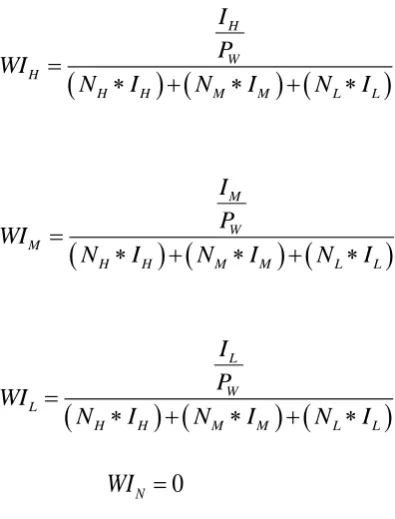
Step 2: The weight factor of the four vital levels when adjusted to user preferences and battery power are WIH, WIM, WIL and WIN, respectively.
NHWIH
NMWIM
NLWIL
NNWIN
Pw M M H HI
WI
WI
I
L L H HI
WI
WI
I
0
NWI
M LH H M M L H w
H H
I I
N WI N WI N WI P
I I
Step 3: The Weights of four importance levels are evaluated by using the following calculations
H
W H
H H M M L L
I
P
WI
N
I
N
I
N
I
M W MH H M M L L
I
P
WI
N
I
N
I
N
I
L W LH H M M L L
I
P
WI
N
I
N
I
N
I
0
NWI
From these formulas the weight factor ranks of each parameter are evaluated. These weights factors values are set as the input to the Log Likelihood Ratio Process.
IV.
SIMULATION RESULTS
Proposed WSN, consisting of N sensors framework deployed in a b×b = 20m×20m assessment area. Table 1 illustrates the Parameters values for Simulation set-up. MATLAB programming is applied for testing the proposed LLR-MI method and assessing the execution performance.
Table 1. Parameters values for Simulation set-up S.No Parameters Range
1 Area 20m×20m,
2 No. of Sensors N=25,36.49. 3 Sampling Time
interval
D = 0.5
4 Monte-Carlo trial (MC)
MC=1000
5 Gaussian with mean
E
7 Process Noise (q)
8 No. of MAC M=2,3,4 9 Target tracking
Time step
Ts = 15 time steps/ MC
10 Power of Source Upto 1000
The MSE is computed through
where, MC is the number of Monte Carlo trials. Also, the outcome of the parameters in the model, i.e., the energy constraint E, the number of sensors N and the number of MACs (M of the sensing matrix Φ) is evaluated. Figure 1 show the performance comparison of Suggested LLR-MI with existing UBMI Approach and its clearly proven that proposed method is less MSE. It also reduce the require energy and computation cost.
Figure 1. Compare Simulated MSE Value of UBMI awiht Proposed LLR-MI
V.
CONCLUSION
Proposed log likelihood ratio (LLR) based quantizer optimizes the number of sensors transmitting to the FC and getting detailed information from few sensors. With the proposed approach, the sensor management problem becomes a guarded optimization problem, where the objective is to verify the optimal values of probabilities with trace of the MI at any certain time step is maximized. Formulations for the LLR-MI
derived with help of Power, Energy, Mutual Information (Entropy), Distance Parameters for Select the Sensors. From the simulation results, the proposed method significantly better than other probabilistic sensor management approaches for target tracking in sensor networks and it also suitable for tracking moving target.
VI.
REFERENCES
[1]. E. Masazade, R. Niu, P. K. Varshney, and M. Keskinoz, "Energy aware iterative source localization for wireless sensor networks," IEEE Trans. Signal Process., vol. 58, no. 9, pp. 4824-4835, Sep. 2010.
[2]. E. Masazade, R. Niu, and P. K. Varshney, "Dynamic bit allocation for objecttrackinginwirelesssensornetworks,"IEEET rans.SignalProcess., vol. 60, no. 10, pp. 5048-5063, Oct. 2012.
[3]. Y. Zhang and Q. Ji, "Efficient sensor selection for active information fusion," IEEE Trans. Syst. Man Cybern. Part B, Cybern., vol. 40, no. 3, pp. 719-728, Jun. 2010
[4]. Y. Zheng, T. Wimalajeewa, and P. K. Varshney, "Probabilistic sensor management for target tracking via compressive sensing," in Proc. IEEE Int. Conf. Acoustics, Speech and Signal Processing (ICASSP), May. 2014, pp. 5095-5099 [5]. L.Zuo,R.Niu, and P.K.Varshney, "A sensor
selection approach for target tracking in sensor networks with quantized measurements," in Proc. IEEE Int. Conf. Acoustic., Speech, Signal Process., Apr. 2008, pp. 2521-2524
[6]. Y. Mo, R. Ambrosino, and B. Sinopoli, "Sensor selection strategies for state estimation in energy constrained wireless sensor networks," Automatica, vol. 47, pp. 1330-1338, Jul. 2011. [7]. N. Cao, E. Masazade, and P. K. Varshney, "A
Information Fusion (FUSION), 2013, pp. 974-980.
[8]. S. Liu, M. Fardad, S. Kar, and P. Varshney, "On optimal sensor collaboration topologies for linear coherent estimation," in Proc. IEEE Int. Symposium on Information Theory (ISIT). IEEE, 2014, pp. 2624-2628.
[9]. S. Liu, M. Fardad, E. Masazade, and P. Varshney, "Optimal periodic sensor scheduling in networks of dynamical systems,"IEEE Trans. Signal Process., vol. 62, no. 12, pp. 3055-3068, June 2014.
[10]. S. Liu, E. Masazade, X. Shen, and P. K. Varshney, "Adaptive non-myopic quantizer design for target tracking in wireless sensor networks," in Proc. Asilomar Conf. Signals Syst. Comput., Nov. 2013, pp. 1085-1089.
[11]. Balamurugan, KS & Chidambararajan, B „Fast and secure intelligence re-authentication mechanism for next generation subscribers‟, International Journal of Control Theory and Applications, 2016.
[12]. D. Schizas, "Distributed informative-sensor identification via sparsity-aware matrix decomposition," IEEE Trans. Signal Process, vol. 61, no. 18, pp. 4610-4624, 2013.
[13]. L. Xu, Q. Liang, X. Cheng, and D. Chen, "Compressive sensing in distributed radar sensor networks using pulse compression waveforms," EURASIP Journal on Wireless Communications and Networking, vol. 2013, no. 1, pp. 1-10, 2013. [14]. Kose and E. Masazade, "Adaptive sampling with sensor selection for target tracking in wireless sensor networks," in Proc. 48th Asilomar Conf. Signals Syst. Comput., Nov. 2014, pp. 909-913. [15]. N. Cao, S. Choi, E. Masazade, and P. K.
Varshney, "Sensor selection for target tracking in wireless sensor networks with uncertainty," IEEE Trans. Signal Process., vol. 64, no. 20, pp. 5191-5204, Oct. 2016.
[16]. L. Orihuela, F. Gmez-Estern , and F. R. Rubio, "Scheduled communication in sensor networks,"
IEEE Trans. Control Syst. Technol., vol. 22, no. 2, pp. 801-808, Mar. 2014.
[17]. Y. Zheng, N. Cao, T. Wimalajeewa, and P. K.Varshney, "Compressive sensing based probabilistic sensor management for target tracking in wireless sensor networks," IEEE Trans. Signal Process., vol. 63, no. 22, pp. 6049-6060, Nov. 2015.
[18]. S. S. Kalamkar, J. P. Jeyaraj, A. Banerjee, and K. Rajawat, "Resource allocation and fairness in wireless powered cooperative cognitive radio networks," IEEE Trans. Commun., vol. 64, no. 8, pp. 3246-3261, Aug. 2016.
[19]. L. Xu, Q. Liang, X. Cheng, and D. Chen, "Compressive sensing in distributed radar sensor networks using pulse compression waveforms," EURASIP Journal on Wireless Communications and Networking, vol. 2013, no. 1, pp. 1-10, 2013 [20]. G. Wang, J. Chen, J. Sun, and Y. Cai, "Power