BOSNIAN JOURNAL OF BASIC MEDICAL SCIENCES 2011; 11 (1): 41-45
Abstract
Antiresorptive agents are widely used to treat osteoporosis. Both reduction in bone turnover and increase in BMD may be necessary to de-crease the fracture risk. Th e aim of the study was to evaluate the eff ects of aledronate on bone turnover markers and bone mineral density in postmenopausal women with osteoporosis. Th e study involved a group of postmenopausal women with osteoporosis treated with alen-dronate ( mg) weekly at the Institute of Nuclear Medicine Clinical Center University of Sarajevo during a -months period. Bone mineral density (BMD) at lumbar spine and proximal femur and bone turnover markers (serum β-CrossLaps, urinary N-telopeptides of type I collagen (NTx), total serum alkaline phosphatase (AP) and serum osteocalcin) were measured at baseline and after months of the treatment with ale-dronate. BMD values signifi cantly increased both at lumbar spine by . and proximal femur by . during the study period (-.±.
vs. -.±. and -.±. vs. -.±. respectively; p<.). Bone turnover markers signifi cantly decreased during the study period; C-terminal telopeptides of type I collagen fragment (β-CrossLaps) . (.±. vs..±. ng/mL), NTX . (.±. vs..±. nMBCE/mM Cr), AP . (.±. to .±. IU/L) and serum osteocalcin by . (.±. to .±. ng/mL)(p<.).
Alendronate treatment increased BMD and reduced the level of bone turnover markers. Th erefore, the treatment with aledronate during months period can be recommended in postmenopausal women with osteoporosis.
© Association of Basic Medical Sciences of FBIH. All rights reserved
KEY WORDS: postmenopausal osteoporosis, bone turnover markers, bone mineral density, alendronate
after one year treatment with alendronate in
postmenopausal women with osteoporosis
Elma Kučukalić-Selimović 1*, Amina Valjevac 2, Almira Hadžović-Džuvo 2,
Amra Skopljak-Beganović 1, Rubina Alimanovic-Alagić 1, Amera Brković 1
1 Clinical Centre University of Sarajevo, Institute for Nuclear Medicine, Bolnička 25, 71000 Sarajevo, Bosnia and Herzegovina, 2 University of Sarajevo, Medical Faculty, Physiology Department, Čekaluša 90, 71000 Sarajevo Bosnia and Herzegovina
Introduction
Osteoporosis is defined as a skeletal disorder character-ized by compromised bone strength, predisposing a person to an increased risk of fracture []. Properties related to bone strength include rate of bone turnover, BMD, geom-etry, microarchitecture, and mean degree of mineralization []. During the postmenopausal osteoporosis, bone resorp-tion exceeds formaresorp-tion, resulting in decreased bone mass and deterioration of the microarchitecture, with conse-quent decreased bone strength and increased susceptibility to fracture []. In particular, hip fractures are an important cause of mortality and morbidity among postmenopausal women. The proximal femur of the hip is primarily com-posed of cortical bone. In cortical bone, high bone turnover, as observed after the menopause, is associated with de-creased BMD, inde-creased cortical porosity due to inde-creased
bone remodelling in the Haversian canal, decreased corti-cal thickness due to increased endocorticorti-cal bone remodel-ling, and decreased mean degree of mineralization [, ]. Treatment with potent anti-resorptive drugs is a strategy for preventing hip fractures in postmenopausal women. Several therapeutic agents are currently available to treat or prevent postmenopausal osteoporosis [, ]. Among commercially available drugs, however, only alendronate, risedronate, in-travenous zoledronate, strontium ranelate, and hormone replacement therapy (HRT) have shown anti-fracture ef-fi cacy against hip fractures in post-menopausal women []. Alendronate and risedronate, which are the second- and third-generation bisphosphonates, respectively, have been used as fi rst-line drugs in the treatment of osteoporosis for many years. For example, Black et al. [] have found that three years of treatment with alendronate increases lumbar spine bone mineral density (BMD) by about and reduces vertebral fracture rate by about []. Interestingly, alen-dronate treatment results in a greater BMD increment in the lumbar spine than the hip, but reduces fracture risk at both sites by roughly the same degree []. Th is suggests that factors other than BMD play an important role in dictating * Corresponding author: Elma Kučukalić-Selimović; Clinical Centre
University of Sarajevo, Institute for Nuclear Medicine, Bolnička 25, 71000 Sarajevo, Bosnia and Herzegovina, Phone: + 387 33 297 165, Fax: + 387 33 298 240; e-mail: [email protected]
BOSNIAN JOURNAL OF BASIC MEDICAL SCIENCES 2011; 11 (1): 42-45 the eff ects of bisphosphonates on preventing bone fractures.These factors may include the site specific biomechanical milieu, the propensity to fall or alterations in the bone tissue matrix properties. It has also been proposed that the pre-treatment rate of bone turnover contributes to the ability of bone to resist fracture [, ]. Clinical studies have found that after adjusting for BMD, the biochemical markers of bone turnover can still predict fracture risk [, ]. Because el-evated bone turnover markers and low bone mineral density (BMD) are independent predictors of hip fracture risk, and the risk is multiplied when both are present, bone turnover and BMD are important factors in decreasing the risk of hip fractures []. Both reduction in bone turnover and increase in hip BMD may be necessary to decrease the fracture risk of the hip, which is primarily composed of cortical bone and may require greater proportionate changes than trabecular bone [, ]. In fact, drugs with a smaller eff ect on bone turnover reduce the risk of only vertebral fractures, where-as those with a greater eff ect reduce the risk of both verte-bral and nonverteverte-bral fractures including hip fractures []. Th e aim of the study was to evaluate the eff ects of aledronate treatment during -months period on bone turnover includ-ing bone formation and bone resorption markers and bone mineral density in postmenopausal women with osteoporosis.
Materials and Methods
Patients
Th e study involved a group of postmenopausal women (mean age was .±. years, mean menopause duration .±. years) diagnosed with osteoporosis and treated at the Institute of Nuclear Medicine Clinical Centre University of Sarajevo. Osteoporosis was diagnosed based on the bone mineral density (BMD) T-score values ≤ -. at the lumbar spine and/or proximal femur measured with dual-energy x-ray absorptiometry (DEXA). None of the subjects suff ered from any metabolic bone diseases, had a history of hormone (estrogen) replacement therapy, or had ever taken medication known to aff ect bone metabolism prior to the present study. Informed consent was obtained from each participant prior to participation in the study. Pre-existing vertebral fractures were documented in . of patients. All of patients included in the study received alendronate mg weekly (Fosamax T, Merck) and were instructed to take the medication consis-tent with the instructions in the product insert. Th ey received also mg of calcium citrate daily and IU of Vitamin D.
Measurement of Bone turnover markers
Serum C-terminal telopeptides of type I collagen fragment (β-CrossLaps) and urinary N-telopeptide of type I colla-gen (NTx) as markers of bone resorption and osteocalcin
and serum alkaline phosphate (ALP), as a markers of bone formation, were measured in patients at baseline and at months. Blood and urine specimens were collected on the same day and stored frozen (-oC) until measurement.
Se-rum osteocalcin and β-CrossLaps levels were measured us-ing electrochemiluminescent immunoassay (ECLIA) on Rosche Elecsys system at Institute of Nuclear medicine. Re-ferral values using this method for osteocalcin are - ng/ mL and for β-Crosslaps <. ng/mL. Urinary NTx level was determined by chemiluminescent method on Vitros EciQ Immunidiagnostic system (Orthro-Clinical Diagnos-tic) at the Institute for Clinical chemistry and biochemisty at Clinical Center University of Sarajevo. Urinary sample was collected in an early morning, second voided urine sample, stored at -°C for later analysis. Referral values for urinary NTx using this method are - nMBCE/mM Cr. Serum calcium and AP were measured using standard methods.
Measurement of BMD
BMD was measured at the time of study entry (baseline) and after months. BMD of the lumbar spine (L–L) in the pos-teroanterior projection and femoral neck (left side), expressed in g/cm and converted to T-score values, was measured with dual-energy x-ray absorptiometry (DEXA) on QDR ; Ho-logic system. All DEXA measurements were done at the In-stitute of Radiology at Clinical Centre University of Sarajevo.
Statistical analysis
All values were expressed as mean±SEM. Th e paired t test was used to compare differences in bone turnover mark-ers (ALP, osteocalcin, β-Crosslaps and NTx) and BMD between baseline and months of treatment. P value less than . was considered statistically significant. All statistical analysis were performed with the SPSS soft-ware (version ., SPSS Inc, Chicago, Illinois, USA).
Results
BOSNIAN JOURNAL OF BASIC MEDICAL SCIENCES 2011; 11 (1): 43-45
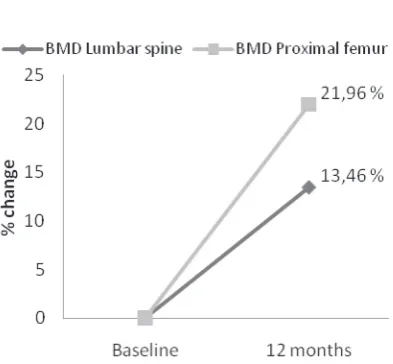
BMD T-score values significantly increased both at lum-bar spine and proximal femur by . and ., re-spectively (Figure ) during the -months treatment period. T-score values at lumbar spine significantly in-creased from -.±. to -.±. and at proximal femur from -.±. to -.±. (p<.)(Table ).
Discussion
The results of our study show that the treatment of post-menopausal osteoporosis with aledronate during the months period is effective in increasing the BMD both at lumbar spine and proximal femur. In our study, BMD in-creased at lumbar spine by . and proximal femur by .. Our results are in concordance with the results from other studies which have observed increases in bone mineral density by . percent at the lumbar spine, . percent at the trochanter, . percent at the femoral neck and . per-cent at the total proximal femur as compared with base-line values [, ]. Meta-analysis conducted by Papapoulos et al. [] demonstrated the efficacy of alendronate against hip fractures in postmenopausal women with osteoporosis. Th e rates of hip fractures were per , person-years at risk (PYR) in the alendronate group and PYR in the control group. Th e overall risk reduction rate was . Re-ductions in risk of hip fractures with alendronate treatment were consistent across all studies. Th e long-term (-year) safety of alendronate has been confi rmed, and the effi cacy of alendronate against hip fractures reductions in bone turnover remain stable throughout years of alendronate treatment and are associated with continued gains in lum-bar spine and hip BMD. Moreover, vertebral and nonver-tebral fracture safety data suggest no loss of benefi t [, ]. Riggs et al. [] who demonstrated that suppression of bone turnover and an increase in vertebral BMD contribute equally to the propensity of bone to resist a vertebral fracture. Riggs et al. [] proposed that the effi cacy of the suppression of bone turnover rate in reducing the incidence of bone frac-tures could be explained by considering the pre-treatment turnover rate. Th e high turnover rate in the vertebra may ex-acerbate the eff ects of bone loss by accelerating the loss of tra-becular connectivity and thickness [, , ]. Normalization of the bone turnover rate in the vertebra, therefore, reduces the eff ects of high turnover rate on the microarchitectural deterioration and improve bone’s biomechanical properties even more than expected based on BMD alone [, , ]. Furthermore, aledronate treatment during months in our study was eff ective in reducing the level of bone turnover markers. Serum β-CrossLaps decreased by . and urinary NTX level by .. Our results are in line with the results from other studies [, , ]. Moreover, treatment with alendronate will suppress but will not abolish bone turnover. Bone turnover will be reduced to a non-zero limit and it will reach this limit regardless of the pre-treatment remodeling rate or the treatment dose. In agreement with these obser-vations, clinical trials have demonstrated that in postmeno-pausal women treated up to years with mg or mg of alendronate, bone turnover reaches a non-zero steady state FIGURE 1. Percent changes of bone remodelling markers during
12 months treatment with aledronate.
Baseline
values 12 months Change
(%) p-value Calcium (mmol/L) 2.41±0.017 2.43±0.036 +0.8% NS Alkaline phosphatase (IU/L) 81.1±5.21 61.43±5.24 -24.3% p<0.001 Serum osteocalcin (ng/mL) 34.3±2.65 24.1±1.36 -29.7% p=0.001 Serum β-CrossLaps (ng/mL) 0.51±0.05 0.26±0.028 -49.0% p<0.001 Urinary NTx (nMBCE/
mM Cr) 48.3±4.9 32.15±3.25 -33,4% p=0.004
TABLE 1. Bone remodeling markers at baseline and after 12 months of treatment with aledronate.
FIGURE 2. Percent changes in bone mineral density (BMD) at lum-bar spine and proximal femur after one-year treatment with ale-dronate.
Baseline values After 12-months p-values Lumbar spine -3.12±0.24 -2.7±0.19 p<0.001 Proximal femur -2.55±0.2 -1.99±0.19 p<0.001
BOSNIAN JOURNAL OF BASIC MEDICAL SCIENCES 2011; 11 (1): 44-45 after about months of treatment []. More importantly,both doses suppress bone turnover to a similar limit []. Alendronate inhibits osteoclastic bone resorption, by
reduc-ing bone turnover, increasreduc-ing hip BMD, decreasreduc-ing cortical porosity, and produces more uniform mineralization (ie, in-creases the mean degree of mineralization of bone (MDMB) in cortical bone, possibly contributing to a reduction in the risk of hip fractures [, ]. In alendronate-treated post-menopausal women, the distribution of the degree of min-eralization in cortical bone shows a clear shift toward the highest mineralization values and a decrease in the number of bone structure units having low values of mineralization []. Th e MDMB augmentation probably accounts for most of the increase in BMD seen with alendronate. According to the hypothesis proposed by Boivin et al. [], the reduc-tion in the activareduc-tion frequency caused by the anti-resorptive eff ect of alendronate is followed by a prolonged secondary mineralization that increases the percentage of bone struc-ture units having reached a maximum degree of secondary mineralization and, though this mechanism, augmentation of the MDMB. Evidence derived from the literature, strati-fied and based on strict EBM guidelines, suggests the effi-cacy of alendronate against hip fractures in postmenopausal women with osteoporosis with an overall risk reduction rate of . According to the analyses of the Fracture Interven-tion Trial, each standard deviaInterven-tion reducInterven-tion in a -year change in bone-specific-alcalinee phospathase BSAP is as-sociated with fewer hip fractures in alendronate-treated postmenopausal women, and those with at least a reduc-tion in BSAP have a lower risk of hip fractures relative to those with less than []. Alendronate is eff ective in reducing the risk of hip fractures across a spectrum of ages. Th e mechanism for this anti-fracture effi cacy has been clari-fi ed; alendronate suppresses bone turnover and subsequently increases hip BMD, decreases cortical porosity, improves pa-rameters of hip structure geometry (cortical thickness, cross-sectional area, section modulus, and buckling ratio), and pro-duces more uniform mineralization (increases the MDMB) in cortical bone. A once-weekly alendronate regimen pro-vides better adherence (compliance and persistence) of the patients to the treatment than the once-daily dosing regimen, leading to greater efficacy against hip fractures. Thus, the effi cacy of alendronate against hip fractures has been con-firmed in postmenopausal women with osteoporosis, es-pecially with once-weekly dosing regimen [, , , ].
Conclusion
Alendronate treatment during months pe-riod, administered once-weekly is effective in in-creasing BMD both at lumbar spine and femoral
neck and reducing bone turnover. Therefore, the treatment with aledronate can be recommended in post-menopausal women with osteoporosis which decreases the eff ects of high turnover rate on the microarchitectural de-terioration and improves bone’s biomechanical properties.
References
[] NIH Consensus Development Panel on Osteoporosis Prevention, Diagnosis, and Th erapy. Osteoporosis prevention, diagnosis, and therapy. JAMA. ;():-.
[] Epstein S. Th e roles of bone mineral density, bone turnover, and other properties in reducing fracture risk during antiresorptive therapy. Mayo Clin Proc ;():-.
[] Bousson V, Bergot C, Meunier A, Barbot F, Parlier-Cuau C, La-val-Jeantet AM et al. CT of the middiaphyseal femur: cortical bone mineral density and relation to porosity. Radiology ; ():-.
[] Szulc P, Seeman E, Duboeuf F, Sornay-Rendu E, Delmas PD. Bone fragility: failure of periosteal apposition to compensate for in-creased endocortical resorption in postmenopausal women. Bone Miner Res. ; ():-.
[] Iwamoto J, Takeda T, Sato Y. Effi cacy and safety of alendronate and risedronate for postmenopausal osteoporosis. Curr Med Res Opin ; ():-.
[] Iwamoto J, Takeda T, Sato Y. Eff ects of antifracture drugs in post-menopausal, male and glucocorticoid-induced osteoporosis--use-fulness of alendronate and risedronate. Expert Opin Pharmacother ; ():-.
[] Delmas PD. Treatment of postmenopausal osteoporosis. Lancet. ; ():-.
[] Black DM, Cummings SR, Karpf DB, Cauley JA, Th ompson DE, Nevitt MC et al. Randomised trial of eff ect of alendronate on risk of fracture in women with existing vertebral fractures. Fracture Intervention Trial Research Group. Lancet ;():-.
[] Sarkar S, Reginster JY, Crans GG, Diez-Perez A, Pinette KV, Del-mas PD. Relationship between changes in biochemical markers of bone turnover and BMD to predict vertebral fracture risk. J Bone Miner Res ;:–.
[] Bauer DC, Black DM, Garnero P, Hochberg M, Ott S, Orloff J et al. Change in bone turnover and hip, non-spine, and vertebral frac-ture in alendronate-treated women: the fracfrac-ture intervention trial. J Bone Miner Res ;:–
[] Kulenović I, Rasić S, Kulenović E. Osteoporosis: current trends in diagnosis and management. Bosn J Basic Med Sci. Feb;():-.
[] Rizzoli R, Laroche M, Krieg MA, Frieling I, Th omas T, Delmas P et al. Strontium ranelate and alendronate have diff ering eff ects on dis-tal tibia bone microstructure in women with osteoporosis. Rheu-matol Int. ; ():-.
[] Epstein S. Is cortical bone hip? What determines cortical bone properties? Bone. ; ( Suppl ):S-S.
[] Iwamoto J, Sato Y, Takeda T, Matsumoto H. Hip fracture pro-tection by alendronate treatment in postmenopausal women with osteoporosis: a review of the literature. Clin Interv Aging ;():-
[] Bone HG, Hosking D, Devogelaer JP, Tucci JR, Emkey RD, Tonino RP et al. Alendronate Phase III Osteoporosis Treatment Study Group. Ten years' experience with alendronate for osteoporosis in postmenopausal women. N Engl J Med. ; ():-. [] Papapoulos SE, Quandt SA, Liberman UA, Hochberg MC, Th
omp-son DE. Meta-analysis of the effi cacy of alendronate for the preven-tion of hip fractures in postmenopausal women.Osteoporos Int. ; ():-.
BOSNIAN JOURNAL OF BASIC MEDICAL SCIENCES 2011; 11 (1): 45-45
alendronate after years of treatment: the Fracture Intervention Trial Long-term Extension (FLEX): a randomized trial. JAMA. ; ():-.
[] Riggs BL, Melton LJ rd, O'Fallon WM. Drug therapy for vertebral fractures in osteoporosis: evidence that decreases in bone turnover and increases in bone mass both determine antifracture effi cacy. Bone. ; ( Suppl):S-S.
[] Diab T, Allen MR, Burr DB. Alendronate treatment results in simi-lar levels of trabecusimi-lar bone remodeling in the femoral neck and vertebra. Osteoporos Int. ; ():-.
[] Akhter MP, Lappe JM, Davies KM, Recker RR. Transmenopausal changes in the trabecular bone structure. Bone ;:–. [] Chavassieux P, Seeman E, Delmas PD. Insights into material and
structural basis of bone fragility from diseases associated with frac-tures: how determinants of the biomechanical properties of bone are compromised by disease. Endocr Rev ;:–
[] Borah B, Dufresne TE, Ritman EL, Jorgensen SM, Liu S, Chmielewski PA et al. Long-term risedronate treatment normal-izes mineralization and continues to preserve trabecular architec-ture: sequential triple biopsy studies with micro-computed tomog-raphy. Bone ;:–
[] Boivin GY, Chavassieux PM, Santora AC, Yates J, Meunier PJ. Alendronate increases bone strength by increasing the mean de-gree of mineralization of bone tissue in osteoporotic women. Bone. ; ():-.